
What Is a Toyger, and How Do You Tell One From a Tabby?
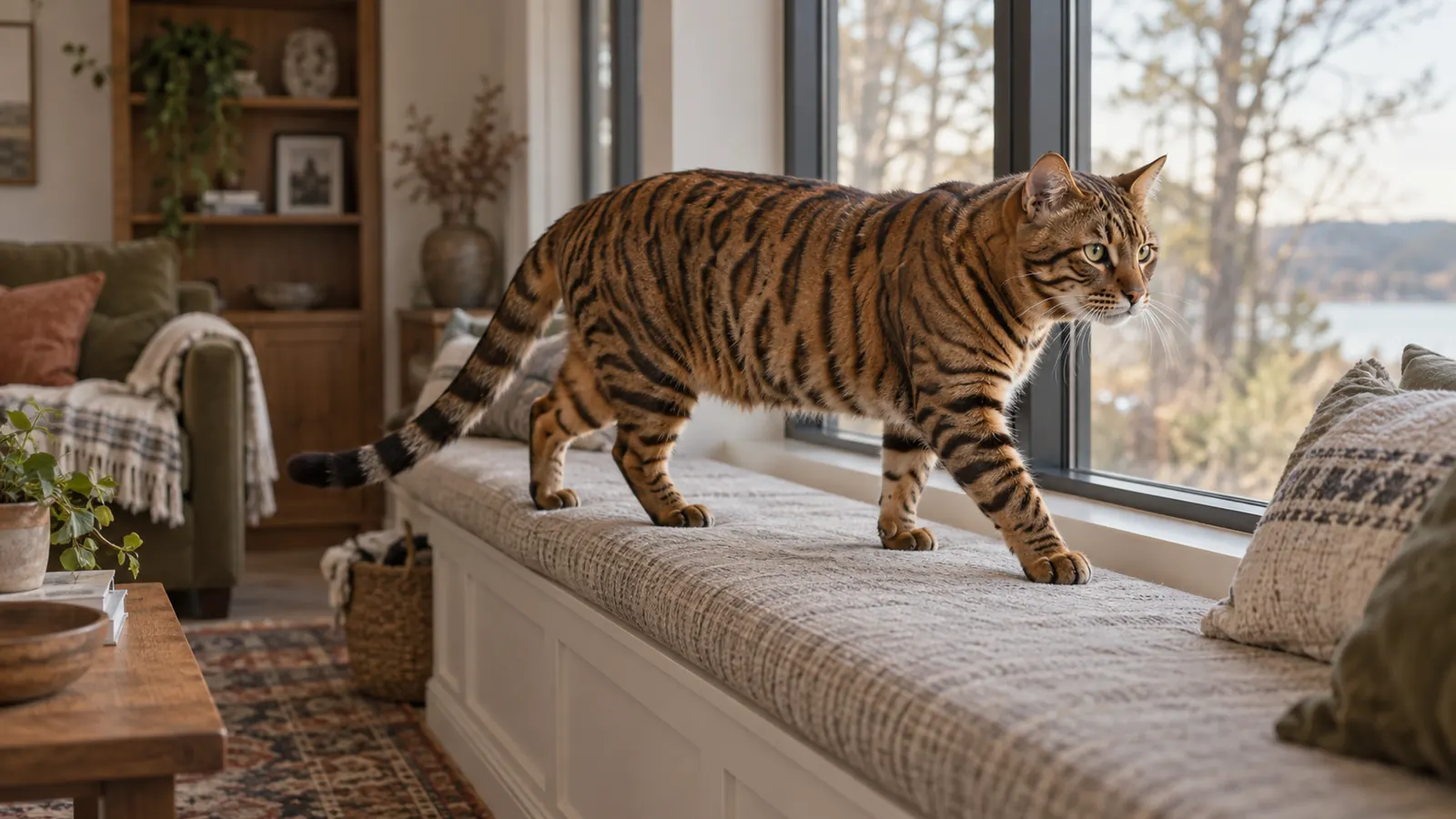
A Toyger is a fully domestic shorthair selected for a tiger-like stripe pattern, and its temperament, energy and daily care all sit inside the ordinary range for an active shorthair. The hard part of the decision is verification, because the breed is young, small in number, expensive, and carries the inherited-disease screening its Bengal foundation brought with it.
- Origin
- United States, begun in the 1980s by Judy Sugden from Bengal, unpedigreed domestic shorthair and one imported Indian street cat foundation stock
- Coat
- Short, thick and unusually plush, in brown mackerel tabby only, with some glitter required by the standard
- Size
- Medium, with a long muscular torso, a broad deep chest, heavy boning and a very long low-carried rope-like tail
- Typical weight
- The GCCF gives roughly 8 to 12 pounds for females and 10 to 15 pounds for males
- Life expectancy
- Commonly quoted at about 9 to 15 years, with no breed-specific population data behind the figure
- Activity level
- High. Interactive play, climbing routes, fetch and harness training suit the breed better than long unattended days
- Grooming
- Low. A weekly brush, with nails, teeth and ears checked on the same routine
- Suits
- Active households that want a sociable, trainable shorthair and will verify pedigree, screening records and local rules before paying
A Toyger is a domestic shorthair that has been selected for one thing above all others: a bold, vertically aligned stripe pattern that reads as tiger rather than as ordinary tabby.
Everything else about the cat sits within the normal range for an active shorthair, including its energy, its sociability and its daily care.
Is a Toyger the right cat for your household?
The fit question is unusually simple in one direction and unusually hard in the other. Nothing about living with a Toyger is exotic, but almost everything about buying one requires verification.
The breed suits people who want an interactive, trainable cat that enjoys company, uses a climbing route and can learn to walk on a harness. It suits them less well when the appeal is mainly the look, because pattern quality varies a great deal between individual kittens and no photograph of a show winner predicts what a particular litter will grow into.
- Best fit
- An active home that wants a sociable shorthair and checks paperwork before paying
- Temperament
- Ordinary domestic range, usually confident, playful and people-oriented
- Daily workload
- Low grooming, high interaction
- Pattern
- Brown mackerel tabby only, with wide variation in how clearly it comes through
- Availability
- Few breeders, long waits, high prices
- Main cautions
- Identity verification, inherited-disease screening, and local rules on wild ancestry
Households that are out for long, predictable days should plan for company and enrichment rather than assume a second cat solves it. A Toyger with nothing to do tends to find something, and shelves, worktops and the top of the fridge are all within reach of a cat that climbs and problem solves.
What actually makes a cat a Toyger?
Pedigree does, not appearance.
The breed began in the 1980s when Judy Sugden, whose mother Jean Mill developed the Bengal, noticed that one of her tabbies carried circular markings on its temples instead of the usual tabby lines.
She bred from that cat and a Bengal, then added an imported tom from India whose head markings broke up in the same way. About forty cats formed the foundation, a mixture of Bengals and unpedigreed domestic shorthairs chosen for how their stripes fell.
Recognition came slowly, and the dates are worth knowing because they cap how much recorded history any pedigree can carry.
- 1993TICA accepts the Toyger for registration
- 2000The breed advances to new breed exhibition classes
- February 2007TICA grants full championship status
- October 2015The GCCF recognises the breed in the United Kingdom
- June 2016The GCCF moves it to preliminary status
The Cat Fanciers' Association still does not recognise the Toyger, so a seller offering CFA registration for one is describing paperwork that does not exist. The World Cat Federation's list of shorthair breeds does include the Toyger, so a registered cat may carry WCF papers as well as TICA's.
The TICA standard also keeps the gene pool closed: the only accepted colour is brown mackerel tabby, and no outcrosses to other breeds are permitted. That single line rules out a great deal of what gets advertised, because a silver, charcoal, snow or blue cat sold as a Toyger falls outside the standard whatever its markings look like.
How do you tell a Toyger from an ordinary striped tabby?
Plenty of brown tabby cats have strong vertical stripes, and a striped shorthair in a rescue pen is far more likely to be a moggy than a rare pedigree.
The standard asks for a combination of features rather than a single one, which is what makes it checkable against a real cat.
| Feature | What the standard asks for | What a lookalike usually shows |
|---|---|---|
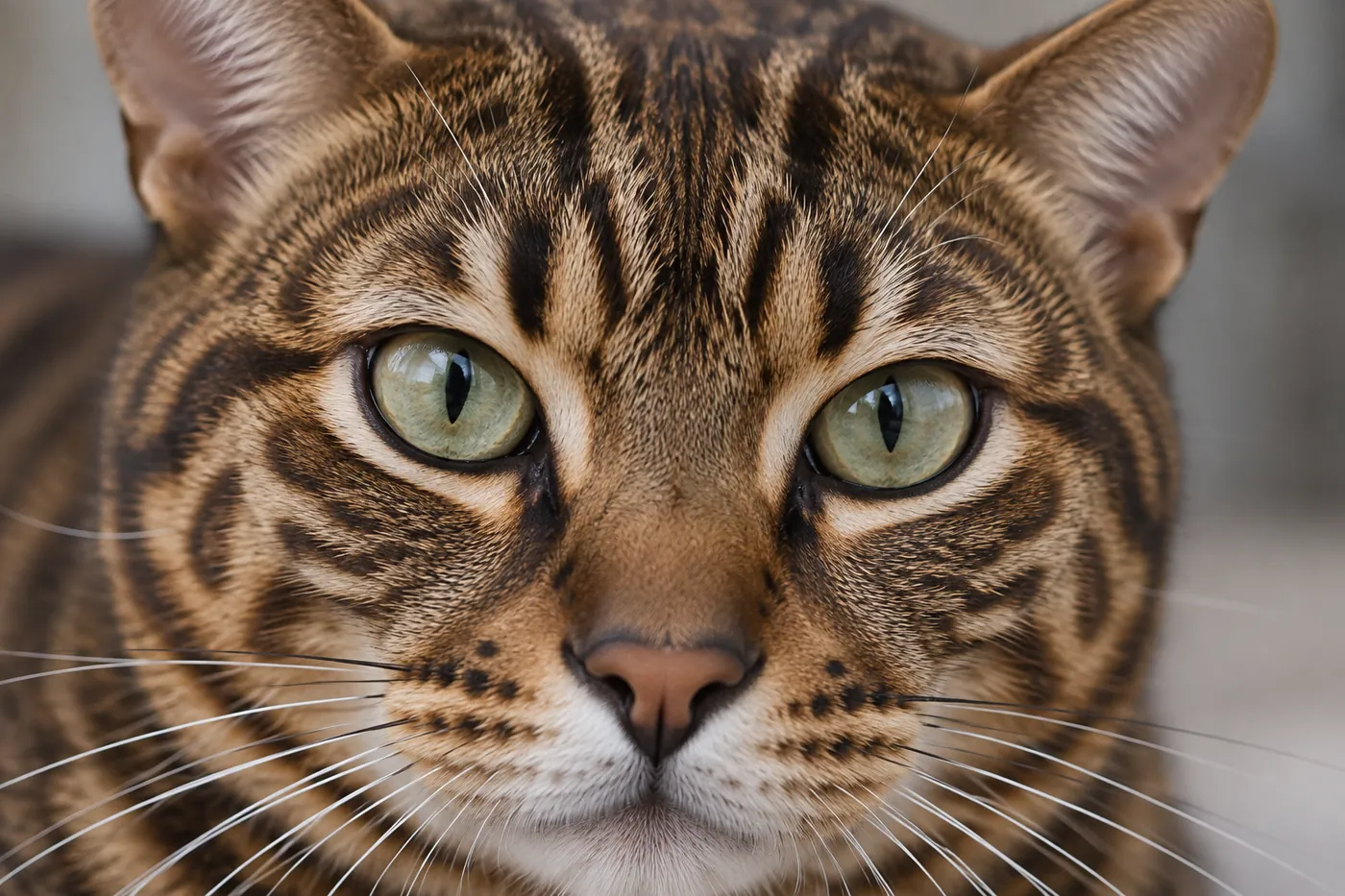
| Head markings | A circular pattern around the face, dark mascara lines and pale spectacle rings | The classic tabby M across the forehead |
| Ears | Small, rounded, set toward the sides, thickly furred temples, no lynx tips | Larger and more pointed, often tufted |
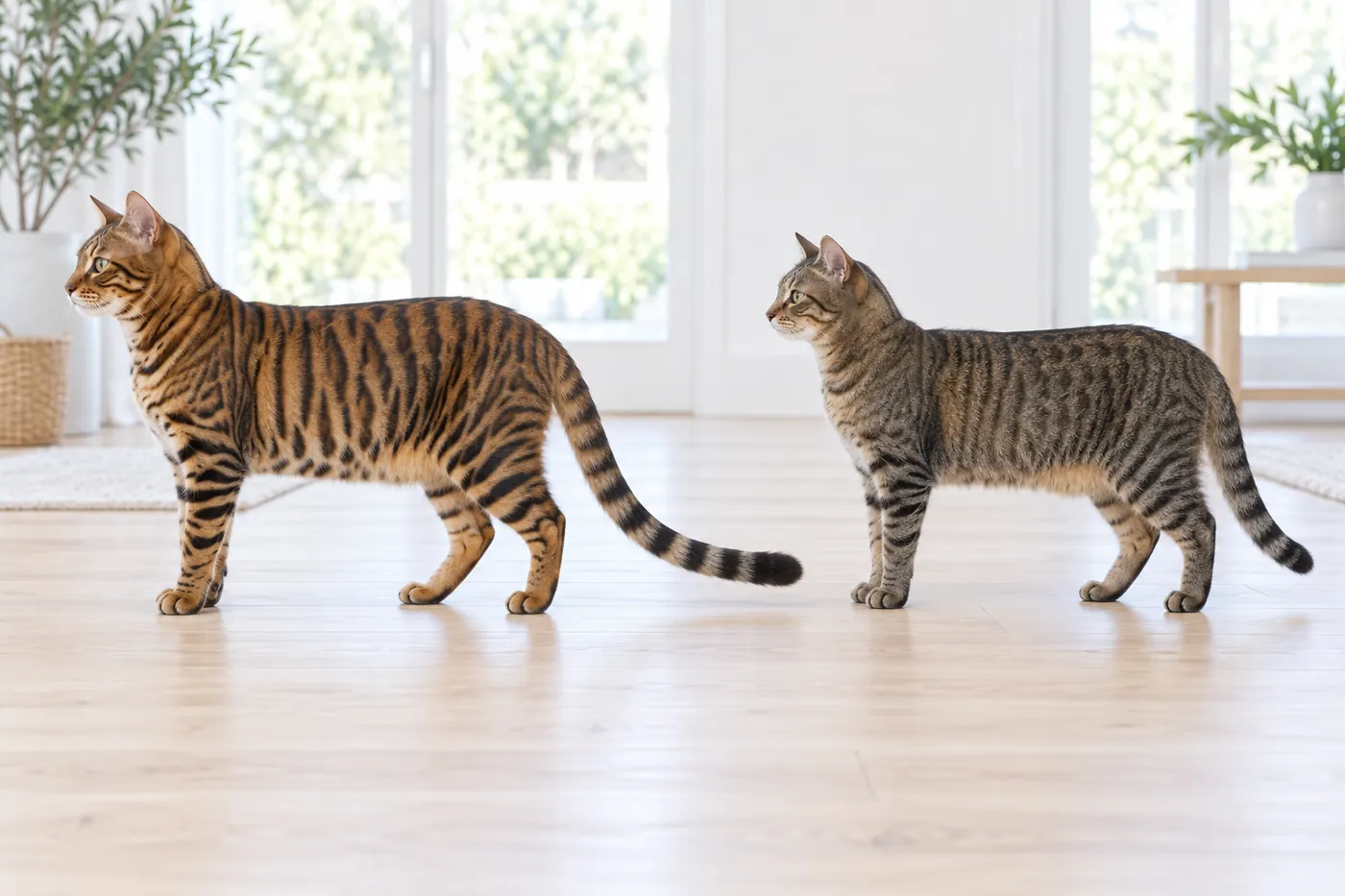
| Body stripes | Bold, braided, non-uniform, aligned vertically | Even, narrow, regularly spaced mackerel stripes |
| Belly and inner legs | Marked, never plain | Frequently pale and unmarked |
| Tail | Very long and muscular, rope-like, carried low, dark blunt tip | Shorter and tapering, often carried high |
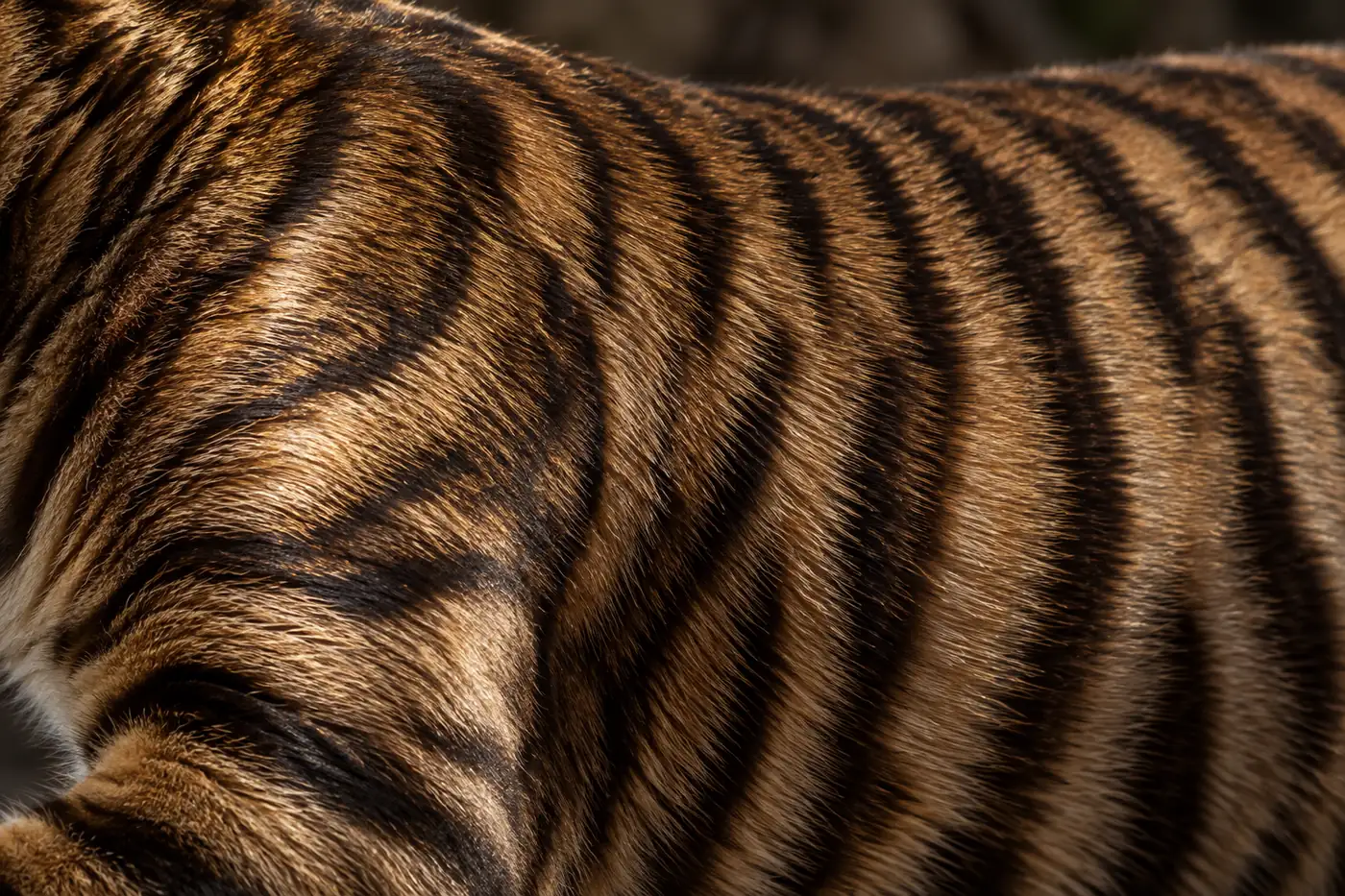
| Coat | Short, thick, plush and unusually soft, with some glitter | An ordinary short coat with no sheen |
Glitter is the trait people most often miss, and it shows up in raking light far better than in a photograph. It appears as a fine gold sheen lying over the ground colour, and the standard requires some of it while penalising a cat that has none.
None of this settles identity on its own. Only registration papers from a registry that recognises the breed establish that a cat is a Toyger, and appearance is the easiest thing in the world to claim in an advertisement.
When a seller cannot produce papers naming both parents, treat the kitten as a domestic shorthair with attractive markings and price the decision accordingly.
Does a Toyger count as a hybrid where you live?
There is no wild cat in a modern Toyger's recent ancestry, but there is some further back, because Bengals were part of the foundation and the Bengal itself was created by crossing domestic cats with the Asian leopard cat. By the time a Toyger is registered today, that ancestry is many generations away and the cat is domestic in behaviour and, in most places, in law.
The complication is that local rules are not written to one definition.
Some restrict early hybrid generations only, and a Toyger falls well outside them. Others prohibit hybrid cats as a category by ancestry rather than by generation, and a few name particular breeds outright.
The same question returns when you travel or move, because import rules, airline policies and rental agreements each apply their own definition. A cat that is unremarkable at home can become a problem at a border, and that is a cheap thing to check early and an expensive one to discover late.
A Savannah meets a stricter version of the same question, which is worth knowing if you are weighing the wild-looking breeds against each other.
What is a Toyger like to live with?
The TICA standard names a dependable, quiet temperament as part of what breeders select for, alongside intelligence and athletic ability.
An aim written into a standard is not a promise about one kitten, and early handling shapes the adult cat more than the breed name does.
Most Toygers turn out active, curious and strongly social. The GCCF describes them as intelligent, affectionate and playful, and notes that they dislike being left alone for long stretches.
Plan for roughly half an hour of genuine interactive play a day, split into short sessions rather than one long one.
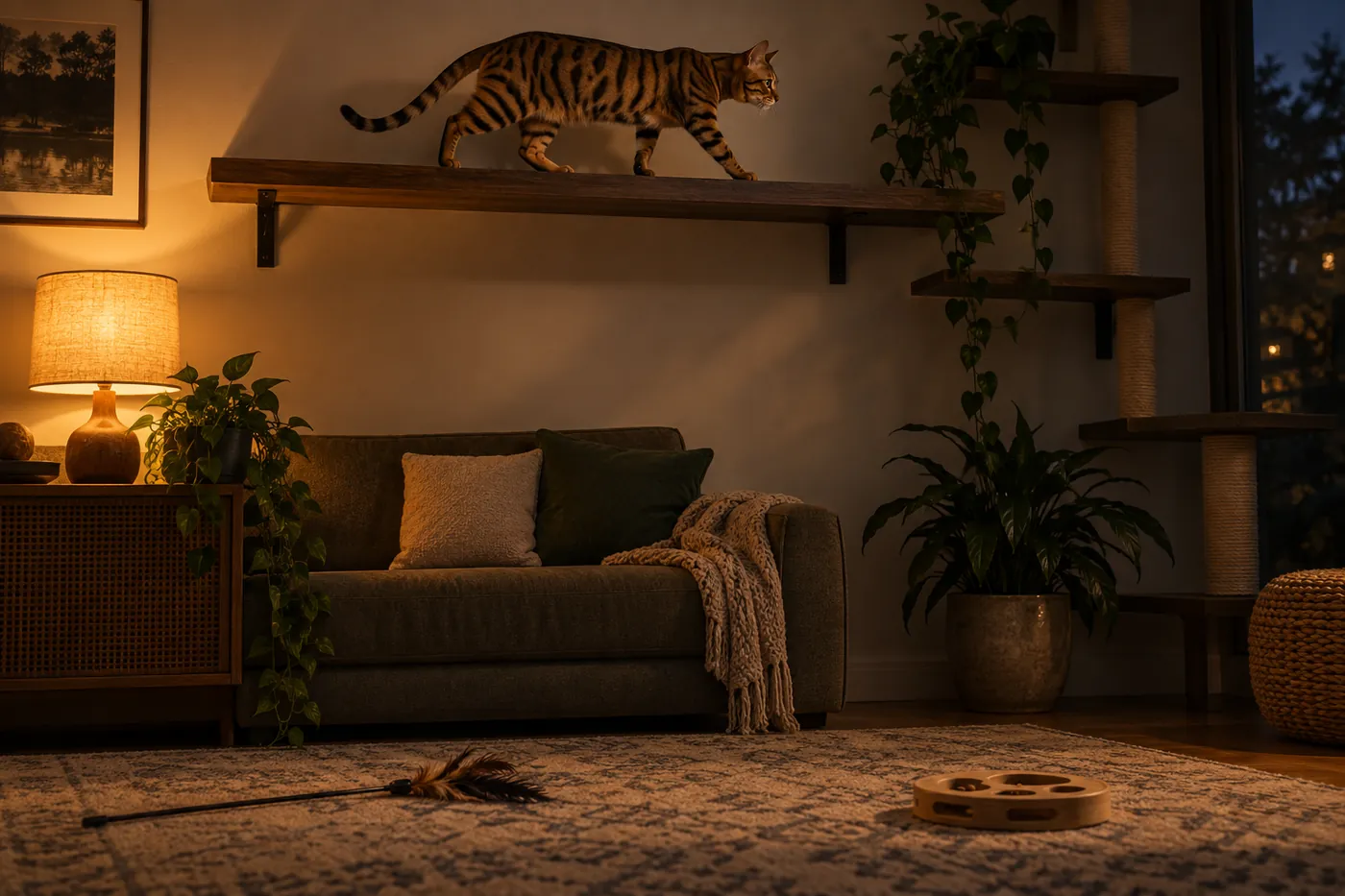
They take to training readily, and fetch, recall and harness walking are realistic goals rather than party tricks. Reward-based clicker training gives that intelligence somewhere to go, and it makes carrier loading and nail care easier for years afterwards.
Harness time outdoors needs supervision and a fitted, escape-resistant design, and it does not replace an enclosed run or indoor climbing space.
A kitten that copes alone at eight weeks may not cope alone at eight months, because social demand tends to rise as confidence does. If the house is empty for a full working day most days, set up puzzle feeding, a window platform and a scratching post tall enough for a full stretch before the boredom turns into a complaint.
How big does a Toyger get, and how much grooming does the coat need?
Medium, and smaller than the pattern suggests.
The GCCF gives roughly 8 to 12 pounds for females and 10 to 15 pounds for males, and veterinary breed references quote a similar band alongside a shoulder height of around 9 to 13 inches. The impression of bulk comes from the build rather than the mass, because a long torso, a broad deep chest and heavy boning read as substantial on a cat that weighs about what a large moggy weighs.
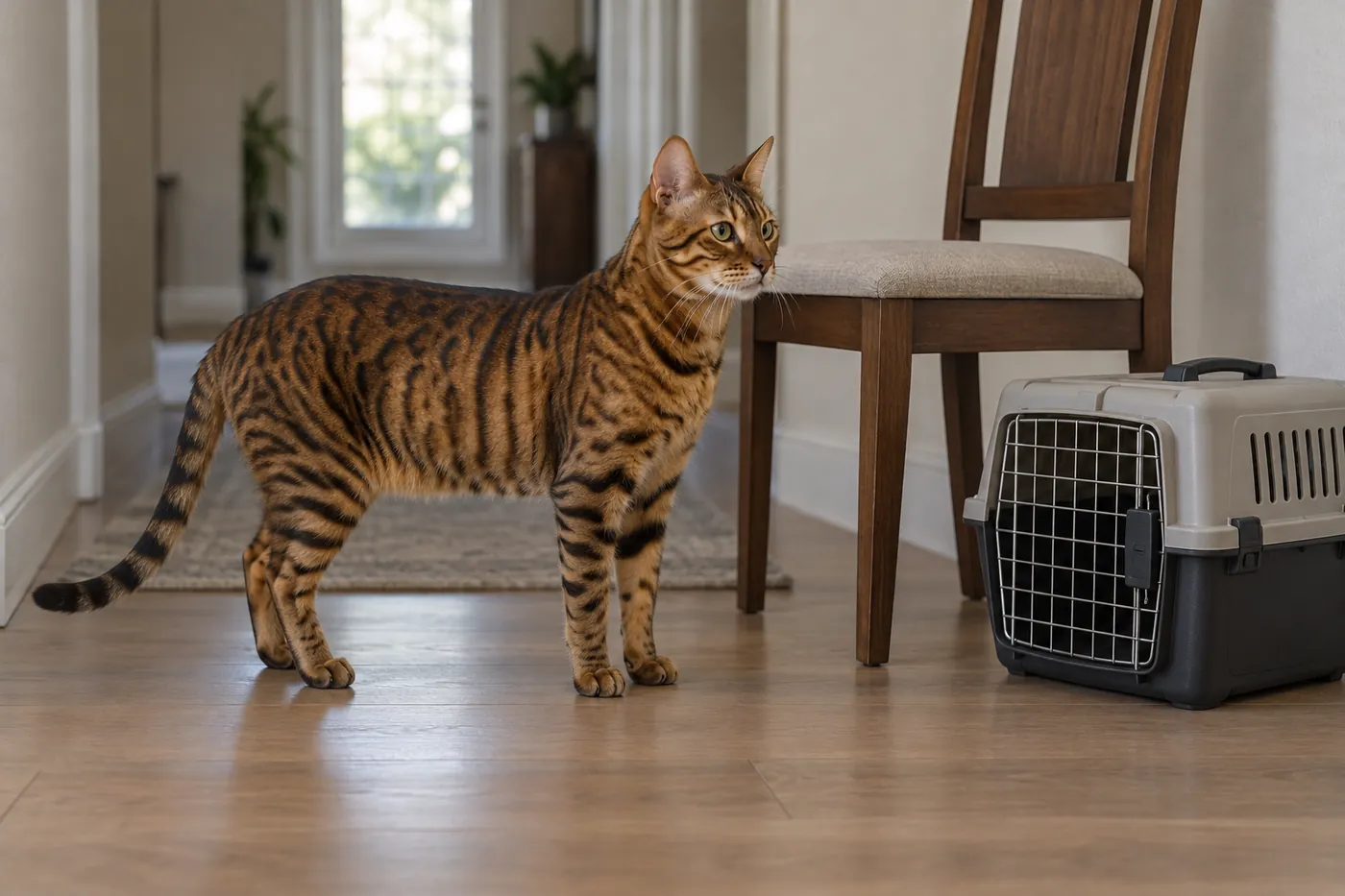
Buy equipment for the adult rather than for the kitten, and check the carrier again at about two years old. The carrier guide covers the measuring, and on a Toyger the floor area decides it, because the length sits in a long torso and a very long tail rather than in height at the shoulder.
Grooming is the easy part of the workload. A weekly brush is usually enough, because a short plush coat does not mat and the job is removing loose hair rather than opening tangles.
Keep nails, teeth and ears on that same weekly round.
A short coat hides less than a long one, so a greasy patch, a thin area or a change in condition shows up early enough to act on.
Feeding is not breed-specific either, and an active cat still gains weight on free access to dry food. Measure the full daily intake with treats included, and use the portion-size guide to compare what different foods actually deliver.
Which health records should a Toyger breeder show you?
Three tests carry most of the weight, and all three trace back to the Bengal lines in the foundation.
The GCCF describes the breed as generally healthy with no conformation-related problems, and notes that the incidence of these conditions looks lower than in Bengals because of the domestic shorthair outcrossing in the early generations.
Lower is not zero, and a record earns its value by being specific to the two parents in front of you.
| What to ask for | What the result establishes | What it cannot tell you |
|---|---|---|
| DNA test for PK deficiency | Whether each parent is normal, a carrier, or affected for the pyruvate kinase mutation | How severe the anaemia would ever be, since some affected cats never show signs |
| DNA test for PRA-b | Whether each parent carries the recessive variant behind Bengal retinal atrophy | Anything about eye disease arising from a different cause |
| Cardiologist echocardiogram | Whether that cat's heart looked structurally normal on that date | Whether it still will in three years, because no DNA test replaces the scan |
| Named and dated reports | That the record belongs to the cat actually being bred from | Anything at all, when the paperwork carries no microchip or registered name |
PK deficiency is inherited recessively, so two clinically normal carriers can produce an affected kitten. The anaemia it causes is intermittent and variable in onset, and lethargy or a reduced appetite may be the only visible signs for a long time.
PRA-b behaves differently and more predictably. Photoreceptor loss begins in the first months of life and vision is usually severely compromised well before the cat is two, which is the outcome a carrier-to-carrier pairing risks and the test exists to prevent.
With so few Toyger breeders working, the same studs sit behind many litters, so one dated report often covers more of the pedigree than you expect.
A murmur found at a routine examination is worth investigating rather than watching, and sudden breathing difficulty, collapse or hind-limb weakness needs same-day veterinary care.
Give copies of the parents' reports to your own veterinarian once the kitten is home, so a later finding can be read against family history instead of sitting in a folder with the receipt.
How long do Toygers live?
Published figures cluster between about 9 and 15 years, and the honest description of that range is that it rests on breeder and reference-site estimates rather than on population data. No Toyger life table exists, because the breed is too young and too small in number for one.
UK primary-care veterinary records give a median life expectancy at birth of 11.74 years across all cats, with crossbred cats at 11.9 years and individual pedigree breeds spread from 6.8 to 14.4 years. That spread is the useful part, because it shows that pedigree status by itself predicts very little, while the particular breed a cat belongs to can move the figure by years in either direction.
Treat the quoted Toyger range as a planning assumption rather than a finding, and expect the second half of the cat's life to be dominated by dental disease, weight and kidney monitoring, as it is in cats generally.
Why are Toygers scarce and expensive?
The population really is small. A Toyger pedigree database recorded 469 registered cats by 2020, and the Toyger Cat Society listed 30 active breeders in 2024.
Kitten prices reported around 2020 reached about 5,000 US dollars, which is high even against other uncommon pedigree cats.
- Registered cats
- 469 recorded in a Toyger pedigree database by 2020
- Active breeders
- 30 listed by the Toyger Cat Society in 2024
- Reported kitten price
- About 5,000 US dollars around 2020
- Gene pool
- Closed, with no outcrosses permitted to widen it
- Recurring cost
- Food, litter, preventive care and insurance at ordinary shorthair rates
Scarcity changes several practical things at once. Waiting lists run long, the nearest breeder may be in another country, and a shortage is exactly the condition under which mislabelled kittens sell well.
A closed gene pool with no permitted outcrosses also concentrates whatever inherited variants the foundation carried, which is why documented screening matters more here than it would in a large breed that can outcross.
Transport deserves its own thought, because a long first journey is a poor introduction for a kitten and the travel plan is easier to settle before a deposit than after one.
Budget past the purchase price as well, because the running cost outlasts it. Food, litter, preventive care and insurance land at the same monthly figure as any other shorthair, and none of it scales with what the kitten cost to buy.
What should you check before you pay?
Start with identity, because every other check depends on it.
- See registration papers from a registry that recognises the breed, naming both parents
- Compare the kitten's markings against the written standard rather than a show photograph
- Read dated PK deficiency and PRA-b results for both parents, not a badge that says tested
- Read the cardiologist's echocardiogram reports and ask when the next one falls due
- Confirm the local rule on wild ancestry in writing, and ask the landlord and insurer separately
- Ask how the kittens are raised, handled, and exposed to ordinary household noise
- Read the health guarantee, the return terms and the neutering agreement before paying
Meet the kitten more than once when distance allows, and watch how it recovers from a surprise rather than how it performs in the first ten minutes.
A well-raised kitten investigates, retreats, and comes back. One that freezes, or that has clearly never met a vacuum cleaner, is telling you about the room it grew up in.
If you are open to an adult, take the offer seriously, because adult size, pattern quality, temperament and health history are all visible now. Those are the four things a kitten purchase asks you to guess.
And when verification fails at any step, walk away with the options still open. A spotted Ocicat or an Egyptian Mau offers a different wild-cat look with a longer record behind it, and a striped rescue shorthair will give you the same company for the cost of neutering.
Checked Against
- The International Cat Association: Toyger tica.org
- Toyger Cat Society: the TICA Toyger breed standard toygercatsociety.org
- The Governing Council of the Cat Fancy: Toyger gccfcats.org
- Langford Vets: feline pyruvate kinase deficiency langfordvets.co.uk
- Langford Vets: Bengal progressive retinal atrophy langfordvets.co.uk
- Cornell Feline Health Center: hypertrophic cardiomyopathy vet.cornell.edu
- Life tables of annual life expectancy and risk factors for mortality in cats in the UK pmc.ncbi.nlm.nih.gov
- World Cat Federation: shorthair breed standards wcf.de
Published 10 September 2026. Last updated .





