
What Is a Savannah Cat, and Is It Legal Where You Live?
A Savannah is a poor impulse purchase. Before considering appearance or price, a prospective owner needs written confirmation that the cat is legal where it will live, verifiable generation and registration records, a secure high-activity home, realistic care coverage and health evidence from the breeder.
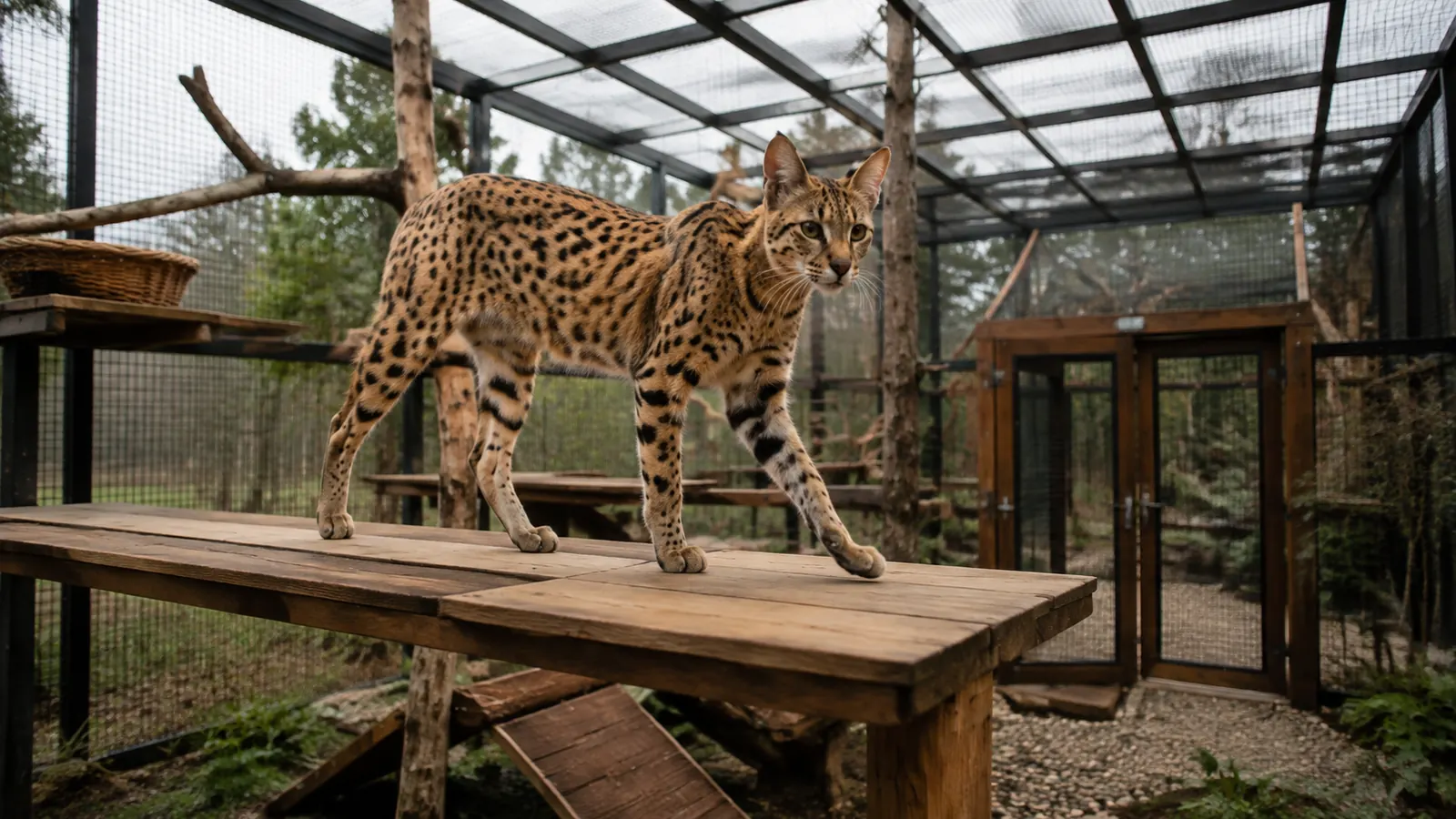
- Origin
- United States, developed from crosses between domestic cats and the African serval
- Coat
- Short to medium-short spotted coat in registry-recognized colours including brown, silver, black and black smoke
- Size
- Tall and long legged; early-generation individuals can be larger and less predictable than later registered breeding generations
- Typical weight
- Height can make the cat look heavier than it is; size varies by sex, generation and line
- Life expectancy
- TICA estimates about 12 to 15 years or longer, but this is not a veterinary population median
- Activity level
- Very high. Requires daily interactive work, robust height and secure containment
- Grooming
- Low coat workload, with light brushing and routine claw and dental care
- Suits
- Experienced, legally compliant homes prepared for intensive enrichment, containment and lifelong contingency care
A Savannah is a domestic-serval hybrid whose spotted coat and height can distract from the ownership decision that comes first: whether keeping that individual is legal and humane in the place where you live.
Rules differ by country, state, province, municipality and generation, and they can change, so a seller's summary is not a safe basis for the decision. The current rule comes from the authority that enforces wildlife or animal law, and it has to be matched to the cat's documented generation. That written response belongs with the cat's registration and veterinary records.
Is a Savannah legal where you live?
There is no worldwide answer. Massachusetts, for example, treats a documented F4-or-later hybrid differently from earlier generations, while Australian jurisdictions prohibit Savannah cats because of biosecurity concerns.
- Identify every jurisdiction that applies to the home, including local rules
- Ask the relevant wildlife or animal authority about the exact generation
- Get the answer in writing or save the current official page
- Confirm housing, landlord and insurance restrictions separately
- Check rules for every place the cat may move or travel through
- Match the documents to the cat's microchip before payment
A registration paper does not override local law. It establishes pedigree within a registry, while a government decides what may be possessed, imported, transported or bred.
What do F1, F2 and later generations mean?
The F number describes genealogical distance from a serval ancestor and says nothing about appearance. An F1 has a serval parent, an F2 has a serval grandparent, and the number increases with each generation away.
| Term | Pedigree meaning | What it does not guarantee |
|---|---|---|
| F1 | One serval parent | A fixed size or temperament |
| F2 | A serval grandparent | Legality in a particular place |
| F3 | Three generations from the serval ancestor | Suitability for an ordinary household |
| F4 and later | Further removed in the recorded pedigree | Permission under every local rule |
| SBT | Registry status based on Savannah-to-Savannah ancestry rules | Identical behaviour among individuals |
Early generations raise greater welfare and management concerns because their recent wild ancestry affects breeding, behaviour and environmental needs. A 2025 Welsh animal-welfare review highlighted reproductive problems and the difficulty of meeting some hybrid cats' needs in domestic settings.
The Chausie uses this same F1-through-SBT generation system, tracing back to a jungle cat ancestor instead of a serval.
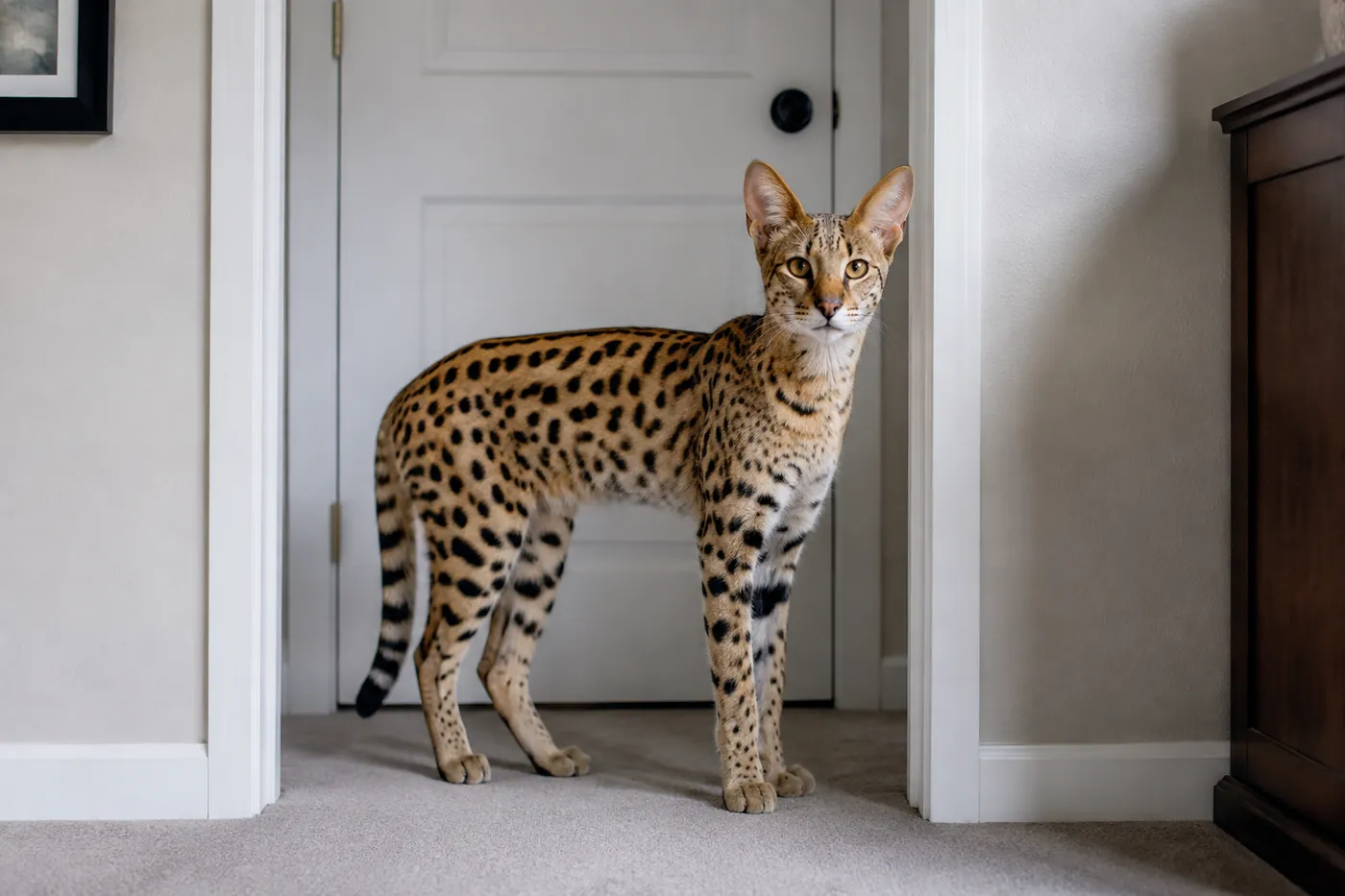
Leg length, spots and price cannot establish generation. The pedigree and registration record answer the ancestry question, while the authority answers the legal one. In a Bengal Savannah cross, hybrid-ownership rules can follow the Savannah parent's generation whatever the other parent is, so an F1 to F3 Savannah parent can bring restrictions that an SBT Bengal parent alone would not.
What does a Savannah look like, and how big can it get?
Tall proportions create the first impression. The standard then separates the breed through a lean body, long legs, hooded ears, a small head and bold solid spots.
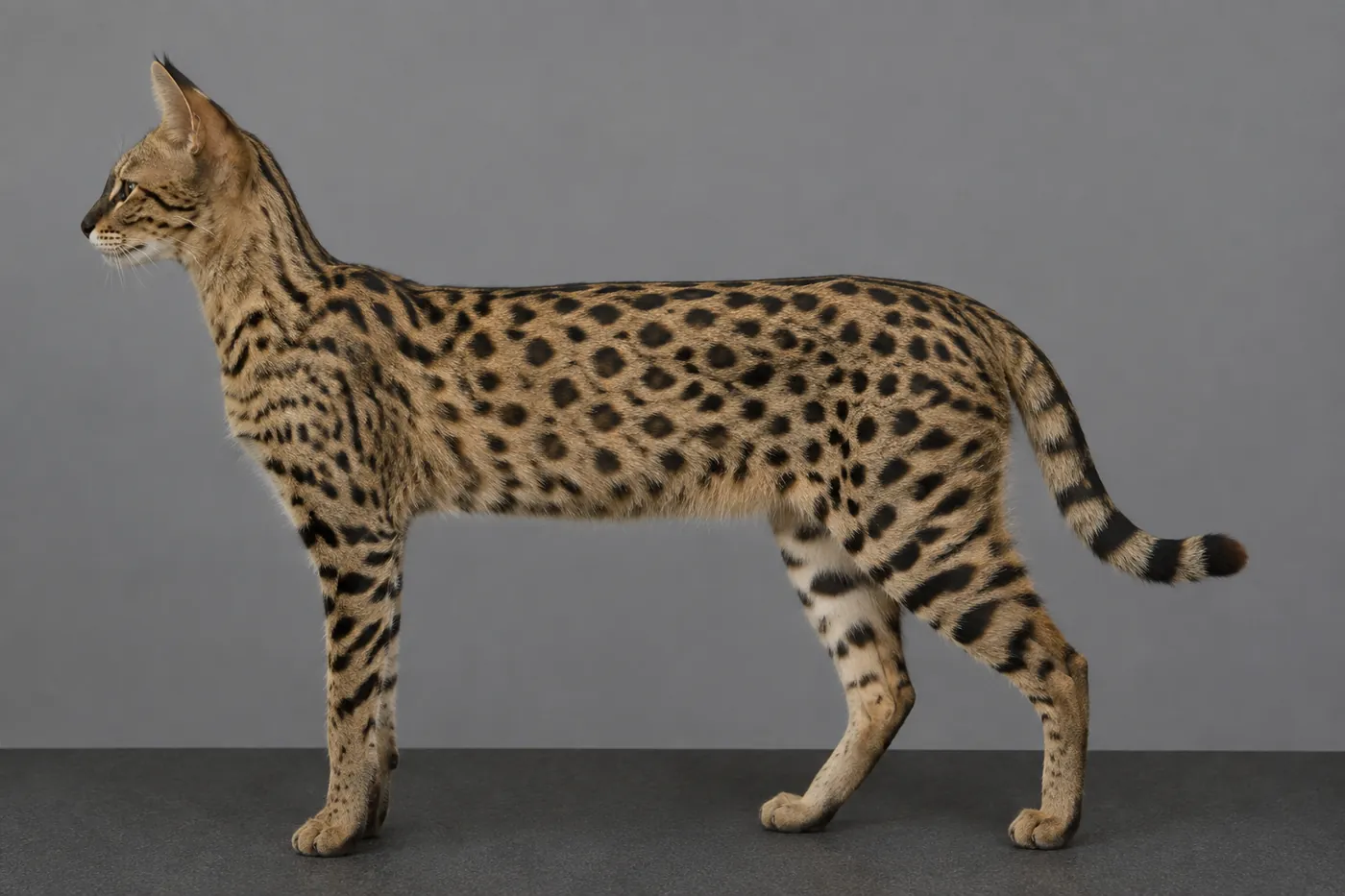
TICA notes that height creates an illusion of extreme weight and that most Savannahs are around the size of a large domestic cat, though individuals and early generations vary. Carriers, litter trays, shelves and enclosures are best sized from the actual adult or its parents.
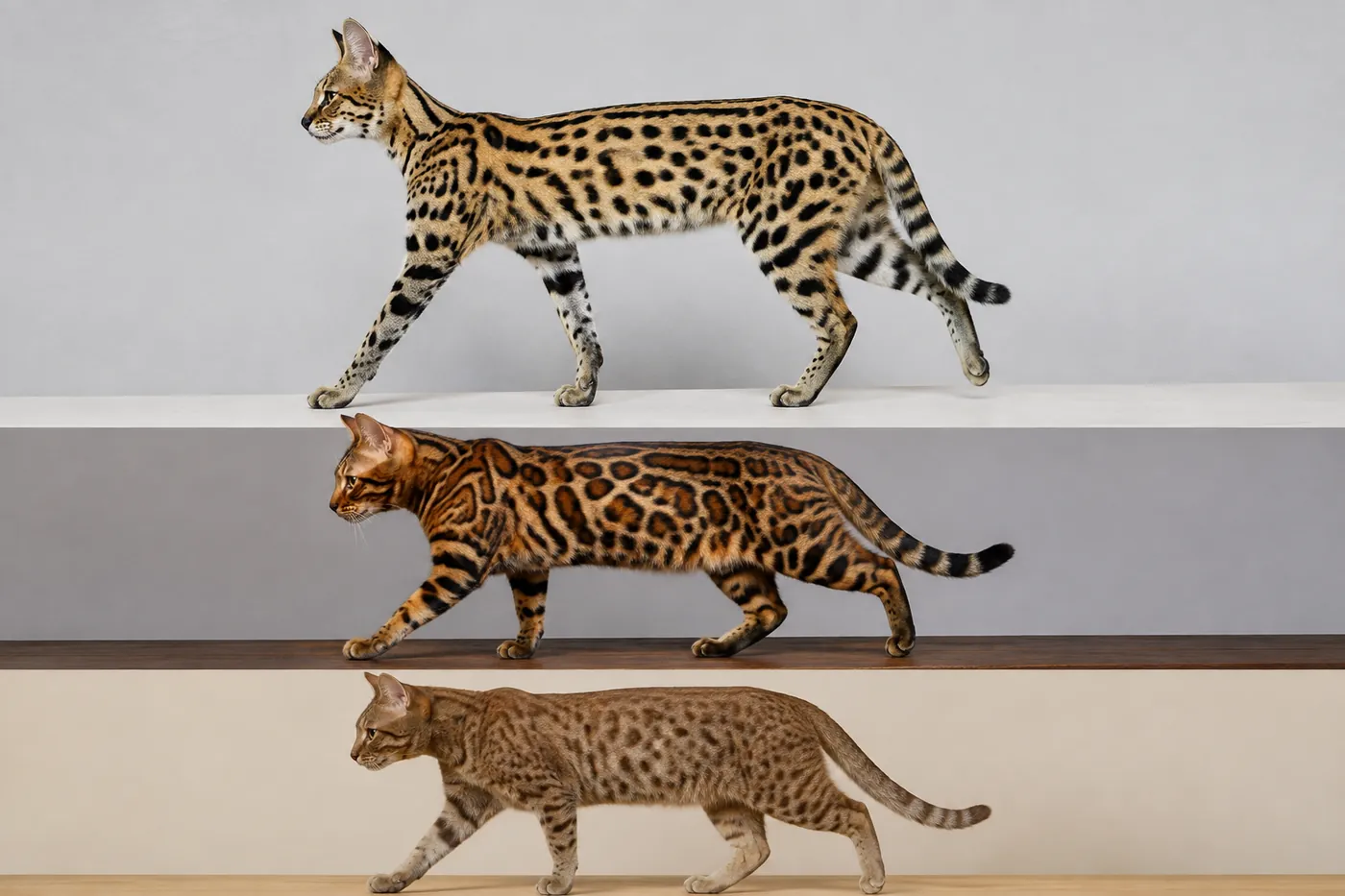
The Bengal is a different hybrid-derived breed with a lower, more substantial body and rosetted or marbled patterns. The Ocicat has a wild-looking spotted coat but entirely domestic ancestry. The Serengeti was bred from Bengal and Oriental Shorthair lines to copy the serval's long legs and large ears, with no serval anywhere in its pedigree.
Can an ordinary home meet the activity needs?
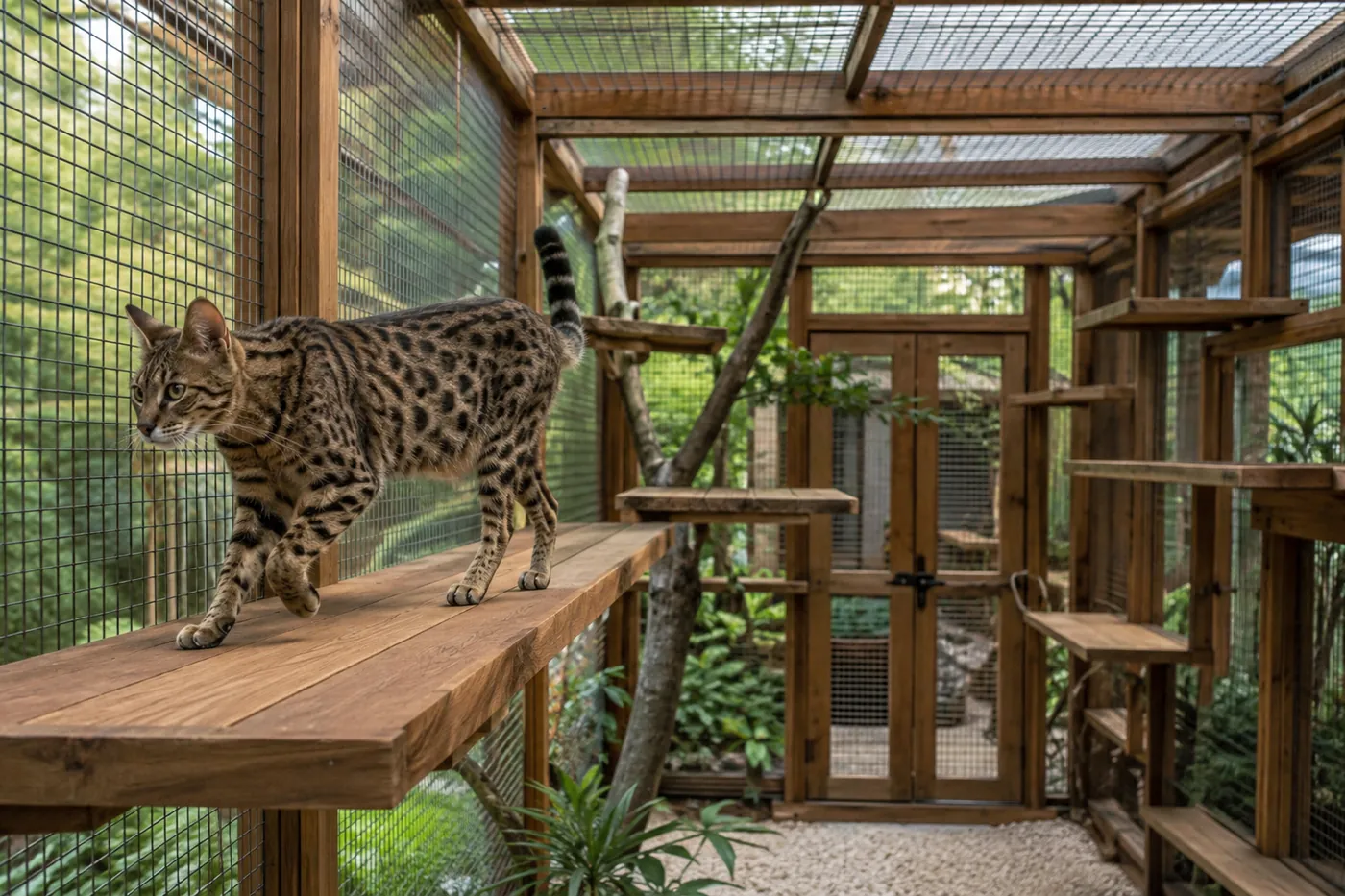
This breed needs more than a tall scratching post. The home should offer robust climbing routes, long horizontal movement, daily interactive play, food-search problems and quiet places where the cat can choose distance.
- Anchor climbing furniture and rate platforms for the adult load
- Provide two routes from important high resting places
- Use a secure roofed enclosure rather than an open garden fence
- Create a double-door routine at exterior entrances
- Rotate chase, carry, scent and food-search activities
- Arrange experienced care before travel or emergencies
A bored or frightened Savannah may open cupboards, damage objects, vocalize or rush a door. Punishment does not supply the missing outlet and can increase fear, so management and reinforcement-based training should begin before a problem becomes rehearsed. Clicker training can support recall, stationing and carrier entry as part of daily care, although a trained hybrid still does not behave like a dog.
What are temperament and family life really like?
Curiosity and assertiveness shape daily life more than the spotted coat. TICA also describes a highly interactive cat, while fetching, water play and harness walking remain individual tendencies rather than promised services.
Children should never chase, restrain or carry a cat that is trying to leave.
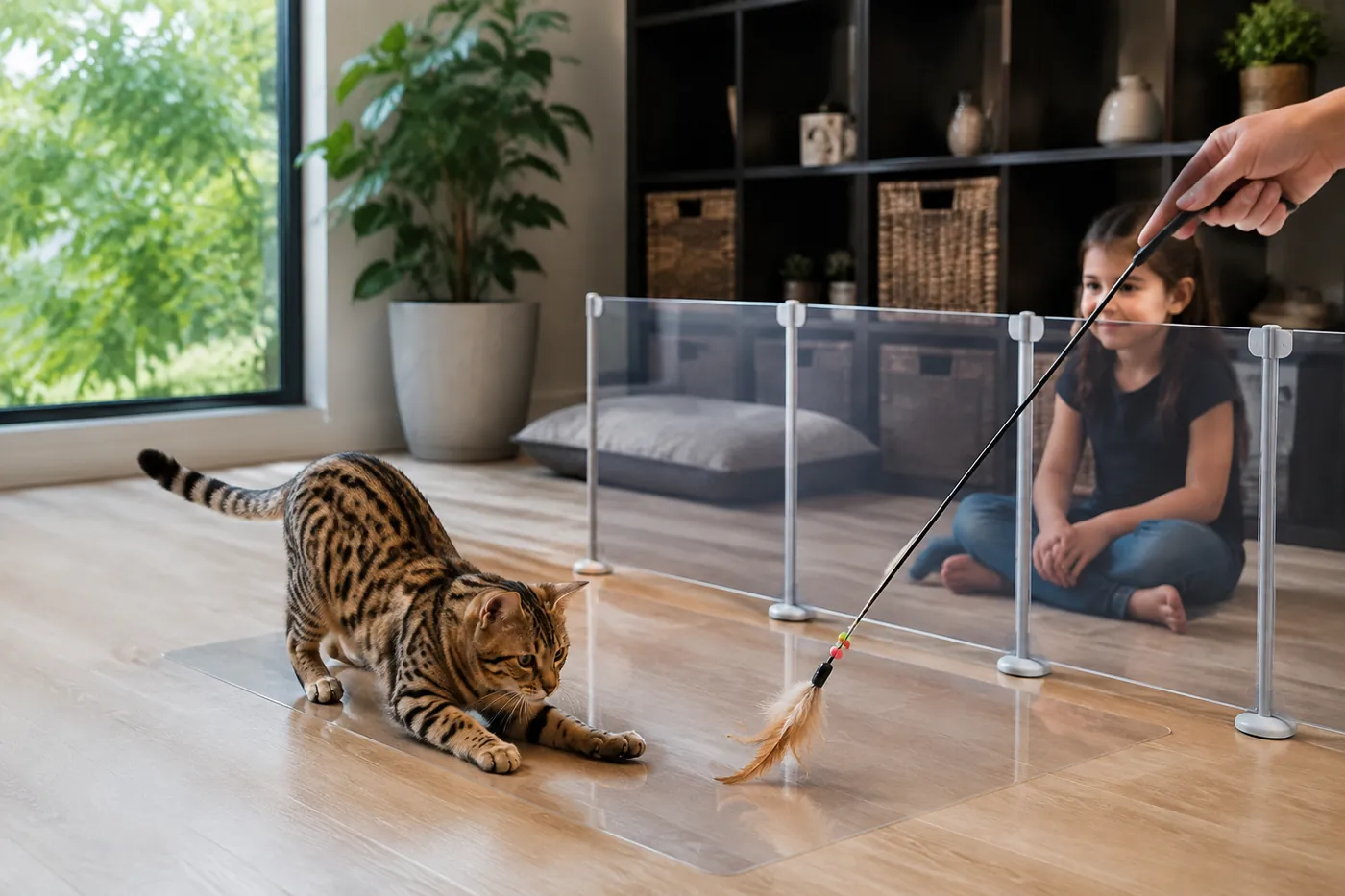
Smaller pets may trigger predatory interest, and no breed description can guarantee safety around birds, rodents, reptiles or fish. Introductions to other cats or dogs need scent work, barriers, separate resources and careful observation. An animal confident with one companion may still respond differently to another, particularly when space or food is contested.
Long absences are a difficult fit. A second pet is not a guaranteed substitute for human interaction, and many boarding settings cannot safely or legally accept a hybrid cat.
Is harness walking or outdoor access appropriate?
Harness work can enrich some individuals, but it should begin indoors with voluntary approach and very short sessions. A frightened cat can reverse out of loose equipment, so fit, a backup attachment and microchip details matter.
- Reward investigation of the harness without putting it on
- Build seconds of comfortable wear indoors
- Attach a light lead and reward following without pressure
- Practise beside the closed exterior door
- Choose a quiet enclosed first location
- End before scanning or crouching becomes sustained distress
A secure catio provides outdoor air without relying on a harness every day. Roof, mesh, door latches and gaps need regular inspection, because athletic jumping and persistent investigation expose weaknesses quickly.
Free roaming creates risks to the cat, wildlife and legal compliance. Wild-looking ancestry does not make traffic, poison, conflict or theft less dangerous.
What health evidence should a buyer request?
Screening starts with three separate questions. TICA recommends asking about pyruvate kinase deficiency and progressive retinal atrophy screening and notes hypertrophic cardiomyopathy in the breed's health history.
| Concern | Evidence to request | Limit |
|---|---|---|
| PK deficiency | Named DNA result for the relevant breeding cats | Covers the tested variant |
| Progressive retinal atrophy | Named DNA result and variant | Does not cover every eye disease |
| Heart health | Recent cardiac assessment and family history | One normal date cannot guarantee later health |
| Generation | Pedigree, registry and microchip match | Does not decide local legality alone |
| General health | Examination, vaccination and parasite records | Cannot predict a lifetime |
Each report should name the laboratory and match the cat's identity. A claim that a single panel makes the line free of disease is too vague to rely on.
TICA's lifespan estimate of 12 to 15 years or longer can support financial planning, but it is not a population median. Insurance exclusions, specialist boarding and legal relocation options deserve attention before adoption because they can shape care for the whole life.
How much grooming and routine care is involved?
The short coat is one of the easier Savannah tasks. A soft brush or grooming cloth every week or two can lift loose hair and create a routine for checking skin, claws and body condition.
Active cats can still gain excess weight when treats and puzzle food are added on top of full meals. Taking training and puzzle food from the measured daily ration keeps activity from quietly increasing calorie intake.
Large water bowls, fountains and play involving water should sit on washable non-slip flooring. Interest in water does not mean a cat should be left with a filled bath, open toilet, aquarium or outdoor pond.
Claw care is easier when a kitten learns to place one paw on a mat for a reward. Scratching surfaces need to stay stable, and frayed material is best replaced before long claws catch during a fast climb.
The coat is the simple part, and containment, activity and observation carry most of the workload.
What happens when you travel, move or need emergency care?
Backup planning is harder for a Savannah than for many domestic cats. A carer may be uncomfortable with a hybrid, a boarding facility may decline it, and a destination may apply a different generation rule from the current home.
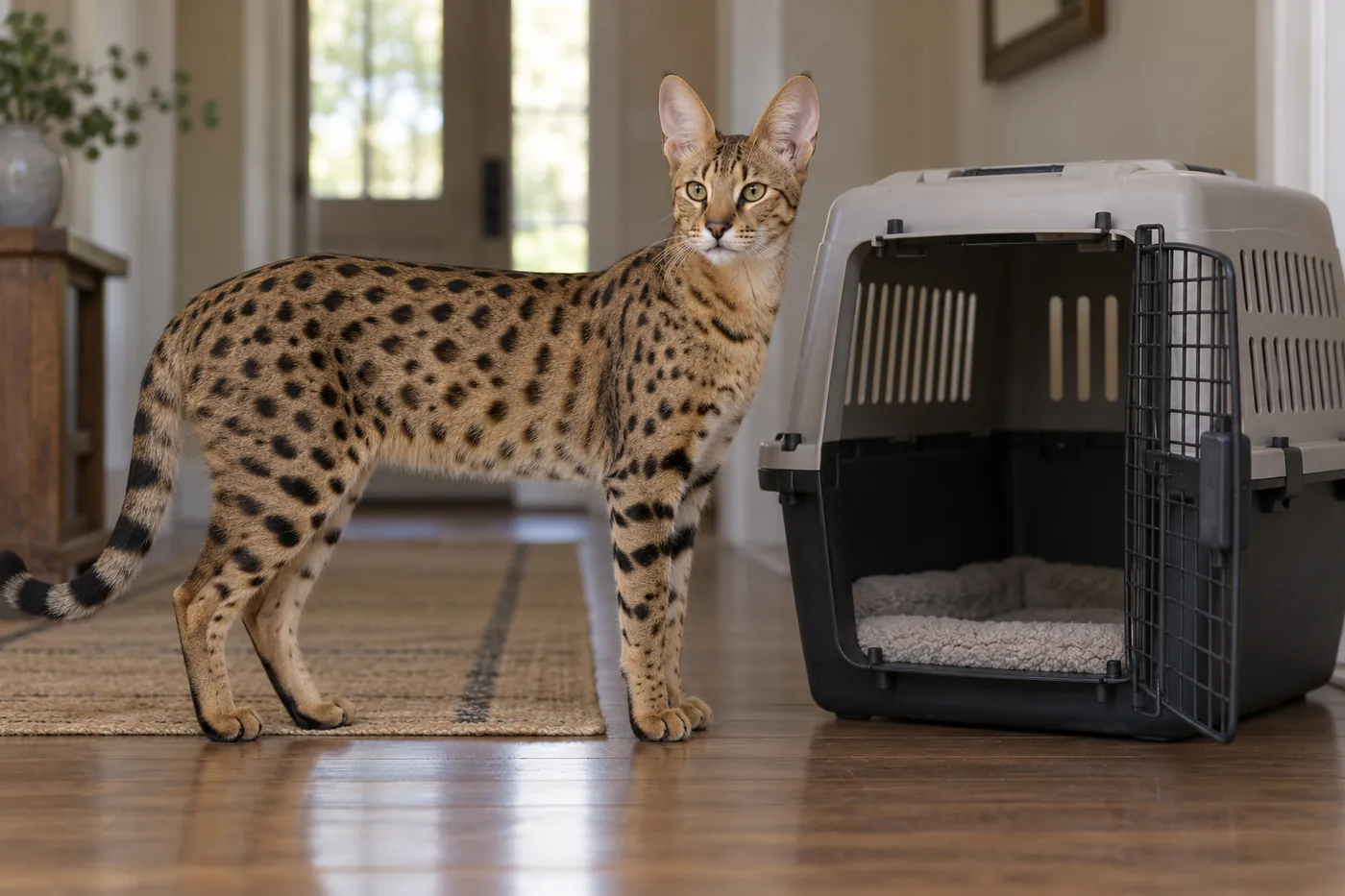
A veterinary practice willing and equipped to see the cat is best found before an emergency. Handling preferences shared in advance and practice at entering a strong carrier matter because a crisis is the worst time to discover the door flexes or the clinic cannot legally accept the animal.
- Routine travel
- Confirm a knowledgeable carer and secure access instructions
- Boarding
- Ask about hybrid policy before relying on a reservation
- Moving home
- Recheck wildlife law for the exact destination and route
- Emergency visit
- Use a measured rigid carrier and current microchip details
- Owner incapacity
- Name a lawful experienced backup in writing
Copies of legal guidance, pedigree, generation record, microchip, insurance and veterinary history belong together. A future carer should not have to reconstruct the cat's status while arranging urgent treatment.
A return clause matters because ordinary rehoming channels may not be suitable. The source should accept responsibility for a cat it produced, including when the owner's location or health changes.
What should you verify before committing?
Legality and care capacity come first, and the animal second. A rare pattern, early-generation label or limited-time deposit should never reverse that order.
- Written current legal guidance for the exact address and generation
- Pedigree, registration and microchip records that agree
- Opportunity to observe the cat moving, settling and recovering
- Named PK deficiency and retinal test reports
- Current cardiac practice and family health history
- Adult-sized enclosure, carrier, litter and climbing plan
- Written plan for travel, emergencies and lawful relocation
- Contract terms covering health, return and lifetime support
If any legal point remains uncertain, do not acquire the cat. If the home cannot contain, enrich or arrange competent backup care, a domestic breed or individual whose needs are easier to meet is the better choice.
Abyssinian and Savannah cats can both need substantial climbing and daily activity, but only the Savannah adds generation, legal and hybrid-ancestry checks. American Shorthair and Savannah cats sit farther apart, with the American Shorthair usually offering the simpler domestic-breed fit for an ordinary workday.
The responsible Savannah decision rests on documents, environment and welfare, whatever the cat looks like.
Checked Against
Published 7 September 2026. Last updated .





