What Is an Abyssinian Maine Coon Mix, and What Can You Actually Predict?
An Abyssinian Maine Coon mix is not a standardised breed. No registry recognises it, no breed standard defines it, and no dedicated breeding programme produces it to a predictable specification. It is an informal name for a cat with ancestry from two very different breeds. Coat type in a first cross follows simple inheritance, while size, build and energy depend on which traits the individual cat actually inherited.

- Origin
- Not applicable; an informal mixed-breed designation, not a developed breed
- Coat
- Usually short and ticked in a first cross; long Maine Coon-type coats appear mainly in later generations
- Size
- Unpredictable; the Abyssinian is medium and fine-boned, the Maine Coon is large and heavy-boned
- Typical weight
- Variable; could fall anywhere between the Abyssinian's 6 to 10 pounds and the Maine Coon's 10 to 25 pounds
- Life expectancy
- No mix-specific data; UK veterinary records give crossbred cats a life expectancy of 11.9 years at birth
- Activity level
- Likely high; both parent breeds are active and interactive
- Grooming
- Depends on coat inheritance; could range from minimal to intensive
- Suits
- Assess the individual cat rather than the breed label
An Abyssinian Maine Coon mix is an informal name for a cat whose parents, or some ancestors, include an Abyssinian and a Maine Coon.
No registry recognises this combination as a breed, and no breed standard defines what it should look like. Most cats described this way come from casual breeding or shelters, not from a deliberate programme with a fixed goal.
That matters because the two parent breeds differ in almost every physical dimension. The Abyssinian is medium, fine-boned, short-coated and built for agility.
The Maine Coon is one of the largest domestic breeds, heavy-boned, long-coated and built for endurance. Size, build and energy in a mix can fall anywhere between the two. The coat is the exception, because two of the genes behind it follow simple rules.
Which Traits of an Abyssinian Maine Coon Mix Can You Predict?
In a standardised breed, generations of selective breeding narrow the range of outcomes. A Maine Coon from a reputable breeder looks and behaves within a predictable band because the parents and grandparents were selected for it.
A first-generation cross of two different breeds has no such narrowing. Each kitten receives a random half of each parent's genes, so size, body type and temperament, which are shaped by many genes at once, depend on the combination that individual received.
Coat is different. Long hair is recessive, so a kitten grows a long coat only when it inherits a long-hair copy of the FGF5 gene from both parents. A Maine Coon always passes one on. An Abyssinian usually passes on a short-hair copy, although some Abyssinian lines carry the long-hair gene that produced the Somali. Most first-cross kittens are therefore short-coated, and long coats appear mainly when the Abyssinian parent is a carrier or when two mixes are bred together.
The Abyssinian's ticked coat comes from a dominant mutation, so a kitten that inherits it will usually show ticked hairs on the body, often with some barring left on the legs and tail. A kitten that also inherits white spotting, silver or red from the Maine Coon side can look quite different while carrying the same ticking.
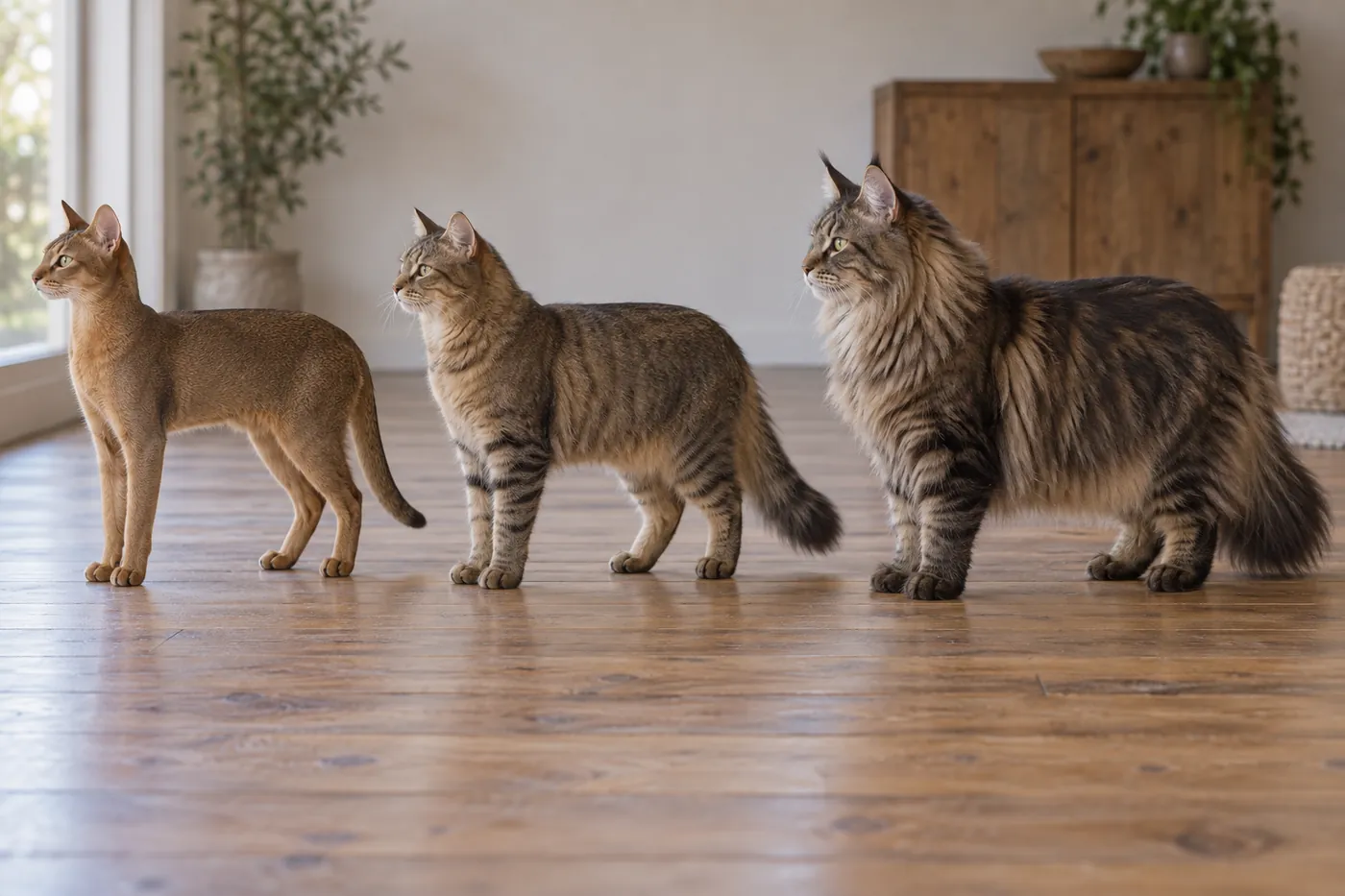
| Trait | Abyssinian parent | Maine Coon parent | What the mix might get |
|---|---|---|---|
| Size | 6 to 10 pounds, medium | 10 to 25 pounds, large | Anything from medium to large |
| Coat | Short, fine, ticked tabby | Long, shaggy, heavy undercoat and ruff | Usually short and ticked in a first cross; long coats mainly in later generations |
| Body | Fine-boned, agile, long-legged | Heavy-boned, muscular, rectangular | Variable; may favour one parent or blend both |
| Temperament | Intensely active, climbing, interactive | Playful but calmer, sociable, slow to mature | Likely active and social; energy level unpredictable |
| Voice | Moderate | Quiet to moderate with distinctive trill | Variable |
A cat sold or described as an Abyssinian Maine Coon mix may have one parent of each breed, a grandparent of each breed, or simply look like a blend with no verified pedigree behind either claim.
CFA says an Abyssinian needs combing or brushing only a few times a month to control shedding and calls it one of the most intelligent breeds, while a Maine Coon's coat needs combing two or three times a week and the breed is described as easy to train. A cross can land anywhere between the two, so the coat a kitten inherits decides how much shedding and combing to expect.
What Health Concerns Come From Each Side?
Both parent breeds carry documented health conditions, and a mix can inherit from either or both.
| From the Abyssinian | From the Maine Coon |
|---|---|
| Progressive retinal atrophy (PRA, rdAc) | Hypertrophic cardiomyopathy (HCM) |
| Pyruvate kinase deficiency (PKDef) | Hip dysplasia |
| Renal amyloidosis reported in the breed | Spinal muscular atrophy (SMA) |
DNA tests exist for PRA (rdAc), PKDef and SMA, and for one Maine Coon heart variant, MYBPC3 A31P. The heart test settles less than it seems to. In a 2024 classification study, HCM risk rose clearly in cats carrying two copies of that variant but not in cats carrying one, and Maine Coons without it still develop HCM. A first-cross kitten usually inherits at most one copy, from its Maine Coon parent, so the result matters mainly if the cat will be bred. Echocardiography, an ultrasound scan of the heart, is the check that shows whether HCM is actually present.
Mixed ancestry neither protects a cat from these conditions nor guarantees it will develop them. Several of the tested conditions are recessive, so a kitten is affected only when it inherits the variant from both parents, and parent test results show whether that could happen.
The individual cat's own health records and, where available, parent health screening are the useful evidence.
No study has measured lifespan in this mix. UK life tables built from veterinary records give crossbred cats a life expectancy at birth of 11.9 years, against 11.74 years for cats overall, which is a fairer starting point than either parent breed's estimate and cannot predict one cat's lifespan.
How Do You Actually Evaluate One?
Beyond coat type in a first cross, the label settles very little, so the cat in front of you is the evidence that counts.
- Observe the actual coat: is it short, long or medium, and what grooming does it need right now
- Weigh the cat or estimate adult size from the current growth trajectory and frame
- Watch the activity level: does it climb, explore and demand interaction, or is it calmer
- Handle the cat to assess tolerance of touch along the body, paws and belly
- Ask for any available health records or parent information, recognising that casual-breeding or shelter origins may provide little
- If the seller claims specific breed parentage, ask what documentation supports it
Children and other pets follow the same logic. Both parent breeds are usually described as sociable, but an Abyssinian-type cat that climbs everything and a slower, larger Maine Coon-type cat suit different households, and a kitten's behaviour keeps changing as it matures. An adult whose behaviour with children, dogs or other cats has already been observed by a shelter or foster carer gives a much firmer prediction than a kitten does.
A healthy, well-tempered cat whose size, coat and energy level suit your household is a good match regardless of the breed names attached to it.
Common Questions
Is an Abyssinian Maine Coon mix a real breed?
No. It is an informal name for a cat with mixed ancestry from two breeds. No registry recognises it, no standard defines it, and most cats described this way come from casual breeding or shelters.
How big does an Abyssinian Maine Coon mix get?
Unpredictable. The Abyssinian parent contributes a 6-to-10-pound medium frame and the Maine Coon parent contributes a 10-to-25-pound large frame. The mix can land anywhere on that range.
What health problems does this mix have?
It can inherit conditions from either parent breed: PRA and PKDef from the Abyssinian side, HCM, hip dysplasia and SMA from the Maine Coon side. DNA tests exist for several of these. Assess the individual cat's health rather than assuming the mix avoids or carries specific conditions.
What temperament does an Abyssinian Maine Coon mix have?
Both parent breeds are active and social, so high energy and interactive behaviour are likely. The specific balance between the Abyssinian's intense climbing drive and the Maine Coon's calmer sociability depends on the individual.
Checked Against
- TICA: Abyssinian breed tica.org
- TICA: Maine Coon breed tica.org
- Kehler et al.: Four independent mutations in the feline FGF5 gene determine the long-haired phenotype (J Hered, 2007) pmc.ncbi.nlm.nih.gov
- Boeykens et al.: Classification of feline hypertrophic cardiomyopathy-associated gene variants (Front Vet Sci, 2024) pmc.ncbi.nlm.nih.gov
- Life tables of annual life expectancy and risk factors for mortality in cats in the UK pmc.ncbi.nlm.nih.gov
- Cornell Feline Health Center: Hypertrophic cardiomyopathy vet.cornell.edu
- The Cat Fanciers' Association: Abyssinian cfa.org
- The Cat Fanciers' Association: Maine Coon cfa.org
Published 17 September 2026. Last updated .