What Is an Abyssinian Siamese Mix, and How Does It Differ From an Ocicat?
An Abyssinian Siamese mix is an informal name for a cross between the two breeds, and no registry recognises it. The Ocicat began from the same pairing in 1964 and was then bred to a standard for decades, so a casual cross does not become an Ocicat. The energy and social demand of two very active parent breeds is the part you can plan around; coat, voice and health depend on what the individual cat inherited.

- Origin
- Not applicable; an informal mixed-breed designation, not a developed breed
- Coat
- Short; usually ticked in a first cross, with points possible only when both parents carry colourpoint
- Size
- Medium; both parent breeds are medium-sized and fine-to-moderate boned
- Typical weight
- Likely 6 to 12 pounds, consistent with both parent breeds' ranges
- Life expectancy
- No study of this cross; UK records put the average cat at 11.74 years at birth
- Activity level
- Very likely high; both parent breeds are among the most active and social domestic breeds
- Grooming
- Low; both parents have short coats, and regular combing or grooming controls shedding
- Suits
- Households with people at home for much of the day and time for daily play; both parent breeds are strongly people-oriented
An Abyssinian Siamese mix is a cat with ancestry from an Abyssinian and a Siamese. The name describes a pairing rather than a breed, so no standard sets what the kittens should look like or how they should behave.
Both parent breeds are intensely active, social and interactive. A mix of the two is likely to want company and play for much of the day, which suits a household with people at home more than one where the cat spends long days alone.
Why Mention the Ocicat?
The first Ocicat, a spotted kitten called Tonga, was born in 1964 from an attempt to cross an Abyssinian with a Siamese to produce an Abyssinian-pointed Siamese. Breeders repeated the cross and later added American Shorthairs to widen the gene pool, which is why the two names are so often confused.
What separates them is the selection that followed. Ocicat breeders worked for decades toward one written standard, a spotted cat with a wild look and a muscular body, and CFA did not advance the breed to championship until 1987 because consistent type took that long to fix.
A casual Abyssinian Siamese cross starts where the first Ocicat breeders started, before any of that selection. A spotted kitten can occur, but nothing makes one likely, and the coat each kitten ends up with follows from the parent genes it happened to receive.
What Might Each Parent Contribute?
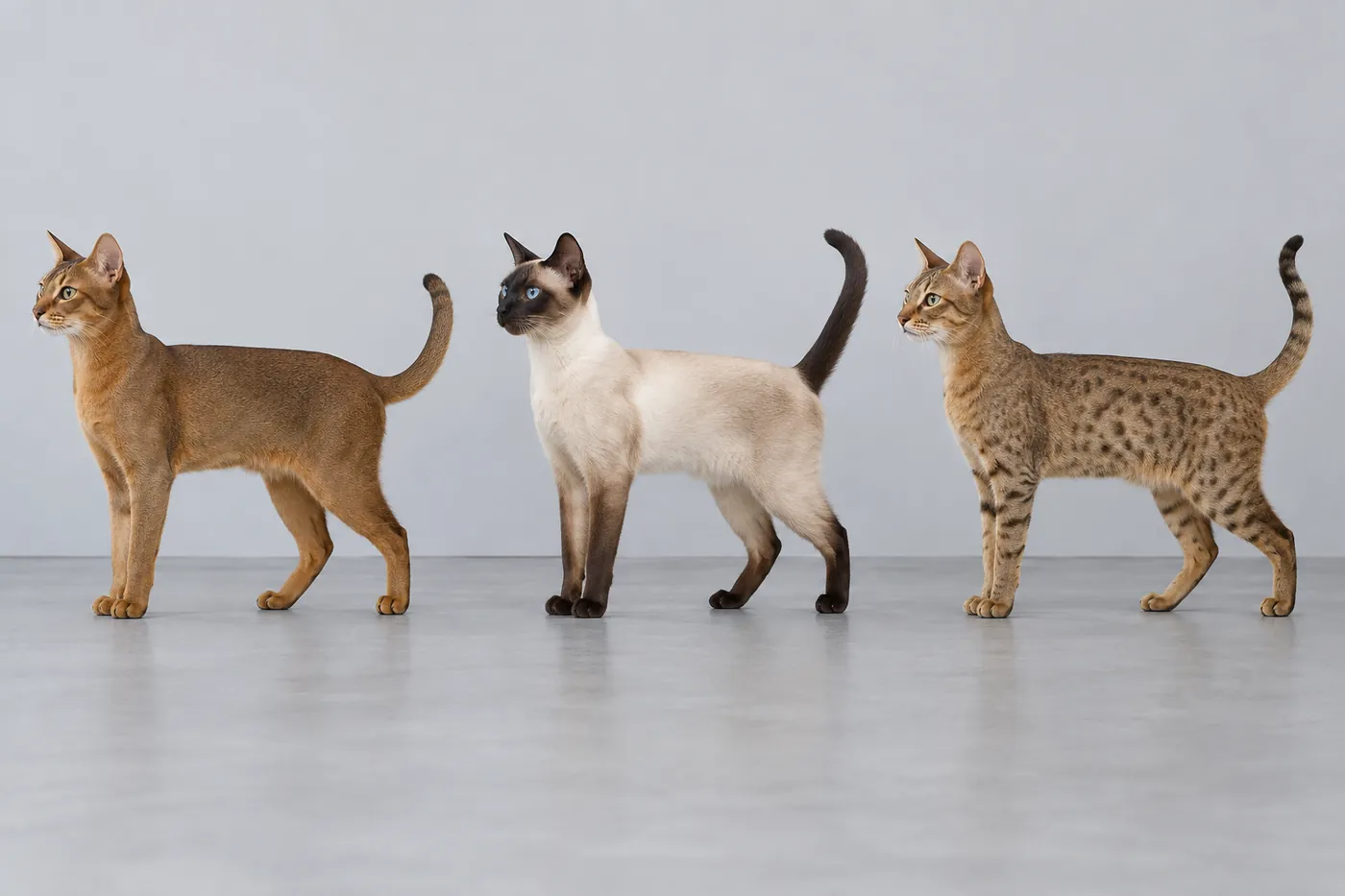
Both parent breeds are medium-sized with short coats, so the physical variation is narrower than in a cross between very different breeds.
| Trait | Abyssinian parent | Siamese parent | What the mix might get |
|---|---|---|---|
| Coat pattern | Ticked tabby, no stripes or spots | Pointed (colour on extremities only) | Usually ticked in a first cross; points only when both parents carry colourpoint |
| Body | Medium, fine-boned, muscular, long-legged | Medium, fine-boned, long, tubular | Fine-boned, lean and athletic in most cases |
| Temperament | Extremely active, playful and inquisitive | Intensely social, vocal, persistent | Very high energy and social demand; vocal level varies |
| Voice | Not particularly talkative | Loud and persistent | Anywhere from quiet to loud |
| Grooming | Combing a few times a month controls shedding | Regular grooming keeps shedding down | Low upkeep, with some shedding from either side |
Coat is the part of this cross that genetics predicts best. The Siamese pattern is recessive, so a kitten shows points only when it inherits a colourpoint copy from both parents. A first cross between an Abyssinian and a Siamese therefore produces kittens without points unless the Abyssinian happens to carry the colourpoint gene, and the Abyssinian's ticking, which sits above the other tabby patterns in dominance, is the likeliest coat. Pointed kittens come back in later generations, when a cross-bred cat is mated to a Siamese or to another cross.
Temperament is harder to predict trait by trait, but the most dependable forecast is high social and activity demand, because it is the one quality both parents share rather than something only one of them brings. A calm, independent adult would be an unusual result.
Three practical points follow from what the parents share. CFA calls the Abyssinian one of the most intelligent breeds and says the Siamese is often considered the most intelligent of cats, so a cross is likely to learn routines and games quickly. Neither parent copes well with long hours alone: CFA suggests a quieter home consider two Abyssinians rather than one, and calls the Siamese unsuited to solitude. CFA also describes the Abyssinian as an excellent choice for families with children and notes that many Siamese form close friendships with other pets, so a well-socialised cross usually fits a busy family, although no description guarantees how one kitten will turn out.
What Health Concerns Come From Each Side?
| From the Abyssinian | From the Siamese |
|---|---|
| Progressive retinal atrophy (PRA, rdAc) | Progressive retinal atrophy (the same rdAc variant) |
| Pyruvate kinase deficiency (PKDef) | Asthma (suspected, not proven in large studies) |
| Renal amyloidosis | Amyloidosis, mainly in the liver |
Two of these risks come from both sides. The rdAc variant was first found in Abyssinians, yet a survey of 41 breeds found it in about a third of the gene copies in North American and European Siamese. It is recessive, so a kitten loses its sight to it only after inheriting a copy from each parent, and with both parent breeds carrying it, that outcome is realistic for this cross.
Amyloidosis also appears in both breeds, in different forms. Abyssinian lines are associated with deposits in the kidneys, while in a Dutch post-mortem series of Siamese and Oriental cats the deposits were mainly in the liver and the protein involved differed from the Abyssinian one.
DNA tests exist for PRA (rdAc) and PKDef, and where the parents were tested, those results are the most useful health paperwork this cross can come with. Amyloidosis and asthma have no DNA test, and a Siamese tendency to asthma has been suggested but not proven, so both are watched for through ordinary veterinary care rather than screened out in advance.
No study has measured how long this cross lives. UK primary-care records put the average companion cat's life expectancy at birth at 11.74 years, which is a population figure rather than a forecast for any one cat.
How Do You Evaluate the Individual Cat?
- Test the activity and social demand: does the cat follow you, vocalise, and seek interaction continuously
- The coat pattern, which also hints at the cross: points mean both parents carried colourpoint
- Handle the cat to assess tolerance and confidence
- Parents' DNA results for PRA (rdAc) and PKDef, with any other health records
- If the seller claims pedigree parentage, ask what documentation exists
- Prepare for high energy and social company needs regardless of which traits dominate
If the activity level and social demand suit your household, the specific breed label is less important than the individual match.
A reader drawn to this pairing who wants a predictable adult has a closer match in the Ocicat, which began with the same two breeds, has been selected toward one standard since the 1960s and holds championship status.
Common Questions
Is an Abyssinian Siamese mix the same as an Ocicat?
No. The Ocicat began with an Abyssinian and Siamese cross in 1964, later took in American Shorthair lines and has been bred to a written standard since. A casual Abyssinian Siamese cross has none of that selection behind it, so its coat and build are far less predictable.
Are Abyssinian Siamese mixes vocal?
Often, though not reliably. The Siamese is known as one of the most vocal breeds, while the Abyssinian is not particularly talkative, so a mix can land anywhere between the two.
What health problems does this mix have?
It can inherit conditions from either breed. The rdAc form of PRA is carried by both Abyssinians and Siamese, so a kitten can receive a copy from each parent and lose its sight. PK deficiency comes from the Abyssinian side, and amyloidosis occurs in both breeds. Being a cross does not protect a kitten from any of these.
How active is an Abyssinian Siamese mix?
Very likely high, because a strong drive for activity and company is the one trait both parent breeds share. A calm, independent adult from this cross would be unusual.
Checked Against
- CFA: Abyssinian cfa.org
- CFA: Siamese cfa.org
- CFA: Ocicat history cfa.org
- OMIA: Colourpoint and the TYR allelic series in cats omia.org
- OMIA: Tabby patterns and the Ticked locus in cats omia.org
- Menotti-Raymond et al.: rdAc retinal degeneration across cat breeds (Veterinary Journal, 2010) pubmed.ncbi.nlm.nih.gov
- van der Linde-Sipman et al.: AA amyloidosis in Siamese and Oriental cats (1997) pubmed.ncbi.nlm.nih.gov
- Cornell Feline Health Center: Feline asthma vet.cornell.edu
- Teng et al.: Life tables of annual life expectancy for cats in the UK (2024) pubmed.ncbi.nlm.nih.gov
Published 17 September 2026. Last updated .