Cat Behaviour, Explained From the Cat's Side
Behaviour

Cat Behaviour, Explained From the Cat's Side

A cat rarely acts without a reason, and the reason is usually about safety, territory, or comfort. Working out what a behaviour does for the cat is what tells you whether to change it or leave it alone.

Start here

The One People Ask About Most

Every behaviour is doing a job for the cat

The most useful shift in thinking about cat behaviour is to stop asking what a cat is trying to tell you and start asking what the behaviour achieves for the cat.

Almost everything resolves into one of three needs: safety, territory, or comfort. A cat that feels unsafe hides, guards, or lashes out. A cat with unclear territory sprays or blocks doorways. A cat that is comfortable kneads and purrs.

Framing it that way makes the fix obvious more often than not. If the behaviour meets a need, removing it without meeting the need another way simply moves the problem.

Punishing a behaviour removes the outlet and leaves the reason, which is why it makes things worse.

It also explains why punishment fails specifically with cats. It adds fear to an animal whose problem was usually fear in the first place.

Signals

What a Cat Is Telling You

Purring, bunting and kneading are all read as simple affection, and not one of them means only that. Each has a specific job, and telling them apart is what turns a fond gesture into information about what the cat wants.

  • Behaviour

    Bunting

    Brief relaxed head bumps are usually part of greeting and scent communication. The interaction goes best when your cat…

  • Behaviour

    Purring

    Cats purr during friendly contact, around food and sometimes when stressed or unwell. The sound means most when read…

  • Behaviour

    Kneading

    Kneading begins during nursing and often continues when an adult cat settles. Read it alongside the cat’s posture and…

Reading a cat before it reaches the loud part

Cats signal continuously and quietly, and most bites and scratches follow warnings that were given and missed.

Tail
Upright with a hooked tip is friendly, thrashing is not
Ears
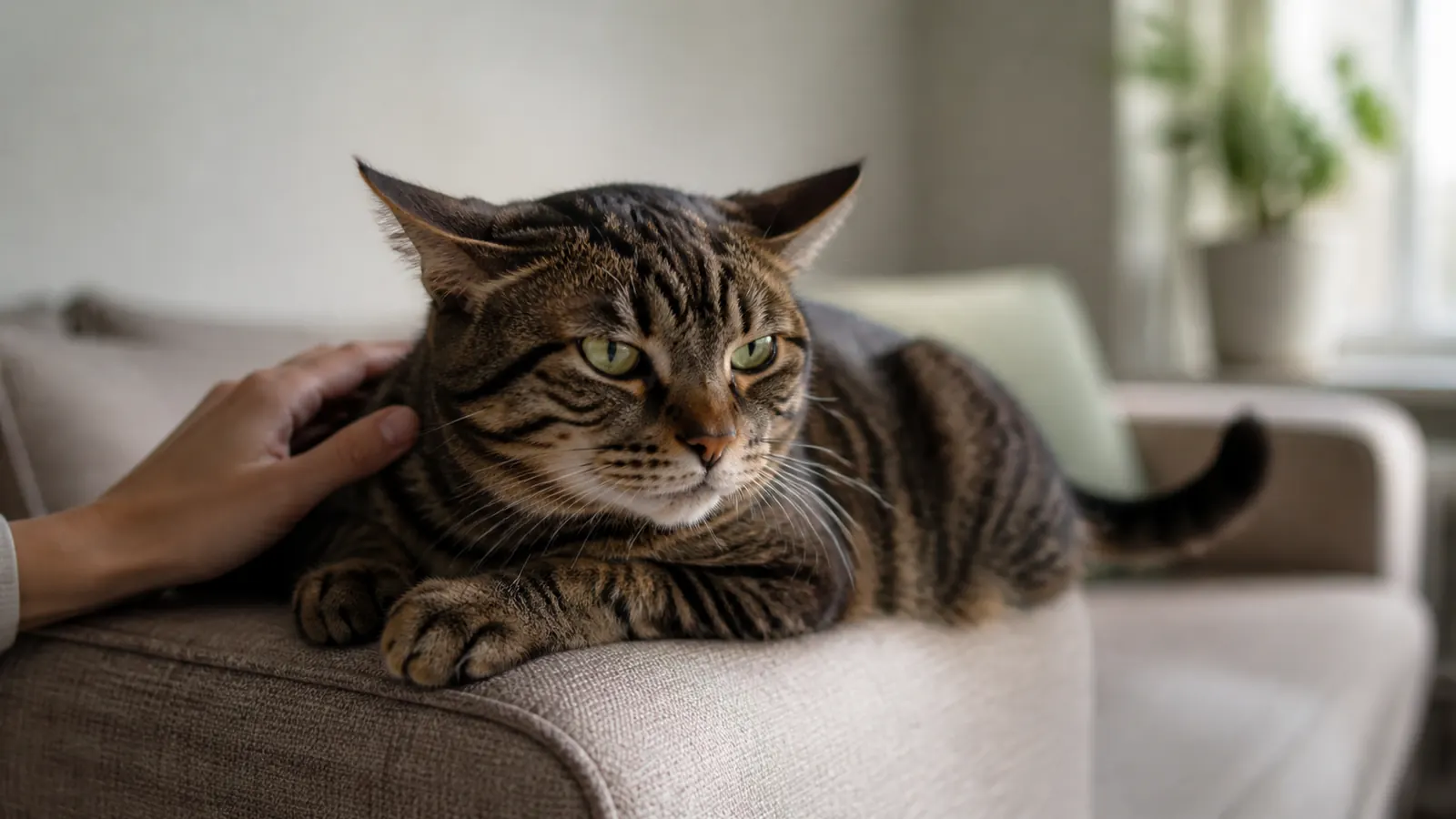
Rotating back or flattening means stop, well before a swipe
Pupils
Widening in a calm room is arousal, not affection
Skin
A rippling back during stroking is a tolerance limit
Body
Weight shifting away from your hand is an answer

The tail is the earliest and most reliable of these. A cat's tail begins reporting discomfort several seconds before anything else changes.

Many cats show subtle tension before biting, but pain, fear or a rapid trigger can leave little warning a person recognises.

The petting aggression guide covers the sequence in detail, including why the belly is defended rather than ticklish.

Teeth

When Stroking Ends in Teeth

A cat that bites a hand or an ankle is rarely being aggressive. It is usually over-stimulated or short of a proper outlet for hunting, and the fix in both cases starts well before the bite rather than after it.

Play is hunting, and it has to finish

Cat play often borrows parts of a predatory sequence such as stalking, chasing, pouncing and catching. Letting the cat catch the toy can make play more satisfying, but individuals differ in how they finish and settle after a session.

That unfinished sequence is behind a large share of the complaints people have about young cats.

  1. Use a wand toy so the prey moves away from the cat, not towards it.
  2. Let the cat catch the toy several times rather than keeping it out of reach.
  3. Wind the session down gradually rather than stopping at peak arousal.
  4. Finish with a small meal or a few pieces of kibble, which completes the sequence.

Several short opportunities can suit a cat better than one long session. End while the cat remains comfortable, and adjust timing and length to the age, health and pattern you observe.

A hunt that never ends in a catch leaves a cat more wound up than before it started.

The ankle biting guide covers what to do when feet have become the target.

Scratching is maintenance, not damage

Scratching does three things at once: it sheds the outer claw sheath, it stretches the whole body from shoulder to toe, and it leaves both a visual mark and scent from glands in the paws.

None of those needs can be trained away, which is why the goal is redirection rather than prevention.

  • Tall enough for a full stretch, which for most cats means at least 80 centimetres
  • Stable enough not to wobble, because a post that moves gets abandoned
  • Sisal or bare wood rather than carpet, which feels too much like furniture
  • Placed where the cat already scratches, not where it looks tidy
  • One near a sleeping spot, because cats scratch on waking

A post may be ignored because of its height, stability, surface or location, so change one property at a time and watch what the cat chooses.

The choosing a scratching post guide covers height and material properly.

The behaviours people misread most

Some of the commonest cat behaviours are read backwards, and the misreading changes how people respond.

Purring is not a reliable sign of contentment. Cats purr when frightened, injured, and dying as well as when relaxed, and it is better understood as a self-soothing signal than a happiness meter.

Kneading is a nursing behaviour carried into adulthood, with scent marking layered on top. It is not a sign the cat was weaned too early.

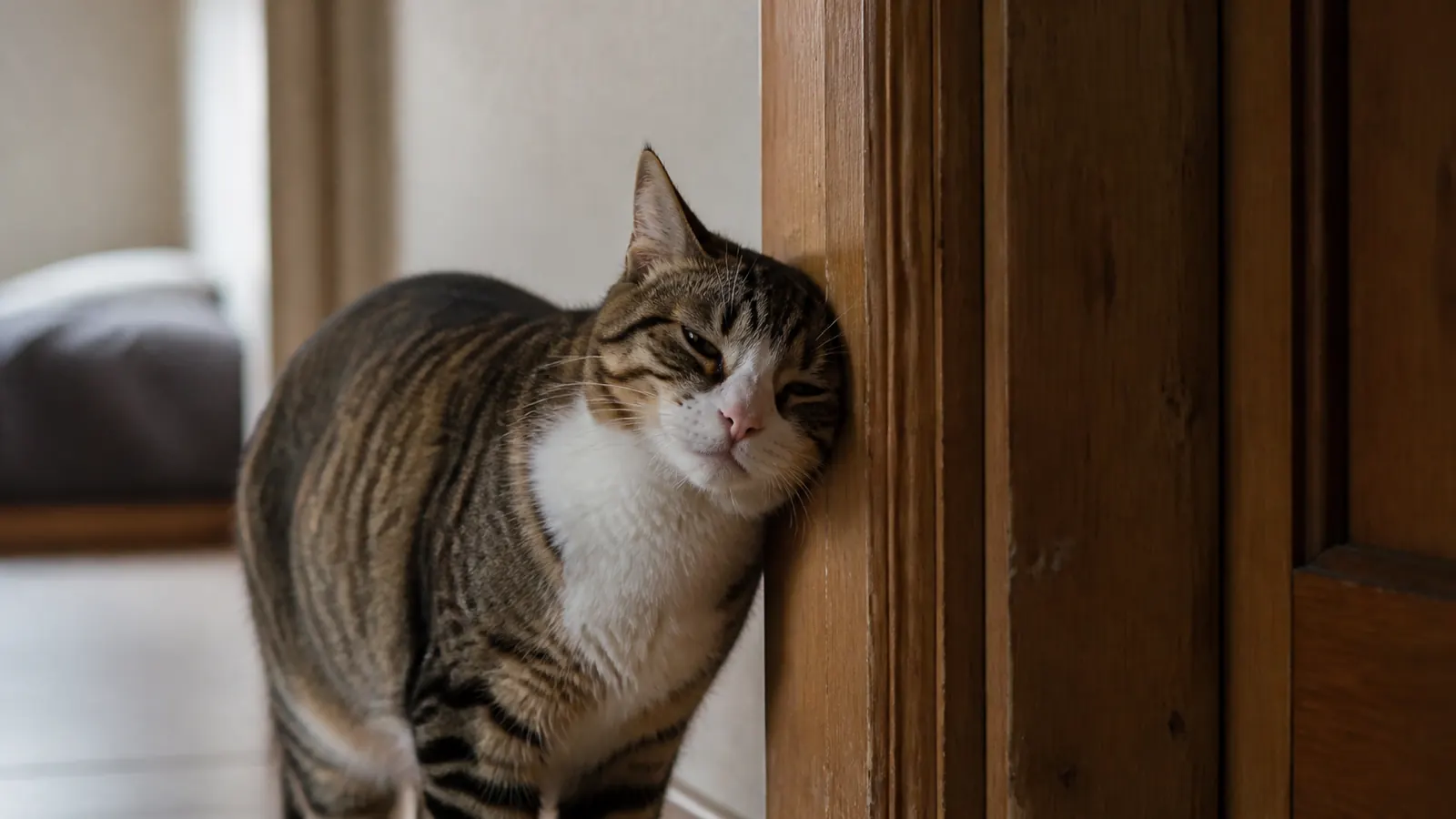
Head bunting deposits facial pheromones and is one of the few unambiguously friendly gestures a cat makes. Head pressing, which is sustained and usually against a wall, is a neurological emergency and completely different.

Purring tells you a cat is coping with something, not necessarily that it is happy.

Spraying, soiling, and the difference between them

These get treated as one problem and are not. Spraying is territorial marking: the cat stands, the tail quivers, and a small amount goes on a vertical surface.

Soiling is elimination in the wrong place: the cat squats, produces a normal volume, and does it on a horizontal surface.

Soiling points at the litter tray, at pain, or at access. Spraying points at territory, at an unfamiliar cat outside, or at a change in the household.

Both need a medical cause ruled out first, and neither responds to being told off.

Standing and quivering is a message. Squatting is a bladder.

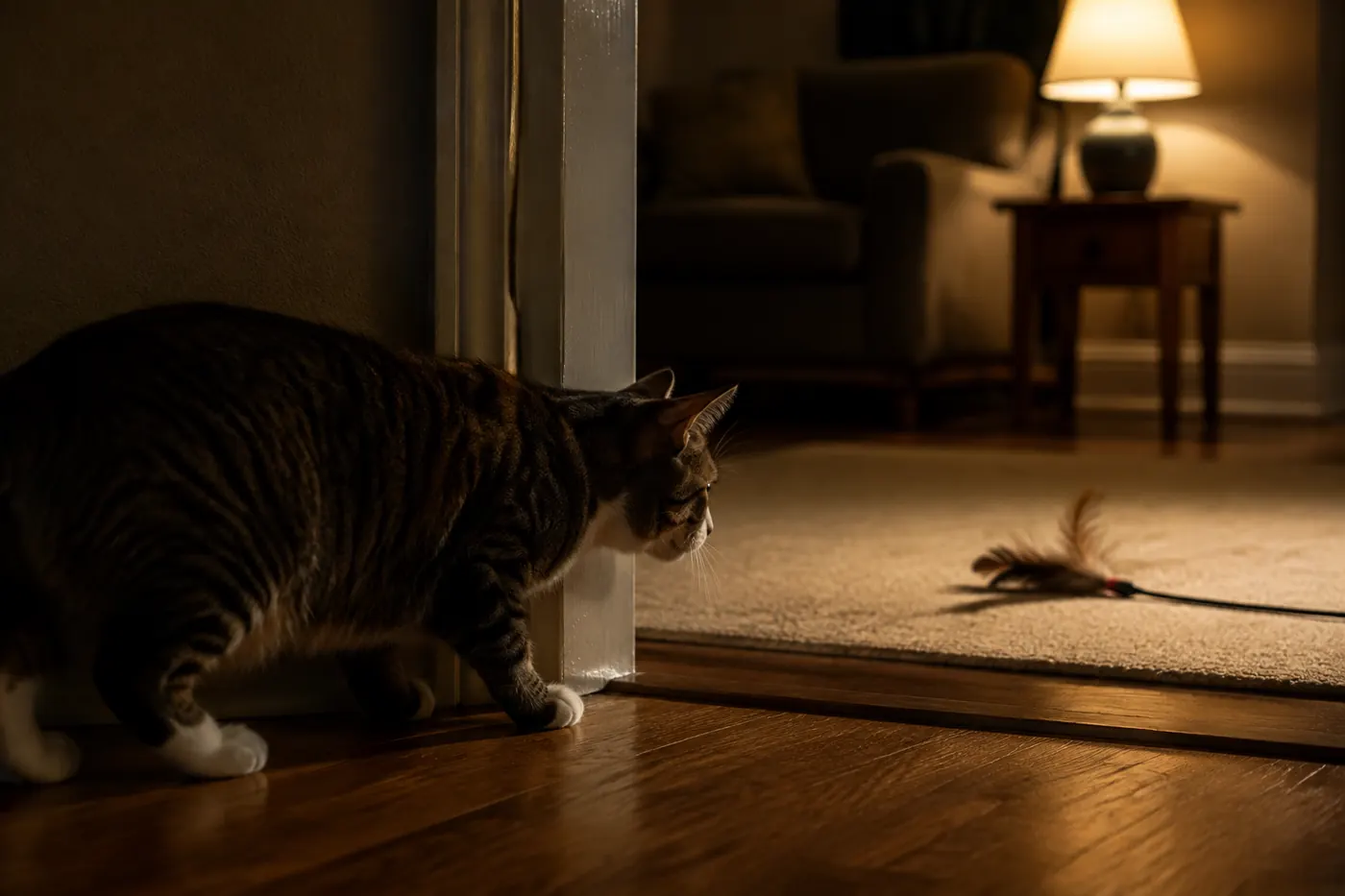
A cat crouched mid-stalk behind a doorway, body low and weight forward, watching a feather toy on the floor of the next room

Two cats, and what actually causes conflict

Cats are not obligate loners, but they also are not automatically social. Whether two cats live well together depends far more on resources and introduction than on temperament.

Most household conflict is competition rather than dislike. Two cats sharing one food bowl, one tray bank, and one warm sleeping spot have a reason to fight that disappears when the resources are spread out.

Conflict is also frequently silent. One cat sitting in a corridor is a blockade, and a cat that quietly stops using a room has lost an argument nobody witnessed.

A cat that leaves instead of protesting is easy to keep annoying without noticing.

The cat aggression guide covers how to reintroduce two cats that have fallen out.

When a behaviour change is actually a health change

This is the check that belongs at the end of every behaviour question, because it is the one that gets skipped.

A cat that suddenly stops tolerating handling, becomes irritable, hides more, stops grooming, or starts grooming one patch bare has usually changed physically rather than mentally.

Pain, dental disease, skin conditions, hyperthyroidism, and failing eyesight all present as behaviour first. So does cognitive decline in an old cat, which often shows as night-time yowling.

A behaviour that changed suddenly in an adult cat is a health question until proven otherwise.

A sudden behaviour change raises the priority of ruling out pain or illness, while a gradual change can still have a medical contribution. Timing helps the veterinary history but does not diagnose the cause.

Enrichment, which is the fix for a large share of complaints

An indoor cat has its food, warmth, and safety handled, which leaves a predator with nothing to do. Most of what gets described as bad behaviour follows from that.

Enrichment is not toys. It is giving a cat things to solve, climb, watch, and hunt.

  • Vertical routes, so the cat can cross a room without touching the floor
  • Part of the measured daily food offered through a puzzle feeder the cat can solve
  • A window perch with something moving outside to look at
  • Short wand-toy sessions adjusted to the cat's interest, mobility and recovery
  • Boxes and paper bags rotated in and out rather than left permanently
  • Cat grass or a safe plant to chew, which redirects an urge rather than blocking it

Height does the most work of anything on that list. A room with a route to the ceiling is a larger territory to a cat than a large room with nothing to climb.

Rotation matters more than quantity. Three toys that appear and disappear beat twelve left permanently on the floor.

Ten minutes of play fixes ten minutes. What the room offers fixes the rest of the day.

For a household that is out all day, add predictable play, feeding activity, resting choices and human contact when people are home. A second cat helps only when both individuals are socially compatible and introduced carefully.

Stress, and the changes that cause it

Cats are territorial in a way that makes them sensitive to changes people consider trivial.

Building work, a new sofa, a visitor staying, a change in someone's working hours, and a new cat two gardens away are all common triggers. So is a change of litter or a moved food bowl.

Stress in cats rarely looks like anxiety in a dog. It looks like hiding, overgrooming, spraying, or a cat that stops using a room.

Predictability, hiding places, height and separated resources are useful starting points. The right change still depends on whether the trigger is pain, fear, conflict, frustration or something outside the home.

A cat under pressure needs more places to be, not more attention.

Anything that persists after the trigger has gone, particularly overgrooming, is worth a vet visit rather than more time.

Keep reading

More About Living With a Cat

One question usually leads to the next one.

  • Health

    What a change in a cat usually means, and how fast it needs looking at.

    Browse
  • Food safety

    One of six verdicts per food, with the reasoning and the sources.

    Browse
  • Nutrition

    How much, how often, and how a cat gets enough water.

    Browse
  • Litter box

    Setup, substrate, placement, and what the tray tells you.

    Browse