How Do You Clicker Train a Cat, and Where Do You Start?
Clicker training marks one voluntary action and follows it with a reward the cat values. Start with an easy behaviour, keep the step small and stop when attention or comfort fades.
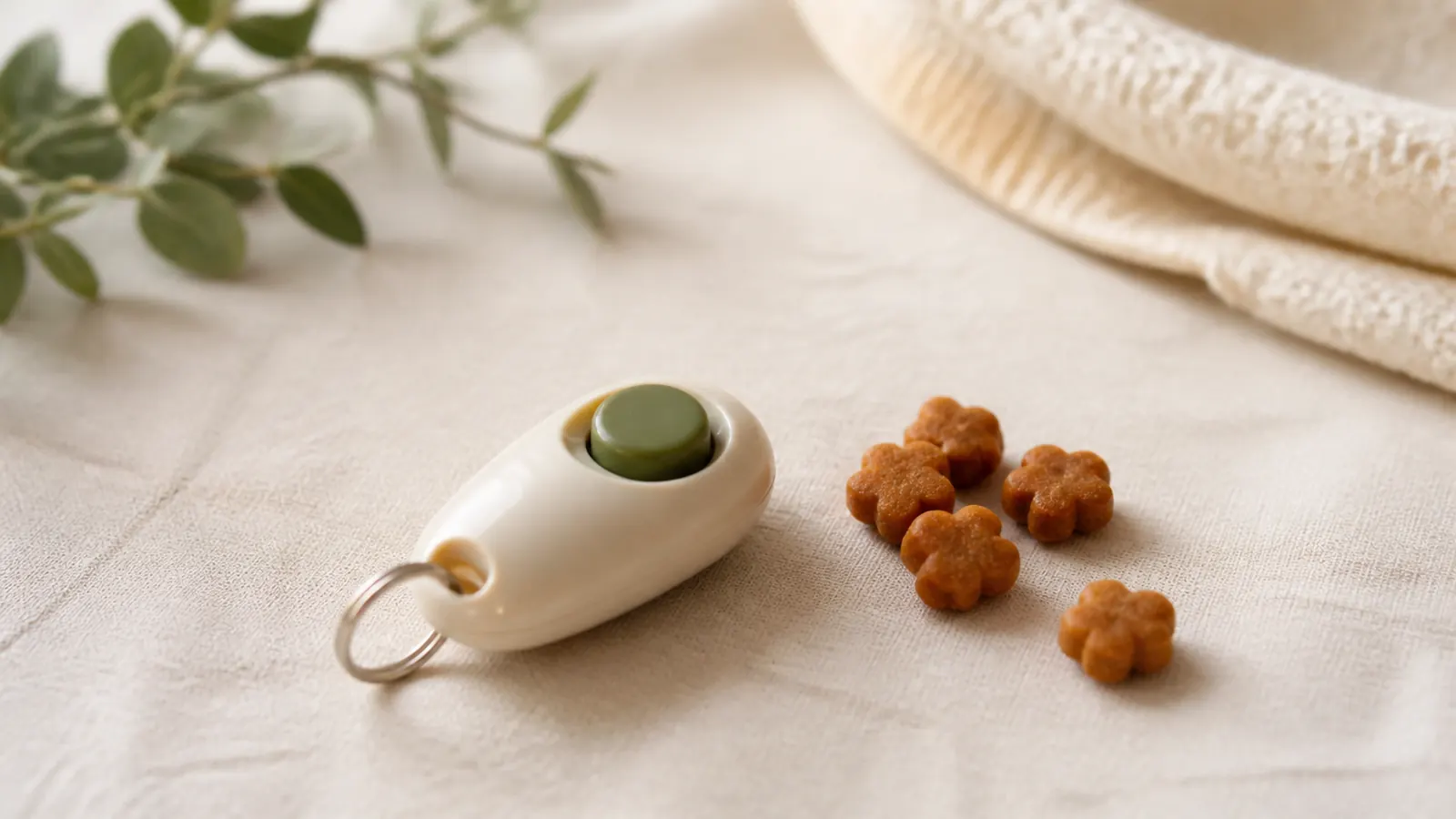
A clicker is a small plastic box that makes a sharp, identical sound every time.
That consistency is the whole point: the sound becomes a marker that tells the cat exactly which moment earned the food.
Why a marker beats praise
A marker identifies the moment that earned a reward, even when the treat arrives a little later. A clicker provides a short, consistent signal that is unlikely to occur elsewhere.
A distinct word can work too if it is used consistently and followed by a reward. Ordinary praise is less precise because it may be prolonged or used in many other situations.
First teach the association between marker and reward. Then mark a behaviour at the moment it happens.
If you click accidentally, still reward that click and improve the timing on the next repetition.
What to expect from a cat
Cats can learn through the same reinforcement principle used with other animals, but motivation and tolerance vary by individual and moment.
Activity, health, past experience and the reward can change whether the cat participates and how quickly it progresses. A breed label does not predict the result for one animal.
The exchange has to remain worthwhile for the cat at that moment. Use a suitable reward and end the session before attention or comfort declines.
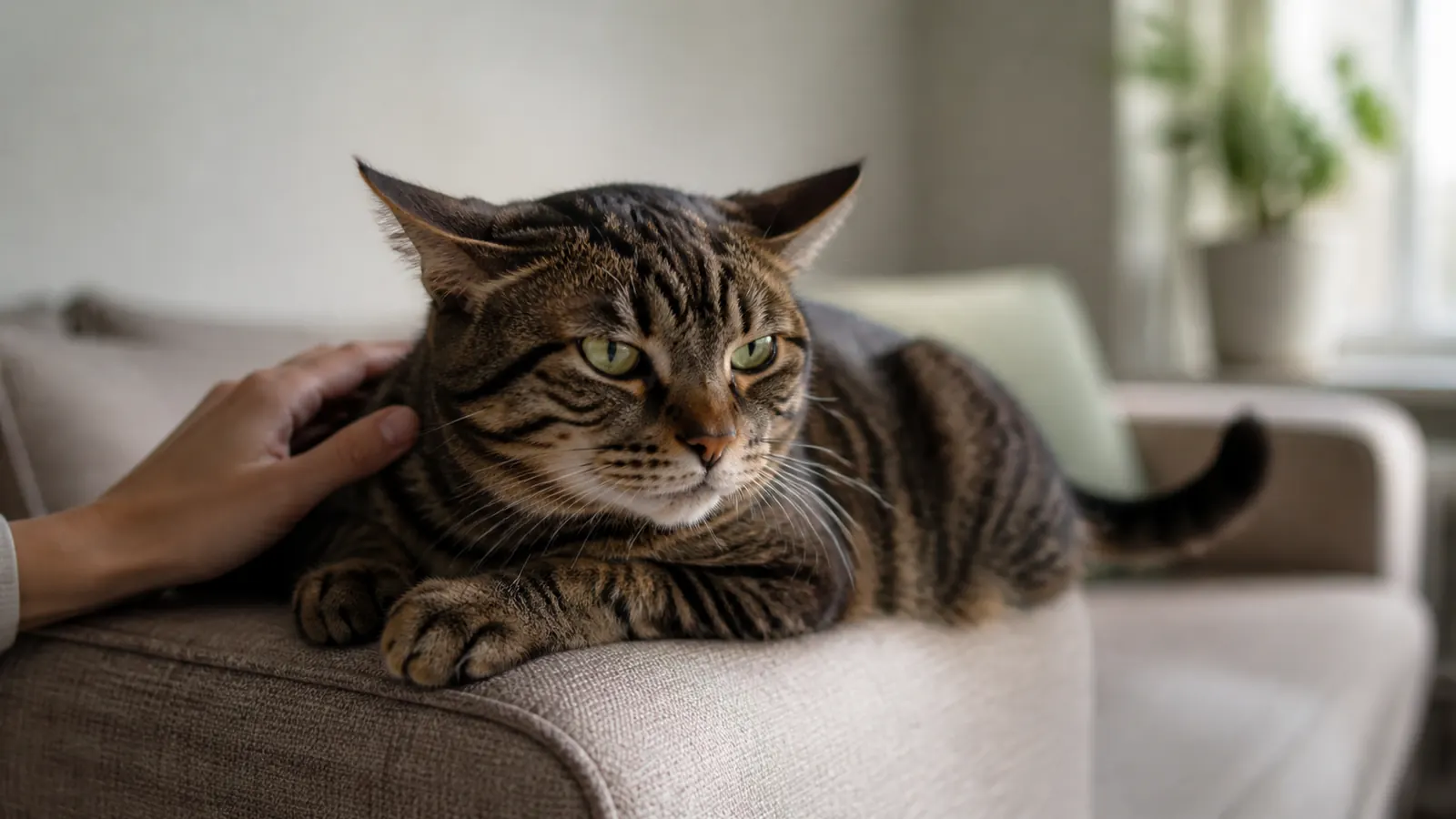
Session length is adaptive. A cat that walks away, freezes, avoids the reward or becomes frustrated has ended the session rather than failed it.
Age is much less of a barrier than people assume. Older cats can learn too.
For reduced hearing, a visible hand signal may suit better than a sound; choose a signal the cat notices without startling.
Charging the clicker
Before it can mark anything, the sound has to mean something.
- Sit with the cat and a small pile of high value treats.
- Click once, then immediately give one treat. Do not wait for any behaviour.
- Repeat only while the cat remains comfortable and interested, then stop.
- Continue in later brief sessions without a required count or deadline.
- The association is forming when the marker reliably prompts an anticipatory response before the reward appears.
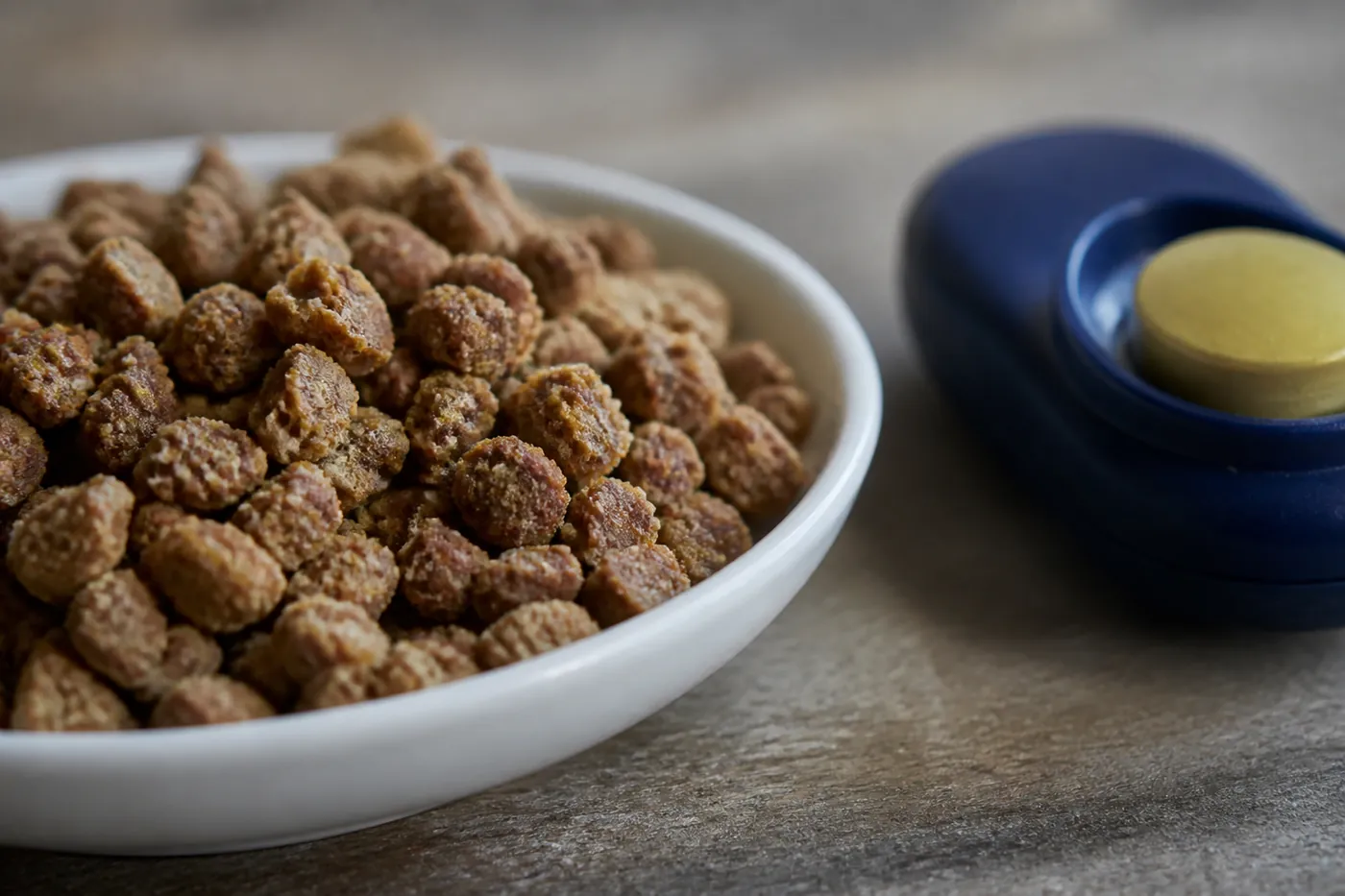
The click has exactly one job, which is marking the instant the cat did the right thing. It can only do that if the sound already predicts food before any training begins.
Reversing the order teaches the opposite lesson. A treat that arrives first makes the click a noise that follows food, rather than a signal that food is on its way.
Choosing the reward
This is where most cat training fails, and it is easy to fix.
The reward has to be worth more than whatever the cat was already doing. Dry kibble from the daily bowl rarely qualifies.
Small pieces of a favourite wet food, a lickable treat, or plain cooked chicken usually do.
Training treats still count towards the day's food, so keep the pieces tiny and take the calories off the meal. How much to feed a cat covers the allowance they come out of.
- Session length
- A few minutes is a starting point; stop earlier if interest or comfort fades
- Sessions per day
- As many brief voluntary sessions as fit the cat's interest and daily ration
- Treat size
- Tiny, so the cat does not fill up
- Best timing
- Before a meal, when the cat is interested
- Stop when
- The cat is still engaged, never after it wanders off
Marking a first behaviour
Start with something the cat already does, so you are capturing rather than teaching.
Hold out a finger or a target stick. Most cats will investigate and touch it with their nose.
Click at the exact moment the nose makes contact, then treat.
Repeat a few times, then end the session while it is going well.
Capturing works because the cat is not being asked to solve anything. A nose touch to an offered finger is investigation, so the behaviour arrives for free and the only new thing is the consequence.
That order matters more than it sounds. A cat that has learned what the click means will offer behaviours to find out what earns it, and a cat that has not is simply being interrupted by a noise.
Timing shapes what is reinforced. Mark the nose contact itself; a later marker may reinforce the movement that followed instead.
Sessions stay short because voluntary attention is the limiting resource. Stop while the cat still chooses to participate rather than extending work to meet a clock.
Putting a name on it
A behaviour the cat offers reliably can be given a cue, and the order matters more than the word.
Wait until the cat performs the behaviour readily, then start saying the word just before it happens, while it is already about to. The cat learns that the word predicts the opportunity.
Saying the cue before the behaviour is reliable teaches the cat to ignore it, because the word will often be followed by nothing.
Once the cue is attached, stop rewarding the behaviour when it is offered without being asked for, and keep paying it when it follows the cue.
Building the behaviours that actually help
Tricks are fine, and the practical value is in husbandry: the handling that makes veterinary care and grooming calmer.
The word husbandry covers everything done to a cat rather than with it. Carriers, nail trims, tablets, ear drops and being lifted onto a table are all things the cat has no reason to accept and every reason to resist.
Training can change what those events predict. Repeated voluntary carrier entry followed by a valued reward may build a safer association than forcing entry only for veterinary trips.
The pattern in every row below is the same and it is worth naming. Each behaviour is broken into a version so small the cat cannot fail, and the criterion moves only once the easy version is reliable.
Coming when called is the one worth building even in a household that wants nothing else. A cat that reliably comes can be found in an emergency, counted after a door has been left open, and brought in before dark without a search.
| Goal | Build it by |
|---|---|
| Entering the carrier | Reward looking, approaching, entry and short comfortable stays in small steps |
| Accepting nail trims | Click for a paw touch, then for holding the paw, then for one nail |
| Coming when called | Begin by rewarding a turn towards you, then build towards coming all the way |
| Standing for a check | Click for staying still while you touch ears, mouth, and sides |
| Going to a mat | Click for stepping on it, then for settling on it |
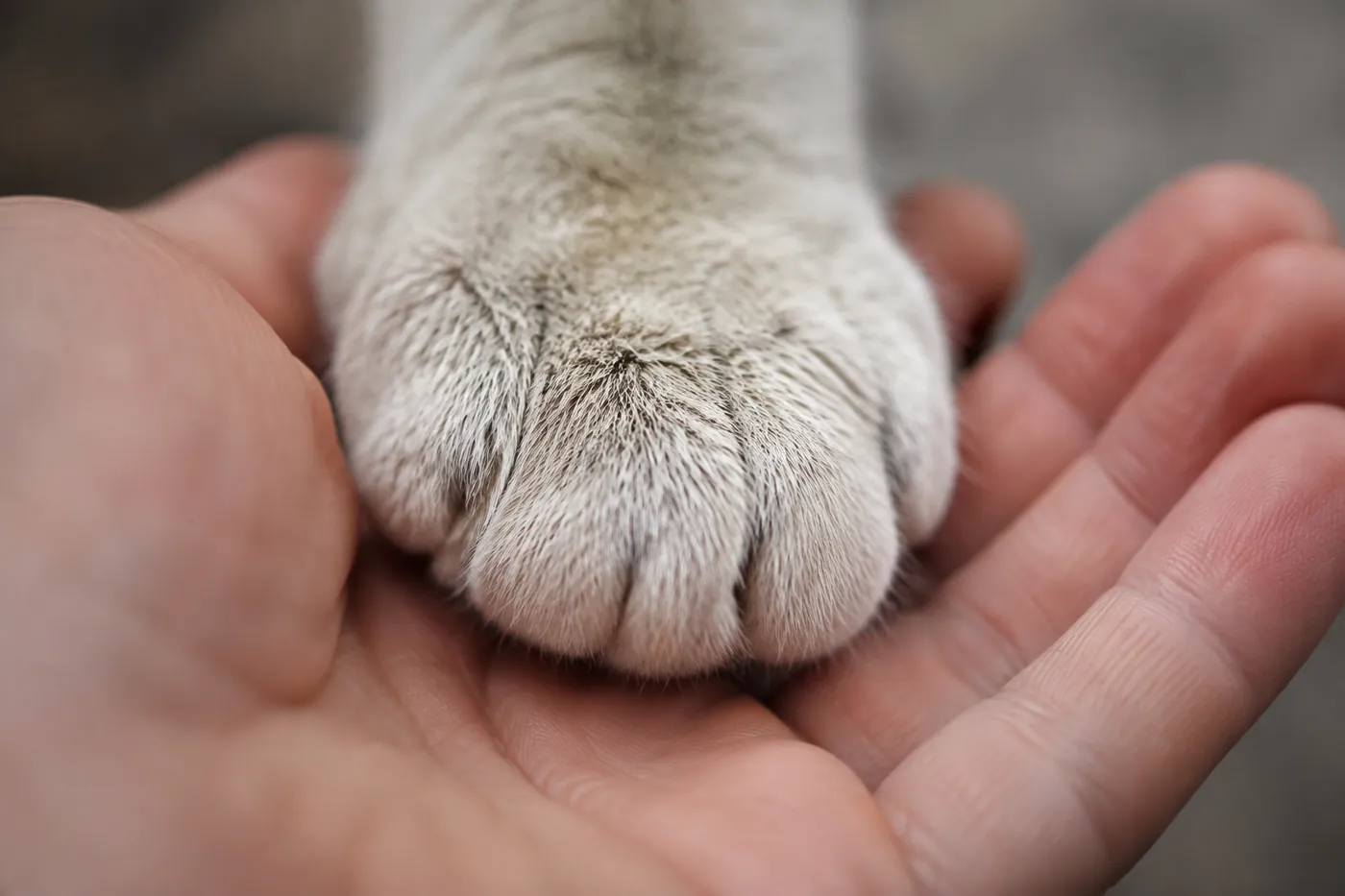
Each of these is built the same way: reward a small step, then ask for slightly more.
If the cat stops responding, the step was too big. Go back to the previous one rather than repeating the failed attempt.
Training in a household with more than one cat
Cats crowd a training session, and the one that learns fastest will take the others' turns.
Work with one cat in a closed room while the others are fed or occupied elsewhere. Trying to train two at once teaches both of them to compete for the treat rather than to offer the behaviour.
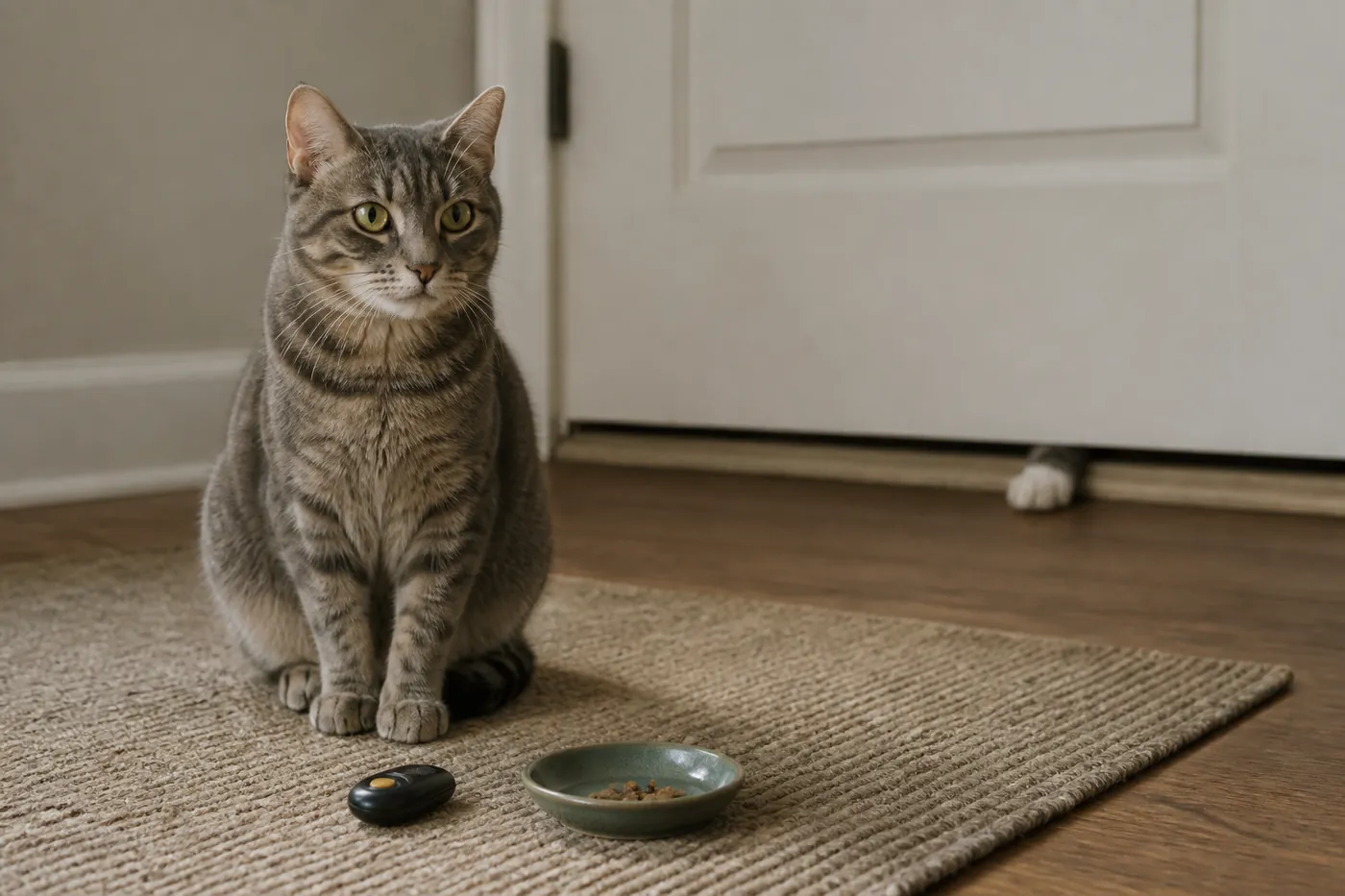
A session is a resource like any other, so in a house where two cats are already fighting it is worth fixing the competition before adding another thing to contest.
A mat for each cat is a useful second step once each has learned to settle on one alone, because it gives every cat a place to be that earns something.
When it is not working
Stalled sessions almost always come down to one of four things, and each has a fix.
The reward may not be appealing at that moment. Try a different suitable reward or another time, without withholding normal meals.
Check for stress or illness if interest has changed.
The reward is not good enough. Some cats work for part of their normal food; others prefer a different suitable reward.
The step was too big. A cat that offered a behaviour twice and then stopped was asked for more than it had learned, and the answer is to go back rather than to wait.
The session ran too long. Cats disengage sharply rather than gradually, so a session should end while the cat still looks interested.
- Low food interest
- Try another suitable reward or time without delaying a normal meal
- Reward too weak
- Try a reward this cat values, including normal food if it works
- Step too big
- The cat offered it twice then stopped. Go back a step rather than wait
- Session too long
- Cats disengage sharply. Stop while the cat still looks interested
- Swiping at the hand
- Fed too slowly or from fingers too close. Drop it or use a flat palm
A cat that swipes or bites at the treat hand is usually being fed too slowly or from fingers that are too close. Drop the treat on the floor or offer it from a flat palm instead.
Fading the clicker
Once a behaviour is reliable, you can reserve the clicker for new learning and reward the familiar behaviour in other ways. Reduce food rewards gradually if appropriate and watch whether the response remains comfortable and willing.
There is no need to stop rewarding useful care behaviours such as carrier entry. Rewarding every time does not inherently make a behaviour fragile.
Whenever you do click, continue to follow it with a reward.
Harness and lead training
A harness gives an indoor cat access to the outside safely, and it is the longest project on this list.
A harness is not identification. A cat that slips one outdoors is an indoor cat loose in unfamiliar territory, so the collar and microchip question is worth settling before the first walk rather than after it.
Introduce the harness in small steps: investigation, brief contact, one fastening and comfortable indoor wear. Progress may take days or longer, and some cats never become comfortable enough for outdoor use.
Freezing, rolling, struggling or attempts to escape may mean the harness is too much at that stage. Remove it safely, return to an easier step and do not reward immobility as if it proves comfort.
Build calm indoor movement with the lead attached and supervised before any door is opened. If the cat remains comfortable, choose a quiet secure first outing and keep an immediate route back indoors.
- Leave the harness out where the cat can investigate it, and click for any interest in it.
- Click for it being draped over the back, with nothing fastened, over several sessions.
- Fasten one strap briefly, mark comfortable participation, reward and remove it before tension rises.
- Build comfortable indoor wearing with the lead held loosely under supervision so it cannot snag.
- Only then open a door, somewhere quiet the cat already knows through a window.
A harness is not a lead in the sense a dog owner means. The cat chooses the direction and the lead exists to stop it leaving, and any attempt to steer usually ends the walk.
A marker word instead of a clicker
The clicker is a convenience rather than a requirement, and there are cases where something else works better.
A short marker word such as yes, said the same way every time, does the same job. Choose a word and delivery you can keep consistent.
For reduced hearing, use a clear hand signal in the cat's line of sight and pair it with the reward. Avoid shining a light into its eyes.
A tongue click is the quiet option for a cat startled by the plastic clicker, and it is useful in a household where a sharp noise disturbs other animals.
| Marker | When it is the right one |
|---|---|
| A clicker | The default, because a device is the easiest thing to keep identical |
| A short word such as yes | Always with you, less precise because a voice varies |
| A visible hand signal | A cat with reduced hearing, paired with reward |
| A tongue click | A cat startled by the plastic, or a household with other animals |
Whatever the marker, the rules do not change. It happens at the instant of the behaviour, it is always followed by a reward, and it is never used to get the cat's attention.
Common mistakes
Nearly every one of these is a timing problem wearing a different coat, because the click is doing one job and one job only.
The click marks a moment. It tells the cat which fraction of a second earned the food, and its whole value comes from being precise about that.
Clicking twice destroys the precision. The cat now has two moments to choose between and no way to tell which one you meant, so the next repetition is a guess.
Clicking late marks the wrong behaviour entirely. A cat that sits, then looks away, then hears the click has been told that looking away is the thing, and it will offer that next time.
Using the clicker to call the cat breaks the association in a subtler way. The sound then predicts food regardless of what the cat did, which turns a marker into a dinner bell and removes the information from it.
Appetite is the currency the whole system runs on, so a cat that has just eaten has nothing to spend. A session before a normal meal may help, but do not withhold food to make the cat comply.
Length is the last of them and the easiest to get wrong. A session that runs until the cat leaves ends on the cat's decision to disengage, and that is the note it starts from tomorrow.
- Clicking more than once for one behaviour
- Clicking late, after the moment has passed
- Using the clicker to call the cat, rather than to mark
- Training a cat that has just eaten and has no interest in food
- Sessions that run until the cat walks away
If a cat is frightened of the sound, muffle the clicker in a pocket or use a quiet tongue click instead.
Common Questions
Can any cat be clicker trained?
Most cats can, including older ones. What varies is how food-motivated the cat is, which changes the reward you need rather than whether it will work.
How long before I see progress?
There is no fixed timetable. Start by pairing the marker with a reward, then reinforce an easy behaviour in brief sessions. Move on when the cat responds comfortably and reliably, rather than after a set number of days.
Do I need an actual clicker?
No. Any consistent, distinct sound works, including a tongue click or a retractable pen. The consistency matters more than the device.
What if my cat is not interested in treats?
Try a small reward the cat values, including normal food if that works, or suitable play. Do not withhold meals to force participation. Check for stress or illness if food interest has changed.
Checked Against
Published 1 September 2026. Last updated .