
What Is a Cornish Rex, and Why Does It Need Warmth and Company?
Every Cornish Rex descends from one farm kitten born in Cornwall in 1950. The coat that draws buyers in is the cheapest thing about the breed, and the demands that follow are attention and warmth.
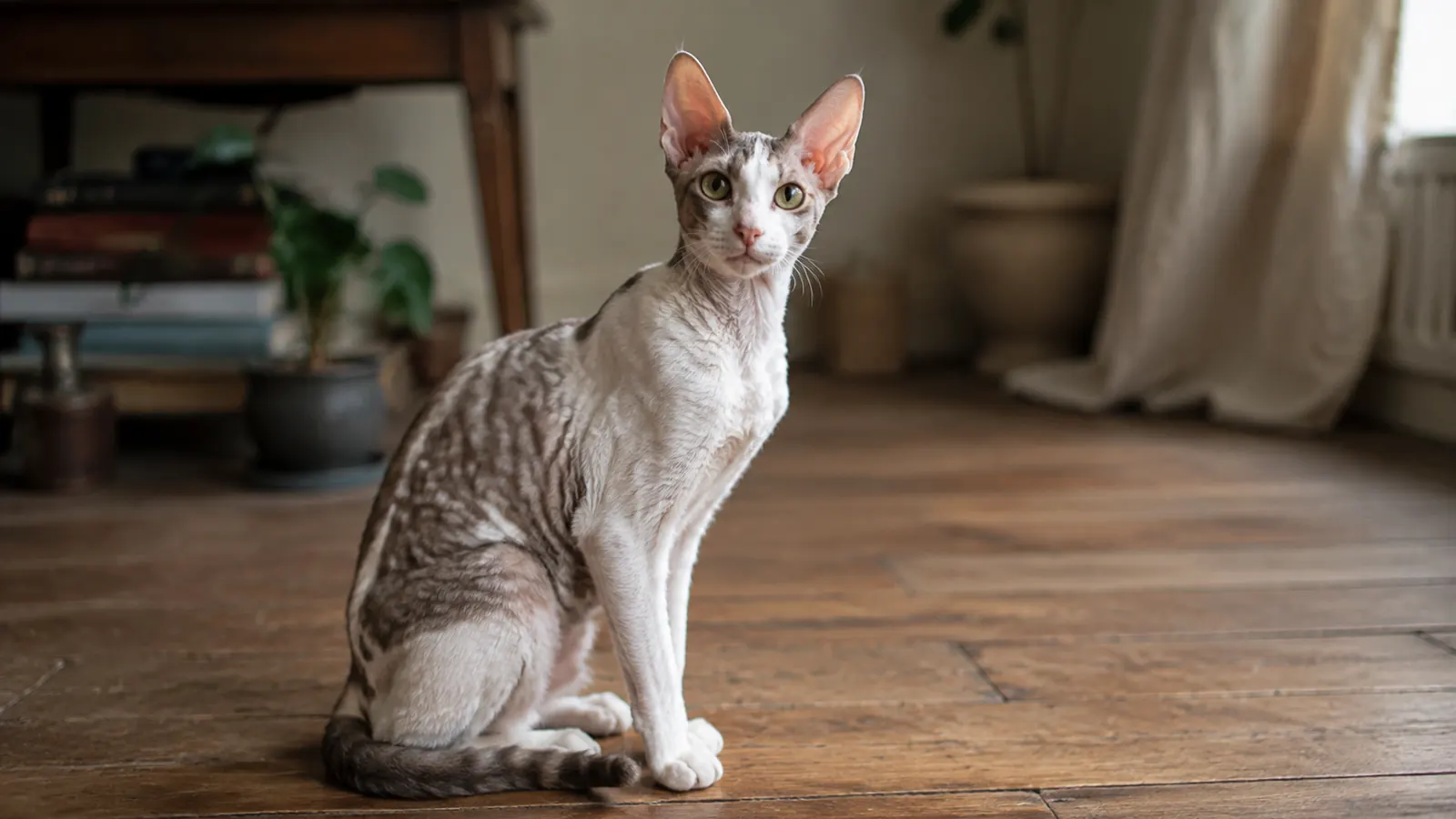
- Origin
- One curly kitten, Kallibunker, born on Bodmin Moor in Cornwall on 21 July 1950
- Coat
- Short and close lying in tight marcel waves, with no guard hairs at all
- Size
- Small to medium, arched back and long slender legs. Reads bigger than it weighs
- Typical weight
- 5 to 10 pounds, with males at 8 to 10 and females at 5 to 7
- Life expectancy
- No breed figure measured. UK life tables give 11.74 years for cats overall
- Activity level
- High and sustained. Invents its own games, and stays playful into old age
- Grooming
- Minimal. Hand grooming is normally sufficient, and brushing can flatten the waves
- Suits
- Warm homes rarely left empty. Ask what the line was outcrossed to, and for blood types
A Cornish Rex is a small, fine-boned cat with a short wavy coat, and every one descends from a single farm kitten born in Cornwall in 1950. The coat costs almost nothing to maintain, and what the cat asks for instead is attention and warmth, a different trade from the one most buyers think they are making.
What does living with a Cornish Rex actually demand?
The coat is the cheapest part of the breed. GCCF describes a cat that is extremely active and energetic, that invents lively games when left without companions, and that stays playful well into old age rather than settling down at three.
Most breeds hand you a quieter animal after the kitten year, and this one largely does not.
That play is also the natural way into training. CFA calls the breed extremely intelligent, and its breed writing lists fetch and catch among favourite Cornish Rex games, along with one it calls discus, in which the cat picks up a small object with its paw and tosses it. A cat that already retrieves gives you a behaviour to reward and build on with clicker training, although CFA's word intelligent describes the breed and does not measure how quickly an individual cat learns.
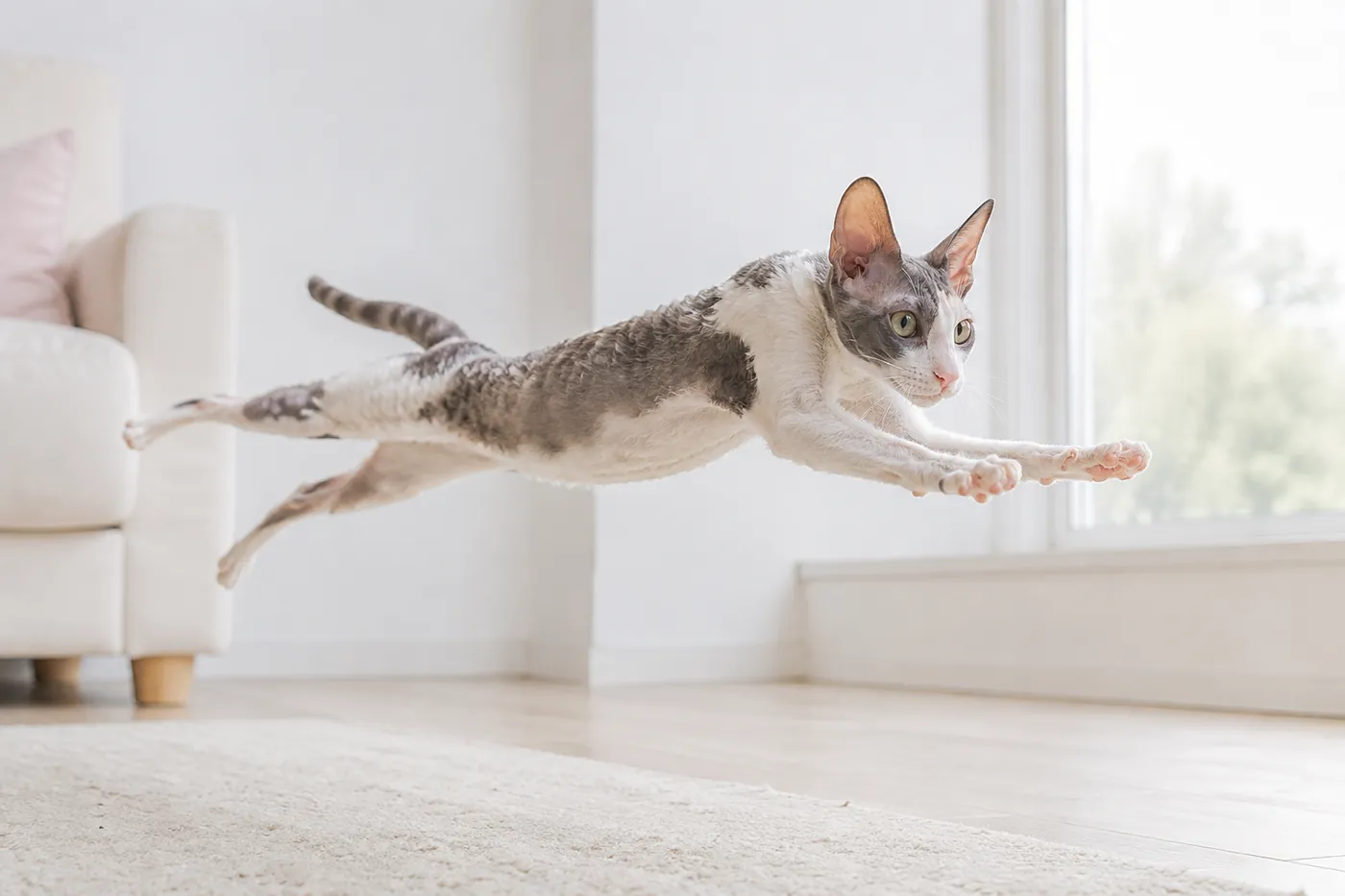
The other half is company. The same description notes dog like habits of following their owners from room to room, which is charming in a house that is usually occupied and a problem in one that is not.
- Activity
- Plan daily interactive play, climbing and changing tasks
- Company
- Allow shared time and assess the individual during absences
- Warmth
- Offer a comfortable bed and protection from cold rain
- Coat care
- Gentle handling usually covers the light coat workload
Taken together, you are buying a cat that wants your time and your thermostat, and giving up almost all of the grooming work in exchange.
Where did the Cornish Rex come from?
Every Cornish Rex alive descends from a single kitten born in a litter of farm cats in Cornwall in 1950, which is a far shorter history than most pedigree breeds can claim.
The kitten was a curly coated cream male, later named Kallibunker. GCCF dates the moment precisely, to Bodmin Moor on 21 July 1950.
Nina Ennismore, who owned the farm, had bred Rex rabbits and recognised the coat for what it was. She named the breed after them.
Fixing the coat meant breeding Kallibunker back to his own mother, because his mother could carry the same recessive variant. That mating produced two more curly kittens, so the trait was shown to be heritable.
- 1950Kallibunker is born on Bodmin Moor, the only source the breed has
- Early 1950sBred back to his mother, which fixes the curly coat and proves it heritable
- 1959 to 1960The long hair gene enters the breed by accident and has never left
- 1962Accepted for CFA registration in the United States
- 1964Reaches CFA Championship status, closing the founding period
The long hair gene arrived accidentally in 1959 or 1960 and is still in the breed, which is why the club now asks breeders not to breed from long coated cats or variants.
Fourteen years from one barn kitten to championship status is fast. It is also why the breed's health question is about a gene pool rather than about a disease.
Why do the Cornish Rex and the Devon Rex never mix?
Two curly breeds came out of the West Country within a decade of each other, and for a while everyone assumed the same accident had simply happened twice.
Breeders tested it the only way available at the time. Kirlee, the original Devon Rex, was bred to female descendants of Kallibunker, and the kittens came out straight coated.
That result meant two different genes rather than one. Modern sequencing named them: the Cornish curl is a four base pair deletion in LPAR6, while the Devon curl sits in KRT71, a different gene acting at a different point in the hair follicle. No such test cross has been published for the Tennessee Rex, a recessive curl with a satin sheen found near Chattanooga in 2004, so its standing as a separate gene still rests on its founder's breeding records and the look of the coat.
| Cornish Rex | Devon Rex | |
|---|---|---|
| Gene | LPAR6, a four base pair deletion | KRT71 |
| Coat | Short, close lying, tight even waves | Shorter, softer, sparser and more fragile |
| A cross between them | Straight coated kittens, which is how the difference was found | The same result from the other direction |
| Registry status of a cross | Reference Register only, and barred from both breeding programmes | Reference Register only |
GCCF now puts it flatly. Cornish Rex are not compatible with Devon Rex, such matings are highly undesirable, and the resulting cats cannot be used in either breeding programme.
One historical footnote survives in the paperwork. Some Cornish Rex pedigrees still carry Devon Rex ancestry from those first experimental crosses, which is legal history rather than a current practice.
The German Rex is a third distinct curly breed. It can share an LPAR6 basis with the Cornish Rex, while its registry history and rounder, more conventional body remain separate.
What does a coat with no guard hairs mean day to day?
Run a hand down the back and the coat is the first surprise.
Most cats carry three hair types, and the coarse outer guard hairs are what you feel first. CFA describes the Cornish Rex coat as short, close lying and covered with tight marcel waves, and as completely lacking in guard hairs.
What reaches your hand is the softer undercoat, arranged in waves you can see in ordinary daylight.
- Wave pattern
- Tight marcel waves, even and defined along the back and flanks
- Guard hairs
- None at all, which is what makes the coat feel unlike any other cat
- Judging weight
- 40 points of the CFA standard, more than any other single feature
- Grooming
- Hand grooming is normally sufficient, with a soft brush or fine comb only if needed
- Rain
- The coat saturates quickly, so outdoor access needs shelter
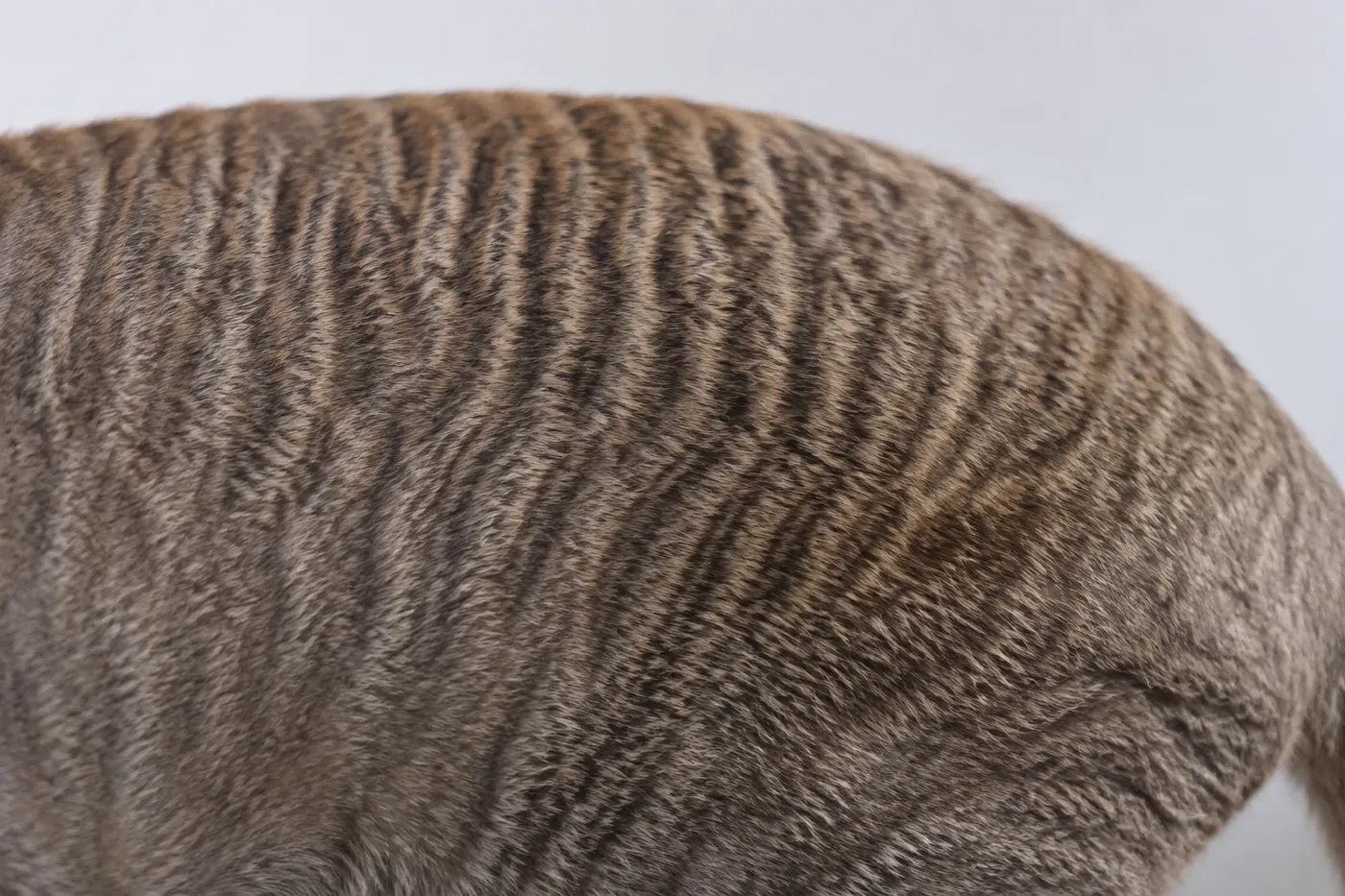
The practical consequences run in two directions. Grooming drops to almost nothing, and GCCF says hand grooming is normally sufficient to keep the coat in condition.
Weather becomes the thing to think about instead. The same source warns that a Cornish Rex should not be left out in the rain without shelter, because a coat with no guard hairs saturates fast.
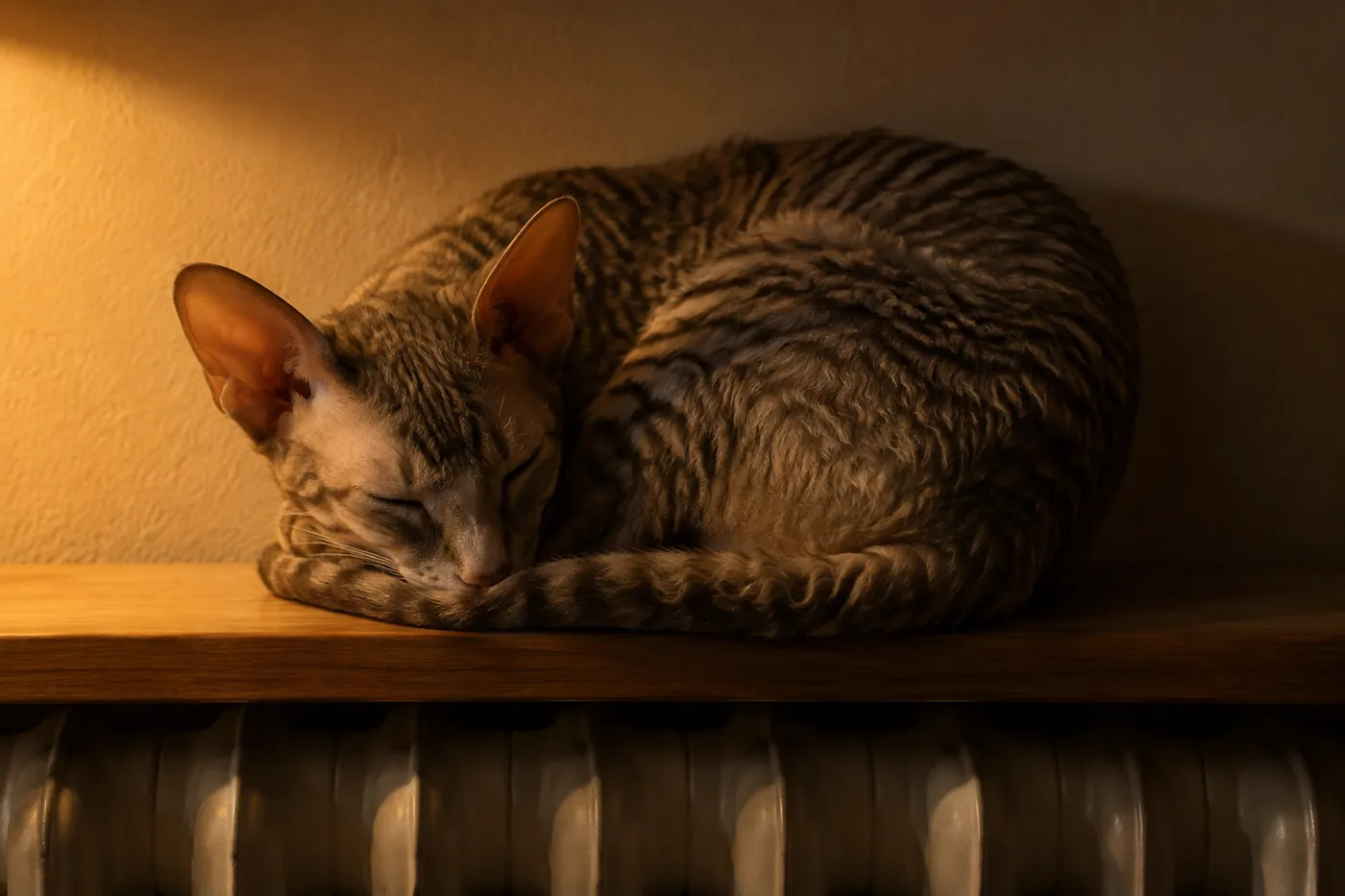
Indoors this shows up as heat seeking. The cat will find the radiator, the laptop, or you, and it is not being affectionate about it so much as thermally sensible.
Is a Cornish Rex hypoallergenic?
No cat is hypoallergenic, and the missing guard hairs do not change the answer. The major cat allergen, Fel d 1, is produced in saliva and skin glands rather than in the hair itself.
A Cornish Rex still has a full coat, still sheds it, and still spreads saliva across itself every time it grooms.
The cited sources do not establish reliably low allergen production in Cornish Rex cats either, and because individual exposure varies, one cat cannot certify the breed as allergy-safe.
That is a slower route than reading a list of allergy friendly breeds. It is also the only one that answers the question you are actually asking.
How big does a Cornish Rex actually get?
Males reach 8 to 10 pounds and females 5 to 7, which puts the breed at the small end of ordinary.
The build argues otherwise. CFA asks for an arched back, very long slender legs, a long slender neck, and bone described as fine and delicate.
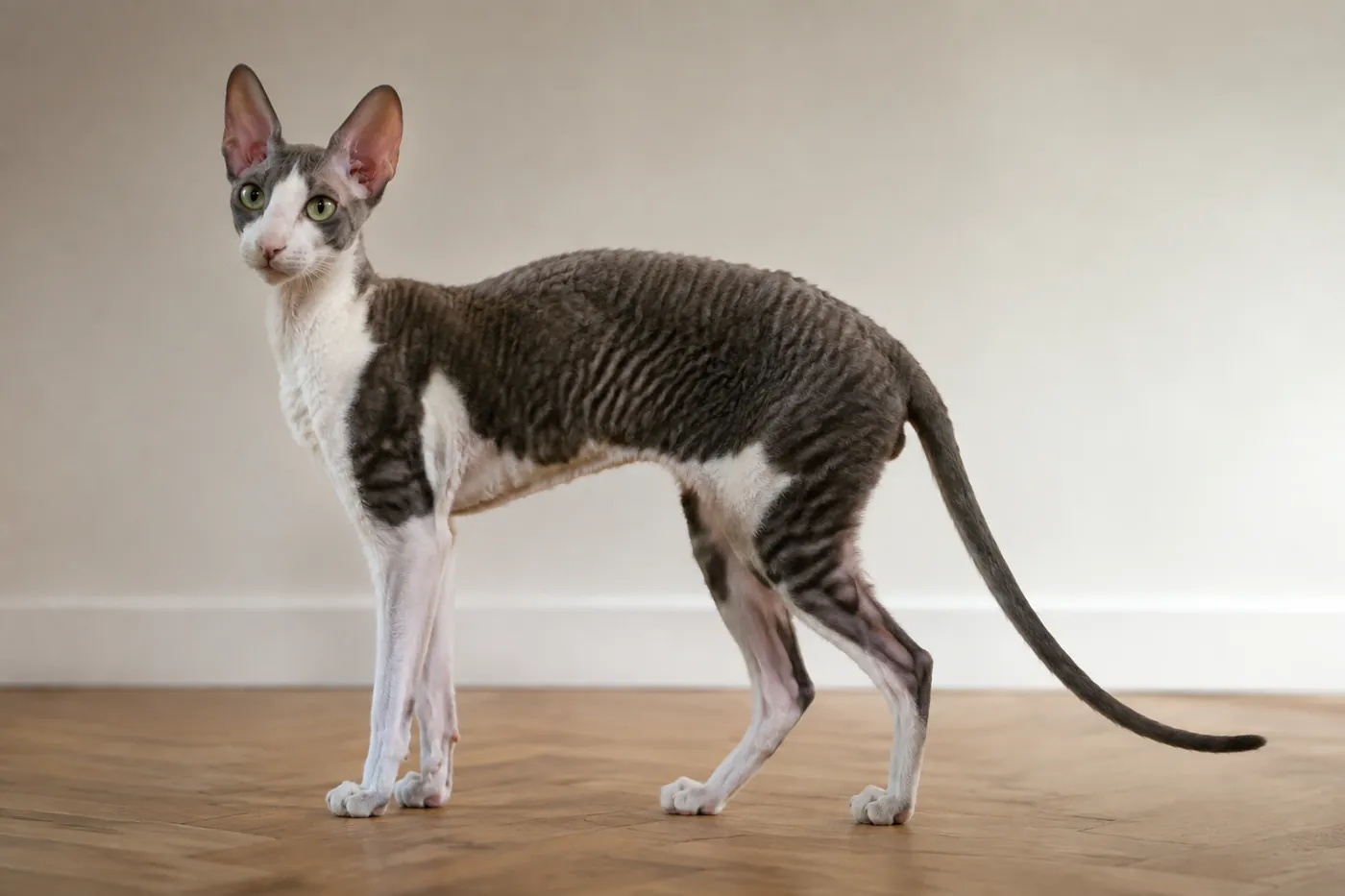
Put together, that reads as a bigger, more delicate animal than the scales support. The head compounds it, being comparatively small and egg shaped with large full ears set high.
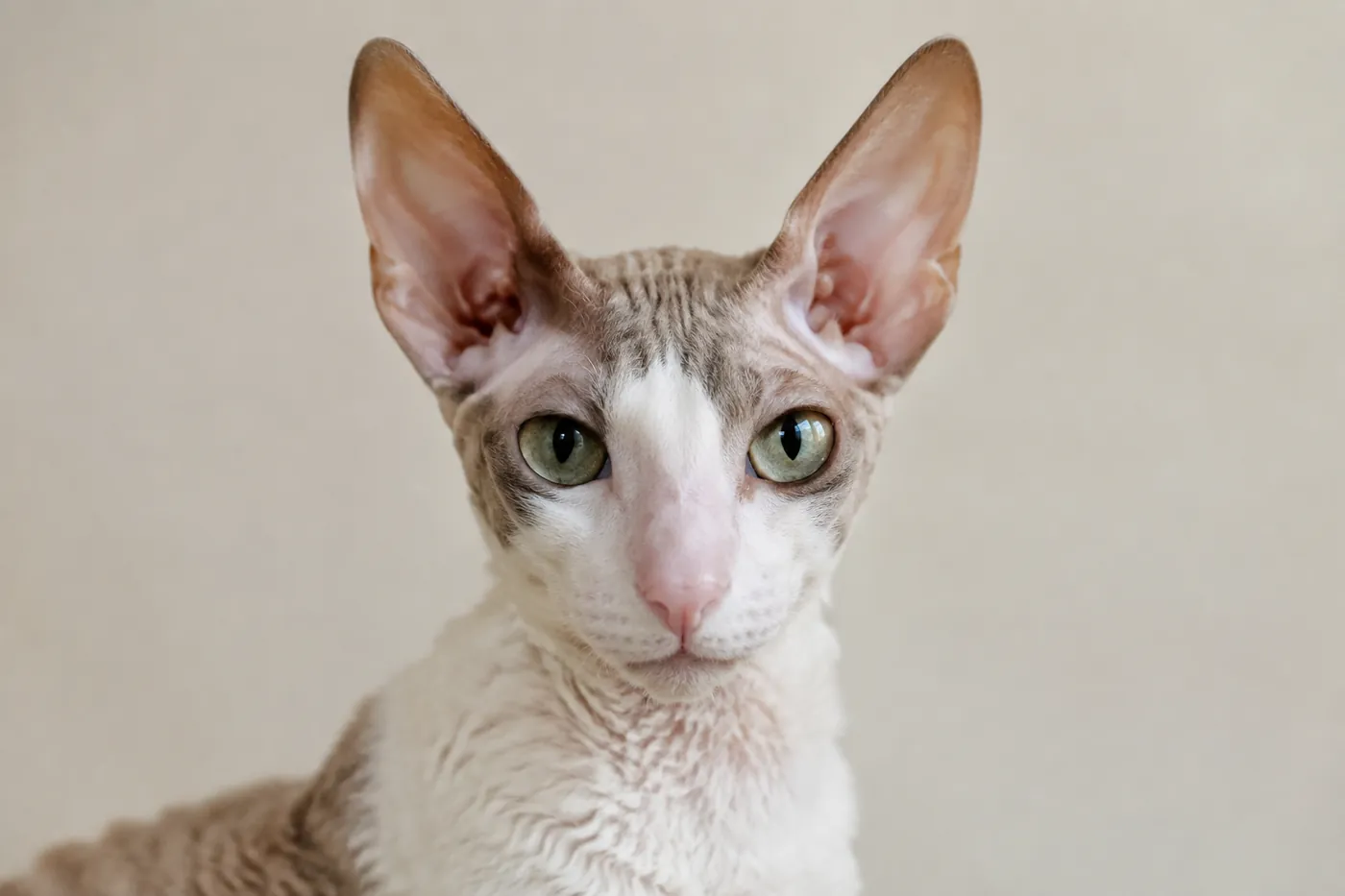
Neither impression is right, because the outline and the scales are measuring different things. It is a small cat and a well muscled one, so people who pick it up expecting something breakable are the ones most surprised.
What does variant mean on a Cornish Rex pedigree?
Sooner or later a Cornish Rex pedigree shows a cat with a perfectly ordinary straight coat, and buyers meeting that for the first time usually read it as a mistake.
It is deliberate. A Cornish Rex Variant is a straight coated cat registered inside the breed and used deliberately in its breeding programme, because the curl is recessive and the gene pool needs widening.
GCCF approves seven breeds for outcrossing, and the list is worth knowing before you read a pedigree: the Abyssinian, the Asian Shorthair, the British Shorthair, the Burmese, the Oriental, the Russian Blue and the Siamese.
All seven are short coated breeds, from the sturdy British Shorthair to the fine boned Siamese, which matters because the policy separately asks breeders not to perpetuate the long hair gene.
Everything else is non-approved, and two exclusions are absolute. No cat with Devon Rex ancestry may be used in current breeding, and no cat with Sphynx ancestry may ever be introduced at all.
- Look for variants in the recent generations, since they signal deliberate outcrossing
- Check any outcross against the seven approved breeds, since anything else is not permitted
- Treat Devon Rex ancestry as a reason to ask more questions
- Rule out Sphynx ancestry entirely, which the policy forbids
- Ask for the blood type result on both parents, whatever the outcross was
A straight coated kitten from two variants cannot itself be called a variant unless DNA testing proves it carries the gene, so the label means something specific rather than merely describing the coat.
How healthy is a breed that descends from one cat?
Ask the breed club and the reply is structural rather than clinical.
GCCF states plainly that the Cornish Rex, unlike most breeds, owes its origin to one cat, and that the inbreeding used to establish it has continued since. The same document calls regular selective outcrossing vital to increase the gene pool and maintain stamina and health.
That is a breed club describing its own founder problem in writing, which is more candid than most and more useful than a list of conditions. No published prevalence study measures a specific disorder in this breed, so anyone handing you confident percentages is extrapolating from elsewhere.
What the policy does single out is blood typing. Both type A and type B occur in the breed, type A is dominant, and a type A kitten that suckles a type B queen may die within its first days from neonatal isoerythrolysis.
| What to ask the breeder | What the answer tells you |
|---|---|
| What did you outcross to, and when | Whether the programme follows the club's own advice on the gene pool |
| Blood type of both parents | Whether the litter was planned around the one risk the policy names |
| Is there Devon Rex in the line | Historical crosses exist, but the breeds are formally incompatible now |
| Are either parent long hair carriers | The club asks breeders not to perpetuate the 1959 gene |
None of that requires a laboratory report from you, only four questions, and a breeder who answers them easily has told you a great deal about how the litter was planned.
How long do Cornish Rex cats live?
Cats in the UK live 11.74 years on average, measured from almost 8,000 recorded deaths in veterinary practice.
That study reported figures for around a dozen breed groups. The Cornish Rex was not one of them, because the breed is not numerous enough in the general cat population to measure.
The all-cat estimate describes that study population. It is not a Cornish Rex prediction, and budgeting should allow for a cat living well beyond an average.
One borrowed comparison is worth blocking directly. The Sphynx recorded the shortest figure in that study at 6.68 years, and readers who group the unusual coated breeds together sometimes carry that number across. The figure does not transfer, because the Cornish Rex is a fully coated breed, unrelated to the Sphynx, and the club forbids introducing Sphynx ancestry precisely because the two are not the same project.
Is a Cornish Rex the right cat for your household?
The decision comes down to heat and company.
Abyssinian and Cornish Rex cats both need serious play, but the Abyssinian directs more of that energy into height and exploration while the Cornish Rex usually seeks more direct participation. American Shorthair and Cornish Rex cats differ more sharply in social intensity, warmth needs and coat handling.
A house that is warm and usually occupied gets a great deal from this breed. You get a cat that plays into old age, follows you between rooms, communicates without shouting, and asks for essentially no grooming.
A house that is empty all day and cool gets a different animal entirely. The same energy that makes the breed good company becomes inventive boredom, and the same coat that costs nothing to maintain stops being an advantage when the heating is off.
Children and dogs are the easier part of the fit. CFA writes that Cornish Rex antics amuse children and adults alike and that dogs find them ready playmates. The same profile says owning one calls for thoroughly child proofing the house and keeping fragile objects behind closed doors, which here means making the house safe from an active, inventive cat, the way you would for a toddler.
How a Cornish Rex gets on with a resident cat is not described in its breed profiles. A resident cat will be living with a newcomer that CFA calls a Velcro kitty for its need to stay in physical contact with its person, so how that goes depends on the resident cat as much as on the breed.
If both of those land on the right side for you, the remaining work is the paperwork: what the breeder outcrossed to, and the blood types of both parents.
Common Questions
Do Cornish Rex cats feel cold to the touch?
They often feel warm rather than cold, because there is less coat between your hand and the skin. That is a sensation rather than a fever. What is real is the cat's own heat seeking, since a coat without guard hairs insulates less well, which is why they settle on radiators, laptops and people.
Can a Cornish Rex go outdoors?
With shelter, and with more thought than most breeds need. GCCF warns that a Cornish Rex should not be left out in the rain without cover, because the coat saturates quickly without guard hairs to shed water. Cold and wet together are the combination to avoid.
Why does my Cornish Rex kitten have a patchy or straighter coat?
Wave definition changes as a kitten matures, and many go through a thinner or less even stage before the adult coat settles. Ask the breeder what their lines typically do at that age. A coat that stays unusually soft and shaggy is worth asking about separately, since the long hair gene has been in the breed since 1959.
Is the Cornish Rex related to the Sphynx?
No. They are separate breeds from separate mutations, and GCCF states that no cat with Sphynx ancestry should ever be introduced into the Cornish Rex, because selecting for hairlessness contradicts the coat the breed exists for.
Checked Against
- The Cat Fanciers' Association: Cornish Rex breed profile and standard cfa.org
- GCCF: Breeding Policy for Cornish Rex (CRX) gccfcats.org
- Governing Council of the Cat Fancy: Cornish Rex breed information gccfcats.org
- Gandolfi et al., To the Root of the Curl: A Signature of a Recent Selective Sweep Identifies a Mutation That Defines the Cornish Rex Cat Breed, PLOS ONE 2013 journals.plos.org
- Teng et al., Life tables of annual life expectancy and risk factors for mortality in cats in the UK, Journal of Feline Medicine and Surgery 2024 pmc.ncbi.nlm.nih.gov
- The Cat Fanciers' Association: Meet the Cornish Rex cfa.org
Published 5 September 2026. Last updated .





