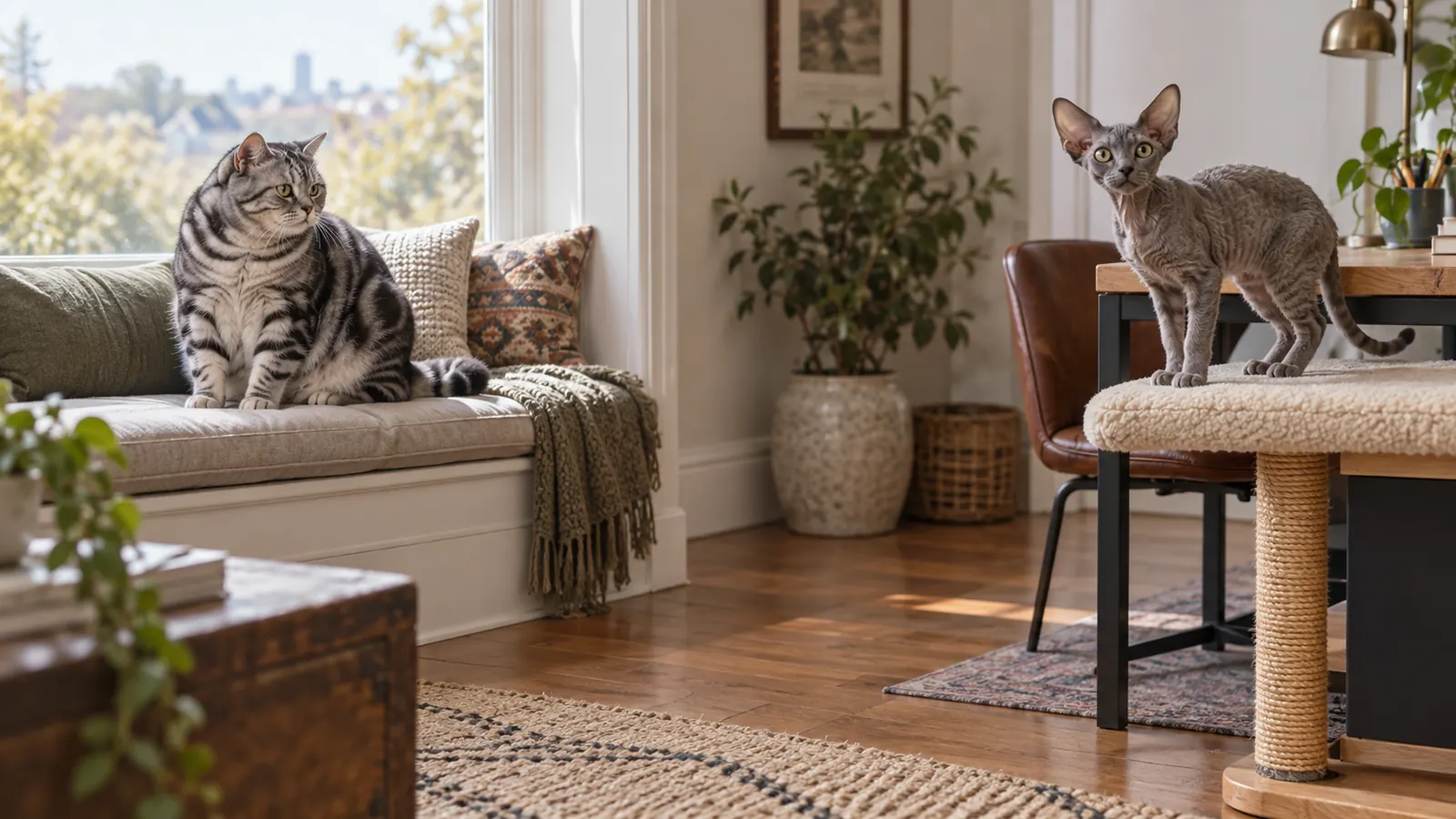
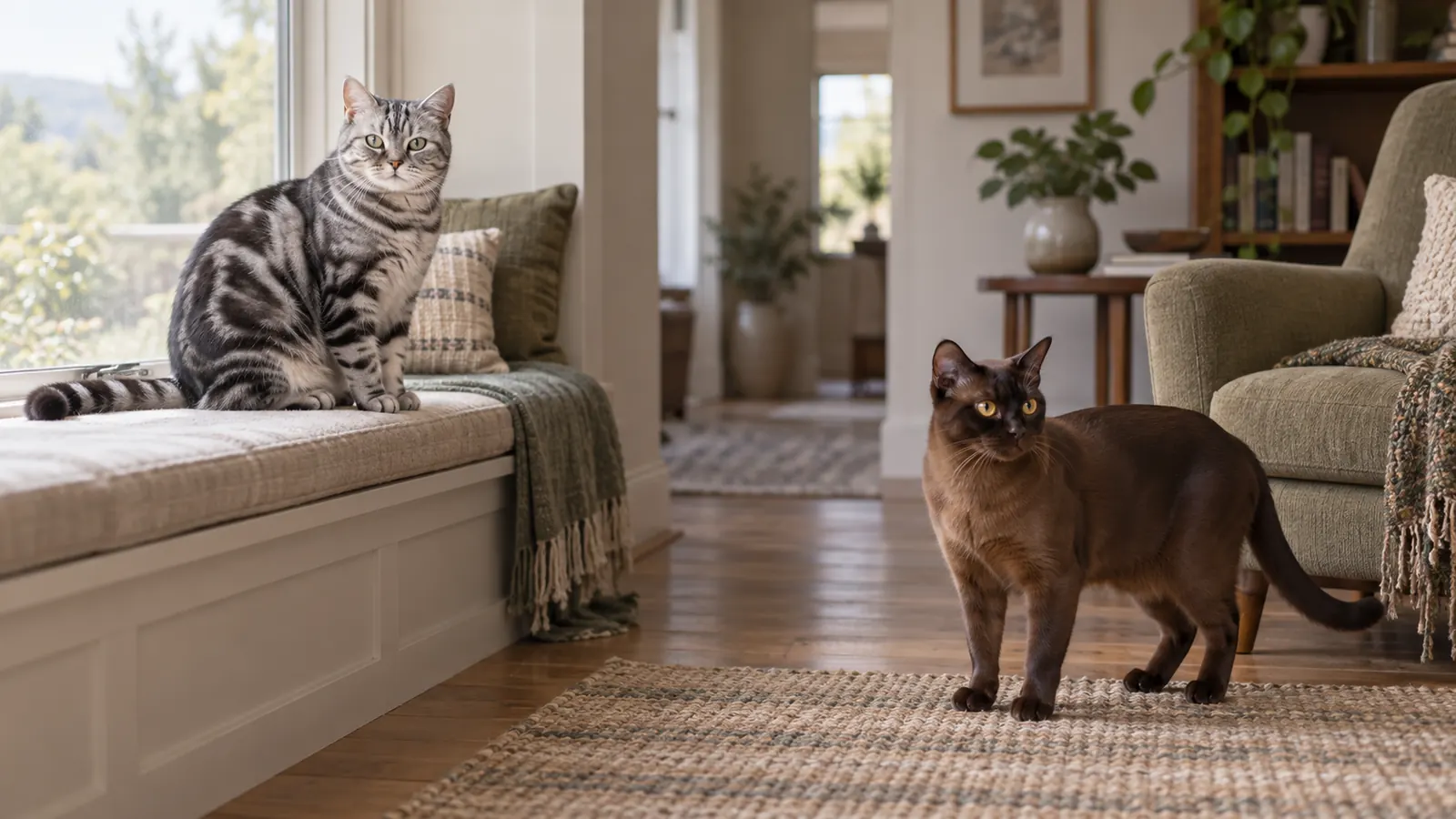
Abyssinian vs Cornish Rex: Which Active Cat Fits Your Home?
An Abyssinian suits a home that wants an athletic explorer and can offer connected height and changing routes. A Cornish Rex suits someone who wants equally serious play in a more people-centred cat and can provide warmth, company and gentle care for a coat with no guard hairs.
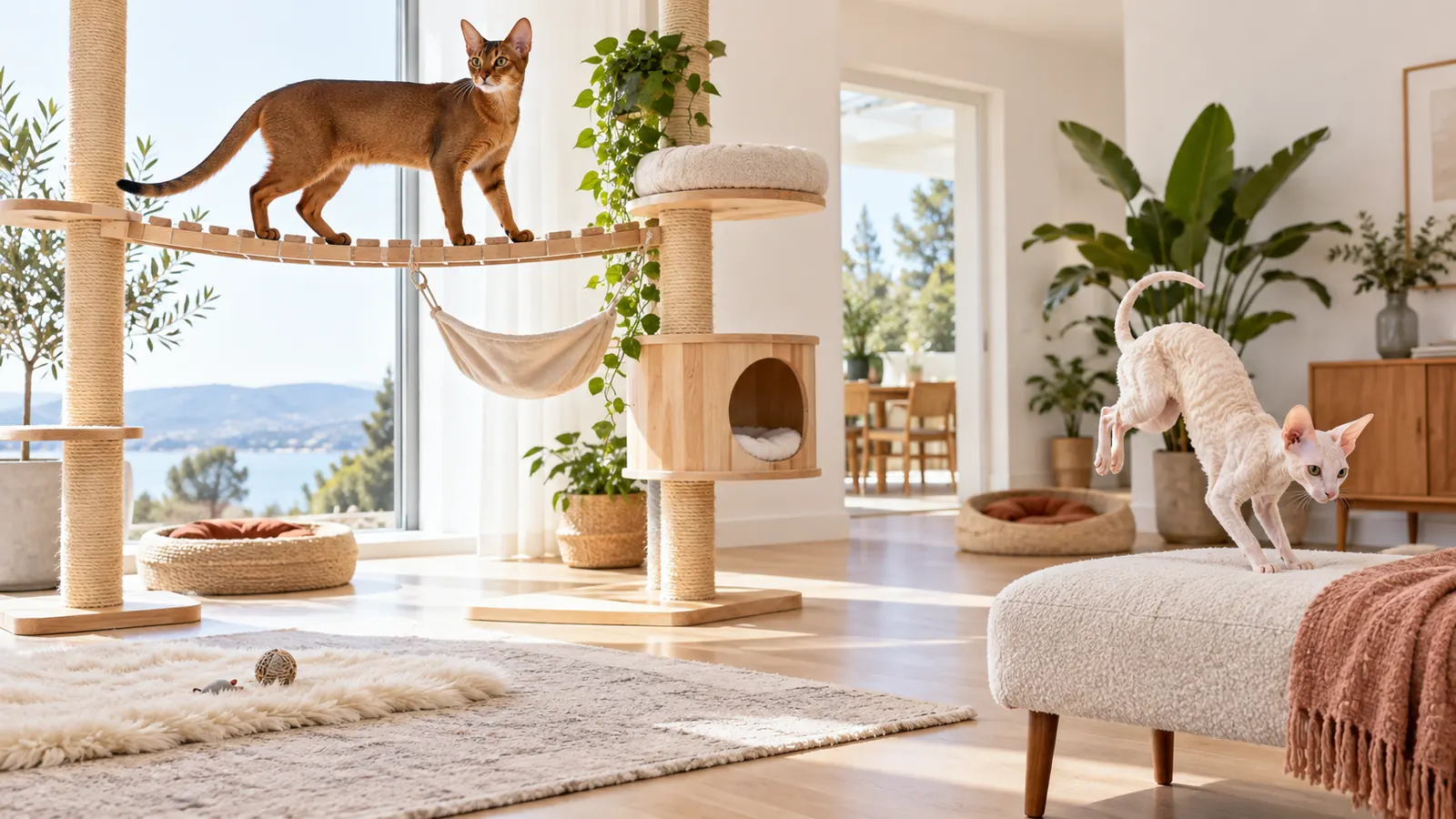
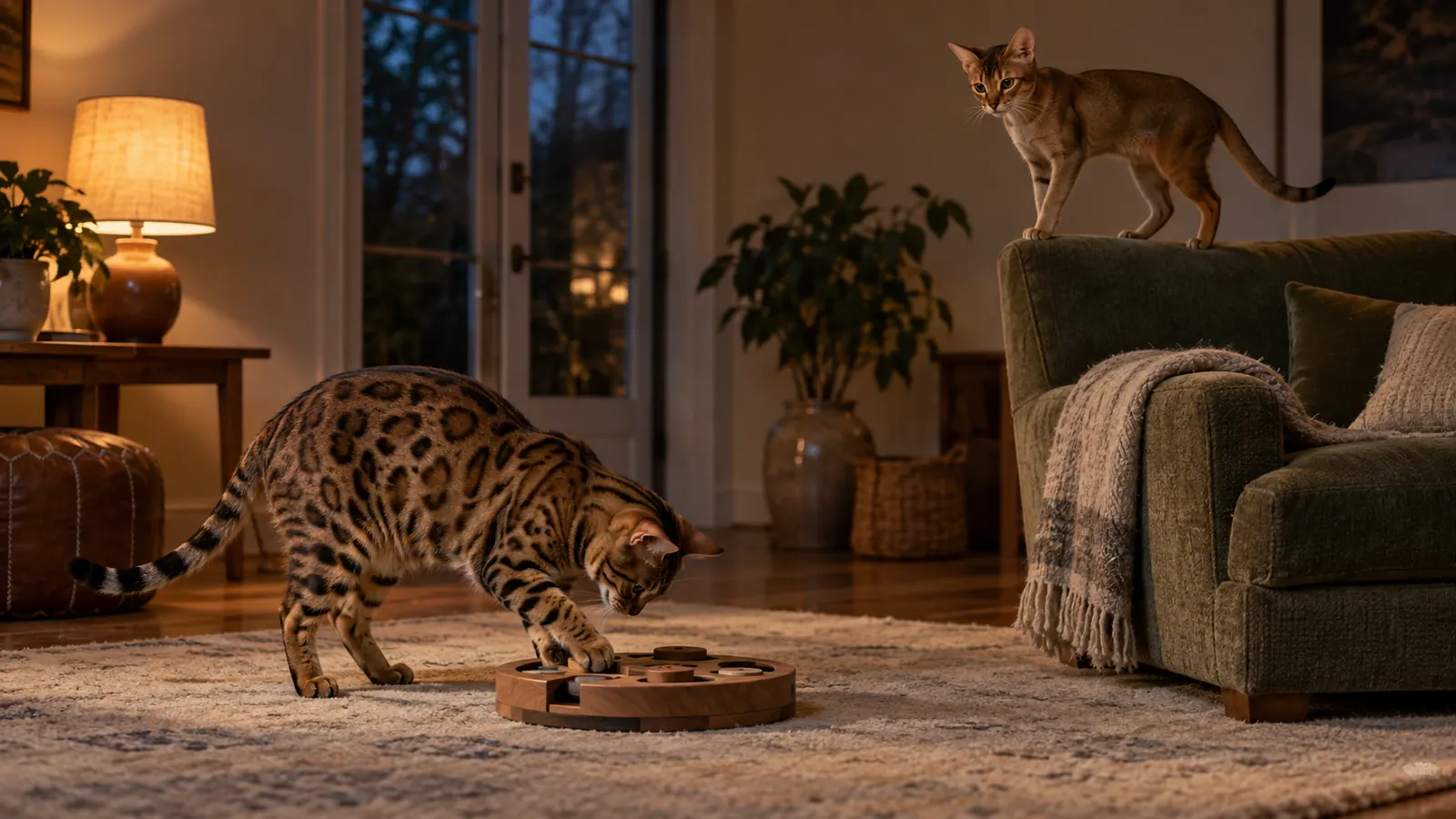
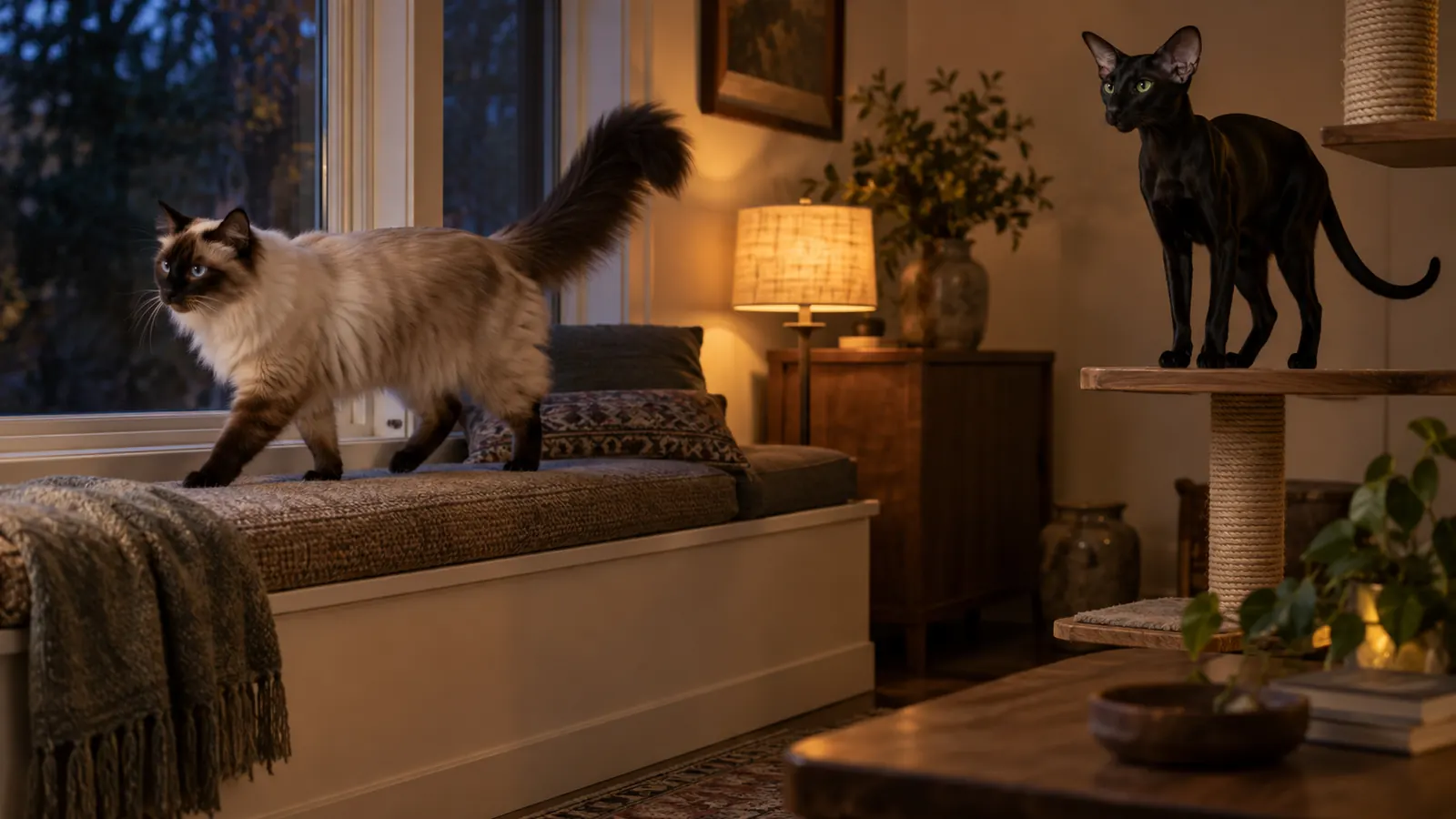
Both breeds are active cats. Each can turn an ordinary room into a course, investigate changes and remain playful well beyond the kitten stage, so the decision is where that energy goes. An Abyssinian commonly maps the room through height and observation, while a Cornish Rex more often folds speed, games and following people into one social routine.
Which breed fits your ordinary week better?
The Abyssinian fits a household that enjoys an independent-minded participant. It tends to stay involved by moving between people, objects and high observation points, so affection often arrives as shared activity rather than a long stay on a lap.
The Cornish Rex fits somebody who wants the play to remain closely connected to people. GCCF describes it as extremely active, energetic and inventive, while CFA emphasises a people-oriented cat that retains kitten-like playfulness. That combination makes a warm, frequently occupied home more important than the tiny grooming workload suggests.
| Profile | Energy direction | Company | Home setup | Best fit |
|---|---|---|---|---|
| Abyssinian | Vertical exploration, object investigation and changing routes | Needs regular interaction but often alternates contact with self-directed inspection | Stable shelves, trees and clear landing zones | A home that enjoys an agile cat using the whole room |
| Cornish Rex | Fast social games, leaps, retrieval and persistent play | Often follows people and can invent disruptive games when company disappears | Warm beds, secure play surfaces and room for speed | A warm, occupied home that wants sustained interactive play |

Neither breed is a sensible shortcut to an easy first cat. The coat may take minutes, but play, home setup and reliable company continue every day.
How different do an Abyssinian and Cornish Rex look?
An Abyssinian has a long, balanced body, slim legs, compact paws and a close coat whose individual hairs carry alternating bands of colour. TICA gives adult females at roughly 6 to 9 pounds and males at 7 to 12 pounds, with firm muscle beneath the fine outline.
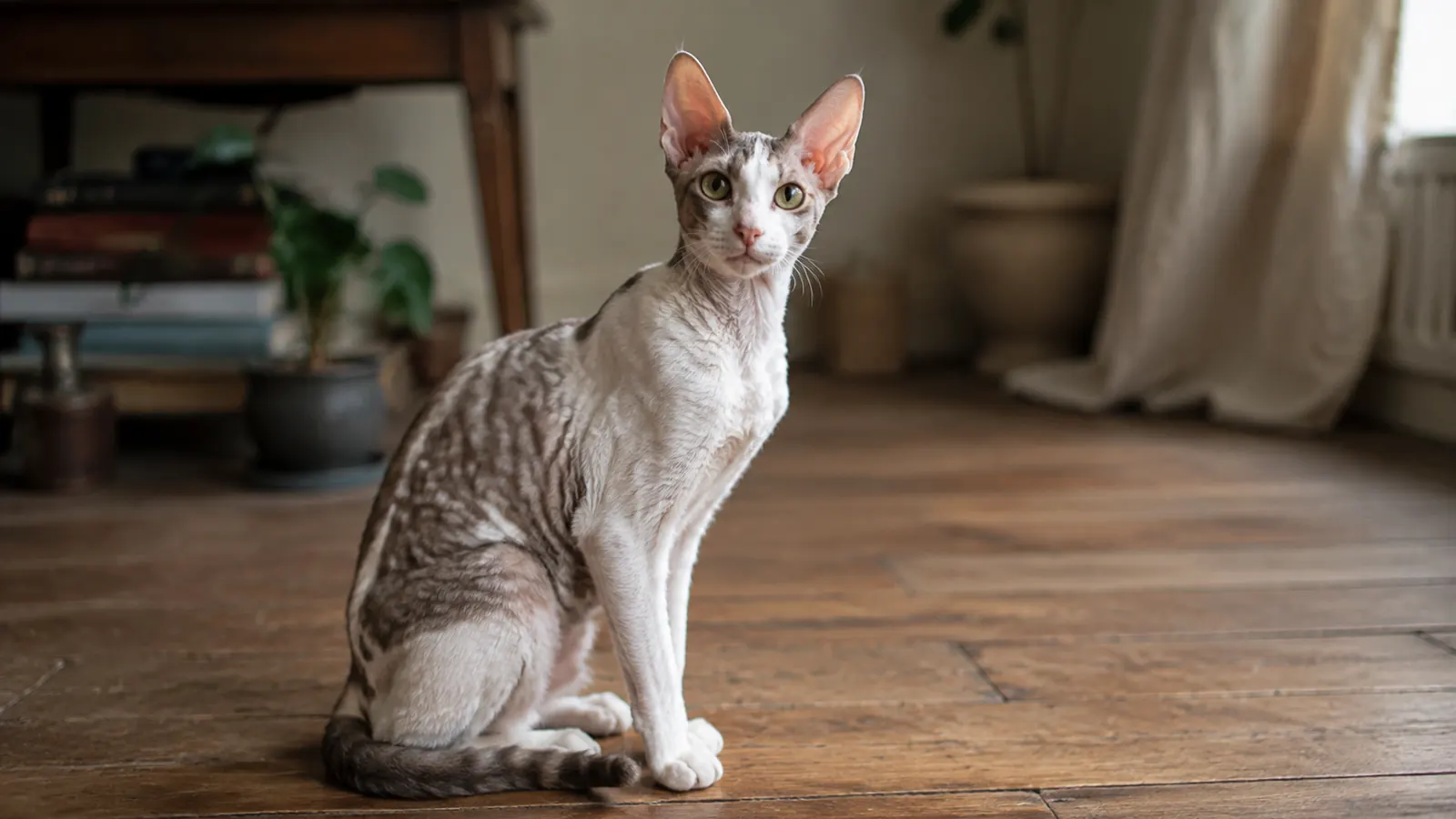
A Cornish Rex usually weighs less. CFA gives about 5 to 7 pounds for females and 8 to 10 pounds for males, yet the arched back, very long legs and long neck make the standing cat read larger than the scale suggests.
The head separates them quickly. The Abyssinian has a modified wedge with large alert ears and almond-shaped eyes. The Cornish Rex standard asks for a comparatively small egg-shaped head, large ears set high and a convex Roman profile.
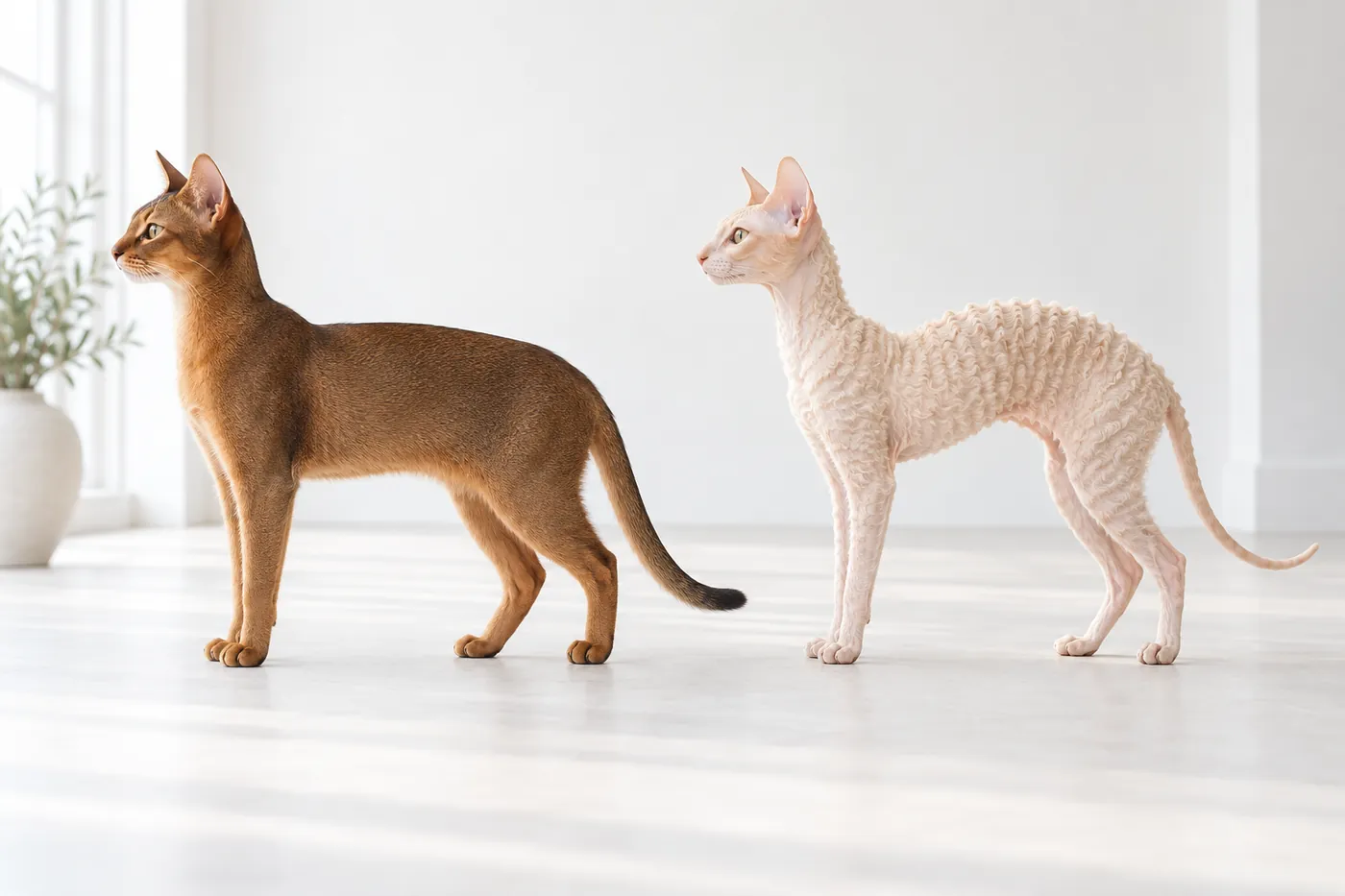
A carrier has to fit the actual cat, because chest depth, standing height and comfortable turning room matter more than the weight attached to either standard.
Which one turns the home into a bigger playground?
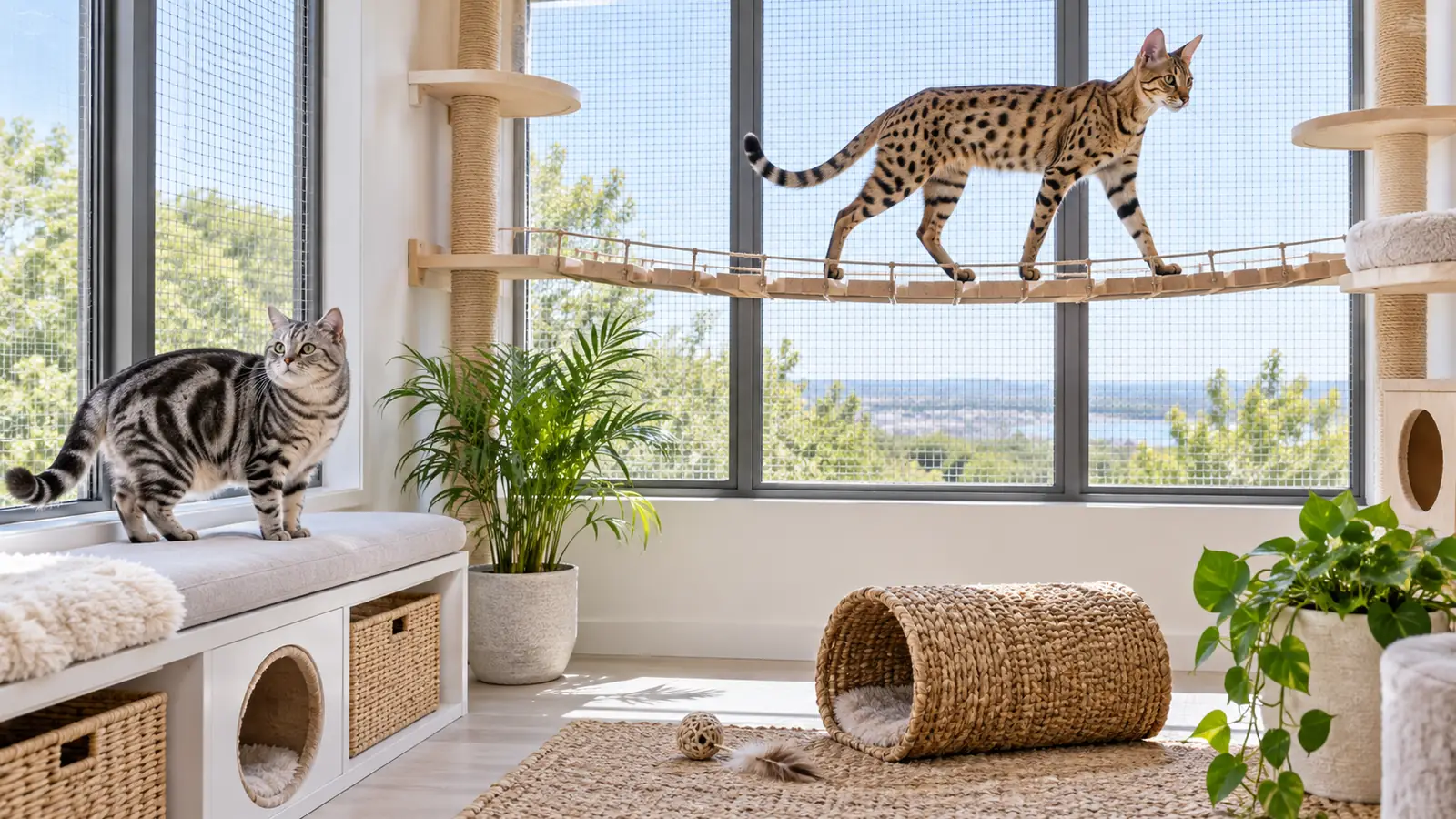
The Abyssinian usually creates the larger vertical planning job. A single tall cat tree gives it one destination, but connected shelves, a secure window perch and more than one route down allow the cat to travel without recruiting a television, door top or unstable cabinet.
The Cornish Rex creates a different problem: speed and repetition. Its long legs and arched body support abrupt leaps and fast changes of direction, and registry descriptions warn that the breed invents lively games when left without suitable occupation. Clear runways, non-slip take-off points and play that changes before the cat becomes frustrated are more useful than decorating one corner with equipment.
| Daily job | Abyssinian | Cornish Rex | Practical setup |
|---|---|---|---|
| Climbing | Uses height as a route and observation network | Leaps readily but may return quickly to the person or moving toy | Anchor tall furniture and keep landing areas clear |
| Interactive play | Often enjoys pursuit, searching and novel object problems | Often sustains fast chase, retrieval and repeated social games | Use short varied rounds and stop before panting or sloppy landings |
| Food work | Benefits from feeders that change location or method | Benefits from puzzles that can be solved with paws and movement | Measure food from the daily ration rather than adding treats |
| Training | Learns quickly and may lose interest when the task repeats | Often values the shared game and can repeat behaviours enthusiastically | Teach carrier entry, target, mat and handling behaviours first |
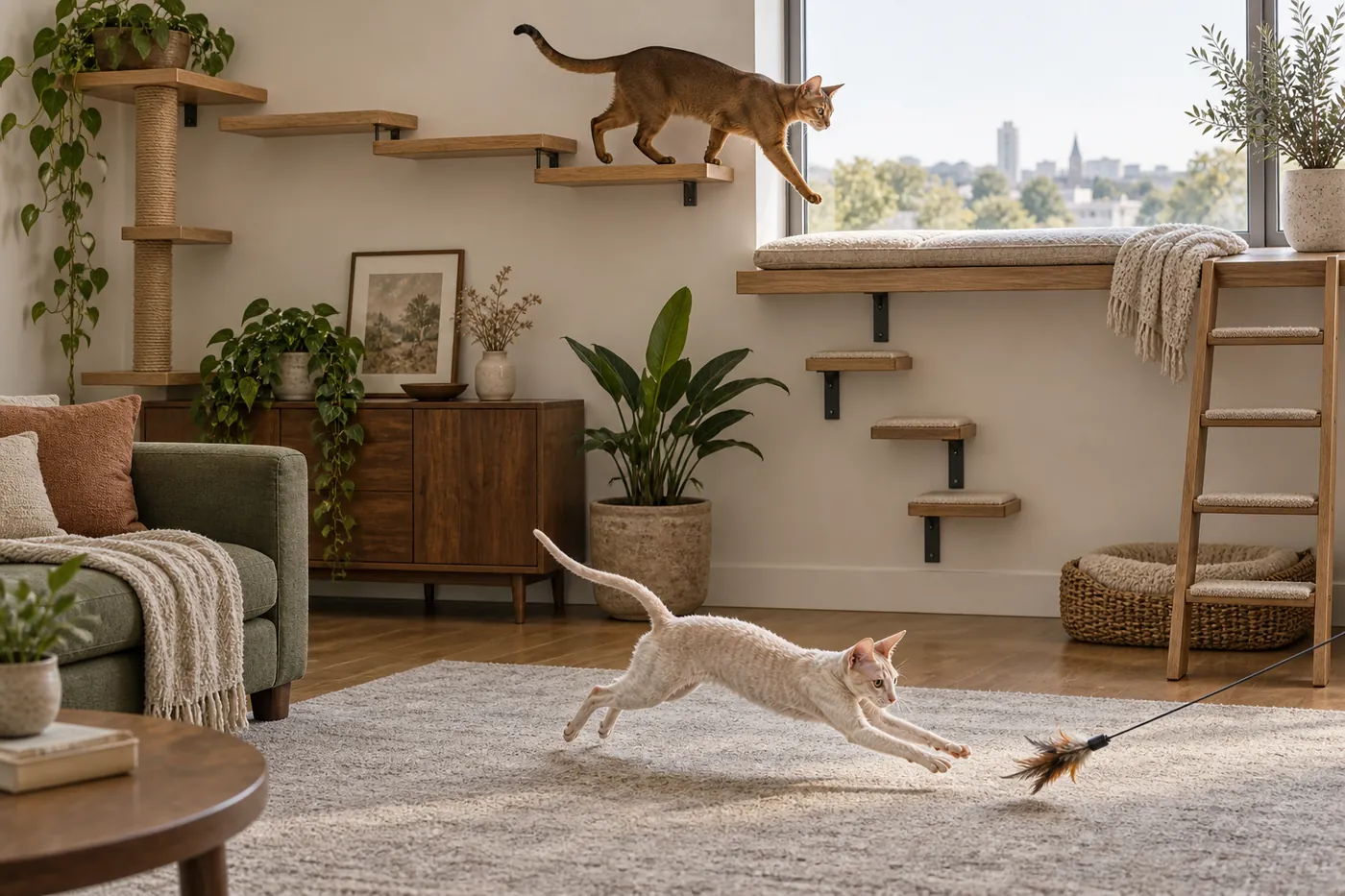
Reward timing and task shaping work the same way for both breeds, as in any clicker training; the breed only changes which reward and movement pattern hold attention longer.
Age changes the safe intensity for either cat, because a kitten's, an adult's and an older cat's exercise needs differ more than any breed-wide number of play minutes allows for.
Can either breed manage a full workday alone?
No reliable source establishes a universal number of safe hours for either breed. A settled adult with a predictable routine differs from a kitten, a new arrival or a cat already showing distress.
The starting risk is still meaningful. An under-stimulated Abyssinian can redirect exploration into cupboards, fragile shelves or repeated attempts to reach forbidden height. A Cornish Rex may experience the missing person and the missing game together, and GCCF explicitly describes lively games invented when companions are absent.
A compatible second cat can provide play and shared rest, but it cannot guarantee either. The home still needs separated food, water, litter, scratching and resting resources so company does not become competition.
If most weekdays are empty from morning to evening, an adult already seen coping with that schedule, or a different breed profile altogether, is the safer start. Buying a high-activity kitten and hoping it becomes independent transfers the experiment to the cat.
What does the Cornish Rex coat change about daily care?
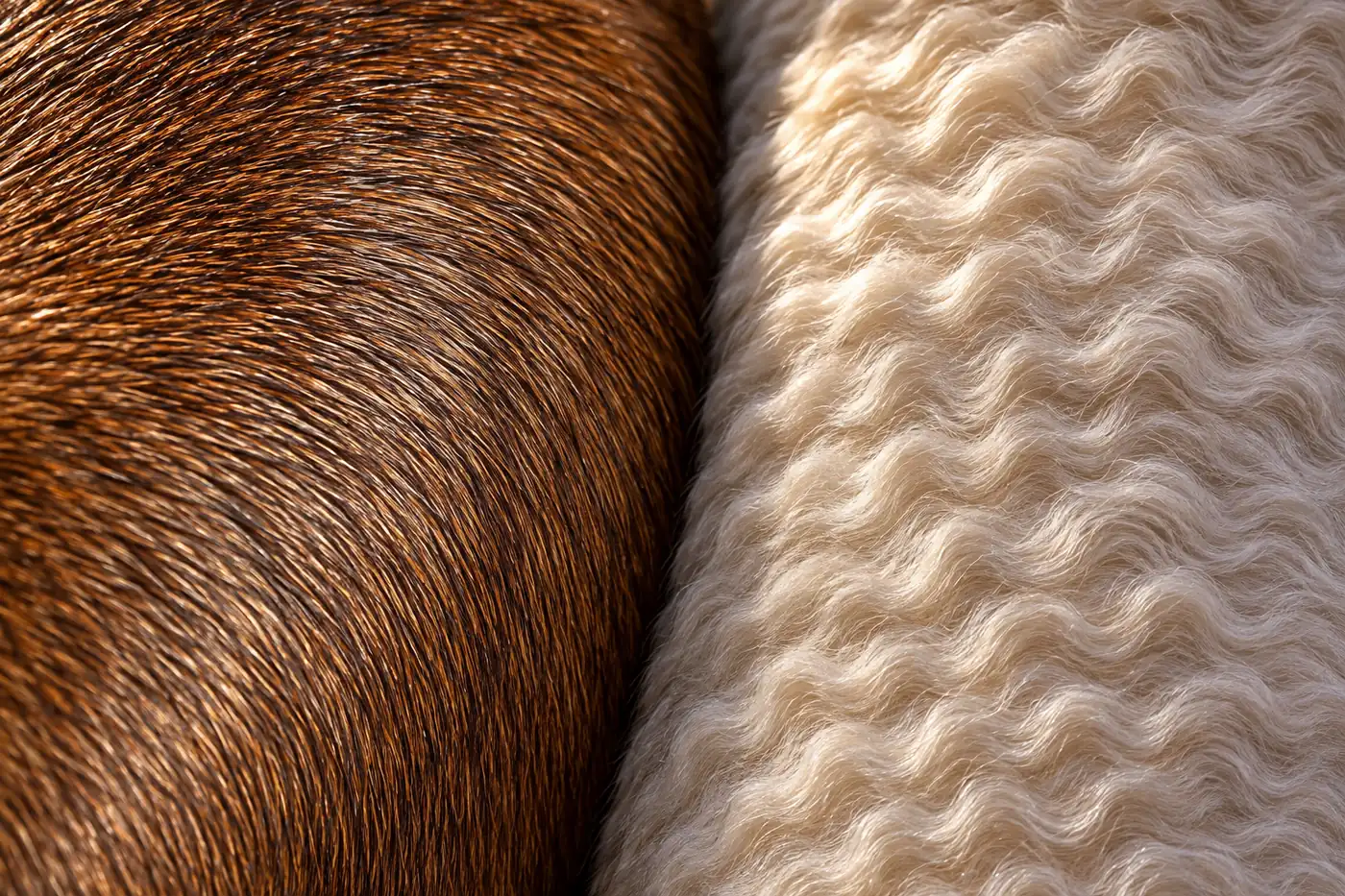
The Abyssinian has a close, resilient-looking short coat with ticking along each hair. Gentle weekly brushing or a grooming cloth usually removes loose hair and provides a useful skin check.
The Cornish Rex coat is built differently from an ordinary short coat. CFA describes tight marcel waves and a complete lack of guard hairs, leaving the softer undercoat exposed. Firm brushing can flatten or damage the wave, so hand grooming or the lightest suitable tool is preferable.
Genetic studies identify a four-base-pair deletion in LPAR6 as the Cornish Rex coat variant. LPAR6 contributes to normal hair-follicle and hair-shaft development, which helps explain why the breed's wave is a structural coat difference rather than a styling effect. That result identifies one coat mechanism. It does not clear the cat of skin disease, heart disease or any other health concern.
- Abyssinian routine
- Gentle weekly removal of loose hair and a skin check
- Cornish Rex routine
- Hand grooming first; use a soft tool only when the individual needs it
- Wet weather
- The Cornish Rex coat saturates quickly, so cold rain requires shelter
- Indoor warmth
- Warm beds for a Cornish Rex, with a cooler place it can still choose
- Bathing
- For either cat, only for contamination or a specific care need
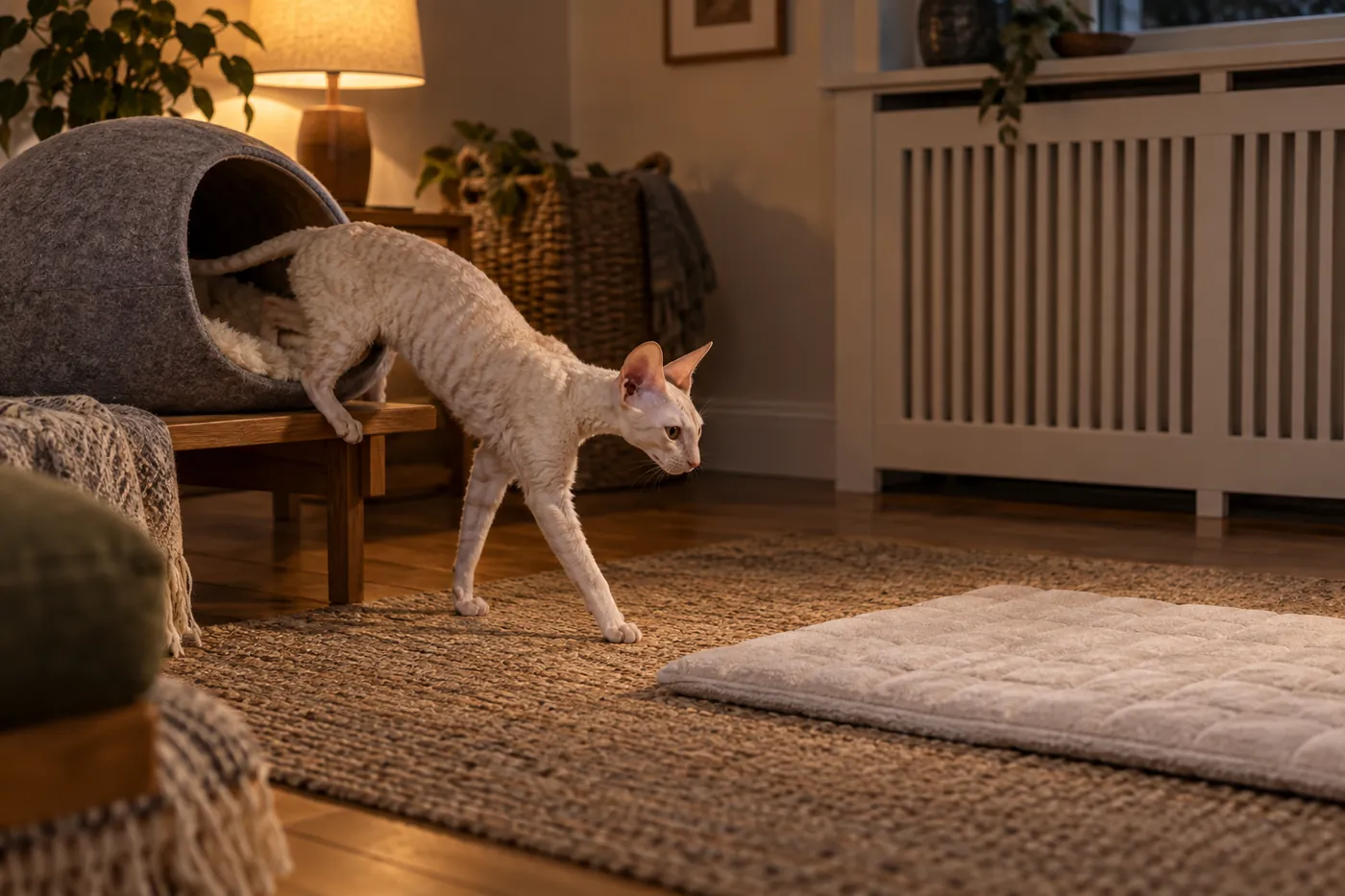
Warmth is therefore part of Cornish Rex care. A radiator shelf, enclosed bed or blanket can be useful, but the cat must be free to leave the heat and should never rest directly against an unsafe hot surface.
Which is easier with children, dogs or another cat?
Registries describe both as capable family companions, yet their speed changes the management. An older child who likes wand play and training may enjoy either breed, while a young child who chases or restrains a cat creates a poor match for both.
The Cornish Rex's fine outline should not invite protective overhandling. It is muscular and athletic, but long limbs and fast movement still need clear floors and calm handling. The Abyssinian needs protected high exits so a child or dog cannot follow every retreat.
- Children use toys rather than hands and stop when the cat leaves
- High resting places stay out of reach of children and dogs
- Dogs remain on controlled introductions until movement no longer triggers pursuit
- Every cat has separate food, water, litter and resting resources
- Adults interrupt play that becomes one-sided, breathless or difficult to stop
- The selected individual can recover from noise and choose contact freely
A shy resident cat may find either newcomer's persistence exhausting, so matched play intensity and the ability to disengage matter more than the idea that active cats automatically entertain each other.
Is either breed hypoallergenic or meaningfully lower-shedding?
Neither breed is hypoallergenic. The Cornish Rex lacks coarse guard hairs and may leave less conspicuous hair on fabric, while the Abyssinian's short close coat also makes loose hair less dramatic than a heavy long coat. That observation does not measure allergen production.
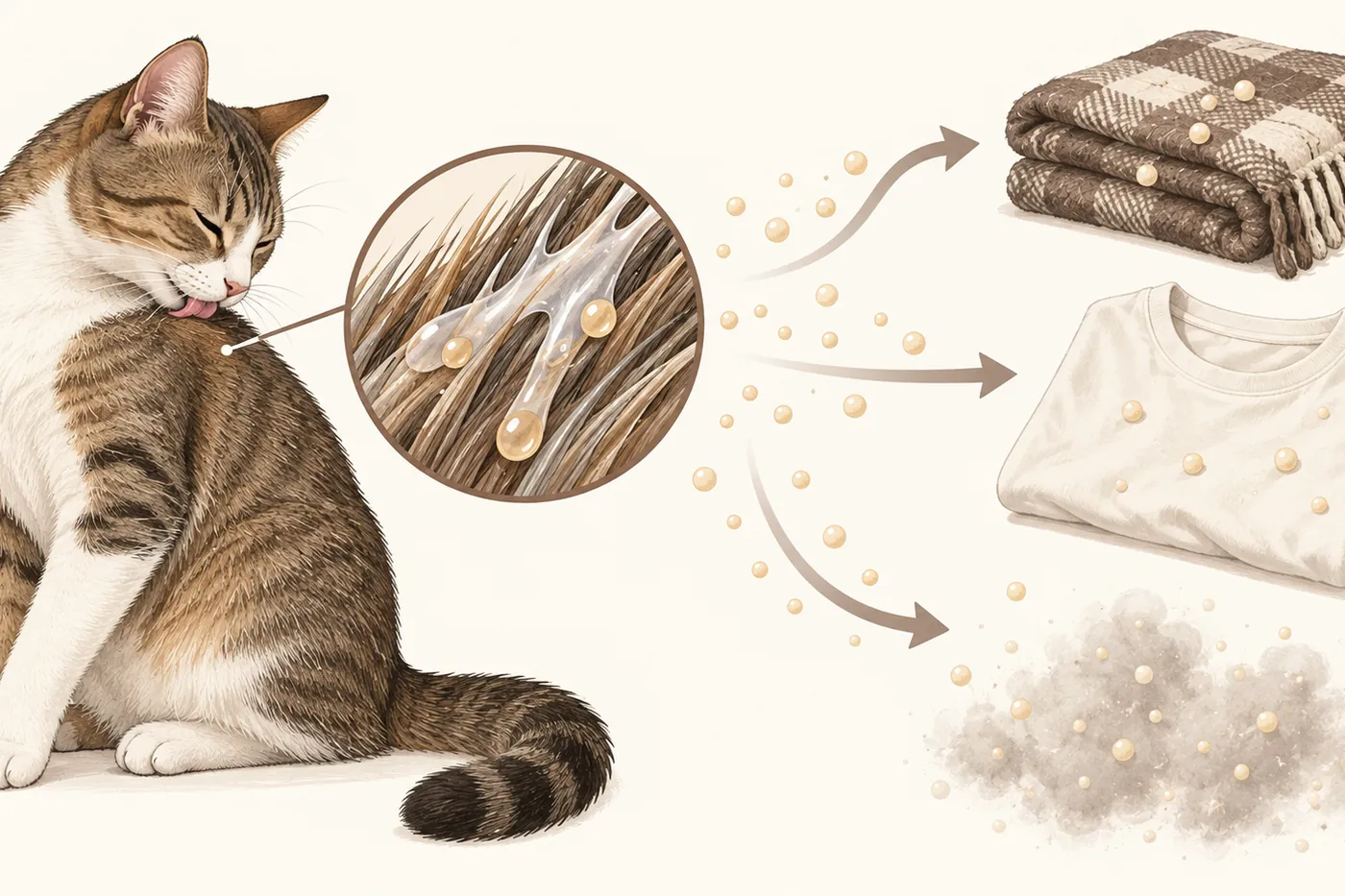
Fel d 1 and other cat allergens come from saliva and skin secretions, then reach the coat and home as the cat grooms. A waved coat, ticking or a small amount of visible hair cannot certify a safe response.
For an allergic person, repeated unhurried time with adult cats from the relevant home or line gives more evidence than any coat description. Medication decisions belong with the person's clinician, and a breeder's allergy guarantee is a reason to slow down.
Shedding also varies with season, diet, health and the individual coat. A sudden patch, irritated skin or a large change in grooming deserves investigation rather than a new brush.
Which health evidence should a breeder show you?
The Abyssinian has two widely available named DNA tests, and the useful evidence is the original laboratory report for both parents covering the CEP290 rdAc variant associated with progressive retinal atrophy and the PKLR variant associated with pyruvate kinase deficiency. Both are recessive questions, so a carrier is not the same as an affected cat.
Renal amyloidosis is different. The GCCF Abyssinian policy recognises the family concern but notes that no simple genetic clearance is available, making ages, causes of death and longitudinal records in close relatives the useful evidence.
The Cornish Rex health conversation begins with population management. GCCF states that the breed descends from one founder and treats selective outcrossing as important to the gene pool, so the useful questions are which approved breed entered the recent pedigree and how the breeder selected back toward Cornish Rex type.
| Breed question | Document or record to request | What it answers | What it cannot promise |
|---|---|---|---|
| Abyssinian PRA rdAc | Both parents' named CEP290 laboratory reports | Whether each parent is clear, carrier or affected for this variant | Every cause of blindness or future eye health |
| Abyssinian PK deficiency | Both parents' named PKLR laboratory reports | Whether the recessive variant can be passed to a kitten | Every cause of anaemia |
| Abyssinian renal amyloidosis | Ages and causes of death in close relatives | Whether the breeder tracks a recognised family concern | A genetic clearance or individual forecast |
| Cornish Rex blood type | Actual blood-type results for both parents | Whether a mating was planned around neonatal isoerythrolysis risk | General health of either parent |
| Cornish Rex founder management | Pedigree and explanation of recent approved outcrosses | How the programme broadens a one-founder gene pool | That an outcrossed kitten will never develop disease |
| Cornish Rex family history | Cardiac, patella, skin and longevity records across close relatives | Whether problems and outcomes are recorded over time | A population prevalence that has not been measured |
GCCF specifically calls for blood typing because both type A and type B occur in Cornish Rex cats. The result helps a breeder manage neonatal isoerythrolysis risk; it is not a general certificate that the parents are healthy.
No cited population study supplies a trustworthy Cornish Rex prevalence for a neat disease ranking, so a breeder who says exactly what each record can establish is offering better evidence than one who describes a broad panel as a lifetime guarantee.
Which activity pattern can you keep supporting?
The Abyssinian is the better match if connected height, daily route changes and a cat inspecting household activity sound enjoyable. Its short coat keeps physical care simple, but the environment has to remain usable from the cat's point of view.
The Cornish Rex is the better match if you want sustained social play, can keep the home warm and enjoy a cat that may follow you from task to task. Minimal brushing does not cancel the need for company or safe high-speed play.
- Compare both breeds against a normal weekday rather than a quiet visit
- Decide whether vertical exploration or sustained people-centred play suits the room
- Meet the individual during activity, rest, handling and a small interruption
- Check that a Cornish Rex has warm options without unsafe direct heat
- Read named Abyssinian DNA reports and both Cornish Rex parents' blood types
- Ask for family ages, causes of death and the reason behind recent outcrosses
- Reject guaranteed temperament, allergy safety or lifetime health
The most useful thing to watch is the actual cat pausing. An individual that can finish a game, recover after surprise and choose distance gives better evidence about daily fit than any adjective in a breed summary, even when the coat and outline are exactly what you hoped to find.
Checked Against
- TICA: Abyssinian breed introduction tica.org
- TICA: Cornish Rex breed introduction tica.org
- CFA: Abyssinian cfa.org
- CFA: Cornish Rex breed profile and standard cfa.org
- UC Davis Veterinary Genetics Laboratory: PRA rdAc vgl.ucdavis.edu
- UC Davis Veterinary Genetics Laboratory: pyruvate kinase deficiency vgl.vetmed.ucdavis.edu
- GCCF: Abyssinian breeding policy gccfcats.org
- GCCF: Cornish Rex breeding policy gccfcats.org
- GCCF: Cornish Rex breed information gccfcats.org
- PLOS ONE: LPAR6 mutation defining the Cornish Rex coat journals.plos.org
- Satyaraj et al.: Keep the cat, change the care pathway, a transformational approach to managing Fel d 1 (Allergy, 2019) pmc.ncbi.nlm.nih.gov
- Bradshaw: Normal feline behaviour and why problem behaviours develop (Journal of Feline Medicine and Surgery, 2018) pmc.ncbi.nlm.nih.gov
Published 11 September 2026. Last updated .