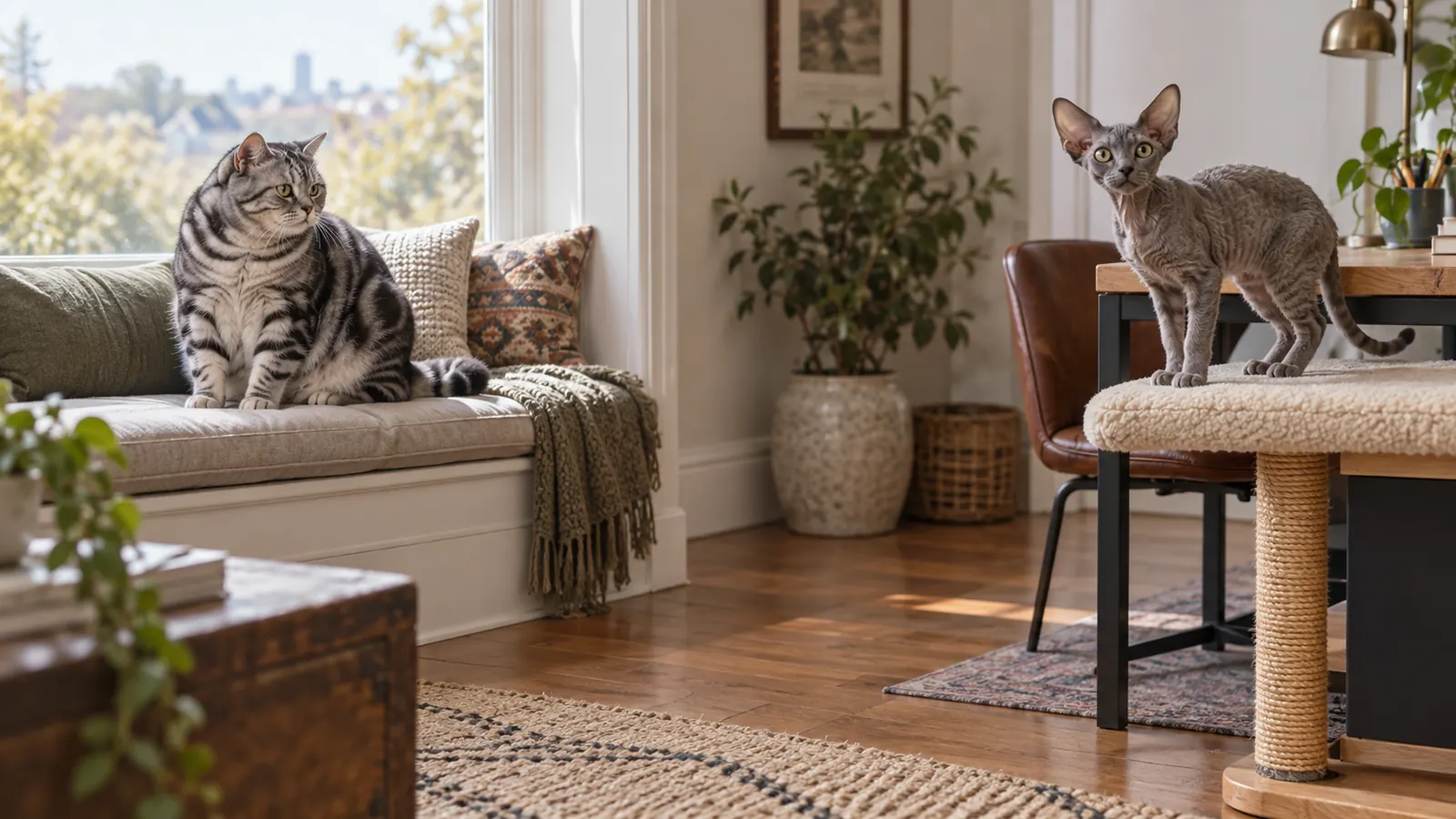
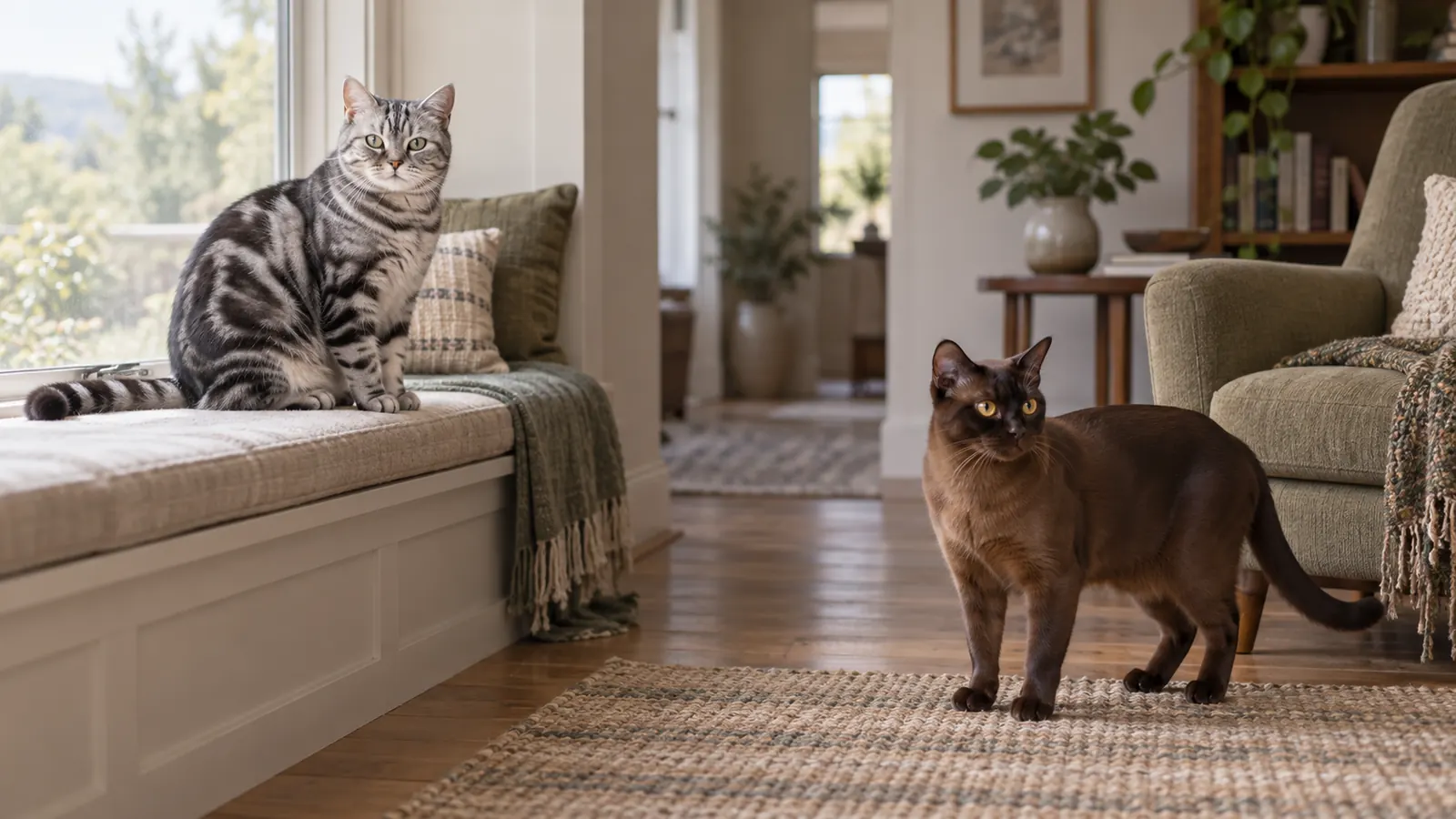
American Shorthair vs Cornish Rex: Which Home Fits?
The American Shorthair suits someone who wants a sturdier, more self-directed cat with ordinary short-coat care. The Cornish Rex suits a household that wants a highly social athlete and can provide warm resting choices, gentle skin and coat care, and frequent participation.
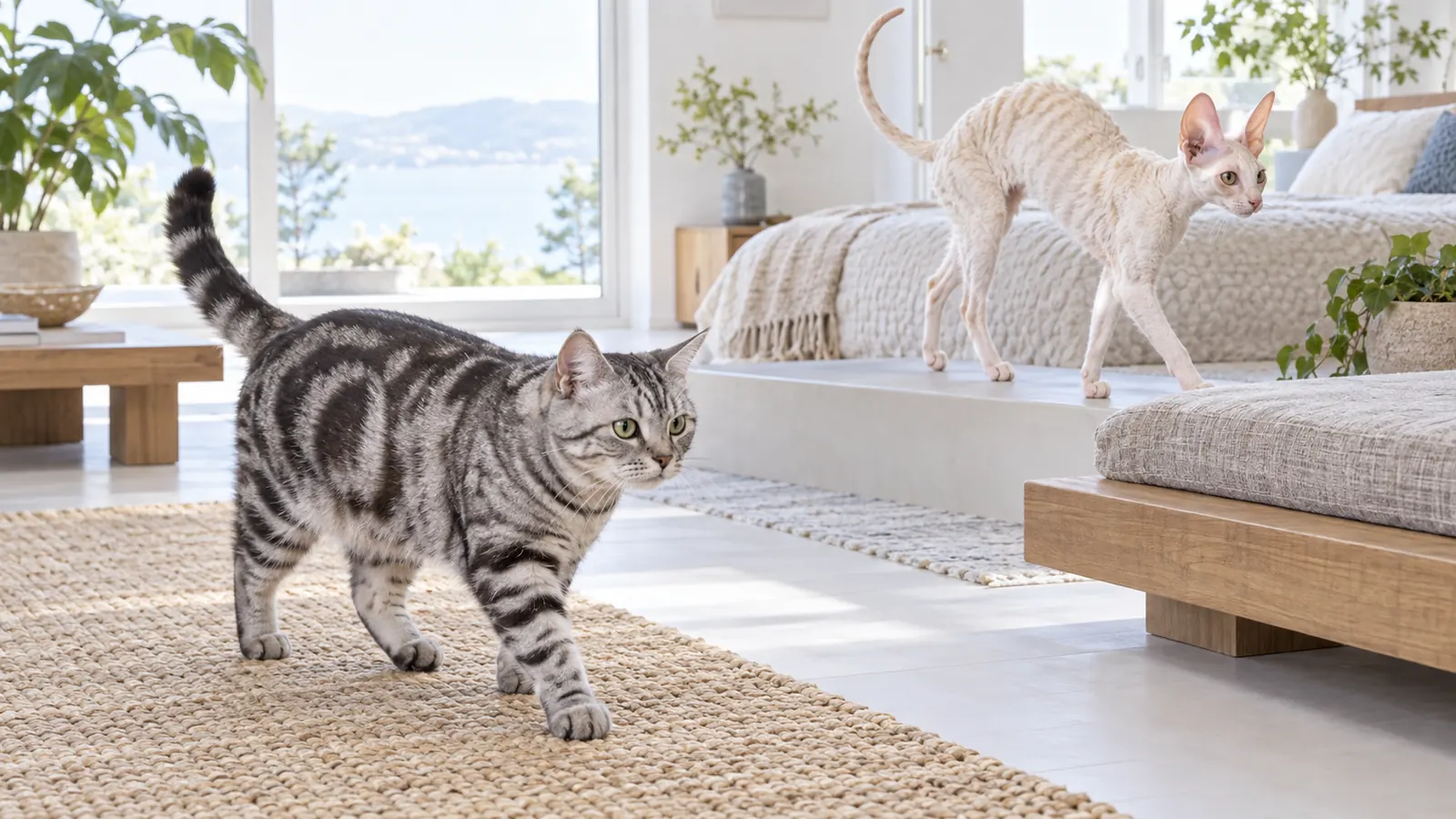
Short hair does not make these breeds equivalent to live with.
An American Shorthair has a dense protective coat and a broad working-cat body. A Cornish Rex has a fine, arched body covered only by an unusually soft wavy coat without the normal outer guard hairs. That coat difference affects warmth, sun exposure, grooming and where the cat chooses to rest. The Cornish Rex also tends to make people and movement a larger part of the day.
Which breed is the easier fit for most homes?
The American Shorthair is usually the easier fit because it combines affection and play with a greater capacity for self-directed rest. It fits apartments and houses when it receives daily interaction, legal climbing places and sensible food control.
The Cornish Rex suits a household that enjoys a more animated, physically close companion. CFA and TICA describe it as intelligent, active and social, with a strong interest in being in the middle of household activity.
| Profile | Daily pace | Warmth | Coat care | Best fit |
|---|---|---|---|---|
| American Shorthair | Moderate play, hunting games and calm periods | Normal indoor comfort with a dense protective coat | Gentle brushing or combing, increased during seasonal shed | A home wanting a sociable cat without constant movement or specialised coat care |
| Cornish Rex | High, acrobatic and likely to revisit play | Warm protected rest matters because the coat has no guard hairs | Minimal brushing but regular skin, ear and paw observation | A warm interactive home that welcomes frequent contact and movement |
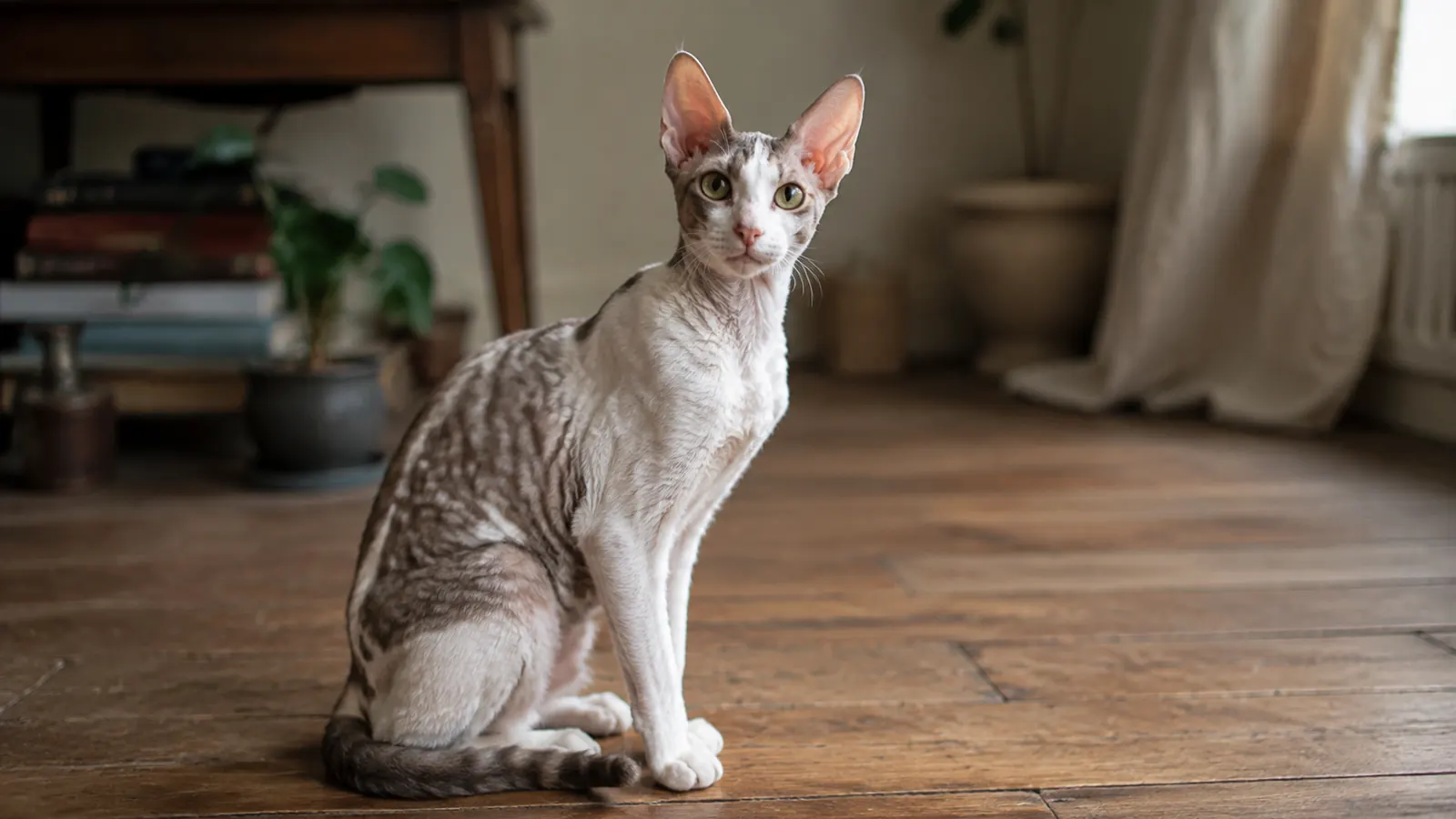
The Cornish Rex needs little grooming and still asks for real work, moved away from loose hair and toward warmth, skin observation and active company.
Recovery after play, tolerance of a boundary and willingness to settle tell you more about everyday fit than a kitten's most entertaining five minutes, which is why the individual is worth meeting after play as well as during it.
How different do an American Shorthair and Cornish Rex look?
The American Shorthair is medium to large, muscular and broad, with well-developed shoulders, chest and hindquarters. Its coat is short, dense and hard enough in texture to give a protective appearance.
The Cornish Rex is small to medium with a long arched torso, fine bone, long slender legs and a tucked waist. Its egg-shaped head, large high ears and short marcel waves produce a silhouette that looks lighter even though the body feels unexpectedly warm and substantial in the hand.
| Feature | American Shorthair | Cornish Rex |
|---|---|---|
| Body | Broad, powerful and balanced | Long, fine, arched and muscular through hips and thighs |
| Legs | Medium and substantial | Very long and slender |
| Head | Broad with a strong jaw and medium-short muzzle | Comparatively small, egg-shaped and longer than wide |
| Ears | Medium and widely set | Large, erect and set high |
| Coat | Dense straight hairs with protective texture | Short silky down hairs in close marcel waves, without guard hairs |
| Identity | Registration and documented parentage | Registration and documented parentage; curl alone is not proof |
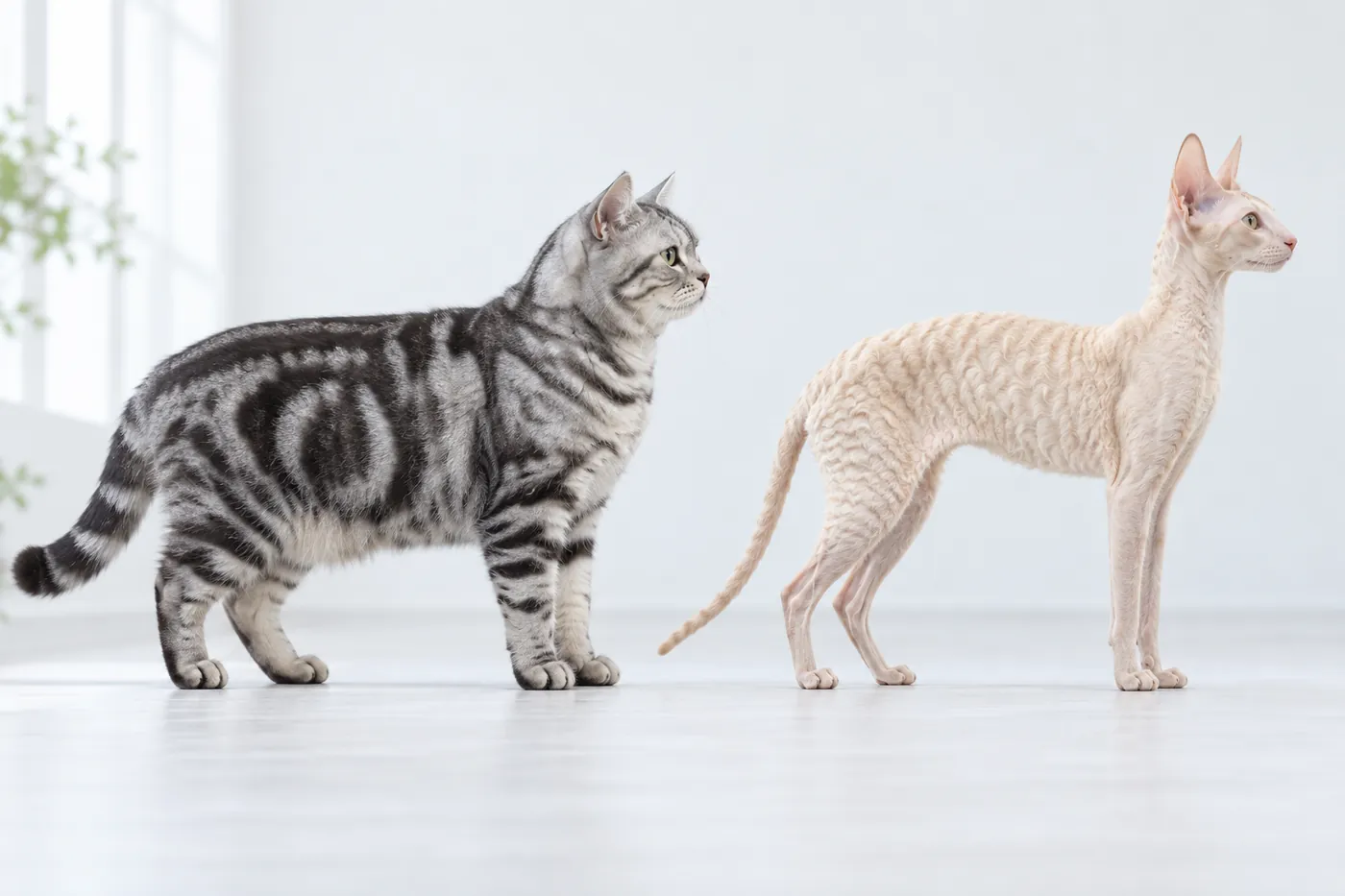
A curly domestic cat is not automatically a Cornish Rex. Several breeds have separately inherited curly coats, so pedigree and registration remain necessary when breed identity matters.
Feeding either cat toward the shape in a standard misses the individual: a fine Cornish Rex still needs adequate muscle, and a broad American Shorthair still needs a palpable rib cage and visible waist appropriate to the individual.
How do warmth and activity change the home setup?
The Cornish Rex coat provides less insulation than the American Shorthair coat. CFA notes that these cats seek warm places and can become chilled, while TICA also describes warmth-seeking around vents, sun and bedding.
The safest warm choices are ones the cat can leave. A covered bed in a draught-free area, a safe patch of indirect sun and ordinary room warmth are preferable to direct contact with a radiator, heating pad or space heater.
The Cornish Rex also needs clear movement lanes. Long legs and an arched athletic body support fast acceleration and high jumps, so stable trees, broad landings and routes clear of breakable objects matter more than a decorative perch. The American Shorthair needs play and climbing too, but its ordinary rhythm is often easier to satisfy with a sturdy tree, window station, food searches and several short hunting games.
- Warm choice
- Provide a draught-free bed that the Cornish Rex can enter and leave freely
- Heat safety
- Block direct access to unsafe heaters, hot pipes and exposed heating elements
- Sun control
- Prevent long intense sun exposure on sparsely covered skin
- Movement route
- Give the Cornish Rex stable take-off and landing space rather than narrow ornaments
- American Shorthair zone
- Combine a broad perch, viewing point and floor-level hunting route
- Recovery
- Make sure either cat can stop, drink, rest and return to normal breathing after play
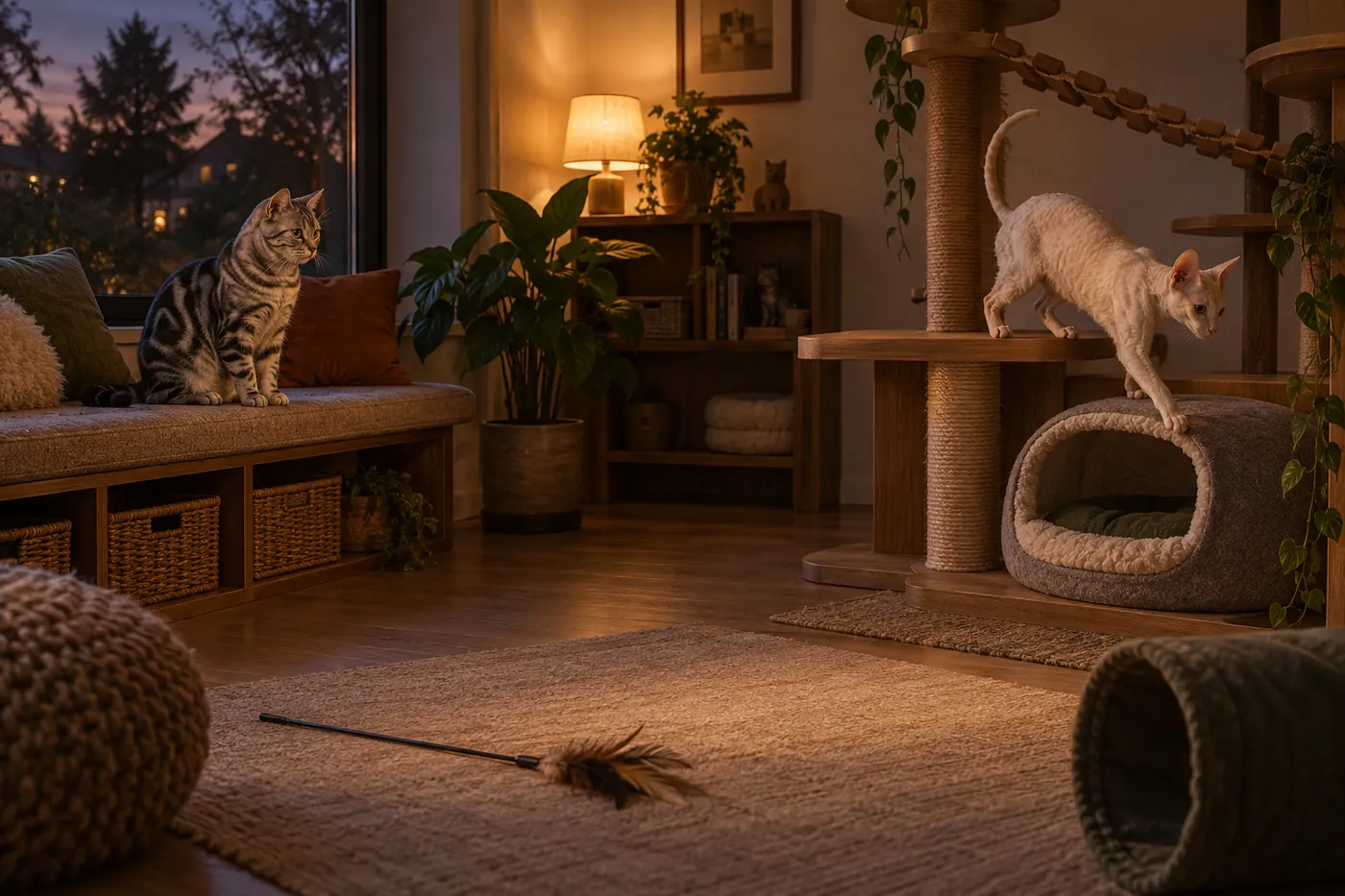
A sweater is not a universal solution. Some cats dislike clothing, fabric can rub the coat, and any garment needs supervision and a fit that does not restrict shoulders, breathing, grooming or toileting.
What are they like with attention, training and time alone?
The American Shorthair often accepts company at a slight distance. It may watch from a chair or window, join a planned game, then settle while the person continues working. The Cornish Rex more commonly returns to the person, climbs into warm contact or creates another activity. A closed door, cold room or long empty day can therefore produce more friction in a home that expected an ornamental low-shedding cat.
| Household moment | American Shorthair | Cornish Rex |
|---|---|---|
| Desk work | Often observes nearby between short visits | More likely to seek the chair, lap, shoulder or active task |
| Time alone | May use safe independent activity and rest | Social and warmth needs make a long empty routine a higher-risk mismatch |
| Play | Stalking, pouncing and food search fit well | Fast running, jumping, retrieval and repeated interactive play fit well |
| Training | Learns carrier, scratching and station routines | Often learns quickly and may demand more variation |
| Bedtime | May accept a nearby bed or separate room after training | Warmth and closeness can make exclusion a stronger conflict |
No breed-wide number of acceptable hours alone is honest. The individual's eating, litter use, sleep, vocalising, destructive searching and recovery after people return are the honest measure.
A warm station near the person, taught before it is needed, lets a Cornish Rex stay involved without standing on a keyboard or hot cooking surface, while the same mat gives an American Shorthair a predictable reward point. The clicker training method also builds voluntary carrier entry, target following and brief handling. Training can create useful alternatives, but it cannot make an unsuitable schedule or cold room appropriate.
What care does the Cornish Rex coat and skin need?
The Cornish Rex coat lacks the outer guard hairs found on the American Shorthair. Its short down hairs can be damaged by repeated brushing, hard rubbing or an attempt to make every wave look identical.
Start with your eyes and hands. Notice odour, redness, flakes, greasy areas, broken coat, wax at the ears and dark debris around nail folds before deciding whether cleaning is needed.
- Run clean hands lightly over the Cornish Rex coat and feel for oil, tenderness or sudden texture change
- Inspect the large ears without inserting a swab into the canal
- Check around claws and toe folds for oily debris before trimming
- Use only a veterinarian-approved cleaner when debris actually needs removal
- Dry the cat completely and return it to a warm room after any necessary bath
- Stop and seek advice for pain, marked redness, odour, sores or abrupt hair loss
Bathing frequency cannot be assigned from the breed name. Some cats accumulate enough oil to need occasional washing, while others remain comfortable with spot cleaning and routine observation.
The American Shorthair has the more conventional shedding job. Its dense undercoat can release strongly in spring and more lightly at another seasonal change, so a gentle comb or grooming mitt may be useful.
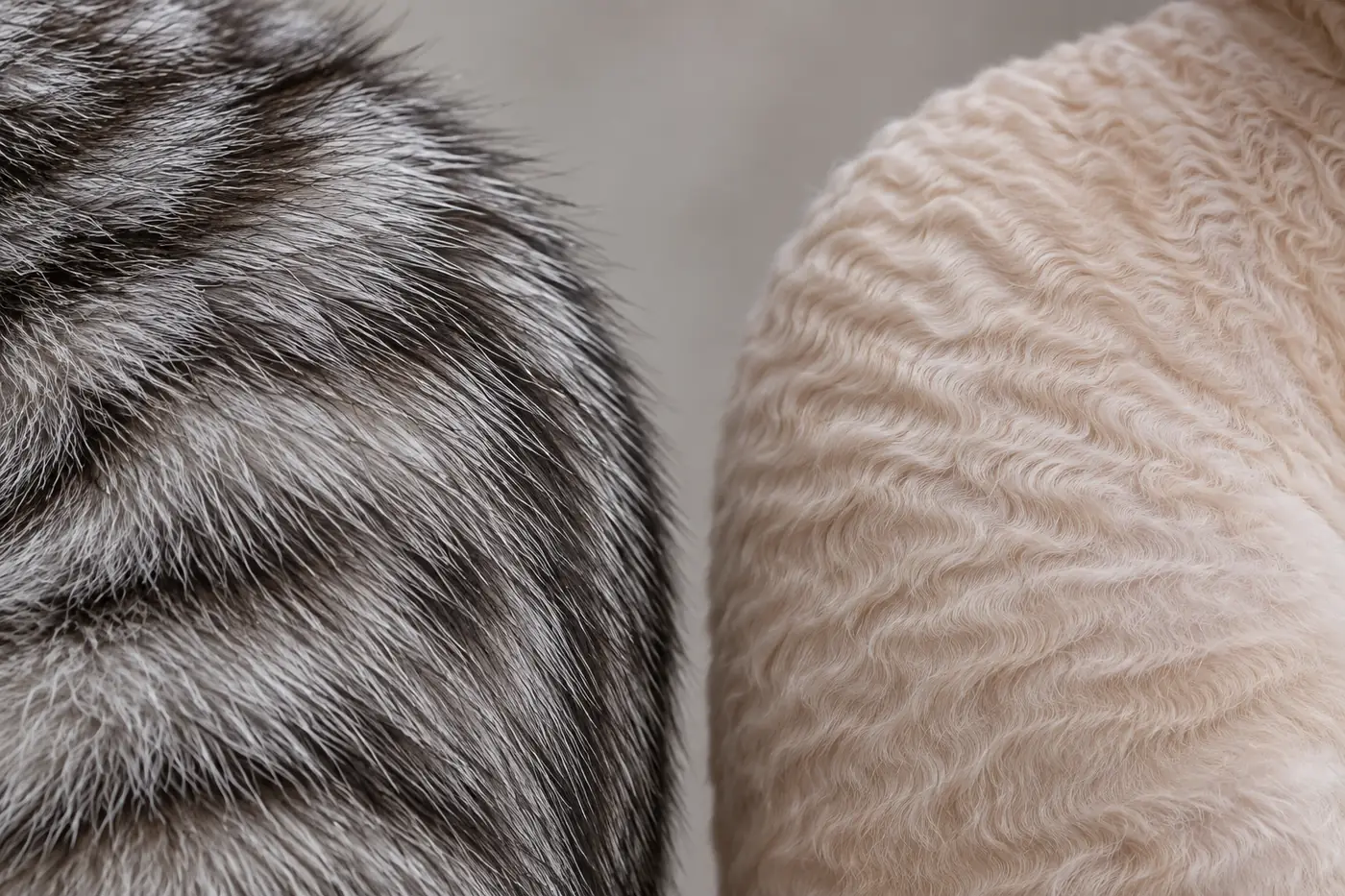
Grooming tools differ in pressure and tooth spacing, and a deshedding tool designed to pull undercoat has no useful job on a Cornish Rex that lacks it.
The Cornish Rex is not hypoallergenic. Cat allergens occur in saliva and skin material as well as on shed hairs, so less loose coat cannot guarantee a safe response.
Which is better with children, dogs or another cat?
The American Shorthair may suit a quieter family more readily, while a Cornish Rex may delight older children who enjoy structured games and can respect rest. Adults still supervise every interaction and give the cat a clear exit.
The Cornish Rex coat makes rough stroking, costume play and repeated lifting particularly poor ideas. Warmth-seeking can also place the cat under blankets or beside a seated person, so children should check before jumping onto furniture or folding bedding.
Fast Cornish Rex movement can trigger dog pursuit. Keep the dog controlled during introductions and provide high retreats with more than one route down.
Another playful cat can be useful company when both animals take turns and pause. It is a poor solution when one cat repeatedly stalks, blocks resources or follows the other after it tries to disengage.
- Children use toys rather than fingers and never rub the Cornish Rex coat backward
- Every warm sleeping place stays visible or is checked before people sit or close furniture
- Dogs remain controlled until quick running no longer triggers pursuit
- Each animal has separate food, water, litter, scratching and sleeping resources
- High retreats have two exits and cannot be guarded by another animal
- Interaction shows pauses, role changes and voluntary return
With a timid resident animal in the home, demonstrated recovery matters more than boldness, and a kitten that approaches everybody is not automatically the safest match.
Which health records should a breeder show?
Ask for the registered identity of both parents, original laboratory reports, dated clinical examinations and the ages and causes of death among close relatives. Each record should answer a named question.
TICA notes hypertrophic cardiomyopathy and patellar luxation among Cornish Rex concerns. Langford also lists progressive retinal atrophy rdAc, Burmese hypokalaemia and low-prevalence polycystic kidney disease among tests relevant to the breed.
| Evidence | Question for the breeder | Meaning | Limit |
|---|---|---|---|
| Parent identity | Do the names and registration numbers match every report? | Connects evidence to the planned litter | Does not guarantee health or behaviour |
| Cardiac screening | Which parents received a heart assessment, when and with what findings? | A dated view of cardiac structure or function | Cannot rule out future HCM |
| Patellar examination | Was kneecap stability examined and were relatives affected? | Records a clinical finding in a named cat | Is not replaced by a generic DNA panel |
| PRA rdAc | Which CEP290 report belongs to each parent? | Status for one retinal variant | Does not exclude every cause of blindness |
| Hypokalaemia | Which known variant was tested and what is each parent's status? | Status for the named recessive variant | Does not explain every episode of weakness |
| Family outcomes | What ages and causes of death are known? | Shows whether the breeder follows health over time | Missing events are not proof of absence |
A carrier is not an affected cat, and not every listed test is necessary for every line; the breeder should be able to explain the inheritance, the mating decision and why each test was relevant.
For the American Shorthair, registry material does not identify the same concentrated test list. Routine veterinary records still matter, and so does a breeder who tracks weight, cardiac findings, longevity and causes of death rather than translating hardy into guaranteed healthy.
Which breed should you choose?
The American Shorthair fits when you want a substantial, adaptable cat with moderate interactive play and conventional short-coat care. It remains a poor fit if hunting play, seasonal shedding and food control will be ignored.
The Cornish Rex fits when you want an agile, social cat that seeks warmth and participation. It becomes a poor fit when the home is cold, long absences are routine, rough handling is likely or coat and skin observation feels like unexpected work.
- Warm beds are safe, optional and separated from direct heat
- Stable climbing routes have clear take-off and landing space
- Frequent social play still fits the busiest weekday
- Children and visitors can protect a fragile wavy coat
- Allergy decisions rely on contact with the individual, not shedding claims
- Original health records match the named parents and show dates
- The cat can pause, recover and settle after activity
For the broadest range of homes, the American Shorthair is the more forgiving choice. The Cornish Rex is the better match when its warmth, movement and close company are the qualities the household deliberately wants to support.
Checked Against
Published 12 September 2026. Last updated .