When Does a Cat Stop Growing, and How Big Will It Get?
A cat's frame, muscle and body fat do not change on one fixed timetable. Most cats enter the adult life stage around their first birthday, while continued changes in shape or weight need to be judged with a growth record and body condition rather than a universal finish date.
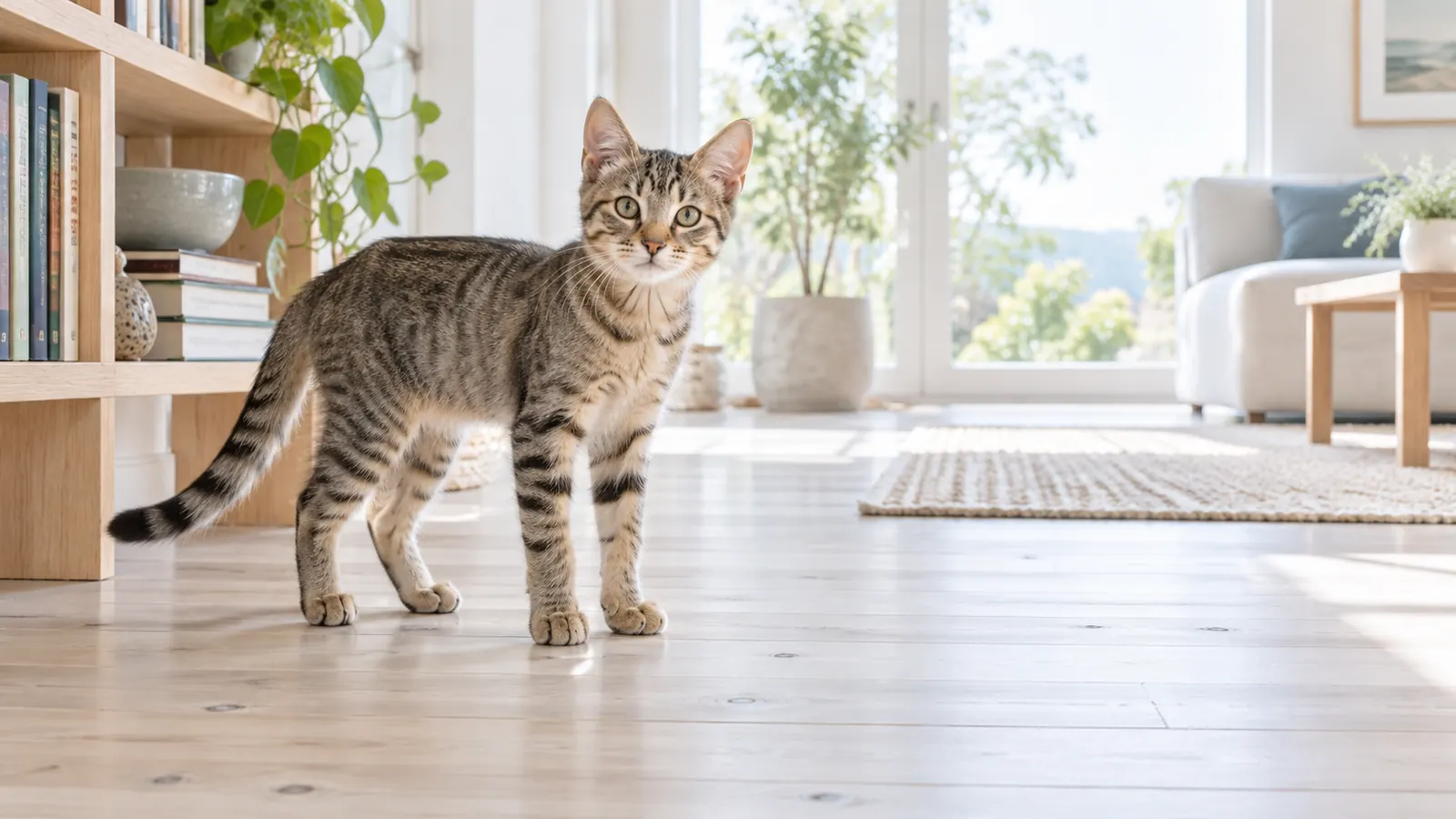
A cat grows in two ways that people tend to merge into one. The frame lengthens and then stops. The body fills that frame afterwards, and it goes on filling it long after the skeleton has finished.
Those two things run on separate clocks, and almost every mistake in this period comes from reading one and acting on the other.
When does a cat's frame stop growing?
Length and height are set by the growth plates at the ends of the long bones. These are bands of cartilage that add new bone while they remain open, and once they fuse the bone cannot lengthen again, and no diet, supplement or feeding regime reopens them.
Different growth plates close at different ages, so there is no single radiographic moment when the whole cat becomes adult. The evidence also does not support assigning every female and male a separate fixed finish date.
- 0 to 4 monthsFastest growth of the whole life. Weight roughly doubles in the first weeks and climbs steeply through this window
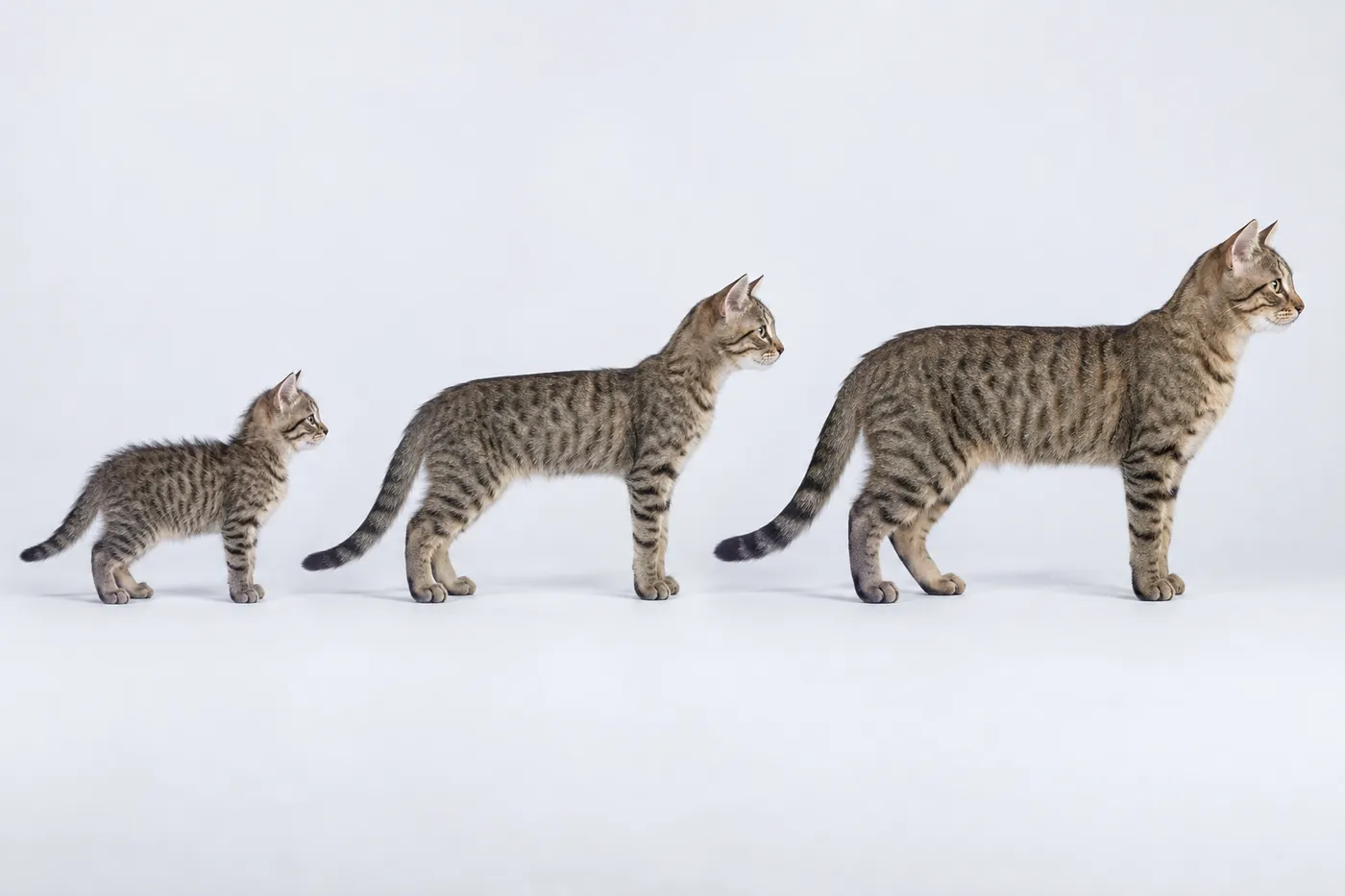
- 4 to 8 monthsThe frame lengthens visibly. The cat looks long, narrow and out of proportion, which is normal
- 8 to 12 monthsGrowth usually slows and many cats approach adult length, while muscle and body condition are still changing
- Around 12 monthsMost cats enter the adult life stage, which is the usual point to review food and portions
- After 12 monthsSome physical development continues, but a wider chest or rising weight does not prove that long bones are still lengthening
The awkward middle stage worries owners more than it should. A cat at seven months is often nearly its final length while carrying almost none of its final muscle, so it reads as thin, leggy and slightly unfinished, which it is, because the muscle arrives over the following months.
Large breeds are often described as taking several years to mature, but that claim usually combines skeletal growth, muscle, coat and body mass. A large cat may continue to broaden after its first birthday without proving that its long bones are still lengthening.
That distinction matters because continued weight gain is not a growth target, and the cat's own measurements and body condition are a better guide than a quoted adult weight.
Does neutering change how big a cat gets?
This is where the folk answer and the evidence part company. A radiographic study including 783 cats found the greater trochanter, distal femoral and tibial tuberosity physes closing later in neutered males than in intact males. It found no neuter effect at the proximal femoral or proximal tibial physes, no significant difference between spayed and intact females, and no significant breed or sex effect.
The authors said the possible clinical consequences needed further evaluation. That study does not justify predicting that an individual neutered cat will become taller or assigning it a different adult size.
The practical response is to reduce the daily amount at the time of the operation rather than waiting to see what happens. Waiting means the correction becomes a weight-loss plan instead of a portion adjustment, and weight loss in cats has to be done slowly and carefully.
What actually decides adult size
Five things do most of the work, and only two of them are under an owner's control.
| Factor | How much it decides | What an owner can do about it |
|---|---|---|
| Breed and genetics | The dominant factor by a wide margin | Nothing after the cat is chosen, which is why the parents matter when picking a kitten |
| Sex | Males typically finish larger and heavier than females of the same line | Nothing |
| Nutrition during growth | A complete growth diet supplies the nutrients required during kittenhood | Follow the food's life-stage statement and review portions against body condition |
| Illness and parasites in early life | Sustained malnutrition or a heavy worm burden during the growth window costs final size | Keep the worming and vaccination schedule, and act early on poor weight gain |
| Neuter status | Selected physes closed later in neutered males in one radiographic study | Discuss timing with your vet against the wider health and behaviour picture |
Extra food is absent from that list. Feeding more than the cat needs during growth does not produce a bigger adult. It produces the same adult carrying more fat, and it does so at an age when fat cells are laid down readily and lost reluctantly.
Equipment sizing follows the same logic: choosing a litter tray for the adult cat means buying once, where one chosen for the kitten has to be replaced.
Mixed-breed cats are harder to predict than pedigrees for the obvious reason. If the parents were seen, their size is the best single guide available; if they were not, the cat at six months gives a rough indication of frame but almost none of eventual weight.
Roughly what a kitten weighs, month by month
A rule of thumb circulates that a kitten gains about half a kilogram a month for the first five or six months. It is a serviceable sanity check and a poor target.
Breed, sex, litter size and starting weight all move the numbers, and a healthy Singapura will sit well below a healthy Maine Coon at every point on the curve.
The bars show a shape rather than a standard, and what they show usefully is the slope, which is steep early and flattens noticeably from about six months.
A kitten's own curve is worth far more than any table. A cat tracking consistently below the average and gaining steadily is usually a small cat; a cat that was tracking normally and then stopped is a cat to have examined.
The most common misuse of numbers like these is feeding up to them. That corrects nothing and creates a separate problem.
Why a big-looking cat is not always a big cat
Coat accounts for a surprising share of apparent size, which is why the same cat looks substantially larger in February than in July. Frame accounts for most of the rest.
A cat can be long and tall while weighing less than a shorter, cobbier cat of the same age, and neither is abnormal. Oriental and Siamese types are built long and light by design, while British Shorthairs and Persians are compact and dense.
That is why weight alone answers the wrong question. A number means very little without the frame it sits on and the condition score that describes how it is distributed.
Telling frame growth apart from weight gain
This is the skill worth learning, because the scale alone cannot distinguish the two. A number that climbs steadily can mean the cat is growing or that the cat is getting fat, and body condition scoring is what separates them.
It is done by hand and by eye rather than by the number, and on the standard nine-point scale five out of nine is the target. The scoring itself takes about twenty seconds once the feel of it is familiar.
- Score 1 to 3, underweightRibs, spine and pelvis visible from a distance with no fat cover. Worth a vet visit
- Score 4 to 5, idealRibs felt easily under a thin layer, waist visible from above, abdomen tucks up from the side
- Score 6 to 7, overweightRibs need firm pressure to find, waist barely visible, abdominal fat pad developing
- Score 8 to 9, obeseRibs cannot be felt at all, no waist, obvious fat over the spine and abdomen
Run both hands along the ribs with light pressure. If you can feel them the way you feel the knuckles on the back of your hand, the cover is about right. Then look down from directly above.
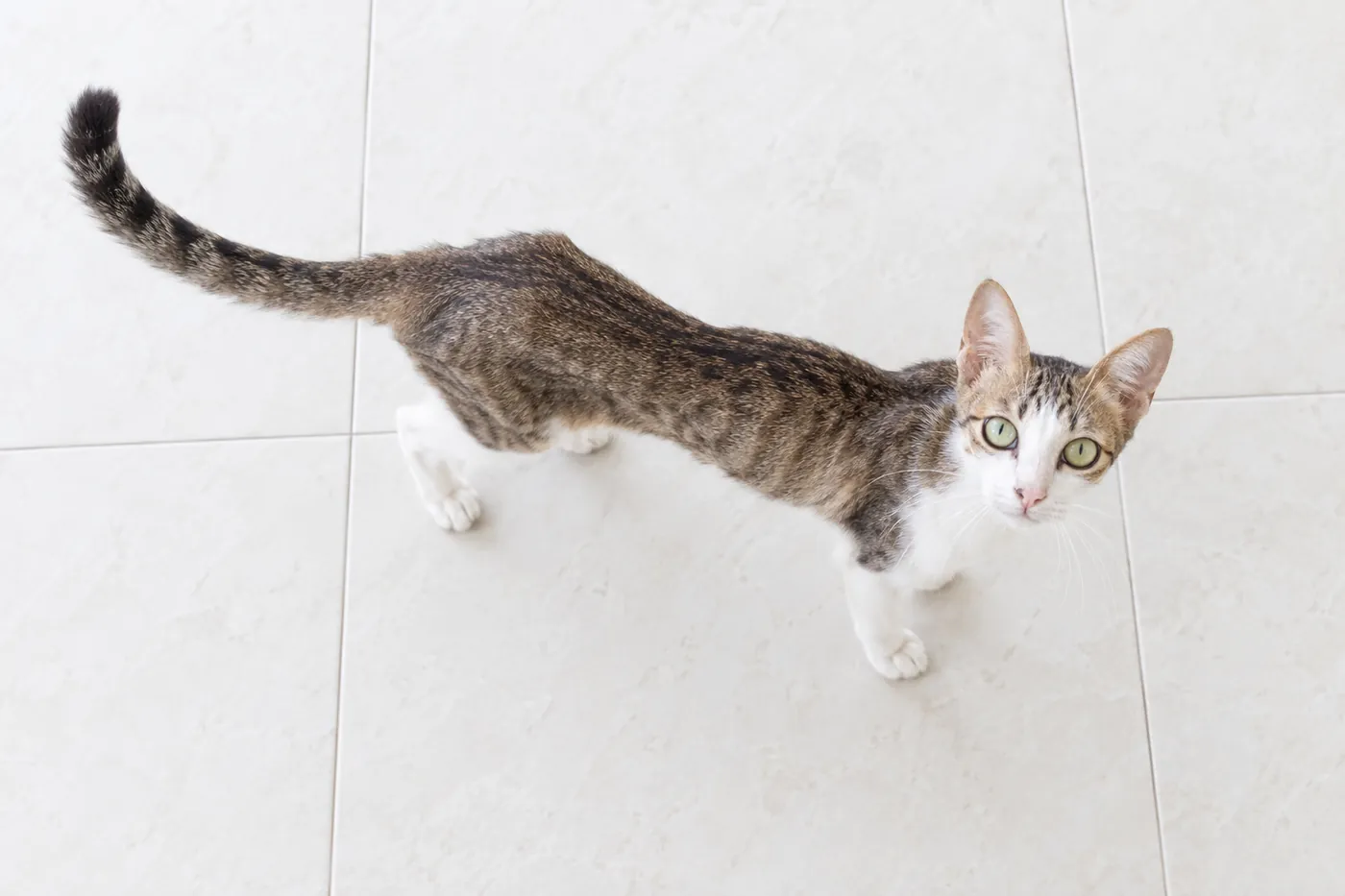
A growing cat gets longer and taller while the waist stays visible. A cat that has stopped growing but keeps gaining loses the waist first and the rib definition second.
Long coats hide all of this, which is why the assessment has to be done with the hands. A Persian or a Maine Coon can carry a considerable amount of extra weight invisibly.
Weighing at home, and what the curve should look like
Monthly weighing during the first year turns a vague impression into something you can act on.
A digital kitchen or baby scale is accurate enough, and precision matters most while the numbers are small. Weighing yourself holding the cat and subtracting works, but the error is large relative to a kitten.
Very young kittens gain in the region of a hundred grams a week. That rate falls steadily through the first year, so a flattening curve after eight months is expected rather than alarming, and the direction matters more than any single reading.
- Weigh on the same scale at the same point in the day, because a full stomach and bladder shift the reading
- Record the number rather than remembering it, since the trend is what matters and the trend is easy to misremember
- Add a body condition check to each weighing, because the two readings together mean far more than either alone
- Treat a stall or a loss during the growth window as a reason to book a vet visit, not to feed more
- Keep weighing after the frame finishes, since this is when quiet weight gain starts
Stalled or falling weight in a kitten is a clinical sign rather than a feeding puzzle. Parasites, poor absorption, congenital problems and dental pain all present this way, and all of them need diagnosis rather than a bigger bowl.
Once a cat is grown, weight change becomes one of the most useful signals available to an owner. Losing weight while eating normally is a classic early presentation of hyperthyroidism and of several other conditions among the signs a cat is ageing.
When to move from kitten food to adult food
The first birthday is the usual point to review the diet, and nothing requires the change on that exact day.
Kitten diets are formulated for growth and usually carry more energy per portion than adult-maintenance diets. The right transition depends on whether the food is labelled for growth or all life stages, the cat's body condition and the veterinarian's assessment.
For most cats, around twelve months is the standard time to review the diet because AAHA and AAFP define kittenhood as birth to one year. A large breed name alone does not prove that growth food is needed until eighteen months or two years.
The complication is that neutering usually happens well before the switch. A neutered kitten still needs a growth diet but needs measurably less of it. The portion comes down while the food stays the same, and that distinction is where most young cats gain their first unnecessary kilogram.
- Review the cat's growth record, body condition and current food label with your veterinarian around the first birthday.
- Work out the daily amount for the new food from the cat's current weight and condition, not from the amount it was eating before.
- Mix a small proportion of the adult food into the kitten food and increase it across seven to ten days, which gives the gut time to adapt.
- Weigh and body-condition score two weeks after the transition finishes, and adjust the portion from what you find.
- Split the daily amount across meals rather than free-feeding, so that a change in appetite is visible immediately.

The daily amount starts from the cat's daily calories and becomes a weighed portion through how much to feed a cat of that particular food. If the switch also means choosing between wet food or dry food, the portion has to be worked out again for the new format.
Cats that came off milk unusually early sometimes reach this stage from a different starting point, depending on when they started eating solid food.
What a finished frame changes around the house
Adult size decides equipment, and equipment bought during the lanky stage frequently stops fitting.
A carrier is the clearest example. A cat that fitted comfortably at eight months may not be able to turn around in the same carrier at eighteen, and it will be a considerably less cooperative passenger for it.
The projected adult is the one to buy for, judged from the parents or the breed range rather than the current measurement. Choosing a carrier comes down to a few dimensions, and airline carriers add constraints that only apply to flying.
The same applies to litter trays, which need to be about one and a half times the cat's body length excluding the tail.
Getting that wrong is a common and entirely avoidable cause of tray refusal. Scratching posts have a similar problem, because a post a cat cannot stretch out fully against stops being used.
The large breeds, and the claims made about them
Maine Coons, Ragdolls, Norwegian Forest Cats, Siberians and Savannahs are often described as slow to mature. The useful part of that claim is that adult size may be harder to predict early, not that every cat in those breeds shares one proven growth-plate schedule.
The sales claims attached to these breeds are less reliable. A kitten advertised as coming from unusually large parents will not necessarily grow unusually large, and photographs of an adult cat held against a person's chest tell you about the lens and the pose rather than the cat. The reliable evidence is meeting the parents and seeing the breed standard's stated range.
Large projected size has practical consequences even when the finish date is uncertain. Equipment should be bought at adult dimensions from the start, while diet duration should follow the individual cat, the food's life-stage statement and veterinary advice.
- Frame finishes
- No single breed-wide date is established for every growth plate
- Body shape
- Muscle, coat and body mass can continue changing after the first birthday
- Diet
- Review around twelve months and individualise from the cat's condition, growth record and food label
- Equipment
- Buy trays, carriers and posts at adult dimensions from the start
- Assessment
- Appearance is unreliable for years, so score condition by hand every month
Judging whether such a cat is overweight from its appearance stays unreliable for a long time. Hands-on condition scoring is the only assessment that works through that period.
The months after the frame finishes
The end of growth begins the period where weight becomes a health question rather than a development one.
Energy needs fall, activity often falls with them, and the portion that was correct at twelve months is usually too much at eighteen. Nothing announces this, which is precisely why it is missed.
The first sign shows at the waist rather than on the scale: the waist disappears well before the number becomes obviously wrong, and a monthly hands-on check catches the change while the correction is still a portion adjustment.
Adolescent behaviour runs on its own timetable through the same window, and coat changes on a third, so very little about a cat's first two years finishes tidily at once.
Common Questions
At what age is a cat fully grown?
Most cats enter the adult life stage around twelve months, but different growth plates close at different ages and body shape can keep changing afterwards. Use the cat's own growth record and body condition instead of a single universal finish date.
Does neutering make a cat bigger?
One radiographic study found three selected physes closing later in neutered males than in intact males, but not at two other physes or between spayed and intact females. The authors said the clinical consequences needed further study, so it cannot predict one cat's size.
How do I know whether my cat is growing or getting fat?
Use the weight and the body condition together. A growing cat gets longer while the waist behind the ribs stays visible from above; a cat that has stopped growing loses that waist first and rib definition second.
When should I switch from kitten food to adult food?
Around twelve months is the usual review point for most cats. Check the food's life-stage statement, the cat's growth record and body condition with your veterinarian rather than extending kitten food automatically because the breed is large.
Can I make my cat bigger by feeding it more?
No. Once the growth plates have fused the bone cannot lengthen, and extra food during the growth window produces the same adult frame carrying more fat rather than a larger cat.
My seven-month-old kitten looks thin and leggy. Is that normal?
Usually yes. The frame reaches close to its final length before the muscle fills it, so a cat in that window commonly looks unfinished. Check the ribs by hand and the waist from above, and see a vet if the ribs and spine are visible from a distance.
Checked Against
- AAHA and AAFP: 2021 Feline Life Stage Guidelines aaha.org
- Journal of Feline Medicine and Surgery: effect of neutering and breed on feline physeal closure pubmed.ncbi.nlm.nih.gov
- WSAVA: global nutrition guidelines and body condition score charts wsava.org
- Cornell Feline Health Center: feeding your cat vet.cornell.edu
- International Cat Care: neutering your cat icatcare.org
Published 10 September 2026. Last updated .