Why Is My Adolescent Cat Suddenly So Difficult?
Adolescent behaviour can reflect sexual maturity, normal activity, learning, stress, pain or the home environment. Which of these is behind it decides whether neutering, management or reward-based training helps, and illness has to be ruled out first.
Adolescence changes activity, social behaviour and reproductive behaviour, but it does not explain every new problem. Pain, urinary disease, fear and resource conflict can appear at the same age, so a record of what the cat actually does, when it happens and what changed beforehand is more useful than assuming every difficult behaviour belongs to one temporary phase.

When adolescence starts and how long it lasts
Sexual maturity and behavioural development vary with the individual, health, season and neuter status. A cat can be capable of breeding months before it behaves like an adult, and in that gap a young cat strong enough to act on every new drive has had little practice at handling any of them.
- First yearKitten life stage. Growth, learning and possible reproductive maturity overlap
- After maturity beginsCalling, spraying, roaming or escape attempts may appear in an unneutered cat
- Young adulthoodActivity and social relationships continue to change without one universal settling date
- At any ageSudden toileting, aggression, appetite or activity change still needs a health and environment check
The 2021 AAHA and AAFP life stage guidelines place the whole first year in the kitten stage and the following five in young adult. That grouping is deliberate, because the change from kitten to adult is a gradient rather than a birthday.
Physical growth and behaviour do not share one clock, and a breed's growth reputation does not predict when an individual's behaviour will settle. Waiting alone does not address a rehearsed habit, illness or conflict.
The behaviour that is driven by hormones
This group is the easier one to recognise, because it appears fairly suddenly and it has a smell, a sound or a direction to it. Spraying, calling, roaming and pushing at doors all belong here.
A spraying cat backs up to a vertical surface, stands with its tail upright and quivering, and leaves a small amount high up. It is a signalling behaviour rather than a toileting failure, and it has nothing to do with whether the litter tray is clean. Cats spray at boundaries, which is why doors, windows, new furniture and the bag a visitor left in the hall are the usual targets.
Calling is the female equivalent and sounds alarming the first time. A cat in season rolls, treads with the hind feet, raises her rear end and produces a loud repetitive cry that many owners mistake for pain. Cycles and intervals vary with season and the individual. An unneutered female needs secure indoor keeping through them, and the veterinarian can advise on timing and reproductive health.
| What you see | Hormonal signature | What usually changes after neutering |
|---|---|---|
| Small marks sprayed on walls, doors or furniture | Strong-smelling urine placed high and vertically | Often decreases, but learned marking, stress or other cats can sustain it |
| Loud, repetitive calling, often at night | Rolling, treading and a raised rear end in females | Cycles stop, and so does the calling that goes with them |
| Pushing at doors and bolting outside | Sustained interest in leaving rather than curiosity about the gap | Roaming distance drops sharply, though the learned habit can outlast the hormones |
| Sudden fighting with a familiar cat | Appears around social maturity in a household that was previously calm | Helps, but established conflict usually needs a separate plan |
| Mounting and gripping a housemate's neck | Directed, repetitive, and often resisted by the other cat | Usually resolves, though the pattern can persist as a learned habit |
The common thread is that all of it is communication with cats you may never see. A tom two gardens away is the reason a cat that has never been outside is spraying the front door.
Neutering: what it changes and when
Neutering removes reproductive hormones that contribute to calling, roaming and some marking, but it does not resolve every cause of those behaviours. A cat that has been spraying for half a year has also learned where it sprays, which surfaces hold the scent and which situations prompt it. Neutering removes the hormonal reason but not the habit, and the habit is what makes late intervention less predictable.
Traditionally the operation was done at around five to six months. Many practices now offer it from around four months, before sexual maturity rather than after it, and both timings are in ordinary veterinary use. The veterinarian weighs that choice against the individual cat's size, health and household.
Spraying can continue or begin after neutering because stress, conflict, learned locations and medical problems still matter. Persistent marking needs a veterinary and environmental review rather than a promise that one operation will stop it.
The behaviour that is driven by energy
The second group looks like chaos rather than signalling. Night sprinting, ambushing feet, clearing worktops, grabbing hands and biting mid-cuddle all sit here. None of it responds to neutering, because none of it is about reproduction.
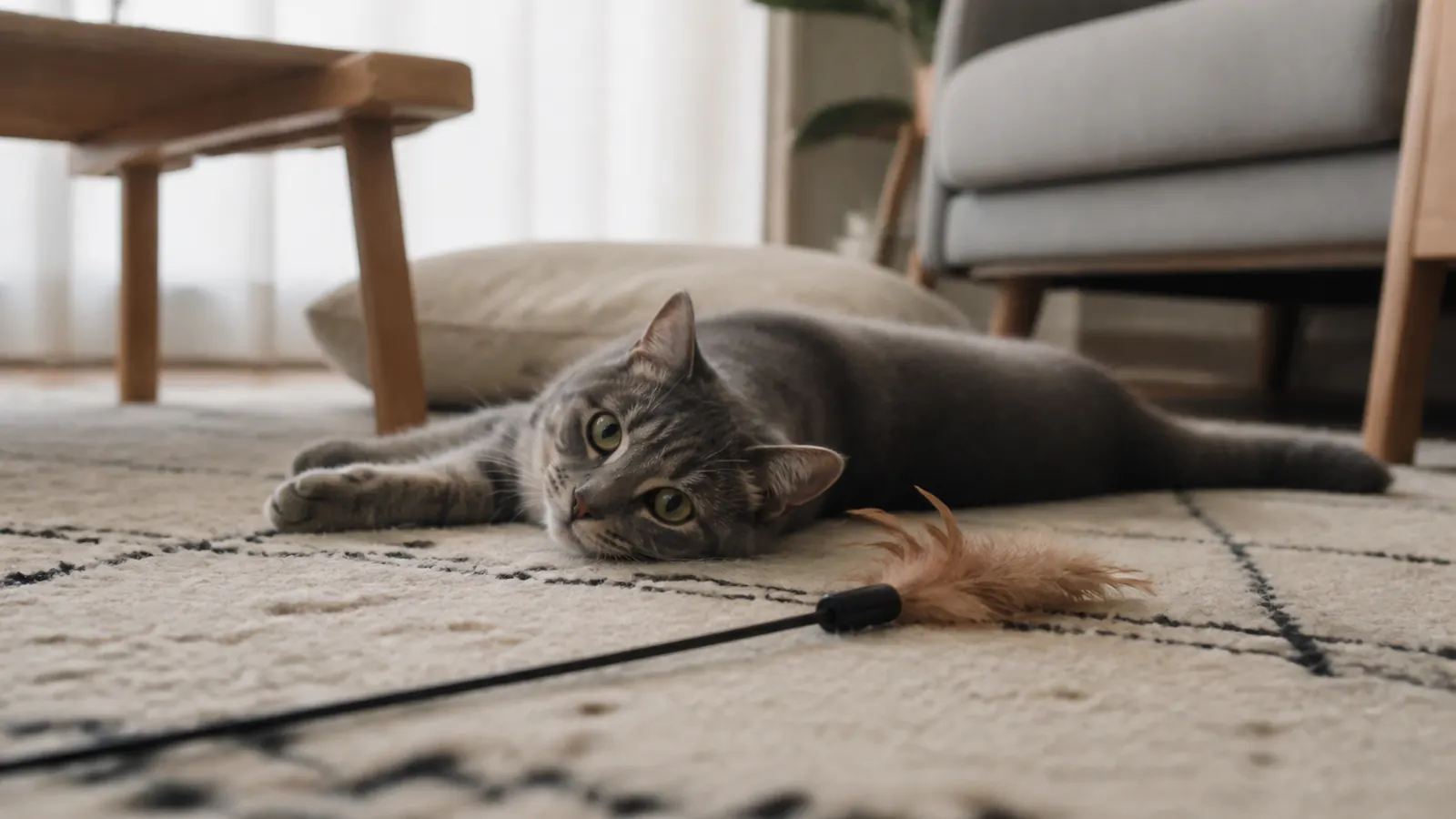
High activity, play motivation and repeated reinforcement can combine in a young cat. Two changes do most of the work: giving the arousal a legitimate outlet, and no longer rewarding ambushes or rough play with attention.
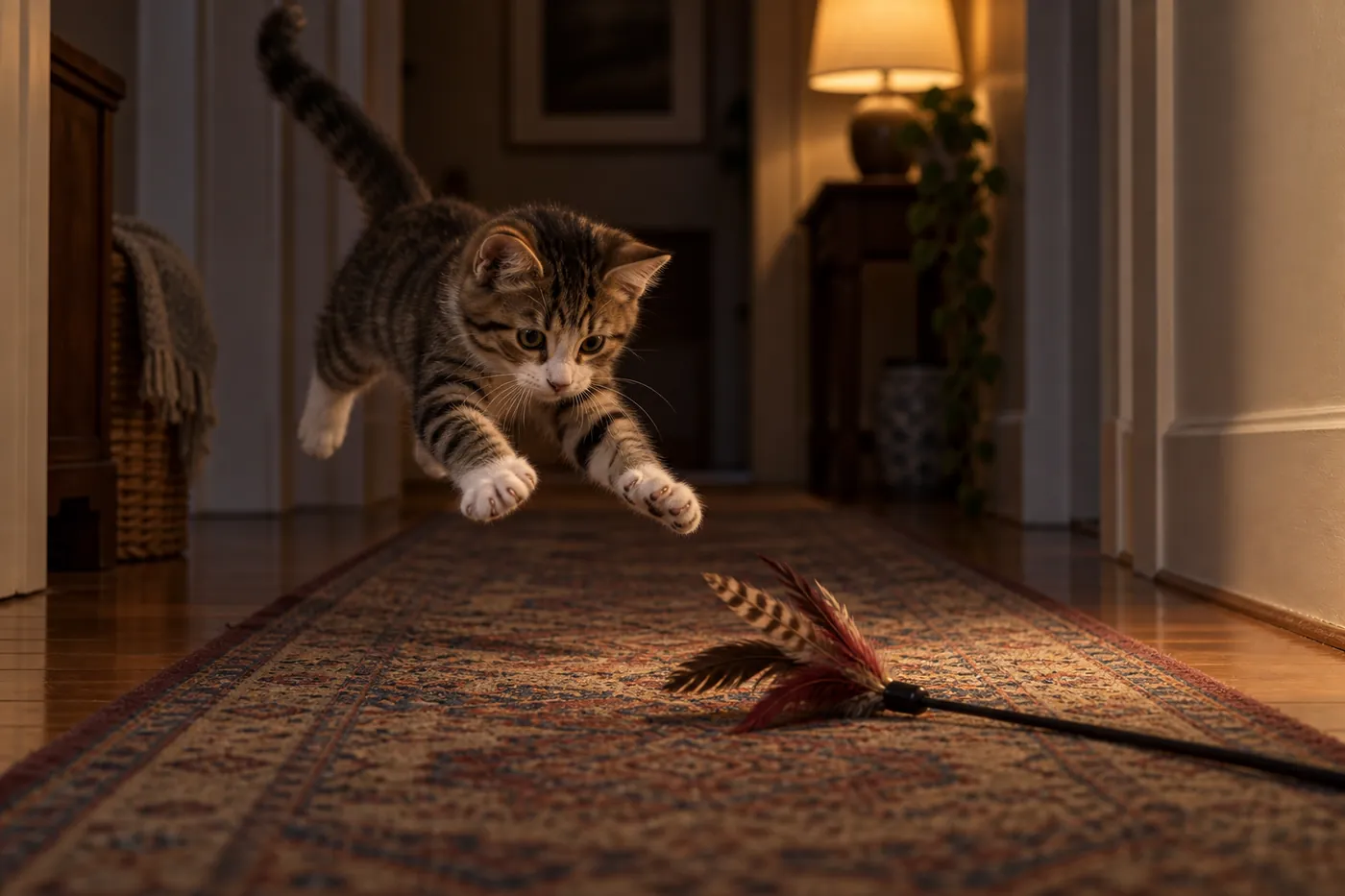
- Run short interactive sessions rather than long ones, and let the cat actually catch the toy at intervals so the hunting sequence completes rather than stalling in frustration.
- Time one session just before the cat's own peak, which is usually dusk and again around dawn, rather than after the trouble has already started.
- Feed a meal at the end of an evening session, taken from the daily allowance rather than added to it.
- Retire hands and feet as toys completely, including gentle wrestling, because an adolescent cannot reliably scale down a game an adult started.
- Give height and a scratching surface in the rooms where the trouble happens, not only in the room you would prefer them in.
- Keep a wand toy in each of those rooms so that redirecting the cat takes two seconds rather than a trip to a cupboard.
How much play a cat needs keeps changing as it ages, and grabbing feet in the hallway is common enough to be a pattern of its own, ankle ambushing.
Biting that arrives during affection is a different signal again, with a warning phase that is easy to miss: the tail and the skin over the back usually change before the teeth arrive in biting during petting.
Why the trouble peaks at night
Cats are crepuscular, which means their natural activity peaks around dawn and dusk rather than through the middle of the day or the middle of the night. An adolescent has more energy to spend in those windows and less ability to sit through them quietly. The four in the morning session is the dawn peak arriving on a cat that slept through the evening.
A substantial interactive session in the late evening, finished with a meal, shifts the cat's own schedule far more effectively than any attempt to ignore the behaviour.
Getting up works against that. Attention at four in the morning, even irritated attention, is the most reliable reward in the house at that hour, and a cat needs very few repetitions to learn it. An automatic feeder set for early morning takes the food motive out of the equation entirely.
What punishment does to an adolescent
Shouting, spray bottles, scruffing and tapping the nose all raise arousal in an animal whose problem is already too much arousal. A cat that is over-threshold does not learn the lesson being taught; it learns that the situation is unpredictable.
They also teach something specific and durable: that hands and your approach predict something unpleasant. That lesson is the behaviour change from this period most likely to become permanent, and it comes entirely from the punishment.
Redirection works where punishment does not, because it gives the cat a correct answer instead of only a wrong one. Clicker work is unusually effective at this age, for the same reason the cat is difficult: a young cat is highly motivated, learns quickly, and will happily spend that capacity on something you chose rather than something it chose. Brief voluntary sessions that end while the cat remains comfortable work better than a fixed daily duration.
Litter tray trouble at this age
This is where the two groups have to be separated carefully, because the wrong reading is expensive. Spraying and squatting are different behaviours with different causes.
A cat that squats and empties its bladder on a horizontal surface has a toileting problem rather than a marking one, and it is a medical question until a veterinarian has said otherwise. Cystitis, crystals and stress-related bladder inflammation are common in young cats and all of them produce exactly this picture.
- Spraying
- Standing, tail up and quivering, small volume, vertical surface, often near a door or window
- Squatting
- Crouched, normal or large volume, horizontal surface, often soft bedding or a bath
- Straining
- Repeated trips, small amounts, vocalising, licking. In a male cat this is an emergency
- Relinquishment risk
- Cats with urinary house soiling were found at roughly 6.9 times the risk of being given up
Once illness has been excluded, tray provision is the usual culprit. Adolescence is exactly when a marginal setup stops being tolerated, because the cat's standards and its confidence both change at once. One tray per cat plus an extra is a useful starting guideline, distributed so one cat or doorway cannot control every option, and the number and location then follow from actual use and conflict.

- One tray per cat plus a spare, placed in different rooms rather than beside each other
- Uncovered and large enough that the cat can turn around fully inside it
- Away from food and water, and away from a route another cat can block
- Scooped daily, with a full change and wash on a schedule rather than when it smells
- Unscented litter at a depth the cat can dig into properly
When a cat stops using a tray it previously accepted, tray refusal is easier to solve one change at a time, watching long enough to see whether use improves, because several changes at once hide which one mattered. That experiment never justifies delaying urgent medical care or leaving an unsafe setup in place.
Trouble with the other cat in the house
Conflict can emerge as a young cat grows, but timing alone does not diagnose social maturity. Pain, fear, blocked resources, outdoor cats and a poor introduction can produce the same change. When the change does come from a young cat maturing socially, neither cat is being difficult on purpose, and neither is going to concede simply because you would prefer it.
Separating the pair and reintroducing them slowly works better than waiting for them to settle it. Left alone they practise the fight rather than resolving it, and each repetition makes the next one more likely. Cats do not have a reliable mechanism for repairing a relationship after conflict, which is why time on its own is a poor plan.
Every resource that can be guarded is worth duplicating. Trays, water, food stations, beds and high perches all qualify, and a resource that exists only once creates a chokepoint where the fights happen.
- Separate the pair completely before starting, rather than supervising increasingly tense encounters
- Duplicate trays, water, food stations, beds and high perches so nothing has to be queued for
- Swap bedding between the two spaces so each cat meets the other's scent before it meets the cat
- Reintroduce through a barrier, feeding both cats at a distance they can each hold comfortably
- Shorten the distance only when both are eating calmly, and go back a step rather than pushing through a hiss
The barrier and distance sequence above is the same one used when one cat has started attacking another. Vertical space matters more than floor space here, and a tall, stable scratching post can double as a high perch that lets one cat move out of the other's way.
Doors, escapes and the outdoor question
Adolescence is when a cat that had never shown any interest in the front door starts waiting beside it. Entire cats will roam considerable distances, and the drive is strong enough to override recall, food and weather. Neutering reduces that sharply, but it does not remove the curiosity of a young cat that has already discovered the outside.
A microchip with current registered details is what gets a lost cat home, since a chip that points at an old phone number leads nowhere. If the cat wears a collar, a breakaway collar with a quick-release buckle lets it pull free when the collar snags.
The indoor or outdoor question is best settled deliberately rather than by accident. A door that gets opened once during a scuffle sets a precedent that is difficult to reverse, and an adolescent will test that door daily thereafter.
What settles by itself, and what does not
This is the distinction worth holding on to, because it decides whether waiting is a strategy or a mistake.
| Behaviour | Does waiting fix it? | What actually resolves it |
|---|---|---|
| Night sprinting and dawn activity | Partly, as arousal thresholds rise | An evening play and feed routine, applied consistently |
| Ambushing feet and hands | No, if it is being practised daily | Toy-only play plus predictable interception with a wand |
| Spraying | Rarely once established | Neutering early, plus enzymatic cleaning of every marked surface |
| Calling and roaming | No while the cat is entire | Neutering, then securing the escape routes the cat already knows |
| Fighting with a housemate | No, and it usually worsens | Reintroduction and duplicated resources |
| Sudden fearfulness | Sometimes | Check health and recent events first, as covered in fear periods |
| Counter surfing | No | Remove the reward, then give an equally high perch the cat is allowed |
The pattern is straightforward once it is laid out. Behaviour with a hormonal driver stops when the driver is removed, and behaviour that has become a practised habit continues until the habit is replaced. Wherever the table says waiting does not fix it, the behaviour needs an active plan, because time alone will not end it.
When to bring in a vet or a behaviourist
Any sudden change in toileting, appetite, grooming or sociability is a health question first. Pain and illness produce behaviour changes that look exactly like adolescence, and the age of the cat is not evidence against them. A young cat with a sore mouth, a full bladder or an itchy skin condition will look moody rather than ill.
A qualified feline behaviour professional is worth involving when cats remain in sustained conflict, anyone is being injured or a properly followed plan is not improving safety. The referral point depends on severity rather than a fixed number of weeks. A referral from the veterinarian is safer than choosing on marketing, because the title is not protected in most places and the qualification behind it is what matters.
While all of this is happening the cat's body is on a separate schedule again. Growth continues through the same months, and food and portion decisions belong to that period while the behaviour is taking your attention.
Common Questions
At what age does a cat's adolescent behaviour peak?
There is no reliable peak age for every cat. Sexual maturity, activity, learning and social change overlap, so judge the individual behaviour and rule out illness rather than waiting for a birthday.
Will neutering calm my cat down?
It often reduces reproductive calling, roaming and some marking, but does not resolve every cause of spraying or high activity. Ask the veterinarian about timing and investigate learned, medical and environmental causes too.
Why has my neutered cat started spraying anyway?
Stress, conflict, a cat outside the window, learned locations and medical problems can all contribute. A veterinary check and an environmental review should come before assuming the neutering procedure failed.
Is it normal for an adolescent cat to bite hard during play?
It is common, and it is also the point at which to stop offering hands. A young cat cannot reliably moderate a game once it has started, so the dependable fix is a wand toy the cat can actually catch rather than a firmer correction.
My adolescent has started fighting with our older cat. Will they work it out?
Usually not on their own. Conflict that begins around social maturity tends to be rehearsed rather than resolved, so separate the pair, duplicate every resource that can be guarded, and reintroduce them gradually.
Why does my adolescent cat go wild at four in the morning?
Cats peak around dawn and dusk, and an adolescent that slept through the evening arrives at the dawn peak with everything unspent. A substantial late-evening play session finished with a meal shifts that schedule better than ignoring the behaviour does.
Checked Against
- AAHA and AAFP: 2021 Feline Life Stage Guidelines aaha.org
- International Cat Care: problem behaviour in cats icatcare.org
- FelineVMA: setting up the environment for success catvets.com
- ASPCA: aggression in cats aspca.org
- Journal of Applied Animal Welfare Science: risk factors for relinquishment of cats pubmed.ncbi.nlm.nih.gov
- International Cat Care: neutering your cat icatcare.org
Published 10 September 2026. Last updated .