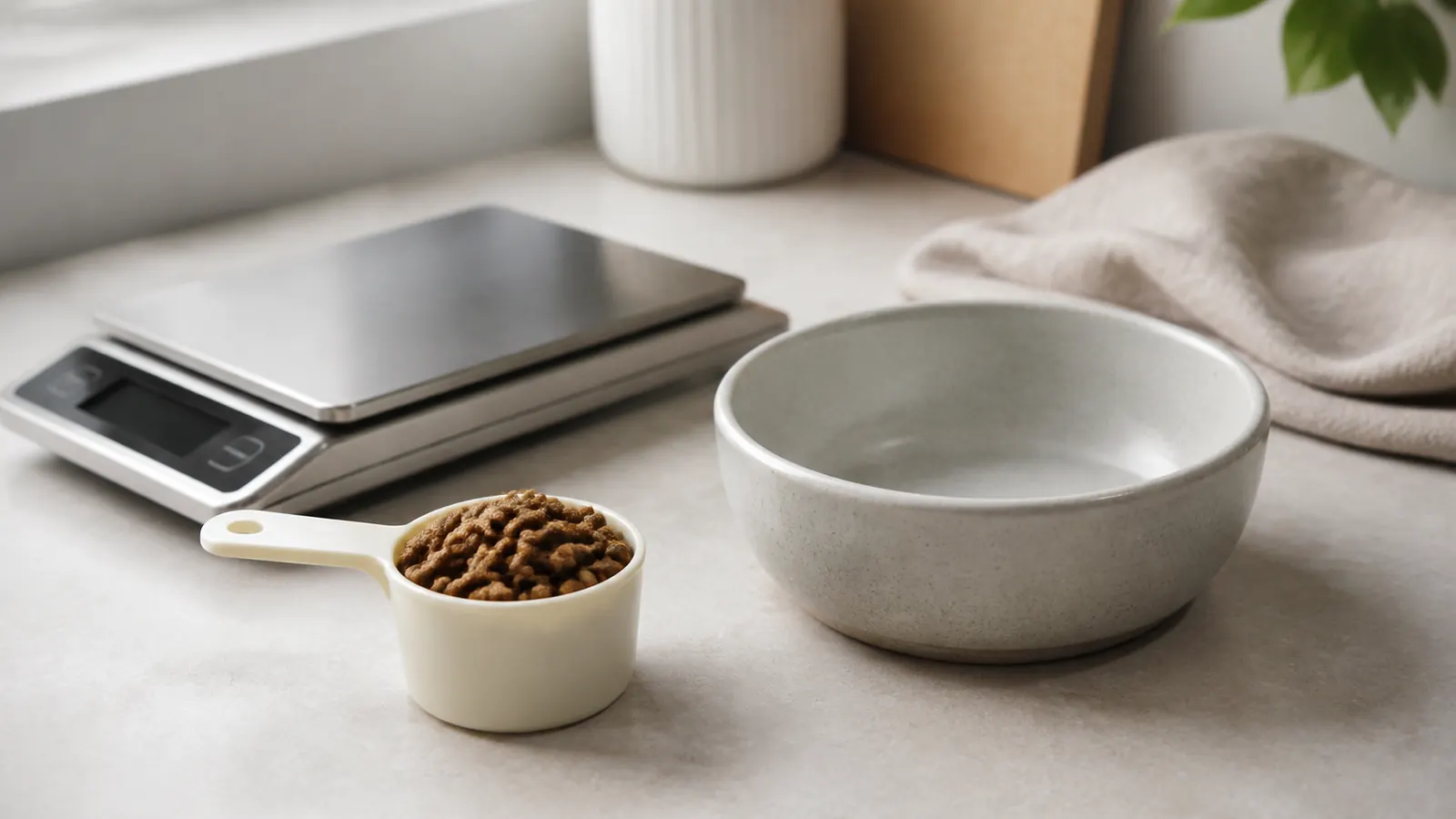
Calculating a Cat's Daily Calories, Step by Step
Use calories to estimate a daily ration, then refine it using your cat’s condition. Correct label units matter as much as the starting formula.
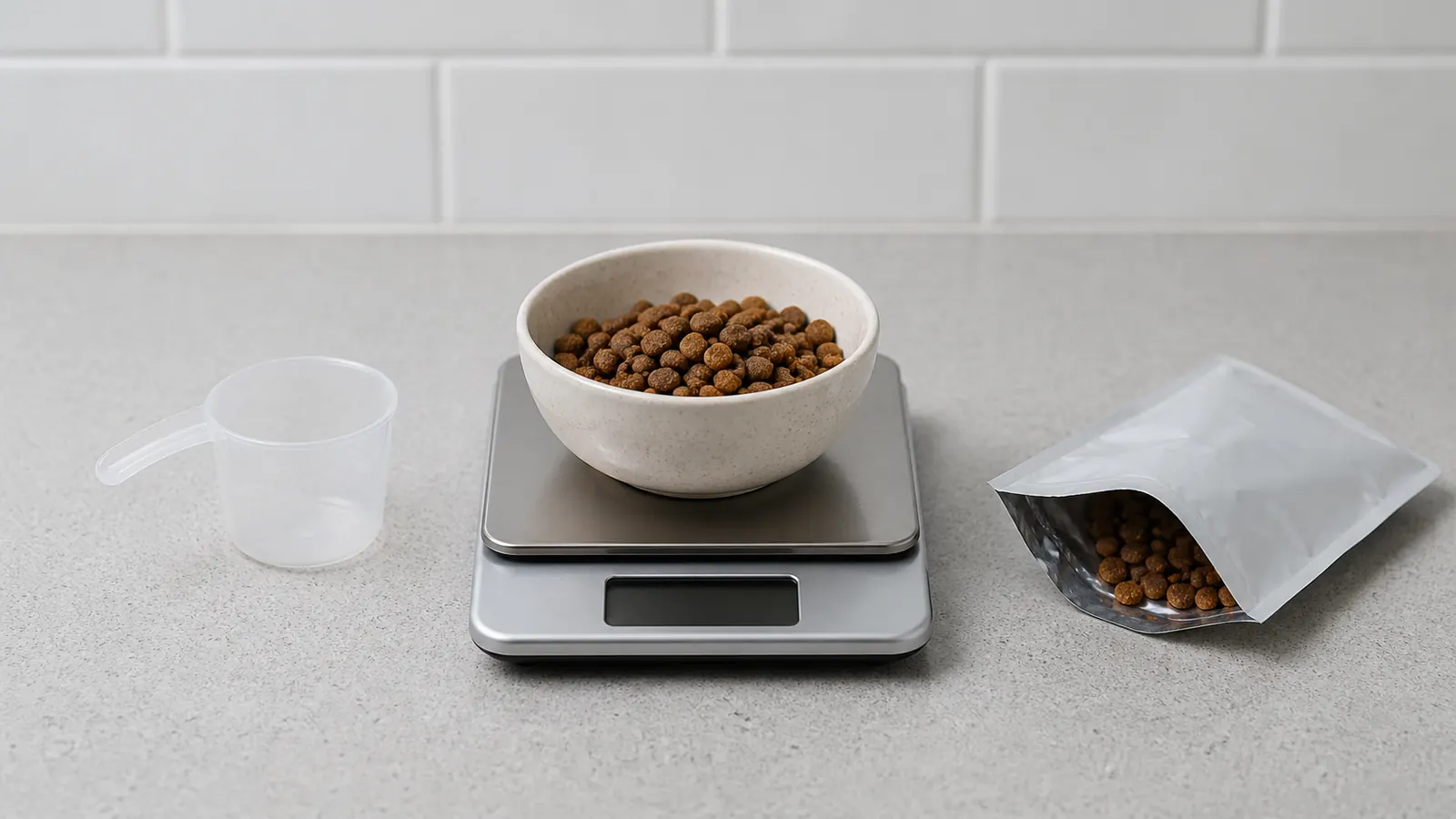
A calorie calculation gives a starting estimate, not a precise daily prescription. Estimate the needs of a healthy adult, convert the food's energy information into a weighed portion, then check whether weight, body condition and muscle condition remain appropriate.
Kittens, pregnant or nursing cats, cats needing weight loss and cats with illness need an individual feeding plan. Do not use an adult maintenance example to set their ration.
Start with a current weight and body-condition check
Weigh your cat and record the result in kilograms. If your scale uses pounds, divide by 2.205 to convert.
A weight is useful only in context: two cats at the same weight can have different frames and different amounts of fat and muscle.
Ask your veterinary team to demonstrate body and muscle condition scoring if you are unsure. An overweight cat's current weight is not automatically the correct weight to enter into a weight-loss plan, and choosing a target weight by appearance can lead to inappropriate restriction.
Calculate resting energy needs
A commonly used estimate is:
RER = 70 × body weight in kilograms raised to the power 0.75.
RER means resting energy requirement. Enter the weight, use the calculator's power function for 0.75, then multiply by 70.
For a 4 kg cat, the result is about 198 kilocalories per day. On food labels, a capital-C Calorie generally means the same energy unit as a kilocalorie, or kcal.
This estimate describes energy use at rest. It is not a guaranteed minimum that every cat must eat, and it does not include every influence on the daily ration.
Daily maintenance estimates apply a factor for the individual cat's life stage and circumstances; the eventual ration is adjusted using the cat's response.
Rather than selecting a factor solely because a cat is neutered or indoors, check the starting target with your veterinary team or the food manufacturer. Activity, body condition and individual variation matter.
A cat maintaining a healthy condition on a measured complete diet already provides useful evidence of its needs.
Convert calories into grams
Read the energy unit carefully. A label may report kcal per kilogram, per 100 g, per can or per pouch.
Convert it before dividing, or the portion can be wrong by a factor of 100 or 1,000.
| Label example | Conversion | Portion for a 220 kcal example day |
|---|---|---|
| 3,800 kcal/kg | Divide by 1,000: 3.8 kcal/g | 220 ÷ 3.8 = about 58 g |
| 380 kcal/100 g | Divide by 100: 3.8 kcal/g | 220 ÷ 3.8 = about 58 g |
| 85 kcal per pouch | Use kcal per whole pouch | 220 ÷ 85 = about 2.6 pouches |
These are arithmetic examples, not a recommendation that every cat needs 220 kcal. Use the energy information for the exact product and package size.
If it is absent, ask the manufacturer; an ingredient list or protein percentage cannot supply the missing figure accurately.
Combine wet food, dry food and extras
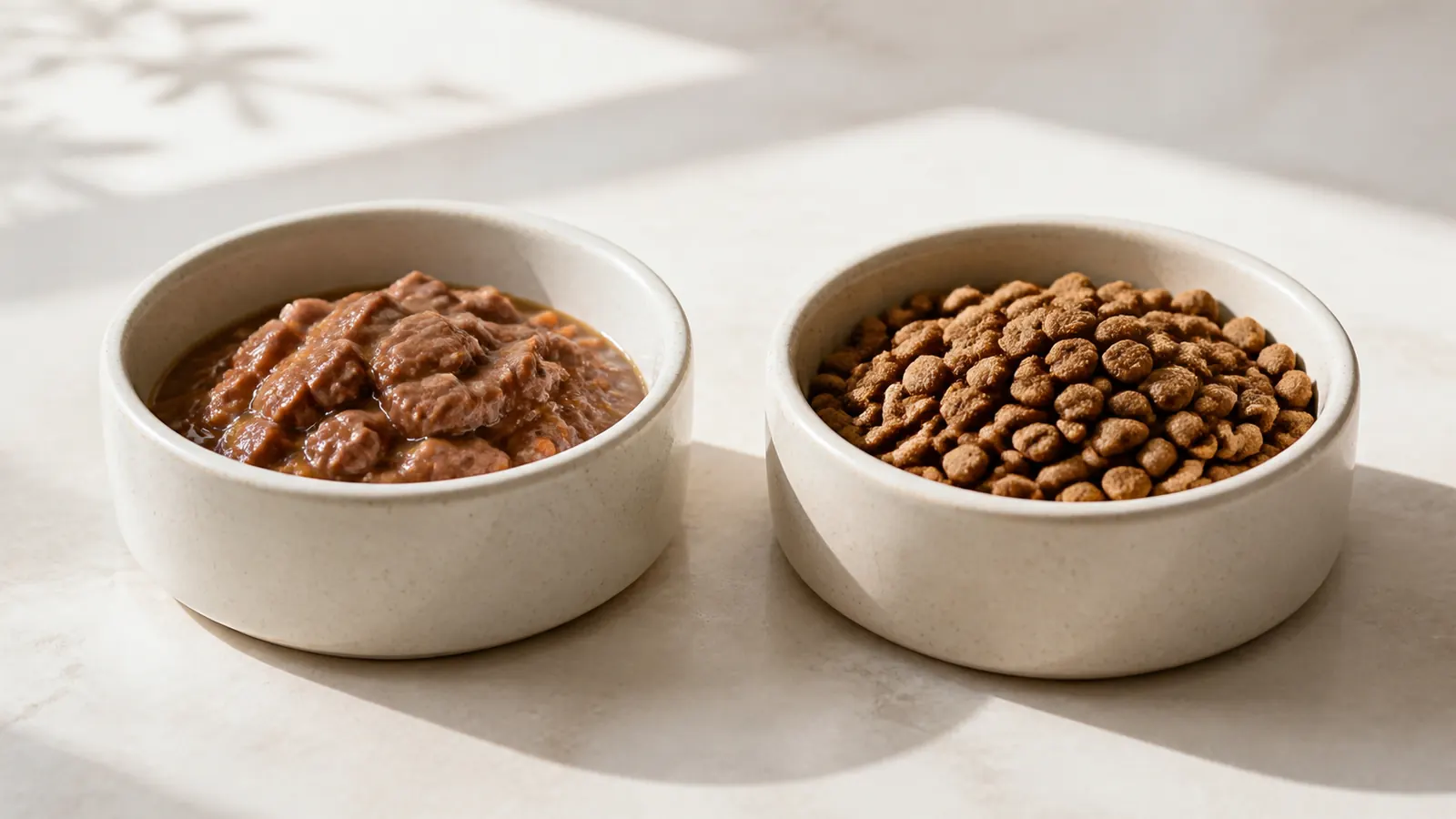
Suppose the agreed target is 220 kcal and the cat receives two pouches containing 70 kcal each. The pouches supply 140 kcal, leaving 80 kcal.
If the dry food supplies 4 kcal/g, the remaining dry portion is 80 ÷ 4 = 20 g for the day.
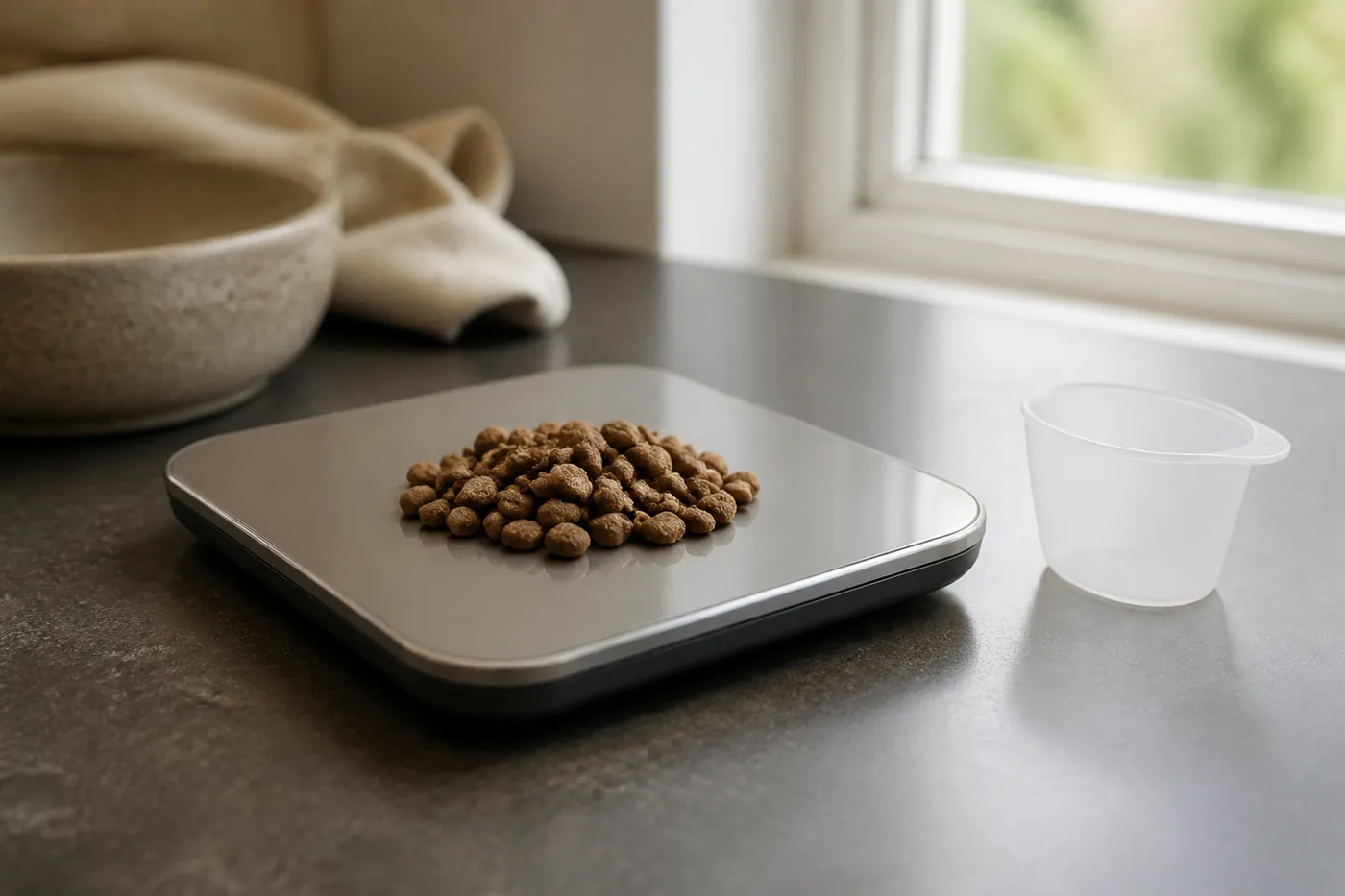
Count treats, food used for medication, table food and food taken from another cat. Keep ordinary treats below 10% of daily calories, with the main intake from complete food suited to the cat.
A therapeutic feeding plan may require stricter limits or particular treats.
Split the total daily amount into the feeding opportunities that suit the household and cat. Do not serve the calculated full-day ration at each meal.
The portion-size guide covers practical meal division and tracking who eats what.
Adjust using the trend
Record the amount actually eaten and weigh your cat consistently. Compare the trend with body and muscle condition rather than reacting to one small scale fluctuation.
If a healthy adult is drifting away from a suitable condition, discuss a modest ration adjustment and recheck its effect.
Do not cut food abruptly or use hunger as a way to force acceptance of a new diet. Poor appetite, unplanned weight loss, excessive thirst or a major change in hunger needs veterinary assessment.
A cat can lose muscle even when the scale seems reassuring, and a medical problem cannot be corrected safely by repeatedly changing the calorie number.
There is no universal birthday on which every cat needs a large ration cut. Growth, ageing and activity change at different rates.
Recalculate when the food or circumstances change, and use your cat's continuing condition to refine the estimate.
Common Questions
How do I convert kcal per 100 g into a portion?
Divide kcal per 100 g by 100 to get kcal per gram, then divide the daily calorie allocation by kcal per gram. At 380 kcal per 100 g, a 220 kcal allocation is about 58 g.
Is RER the minimum my cat must eat?
No. It is an estimate of resting energy use, not a universal minimum intake or a complete feeding prescription.
Can I use this for weight loss?
A veterinarian should set the target weight and feeding plan. Do not assume the adult maintenance example or a self-chosen target weight provides safe restriction.
Checked Against
Published 2 September 2026. Last updated .