Cat Airline Carriers: Which Ones Airlines Accept
Confirm that your cat can travel safely and that its carrier meets the operating airline's rules for the exact flight. Both the cat's space and ventilation needs and the airline's limits must be met.
Check the destination before the airline
Check the official import rules for the destination and any transit country before booking. Depending on the route, these may require identification, vaccinations, blood tests, permits or quarantine, with waiting periods that cannot be shortened to match a ticket.
The order and starting date of each requirement vary. For example, some routes require the microchip before the rabies vaccination and count a waiting period from a blood draw; do not assume a laboratory result starts every country's clock.
Ask your veterinarian to work backwards from the intended arrival date, then confirm animal space and equipment with the airline. Keep the official requirements and written airline confirmation together.
The rules come before the product
Cabin and hold are two different problems with two different carriers, and the airline decides which applies.
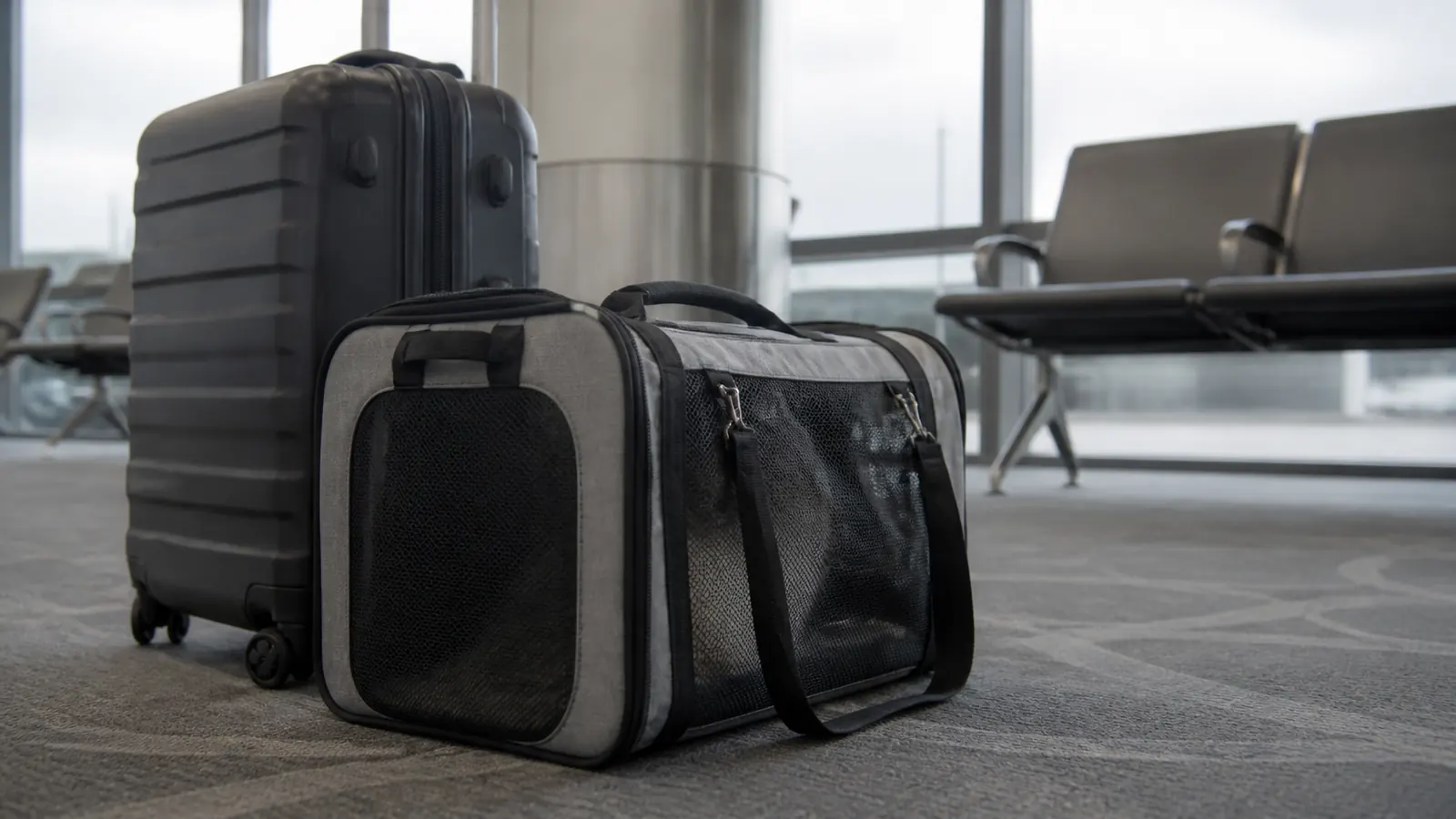
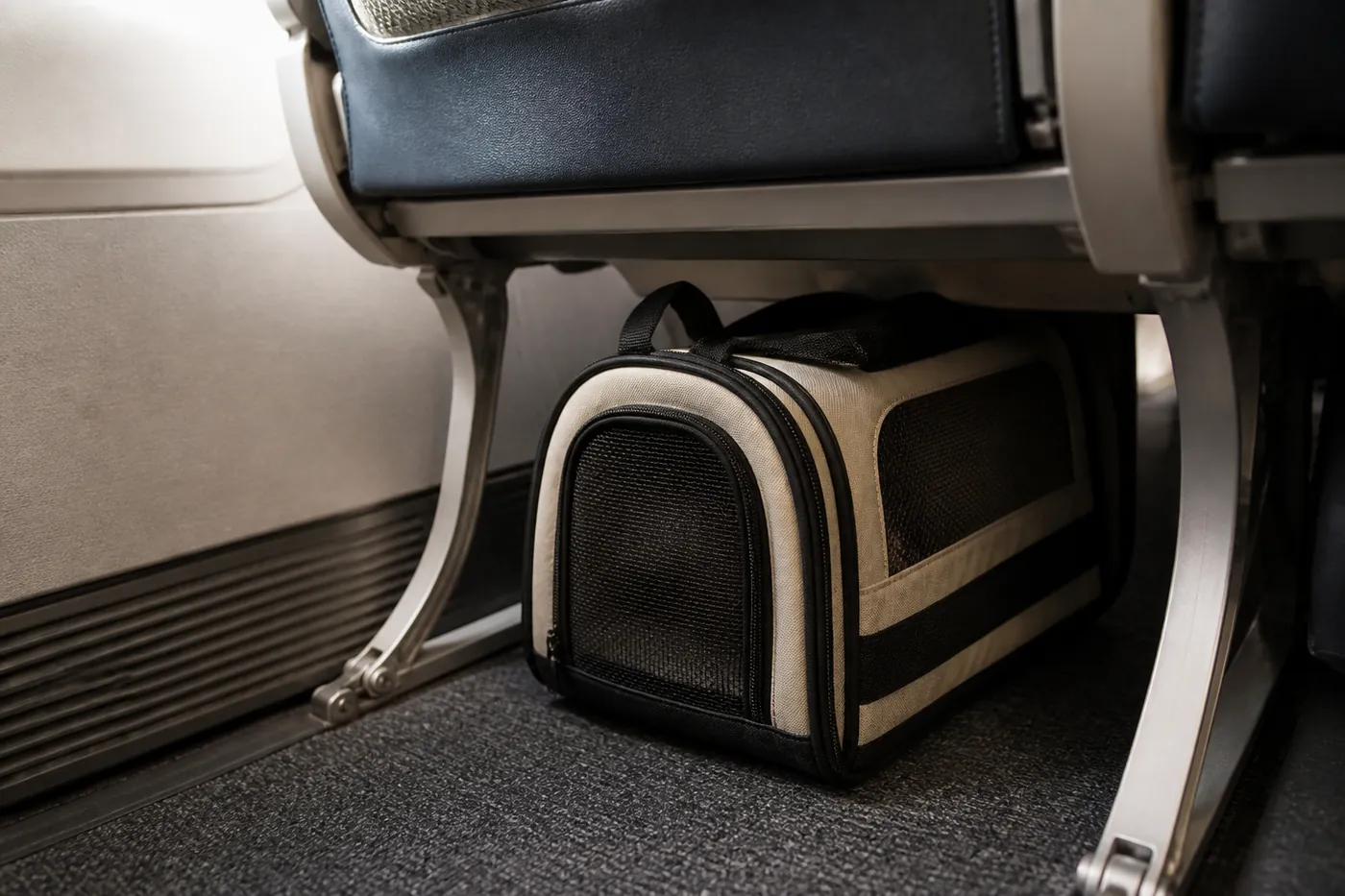
In the cabin, the carrier must fit under the seat in front. The maximum dimensions vary by airline and by aircraft, are usually smaller than they look, and accepted carrier types vary.
A soft carrier must not be compressed so far that the cat loses space or ventilation.
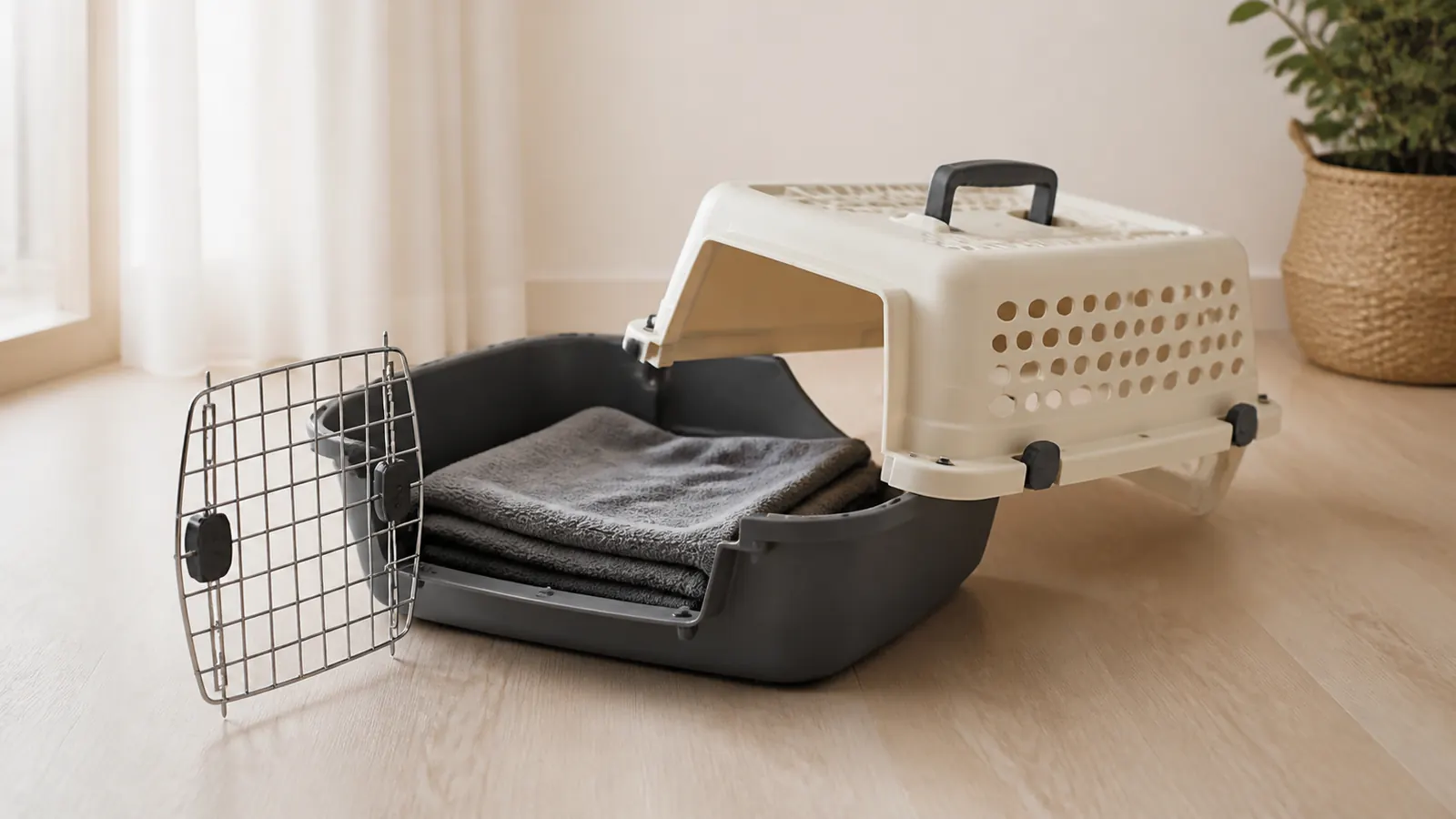
In the hold, the carrier must be rigid, ventilated on multiple sides, and secured with bolts rather than clips. Airlines that accept animals in the hold generally require a container meeting the IATA Live Animals Regulations.
Confirm the numbers with the airline for your specific flight before buying anything. Codeshares are the common trap: the rules that apply are the operating carrier's, not the one on the ticket.
What the carrier itself has to do
The carrier must satisfy the current species-specific requirements and any stricter airline rules.
Standing room must be assessed with the cat inside, including the bedding. The cat must be able to stand without its ears touching the roof, turn around completely, and lie flat with its legs extended.
Measure the cat rather than the box. Height is taken to the top of the head with the cat standing, and length from nose to tail base plus a margin, and it is the height that most cabin carriers fail on.
Fastening is the other requirement people meet loosely. Hold carriers are bolted rather than clipped because a clipped shell can spring under pressure in handling, and cable ties on the door exist so the door cannot be opened accidentally by anyone but a person cutting them.
Both ventilation area and placement matter. Check the current IATA container requirement and airline instructions; the 2026 dog-and-cat requirement calls for ventilation on all four sides.
Openings must also prevent escape or a paw protruding, and must not be blocked by luggage or covers.
The floor requirement is about what happens if the cat is sick or wets. A loose towel slides into a corner and leaves the cat on bare plastic, while a fitted absorbent pad stays where it was put.
- Dimensions
- Confirmed against the operating airline and aircraft, in writing
- Standing room
- The cat can stand, turn, and lie flat, which is also a legal requirement in the hold
- Ventilation
- Check area, all required sides and unobstructed openings against the current airline and IATA requirements
- Fastening
- Hold carriers bolted, not clipped, with cable ties on the door
- Floor
- Solid and absorbent, with a fitted pad rather than a loose towel
- Labelling
- Live animal labels, destination, and your contact details
- Water
- A fixed bowl reachable from outside for hold travel
A soft carrier used in the cabin still needs a firm base. A floor that sags under the cat makes the whole journey unstable, which is the thing cats object to most.
Labelling the crate
A hold crate travels without you, and everything a handler needs to know has to be written on it.
Use every label and orientation mark required by the operating airline and the current IATA container rule. Do not copy a generic label set without checking the booking instructions.
Add your name, both phone numbers, the destination address, and the flight number. A handler who finds a crate separated from its paperwork needs to be able to act on the box alone.
Write feeding and watering instructions on the crate as well, along with the time the cat last ate. Confirm who will provide water during handling and connections, and how the container must make it accessible.
Attach a small bag of food to the outside, taped securely, for any journey with a connection or a possible delay.
Paperwork travels with the carrier
Requirements vary by country and change, so check the current rules for both the origin and the destination well ahead.
International requirements vary by origin, transit point and destination. Use the relevant government import page to confirm identification, vaccination, testing, permit and certificate requirements in their required order.

Some destinations require a rabies antibody titre test and a waiting period. Starting before the official timetable is confirmed can still create an invalid sequence, so work backwards from the current rule with the veterinarian.
Ask the issuing veterinarian when to book each appointment. A certificate may have a narrow validity window, while earlier identification, vaccination or testing can require a much longer lead time.
Cabin or hold, and how to decide
Where the cat travels changes the equipment, the cost, and the risk, and the choice is often made by the airline rather than by you.
In the cabin the cat stays under the seat in front of you for the whole flight. Spaces are limited and should be booked early, and there is usually a weight limit covering the cat and carrier together.
In the hold the cat travels in a pressurised, temperature-controlled compartment in an approved crate. Some airlines require this for animals that cannot travel in the cabin.
Suitability depends on the cat, route, weather and handling arrangements.
Some airlines or routes apply temperature or seasonal restrictions. Confirm the rule for every airport and travel date because ground handling conditions, not only cabin temperature, affect acceptance.
Direct flights are worth paying for. Most of the difficulty in air travel happens on the ground, and a connection means a second set of loading, unloading, and waiting.
| Cabin | Hold | |
|---|---|---|
| Caregiver access | You are nearby, but the carrier stays closed | You cannot monitor the cat during flight |
| Carrier | Soft, under-seat dimensions | Rigid, bolted, IATA specification |
| Limits | Airline-specific size and weight rules | Airline and route-specific container and handling rules |
| Booking | Animal space may be limited | May be booked as cargo or accompanied baggage |
| Temperature restrictions | Check the exact airline and route | Often more relevant because of ground handling |
| Cost | Confirm all animal and baggage fees | Confirm crate, handling and cargo or baggage fees |
What happens at the airport
One part of the process surprises almost everybody, and it is worth preparing for.
Security procedures vary by airport and country. The carrier may need separate screening, so ask for the secure procedure before opening it and request a private room when available.
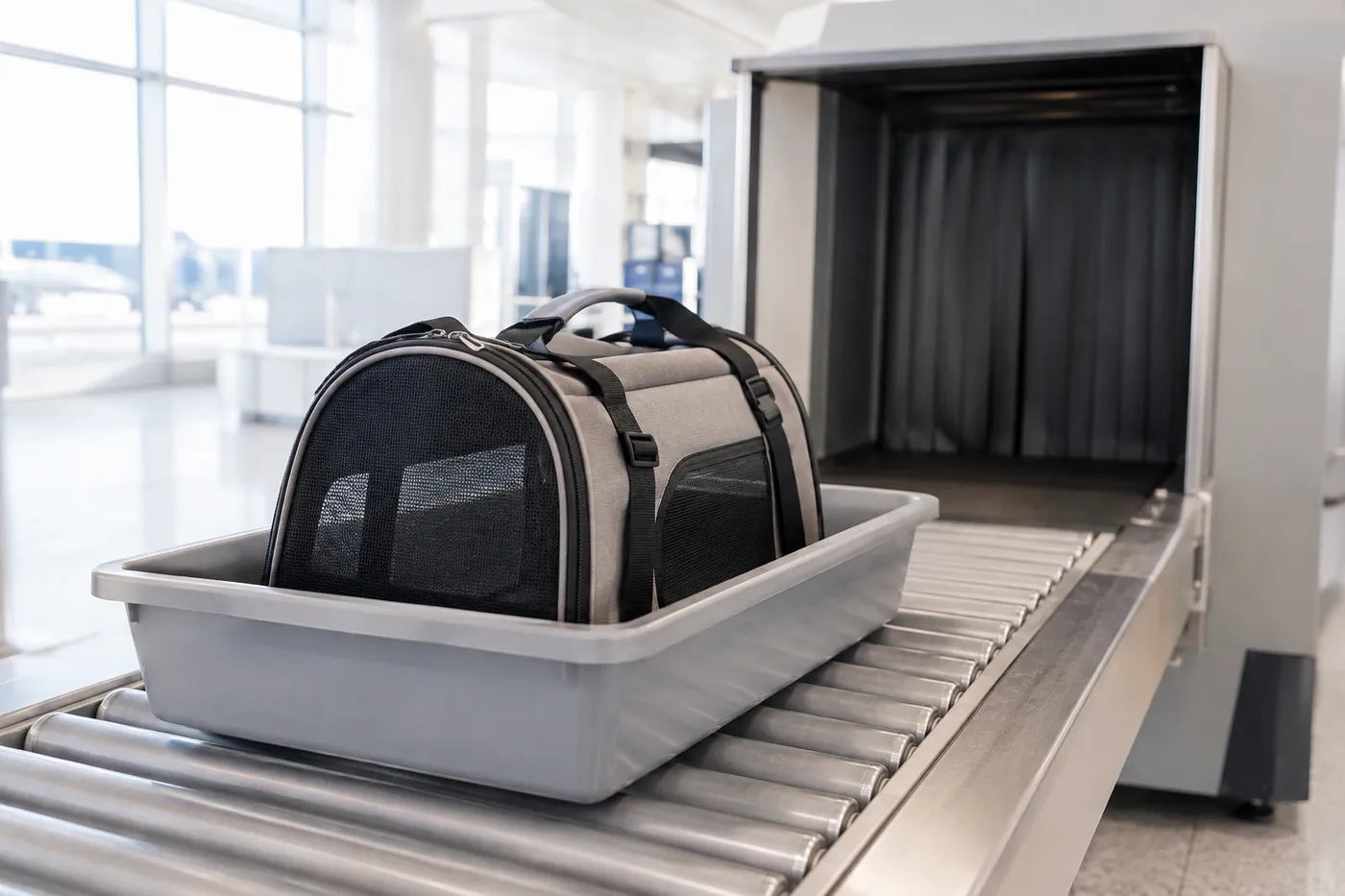
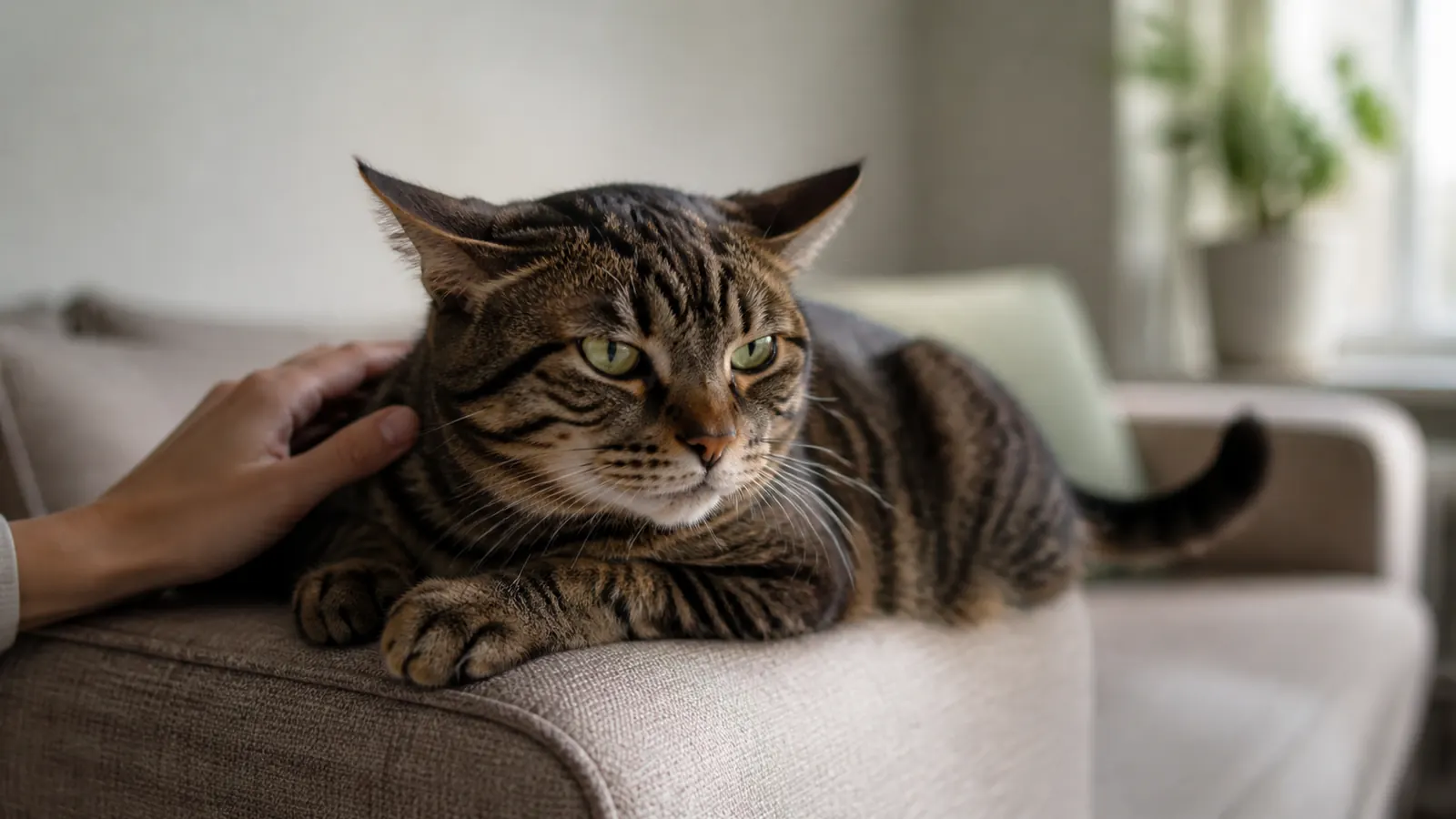
If staff require the cat to leave the carrier, escape prevention matters. Ask the airport and airline whether a fitted harness, lead or private room is compatible with their screening process.
Ask for a private screening room. Procedures vary by airport.
Ask staff how they can provide secure screening before opening the carrier.
- Fit a harness and lead before joining the security queue, not at the front of it.
- Ask staff for a private screening room as soon as you reach the checkpoint.
- Keep a firm hold of the lead and the cat while the carrier is scanned.
- Put the cat straight back in and check the door is properly closed.
- Carry spare absorbent pads, and change one after security if needed.
- Offer water at the gate, and expect the cat not to take it.
Preparing the cat
The carrier should be an ordinary piece of furniture long before the journey, and this is the part with the largest effect on how the flight goes.
Start as early as practical and let the cat's comfort set the pace. Marker training can reward voluntary entry, but it does not guarantee readiness by a ticket date.
- Leave the carrier open at home long enough for calm voluntary use, with familiar bedding inside.
- Feed meals in it so the cat goes in for its own reasons.
- Practise short car trips that end back at home rather than at a vet.
- Put an unwashed item that smells of home inside for the journey itself.
- Withhold food for a few hours before the flight, on veterinary advice, but never water.
Do not sedate a cat for a flight unless a vet has specifically advised it. Sedatives affect temperature regulation and blood pressure at altitude, and most airlines and veterinary bodies advise against routine sedation.
If using a feline pheromone spray, follow its label and let the carrier air before the cat enters. It may help some cats but cannot replace preparation or a veterinary travel plan.
After the flight
Arrival is not the end of the journey from the cat's point of view, and the first days matter.
A cat may be tired or unsettled after flying; dehydration or illness should not be assumed to be a normal consequence. Offer water immediately, expect it to be refused at first, and do not force food.
Set up one quiet room before the cat is released, with its own tray, water, familiar bedding, and a hiding place. That room does the same job as it does after a house move, giving the cat a small known space before the territory expands.

Give the cat a quiet place to settle and monitor eating, drinking, breathing and toileting.
Tray habits often slip in the same period, which the tray guide covers. Repeated accidents or straining need assessment rather than being dismissed as travel stress.
- Set up one quiet room before the cat comes out of the carrier: tray, water, familiar bedding, and somewhere to hide.
- Offer water immediately and expect it to be refused at first. Do not force food.
- Let the cat come out on its own rather than lifting it out.
- Expand access when the cat is eating, toileting and exploring comfortably rather than after a fixed number of days.
- Update the microchip registration with the new address on the day you arrive.
Seek emergency care for difficulty breathing or straining without urine. Call a vet promptly for repeated vomiting, marked lethargy or refusal to eat; do not wait two days, especially for a kitten or cat with an existing condition.
Have the details of a local veterinary practice before you arrive rather than searching for one afterwards.
Update the microchip registration with the new address as soon as you arrive. A chip pointing at a country you no longer live in is worth very little.
What it costs, and how to book
Air travel with a cat is more expensive than most people expect, and the costs arrive in several separate places.
The airline fee may be charged per animal, sector, container or weight and may sit outside the passenger ticket. Ask for the complete written quote and payment method before booking.
Veterinary costs can include identification, vaccinations, laboratory work, certificates and official endorsement. Which items apply and when they must occur come from the destination's current requirements.
Equipment costs depend on the approved container size and route. A hold container still has to meet the applicable IATA and airline requirements rather than merely being sold as airline approved.
Confirm animal acceptance before buying a non-refundable passenger ticket. Airlines may cap spaces or accept animals only on particular aircraft and routes.
- Ring the airline before booking the ticket, and get the rules in writing
- Confirm the operating carrier on any codeshare, since its rules apply
- Ask about seasonal embargoes for the months you are travelling
- Book the animal space at the same time as the seat, not afterwards
- Check import rules for the destination country and any transit country
- Book the veterinary certificate appointment as soon as the flight is confirmed
Delays, connections, and what to plan for
Plan for ground delays and connections as well as the flight itself.
A delayed flight with a cat in the hold is the scenario worth preparing for. Attach food to the crate, make sure the water container is fixed and reachable from outside, and write feeding instructions on the box itself.
For cabin travel, carry more absorbent pads than you think you need and a spare towel. A delay turns a two hour journey into six, and a soiled carrier with nothing to change it is a miserable way to spend that.
Avoid connections where the fare allows it. Every change means another loading, another unloading, and another period on a tarmac at whatever temperature that airport happens to be.
- Food taped to the crate, and a water container fixed and fillable from outside
- Feeding instructions written on the box itself, not on a sheet inside it
- More absorbent pads than you expect to need, and a spare towel, for cabin travel
- A direct routing where the fare allows one, because every change means another loading
- Paperwork, a photograph of the cat, and the microchip number in hand luggage
Keep the paperwork in your hand luggage rather than in a checked bag, along with a photograph of the cat and its microchip number. If the crate and the paperwork are separated, that photograph is what reunites them.
Whether to fly the cat at all
Flying is stressful for most cats, and for some it carries real risk.
For a short move, a car journey with overnight stops is usually kinder than a flight, and it keeps the cat with you throughout.
Where the cat cannot travel safely, a professional pet relocation service or a longer surface route is worth costing before assuming the flight is the only option.
Common Questions
What size carrier can go in an aircraft cabin?
It must fit under the seat in front, and the maximum varies by airline and aircraft. Confirm with the operating carrier for your specific flight before buying.
Can I sedate my cat for a flight?
Not unless a vet has specifically advised it. Sedatives affect temperature regulation and blood pressure at altitude, and routine sedation is generally advised against.
Which cats should not fly?
Flat-faced breeds are restricted or refused by many airlines, and cats with heart or respiratory disease or advanced kidney disease should be assessed before a flight is booked.
Checked Against
Published 2 September 2026. Last updated .