What Is a Neva Masquerade, and Is It a Separate Breed From the Siberian?
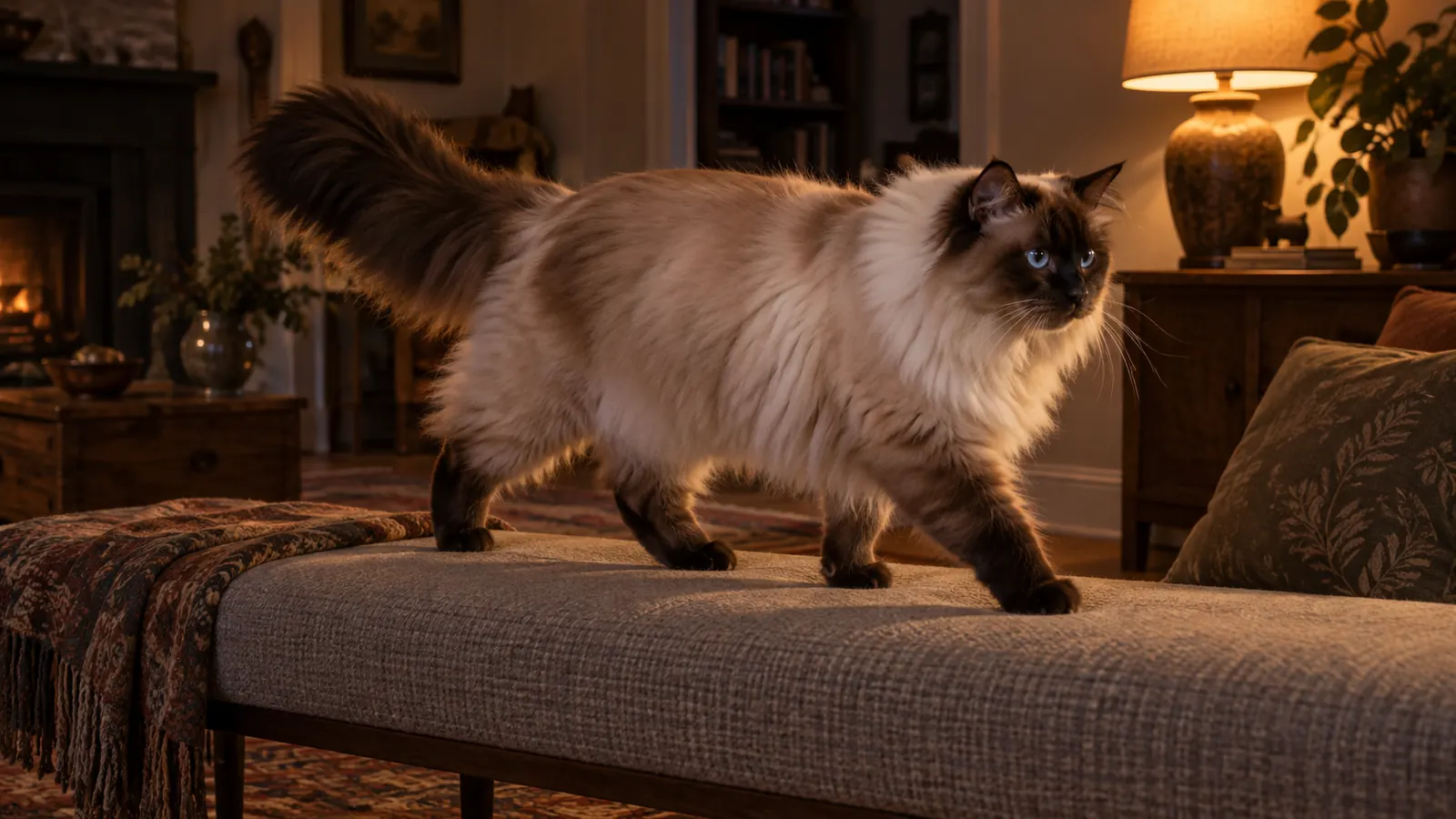
A Neva Masquerade is a colorpoint Siberian cat: the same powerful, slow-maturing body and seasonal triple coat as the Siberian, with a pointed coat pattern that restricts full colour to the face, ears, legs and tail. Some registries treat it as a separate breed name; others accept colorpoints within the Siberian standard. The ownership experience is a Siberian ownership experience in a pointed coat.
- Origin
- Russia, from colorpoint kittens appearing in Siberian litters; the name refers to the Neva River in Saint Petersburg
- Coat
- Seasonal semi-long triple coat with a water-resistant outer layer, awn hair and dense undercoat, in colorpoint pattern
- Size
- Medium-large to large, muscular and rounded, with powerful hindquarters and slow maturation
- Typical weight
- Consistent with the Siberian: CFA gives 8 to 12 pounds for females and 12 to 18 pounds for males
- Life expectancy
- Consistent with the Siberian
- Activity level
- Moderate to high; athletic, playful and capable of substantial jumps
- Grooming
- Moderate most weeks and intensive during spring and autumn coat release
- Suits
- Homes with climbing space, room for large equipment, interactive play and realistic allergy and health planning
A Neva Masquerade is a Siberian cat with a colorpoint coat pattern.
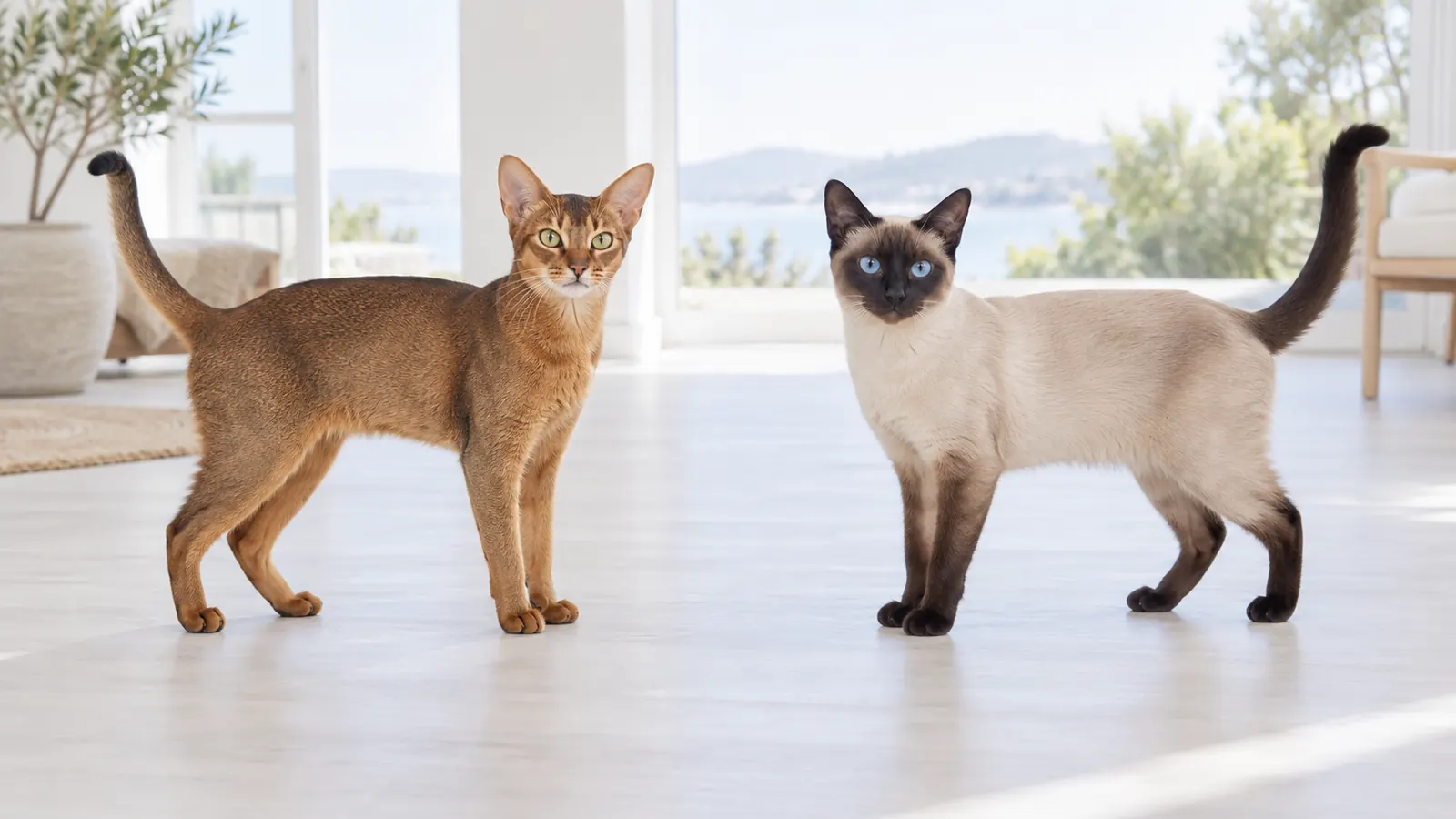
The body, temperament, health profile and triple coat are those of the Siberian. The difference is the pointed colour: darker pigment on the face, ears, legs and tail, with a lighter body, and blue eyes rather than the green or gold of a non-pointed Siberian.
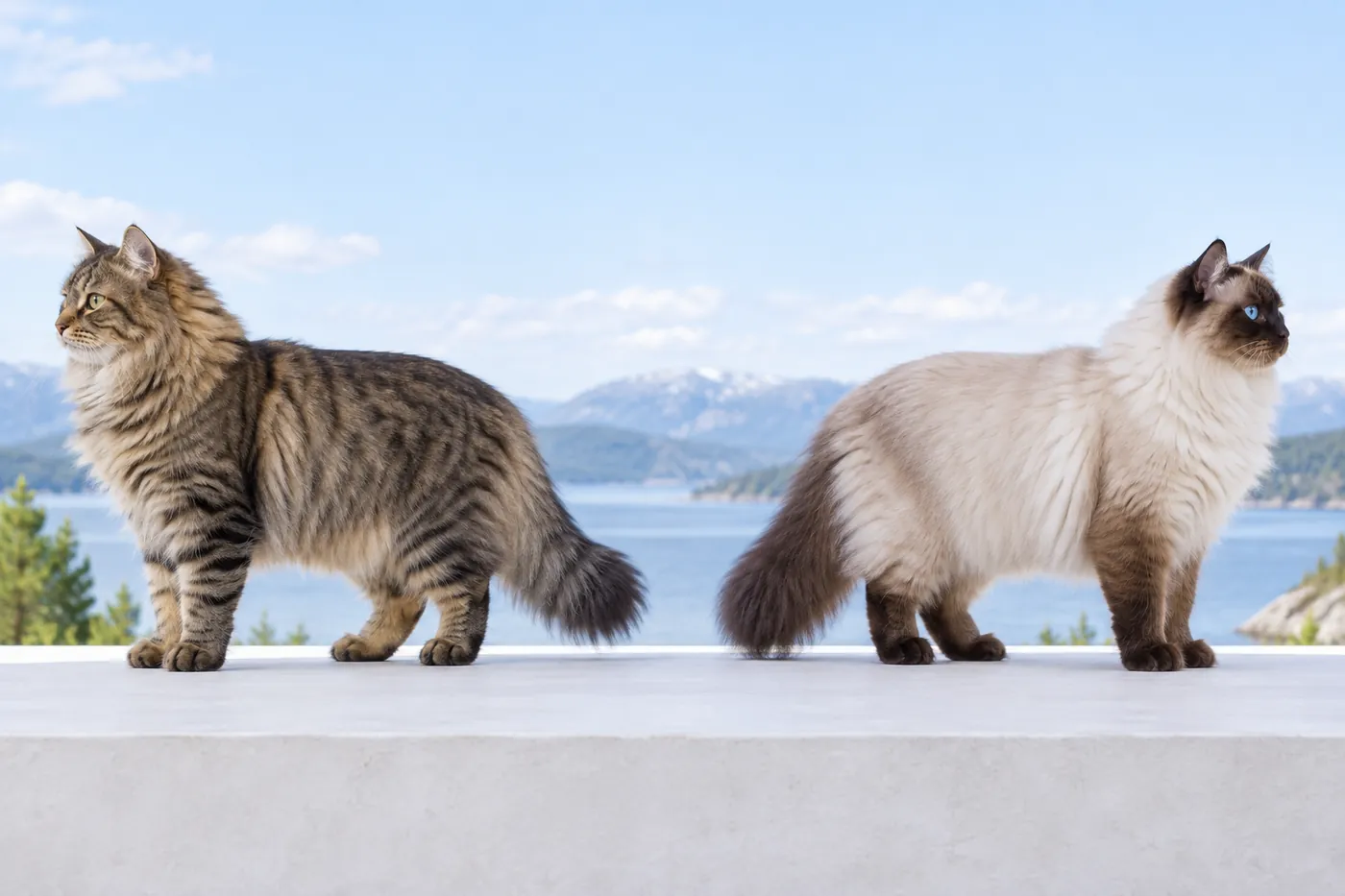
Whether the Neva Masquerade is a separate breed depends on which registry you ask. FIFe recognises it as a breed of its own, while CFA and WCF register the same cat as a Siberian.
What Is a Neva Masquerade, and How Do Registries Treat It?
Colorpoint kittens have appeared in Siberian litters in Russia for decades. The name Neva Masquerade refers to the Neva River in Saint Petersburg and the masked appearance the dark facial points create.
CFA and WCF accept colorpoint Siberians within the Siberian standard. CFA's standard lists seal, blue, flame and cream points among its accepted colours, and WCF names the Siberian and the Neva Masquerade together under a single breed code.
FIFe is the exception. It recognised the Neva Masquerade in 2011 as a separate breed, which it describes as the Siberian's pointed sister breed, so a pointed cat registered with FIFe carries the Neva Masquerade name rather than Siberian.
- WCF
- Listed with the Siberian under one breed code (SIB)
- FIFe
- A separate breed, recognised in 2011
- CFA
- Accepted within the Siberian standard
- Origin
- Russia, from colorpoint kittens in Siberian litters
- Genetic relationship
- A Siberian carrying the colorpoint (cs) gene
- Coat
- The same triple coat as the Siberian, in a pointed pattern
- Blue eyes
- Required, consistent with colorpoint genetics
The registration question matters if you plan to show or breed. For a pet household, the practical difference is colour: everything else about the cat is Siberian.
What Size, Build and Coat Does a Neva Masquerade Carry?
The body follows the Siberian standard: medium-large to large, muscular, barrel-chested and rounded, with powerful hindquarters that support substantial jumps.
The colorpoint pattern comes from the cs allele, the same allele of the tyrosinase gene that gives the Siamese and Balinese their points.
The gene encodes a temperature-sensitive form of tyrosinase, the enzyme that produces melanin. At normal body temperature the enzyme is largely inactive and the coat stays pale; at the cooler extremities it functions and deposits full pigment.
A Neva Masquerade carries two copies of cs (homozygous), which is why the pointed pattern breeds true when two pointed cats are mated. Crossing a pointed Siberian with a non-pointed one produces non-pointed kittens that carry cs as a hidden recessive.
Point colours include seal, blue, red, cream, tortie and tabby point variations.
The triple coat is seasonal: a neck ruff, britches and bushy tail become dramatic in winter, while the same cat may look much leaner after releasing undercoat in spring.
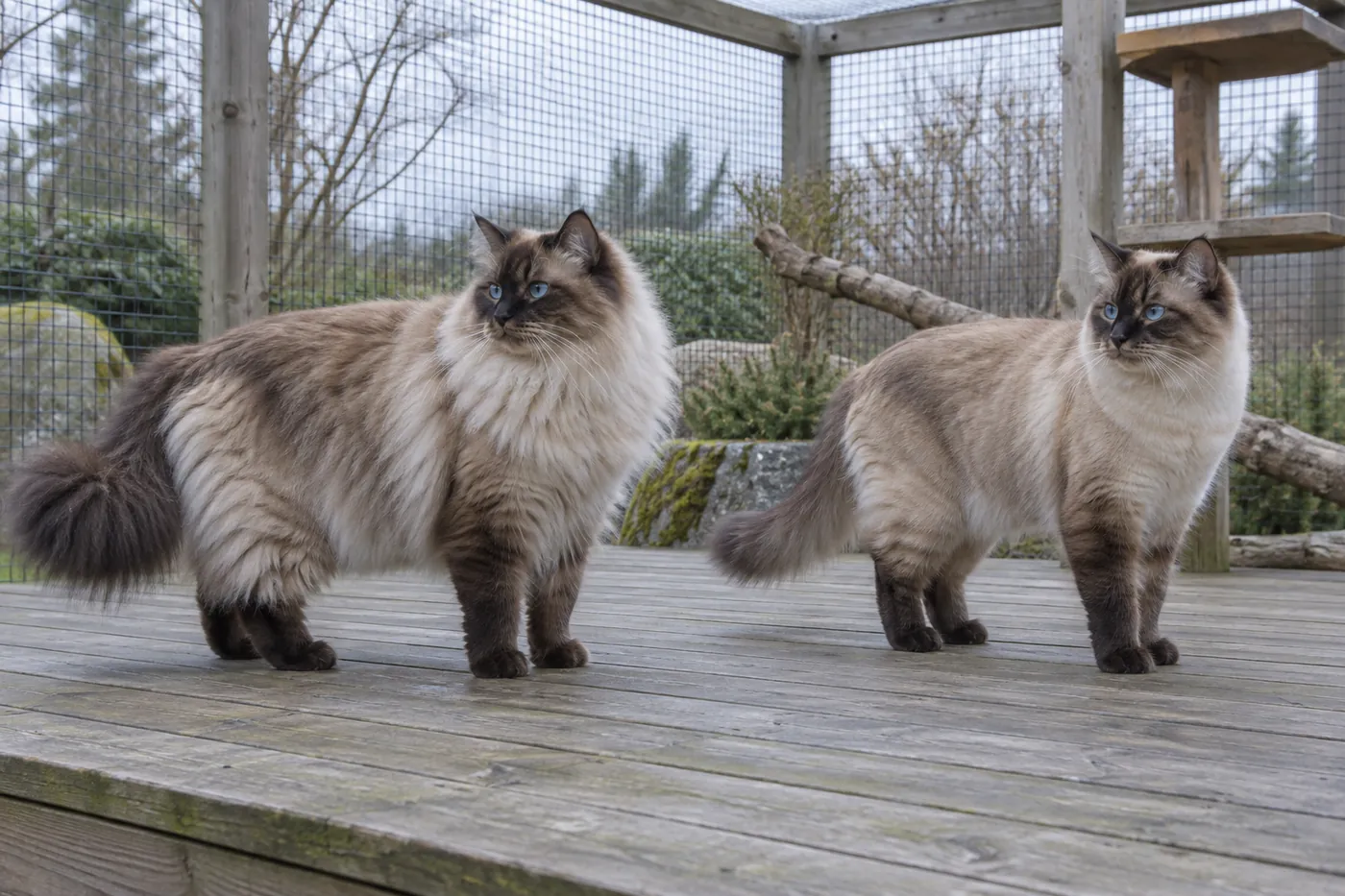
CFA gives 8 to 12 pounds for females and 12 to 18 pounds for males, and healthy adults can fall outside those figures. Siberians are among the slowest breeds to mature: most reach full size by three years, and some keep adding chest depth and muscle until five.
What About the Allergy Claims?
Siberians are sometimes marketed as hypoallergenic, and the Neva Masquerade inherits the same claim.
A Siberian still produces cat allergens. The primary allergen, Fel d 1, is produced in saliva, sebaceous glands and skin. Siberians are often said to produce less Fel d 1 than other breeds, but individual cats vary widely, and no test predicts how one allergic person will respond to one specific cat.
The colorpoint allele acts on pigment, and nothing links it to Fel d 1, so a pointed Siberian offers an allergic person no advantage over a non-pointed one.
What Temperament Comes With the Siberian Body?
The temperament is Siberian: affectionate, intelligent, playful and confident, with enough physical ability to explore the upper parts of a room.
CFA describes Siberians as sociable, curious and easygoing, and as quiet cats that prefer a loud purr to most other forms of communication. Many individuals adjust well to respectful children and compatible pets.
The colorpoint gene does not alter temperament, so a Neva Masquerade's behaviour and social style follow the same range as any other Siberian's.
How Should You Groom a Neva Masquerade?
The triple coat is the breed's largest daily-care commitment, and it follows the Siberian schedule exactly.
Most weeks: regular combing to maintain the coat and check the skin beneath the dense undercoat.
During spring and autumn coat release: daily combing may be necessary. The undercoat releases in volume, and unmanaged shedding produces matting and loose hair throughout the home.
The comb has to reach the skin through the undercoat, which is the same technique as brushing a long coat on any semi-longhair. A cat that resists the comb needs the slower, shorter sessions used for brushing a reluctant cat, because skipped sessions during a moult are how this coat mats.
Spring and autumn shedding is heavy but even. Patchy loss or sore skin falls outside that pattern, and so does the gradual thinning that belongs to coat changes across life stages rather than to the seasons.
Colorpoint cats may darken overall with age. This is normal and reflects the temperature-sensitive colour expression responding to slower metabolism and cooler skin temperatures in an older cat.
How Much Activity Does a Neva Masquerade Need?
A Neva Masquerade needs the same activity as a Siberian: moderate to high, with strong jumping and climbing ability.
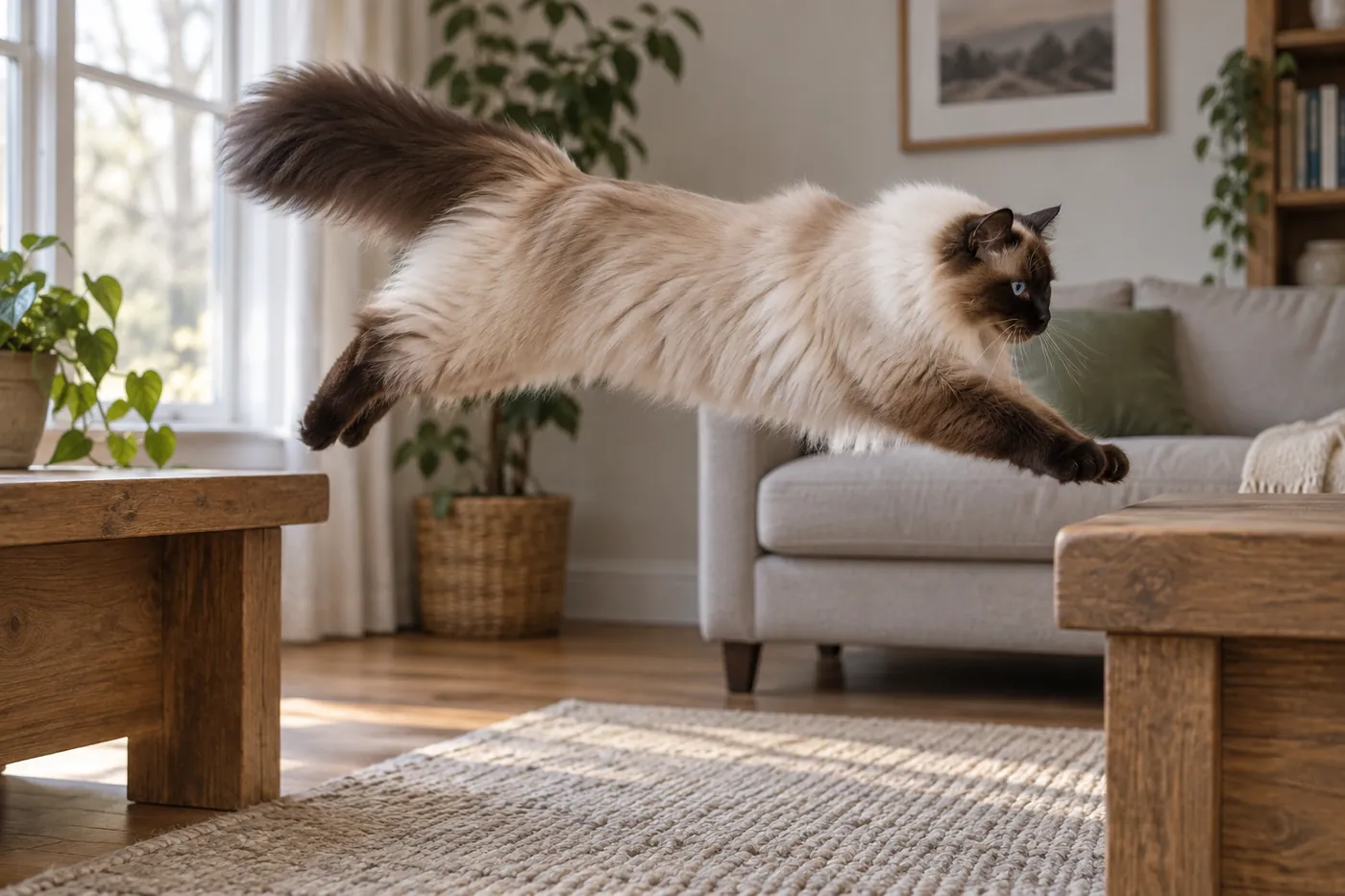
- Secure tall climbing furniture with broad platforms rated for a large cat
- Interactive play that engages hunting and problem-solving behaviours
- Room for a large carrier, large litter tray and turning space at feeding stations
- A scratching post tall and sturdy enough for a full stretch by a cat of up to 18 pounds
A young Neva Masquerade may be intensely active, while a senior usually prefers shorter bursts, following the general change in exercise needs by age.
What Is Known About Health and Lifespan?
Health follows the Siberian profile. The same conditions and screening recommendations apply.
Hypertrophic cardiomyopathy (HCM) occurs in Siberians as in many other breeds, and some breeders have their breeding cats examined by echocardiography before mating them.
| Area | What to monitor | When |
|---|---|---|
| Cardiac health | HCM screening by echocardiography | As recommended by the breeder and veterinarian |
| Weight and body condition | Rib feel, waist view, weight trend | Every routine visit; slow maturation means weight changes over years |
| Dental | Gum colour, tartar, eating changes | Annual dental check |
| Coat and skin | Matting, seasonal shedding, skin beneath the undercoat | During grooming sessions |
Body condition gives more practical information than a breed weight range, and the same portion and body-condition assessment used for any cat applies.
A Siberian still filling out at three or four is following its breed's slow curve, which runs later than the usual adult size and growth timing for cats.
How Does a Large Athletic Cat Fit a Family Home?
A calm, sociable Siberian usually adapts well to family life, and its size is the main thing a household has to plan around.
Siberians are a large, powerful breed, and a child should not attempt to lift or carry a full-grown adult without support. Interactive play at floor and furniture level works better.
Multi-pet households often suit Siberians well, provided introductions are staged with separate resources and gradual shared access.
What Should You Check Before Buying a Neva Masquerade?
The papers should name the registry as well as the breed, since the same cat is a Neva Masquerade under FIFe and a Siberian under CFA and WCF.
- Registration papers naming both parents and the registry that issued them
- The colorpoint pattern with blue eyes on a Siberian body type
- HCM screening records for the parents
- Individual temperament assessed during calm contact
- The source explains the allergy limitations honestly
- Equipment rated for a large, athletic, slow-maturing cat
If you are choosing between a pointed and a non-pointed Siberian, colour is the decision and everything else is the same cat, so the Siberian's health screening, coat work and temperament apply in full.
A Ragdoll and a Balinese are other colorpoint breeds with long coats. The Ragdoll has a different body type and a famously docile disposition, and the Balinese is a long-haired Siamese with a very different build and energy level. The Neva Masquerade's Siberian body, triple coat and slow maturation distinguish it from both.
Common Questions
Is a Neva Masquerade the same as a Siberian?
Yes, genetically. A Neva Masquerade is a Siberian carrying the colorpoint gene, which produces the pointed coat pattern and blue eyes. The body, temperament, health and coat type are those of the non-pointed Siberian.
Are Neva Masquerade cats hypoallergenic?
No cat is truly hypoallergenic. Siberians are often said to produce less Fel d 1, but individual cats vary widely, and nothing links the colorpoint gene to allergen production. Time spent with the specific cat tells an allergic person more than any breed-level claim.
Is the Neva Masquerade a recognised breed?
CFA and WCF accept colorpoint Siberians within the Siberian standard. FIFe recognised the Neva Masquerade as a separate breed in 2011.
How big does a Neva Masquerade get?
The same as a Siberian: CFA gives 8 to 12 pounds for females and 12 to 18 pounds for males. Most reach full size by three years, and some keep adding muscle until five.
Do Neva Masquerade cats need a lot of grooming?
Yes. The seasonal triple coat needs regular combing, with intensive daily sessions during spring and autumn coat release. Between those peaks, two to three sessions per week usually suffice.
Checked Against
Published 17 September 2026. Last updated .