
What Is a Minuet Cat, and What Does Each Parent Breed Contribute?
A Minuet, formerly called a Napoleon, is a short-legged cat with a round face and a dense coat, developed by crossing Munchkin with Persian and Exotic Shorthair lines. TICA recognised the breed for championship in 2016. A Minuet inherits two separate sets of health questions: the skeletal effects of the Munchkin short-leg gene, and the kidney, breathing and eye concerns that come with Persian lines.
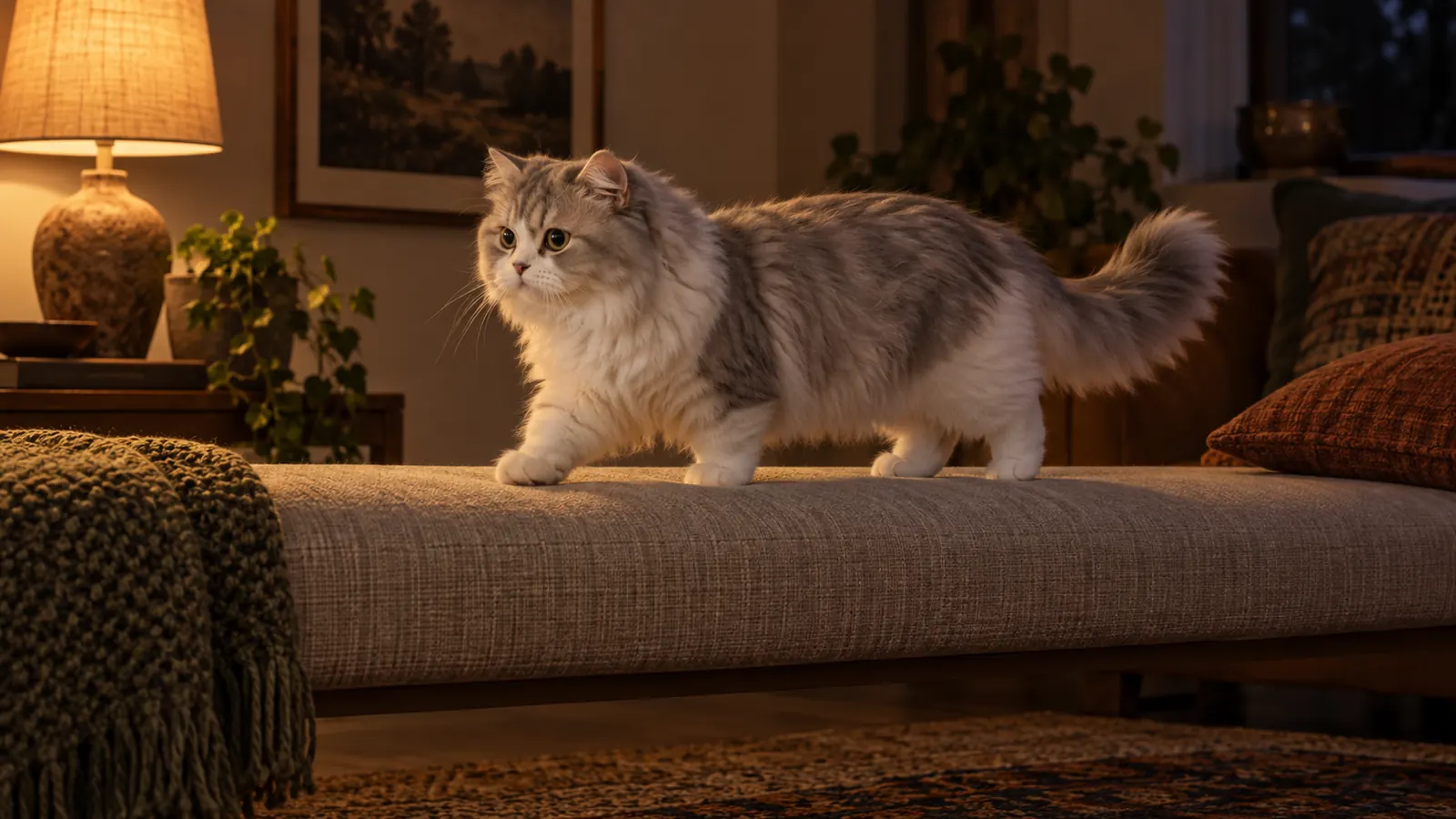
- Origin
- United States, begun by Joe Smith in 1996 by crossing Munchkin with Persian and Exotic Shorthair cats; first litter late 1997
- Coat
- Long or short, dense and plush, in all colours and patterns
- Size
- Small to medium, with shortened legs from the Munchkin UGDH variant and a round, moderate face from the Persian side
- Typical weight
- Breed descriptions commonly cite 5 to 9 pounds; the TICA standard sets no weight range
- Life expectancy
- Not measured; breed descriptions quote 12 to 14 years
- Activity level
- Moderate; described as playful and gentle
- Grooming
- Moderate to high depending on coat length; long-coated Minuets need regular combing to prevent matting
- Suits
- Households that can manage both the short-leg structural needs and the coat and facial care from the Persian side
A Minuet is a short-legged cat with a round face, a dense coat and a gentle disposition, produced by crossing Munchkin with Persian and Exotic Shorthair lines.
TICA's board voted the breed to championship status in January 2016, which makes it one of the better-recognised Munchkin-derived breeds. The earlier name, Napoleon, was changed to Minuet in 2015.
The breed inherits two separate sets of considerations from its parent lines. The Munchkin side contributes the short-leg skeletal structure and its documented concerns. The Persian and Exotic Shorthair side contributes the round face, dense coat and a set of health conditions unrelated to the legs.
How Did the Minuet Get Championship Status?
Joe Smith started the breed after reading a Wall Street Journal article about the Munchkin in June 1995. In February 1996 he bought a Munchkin kitten that was the granddaughter of a show Persian, an Exotic male joined the programme, and the first litter arrived late in 1997.
The cross combined the Munchkin short-leg trait with the Persian and Exotic Shorthair body, coat and face. Smith chose doll-faced Persians, which have a longer nose than the modern show Persian, and that choice still shapes what the standard asks for. TICA's board voted the Minuet to full championship in January 2016.
CFA does not list the Minuet.
- Registry status
- TICA Championship (2016)
- CFA
- Not listed
- Origin
- United States, first litter 1997
- Parent breeds
- Munchkin and Persian or Exotic Shorthair
- Coat varieties
- Long and short, both accepted
- Key consideration
- Two separate health inheritance pathways from each parent breed
The Minuet standard calls for a moderately round face rather than the extreme flat face seen in some show Persian lines. That distinction matters because the degree of facial shortening affects breathing, tear drainage and dental alignment.
What Do Short Legs and a Persian Face Look Like Together?
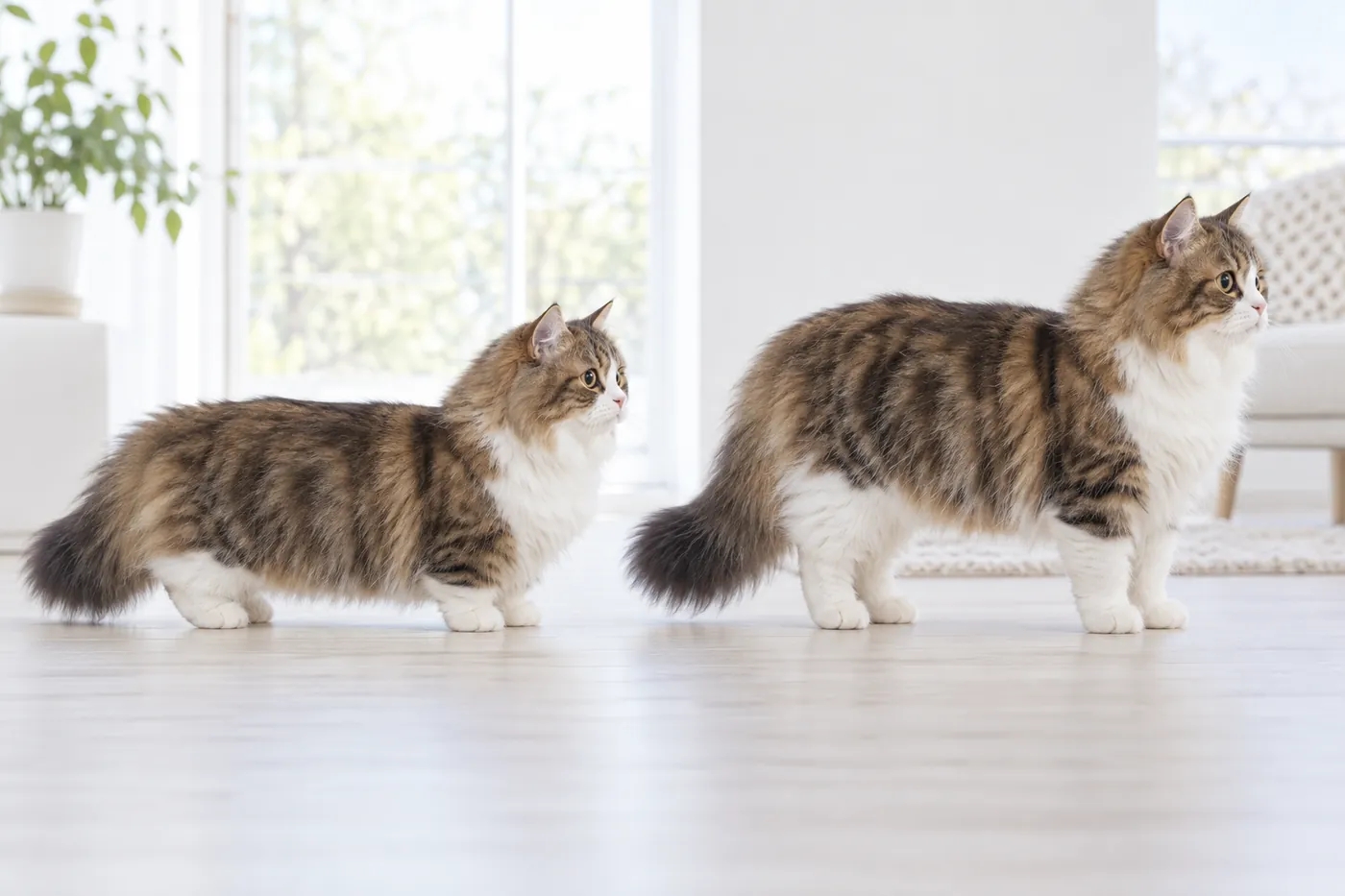
The body is small to medium, low to the ground and rounded rather than elongated. The legs are short on all four limbs, and the overall impression is compact and sturdy.
The face should be round with a moderate nose, open nostrils and large round eyes. A Minuet whose face is as flat as an extreme-type Persian carries the same breathing and tear-drainage problems that face structure creates.
The coat comes in two varieties: long and short. Both are dense and plush, reflecting the Persian and Exotic Shorthair influence.
All colours and patterns are accepted.
Not every kitten from a Minuet litter will have short legs. A kitten that inherits the standard-length leg variant has the same round face and dense coat but stands at ordinary height.
What Genetics Does Each Parent Breed Contribute?
From the Munchkin side: the UGDH gene variant produces shortened legs. It is autosomal dominant, and two copies appear to be lethal before birth.
A 2021 imaging study by Anderson and colleagues compared six short-legged cats confirmed to carry the UGDH variant with twelve standard-legged cats. Every short-legged cat had deformities in all four limbs, including an exaggerated S-shaped curve in the upper foreleg bone and twisting or angling in the lower leg bones. Spinal scans of two of the cats showed no abnormality. Those are the joints a Minuet owner is watching when gait and willingness to jump change with age.
From the Persian and Exotic Shorthair side: the round face, dense coat, compact body type and a set of inherited health conditions.
Polycystic kidney disease (PKD) is the most important one. A dominant mutation in the PKD1 gene causes fluid-filled cysts to develop in the kidneys, eventually compromising function.
A DNA test identifies cats carrying the mutation, and responsible breeders test both parents before a mating, so a negative result for each parent, named on the report, is the document that matters here.
Brachycephalic facial structure creates a second set of concerns when the face is shortened.
A moderately round face with visible nose length and open nostrils is the Minuet standard's intention. A face shortened further toward the extreme Persian type compresses the nasal passages, narrows the nostrils and kinks the duct that drains tears into the nose, which produces audible breathing, chronic tear overflow and dental crowding from a jaw that has less room for the same number of teeth.
Breeding typically pairs a short-legged Minuet with a standard-legged cat to avoid the homozygous lethality of the UGDH variant.
What Does the Persian Influence Do to Temperament?
TICA describes the Minuet as extremely affectionate and people-oriented, with the gentleness of the Persian and the energy and curiosity of the Munchkin, and as a good companion for families and older people.
That mix is the useful way to read the breed. The Persian side tends to settle it, while the Munchkin side brings the curiosity and bursts of play, and which one dominates varies from cat to cat, so the kitten's parents are a better guide than the breed description.
Trainability follows the food-motivated, reward-based pattern that works for most breeds. Carrier entry, recall and cooperative handling for grooming are realistic goals.
How Much Grooming Does a Minuet Need?
This is one of the breed's larger practical commitments, and the answer depends on coat length.
A long-coated Minuet needs regular combing to prevent matting, particularly under the legs, on the belly and around the ruff. The dense Persian-type coat tangles more easily than a single-layer coat.
A short-coated Minuet has a plush, dense coat that is easier to maintain but still needs weekly attention to remove loose hair and prevent undercoat buildup.
Brushing a long coat takes different technique from a short layer. A cat that resists the comb can be brought round in small steps, which matters in a breed that will need grooming all its life.
Facial care depends on the degree of facial shortening.
A Minuet with a moderate nose may need only routine wiping. One with a flatter face may produce excessive tear staining and need daily attention around the eyes.
Shedding is moderate to heavy, with seasonal peaks, and a heavy spring moult in a dense coat is normal seasonal release rather than a sign of trouble.
How Much Activity Does a Minuet Need?
The Minuet's combination of short legs and a gentle disposition means its activity needs are moderate rather than intense.
Short legs shorten the jump as well as the stride, and the limb deformities described above make hard landings a poor idea. Low platforms, gentle ramps and floor-level enrichment suit the body better than tall towers.
- Low shelves or furniture connected by ramps
- A litter tray with a low entry
- A scratching post at a reachable height
- Interactive play at floor level
- Separate food, water and resting spots
A Minuet is unlikely to demand the continuous activity of a Bengal or Abyssinian, but its exercise needs still include daily play, and short-legged cats that stop playing put on weight their joints then have to carry.
What Health Concerns Does a Minuet Inherit?
The Minuet inherits concerns from both parent lines, and a responsible health plan should address both.
| Source | Condition | What to do |
|---|---|---|
| Munchkin UGDH variant | Disproportionate limb shortening with documented deformities | Monitor mobility and gait across the cat's life |
| Munchkin homozygous lethality | Two copies of the variant appear lethal before birth | Ask whether both parents have short legs |
| Persian and Exotic lines | Polycystic kidney disease (PKD) | Ask for PKD DNA test results on both parents |
| Persian facial structure | Breathing difficulty, tear drainage problems, dental crowding in flat-faced individuals | Assess the degree of facial shortening and nostril openness |
| Persian and Exotic lines | Hypertrophic cardiomyopathy (HCM) | Ask for a dated heart scan, since HCM is screened by echocardiogram rather than DNA in these lines |
| Persian and Exotic lines | Progressive retinal atrophy, reported in some Persian lines | Ask whether the parents were DNA tested |
No study has measured Minuet lifespan, so the 12 to 14 years quoted in breed descriptions is an estimate rather than a measured figure.
Weight matters more than usual in a short-legged cat, because extra weight loads limbs that are already deformed. Body condition is judged by feeling the ribs and looking at the waist rather than by a number on the scales.
Is a Gentle Short-Legged Cat a Good Family Fit?
TICA describes the Minuet as a good companion for families and older people, and the gentleness it inherits from the Persian side suits a calm household.
Children do best handling the cat at floor level, because a fall onto limbs that are already deformed is a worse landing than for an ordinary cat, and a dense coat pulls painfully if it is grabbed.
Multi-cat households can work when introductions are staged with separate resources and gradual shared time.
How Do You Assess a Minuet?
TICA championship status means a published breed standard and judging history exist, which puts the Minuet on stronger ground than experimental Munchkin crosses.
The face is the single most important thing to assess in person.
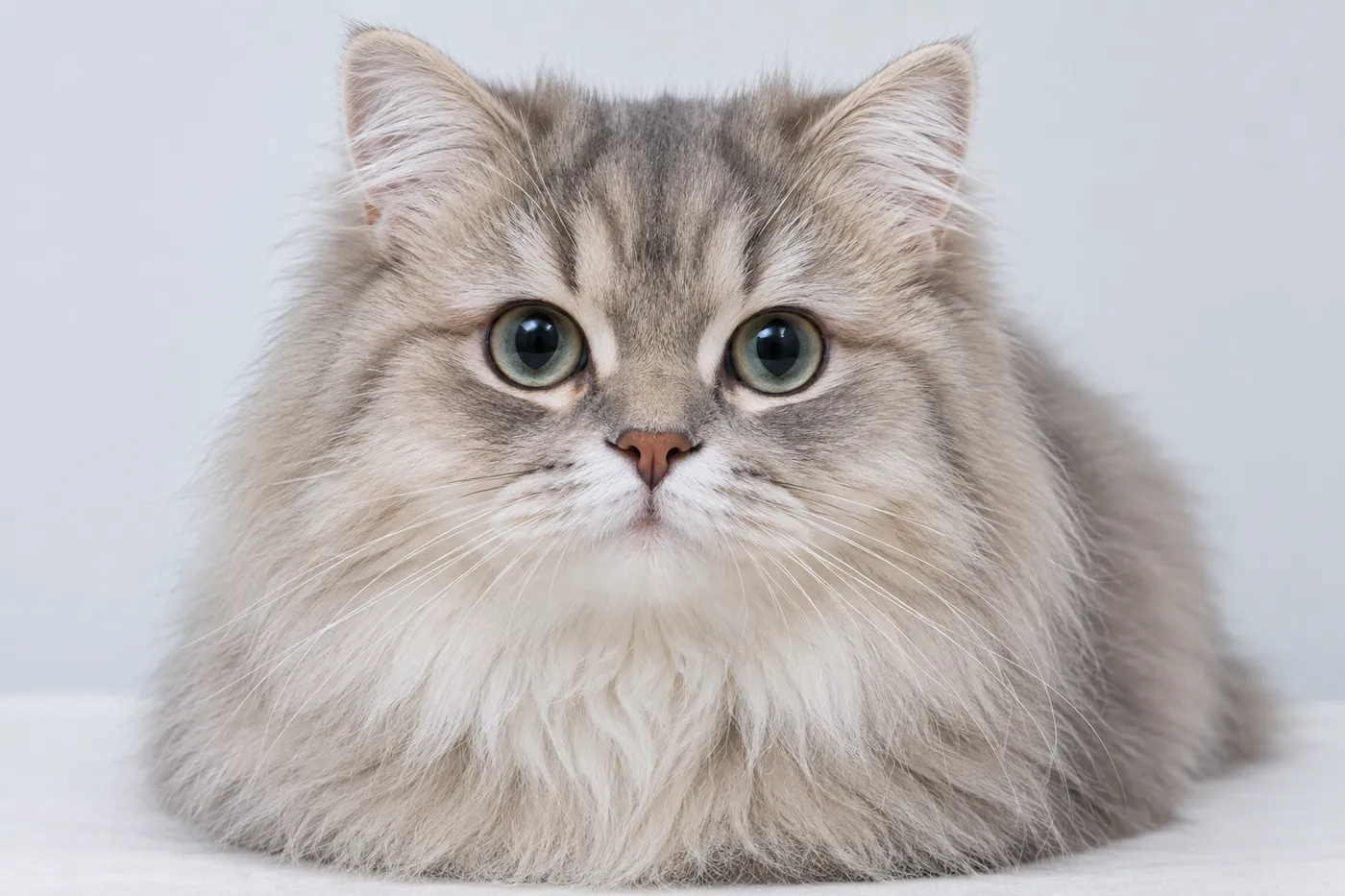
A moderate face with a visible nose bridge, open nostrils and quiet breathing at rest is what the standard describes. A face where the nostrils are pinched, the breathing is audible or the eyes show chronic tear staining has inherited the extreme Persian face structure rather than the moderate version.
- TICA registration papers naming both parents
- PKD1 DNA test results showing both parents tested negative
- Confirmation that one parent of the litter had standard-length legs
- The face is moderate with a visible nose bridge and open nostrils
- Breathing is quiet at rest and during light activity
- The cat's mobility and gait observed during natural movement
- Equipment and layout suit a short-legged cat with a dense coat
A breeder who can show PKD test certificates, explain the difference between a moderate and extreme face, and discuss the skeletal evidence from the Munchkin side is demonstrating the responsible practice this cross requires.
Common Questions
Is a Minuet the same as a Napoleon cat?
Yes. The breed was renamed from Napoleon to Minuet by TICA in 2015. Both names refer to the same Munchkin and Persian or Exotic Shorthair cross.
Is the Minuet a recognised breed?
TICA granted championship status in 2016. CFA does not list it.
What health problems do Minuet cats have?
Minuets inherit concerns from both parent lines: the Munchkin-side skeletal deformities from the UGDH variant, and the Persian-side polycystic kidney disease, potential breathing difficulty and cardiac concerns. Both sets need screening.
How big does a Minuet get?
Breed descriptions commonly cite 5 to 9 pounds, but the TICA standard does not set a weight range, so body condition is the better guide.
Do Minuet cats need a lot of grooming?
Long-coated Minuets need regular combing to prevent matting, similar to Persian care. Short-coated Minuets are easier but still need weekly attention. Facial care depends on the degree of facial shortening.
Checked Against
- TICA: Minuet breed tica.org
- Struck et al.: A structural UGDH variant associated with standard Munchkin cats (BMC Genetics, 2020) pmc.ncbi.nlm.nih.gov
- Anderson et al.: Skeletal manifestations of heritable disproportionate dwarfism in cats as determined by radiography and magnetic resonance imaging (Vet Comp Orthop Traumatol, 2021) pmc.ncbi.nlm.nih.gov
- Lyons et al.: Feline polycystic kidney disease mutation identified in PKD1 (J Am Soc Nephrol, 2004) pubmed.ncbi.nlm.nih.gov
- CFA: Current breeds cfa.org
Published 17 September 2026. Last updated .





