
What Is a Persian Cat, and What Do Its Coat and Flat Face Demand?
A Persian can be a quiet, affectionate companion when daily coat and eye care are realistic. The deciding points are comfortable breathing, manageable grooming and transparent health records, alongside temperament.
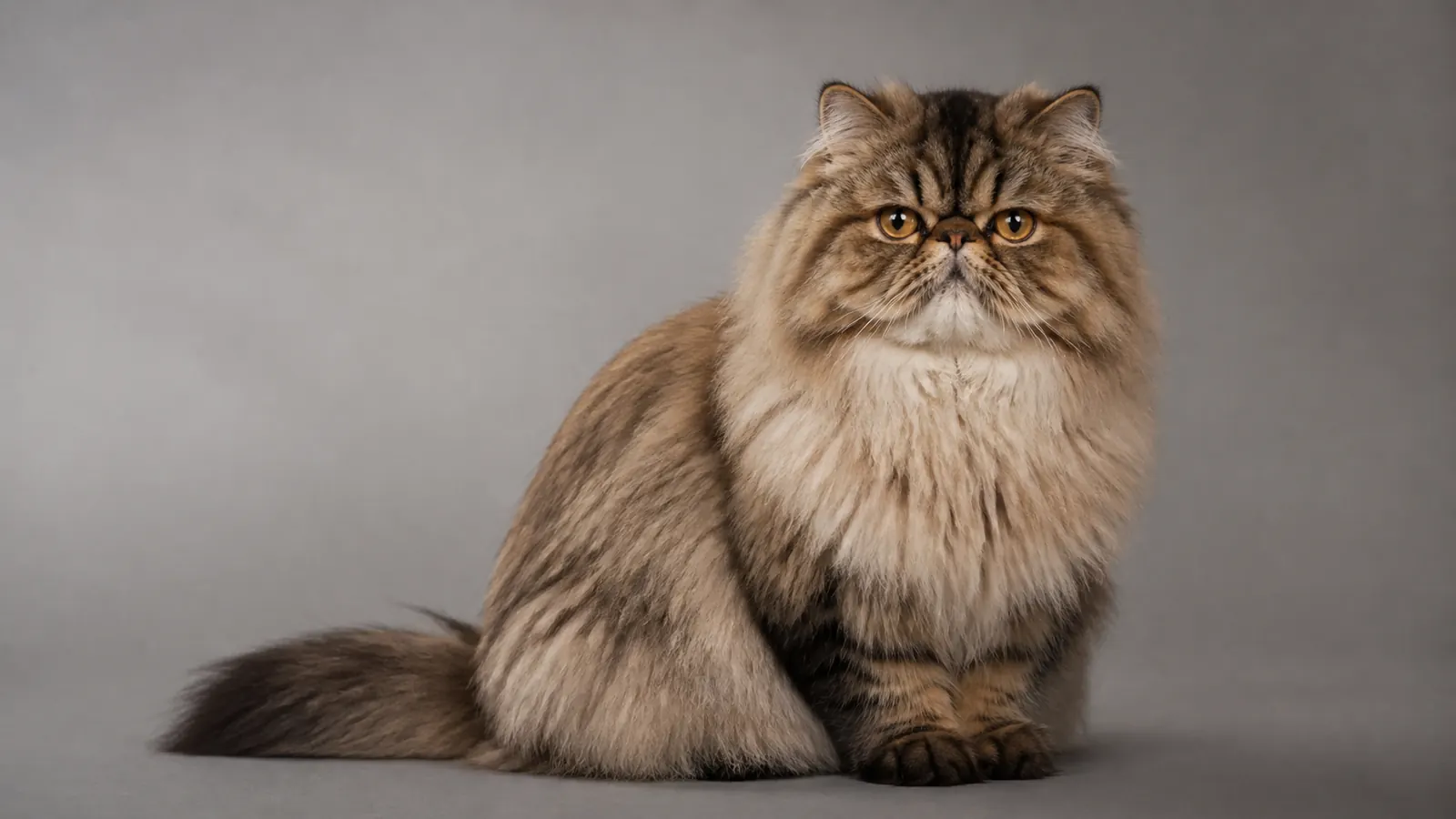
- Origin
- Persia, now Iran, with modern type developed in Britain and the United States
- Coat
- Long, dense, with a heavy undercoat
- Size
- Medium sized with a broad, cobby build
- Typical weight
- Typically 3 to 4.5 kg for females, 4 to 6 kg for males
- Life expectancy
- Commonly 12 to 16 years
- Activity level
- Low. Content on the floor and on low furniture
- Grooming
- Very high. Daily, without exception
- Suits
- Quiet indoor households prepared to groom every day
The Persian is the most demanding coat in the domestic cat, and one of the calmest temperaments. It is a genuinely quiet, affectionate cat that wants company without wanting activity.
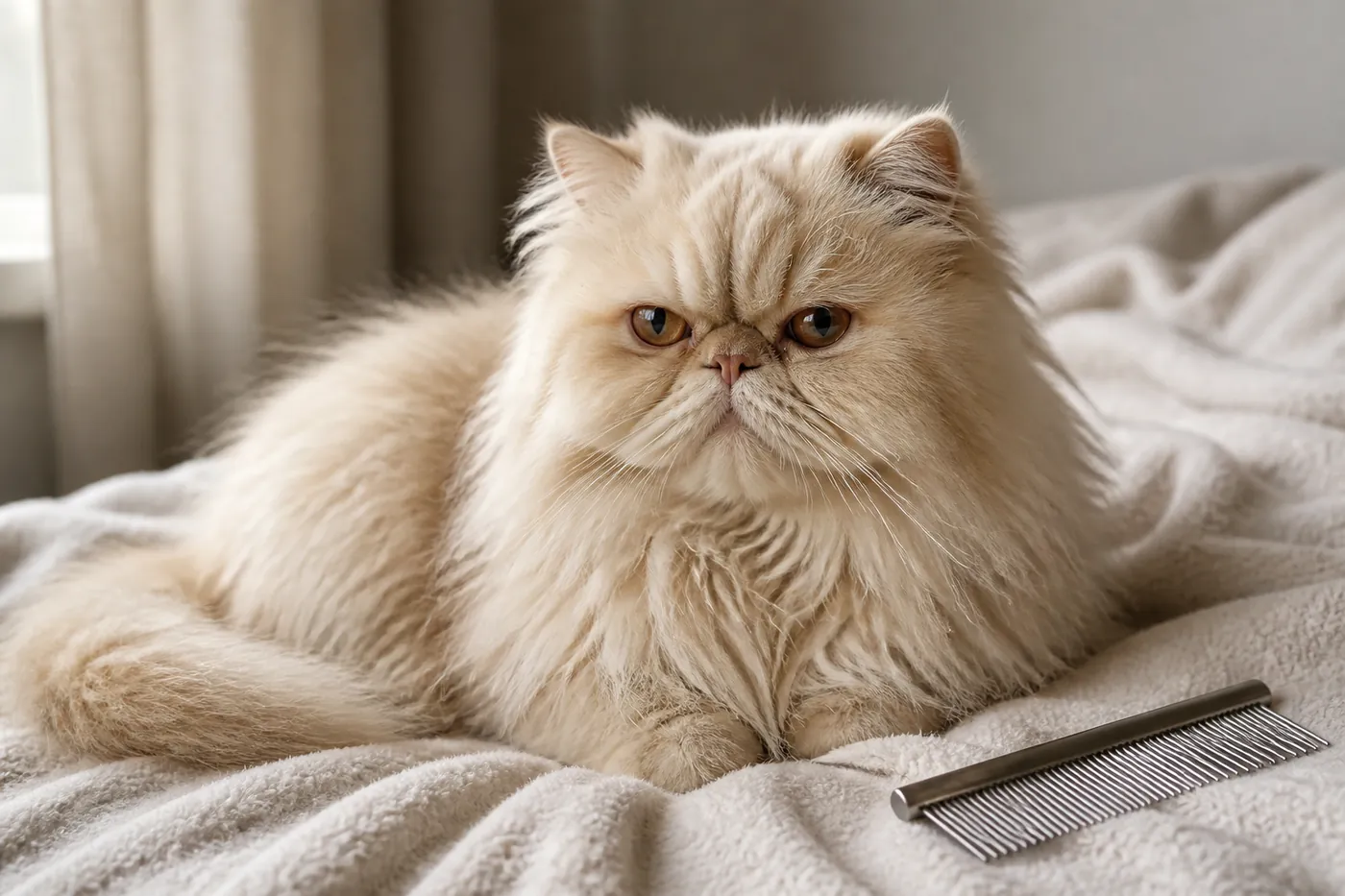
Daily grooming is not negotiable
The coat is long and densely undercoated, and a Persian cannot keep it clear on its own.
Missed days compound quickly. A week without brushing produces mats that tighten against the skin and need clipping out by a professional.
The reason this breed cannot self-manage is anatomical rather than behavioural. A Persian's coat is longer than its tongue can reach through, and the flattened face limits the leverage the cat has to work at it.
The undercoat is the part that defeats it entirely. Shed undercoat is held in place by the long guard hairs above, and no amount of licking lifts it out.
Each day's shed hair is caught by the previous day's, so the coat degrades faster and faster once the first knot forms.
That is why a week is the threshold rather than a month. The change between day three and day seven is far larger than the change between day one and day three.
The lion clip is a legitimate answer to that arithmetic. Removing the length removes the mechanism, and a clipped Persian needs a fraction of the attention with none of the welfare cost of a matted one.
What the daily routine actually involves
The grooming is only part of it, and the face needs attention every day whether the coat does or not.
Wipe under each eye with damp cotton wool or a purpose-made pad, using a separate piece for each eye so nothing is carried across. Dried tear staining is far harder to shift than fresh, which is why this is daily rather than weekly.
The coat itself is combed rather than brushed, working in sections from the skin outwards, with the wide-toothed comb finding tangles before any brush goes near them, in the same order as any long-coat routine.
The area under the tail needs checking every day too. A dense coat catches faeces, and a hygiene trim kept short there prevents a genuinely unpleasant problem.
Ten minutes a day, done every day, is the whole commitment. It is a small job that becomes a large one the moment it is skipped for a week.
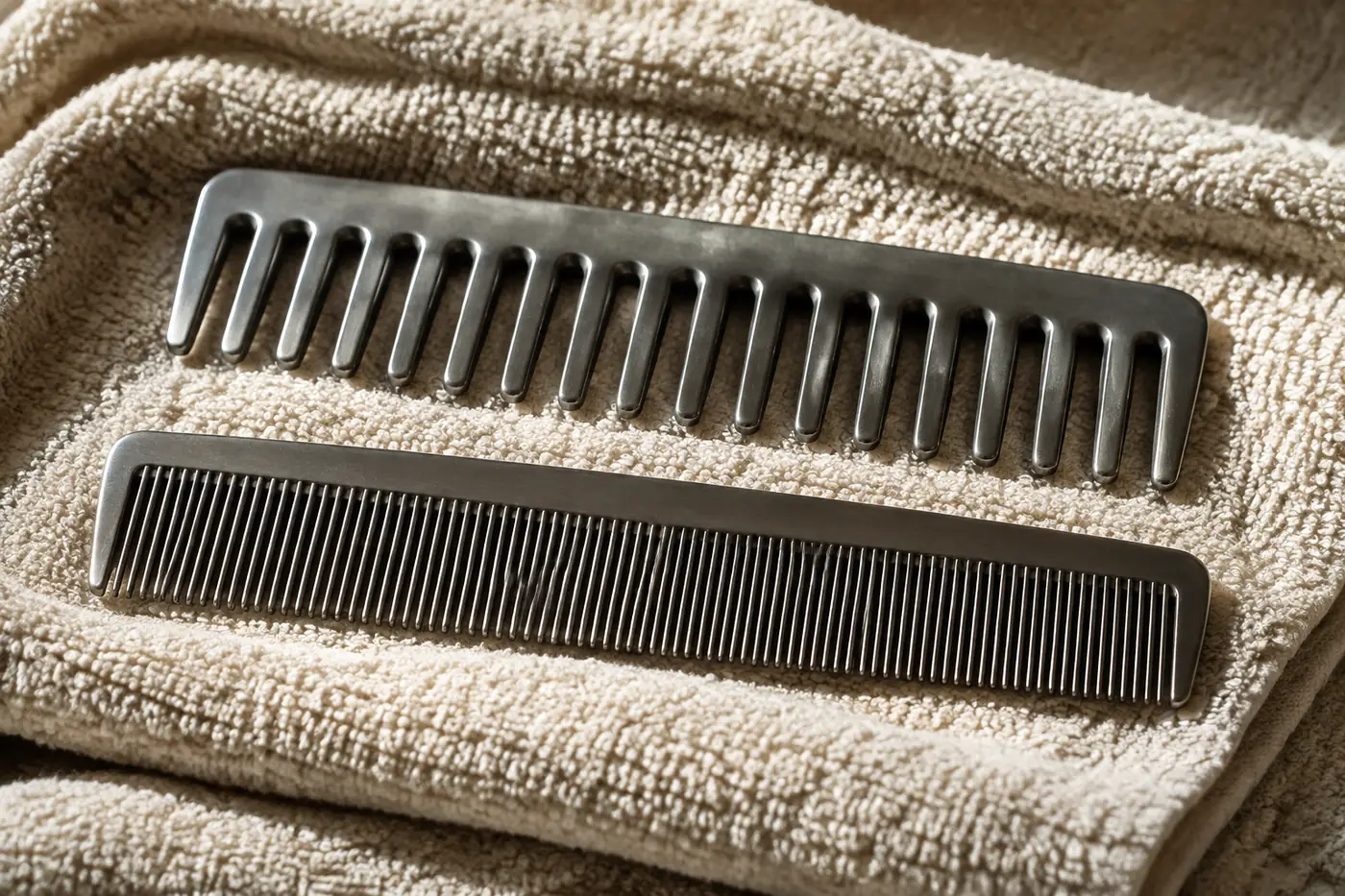
The tools that make it possible
The daily routine is short only if the right tools are used, and most of what is sold is the wrong thing for this coat.
A wide-toothed metal comb does nearly all of the work. It reaches through to the skin and finds a tangle gently, where a brush passes over the top of exactly the problem you are looking for.
A finer comb is useful for the face and behind the ears, and a slicker brush has a limited role once the coat is already tangle-free.
What this coat does not need is a deshedding blade. Those cut the topcoat as well as removing undercoat, and on a Persian they spoil the coat without reducing matting.
Work in sections, lifting a layer of hair and combing from the skin outwards rather than skimming the surface. Combing only the top of a Persian's coat leaves the undercoat beneath it to felt.
| Tool | What it does on this coat |
|---|---|
| Wide-toothed metal comb | Nearly all of the work. Reaches the skin and finds a tangle gently |
| Fine comb | The face and behind the ears, where the coat is shorter |
| Slicker brush | A limited role, and only once the coat is already tangle free |
| Deshedding blade | Not this coat. It cuts the topcoat as well as removing undercoat |
The eyes need their own minute
The face routine sits alongside the coat and takes about as long, and it cannot be folded into the grooming session.
Wipe below each eye daily with damp cotton wool and a fresh pad for each side, then dry the fold rather than leaving it damp. The drying is the step that prevents the skin problems.
Fresh staining lifts easily and dried staining does not, which is the whole argument for doing it every day rather than well once a week.
Redness, squinting, signs of pain or a change in discharge are the point at which wiping stops being enough and a veterinarian needs to see the eye.
Bathing, which this breed sometimes needs
Most cats never need a bath, and Persians are the main exception.
A dense undercoat holds grease, and a cat that cannot reach its own back can become genuinely greasy over months. A bath every few weeks is part of the routine for many show cats and occasionally necessary for pets.
The coat has to be combed out completely before any bath, because water tightens existing tangles into a solid felt and bathing a matted Persian makes things considerably worse.
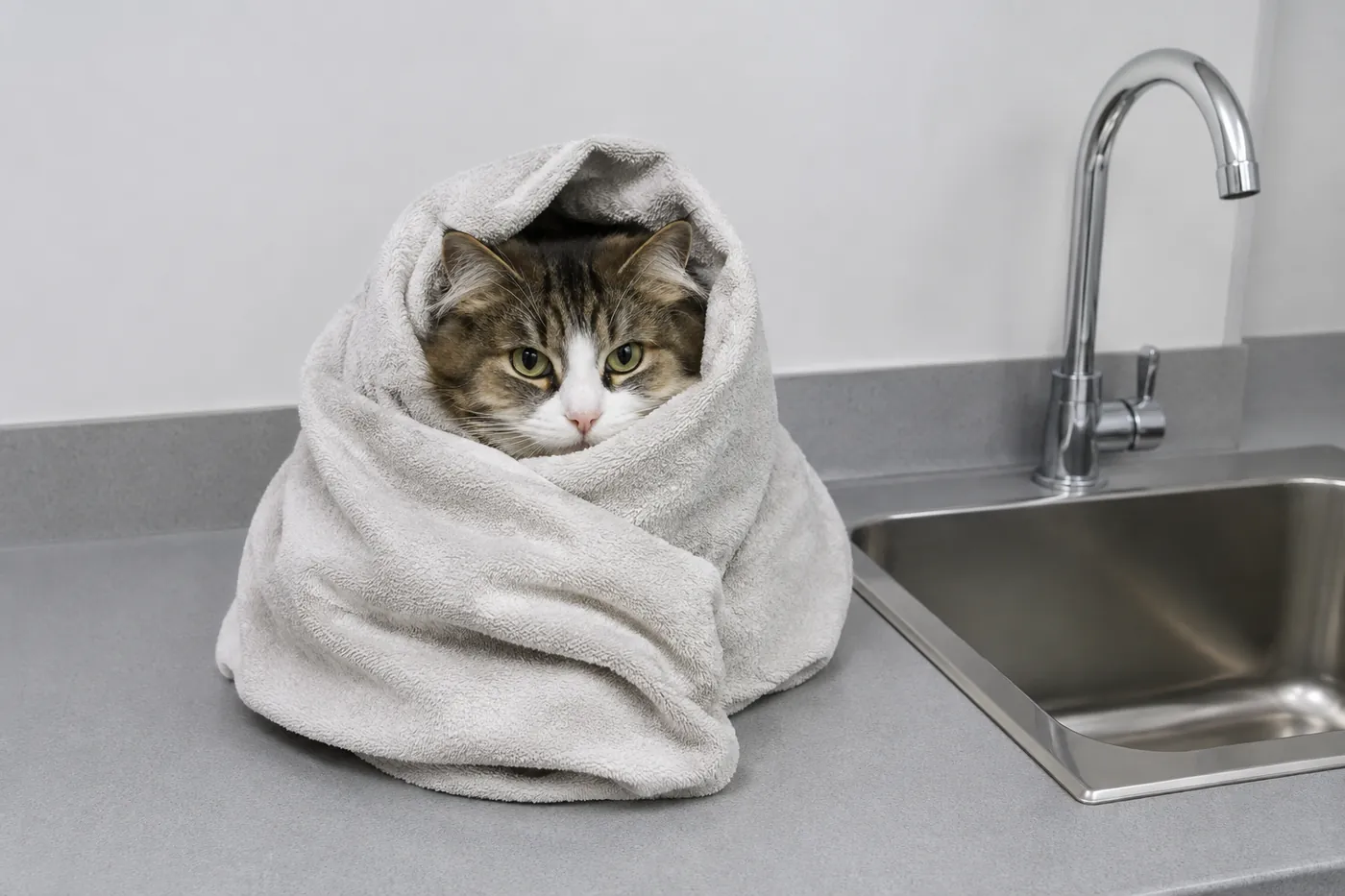
- Comb the coat out completely first, because water turns an existing tangle into solid felt.
- Wash with a shampoo made for cats, not a human one.
- Rinse until the water runs completely clear.
- Dry actively and comb the coat through while it is still damp, since a wet undercoat mats as it dries.
Bathing is worth starting in kittenhood if it is going to be part of the routine, since a cat introduced to it young accepts it and one meeting it at four years old generally does not.
The face shape has consequences
Modern Persians have been bred progressively flatter, and the flatter the face, the more problems follow:
- Brachycephalic obstructive airway syndrome causes noisy breathing, snoring, and reduced heat tolerance.
- Tear ducts are distorted, so eyes water constantly and the fur below them stains and needs daily wiping.
- Jaws are compressed, which crowds the teeth and makes dental disease more likely.
Each of those is the same change in the skull expressed in a different tissue. Selection has shortened the bone while the soft tissue inside it has stayed close to full size, so everything that used to fit now competes for room.
The airway is where that costs most. Nasal passages narrowed to a fraction of their normal cross-section make every breath more work, and the effort shows as noise at rest and as poor recovery after mild exertion.
Heat is the consequence people underestimate. Cats shed heat largely by breathing, so a cat with a compromised airway has a reduced ability to cool itself and is genuinely at risk on a hot day indoors.
The eye problem is one of drainage. A shortened muzzle kinks the duct that should drain tears into the nose, so tears run down the face instead and keep the fur beneath permanently damp.
The teeth follow the same logic. A full set of teeth in a shortened jaw sits rotated and overlapping, which traps food and plaque in places a tongue cannot clear.
Heat, and summer
A flat-faced cat may have difficulty breathing and handling heat, so provide shade, fresh water, ventilation and a cooler resting place. Avoid hot cars and vigorous play in a hot room.
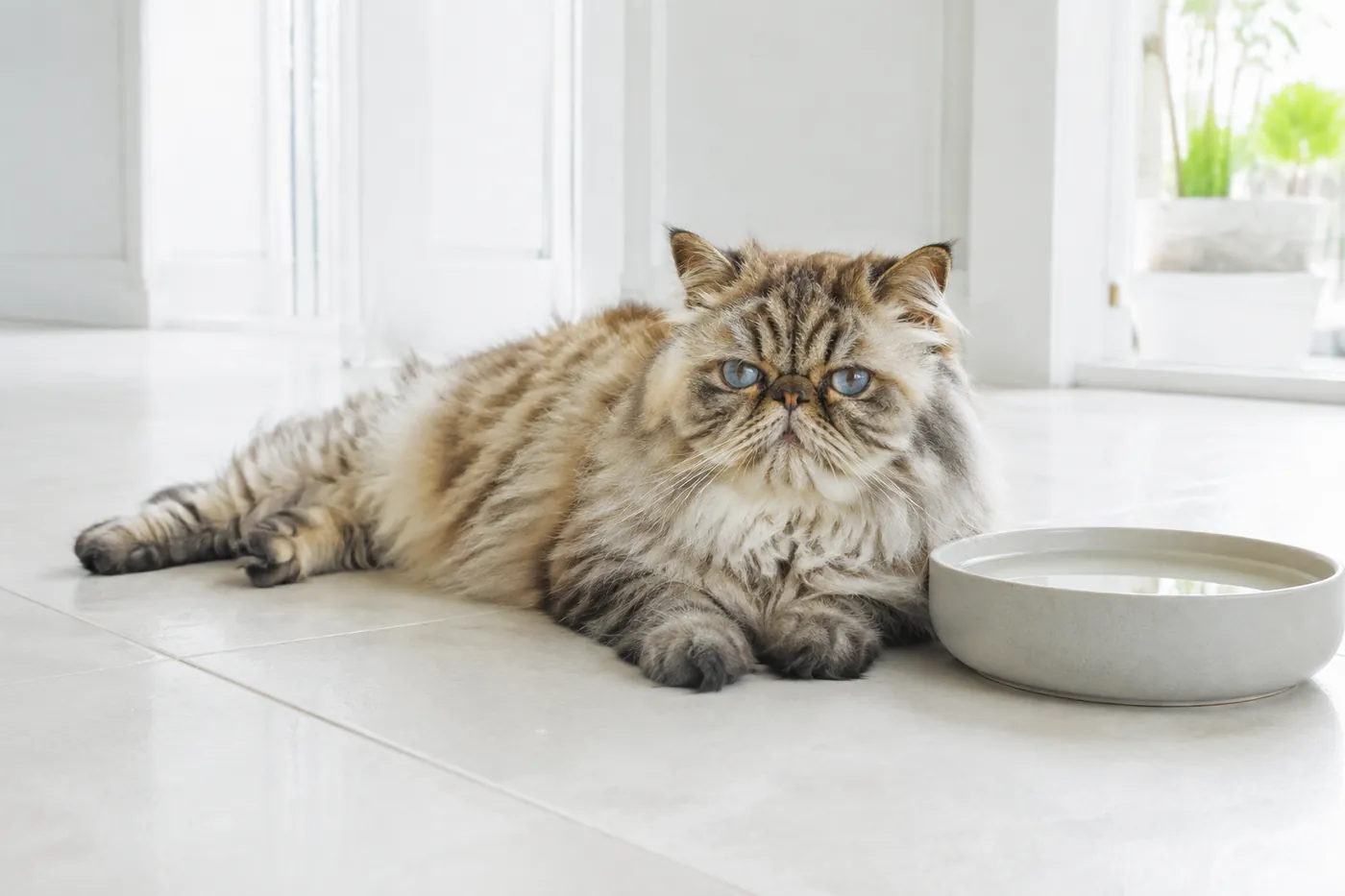
Cats do not normally rely on panting as their main cooling method. Open-mouth or laboured breathing, weakness or collapse requires urgent veterinary attention.
Move the cat out of heat while contacting the clinic; do not wait for the coat to cool by itself.
Clipping is a coat-management decision made cat by cat, and summer alone does not make it necessary. Ask a veterinarian or experienced cat groomer about a matted or unmanageable coat rather than using scissors close to skin.
Teeth, and why they need planning for
Shortened facial anatomy can contribute to tooth crowding and abnormal alignment. That can complicate cleaning, but it does not mean every Persian inevitably needs the same extractions or that preventive care is pointless.
Start gentle feline tooth-brushing practice when the mouth is comfortable. Have the veterinarian assess bite, gums and tooth position, and arrange treatment for pain, drooling, bad breath or changes in chewing. Cats may keep eating despite oral pain.
Food texture and dental products do not replace examination. The useful budget is for ongoing preventive care and any treatment this individual needs, rather than a promised timetable of repeated procedures.
Choosing between the two types
Comfortable function matters more than a label such as traditional or doll-faced. Less extreme features can reduce some conformational concerns, but appearance alone cannot certify breathing, eye comfort or dental health.
Watch the cat breathe quietly at rest, eat and move, then ask a veterinarian about concerns. Request the parents' relevant health results and the kitten's own records. A side-view photograph and a show standard answer different questions from a clinical examination.
Health screening
One entry on this list is answered by a document, one only by watching the cat, and the difference decides how a buyer should use each.
Polycystic kidney disease was once present in a very large share of the breed. It is dominant, so one copy is enough, and cysts enlarge from birth until working kidney tissue is displaced and the cat reaches kidney failure years earlier than it otherwise would.
The DNA test is why the picture has changed. A single conclusive result per parent removes it, and widespread testing has pushed the condition from common to uncommon within the breed.
Brachycephalic airway syndrome requires clinical assessment. Watching breathing can identify concerns, but veterinary examination and further investigation may be needed to assess anatomy and severity.
Noisy breathing, open-mouthed breathing after mild exertion, and a cat that has to pause during a meal to catch its breath are the things to look for. That assessment is worth doing on the kitten in front of you rather than accepting anything about the line.
Cardiomyopathy is screened by scan rather than by DNA in this breed, so the date matters. Dental disease is close to expected rather than possible, which makes it a plan rather than a risk.
- Polycystic kidney disease
- Historically common in the breed; a DNA test exists and should have been used
- Hypertrophic cardiomyopathy
- Ask about cardiac screening
- Brachycephalic airway syndrome
- Observe breathing and request a veterinary assessment of any concern
- Progressive retinal atrophy
- Reported in some lines
- Dental disease
- Plan preventive home care and veterinary examinations
The PKD DNA result for both parents, in writing, is the single most important document for this breed.
What the temperament is actually like
The coat dominates any discussion of this breed, and the temperament is why people keep them.
Persians are quiet, undemanding, and affectionate without being intrusive. They are among the least vocal breeds, and what voice they have is soft.
They want company rather than activity. A Persian will settle in the room you are in and stay there, which is quite different from a Siamese following you and commenting.
Play happens, briefly and at ground level, and it usually has to be started by a person. A wand toy drawn slowly along the floor suits them better than anything requiring a leap.
That combination suits older households, flats, and anybody who wants a calm cat, provided the daily grooming is genuinely going to happen.
For the same calm temperament with a face that breathes normally and a coat that needs combing twice a week, the British Shorthair is the comparison worth making. The coat is the whole of the commitment and the temperament asks for almost nothing.
Daily life
Persians are floor cats. They do not climb much and are content on low furniture, which suits an older household.
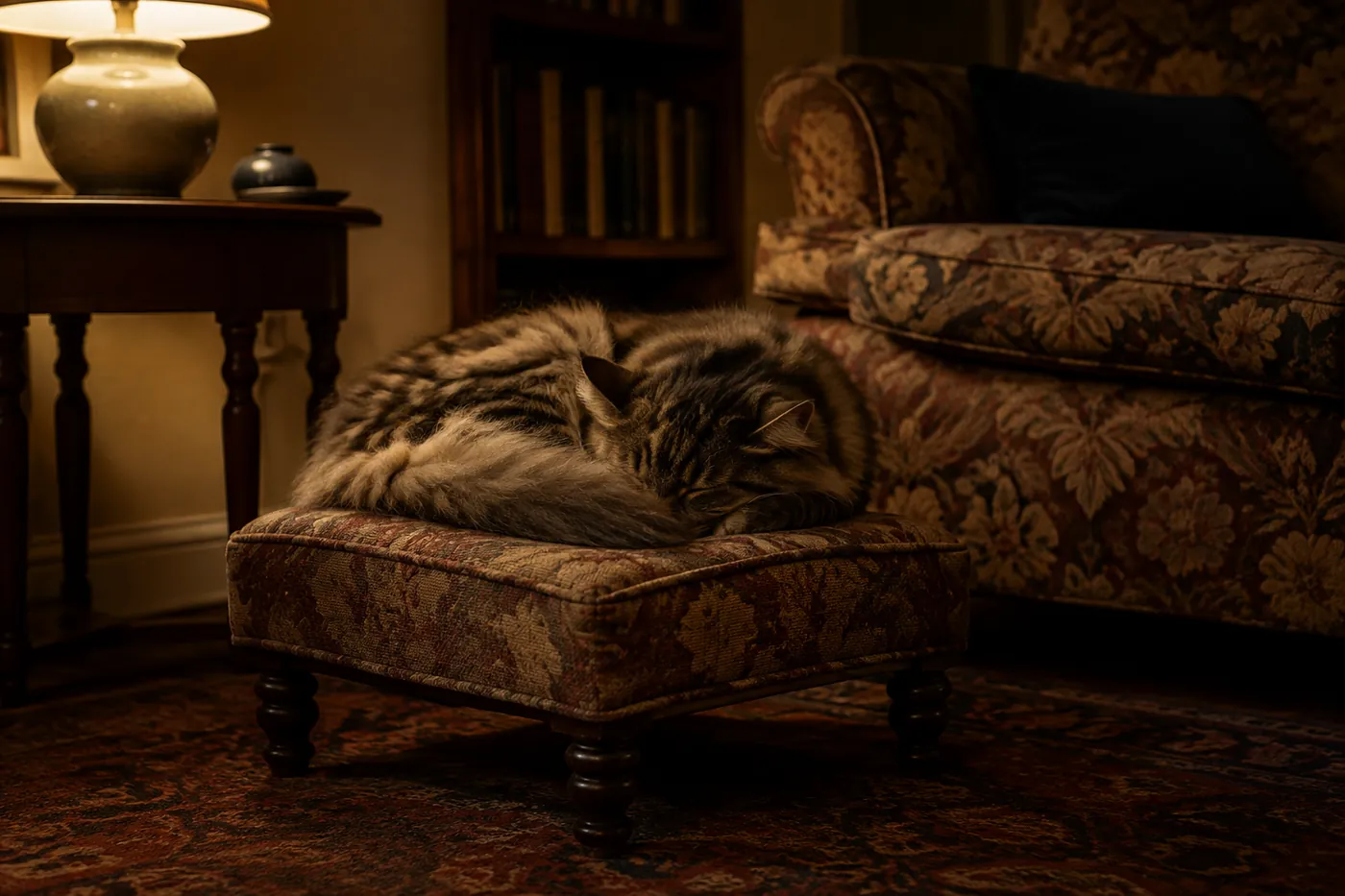
They are quiet, rarely vocal, and cope reasonably with being alone during a working day. They are strictly indoor cats: the coat picks up everything outdoors, and the face does not tolerate heat.
A flat-faced cat is also harder to feed comfortably, and a shallow wide dish suits one better than a bowl it has to push its face into. In a breed whose coat hides its outline, the amount is best judged by body condition with the hands rather than by eye.
CFA describes the Persian as compatible with children of all ages and able to coexist peacefully with other pets. It also calls the breed one of the easiest to train: Persians quickly learn the meaning of the word no, and many learn to respond to their names.
Kittens, and starting the routine early
Everything difficult about living with a Persian is easier if it starts in the first months.
A kitten that is combed daily from the day it arrives, whether or not the coat needs it, becomes an adult that stands for it. One that meets a comb properly at a year old, when the first mats appear, learns that grooming is unpleasant.
The same applies to face wiping, to having its mouth opened, and to having paws held. Each is a few seconds a day, and each is a fifteen year habit being set.
Keep every session short and finish before the kitten objects. A kitten held until it struggles has learned that struggling ends things.
- Comb daily from the day the kitten arrives, whether or not the coat needs it
- Wipe the face, open the mouth, and hold each paw, a few seconds a day
- Finish every session before the kitten objects, not after
- Book a first grooming appointment early, even with nothing to do
A cat that has met a groomer as a kitten is far easier to hand over when a mat eventually needs clipping out.
Common Questions
How much grooming does a Persian really need?
Plan daily hands-on coat checks and regular thorough combing, adjusting to the individual coat and shedding. Mats can tighten painfully; seek skilled removal for a tight mat instead of cutting close to skin.
What is a doll-face Persian?
A Persian bred with a less extreme, more traditional muzzle. It typically has fewer breathing and tear-duct problems than an extreme flat-faced cat.
Why do Persian cats' eyes water so much?
The flattened face distorts the tear ducts, so tears spill onto the face instead of draining. The area needs wiping daily to prevent staining and skin irritation.
Checked Against
Published 22 August 2026. Last updated .





