What Is an Exotic Shorthair, and What Does Its Short Coat Actually Change?
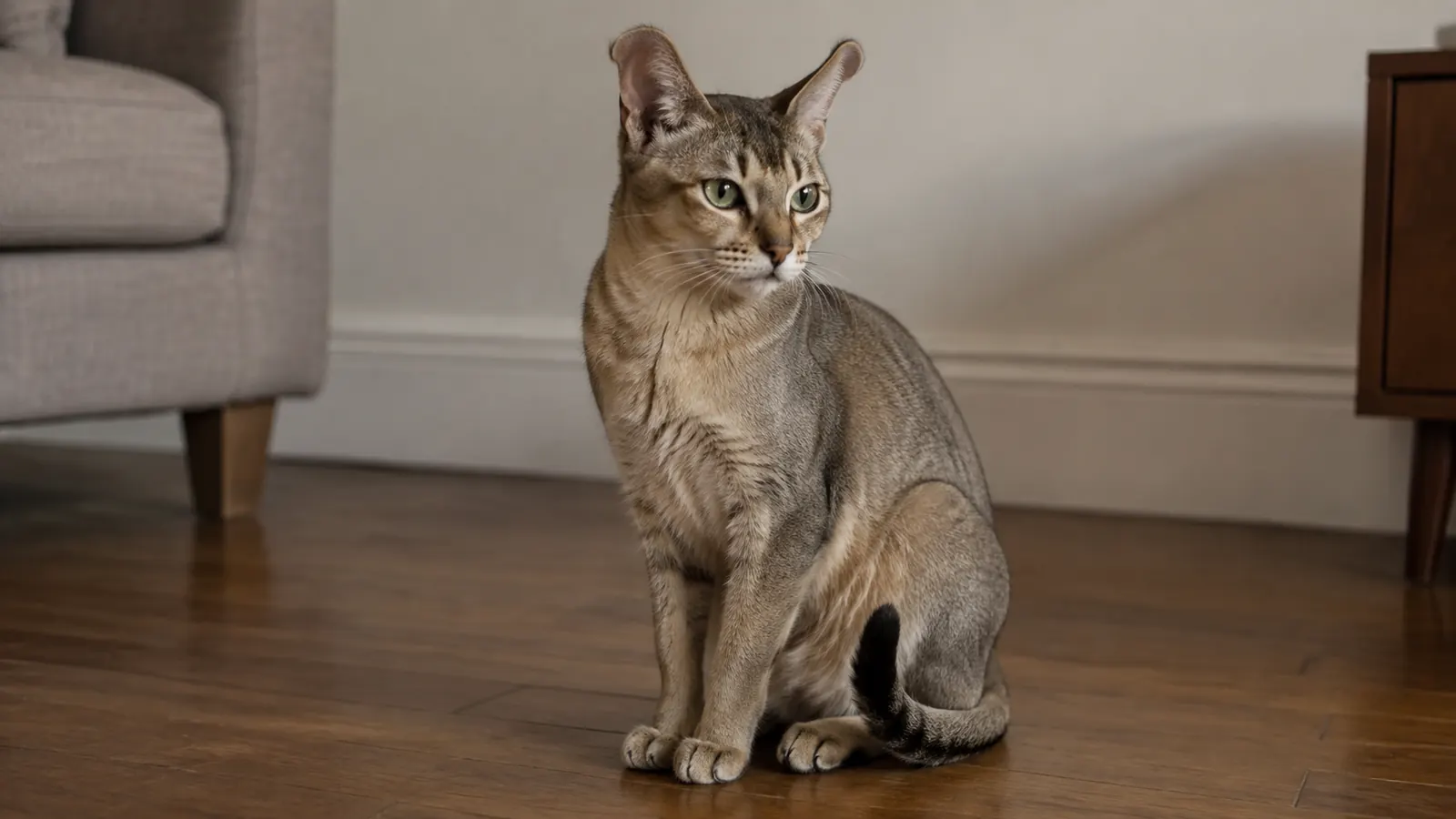
The Exotic Shorthair has a Persian-like build and a shorter, dense coat. Grooming may be easier, but the shorter hair does not remove the need to assess breathing, eyes, teeth and documented kidney screening.
- Origin
- Two registry accounts: a 1950s American cross with the American Shorthair, and a later British one
- Coat
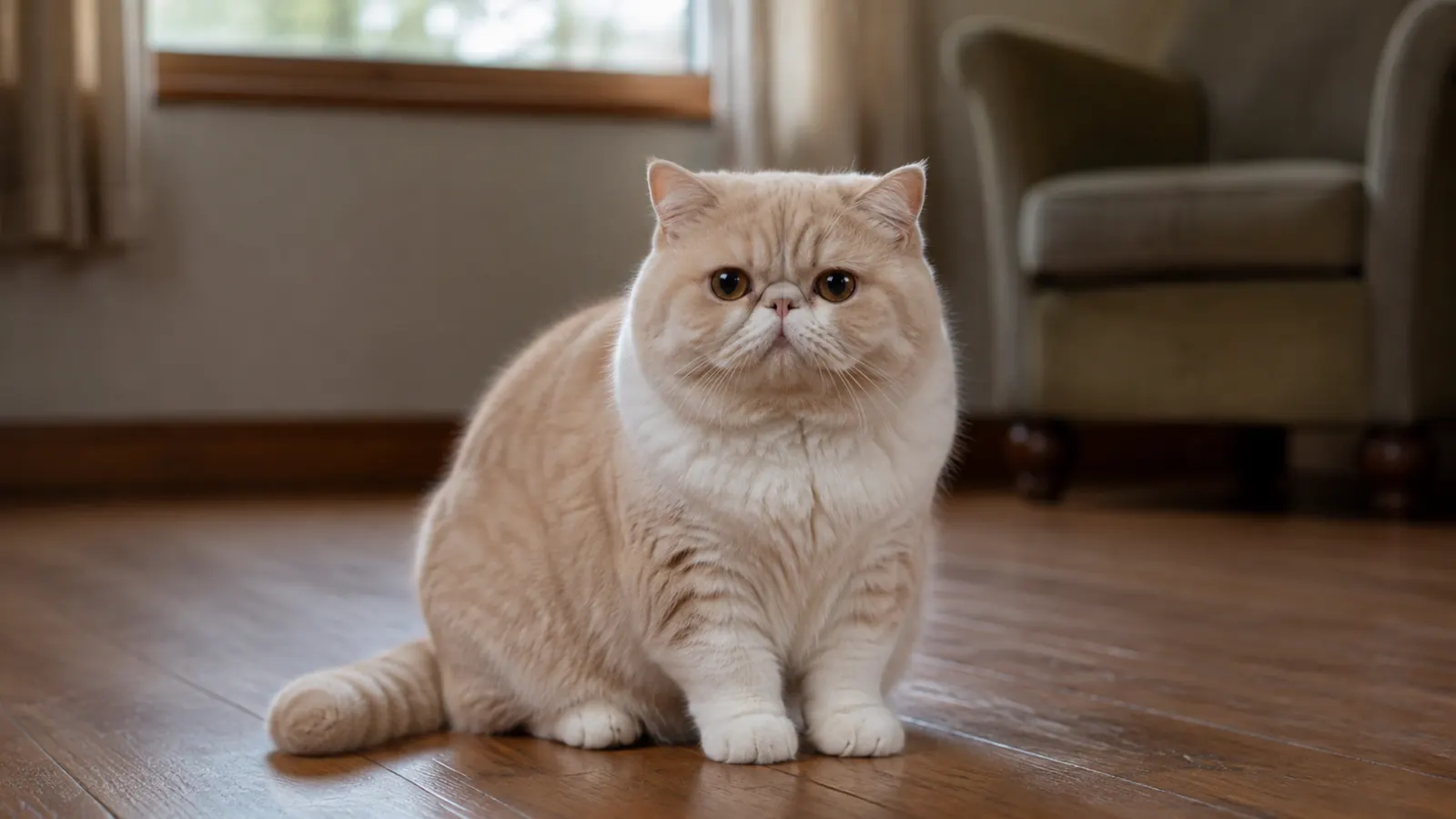
- Plush and dense with a thick undercoat, medium in length, standing away from the body
- Size
- Short, cobby and muscular, low on short thick legs, with a round massive head
- Typical weight
- No weight range in the standard, which describes the Exotic by body shape instead
- Life expectancy
- Never measured. The closest figures are the Persian's, and the two published ones disagree
- Activity level
- Low to moderate. A floor-level cat that settles near you rather than above you
- Grooming
- A weekly comb with a steel comb, and the shedding is real
- Suits
- Quiet households, and buyers who will ask for both parents' PKD results
The Exotic Shorthair is usually described as the easy Persian. That description is accurate about one thing, and the rest of the Persian arrives with it.
Is an Exotic Shorthair the right cat for you?
An Exotic may suit somebody who enjoys a quiet companion and can maintain a dense short coat, but face shape and documented health screening deserve attention before appearance. A shorter coat can reduce grooming without removing skin, dental, eye or breathing problems.
A UK study described disorders in 3,235 Persians, not Exotics. Its findings provide relevant questions because the breeds share ancestry and a similar skull, but they do not establish Exotic disease rates or show that a short coat prevents those disorders.
| Decision | What to assess in this cat |
|---|---|
| Coat workload | Density, shedding, tangles and tolerance of gentle combing |
| Breathing and eyes | Quiet resting breathing, open nostrils and any recurring discharge |
| Inherited kidney risk | Both parents' named PKD1 results and identifying details |
| Household fit | Activity, approach, handling and ability to retreat |
The decision rests on the individual animal and its records. Persistent noisy breathing, sore eyes or difficulty eating need veterinary assessment before you interpret them as normal breed features.
An Exotic Shorthair is a Persian in a different coat
This is not a figure of speech. The standard developed for the Exotic was identical to the Persian standard except for the coat description, and CFA went further in 1984. When it split its breeds into a longhair group and a shorthair group, it put the Exotic in the longhair group, on the stated grounds that the cats are structurally identical to a Persian.
- The standard
- Identical to the Persian standard apart from the coat description
- The show group
- CFA moved the Exotic into the longhair class in 1984
- CFA's stated reason
- The cats are structurally identical to a Persian
- The permitted outcross
- The Persian, and nothing else, under the GCCF Exotic policy
- The colours
- All the recognised Persian colours, because it is the same breed in another coat
The GCCF side says the same thing from the other direction. Its Exotic breeding policy calls the breed the shorthaired equivalent of its close relative the Persian, and names the Persian as the only permitted outcross. That last rule is the one that matters most. Permitted outcrossing maintains close ancestry, but it does not make every health finding interchangeable between the two registered populations.
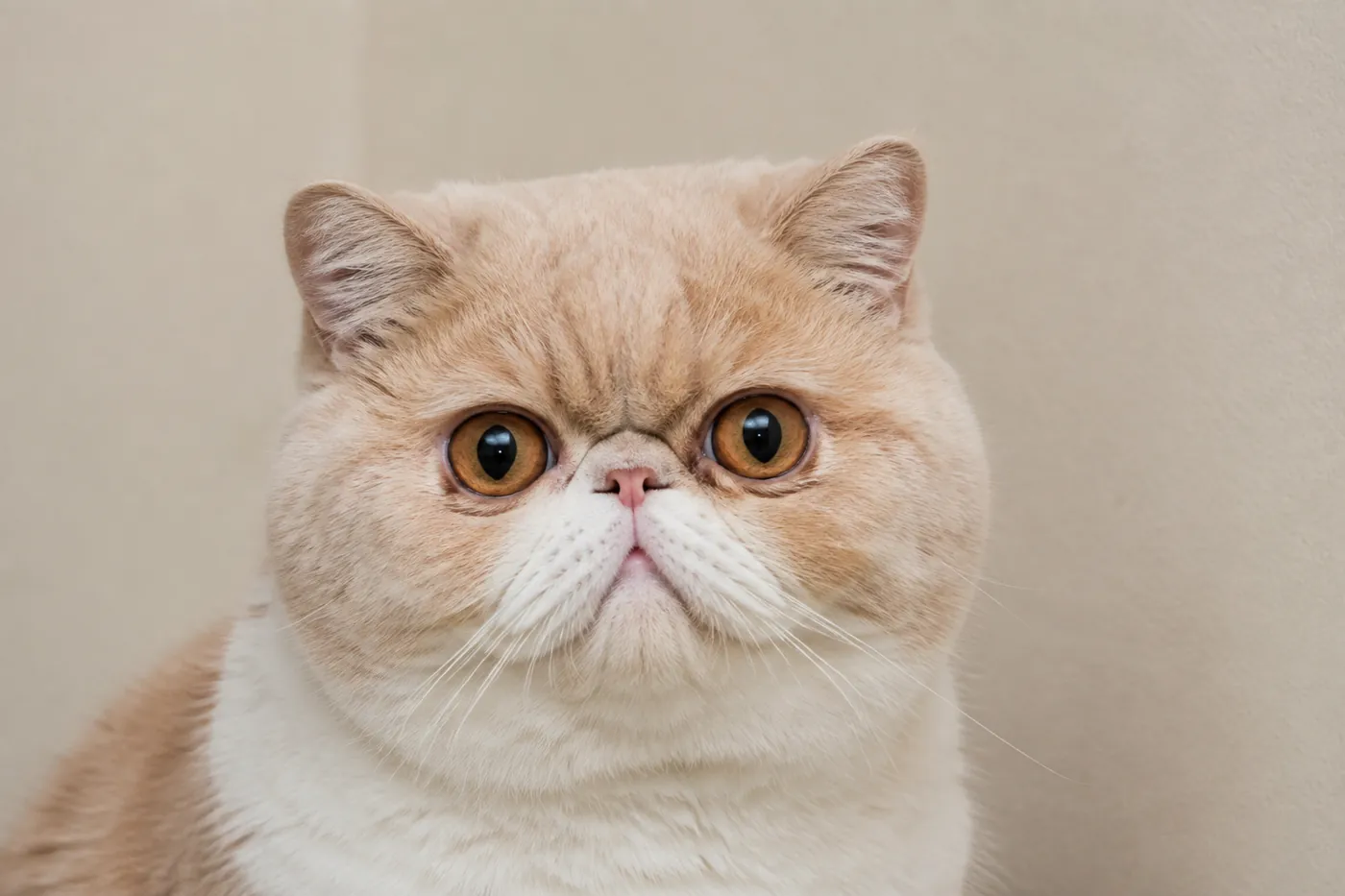
Everything the standard asks for below the neck is Persian too: a short cobby muscular body, low on the legs, with short thick legs and large rounded paws.
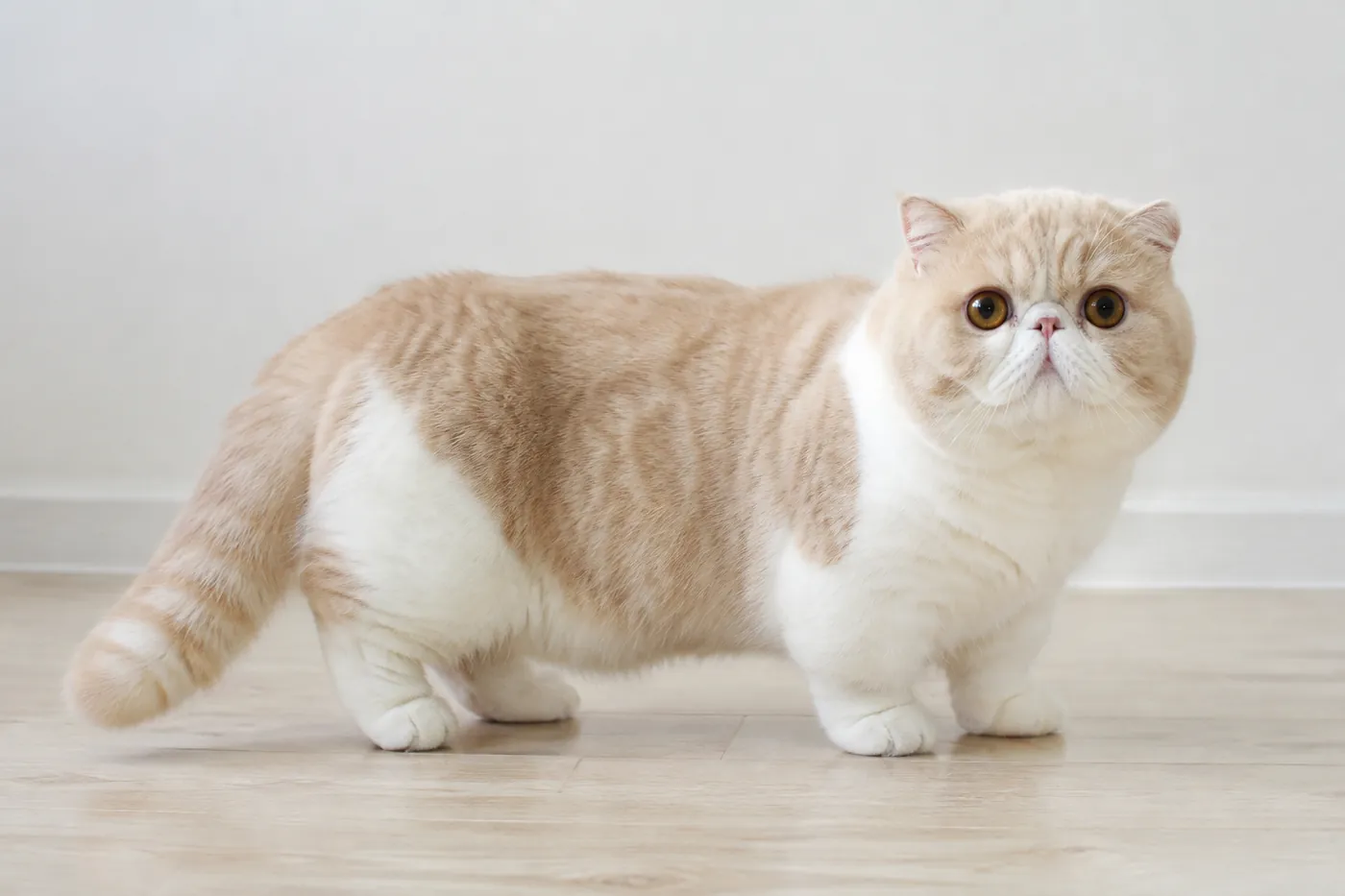
The shared head and body standard explains the comparison; breed-specific health claims still need breed-specific evidence.
Two registries tell two different origin stories
CFA and GCCF give two answers to where the Exotic came from, in two countries, thirty years apart.
CFA's account starts in 1950s California, where West Coast Persian breeders crossed their cats with American Shorthairs. CFA established the result as a breed in 1966.
The name came from the colours. So many of the new shorthairs were shaded silver or chinchilla, colours that did not then exist in any shorthair breed, that the breed was called the Exotic Shorthair. The word Shorthair was dropped later, because it caused exactly the confusion you would expect from a longhair-group breed with Shorthair in its name.
| CFA's account | The GCCF account | |
|---|---|---|
| Decade and country | 1950s, American West Coast | Britain, recognised from 1986 |
| The shorthaired breed used | American Shorthair | British Shorthair |
| Recognition | Established as a breed in 1966 | Preliminary 1986, championship 1995 |
The GCCF account starts somewhere else entirely. British Shorthair breeders had for years mated their cats to Longhairs to improve bone, body shape and eye colour, and the kittens were usually too heavily typed to show as British Shorthairs. Some breeders liked the look enough to keep it, and mated those kittens back to Persians. GCCF granted preliminary recognition in 1986 and full championship status in 1995.
Neither account is folklore and neither cancels the other. They are two registries describing their own populations, and both end in the same place: a shorthaired cat bred back towards the Persian standard.
Longhaired kittens are normal in an Exotic litter
Longhair is recessive to shorthair, which means a shorthaired cat can carry it invisibly. The GCCF policy says most Exotics used for breeding are heterozygous, carrying one copy each. The consequence is stated plainly in the same document: longhaired kittens are frequently produced in Exotic litters.
Both registries have a written route for those kittens, which is the clearest sign that nobody treats them as a mistake. GCCF classes the Exotic Longhair as a variant exactly similar in phenotype to an existing breed, and shows it in the Persian Open. CFA does something similar and scores it differently. Longhair Exotics may compete in Persian colour classes, but the points they win count towards longhair Exotic wins rather than Persian wins.
A fluffy kitten in an Exotic litter is expected, registrable, and a full Persian coat commitment.
What grooming an Exotic Shorthair actually takes
An Exotic needs less grooming than a Persian, but it still needs combing. The coat is plush and dense, with a thick undercoat that pushes it away from the body, and the GCCF standard is specific about the difference. The coat is medium in length, longer than in other shorthairs, and should never be long enough to flow, while a flat close-lying coat is undesirable.
That density is why CFA says combing is needed, with a steel or Teflon coated comb, to manage shedding.
- Comb through once a week with a steel comb, following the lie of the coat.
- Work down to the undercoat rather than skimming the surface, since that is where the loose hair sits.
- Comb more often while the coat is dropping.
- Look at the skin while you are in there, because haircoat problems were the commonest recorded disorder in the related Persians.
Coat quality varies more than buyers expect, and the reason is genetic. A cat carrying one longhair copy can have a longer, softer coat than one carrying none.
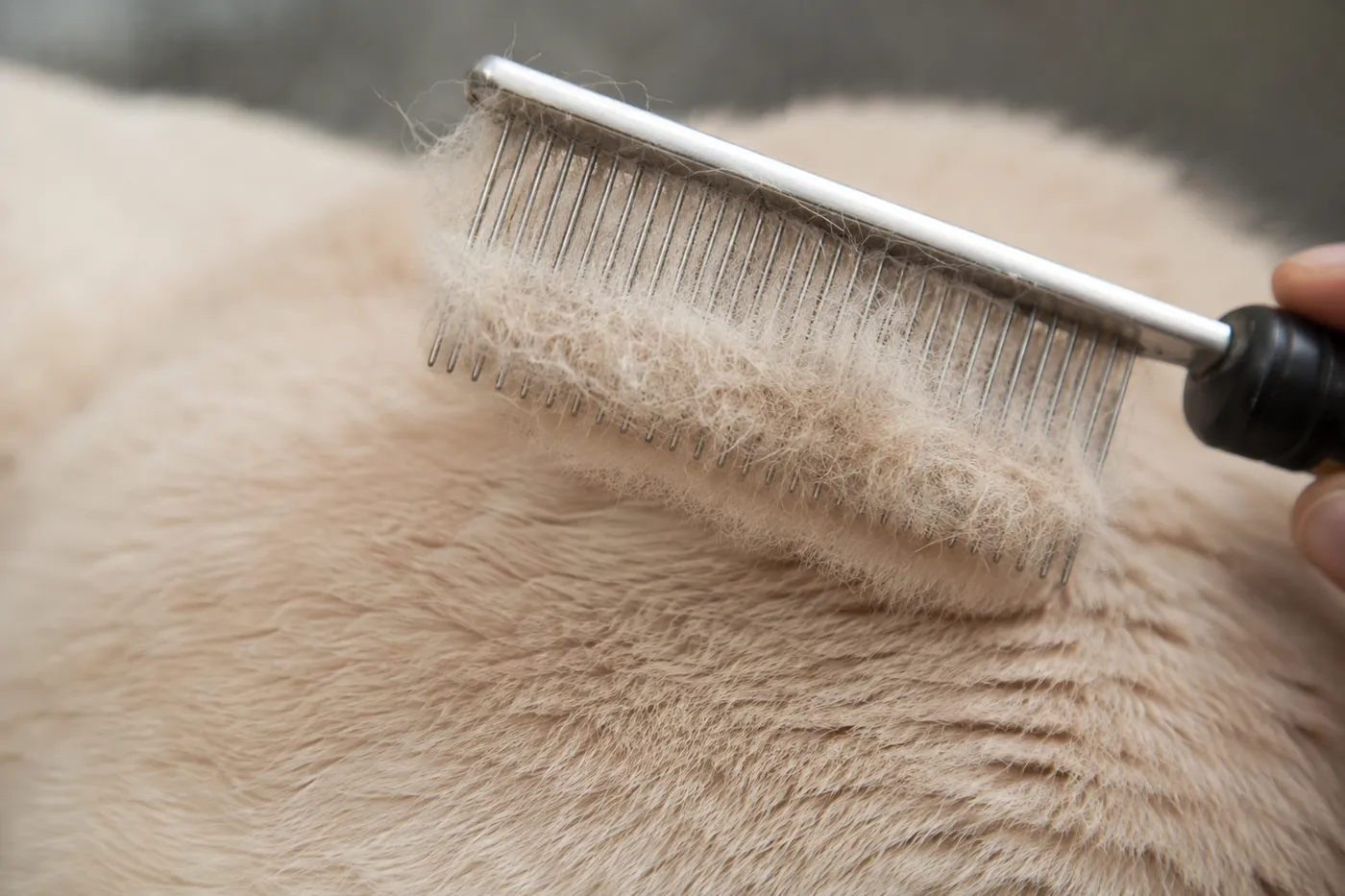
A weekly comb is enough for most of the year, and the shedding is real because the undercoat is thick.
The face is the Persian face, and so are its consequences
The head is round and massive, the nose short and snubbed, with a deep break centred between the eyes. Nothing about the short coat changed any of that.
The GCCF Standard of Points is unusually direct about where this goes wrong. It discourages breeding extreme type that may lead to physical anomalies, and asks breeders to pay particular attention to a fully formed nose leather and nostril apertures of adequate size.
- Nostril apertures of adequate size, which the breeding policy names first
- A fully formed nose leather, named alongside them
- Tear staining below the eye, recorded as ocular discharge in 5.8 per cent of the related Persians
- The parents' teeth and gums, since periodontal disease was recorded in 11.3 per cent of them
Those percentages describe the sampled Persians. A shorter coat does not eliminate dermatological disease, and the study did not measure whether Exotics had lower rates.
None of that follows from the coat, so a shorter one cannot change it. The breeding policy's own warning about extreme type leading to physical anomalies is a warning about the head.
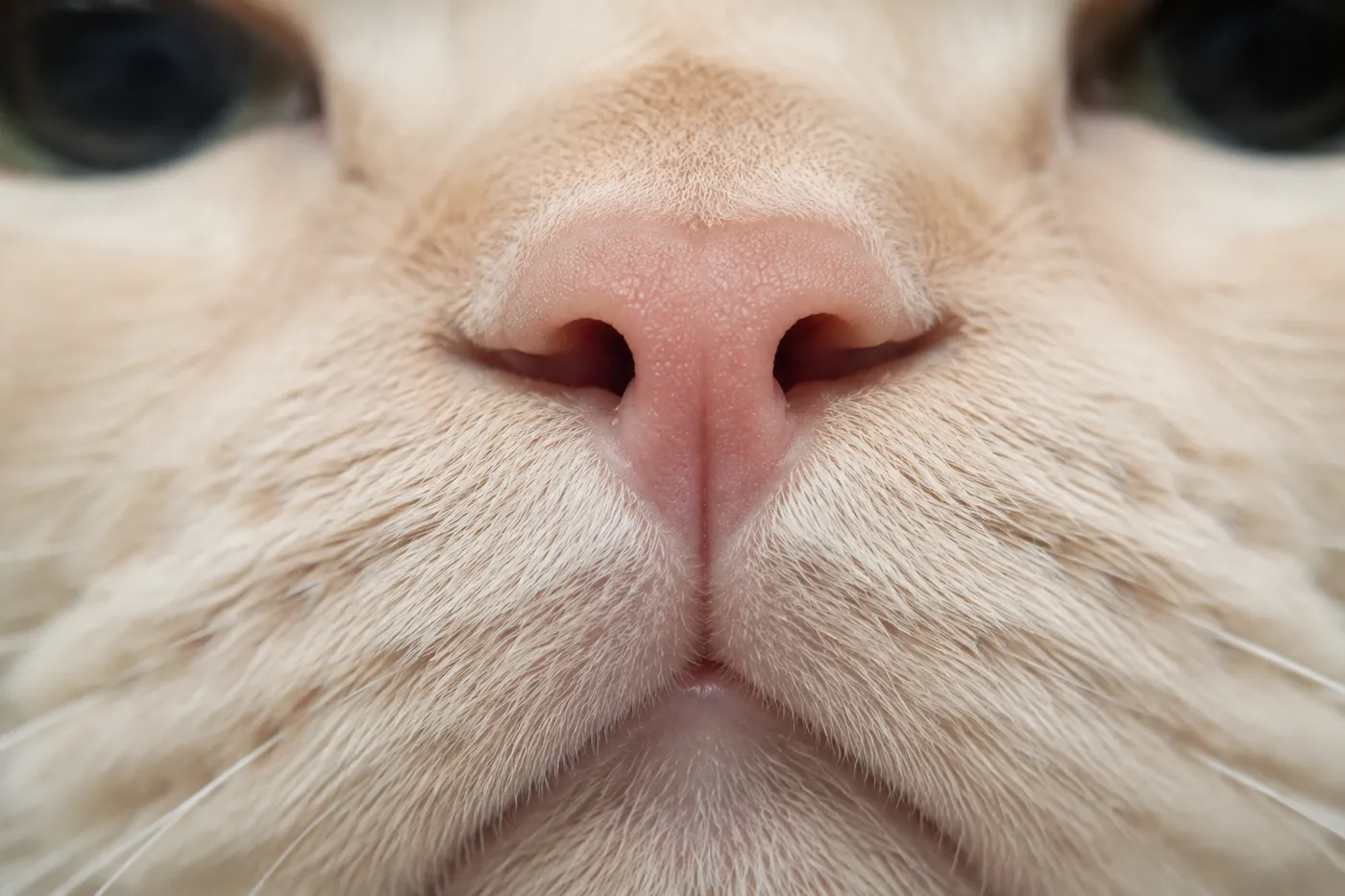
Face shape varies between individual cats, and a less compressed muzzle is a real difference rather than a cosmetic one. Daily care of a folded face is a separate job with its own routine.
What an Exotic Shorthair is like to live with
CFA describes a cat that is sweet, affectionate and quiet, and then makes an unusually specific claim: devoted but not intrusive. The elaboration is what makes it useful. The breed is content to stay close to you without needing to be included in what you are doing.
- Voice
- Meows are rare. CFA says they speak with their eyes rather than their voices
- Attention
- Devoted but not intrusive, which is a narrower claim than affectionate
- Where it will be
- In the room with you, not in the middle of what you are doing
- Build
- Cobby and low on short thick legs, so this is a floor-level cat rather than a shelf-level one
The quiet is not a small detail in a flat. A cat that rarely meows and settles nearby is a different daily proposition from one that follows you talking.
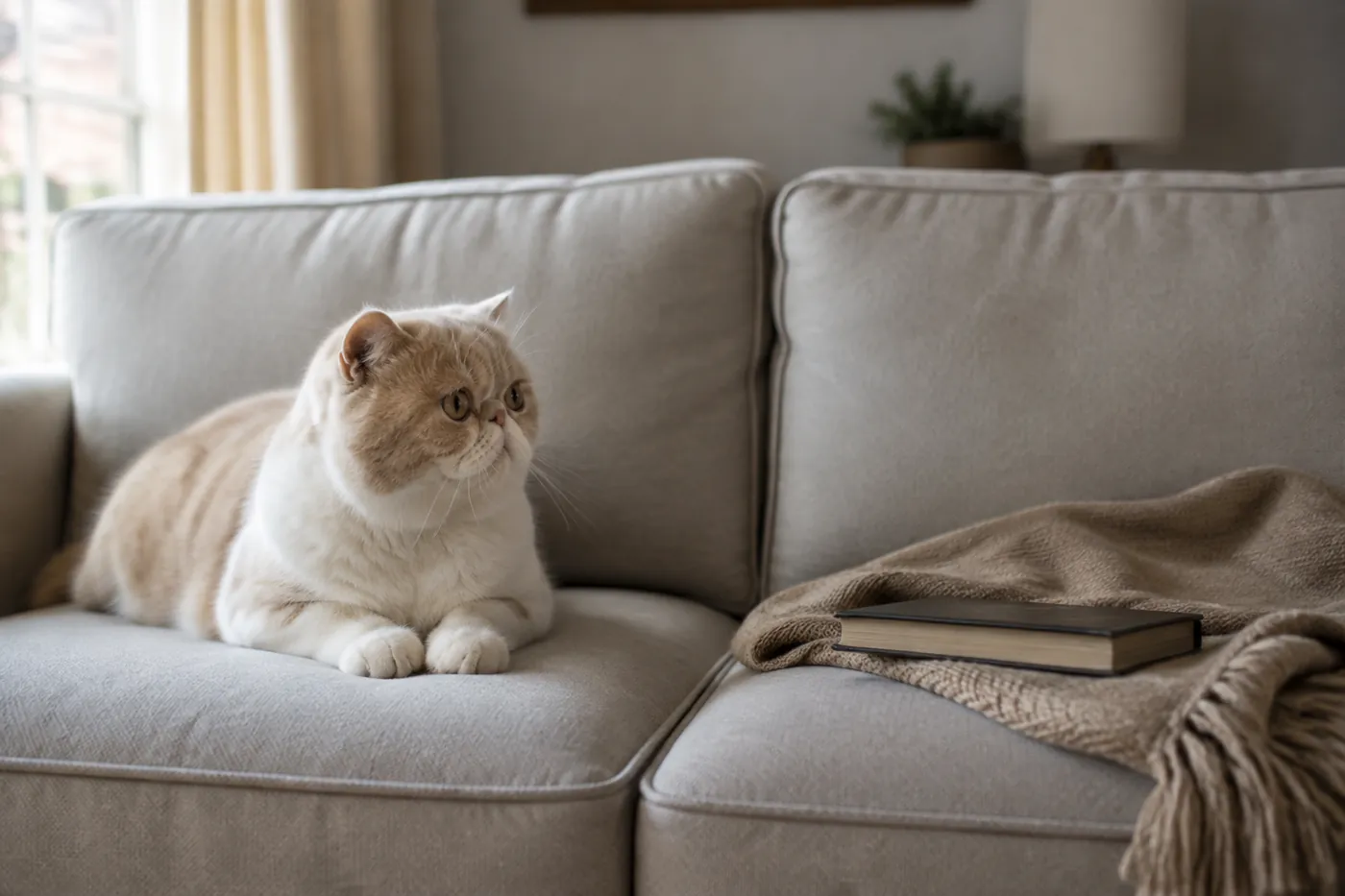
CFA is just as specific about the rest of the household. It calls the Exotic an excellent choice as a pet for young children, and says it may be shy with other animals at first before it learns to live peacefully with dogs and other cats. It also describes an adaptable cat that can settle into a new home at any age, which keeps an adult Exotic in the running alongside a kitten.
None of this is a promise about an individual. It is a breed description, and quiet has never meant undemanding: this cat still wants the company it is being quiet next to.
Polycystic kidney disease, and the document that settles it
This is the one health question a breeder can settle with a document. A French screening study ultrasounded 310 cats between December 2000 and April 2002, 64 of them Exotic Shorthairs.
The screening study found no significant difference between those two sampled groups; that is not proof that the populations have identical risks. It detected no polycystic kidney disease in any of the other breeds it screened.
Two things follow. The disease is autosomal dominant, so a single copy affects the cat and an affected parent passes it to about half a litter. And a DNA test exists. The GCCF Exotic policy says so and strongly recommends that breeders work only with lines tested clear, which is why the PKD result is the document to ask for.
Those figures are from screening done before the DNA test was available, so they describe the breed as it was rather than as it is. That cuts both ways: the test has been available for two decades, and a breeder still not using it has had a long time to start.
Both parents' PKD DNA results settle the one inherited risk in this breed that paperwork can settle.
How long do Exotic Shorthairs live?
The sources cited here do not provide a representative breed estimate. The UK life tables report life expectancy for 12 breed groups and the Exotic is not one of them.
The Persian is, which is the closest thing available, and this is where two numbers start fighting. The life tables give the Persian 10.93 years, against 11.74 years for cats overall, while the general practice study of 3,235 Persians reports 13.5 years. Both figures are correct and they are not measuring the same thing.
The renal figure from that same study is the one worth carrying. Renal disease was the most common grouped cause of death in those Persians, at 23.4 per cent, which is what makes the kidney test more than paperwork.
What to ask before buying an Exotic Shorthair
The useful questions are the ones a breeder answers with a result, a record, or by handing you the kitten.
- Both parents' PKD DNA results, seen rather than described
- Whether the litter contained longhaired kittens, which changes the coat routine for whoever takes one
- A look at the kitten's nostril apertures and nose leather, which the breeding policy names
- Tear staining and gums on both parents, since ocular and dental problems are the recorded ones
- What the breeder thinks about extreme type, since the standard discourages it
That last one is a question about reading rather than about cats. The GCCF policy makes health the overriding consideration in any breeding programme and warns against extreme type by name, so a breeder who has not met the argument has not read their own document.
The longhair question is worth asking even when every kitten in front of you is short coated, because longhaired kittens are frequent in this breed and the answer shows what the breeder does with them.
None of these questions predicts the cat's personality, and nothing does. They settle the parts that can be settled, which is more than most breeds allow.
Common Questions
What is the difference between an Exotic Shorthair and a Persian?
The main visible difference is the shorter, dense coat. Their standards and permitted outcrossing reflect close ancestry, but that does not make every measured Persian disease rate an Exotic rate.
Why did my Exotic Shorthair litter have a longhaired kitten?
Because longhair is recessive and most Exotics used for breeding carry one copy of it. The GCCF breeding policy says longhaired kittens are frequently produced in Exotic litters. Both registries have a written route for them: GCCF shows the Exotic Longhair in the Persian Open, and CFA lets them compete in Persian colour classes while scoring the points as longhair Exotic wins.
How long do Exotic Shorthairs live?
The cited UK life tables do not report an Exotic-specific estimate. Persian figures in other studies use different methods and samples, so they should not be presented as an Exotic lifespan.
Do Exotic Shorthairs need grooming?
Yes, about once a week. The coat is plush and dense with a thick undercoat, and CFA says combing with a steel or Teflon coated comb is needed to manage shedding. It is far less work than a Persian, but a flat close-lying coat is actually undesirable in this breed, so there is more hair there than the word shorthair suggests.
Checked Against
- The Cat Fanciers' Association: Exotic breed profile cfa.org
- GCCF: The Exotic Breeding Policy gccfcats.org
- GCCF: Policy on Variants in Recognised Breeds, April 2023 gccfcats.org
- Barthez et al., Prevalence of polycystic kidney disease in Persian and Persian related cats in France, Journal of Feline Medicine and Surgery 2003 pubmed.ncbi.nlm.nih.gov
- O'Neill et al., Persian cats under first opinion veterinary care in the UK: demography, mortality and disorders, Scientific Reports 2019 nature.com
- Teng et al., Life tables of annual life expectancy and risk factors for mortality in cats in the UK, Journal of Feline Medicine and Surgery 2024 pmc.ncbi.nlm.nih.gov
Published 5 September 2026. Last updated .