
What Is a Minskin Cat, and What Do Its Mutations Mean for Care?
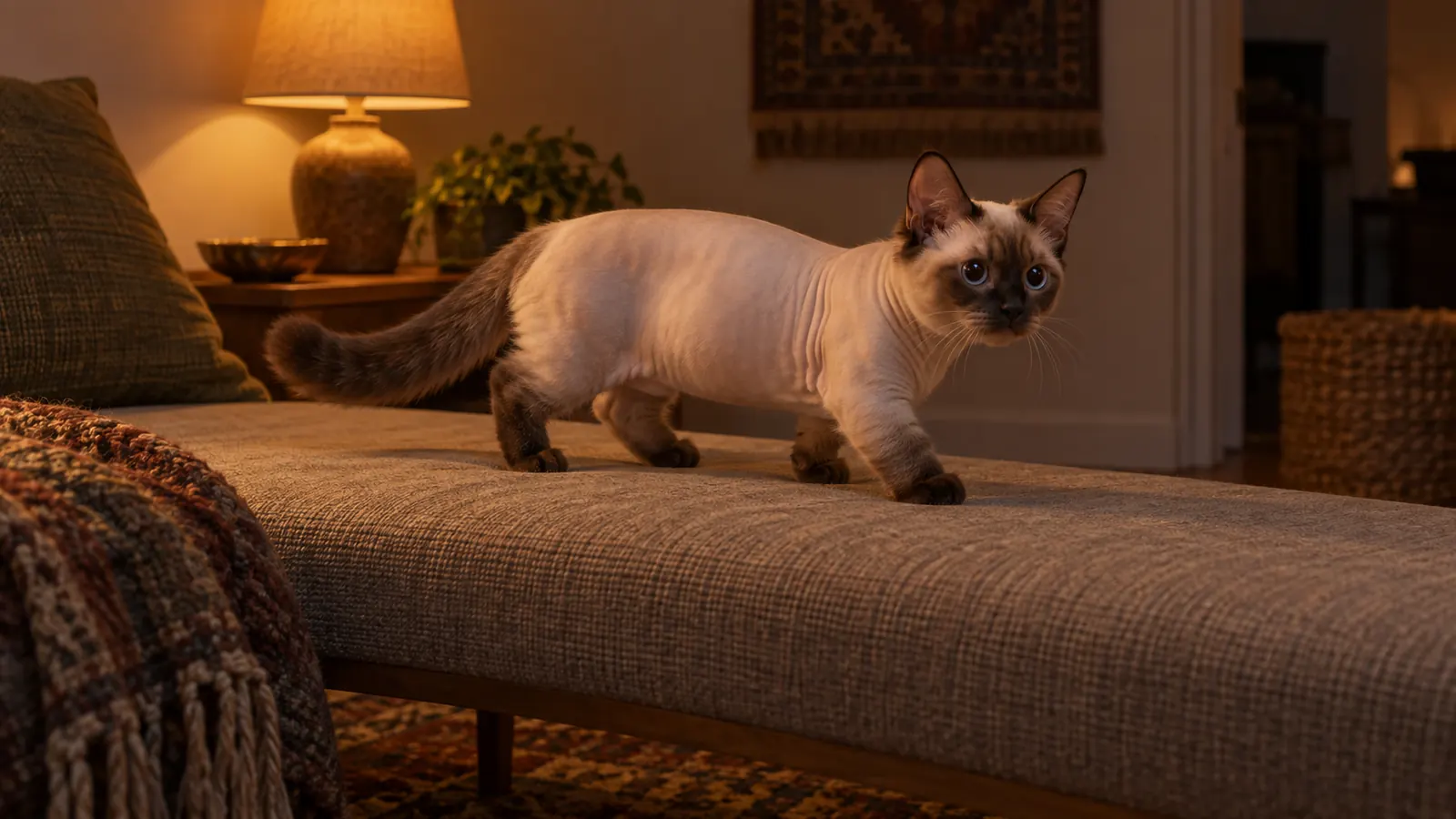
A Minskin is a small, short-legged cat with a sparse, fur-pointed coat, developed from crosses between Munchkin, Sphynx, Devon Rex and Burmese lines. TICA registers the Minskin but it has no championship status, and no breed-specific health study has been published, so the best evidence about its body and skin comes from the documented genetics of its parent breeds.
- Origin
- Developed from Munchkin, Sphynx, Devon Rex and Burmese lines
- Coat
- Fur-pointed: denser hair on the face, ears, legs and tail with a sparser or nearly bare torso
- Size
- Small and compact, with shortened forelegs and hindlegs from the Munchkin UGDH variant
- Typical weight
- No official standard weight range exists; secondary sources commonly cite 4 to 6 pounds without identifying a study
- Life expectancy
- No Minskin-specific population data was found; secondary sources cite 12 to 14 years without identifying a study
- Activity level
- Commonly described as outgoing, playful and people-oriented
- Grooming
- Low coat maintenance but regular skin care on exposed areas; bathing to manage oil buildup
- Suits
- Households that can provide low-level enrichment, skin and temperature care, and veterinary monitoring around the skeletal structure
A Minskin is a small, short-legged cat with a distinctive coat pattern: denser fur on the extremities and a sparser or nearly bare torso. The breed combines the Munchkin short-leg mutation with coat genetics drawn from Sphynx and Devon Rex lines. TICA registers the Minskin, but the breed has no championship status.
No Minskin health study or temperament survey has been published, so the most reliable evidence about its body and skin comes from the documented genetics of its parent breeds.
What Registry Status Does the Minskin Hold?
The Minskin was developed by crossing Munchkin cats with Sphynx and Devon Rex lines, with Burmese introduced later. The goal was a short-legged cat with a fur-pointed coat pattern.
TICA accepts Minskin registrations, which record a cat's parents and identity. The breed has not reached championship status, so a Minskin cannot earn championship titles, and its standard is not finalised. CFA does not list the Minskin.
- TICA status
- Registered; no championship status
- Championship or breed standard
- Not finalised
- CFA
- Not listed
- Parent breeds
- Munchkin, Sphynx, Devon Rex and Burmese
- Defining features
- Short legs combined with a fur-pointed coat pattern
- What the listing does not establish
- A fixed coat standard, a breed-specific health profile or championship eligibility
The Bambino combines the same Munchkin short-leg mutation with the Sphynx and sits in TICA's Experimental Registry. The Kinkalow and Lambkin combine it with the American Curl and Selkirk Rex respectively. All four share the same skeletal considerations from the Munchkin side.
What Do Short Legs and a Fur-Pointed Coat Look Like Together?
The intended appearance combines shortened legs with a coat that is denser on the points and sparser across the body.
The fur-pointed pattern is different from both the Sphynx and the Lykoi. A Sphynx carries a variant of KRT71, a keratin gene, which produces near-complete hairlessness across the body. A Lykoi carries a follicle-maintenance mutation that produces a roan pattern. The Minskin's coat concentrates hair on the face, ears, legs and tail and leaves the torso sparse, the distribution its founder set out to produce by analogy with the Siamese points.
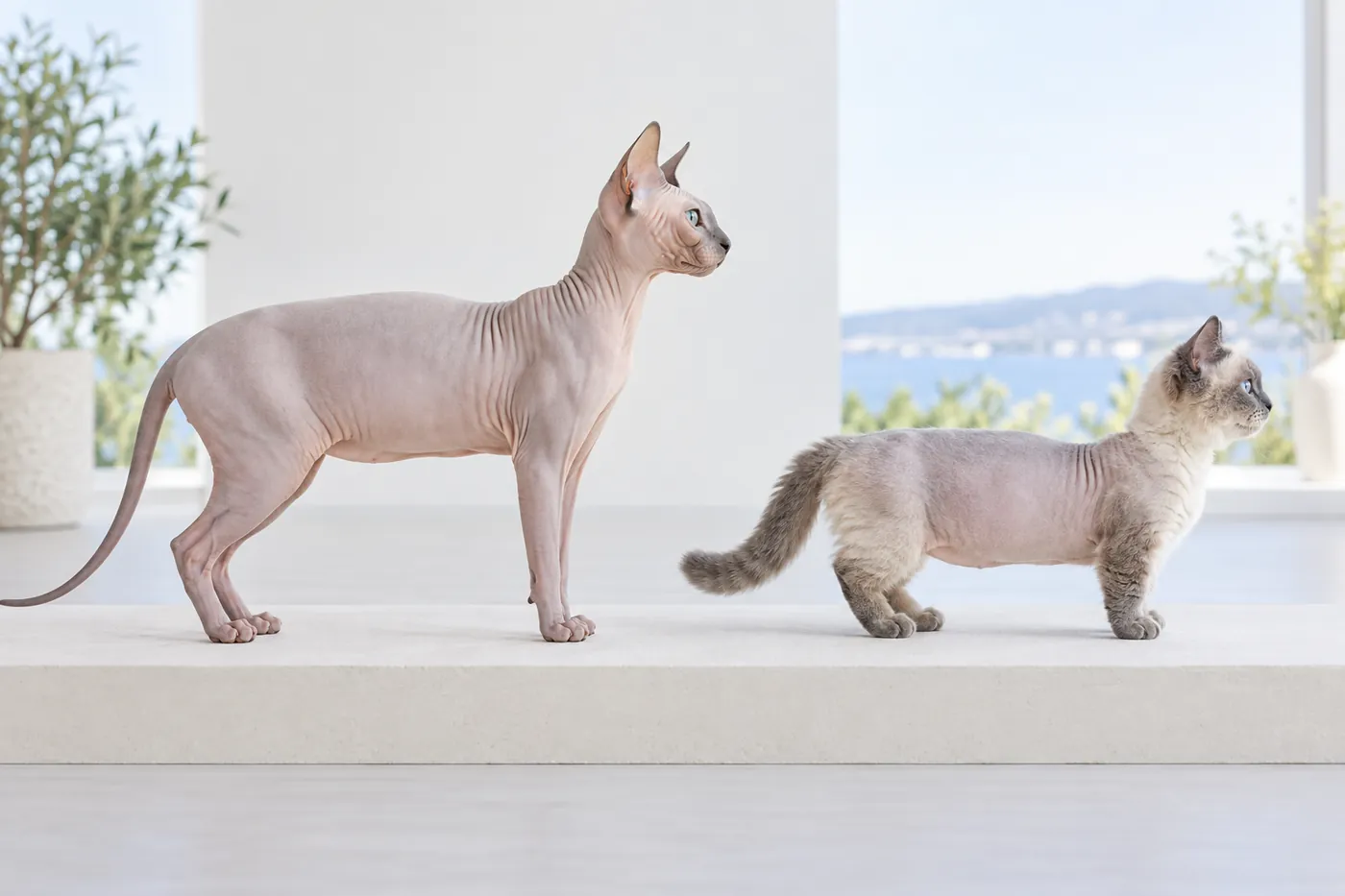
Not every kitten from a Minskin litter will express both traits, because the short legs and the sparse coat come from different genes and are inherited separately. A kitten that inherits neither the short-leg variant nor the sparse-coat pattern looks like an ordinary domestic cat.
Body proportions are small and compact. Secondary sources commonly cite 4 to 6 pounds, but no registry standard publishes an official weight range.
What Genetics Shape the Short Legs and Sparse Coat?
The short-leg trait comes from the UGDH gene variant identified in Munchkin cats by Struck and colleagues in 2020. The variant is autosomal dominant, and two copies appear to be lethal before birth.
A 2021 imaging study by Anderson and colleagues compared six cats confirmed to carry the UGDH variant with twelve normal-legged cats and found deformities in all four limbs of the short-legged group: an exaggerated S-shaped curve of the upper foreleg bone, bowed and outwardly twisted forearm bones, and angled thigh and shin bones. Spinal MRI in two of the cats showed no abnormality, although one later case had a herniated disc in the lower back. These are structural changes that may contribute to altered movement and joint stress, and the authors called for longer follow-up to show how they affect cats as they age.
The coat pattern draws from multiple sources: the Sphynx and Devon Rex lines contribute the coat genetics, and Burmese stock was added later in the programme. The specific inheritance pattern of the fur-pointed distribution has not been characterised in published research the way the Sphynx KRT71 variant has.
What Skin and Coat Care Does a Minskin Need?
The sparse torso coat creates practical care needs similar to those of other reduced-coat breeds, adjusted for the fact that a Minskin has more coverage on its extremities than a Sphynx does.
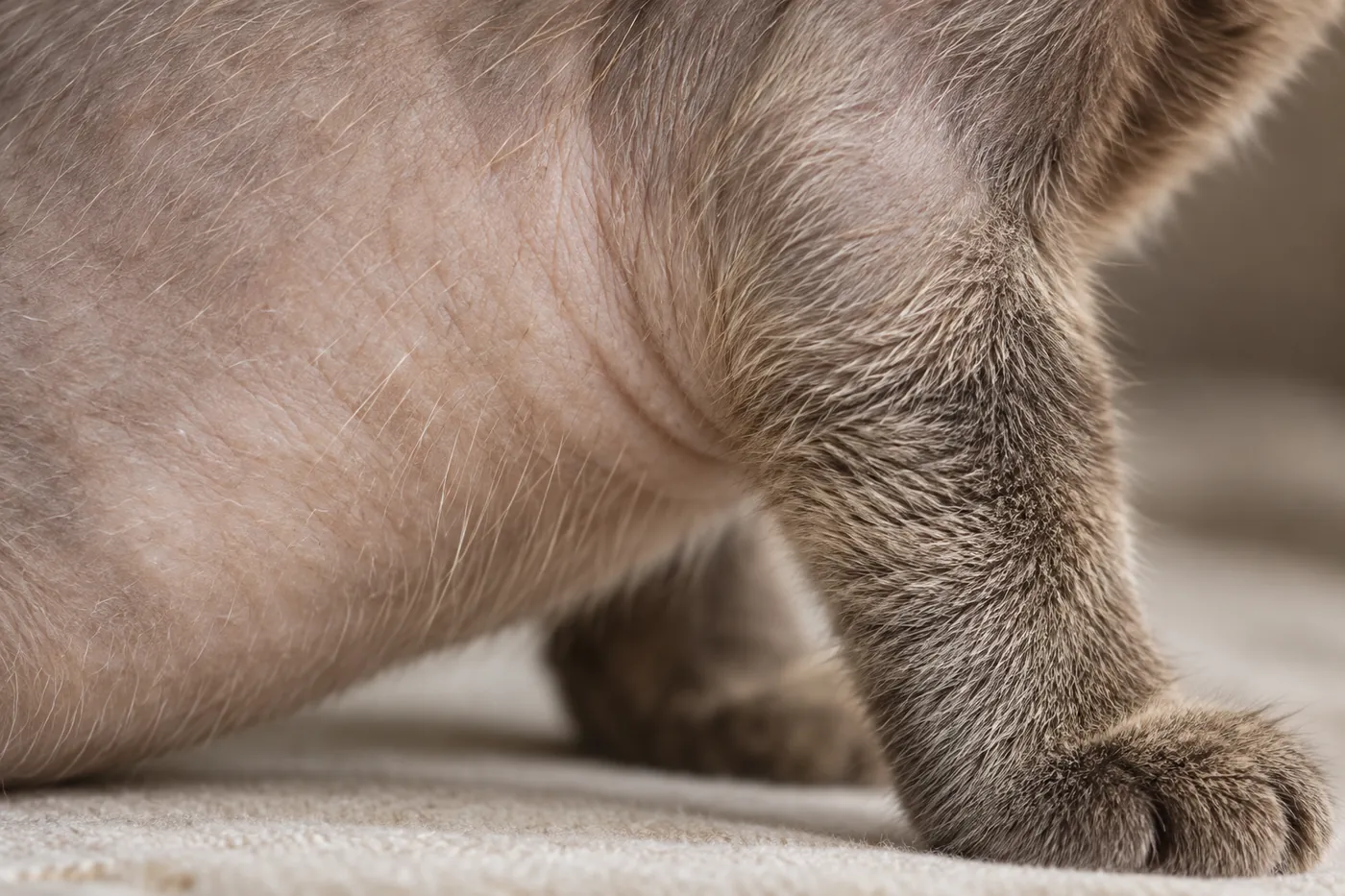
Oil buildup on exposed skin. Where hair is thin or absent, the skin's natural oils accumulate on the surface. Regular gentle bathing with a mild, unscented cleanser removes the buildup.
Sun exposure. Thinly haired skin has little protection from ultraviolet light and can burn, so shade during the strongest midday sun matters more for a Minskin than for a fully coated cat.
Temperature sensitivity. The sparser torso means less insulation than a fully coated cat. A warm bed, stable indoor temperature and protection from draughts help, particularly in cooler months.
Nails can grow longer between trims than on a standard-legged cat, because short legs may not wear them down unless the cat uses a scratching post.
What Behaviour Can You Expect From Burmese and Devon Rex Lines?
Secondary descriptions call Minskins outgoing, affectionate and social. The Burmese and Devon Rex lines in the background are both known for people-oriented behaviour, and a kitten from those lines raised with calm handling is likely to develop confidence around people.
With no breed study to go on, three observations of the individual kitten say more than any breed label:
- It comes back to people voluntarily after play, a sudden sound or a delay
- It resumes eating and exploring after something unfamiliar, without prolonged hiding
- It tolerates handling along the back, belly and paws and across the sparser skin
Short reward-based training sessions can build carrier entry, recall and cooperative handling. Swatting during handling can come from overstimulation or from pain, and in a cat whose limbs carry structural changes, pain is worth ruling out before the behaviour is treated as petting-related aggression.
How Much Activity and Space Does a Minskin Need?
Jumping ability is reduced compared to a standard-legged cat. High shelves and tall towers that require long vertical leaps may be difficult or harmful.
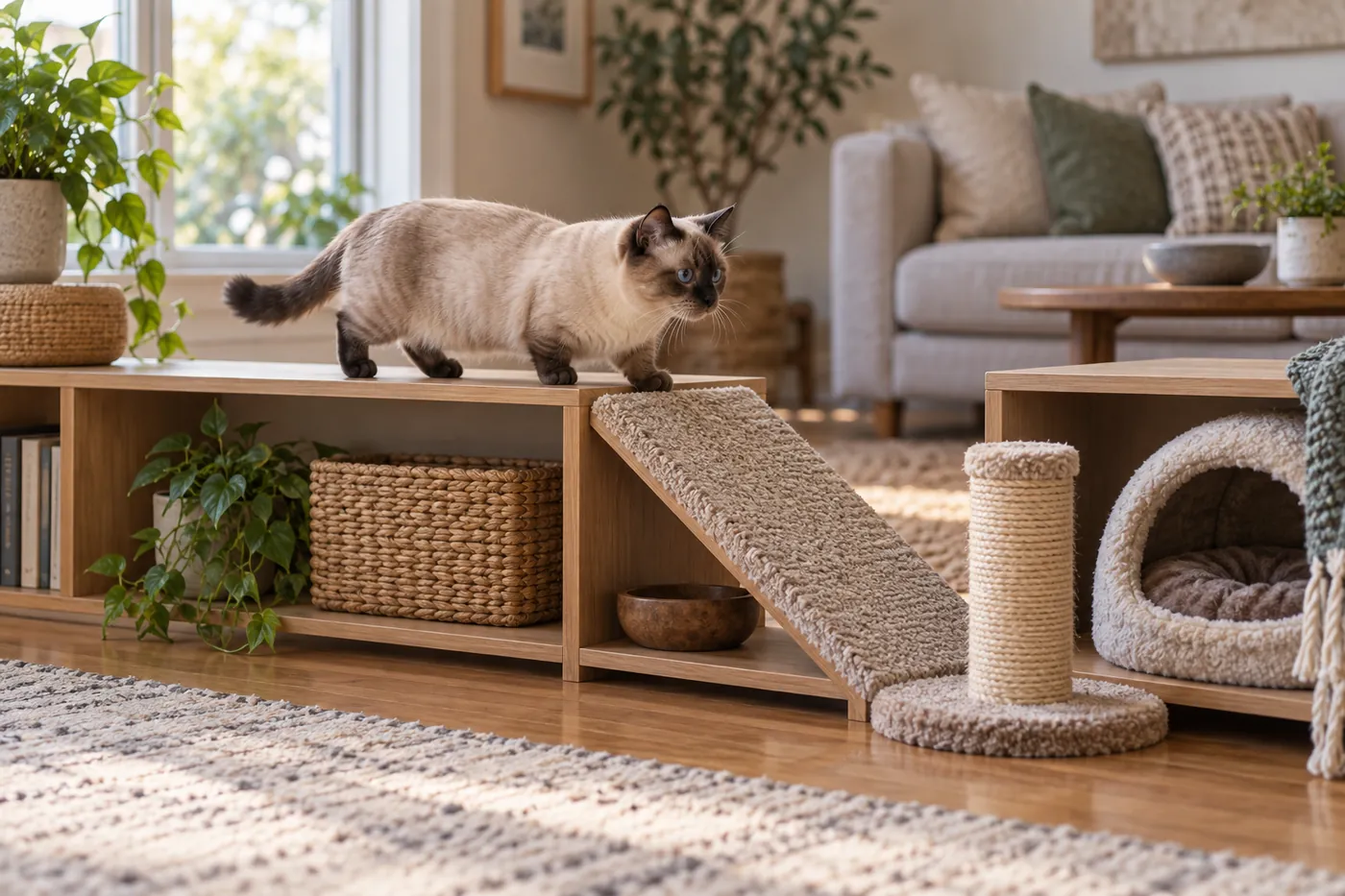
- Stable low shelves or furniture connected by ramps rather than wide gaps
- A litter tray with a low entry
- A scratching post at a reachable height
- Interactive play at floor level with short sessions
- Warm resting spots away from draughts and direct sun
What Is Known About Minskin Health and Lifespan?
No study has measured disease rates, lifespan or congenital problems in Minskins. Secondary sources cite a lifespan of 12 to 14 years without identifying a population or method, so the figure is an estimate rather than a measurement.
The strongest health evidence comes from the parent breeds:
| Source | Concern | What it means for a Minskin |
|---|---|---|
| Munchkin UGDH variant | Disproportionate limb shortening with documented deformities | Mobility and gait changes are the signs to watch across the cat's life |
| Munchkin homozygous lethality | Two copies of the short-leg variant appear lethal before birth | A litter from two short-legged parents is smaller, because kittens with two copies do not survive |
| Sphynx and Devon Rex coat genetics | Skin oil buildup and temperature sensitivity on sparse areas | Regular bathing and indoor temperature management |
How Does a Small Exposed-Skin Cat Fit a Family Home?
A Minskin can live with respectful children and compatible animals when the individual cat is comfortable and the household manages its specific needs. Floor-level play suits children and a Minskin best, because a small cat with short legs is more easily hurt if it is carried and dropped. The sparser skin areas are more sensitive to rough handling than a fully coated cat's body.
How Much Can a Minskin's Registration Tell You?
TICA registration records a Minskin's parents and identity, but the breed has no finalised standard, no championship history and no independent genetic study, so a registration says who the cat is related to and nothing about its health.
- The pedigree names the issuing organisation and both parents' registered identities
- Both defining traits are present, or the cat is described honestly as non-standard
- Health records name the laboratory, test, identifier and outcome
- The cat's behaviour is observed during contact, play and handling
- Equipment and temperature management suit a small short-legged cat with exposed skin
- The seller explains what the Minskin's TICA status does and does not cover
A source who explains the limits of the Minskin's registration and the care demands of both the short-leg structure and the sparse coat gives more useful information than one who treats rarity as proof of value.
Common Questions
Is the Minskin a recognised cat breed?
TICA registers the Minskin, but the breed has not reached championship status and has no finalised standard. CFA does not list it.
Is a Minskin the same as a Bambino?
No. Both are Munchkin-derived short-legged cats, but the Bambino crosses Munchkin with Sphynx only. The Minskin draws from Munchkin, Sphynx, Devon Rex and Burmese, producing a fur-pointed coat pattern rather than near-complete hairlessness.
How big does a Minskin get?
No official weight range exists. Secondary sources commonly cite 4 to 6 pounds, but that figure is not confirmed by a registry standard or population study.
Are Minskin cats healthy?
No breed-specific health data exists. The short-leg variant from the Munchkin side causes documented limb deformities, and the sparse coat needs skin care and temperature management, so mobility and skin condition are the two things to watch across the cat's life.
What care does a Minskin's coat need?
The sparser torso skin needs regular gentle bathing to remove oil buildup. Sun protection matters for exposed areas. Temperature management is important because the sparse coat provides less insulation than a full coat.
Checked Against
- TICA: Registration rules and breed status tica.org
- Struck et al.: A structural UGDH variant associated with standard Munchkin cats (BMC Genetics, 2020) pmc.ncbi.nlm.nih.gov
- Anderson et al.: Skeletal manifestations of heritable disproportionate dwarfism in cats as determined by radiography and magnetic resonance imaging (Vet Comp Orthop Traumatol, 2021) pmc.ncbi.nlm.nih.gov
- CFA: Current breeds cfa.org
- TICA: Minskin breed, Preliminary New Breed programme (limited access) tica.org
Published 17 September 2026. Last updated .





