
What Is a Lambkin Cat, and What Do Its Two Mutations Mean?
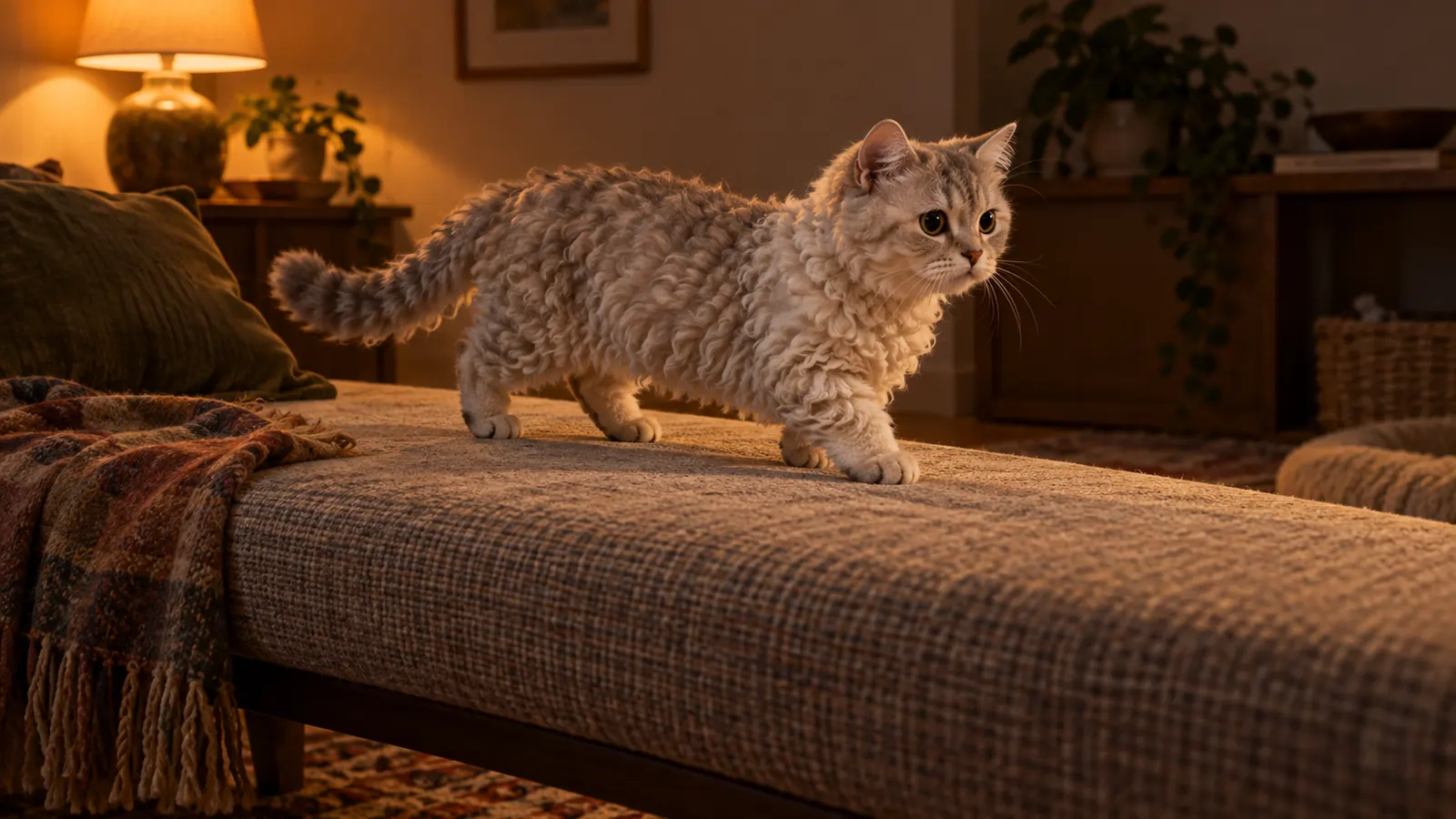
A Lambkin is a small, short-legged cat with a curly or wavy coat, produced by crossing Munchkin and Selkirk Rex lines. CFA, FIFe and WCF do not list it, and no breed-specific health study, temperament survey or published breed standard was found. The strongest Lambkin evidence begins with its parent breeds' known genetics.
- Origin
- United States, developed in the 1990s by crossing Munchkin and Selkirk Rex cats
- Coat
- Curly or wavy, short or long, with the Selkirk Rex texture on a compact body
- Size
- Small, with shortened forelegs and hindlegs from the Munchkin UGDH variant
- Typical weight
- No official standard weight range exists; secondary sources commonly cite 5 to 9 pounds without identifying a study
- Life expectancy
- No Lambkin-specific population data was found; secondary sources cite 12 to 14 years without identifying a study
- Activity level
- Commonly described as playful and gentle, adjusted for any mobility limitation from the short-leg structure
- Grooming
- The curly coat needs regular gentle combing to prevent matting, with extra care around the legs and belly
- Suits
- Households that can provide low-level enrichment, gentle handling of the curly coat and veterinary monitoring around the skeletal structure
A Lambkin is a small, short-legged cat with a curly coat, produced by crossing Munchkin and Selkirk Rex lines.
There is no published Lambkin breed standard, health study or temperament survey, so what can be said with confidence comes from the two mutations it carries.
What Registry Status Does the Lambkin Hold?
The name Lambkin describes a cat carrying two defining mutations: the short-leg trait associated with the Munchkin and the curly-coat trait associated with the Selkirk Rex.
CFA, FIFe and WCF do not list the Lambkin among their breeds. For a Lambkin buyer, that means there is no published standard to judge a kitten against and no championship record behind its lines, so any pedigree is worth reading for which organisation issued it and what that organisation actually checks.
- Origin
- United States, 1990s
- Parent breeds
- Munchkin and Selkirk Rex
- What the name establishes
- Munchkin and Selkirk Rex ancestry, with short legs and a curled coat as the intended traits
- What the name does not establish
- That a given kitten carries both traits, or any fixed temperament, health profile or standard to judge it against
The Bambino shares the same Munchkin short-leg mutation crossed with the Sphynx, and the Kinkalow crosses it with the American Curl. All three inherit the same skeletal considerations from the Munchkin side.
What Do the Short Legs and Curly Coat Look Like?
The intended appearance combines shortened legs with a soft, wavy or curly coat.
Not every kitten from a Lambkin litter shows both traits, because the Munchkin short-leg variant and the Selkirk Rex curl gene are each passed on separately. A kitten that inherits neither the short-leg variant nor the curly-coat gene looks like an ordinary domestic cat with standard proportions and a straight coat.
Leg length varies within a litter. A kitten with one copy of the Munchkin variant has shortened legs on all four limbs, while a littermate without it stands at ordinary height even if it has the curly coat.
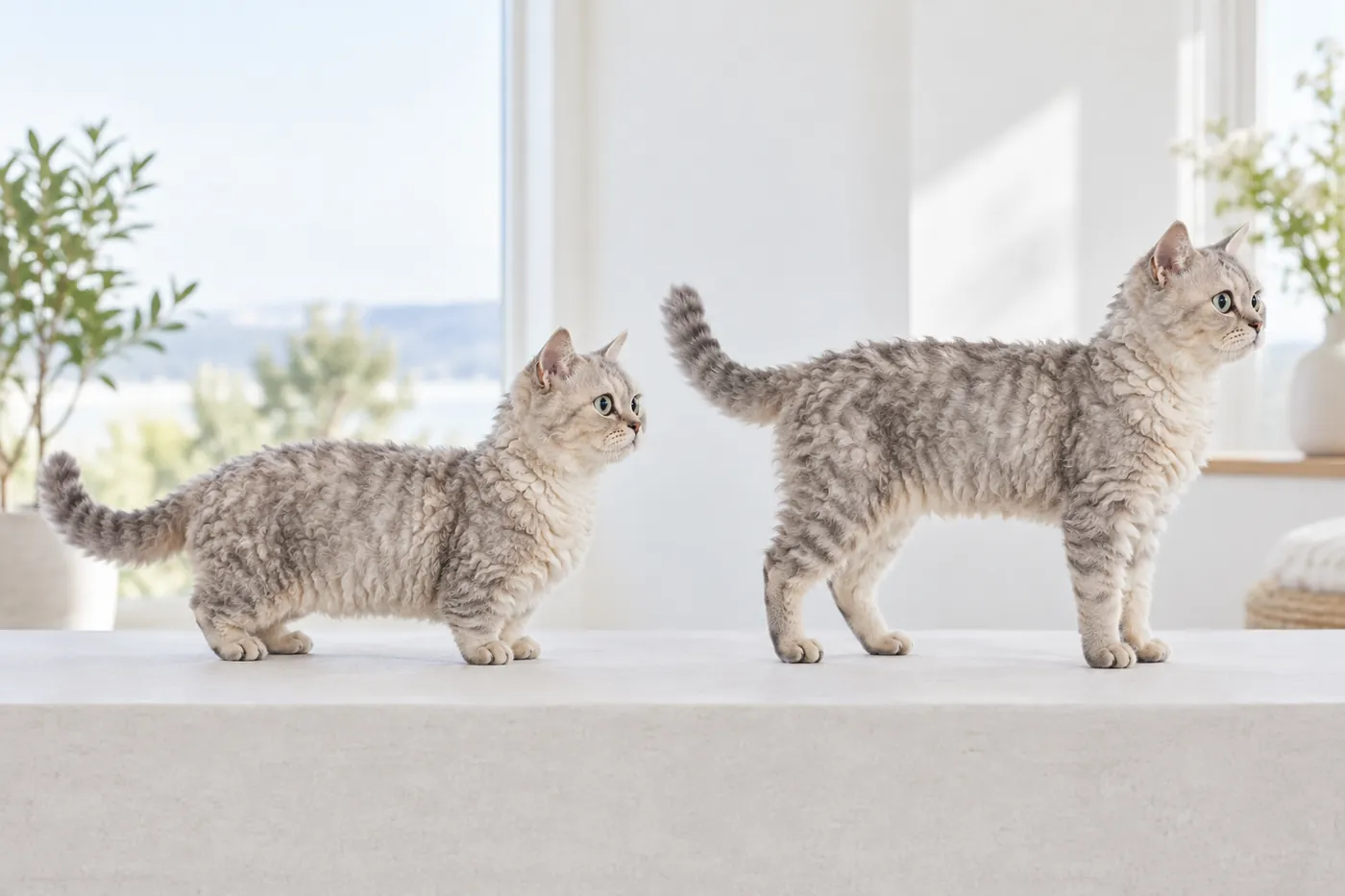
The coat ranges from loose waves to defined curls, depending on what each parent contributes. Coat type can be short or long, and all colours and patterns are reported.
Secondary sources commonly cite 5 to 9 pounds, but no registry standard publishes an official weight range.
| Feature | Intended appearance | What it does not tell you about a particular kitten |
|---|---|---|
| Legs | Shortened on all four limbs | That every kitten in the litter will be short-legged |
| Coat | Curly or wavy, soft texture | A predictable grooming schedule |
| Body | Small and compact | That the commonly quoted 5 to 9 pounds applies to this cat |
| Tail | Medium to long and flexible | Anything about Lambkin ancestry, since most domestic cats share it |
The curly coat can feel softer and lighter than a straight coat of the same length. Individual coat density and curl tightness vary between kittens in the same litter.
What Genetics Shape the Short Legs and Curly Coat?
The Lambkin's two mutations come from different parent breeds, and only one of them carries a documented welfare cost.
The short legs come from the Munchkin parent, through a structural variant in the UGDH gene identified in Munchkin cats by Struck and colleagues in 2020. It is autosomal dominant, so one copy shortens a Lambkin's legs and two copies appear to be lethal before birth. That is why responsible Lambkin breeding pairs one short-legged parent with one standard-legged parent, and why standard-legged kittens are an expected part of a Lambkin litter.
A 2021 imaging study by Anderson and colleagues compared six cats confirmed to carry the UGDH variant with twelve standard-legged cats and found deformities in all four limbs: an exaggerated S-shaped curve in the upper foreleg bone, bowed and twisted forearm bones, and angled thigh and shin bones. These structural changes may alter movement and add joint stress over a lifetime, although a group of six cats cannot show how often that happens.
The curly coat comes from a dominant gene designated Se, identified in the Selkirk Rex. One copy of the gene produces curly hair, and the homozygous form can produce a tighter, sometimes coarser curl. The Skookum pairs the same Munchkin legs with a different dominant curl gene, the LaPerm's Lp, which sits in a coat with little undercoat and gives a lighter, springier curl that stands away from the body.
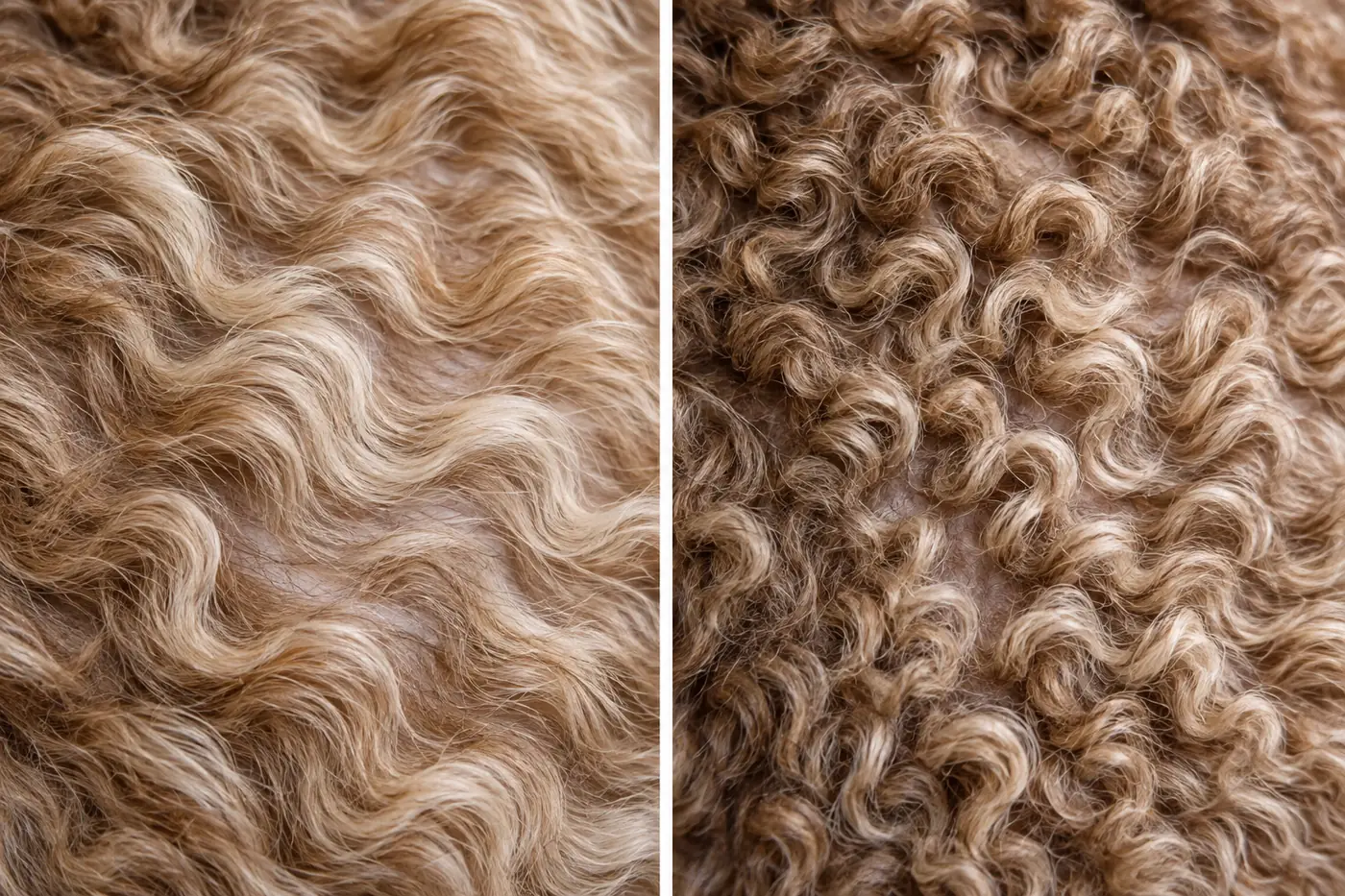
The Selkirk Rex has not been associated with the skin fragility or coat-loss problems seen in some other curly-coated breeds. The curly-coat mutation itself does not carry documented welfare concerns comparable to the short-leg trait.
How Predictable Is a Lambkin's Behaviour?
Secondary descriptions commonly call Lambkins gentle, playful and affectionate, but no behaviour study or temperament survey of the cross was found to test those words. The honest expectation is a range shaped by genetics, early socialisation, age and the home environment.
With no breed evidence to lean on, the individual cat's behaviour is the evidence, and three observations during a visit say more than the label:
- The cat comes back to people after play ends, a sound interrupts or food is delayed
- Normal eating and exploring resume after something unfamiliar, without prolonged hiding
- Touch along the back, belly, paws and through the curly coat is tolerated without escalating
Neither mutation affects learning, and like most cats a Lambkin responds to short sessions with a clear food reward, which is enough to build practical behaviours such as carrier entry, coming when called and cooperative handling.
A swipe or bite during handling can come from pain as easily as from petting-related aggression or fear, and in a cat whose limbs carry structural stress, pain deserves to be ruled out first.
How Much Activity and Home Space Does a Lambkin Need?
A Lambkin is commonly described as gentle and playful, but its short-legged structure changes what suitable activity looks like.
A short-legged Lambkin cannot jump as high as a standard-legged cat, including its own standard-legged littermates. High shelves, tall towers and platforms that require long vertical leaps may be difficult or harmful for limbs that already carry the structural changes imaged in cats with the Munchkin variant.
- Low shelves or furniture joined by ramps, with gaps a short-legged cat can step across instead of leaping
- A litter tray with an entry low enough for short legs to step over
- A scratching post short enough for a short-legged Lambkin to stretch up it fully, which may be lower than its littermates need
- Wand play at floor level in short sessions
- Food, water, litter and resting spots in separate places, each reachable without a jump
An apartment can suit a Lambkin as well as a house does, because the space a short-legged cat uses is floor area and low routes rather than height.
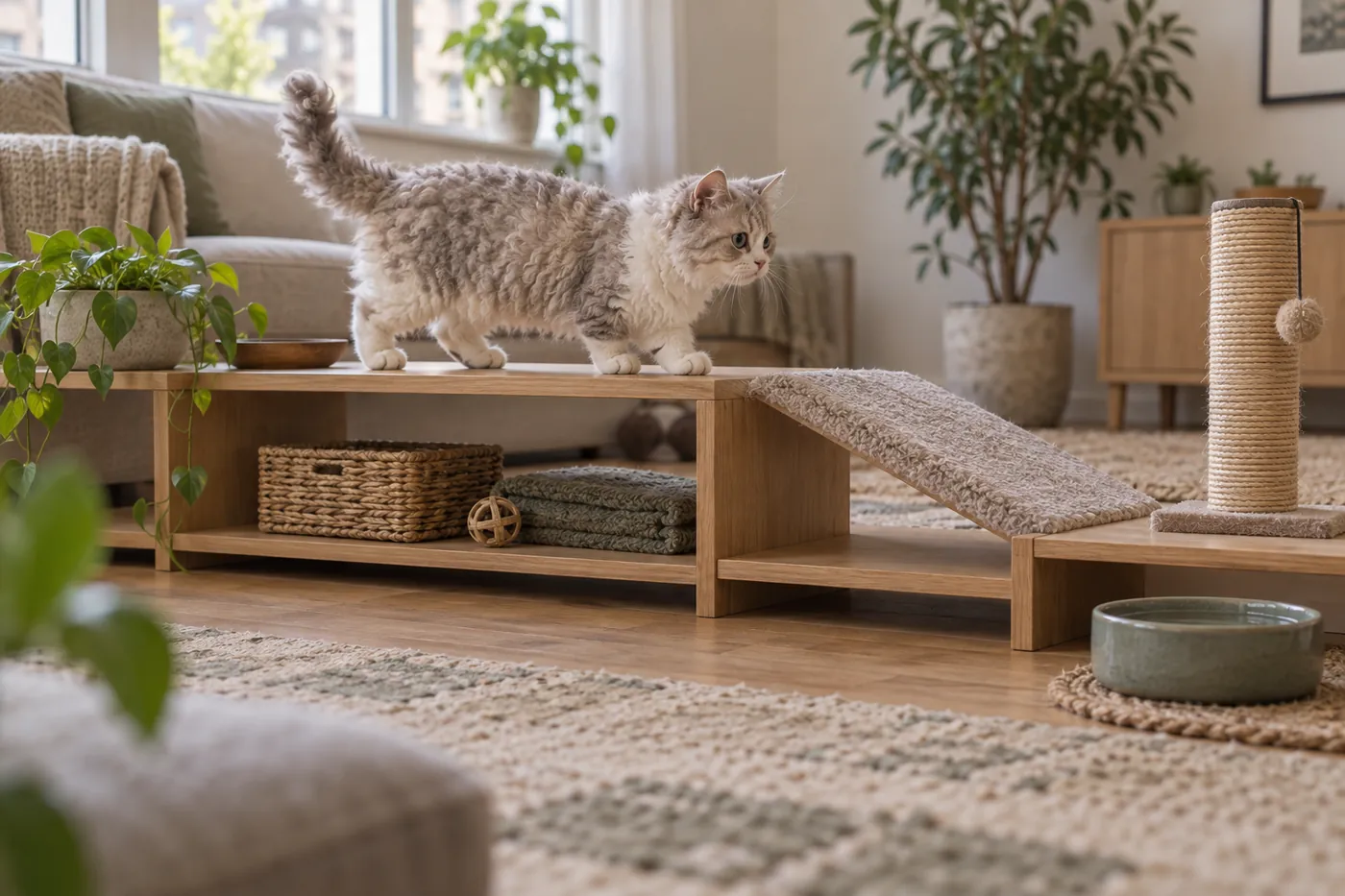
A Lambkin that stops jumping onto a surface it used to reach, or starts avoiding stairs, may be showing early joint discomfort rather than laziness, and that change is the point at which a veterinary visit is worth it.
Short play bursts with recovery time between them suit a cat's exercise needs by age in general, and they matter more when the skeleton is already under structural stress.
How Should You Groom a Lambkin?
The curly coat needs more attention than a straight coat of the same length.
Gentle combing with a wide-tooth tool helps prevent the curls from matting, especially around the legs, belly and behind the ears. Pulling through tangles can damage the curl structure and the skin beneath.
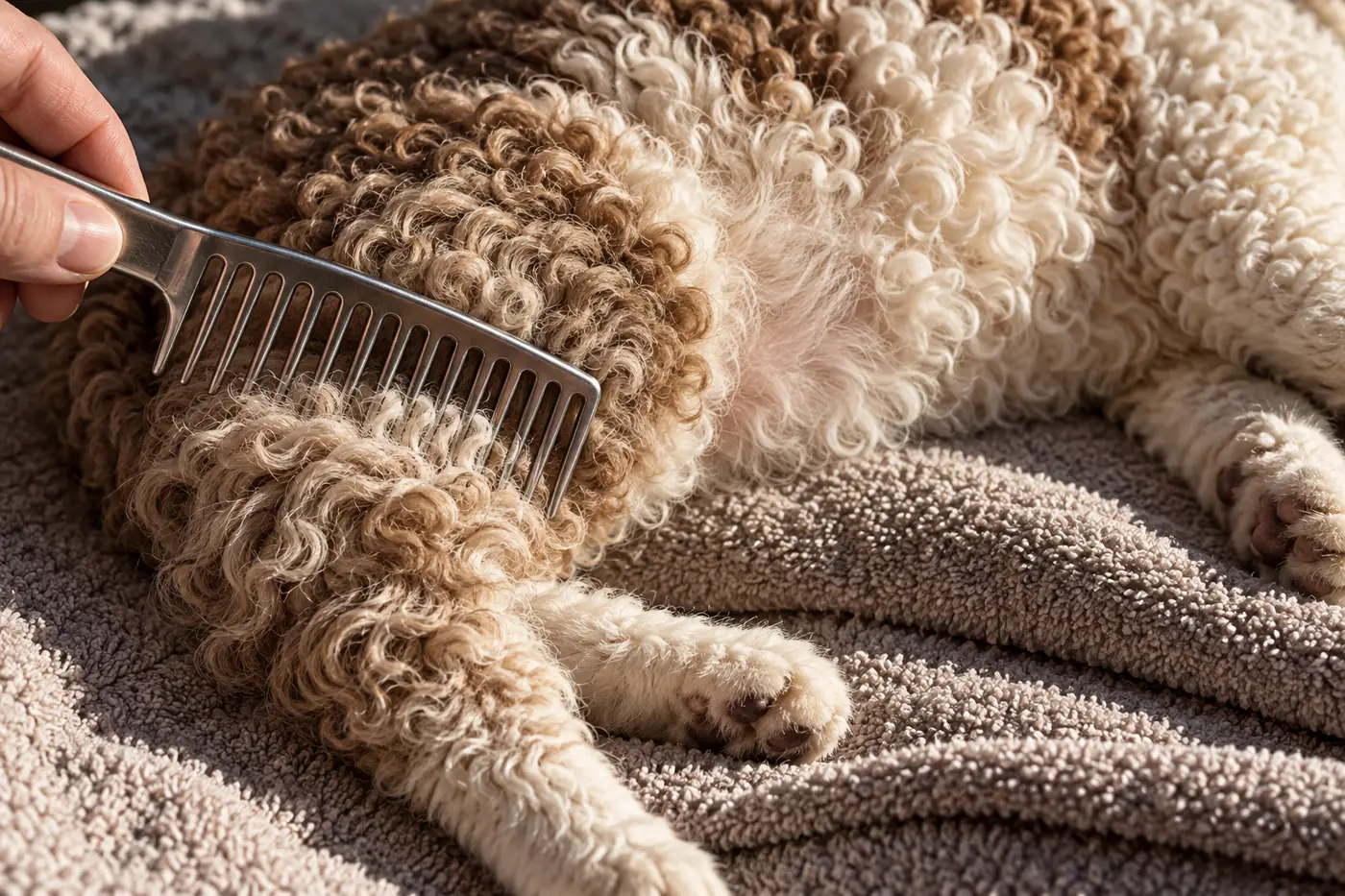
A curly coat can hold oil and debris close to the skin, so some Lambkins benefit from an occasional gentle bath while others never need one.
A Lambkin that dislikes being combed can usually be brought round in short, rewarded sessions, the method used for brushing a reluctant cat.
Dental care, nail trimming and routine weight checks follow the same principles as any cat, with one Lambkin-specific reason to take weight seriously: extra weight adds load to limbs that are already shaped differently.
What Is Known About Lambkin Health and Lifespan?
No Lambkin-specific study of disease prevalence, lifespan or congenital problems was found.
Secondary pages commonly cite a lifespan of 12 to 14 years without identifying a population or method, so the figure is an estimate rather than a measurement.
What is documented about Lambkin health comes from the Munchkin and the Selkirk Rex:
| Parent-breed finding | Concern | What it means for a Lambkin |
|---|---|---|
| Munchkin UGDH variant | Disproportionate limb shortening, with deformities imaged in all four limbs | Stiffness, a changed gait or reluctance to jump are the signs to watch for across the cat's life |
| Munchkin homozygous lethality | Two copies of the short-leg variant appear lethal before birth | A responsible pairing puts one short-legged parent with one standard-legged parent |
| Selkirk Rex coat gene | No documented health concern from the coat mutation itself | The curly coat affects grooming and has no known medical cost |
How Does a Small Short-Legged Cat Fit a Family Home?
A Lambkin can share a home with respectful children, other cats or a cat-safe dog, provided it can get away from them at its own height, since a short-legged cat cannot escape to a high shelf the way most cats do.
With children, a child should interact with the cat on the floor rather than picking up a small body whose short legs make being dropped more dangerous than usual.
With other pets, separate resources and gradual introductions matter more than usual, because a cat that cannot jump clear is easier for another animal to corner.
How Confident Can You Be About a Lambkin?
The word Lambkin guarantees less than a recognised breed name. With no published standard, no championship history, no Lambkin genetic study and no CFA, FIFe or WCF listing behind it, the name tells you a cat descends from Munchkin and Selkirk Rex lines and little more. That does not make the cat unhealthy or the cross fraudulent, but it means the checks below carry more weight than the name does.
- The pedigree names the issuing organisation and both parents' registered identities
- The kitten shows both short legs and a curled coat, or is sold honestly as a standard-legged or straight-coated littermate
- Health records for this kitten name the veterinarian or laboratory, the check made and the result
- The kitten has been seen handled, playing and settling afterwards, against the three observations in the behaviour section
- The home already has low routes, a low-entry tray and a ground-level retreat ready for a short-legged cat
- The breeder describes the registry position accurately, as papers without a published standard or championship record
A breeder who volunteers how little is documented about Lambkin registration, health and temperament is giving a buyer more to go on than one who sells the cat on its rarity.
Common Questions
Is the Lambkin a recognised cat breed?
CFA, FIFe and WCF do not list it, and no published Lambkin breed standard or championship record was found.
How big does a Lambkin cat get?
No official weight range exists. Secondary sources commonly cite 5 to 9 pounds, but that figure is not confirmed by a registry standard or population study.
What is a Lambkin cat's lifespan?
No Lambkin-specific population study was found. Secondary sources cite 12 to 14 years without identifying a sample or method.
Are Lambkin cats healthy?
No breed-specific health data exists. The short-leg trait from the Munchkin side is associated with documented skeletal deformities. The curly-coat trait from the Selkirk Rex side has not been linked to health problems. Stiffness, a changed gait or reluctance to jump are the signs to watch across the cat's life.
What is the difference between a Lambkin and a Kinkalow?
Both are Munchkin crosses that carry the same short-leg mutation. The Lambkin's second parent breed is the Selkirk Rex, giving it a curly coat. The Kinkalow's second parent breed is the American Curl, giving it backward-curled ears. Both carry the same skeletal concerns from the Munchkin side.
Checked Against
- Struck et al.: A structural UGDH variant associated with standard Munchkin cats (BMC Genetics, 2020) pmc.ncbi.nlm.nih.gov
- Anderson et al.: Skeletal manifestations of heritable disproportionate dwarfism in cats (Veterinary and Comparative Orthopaedics and Traumatology, 2021) pmc.ncbi.nlm.nih.gov
- TICA: Selkirk Rex tica.org
- CFA: Recognised breeds, page 2 (Lambkin not listed between Korat and LaPerm) cfa.org
- WCF: Shorthair breed standards (Lambkin not listed) wcf.de
- FIFe: Recognised breeds (Lambkin not listed) fifeweb.org
Published 17 September 2026. Last updated .





