What Is a Sphynx Cat, and How Much Care Does a Hairless Breed Need?
A Sphynx can be an affectionate, active companion for a temperature-controlled indoor home, but hairlessness does not make ownership low maintenance or allergy-safe. The breed needs individualized skin, ear and nail care, protection from sun and cold, close company, and repeated cardiac screening that cannot be replaced by one genetic result.
- Origin
- Canada and the United States, developed from spontaneous hairless mutations found from the 1960s through the 1970s
- Coat
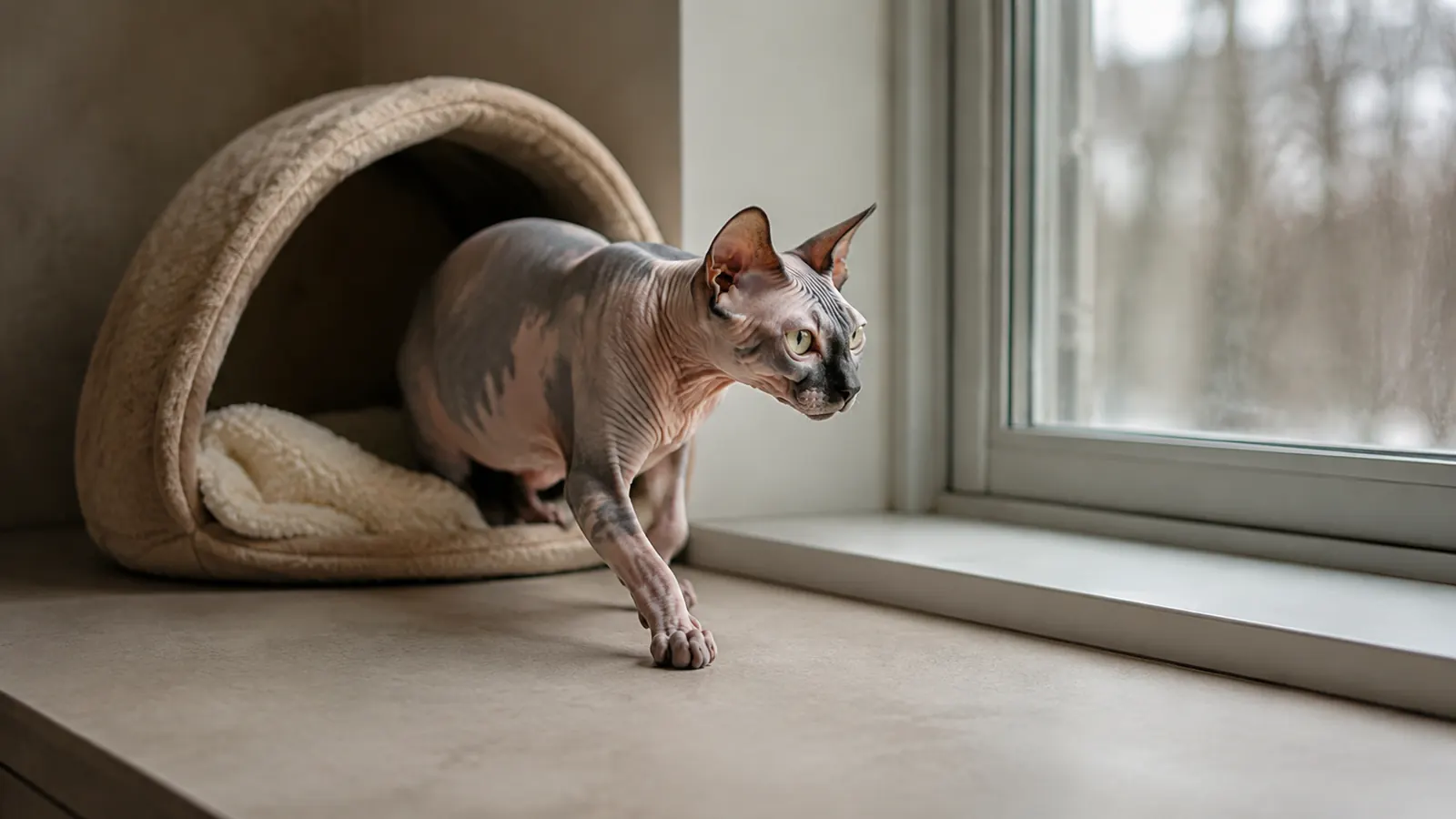
- Apparently hairless skin covered in fine down, with permissible fine hair on the nose, ears, feet and tail
- Size
- Medium, muscular and warm-bodied, with a broad chest, rounded abdomen, large ears and long dexterous toes
- Typical weight
- TICA gives approximately 7 to 10 pounds for females and 8 to 12 pounds for males
- Life expectancy
- TICA estimates approximately 7 to 15 years
- Activity level
- High. Inquisitive, agile, social and often strongly motivated by warmth, food and human contact
- Grooming
- Specific daily checks: skin, ears, nail folds, eyes and teeth need individualized cleaning
- Suits
- Indoor homes with stable warmth, daily social contact, careful hygiene and the budget for ongoing cardiac surveillance
The Sphynx looks hairless, yet most have a fine down that gives the skin a suede-like feel. Without an absorbent coat, skin oils, wax and temperature management become visible parts of routine care rather than disappearing.
This breed is often intensely social and active, which adds a second commitment beyond hygiene. The right home supplies warmth, company and repeated health monitoring.
What does a healthy Sphynx actually look and feel like?
The standard describes a medium, muscular cat with a broad chest, rounded abdomen, large lemon-shaped eyes and very large ears. The body should feel substantial for its size rather than fragile, and males may be noticeably larger while remaining proportionate.
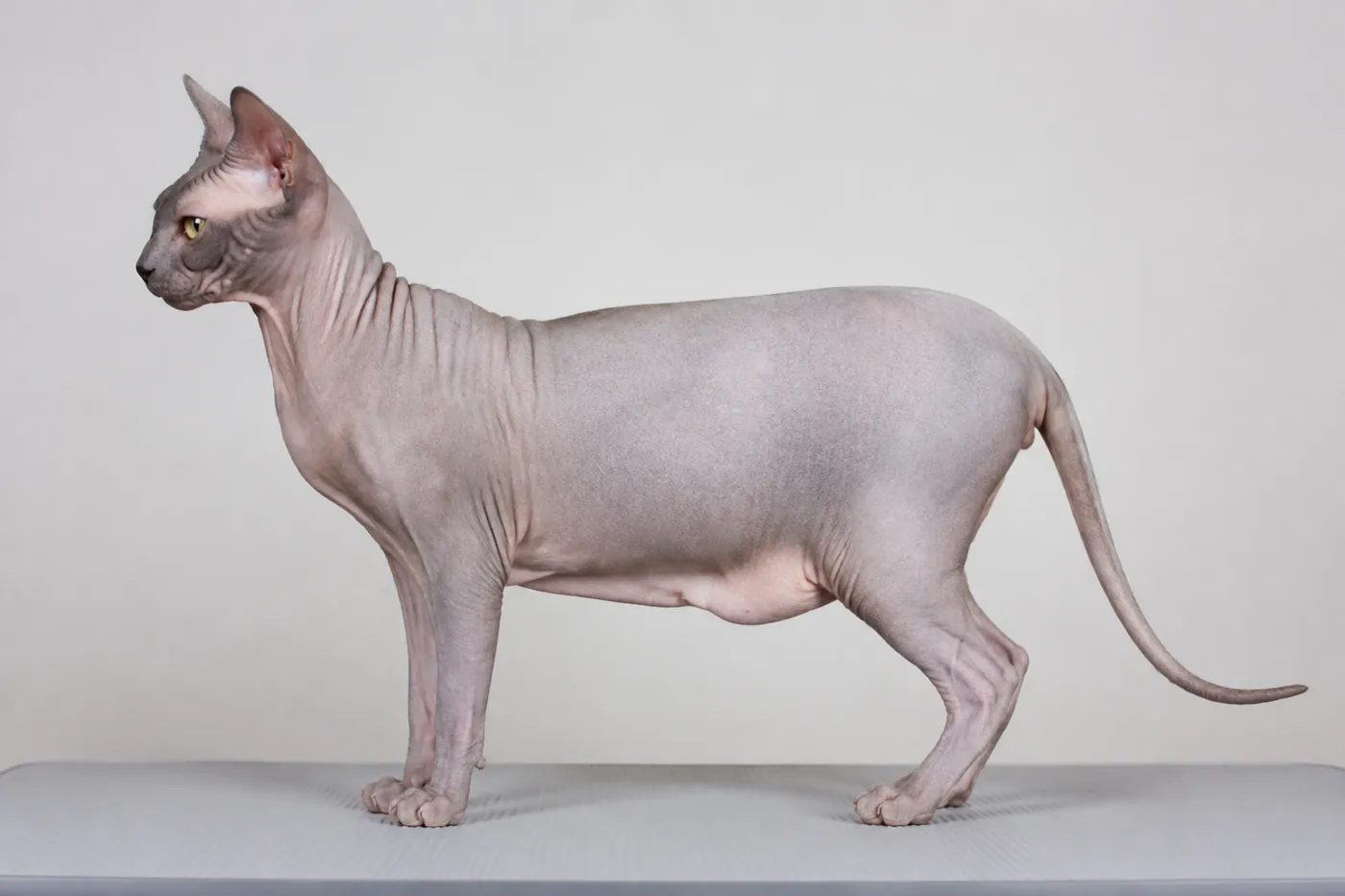
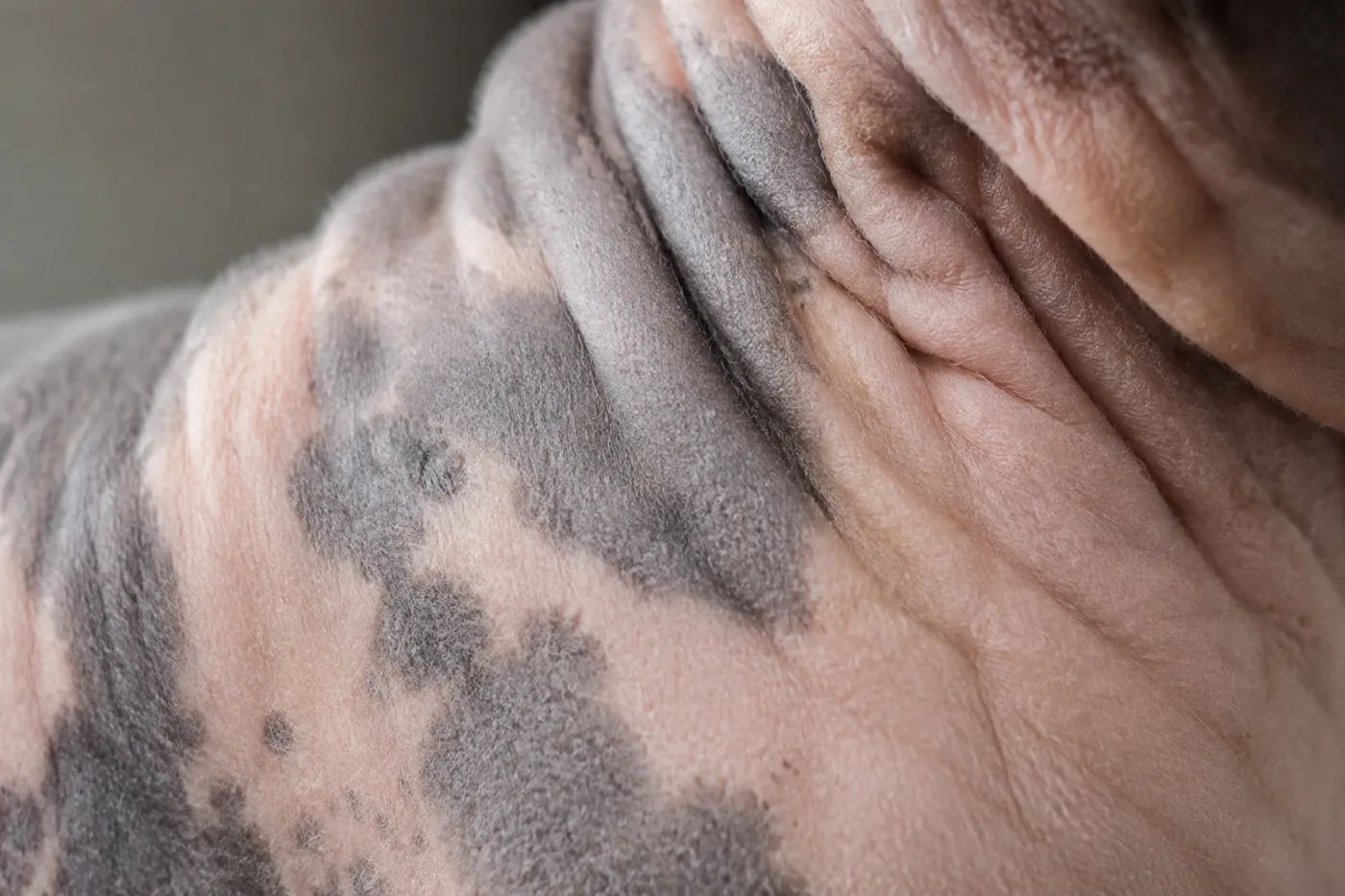
Fine down may cover much of the body, with short soft hair allowed around the nose, ears, feet and tail. Wrinkles are prominent around the head and shoulders, but skin should not look inflamed, cracked or coated in heavy residue.
Colours and patterns appear in skin pigment and the sparse down. Tabby markings, points, solid colour and white patches can therefore remain visible even without a conventional coat.
The Devon Rex and Cornish Rex carry distinct curly coats and different body standards. A hairless kitten from unknown parentage is not automatically a pedigreed Sphynx, so registration and traceable ancestry matter.
The skin surface can make ordinary changes easier to notice, but it can also invite overinterpretation. Natural pigment, fine down and shallow folds vary among individuals; heat, swelling, persistent redness, crusting or pain are the changes that need attention.
Body condition is judged by hand rather than from the rounded abdomen: rib cover, waist, muscle over the back and overall symmetry distinguish breed shape from excess fat or loss of lean tissue more reliably than a side photograph.
Is the affectionate temperament a good fit for you?
TICA and CFA describe Sphynx cats as outgoing, intelligent and strongly people-oriented, and many seek laps, shoulders, blankets and shared sleeping spaces because contact provides both social reward and warmth.
That closeness can be delightful for somebody who wants an involved companion. It may be difficult for a person who values an undisturbed workspace, travels often or expects the cat to remain content alone for long days.
| Home pattern | Likely fit | What the cat still needs |
|---|---|---|
| People present most days | Often strong | Independent rest plus deliberate play |
| Respectful children | Often possible | Supervised gentle handling and warm retreat |
| Compatible cat or dog | Often possible | Slow introduction and separate resources |
| Long empty workdays | More difficult | Reliable company and active routines |
| Cool or variable indoor climate | Demanding | Safe heated choices and temperature monitoring |
| Allergic household | Uncertain | Medical advice and individual exposure testing |
Sphynx cats often greet visitors and participate in family activity, but sociability does not remove consent. Children should invite the cat onto a lap and support the full body rather than carrying it because the skin feels novel.
Another pet may provide play and warm companionship when temperaments match. Introductions still need distance, scent work and multiple resource stations, because a highly social breed can experience conflict like any other cat.
Shared sleeping can create warmth without guaranteeing emotional compatibility. Each animal still needs an unshared bed, feeding place and exit route so closeness remains a choice rather than the only available warm option.
Travel and absences need planning before they occur: a sitter has to understand temperature, skin observations and the cat's social routine, while a boarding space needs safe heat and enough familiarity that reduced appetite or withdrawal is noticed promptly.
How much play and supervision does a Sphynx need?
Sphynx cats are commonly agile, curious and food motivated. Their long toes can manipulate cupboard doors and small objects, so environmental security matters as much as providing toys.
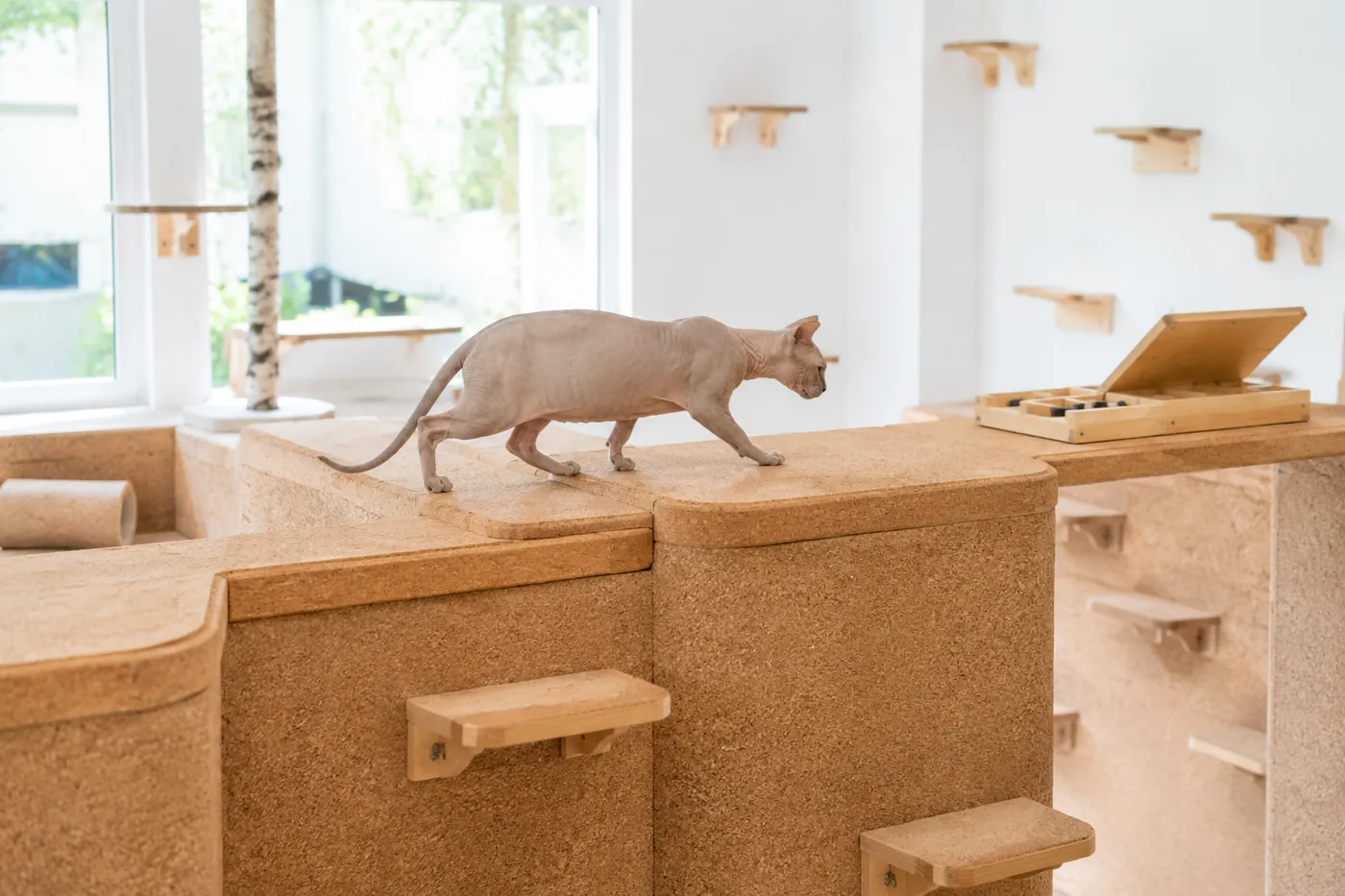
Several short sessions of chase, fetch, food search and reward-based training suit the breed, and clicker training can teach carrier entry, mat stationing, voluntary paw presentation and stepping into a bathing area.
- Inspect shelves for rough seams that can scrape skin
- Secure cupboards containing chemicals, string or food
- Use broad warm resting pads at several heights
- Provide a route down that another pet cannot block
- Rotate movement and puzzle types across the week
- Count training food within the daily portion
Clothing is poor constant protection during play, because poorly fitted garments can restrict shoulders, rub armpits or catch a claw, and a safely warm room lets the cat play undressed.
A sudden decline in jumping or play is meaningful. Pain, illness or heart disease can change behavior before an owner sees another sign.
How do you keep a Sphynx comfortably warm?
Lack of an insulating coat increases dependence on the indoor environment, and several safe warm choices work better than clothing: covered beds, fleece layers, sunny access behind safe glass and a pet-safe heated pad with room to move away.
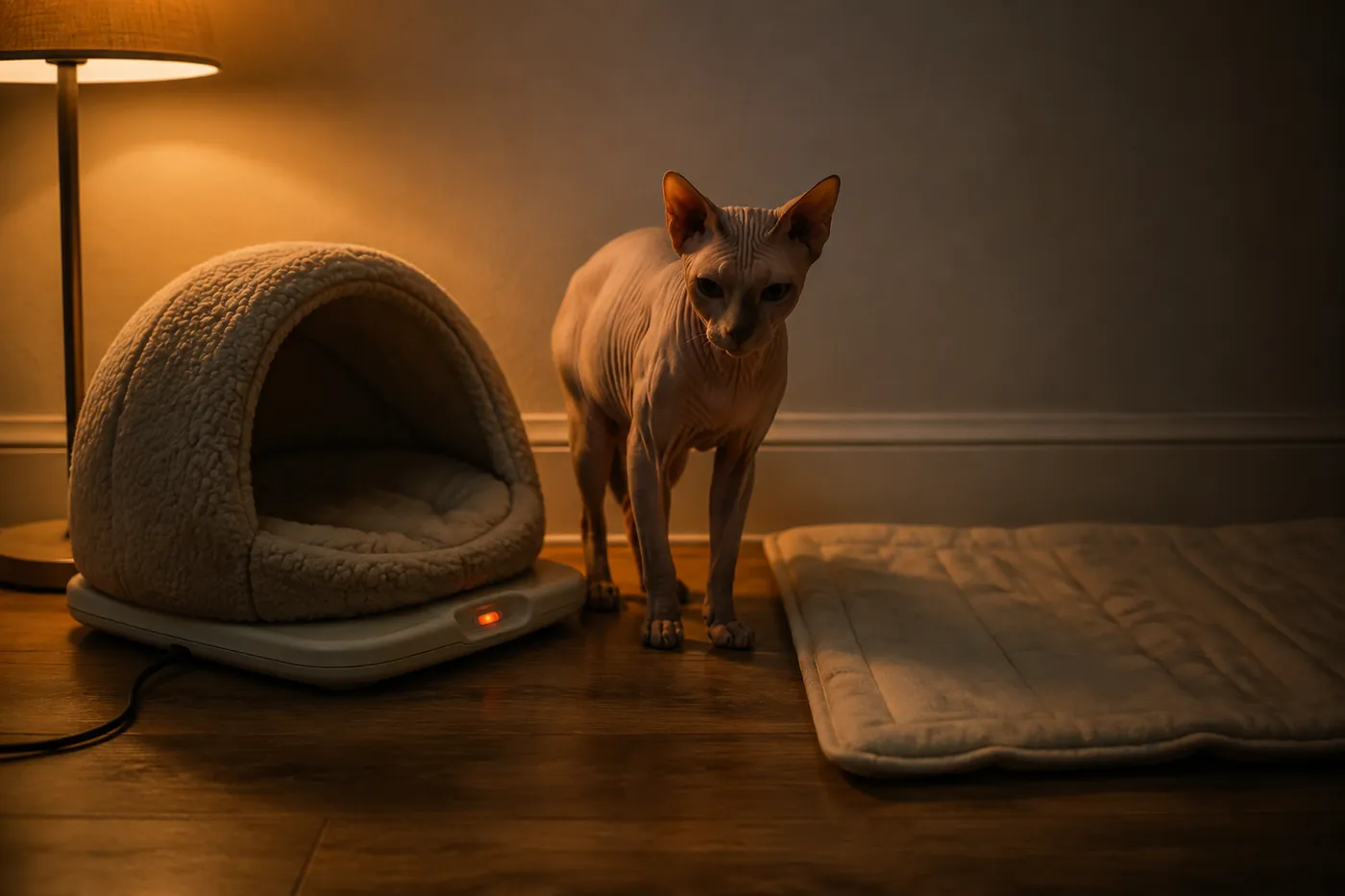
Heated products need thermostatic control, intact cords and enough space for the cat to leave the heat. Human heating pads and hot-water containers can create burns, especially when prolonged contact hides the rising skin temperature.
Clothing should be soft, correctly sized and checked at the neck, legs and armpits. It comes off regularly so the skin can be inspected, and a garment with loose loops or fasteners should never be left on an unsupervised cat.
Room temperature alone does not describe comfort. Drafts, cold floors, damp skin after washing and long contact with a hot surface can each change heat loss or burn risk even when the thermostat displays a reasonable number.
Where the cat chooses to rest, and whether it can leave easily, shows how comfortable it is. Persistent heat seeking, shivering or reluctance to move away from a warmer should prompt an environmental check and, when new, a health assessment.
How much sun exposure is safe?
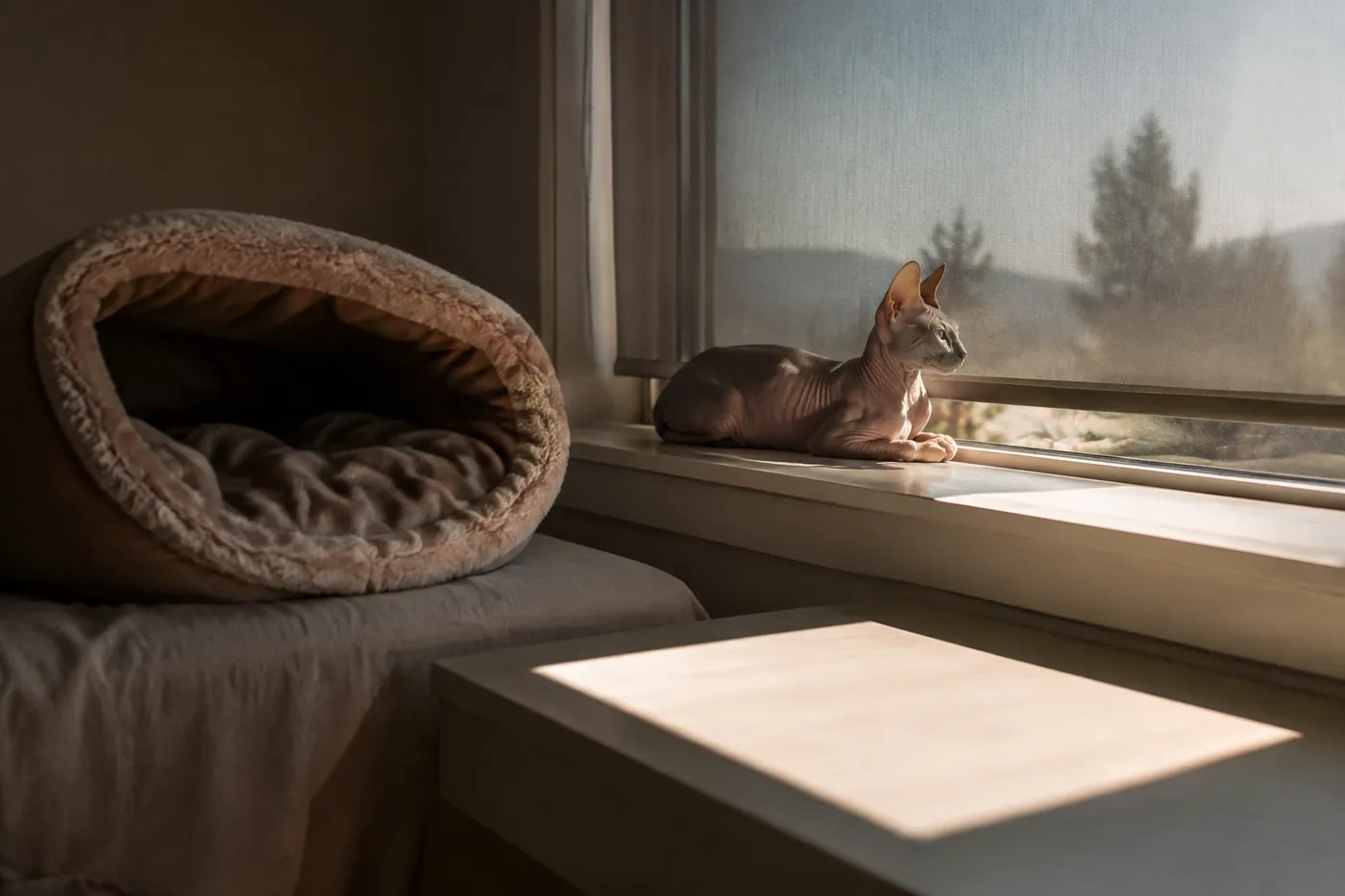
Sphynx skin can sustain ultraviolet damage and sunburn. Windows reduce some ultraviolet wavelengths but do not make prolonged intense sun exposure automatically safe.
Shade, filtered light and timing manage exposure: beds away from direct midday sun, window film where needed, and shaded warm spots that are just as appealing.
Do not apply human sunscreen unless a veterinarian specifically directs a product and method. Ingredients safe on human skin may be unsafe when a cat licks them.
Redness, tenderness, peeling, new crusts or pigment changes need veterinary assessment. Chronic lesions should not be treated as normal colour variation. On a black Sphynx, whose dark skin is better protected than pink skin but hides early redness, a scaly or crusted patch that persists or a sore that does not heal may be the first sign anyone sees.
Does every Sphynx need frequent baths?
No single bathing interval suits every Sphynx. Without a full coat to absorb and distribute sebum, oil may collect on skin and transfer to bedding, but overly frequent washing can dry or irritate the barrier and provoke more problems.
Observation sets the interval: a bath is due when residue, odour or visible buildup creates a need, and acne, yeast, dermatitis or persistent excess oil calls for veterinary guidance on how often.
- Warm the room and prepare every item before bringing the cat
- Use comfortably warm shallow water and a non-slip surface
- Apply only a veterinarian-approved gentle cat cleanser
- Clean folds lightly without hard scrubbing
- Rinse until no product remains
- Pat dry, inspect the skin and return the cat to warmth
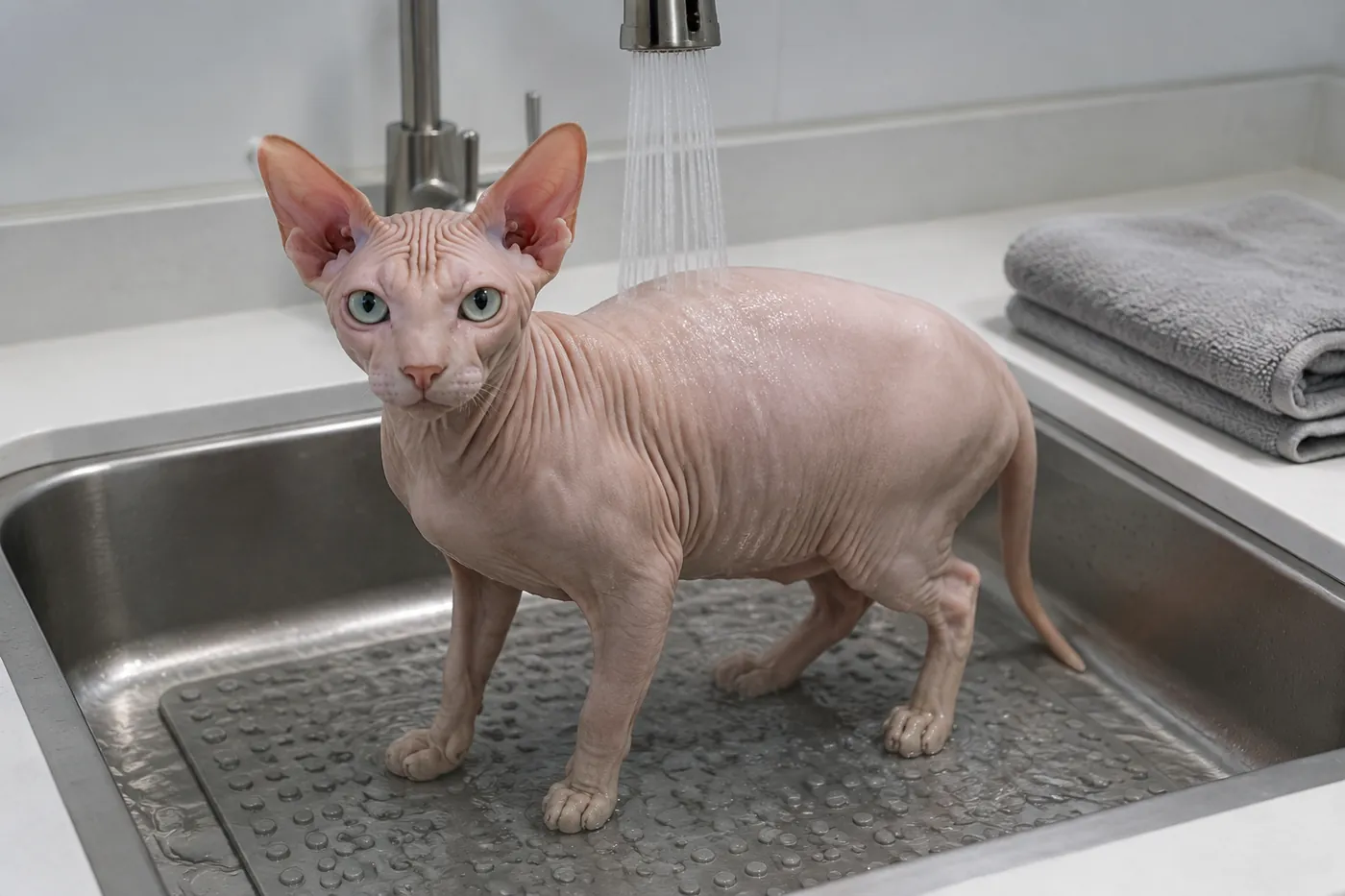
Detergent, essential oils, human acne products and abrasive exfoliating tools should never be used. Dark residue is not proof that the cat is dirty through neglect; it signals that the care interval or a skin condition needs assessment.
Bedding washed often enough to remove oil, without heavily fragranced products, avoids leaving irritating residue. Skin that feels squeaky or tight after a bath has been washed too hard or too often.
Baths that become progressively more frequent while the skin worsens mean frequency is not the answer, and a veterinarian should evaluate infection, allergy, diet claims, hormonal factors and product reactions.
A simple record of bath date, cleanser, skin condition and how quickly residue returns gives a veterinarian more useful evidence than changing several products and intervals at once.
Drying is part of the care task, because damp folds and feet chill a hairless cat and an oily bed undoes the bath, which is why patting, checking the folds and a warm clean bed finish the routine.
Why do ears and nail folds need separate care?
Large ears with little hair can accumulate visible wax, while sebum and debris can collect around nail beds. These are different surfaces and require different methods.
Inspect ears in good light and clean only the accessible outer portion with a veterinarian-approved solution and technique. Never push a cotton swab into the canal, and do not assume dark discharge is ordinary wax when odour, redness, pain or head shaking is present.
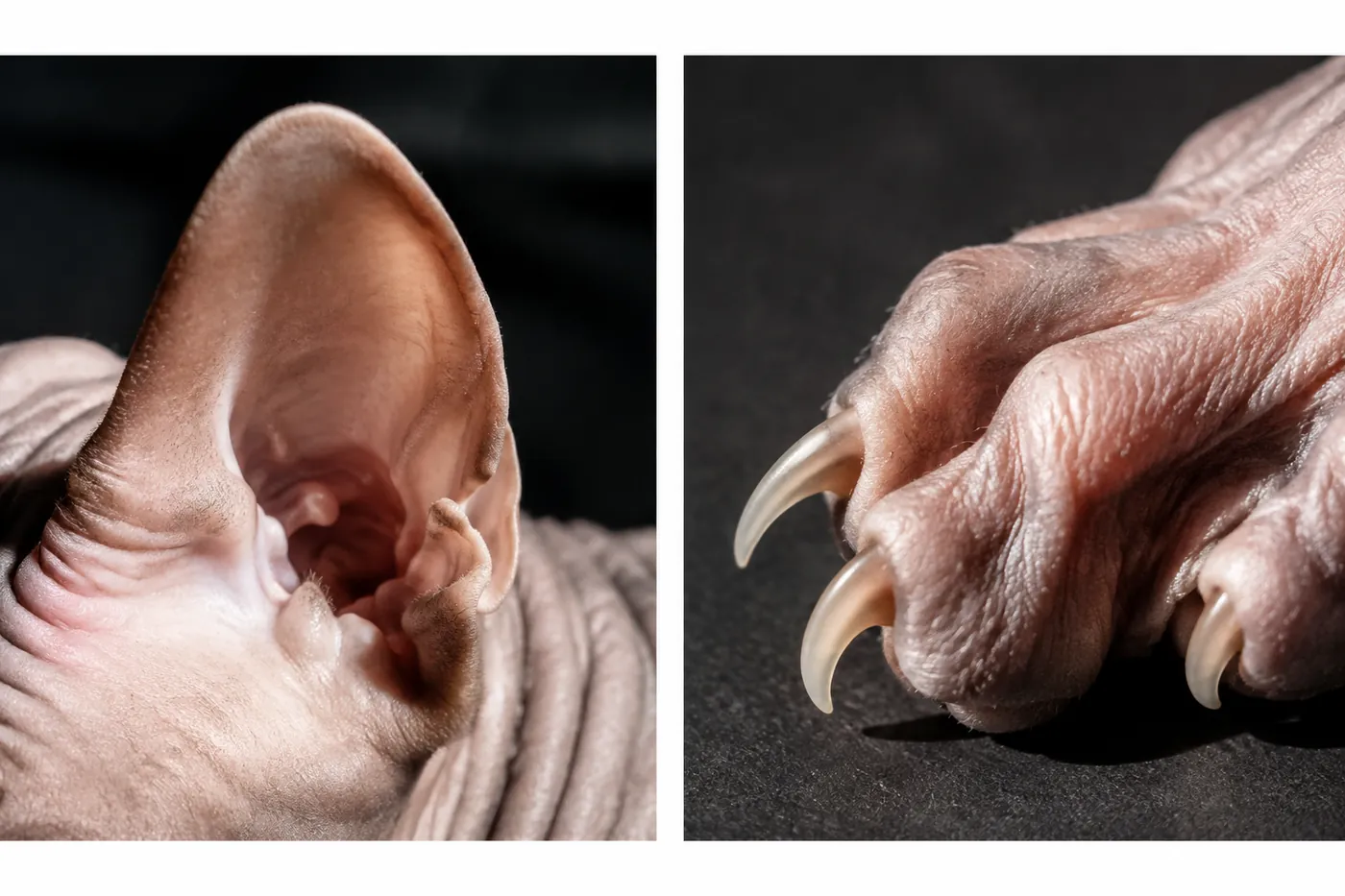
For paws, ask the cat to present one foot, extend a claw gently and wipe loosened residue from visible skin. Do not scrape under the nail or continue when the toe is swollen, sore or producing discharge.
Eyes may also leave more visible debris because lashes are sparse. Wipe the corner with a clean damp pad as advised, using a fresh surface for each eye, and seek care for squinting, cloudiness, marked redness or coloured discharge.
Dental care follows the same preventive logic as for coated cats. Tooth brushing starts gradually with feline toothpaste, and red gums, changed breath or awkward eating call for a professional assessment.
Are Sphynx cats hypoallergenic?
No. Sphynx cats produce Fel d 1 and other allergens in saliva and glands, then distribute them through grooming and contact with skin, bedding and household surfaces.
Less hair may change how material spreads, and one allergic person may react differently to one individual. It does not create a dependable low-allergen breed or justify a health guarantee.
Bathing may temporarily remove material from the skin but should not be intensified beyond what the skin tolerates. Environmental controls and medical management need professional guidance, especially when asthma is involved.
A written contingency plan belongs in place before purchase, because rehoming after a severe reaction is hard on the cat and household, and a breeder who promises zero allergy risk is not handling uncertainty honestly.
What does HCM screening actually tell you?
Hypertrophic cardiomyopathy thickens the heart muscle and is an important Sphynx health concern. It can be silent, may develop after an earlier normal examination and is best assessed structurally with veterinary echocardiography.
A 2024 New Zealand study enrolled 55 apparently healthy Sphynx cats; 42 returned for a repeat cardiac examination. The authors reported a final HCM proportion of 40 percent, with a median age of 5.8 years. This selected cohort and incomplete repeat attendance limit how broadly that figure can be applied, while supporting the need for ongoing assessment.
The same study found no association between the tested ALMS1 variant and HCM diagnosis in that cohort. An ALMS1 result must not be presented as a cardiac clearance.
| Evidence | What it answers | Important limit |
|---|---|---|
| Cardiologist echocardiogram | Heart structure on the examination date | HCM can emerge later |
| Physical examination | Murmur, rhythm and general clinical signs | Some affected cats have no audible murmur |
| ALMS1 test | Whether the tested variant is present | Does not rule HCM in or out reliably |
| Family history | Pattern among relatives over time | Incomplete records can miss late diagnoses |
| Repeat screening | Change as the cat ages | Still a dated assessment, not a guarantee |
The useful breeder questions are how often breeding cats are scanned, who performs the scan and whether older relatives developed disease, because a one-time kitten check or a generic DNA panel does not answer the adult heart question.
Routine owners should discuss an age-appropriate screening plan with their veterinarian. Frequency depends on the cat, family history and clinician's assessment rather than a universal internet schedule.
Sedation, examination method and image quality can affect how a cardiac study is interpreted, so the written report is worth more than a verbal statement that the heart was checked, and the result should remain attached to the cat and the examination date.
Screening a breeding cat and monitoring a household companion serve related but different decisions. Breeders use serial findings and family history to manage matings, while an owner and veterinarian use the individual record to plan follow-up and respond to changes.
How should you feed a warm, active cat?
Sphynx cats often have strong appetites, and maintaining body temperature contributes to energy use. Those facts do not justify unrestricted feeding or a special diet marketed solely for hairless cats.
A complete diet appropriate to life stage, measured as a daily total and adjusted against weight and body condition, covers the need. The rounded abdomen is part of breed type, while ribs, waist, muscle and overall proportion reveal whether fat is excessive.
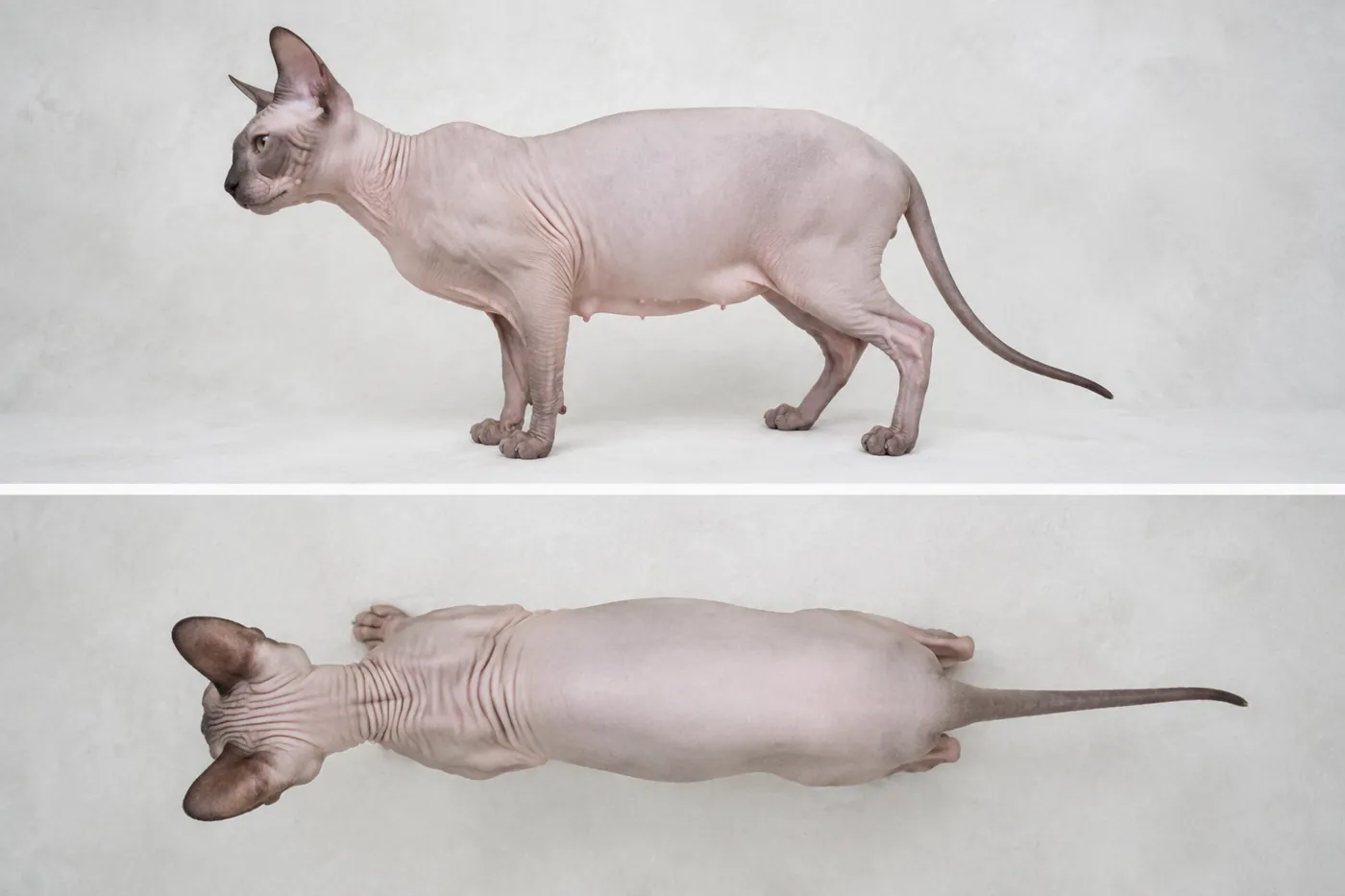
Converting calories per can or gram into a practical portion size makes the daily total concrete, and puzzle and training food come out of that same allowance so activity does not quietly add a second meal.
Weight loss despite a strong appetite, persistent diarrhea, vomiting, larger urine clumps or increased thirst requires veterinary attention. Hairlessness makes some changes easier to see, but it does not explain them.
Several fresh-water stations, away from litter and from places where another pet can block access, support normal intake.
Because the body is easy to see, photographs and weights taken under similar conditions over time show change clearly. A gradual loss of muscle along the back or a steady increase around the ribs matters more than day-to-day changes after a large meal.
Skin care and feeding claims often become entangled online, yet a new diet should not be treated as a universal cure for oil or yeast. Change one factor with veterinary guidance, keep the rest of the routine stable and record whether the skin actually improves before attributing the result to food.
The same caution applies to supplements. Oils and powders can alter calorie intake, stool or skin residue, and a product marketed for hairless cats still needs a defined purpose, safe dose and place within a complete diet.
What should you verify before choosing a Sphynx?
An in-person visit, touching only with permission, shows the skin: healthy skin feels soft and warm, while persistent odour, redness, greasy crusts or repeated scratching calls for questions rather than being normalized as a breed trait.
A buyer at this stage is also likely to be offered one of the crosses derived from the breed, of which the Bambino is the most common, and those carry a second mutation and a second set of questions. Hairlessness alone also does not identify a Sphynx. The Donskoy has a genetically distinct hair-loss trait, and an individual may retain a brush coat or grow seasonal fuzz.
Ordinary adults from the same home show more than freshly bathed show photographs: their skin, nails, ears, body condition and resting choices reveal the routine the source can sustain between presentation days.
How kittens learn bathing, paw handling and carrier entry without force matters too. Early familiarity cannot guarantee lifelong cooperation, but it can show whether the source treats repeated body care as a trainable skill rather than a struggle the new owner inherits.
Seeing the cat breathe after ordinary play, move freely, settle and accept brief handling, and seeing the source carry out its actual ear, nail and bathing routine, lets you judge frequency, products and the cat's response.
- Confirm pedigree or registration and permanent identities
- Review serial echocardiogram dates, methods and examiners
- Ask about HCM diagnoses and ages in older relatives
- Read genetic reports without treating ALMS1 as cardiac clearance
- Review skin, ear, dental and veterinary history
- Prepare safe heat, shade, secure climbing and realistic allergy exposure
- Read congenital-health and return terms before payment
A rigid carrier that opens widely makes examinations easier, and washable warm bedding inside it still needs ventilation and room for the cat to shift away from heat.
TICA gives a broad lifespan estimate of about 7 to 15 years. That range highlights uncertainty rather than predicting one outcome, especially in a breed where cardiac surveillance can alter care decisions over time.
If individualized hygiene, temperature control, close social contact and continuing heart assessment feel excessive, another breed or an adult cat with known needs will be a better choice.
Checked Against
- The International Cat Association: Sphynx tica.org
- The Cat Fanciers' Association: Sphynx cfa.org
- Animals: prevalence of HCM and ALMS1 variant in Sphynx cats pmc.ncbi.nlm.nih.gov
- Silverman et al.: Hypertrophic cardiomyopathy in the Sphynx cat, clinical presentation and heritable etiology (Journal of Feline Medicine and Surgery, 2012) pmc.ncbi.nlm.nih.gov
Published 7 September 2026. Last updated .