
What Is a Kinkalow Cat, and How Certain Can You Be?
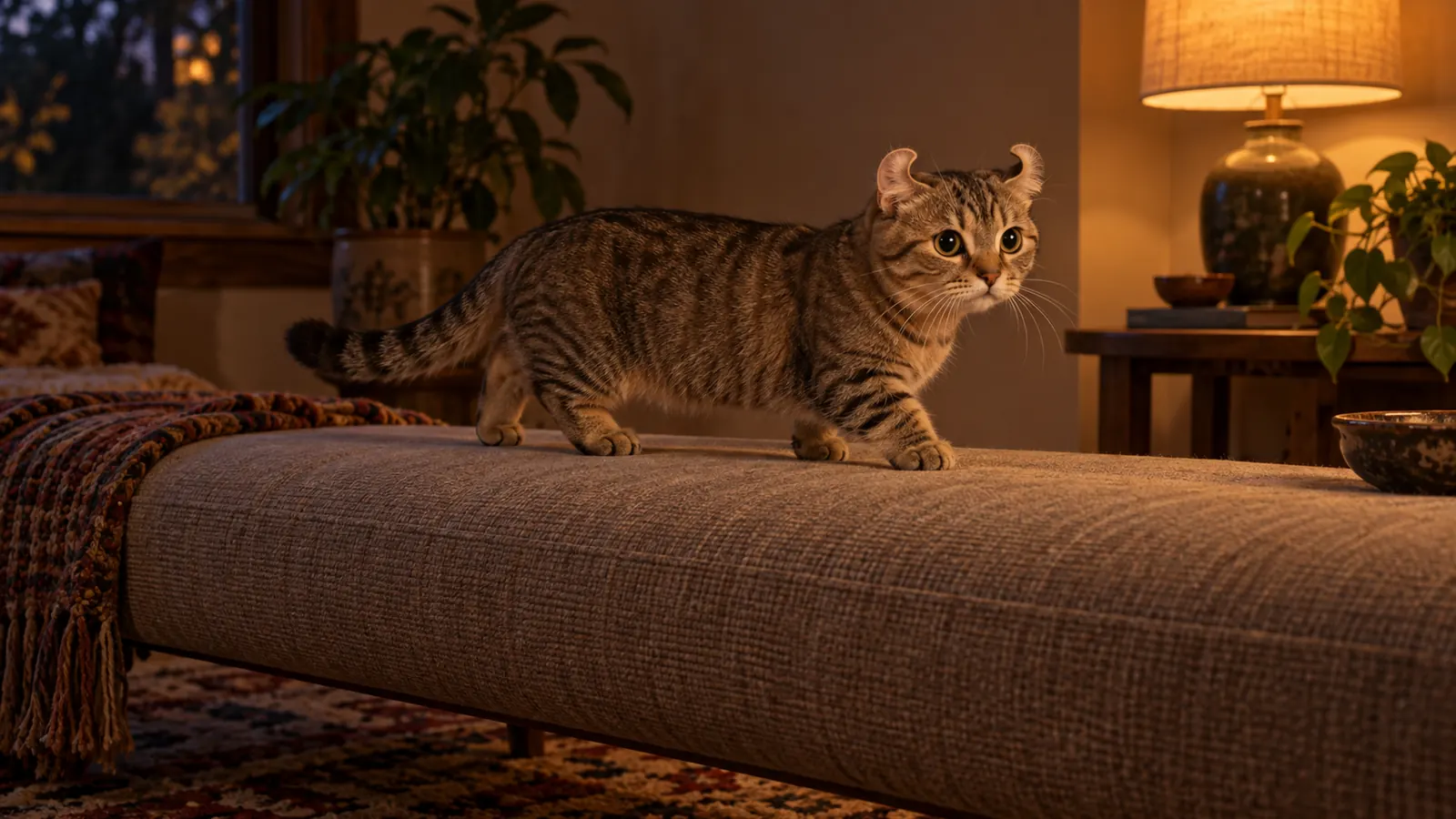
A Kinkalow is a small, short-legged, curled-ear cat developed from Munchkin and American Curl crosses. TICA accepted it only as an experimental breed, never into a championship programme, and no breed-specific health or temperament study has been published. The strongest evidence for a Kinkalow decision starts with its parent breeds' known genetics and the individual cat's own veterinary record.
- Origin
- United States, developed in the mid-1990s by crossing Munchkin and American Curl cats
- Coat
- Short or semi-long, varying by individual; all colours and patterns reported
- Size
- Small and compact, with shortened forelegs and hindlegs from the Munchkin UGDH variant
- Typical weight
- No official standard weight range exists; secondary sources commonly cite 3 to 7 pounds without identifying a study
- Life expectancy
- No Kinkalow-specific population data was found; secondary sources cite 12 to 15 years without identifying a study
- Activity level
- Commonly described as playful and curious, adjusted for individual energy and any mobility limitation from the short-leg structure
- Grooming
- Depends on coat length; short coats need minimal care, semi-long coats need more frequent attention to prevent tangles
- Suits
- Households that can provide low-level enrichment, handle the ear cartilage carefully and plan veterinary monitoring around the skeletal structure
A Kinkalow is a small, short-legged cat with curled ears, produced by crossing Munchkin and American Curl lines.
TICA accepted it only as an experimental breed, which allows pedigree tracking but not championship competition. No Kinkalow breed standard, health study or temperament survey has been published.
That gap matters because many secondary breed profiles present repeated details as equally certain. The strongest Kinkalow evidence begins with its parent breeds' known genetics and the individual cat's own veterinary record.
What Is a Kinkalow, and Who Recognises It?
The name Kinkalow describes a cat carrying two defining mutations: the short-leg trait associated with the Munchkin and the curled-ear trait associated with the American Curl. Breeder Terri Harris is credited with developing the cross in the United States in the mid-1990s.
TICA placed the Kinkalow in its Experimental Registry, a category for breeds still in development. That listing allows pedigree tracking but does not grant a published breed standard, championship status or the advancement pathway that recognised breeds follow.
The current breed lists from CFA, FIFe and WCF do not include Kinkalow.
- TICA status
- Experimental breed, pedigree tracking only
- Championship or breed standard
- None published
- Other registries checked
- CFA, FIFe and WCF do not list Kinkalow
- Origin
- United States, mid-1990s
- Parent breeds
- Munchkin and American Curl
- What the name establishes
- A tracked experimental cross with two intended physical traits
- What the name does not establish
- A fixed temperament, a breed-specific health profile or a standard to judge against
The Bambino shares the same Munchkin short-leg mutation crossed with a different breed.
A Kinkalow registration confirms tracked parentage within the experimental programme, not the level of breed definition that a championship breed's standard and judging history provide.
What Do the Short Legs and Curled Ears Look Like?
The intended appearance combines shortened legs with ears that curve gently backward.
Not every kitten from a Kinkalow litter will express both traits, because each mutation follows its own inheritance pattern. A kitten that inherits neither the short-leg variant nor the curled-ear variant is still a Kinkalow by pedigree, but it looks like an ordinary domestic cat.
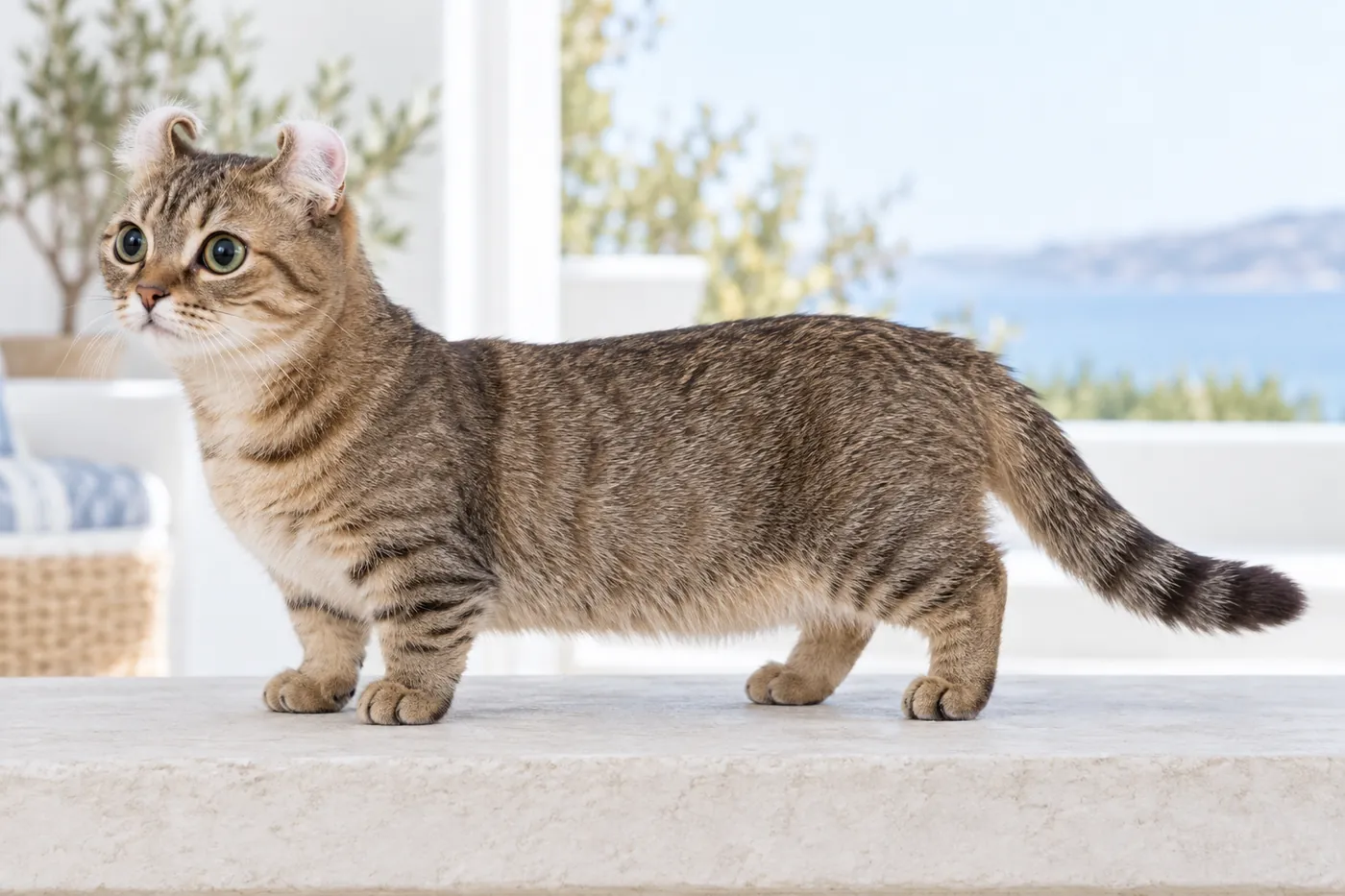
Kittens are born with straight ears. The curl develops within the first week and reaches its final degree by roughly four months.
Leg length varies. Some Kinkalows have noticeably shortened legs on all four limbs, while others inherit the long-leg version and stand at ordinary height.
Body proportions are small and compact rather than elongated.
Secondary sources commonly cite 3 to 7 pounds, but no registry standard publishes an official weight range.
| Feature | Intended appearance | What it does not prove |
|---|---|---|
| Legs | Shortened on all four limbs | A fixed adult weight or precise height |
| Ears | Backward curl held by firm cartilage | Breed identity without pedigree records |
| Coat | Short or semi-long, any colour or pattern | A predictable grooming or shedding schedule |
| Body | Small and compact | That a secondary weight range applies to this cat |
| Tail | Medium to long and flexible | Any breed distinction on its own |
The coat can be short or semi-long, in any colour or pattern. Coat type depends on what each parent contributes, and litter variation is expected.
What Genetics Shape the Short Legs and Curled Ears?
Two mutations define the Kinkalow, and each carries different practical consequences.
The short-leg trait comes from a structural variant in the UGDH gene, identified in Munchkin cats by Struck and colleagues in 2020. The variant is autosomal dominant: one copy produces shortened legs, and two copies appear to be lethal before birth.
That lethal homozygous pattern means responsible breeding pairs one short-legged parent with one standard-legged parent.
A litter from two short-legged parents would produce smaller litters with no surviving homozygous kittens. If both parents of a Kinkalow litter have short legs, the breeding practice is questionable.
A 2021 imaging study by Anderson and colleagues, which compared six cats carrying the UGDH variant with twelve standard-legged cats, found bone deformities in all four limbs: an exaggerated curve in the humerus, a bowed and twisted radius, and angled femurs and tibias. The authors noted a possible higher risk of arthritis, although no study has followed short-legged cats into old age to measure it.
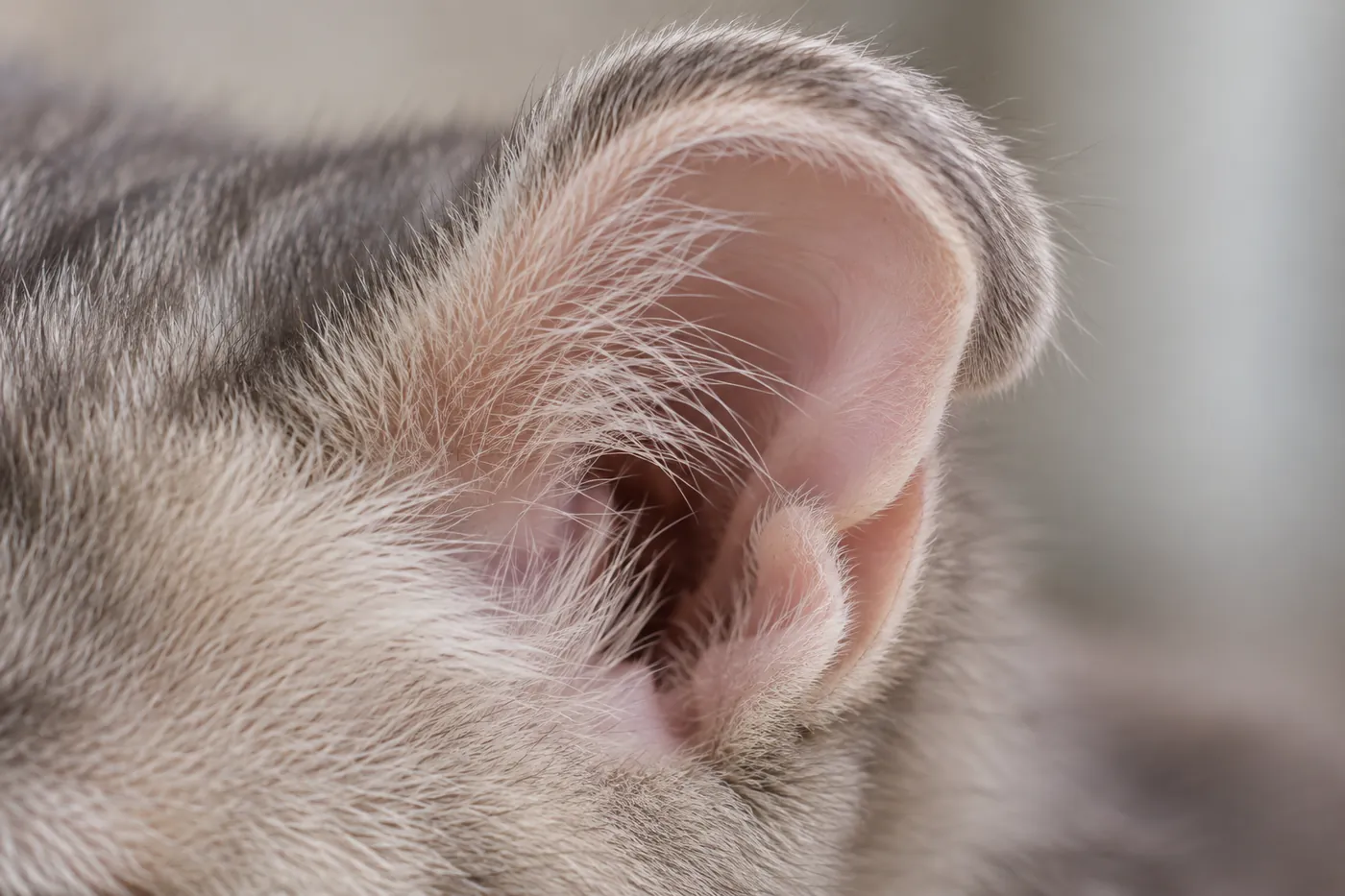
The curled-ear trait comes from a dominant gene designated Cu, identified in the American Curl.
Breeding typically pairs a curled-ear cat with a straight-eared cat to maintain genetic diversity.
The American Curl ear has not been linked to the cartilage and joint disease seen in Scottish Fold cats.
CFA describes the Curl as a healthy breed with no known genetic effects from the ear mutation. That distinction matters because folded ears and curled ears involve different genes with different consequences.
Handle Kinkalow ears gently and never force them into a different position, because bending the firm cartilage can cause permanent damage.
How Predictable Is a Kinkalow's Behaviour?
Secondary descriptions commonly call Kinkalows playful, curious, affectionate and social.
Those words may help set initial expectations, but no breed behaviour study or temperament survey was found for the Kinkalow. The honest expectation is a range shaped by genetics, early socialisation, age, handling history and the home environment.
A kitten raised with calm handling and varied experiences may develop into a confident adult. A kitten isolated or rehomed under stress may present differently in a new household.
Three observations tell more than a breed label:
- Does the cat approach again after play ends, a sound interrupts or food is delayed?
- After something unfamiliar, does normal eating and exploring resume without prolonged hiding?
- Does the cat tolerate touch along the back, belly, paws and ears without escalating to biting or fleeing?
Trainability is plausible based on the curiosity and food motivation reported in both parent breeds. Short sessions with a clear reward can build practical behaviours such as carrier entry, recall and cooperative handling.
Persistent hiding, aggression or sudden behavioural change should prompt a veterinary check rather than being dismissed as a rare-breed trait. The guide to petting-related aggression explains how pain, overstimulation and fear can produce similar outward behaviour for different reasons.
How Much Activity and Home Space Does a Kinkalow Need?
A Kinkalow is commonly described as active and curious, but its short-legged structure changes what suitable activity looks like.
Jumping ability is reduced compared to a standard-legged cat. High shelves, tall towers and platforms that require long vertical leaps may be difficult or actively harmful for a cat whose limb proportions already put different stress on the joints.
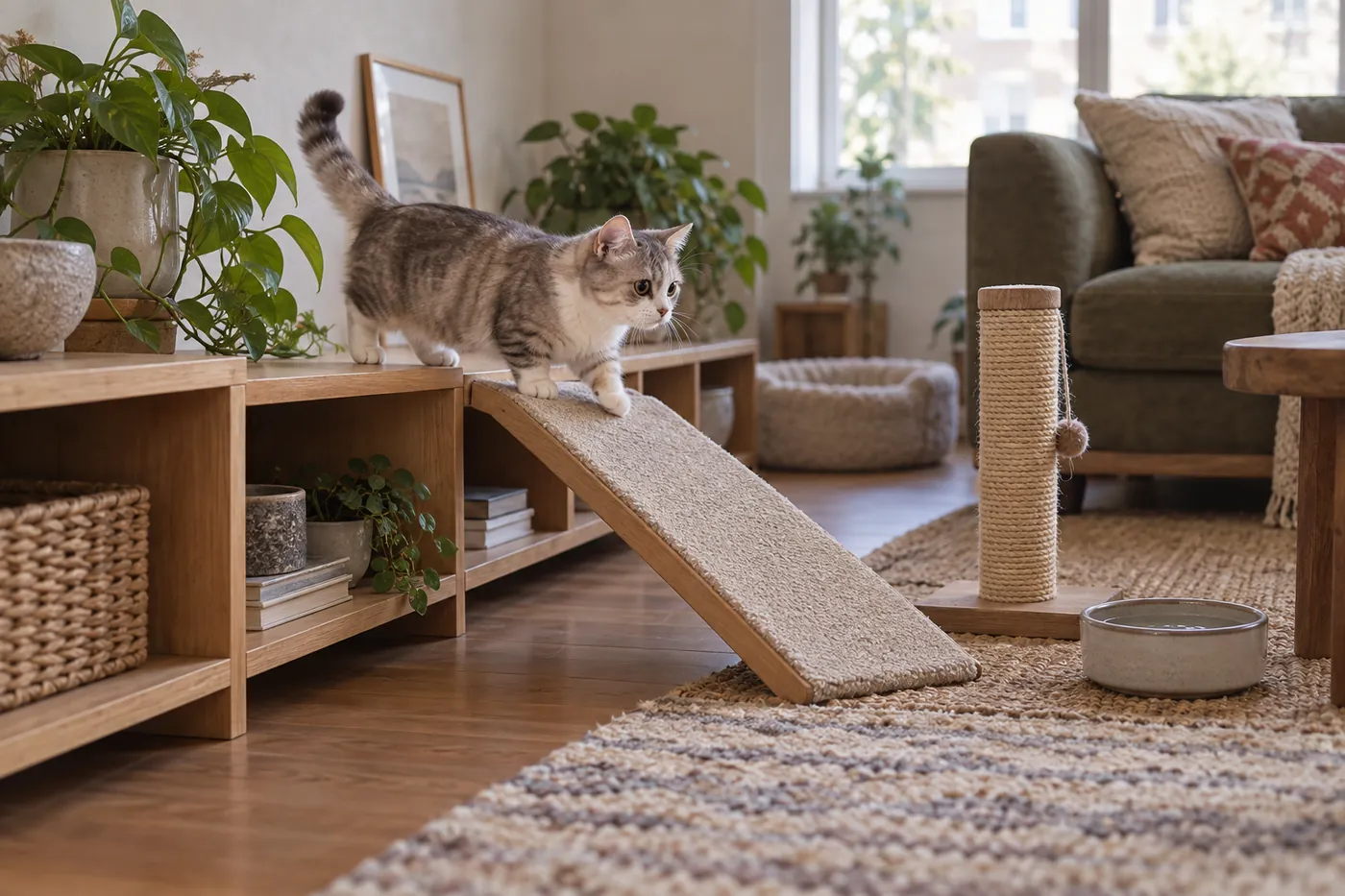
Useful enrichment emphasises horizontal movement, low-level climbing and interactive play at ground height.
- Stable low shelves or furniture connected by ramps rather than wide gaps
- Food, water, litter and resting spots separated rather than clustered together
- A litter tray with a low entry that does not require stepping over a high wall
- A scratching post at a reachable height for the cat's actual leg length
- Interactive play at floor level with short sessions rather than one prolonged chase
- Secure barriers around birds, rodents, reptiles and fish
An apartment can work well when the layout gives the cat choices at its natural height.
A large house with everything at counter height may be harder to use. The exercise needs by age guide shows why short play bursts and recovery time change across a cat's life, and that principle applies with greater force when the skeleton is already under structural stress.
Monitor activity and willingness to move over time. A Kinkalow that stops jumping onto a previously used surface, hesitates before moving or begins avoiding stairs may be showing early joint discomfort rather than laziness.
How Should You Groom a Kinkalow?
Grooming depends on coat length. A short-coated Kinkalow usually needs only a brief pass with the hand or a soft tool to remove loose hair and check the skin.
A semi-long coat requires more frequent attention to prevent tangles around the legs, chest and belly. Brushing a long coat takes different technique from a close layer.
Shedding varies by individual and season rather than following a fixed breed schedule.
A cat that dislikes grooming may tolerate short predictable sessions better than long restraint, and the reluctant-cat brushing guide focuses on building tolerance in small steps.
Ear care deserves extra attention. The curled shape does not trap debris more than a straight ear, but the firm cartilage means you cannot straighten the ear to inspect or clean it.
Look into the visible canal gently without forcing the ear, and consult a veterinarian if you see dark discharge, odour, redness or discomfort.
Shorter legs can leave the nails less worn when the cat does not use a scratching post, so they may need trimming more often than a standard cat's.
What Is Known About Kinkalow Health and Lifespan?
No Kinkalow-specific study of disease prevalence, lifespan or congenital problems has been published.
Secondary pages commonly cite a lifespan of 12 to 15 years without identifying a population, sample or method. Treat that figure as unverified.
The strongest health evidence comes from the parent breeds:
| Source | Concern | What it means for a Kinkalow |
|---|---|---|
| Munchkin UGDH variant | Disproportionate limb shortening with documented deformities in the bones of all four limbs | Monitor mobility, gait changes and willingness to jump across the cat's life |
| Munchkin homozygous lethality | Two copies of the short-leg variant appear lethal before birth | Ask whether both parents have short legs |
| American Curl ear cartilage | Firm but not associated with joint or skeletal disease | Handle ears gently and never force them; watch for infection signs |
Routine health planning follows the individual cat's life stage. AAHA and AAFP guidance supports adjusting preventive care as age, lifestyle and examination findings change, rather than using one visit schedule as a lifetime promise.
An unlabelled "clear health panel" is weak evidence because it does not reveal which variants were tested or whether the report belongs to the listed parent. A useful result names the laboratory, cat identifier, gene or condition, test date and outcome.
How Does a Kinkalow Fit a Multi-Pet or Family Home?
A Kinkalow can live successfully with respectful children, compatible cats or a cat-safe dog when the individual animal is comfortable and the environment protects its ability to retreat.
The breed name cannot guarantee that outcome.
With children, the strongest evidence comes from the cat's own behaviour: voluntary approach, relaxed play and an easy exit. A child should interact with the cat on the floor rather than picking up a small body whose short legs make being dropped more dangerous than usual.
Another cat or dog changes access to food, water, litter and resting space. Separate starting resources and gradual introductions reduce the chance that one animal controls the other's movement.
Early calm does not prove the introduction is complete. The cat conflict and introduction guide explains how blocking, staring and ambushes can appear after animals begin sharing more space.
Every animal in the household needs a retreat it can reach without being followed. For a short-legged cat, that retreat must be accessible at ground level rather than requiring a vertical escape.
How Confident Can You Be About a Kinkalow Classification?
A Kinkalow sits below a fully recognised breed in terms of verifiable definition.
It has no published standard, no championship history, no independent genetic study and no registry beyond the experimental tracking programme. That does not make the cat unhealthy or the cross fraudulent, but it means the word Kinkalow establishes less than a name with a full standard and population history behind it.
- The pedigree names the issuing organisation and both parents' registered identities
- Both mutations are present, or the cat is described honestly as non-standard
- Health records name the laboratory, test, identifier and outcome rather than offering a general clearance
- The cat's ordinary behaviour is observed during contact, play, interruption and recovery
- Equipment, retreat space and the daily routine suit a small short-legged body
- The source explains what experimental registry status means rather than presenting it as full recognition
A source who explains the limits of the Kinkalow's registration, health data and temperament evidence gives more useful information than one who treats rarity as proof of value.
An adult without pedigree records should be described by what can be observed and documented.
A known foster history and veterinary examination may offer strong evidence of household fit, but appearance alone should not be upgraded into a registered Kinkalow identity.
The strongest match is a cat whose real activity, handling tolerance and social behaviour suit the household, with documents that support every claim being made and realistic expectations about what a small, short-legged body requires across a lifetime.
Common Questions
Is the Kinkalow a recognised cat breed?
TICA accepted the Kinkalow only as an experimental breed, a category for breeds still in development. It has no championship status, no published breed standard and no listing with CFA, FIFe or WCF. The experimental registry tracks pedigrees but does not provide the breed definition that fully recognised breeds have.
How big does a Kinkalow cat get?
No official weight range exists. Secondary sources commonly cite 3 to 7 pounds, but that figure is not confirmed by a registry standard or population study. Use the individual cat's growth trend and body condition rather than a copied weight range.
What is a Kinkalow cat's lifespan?
No Kinkalow-specific population study was found. Secondary breed pages cite 12 to 15 years without identifying a sample or method. Individual veterinary records and family history provide more useful evidence than an unsupported range.
Are Kinkalow cats healthy?
No breed-specific health data exists. The short-leg trait from the Munchkin side is associated with bone deformities documented in all four limbs, and the variant appears lethal when a kitten inherits two copies. The curled-ear trait from the American Curl side has not been linked to the cartilage problems seen in Scottish Folds, so mobility and joint comfort are the things to watch across the cat's life.
What temperament does a Kinkalow have?
Secondary descriptions call Kinkalows playful, curious and social, but no breed behaviour study was found. Observe the individual during play, handling, interruption and recovery rather than relying on a general breed description.
Checked Against
- TICA: Registration rules and experimental breed status tica.org
- Struck et al.: A structural UGDH variant associated with standard Munchkin cats (BMC Genetics, 2020) pmc.ncbi.nlm.nih.gov
- Anderson et al.: Skeletal manifestations of heritable disproportionate dwarfism in cats (Veterinary and Comparative Orthopaedics and Traumatology, 2021) pmc.ncbi.nlm.nih.gov
- CFA: American Curl breed article cfa.org
- TICA: American Curl tica.org
- CFA: Current breeds cfa.org
- AAHA and AAFP: Feline life stage guidelines catvets.com
Published 17 September 2026. Last updated .





