
What Is a Bambino Cat, and What Do Its Mutations Mean?
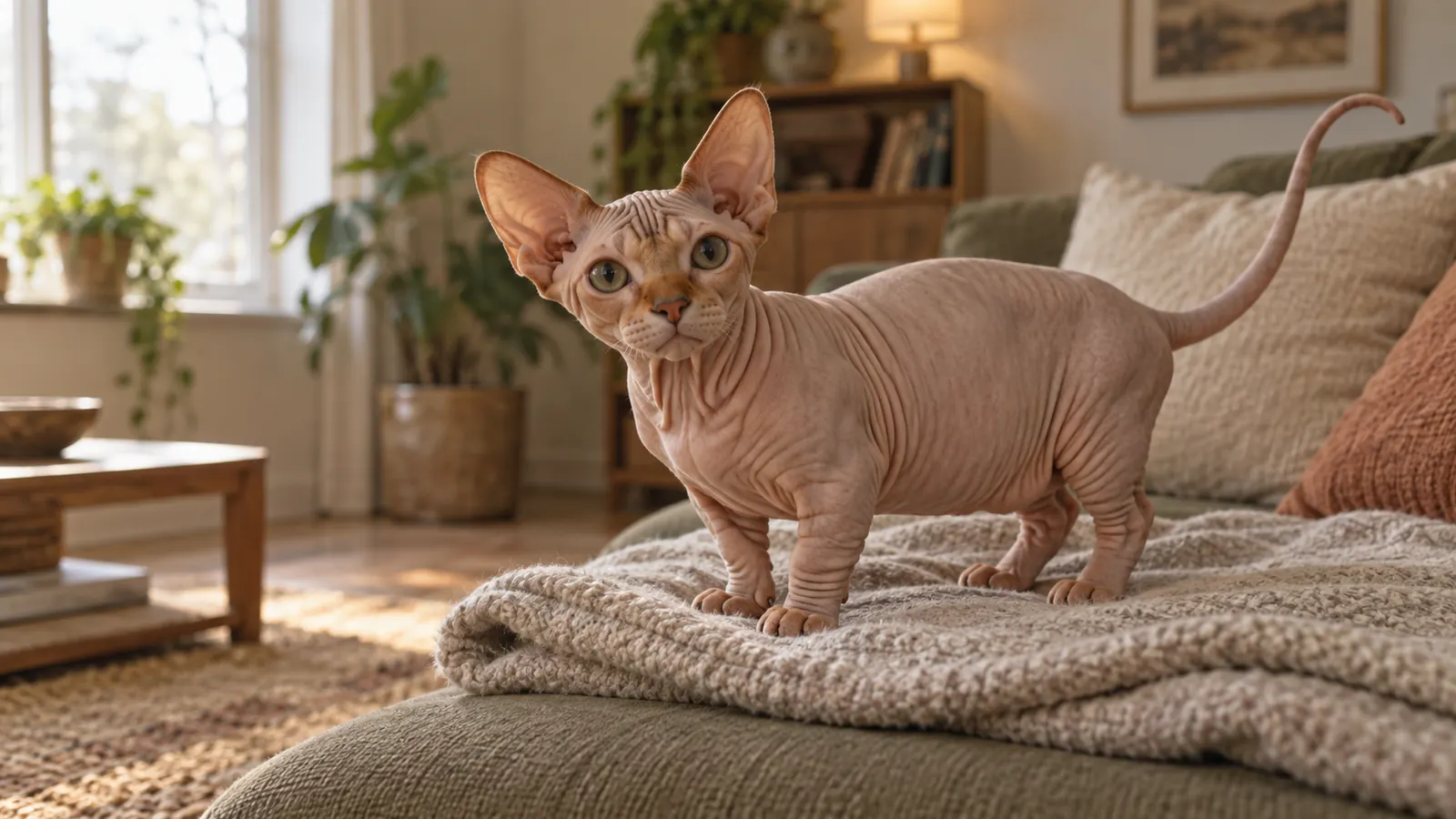
The Bambino is a Sphynx crossed with a Munchkin, which means it inherits two separate mutations and the consequences of both. The limb variant is a chondrodysplasia with no surviving homozygotes, the hairlessness brings a documented heart-screening burden, and several major registries refuse to recognise the cross at all.
- Origin
- United States, from crosses of the Sphynx and the Munchkin beginning in the early 2000s
- Coat
- Effectively hairless, with warm, wrinkled skin and at most a fine down
- Size
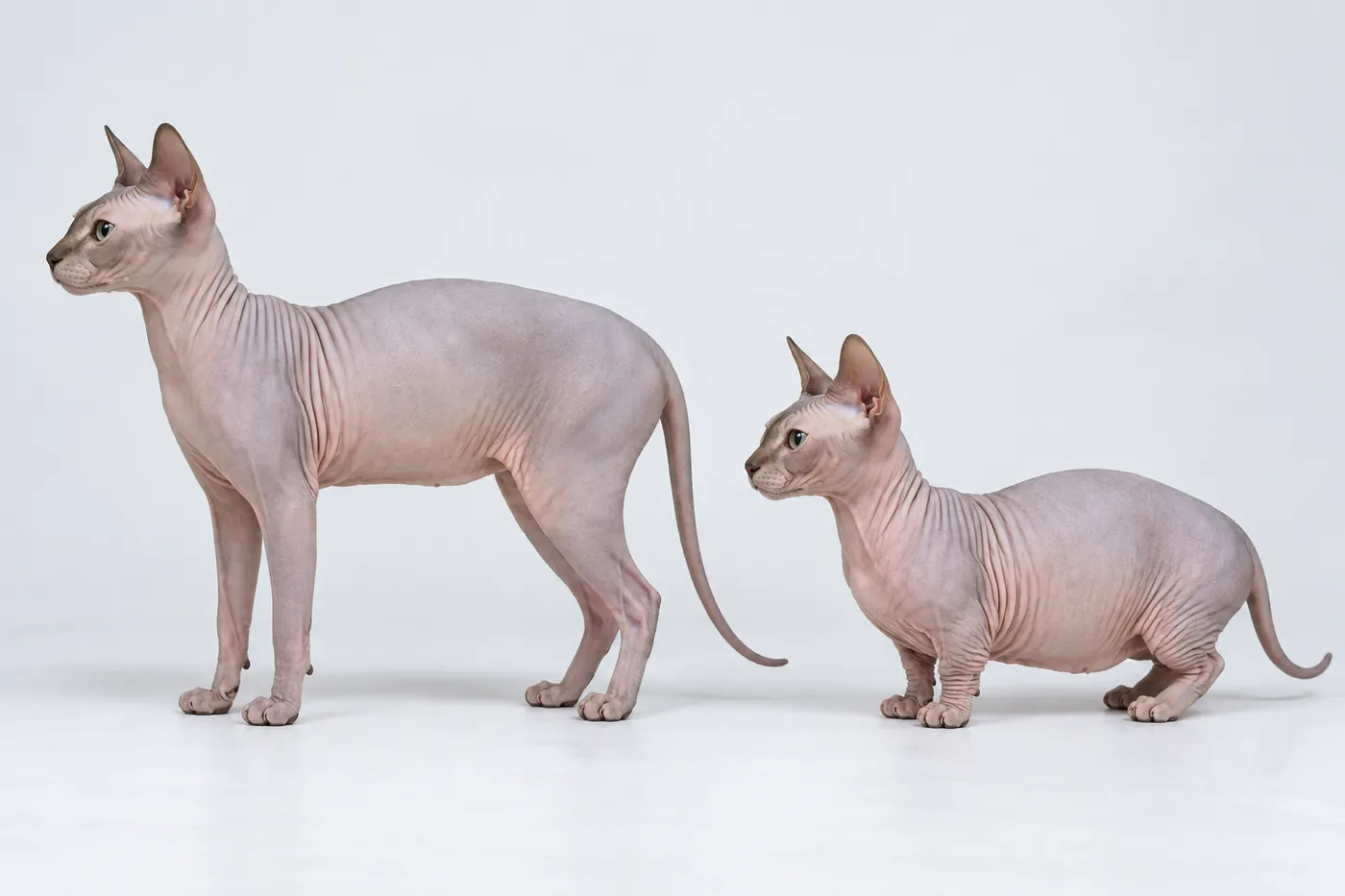
- Small, with markedly shortened legs on a normal-length body and a long tail
- Typical weight
- Typically about 5 to 9 pounds, roughly 2.3 to 4 kg
- Life expectancy
- Commonly quoted around 9 to 15 years, with no breed-specific study behind either end of that range
- Activity level
- Moderate to high in intent, limited in reach. Playful and sociable, but unable to jump like a normal cat
- Grooming
- High. Regular bathing, frequent ear cleaning, nail-fold cleaning and skin monitoring
- Suits
- Experienced owners in warm homes who have read the health evidence and accepted it deliberately
The Bambino is a Sphynx crossed with a Munchkin: hairless skin on short legs.
Both parent breeds are built on a mutation, and the Bambino inherits both. That is the whole of the argument here, and it is why the breed deserves more care than a description of a friendly cat with an unusual outline.
Nothing here says a living Bambino is a bad cat or a suffering one. The question is what the evidence supports about the breeding, and what an owner is signing up to.
What exactly is a Bambino?
A deliberate combination of two established mutations, produced in the United States from the early 2000s.
The Sphynx contributes a variant in the KRT71 gene that leaves hair without a solid root, so it breaks off and the cat is effectively bald. The Munchkin contributes the short-legged chondrodysplasia.
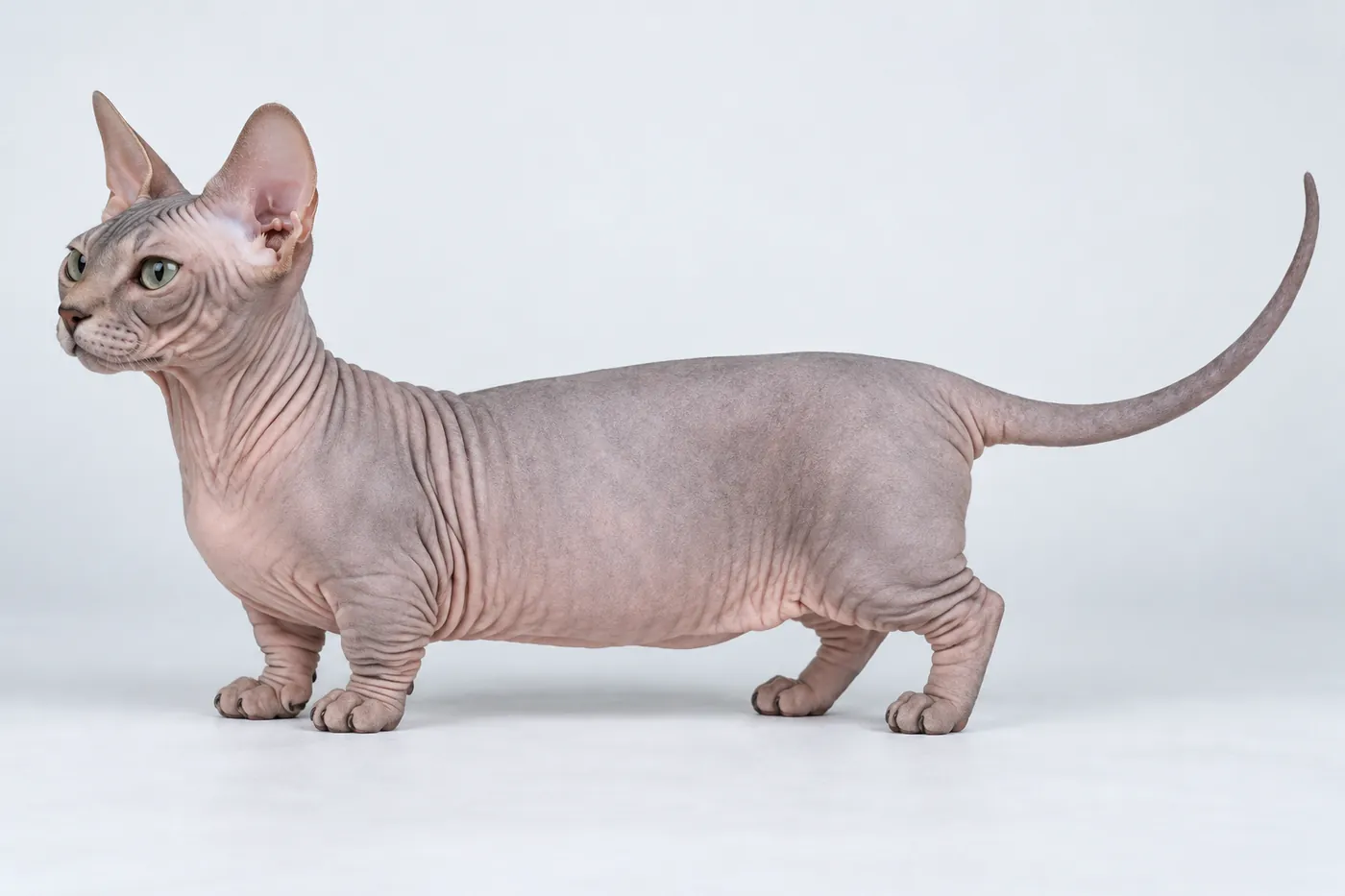
Neither mutation is new. What is new is putting them in the same cat.
Derived crosses have multiplied from the same starting point, including the Minskin, the Dwelf and the Scottish Kilt, and they share the Bambino's evidence problem rather than solving it.
What is actually known about the short-leg mutation?
More than most breed pages admit, and it is worth stating precisely.
A 2020 genetic study identified a structural variant in the UGDH gene on feline chromosome B1 associated with standard Munchkin cats, involving a deletion of about 3,300 base pairs with a small insertion between the breakpoints. Inheritance is autosomal dominant.
UGDH produces UDP-glucuronic acid, which is needed to build heparan sulfate proteoglycans. Those proteoglycans regulate the Wnt and Fgf signalling that drives limb development, which is a coherent mechanism rather than a guess.
The measured effect is substantial. Affected long bones come in at 58 to 84 percent of normal length.
- Gene
- UGDH, on feline chromosome B1
- Variant
- A deletion of roughly 3,300 base pairs with a 108 base pair insertion
- Inheritance
- Autosomal dominant for the short-legged phenotype
- Homozygotes
- None found in the study population, alongside reduced litter sizes
- Bone length
- Long bones reduced to between 58 and 84 percent of normal
The homozygote finding is the one with a practical consequence.
No homozygous mutant cats were identified, and litter sizes in Munchkin-to-Munchkin breeding are reduced, which points to embryos carrying two copies not surviving. In practice a short-leg to short-leg mating loses roughly a quarter of the litter before birth.
That is not a hypothetical. It is the arithmetic of the mating.
Does the short leg hurt the cat?
This is where honest reporting has to separate what is established from what is argued.
What is established: the limbs are shortened, the study authors observed shortened limbs in heterozygous cats without recording impaired health, and many Munchkins and Bambinos live ordinary lives.
What is argued, with a mechanism but without long-term feline outcome data: abnormally shaped limbs load joints abnormally, and abnormal joint loading is a well-understood route to osteoarthritis. There is no long-term study showing that these cats do not develop arthritis at higher rates, and the absence of that study is not a finding of safety.
Lordosis, an excessive inward curve of the spine, and pectus excavatum, a sunken chest, are both reported more often in Munchkin-derived cats than in cats generally.
Why do major registries refuse the cross?
Because they treat the founding trait itself as the objection, not the health of any individual cat.
The GCCF has stated since 1991 that it will not recognise any new breed based on a harmful genetic mutation where the resulting structural anomaly is the key feature of the breed, and it names shortened limbs explicitly. FIFe prohibits breeds based on dwarfism and names the Munchkin as an example.
The CFA does not recognise the Munchkin or its derivatives either.
| Registry | Munchkin | Bambino | Stated basis |
|---|---|---|---|
| GCCF (UK) | Not recognised | Not recognised | Will not recognise a breed founded on a harmful mutation or structural anomaly |
| FIFe (Europe) | Prohibited | Prohibited | Breeds based on dwarfism are treated as manipulation of genetic disease |
| CFA (US) | Not recognised | Not recognised | Not accepted for registration |
| TICA | Championship since 2003 | Experimental | Recognises the Munchkin; the Bambino has not advanced |
This is the same structural argument the site sets out for the Scottish Fold, where the folded ear and the cartilage disease are the same variant and cannot be separated. The reasoning transfers even though the gene and the tissue do not.
What does the Sphynx half bring?
A second and entirely separate set of obligations, which the short legs then make harder to meet.
Hypertrophic cardiomyopathy is the significant one. In a prospective screening study of 114 Sphynx cats, 39 had an abnormal examination: 23 were classified with hypertrophic cardiomyopathy and 16 with congenital heart disease.
That selected Sphynx cohort is evidence of a screening concern, not a Bambino prevalence estimate. Echocardiography is the structural test to ask about, and a prospective owner should request dated parental reports while an individual cat's veterinarian or cardiologist sets the follow-up interval.
Congenital myasthenic syndrome is a second inherited condition in the Sphynx population, presenting between roughly 3 and 23 weeks with muscle weakness. A DNA test exists for it.
Sphynx cats are also over-represented in urate urolithiasis, and they are not hypoallergenic: the allergen is Fel d 1 in saliva and skin secretions, and a cat with no coat still produces it.
Our profile on the Sphynx covers that side of the inheritance in full.
How much daily care does a Bambino need?
Considerably higher than a coated cat's, and this is the part people underestimate.
Skin without hair accumulates sebum, which forms a sticky brown film in the folds and along the back if it is not washed off. Bathing is a routine rather than an occasional event, and the frequency depends on the individual cat rather than on a schedule anyone can prescribe.
- Bathe with a gentle, veterinary-approved cleanser in comfortably warm water, and rinse thoroughly because residue irritates bare skin.
- Dry the cat completely with a towel in a warm room, since a wet hairless cat loses heat very quickly.
- Clean the ears on a regular schedule, because minimal ear hair means wax accumulates faster than in coated cats.
- Clean under and around the nails, where oil and debris collect in the folds.
- Check the whole skin surface while you are handling the cat, looking for spots, scabs, sore folds and changes in colour.

Temperature is the other half of that routine, and it pulls against the sun.
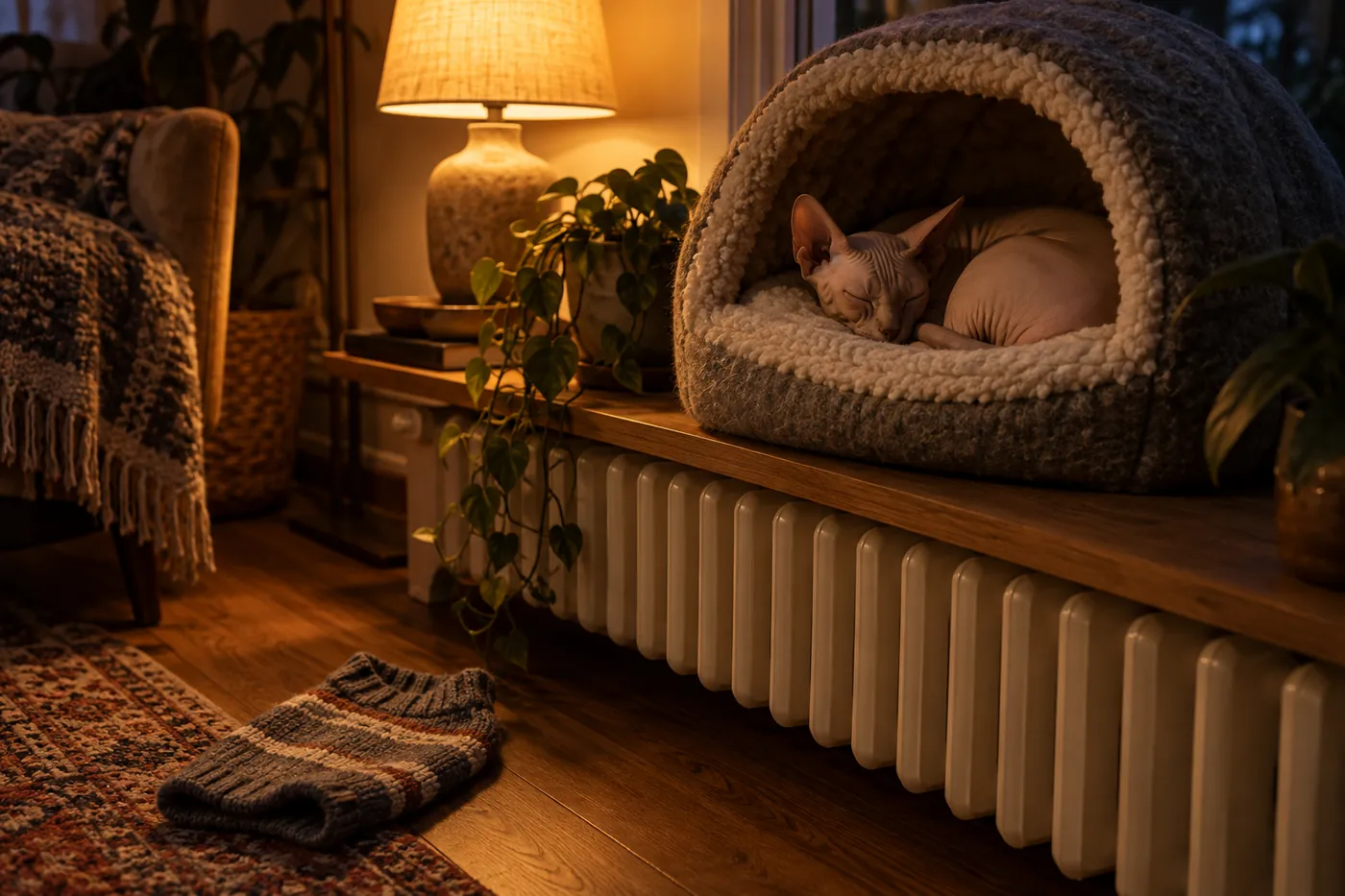
A hairless cat loses body heat far faster than a coated one, so the house has to be warm, not merely not cold. Heated beds, covered beds, fleece and a jumper in winter are ordinary equipment rather than indulgences.
Sun is the other half. Bare skin burns and can be damaged by prolonged exposure exactly as human skin is, so an unshaded sunny window in summer is a hazard rather than a treat.
Never let a Bambino outdoors unsupervised. The short legs remove the escape options a cat normally relies on, and the bare skin removes the protection.
How should the home be laid out?
Around the reach the cat actually has.
A Bambino wants to get onto the sofa, the bed and the windowsill exactly as any cat does, and it cannot make the jump. What it can do is attempt the jump, which is where the joint loading and the injuries come from.
- Put ramps or broad low steps at every place the cat would otherwise jump to, and check nothing requires a leap of more than a few inches
- Use a litter tray with a low entry, or cut a low entry into a high-sided tray, so getting in is not a climb
- Raise food and water bowls slightly, which reduces the reach a short-legged cat has to make downward
- Keep floors free of anything the cat has to scramble over, and provide non-slip surfaces on ramps
- Keep the weight tightly controlled, because extra load on abnormally shaped joints is the one risk factor you fully control
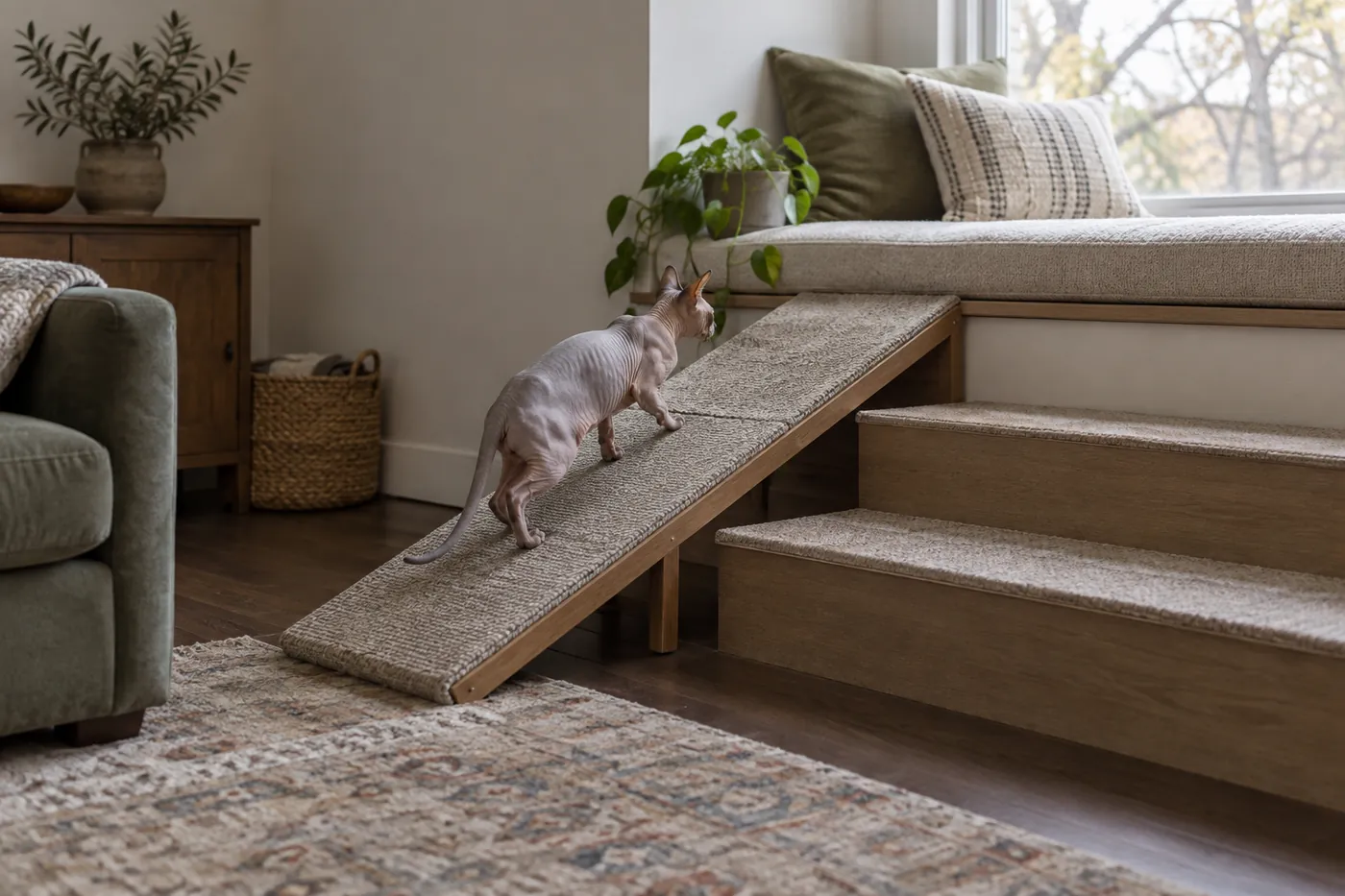
Our page on adapting the home covers the same principles for mobility-limited cats generally.
How much does a hairless cat eat?
More than a coated cat of the same weight, and the reason is straightforward.
A cat with no coat loses heat continuously and burns energy replacing it, so appetite runs high. Owners of Sphynx and Sphynx-derived cats routinely report a cat that eats a great deal and stays lean.
That is not licence to free-feed.
A short-legged cat carrying extra weight is loading abnormally shaped joints, which is the one risk factor here that you fully control. Feed a complete diet to condition, weigh the portion rather than scooping it, and body-condition score by hand every month.
Our guides to calculating daily calories and how much to feed a cat cover the method, and the warmth of the house changes the answer: a cat kept properly warm needs less than one that is constantly cold.
Trays and play are the next two, and neither adjustment is difficult once you have noticed it is needed.
A standard litter tray has sides a normal cat steps over and a short-legged cat climbs. That climb is a deterrent, and a tray a cat finds hard to enter is one of the commonest causes of house soiling in cats with any mobility limit.
- Tray entry
- One low side, or a low entry cut into a high-sided tray with the edge filed smooth
- Tray size
- Still about one and a half times the cat's body length, because a low entry does not excuse a small tray
- Litter depth
- Shallower than usual, since a short-legged cat has less clearance to dig against
- Placement
- On the same level the cat spends its day on, never up or down a flight of stairs
- Play
- At floor level, with a wand toy the cat can catch without jumping
Our page on trays for cats with stiff joints covers the same problem in older cats, and how many trays a cat needs covers provision.
Play needs the same treatment, at floor level.
A wand toy dragged along the ground gives a short-legged cat a full hunting sequence it can actually complete, where a toy thrown onto furniture gives it a frustration. Let the cat catch the toy, and finish with food, following the routine in exercise needs by age.
A second cat raises one more structural question.
Cats resolve tension by leaving, and leaving upwards is the main escape route a cat uses indoors. A Bambino cannot take that route at speed, which means a household with an assertive resident cat can put it in a position it cannot get out of.
The fix is provision rather than supervision.
- Give every high perch a ramp or a stepped route, so the escape option exists at a walk
- Duplicate trays, water, food stations and beds, so nothing has to be contested
- Place at least one covered bed at floor level, which a short cat can reach immediately
- Watch for a resident cat blocking a corridor or a doorway, which is how chokepoints form
- Introduce slowly and separately, using the process in our guide to inter-cat aggression
The full introduction sequence is in stopping one cat attacking another.
What is the temperament like?
Warm, sociable and demanding of company, which both parent breeds contribute.
Bambinos are typically people-focused, playful and inclined to follow their owner from room to room. They are poor candidates for long days alone, and they seek body heat, which means they will be in your bed.
That temperament is genuinely appealing, and it is the reason the breed has buyers. It is not evidence about the breeding.
Children bring the same escape problem as a second cat. A Bambino that wants to get away from a child cannot jump onto a shelf to do it, so a child who chases or corners it leaves it nowhere to go. Play at floor level with a wand toy, with the child sitting and the cat free to walk off, suits its body, and an older child who will sit still gets a willing lap cat. A toddler who wants to carry it about is a poor match for a cat with shortened limbs and a spine where lordosis is reported more often than in cats generally.
No source read for this profile measures how trainable a Bambino is. The weekly bath makes one kind of training matter more than usual: a kitten taught with food rewards to accept bathing, ear cleaning and nail-fold cleaning gets used to that routine early.
Before any of that, there is a list to put to the breeder, and be prepared to walk away.
- Mating
- Whether short-leg cats are bred to short-leg cats, and if so what happens to litter size
- Heart
- A dated echocardiogram from a veterinary cardiologist on both parents, not a stethoscope check
- DNA
- A congenital myasthenic syndrome test result from the Sphynx side
- Skeleton
- Whether any cat in the line has been diagnosed with lordosis or pectus excavatum
- Records
- What the oldest cats in the line are, and what they have been treated for
A breeder who has never heard of UGDH, will not discuss homozygous loss, or presents the short legs as purely cosmetic is not someone whose health claims are worth much.
When should a kitten come home, and what will it cost to keep?
Later than usual, and more than the purchase price suggests.
Sphynx breeders commonly hold kittens until around fourteen weeks rather than the usual twelve, because bare kittens are more vulnerable to respiratory infection and benefit from longer with the litter. A breeder offering an eight-week-old hairless kitten is doing something that is not in the kitten's interest.
The running costs are the part that catches people.
- Cardiac planning
- Ask for dated parental echocardiograms and have a veterinarian or cardiologist set the individual cat's follow-up interval
- Skin and ears
- Cleanser, ear cleaner and consumables for a weekly routine rather than an occasional one
- Heating
- A warmer house than you would otherwise run, plus heated and covered beds
- Orthopaedic risk
- Budget for investigation of any lameness or gait change rather than watching it
- Insurance
- Take a policy out before any problem appears, and read the exclusions
Insurance is the item to arrange first and read carefully. Policies commonly exclude conditions considered hereditary or congenital in the breed, and a short-legged hairless cat presents an insurer with two obvious candidates.
Ask in writing whether cardiomyopathy and joint disease are covered before you buy the policy, not after.
Who should think twice about one?
Most people, honestly.
- Anyone who cannot keep the house reliably warm through the whole year
- Anyone who will not bathe a cat weekly and clean ears and nail folds between baths
- Anyone who wants a cat that can be left alone for a full working day
- Anyone who wants the cat to have outdoor access
- Anyone unwilling to fund cardiology assessment when advised and to investigate any lameness properly
Those are the practical exclusions, and each one is a routine rather than a preference.
The stronger reason to think twice is the one that has nothing to do with convenience.
Buying a kitten funds the next mating, and the next mating is the thing the welfare objection is actually about. That decision belongs to you, but it should be made knowingly rather than after the fact.
There are two versions of this you can have with a clearer conscience, depending on which half you wanted.
If the appeal is the hairless skin and the temperament, a Sphynx gives you both without the limb mutation, and it comes with a real screening programme behind it. If the appeal is a small cat, the Singapura is genuinely small with normal proportions.
And a Bambino already alive in a rescue is a different transaction entirely. Adopting one funds nothing, and the care described above applies unchanged.
Can you own one and still object to the breeding?
The Bambino is an affectionate cat carrying two mutations, one of which reduces limb bones to between 58 and 84 percent of normal length and kills homozygous embryos, and the other of which brings a documented cardiac screening burden and a demanding skin routine.
Individual Bambinos can be healthy and well cared for. That is compatible with the breeding being hard to defend, and the two questions should not be answered as though they were one.
If you go ahead, go ahead with the evidence in front of you, a cardiologist's report in hand and a house with no jumps in it.
Common Questions
What is a Bambino cat?
A cross between the Sphynx and the Munchkin, producing a hairless cat with markedly shortened legs. It carries two separate mutations, one from each parent breed, and is classified as experimental rather than recognised.
Do Bambino cats suffer because of their short legs?
The evidence is incomplete. A 2020 study found shortened limbs in heterozygous cats without recording impaired health, but no long-term work has shown that these cats avoid the osteoarthritis that abnormal joint loading would predict. Lordosis and pectus excavatum are also reported more often.
Which gene causes the Munchkin's short legs?
A structural variant in UGDH on feline chromosome B1, inherited as an autosomal dominant. No homozygous cats were found in the study population, and litter sizes are reduced, which indicates that embryos with two copies do not survive.
Why do the GCCF and FIFe refuse to recognise Bambinos?
Both object to breeds founded on a harmful mutation where the structural anomaly is the defining feature. The GCCF names shortened limbs explicitly, and FIFe prohibits breeds based on dwarfism. The CFA does not recognise them either.
How much care does a Bambino need?
Substantially more than a coated cat. Regular bathing for sebum build-up, frequent ear cleaning, nail-fold cleaning, a reliably warm house, protection from sun, and a home laid out with ramps so nothing requires a jump.
Do Bambinos need heart screening?
Yes. In a prospective Sphynx screening cohort, 39 of 114 cats had an abnormal examination, including 23 with hypertrophic cardiomyopathy and 16 with congenital heart disease. Ask for dated parental echocardiograms and let a veterinarian or cardiologist set follow-up for the cat.
Are Bambinos hypoallergenic?
No. The allergen is Fel d 1, produced in saliva and skin secretions, so a cat with no coat still produces it and still spreads it while grooming.
Checked Against
- Struck et al.: A structural UGDH variant associated with standard Munchkin cats (BMC Genetics, 2020) pmc.ncbi.nlm.nih.gov
- Governing Council of the Cat Fancy: welfare statement and breeding policy gccfcats.org
- Journal of Veterinary Cardiology: prospective echocardiographic screening of Sphynx cats pubmed.ncbi.nlm.nih.gov
- Cornell Feline Health Center: hypertrophic cardiomyopathy vet.cornell.edu
- International Cat Care: inherited disorders in cats icatcare.org
Published 10 September 2026. Last updated .





