
What Is a Skookum, and How Does Its Curl Gene Differ From the Lambkin's?
A Skookum is a small, short-legged cat with a curly coat, produced by crossing Munchkin and LaPerm lines. It is not recognised by any major registry for championship competition. The Skookum shares the same Munchkin short-leg mutation as the Kinkalow, Lambkin, Bambino, Minskin and Minuet, but its curly coat comes from a different gene than the Lambkin's.
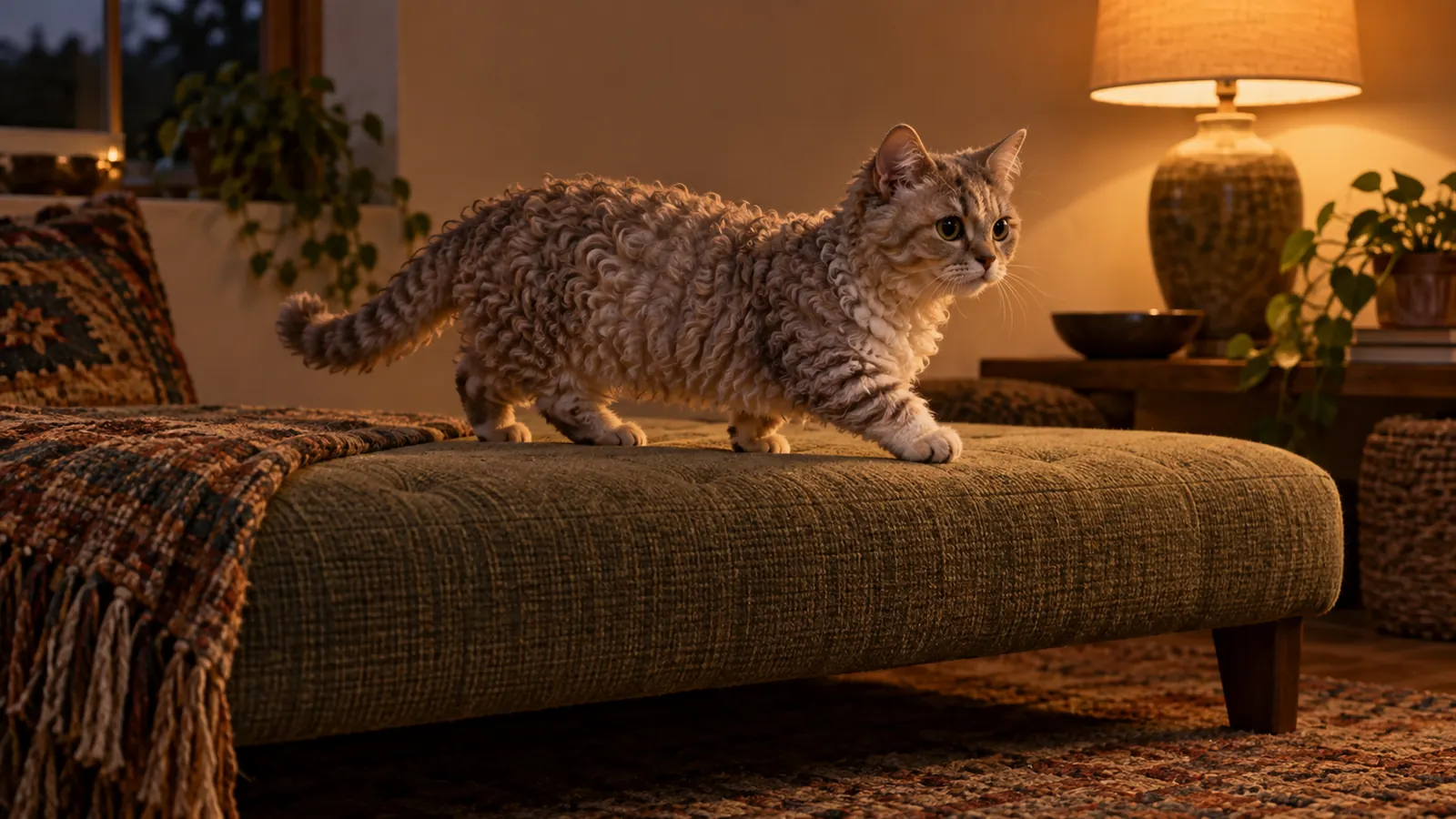
- Origin
- United States, developed by Roy Galusha in the 1990s by crossing Munchkin and LaPerm cats
- Coat
- Curly or wavy, short or long, with the LaPerm curl texture on a compact body
- Size
- Small, with shortened forelegs and hindlegs from the Munchkin UGDH variant
- Typical weight
- Not measured; no study or registry gives a Skookum weight range
- Life expectancy
- Not measured; no study gives a Skookum lifespan
- Activity level
- Commonly described as playful, confident and energetic within the limits of its leg structure
- Grooming
- The curly coat needs gentle combing to maintain curl structure without damaging it
- Suits
- Households that can provide low-level enrichment, gentle coat care and veterinary monitoring around the skeletal structure
A Skookum is a small, short-legged cat with a curly coat, produced by crossing Munchkin and LaPerm lines.
No major registry grants it championship status.
The Skookum shares the Munchkin short-leg mutation with the Lambkin, but the two carry different curly-coat genes. That difference matters for grooming and for understanding what the name means genetically.
How Does the Skookum Curl Differ From the Lambkin Curl?
Both the Skookum and the Lambkin combine Munchkin short legs with a curly coat, but the curl comes from different breeds.
The Lambkin carries the Selkirk Rex curl gene (Se). The Se gene is autosomal dominant and curls all three hair types in a dense coat, which gives a thick, plush feel with loose, irregular curls.
The Skookum carries the LaPerm curl gene (Lp). The Lp gene is also autosomal dominant, but it sits in a coat with relatively little undercoat, so the curl is light, airy and springy and stands away from the body, in open ringlets on longer-coated cats and firmer waves on shorter ones.
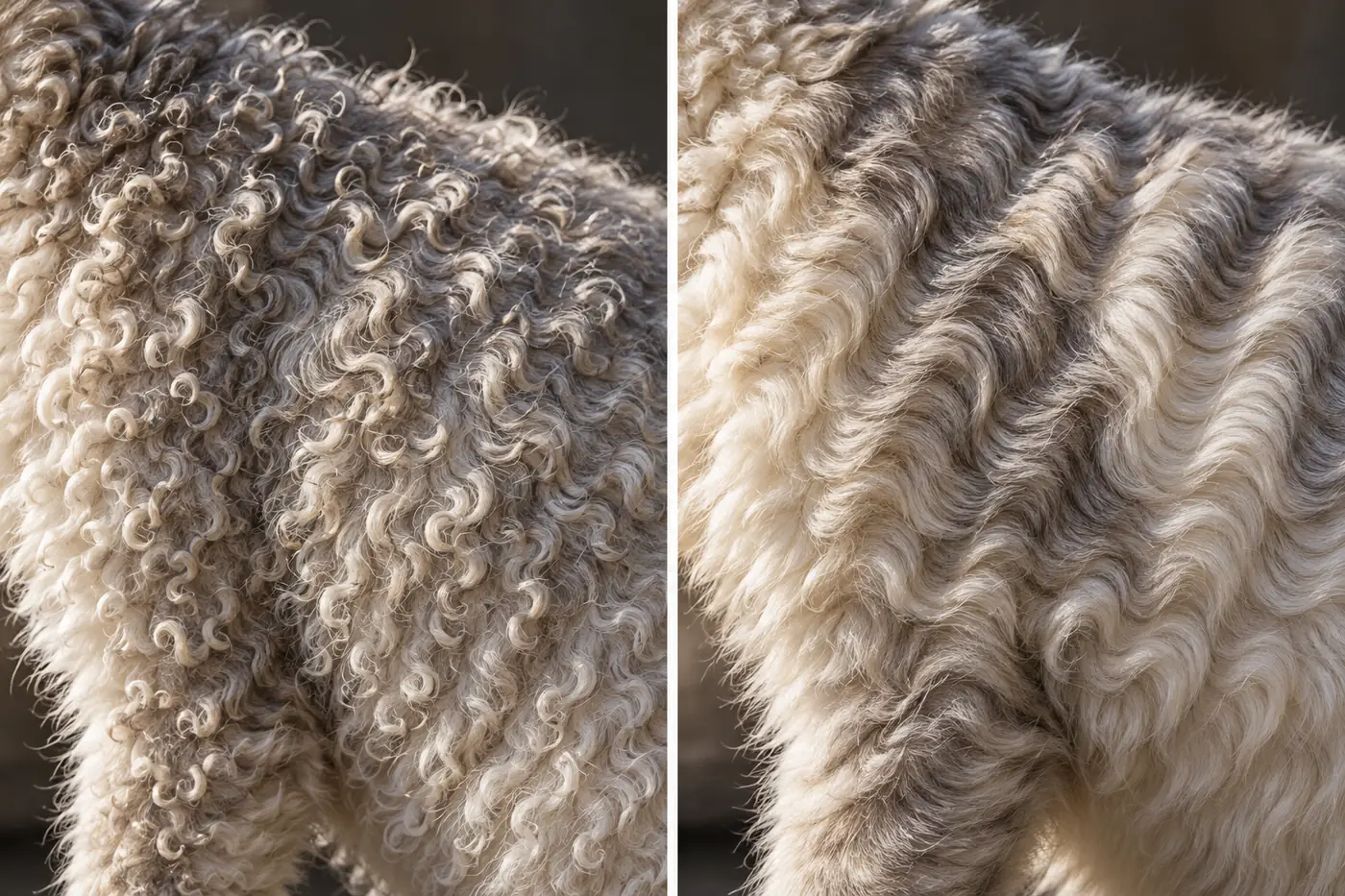
| Feature | Skookum (LaPerm curl) | Lambkin (Selkirk Rex curl) |
|---|---|---|
| Curl gene | Lp (autosomal dominant) | Se (autosomal dominant) |
| Curl texture | Light, springy, airy curl standing away from the body | Dense, plush coat with loose, irregular curls |
| Short-leg gene | UGDH variant (same in both) | UGDH variant (same in both) |
What Does the Short-Leg Gene Mean?
The Skookum carries the same UGDH variant that defines every Munchkin-derived breed. It is autosomal dominant, so one copy is enough to shorten the legs. Two copies appear to be lethal before birth, which is why responsible breeding pairs a short-legged cat with a standard-legged one.
An imaging study published in 2021 compared six short-legged cats carrying the variant with twelve standard-legged cats. Every affected cat had deformities in all four limbs, including an exaggerated S-shaped curve in the upper foreleg bone, an outward twist and bowing in the lower foreleg bone, and angular changes in the thigh bone and shin. Spinal scans of two of the cats showed no abnormality.
What Registry Status Does the Skookum Hold?
No major registry grants championship or preliminary status. The breed population is small and the breeding community is limited.
Without a finalised standard, judging history or championship pathway, the name Skookum establishes less about the cat than a fully recognised breed name does, so a pedigree from a Skookum breeder confirms tracked parentage rather than a level of breed definition comparable to what a championship breed carries.
What Is Known About Health and Lifespan?
No Skookum-specific health study exists. The same evidence gap applies as with every unrecognised Munchkin cross.
The strongest health evidence comes from the parent breeds. The Munchkin side brings the UGDH limb findings above. On the LaPerm side, no health condition has been linked to the curl gene itself, although UC Davis lists the LaPerm among breeds for which testing for pyruvate kinase deficiency, a recessive anaemia, may be appropriate.
No study or registry has measured Skookum lifespan or adult weight, and the figures repeated online name no source, so no measured range can be given for either. The cat is small, with the Munchkin's shortened legs.
How Do You Manage the Curly Coat Day to Day?
The LaPerm-type curls need a lighter touch than a straight coat. Finger combing through the ringlets preserves their shape, and a wide-tooth comb used gently can work through small tangles without flattening the curl.
Bathing is occasionally useful to refresh the curl pattern and remove buildup. A gentle unscented cleanser and air drying preserve the texture better than towel-rubbing, which can frizz the coat.
Shedding is generally described as light, but hair that is shed can stay caught in the curls, so regular gentle combing is what stops it matting.
The coat also changes over the cat's life. In the LaPerm, kittens can be born curly, straight or bald, and an adult's coat can thin and regrow with age, hormones and shedding, so a Skookum kitten's coat is not a reliable preview of the adult's.
How Does the Short-Leg Structure Affect Daily Life?
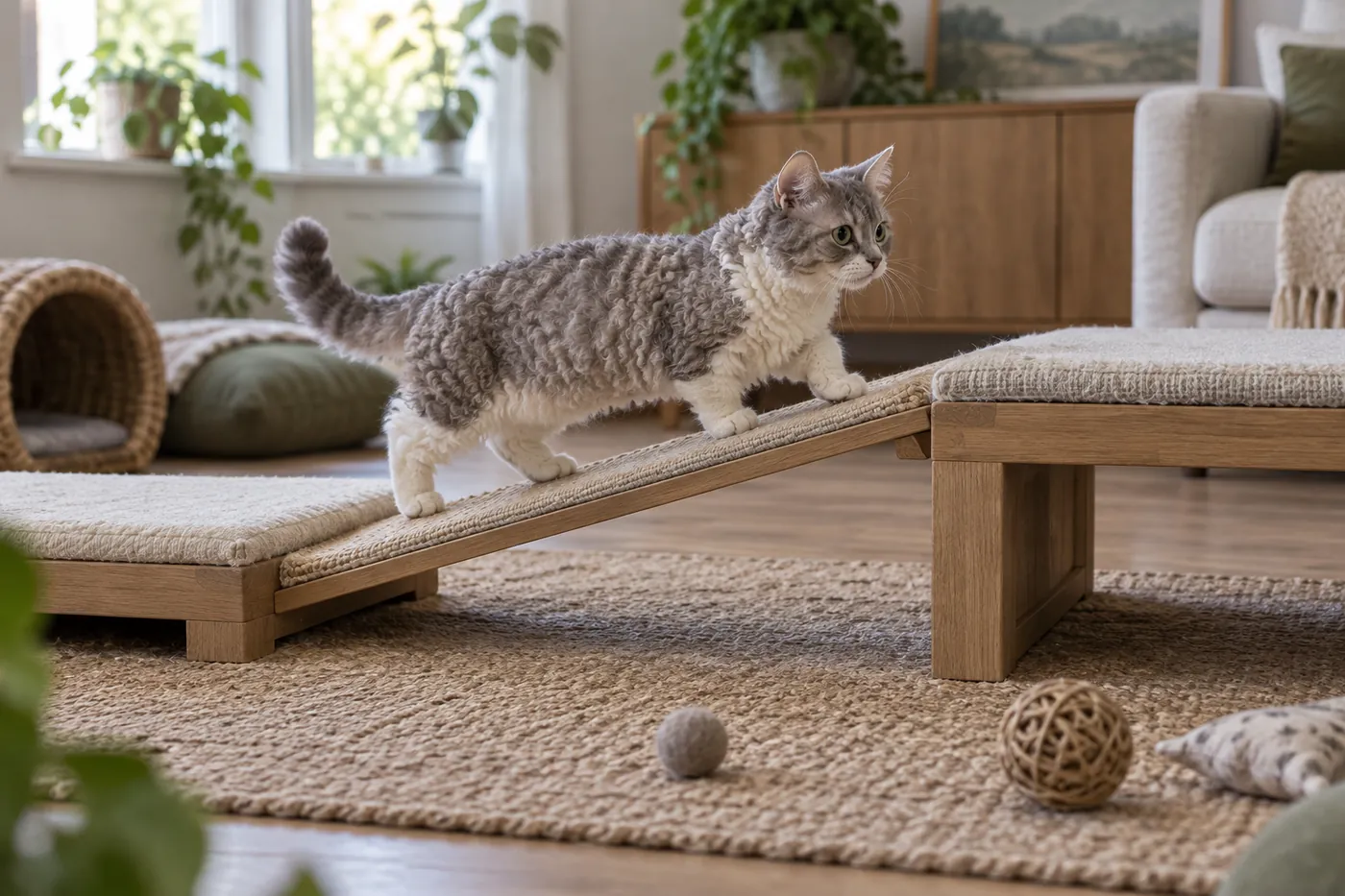
A Skookum climbs and plays, but it cannot jump as high as a standard-legged cat, so height is best reached by walking. Low platforms joined by ramps suit the body better than tall towers with wide gaps between levels, and a litter tray with a low entry saves a step up on every visit.
Weight matters for the same reason. Every extra pound is carried by limbs the imaging study found deformed, so keeping a Skookum lean is one of the few things an owner can do that directly protects its joints.
How Does a Skookum Fit a Family or Multi-Pet Home?
Children do best handling the cat while sitting on the floor, because a small cat dropped from standing height lands on limbs that are already deformed.
The breed's reported confidence and playfulness suggest compatibility with calm, interactive children. A second compatible cat provides daytime company for a social breed.
Small animals need secure physical barriers regardless of the cat's size or temperament.
Who Suits a Skookum, and How Do You Find One?
The Skookum suits a household that accepts the Munchkin-derived skeletal commitment, can manage a LaPerm-type coat gently, and is comfortable owning a cat whose name no registry fully recognises.
The Skookum is rare. Active breeders are few, and finding one may require extended searching.
- The individual cat's curl type (LaPerm ringlet) and leg length confirmed
- Both parents' health history, including mobility and skeletal records
- The breeder explains the UGDH variant and its documented skeletal findings
- The LaPerm curl is distinguished from the Selkirk Rex curl the Lambkin carries
- The breeder can discuss why major registries have not advanced the breed
Common Questions
Is a Skookum the same as a Lambkin?
No. Both combine Munchkin short legs with a curly coat, but the Skookum carries the LaPerm curl gene (Lp), which gives a light, springy curl in a coat with little undercoat, while the Lambkin carries the Selkirk Rex curl gene (Se), which gives a dense, plush coat with loose curls. The short-leg gene is the same in both.
Is the Skookum a recognised breed?
No major registry grants championship status, and no published breed standard exists.
How big does a Skookum get?
No study or registry gives a Skookum weight range. It is a small cat with shortened legs, but no measured figure exists.
Are Skookum cats healthy?
No breed-specific health data exists. The Munchkin-side skeletal deformities apply. The LaPerm-side curl gene has not been linked to health problems. Monitor mobility across the cat's life.
How do you groom a Skookum's curly coat?
Finger combing and minimal brushing preserve the ringlet structure. Over-brushing loosens the curls and can make the coat frizzy.
Checked Against
- TICA: Current breeds (Skookum not listed for championship) tica.org
- Struck et al.: A structural UGDH variant associated with standard Munchkin cats (BMC Genetics, 2020) pmc.ncbi.nlm.nih.gov
- Anderson et al.: Skeletal manifestations of heritable disproportionate dwarfism in cats (Vet Comp Orthop Traumatol, 2021) pmc.ncbi.nlm.nih.gov
- TICA: LaPerm tica.org
- UC Davis Veterinary Genetics Laboratory: Pyruvate kinase deficiency vgl.ucdavis.edu
Published 17 September 2026. Last updated .





