What Is a Foldex Cat, and Is Its Folded Ear Healthy?
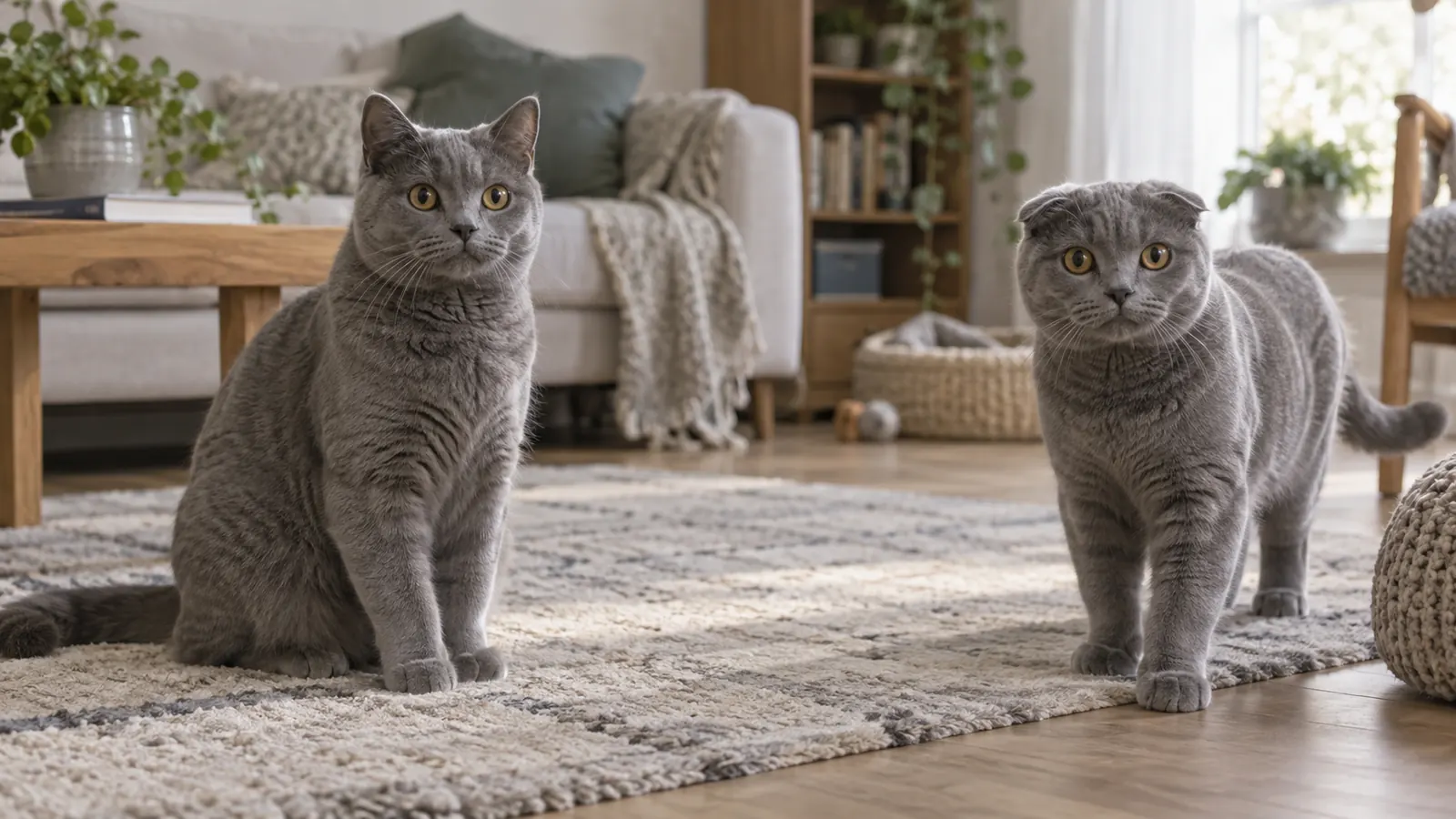
The Foldex is a Canadian-developed cross of Scottish Fold and Exotic lines, bred for a round face, plush coat and either folded or straight ears. A folded ear is caused by the same inherited cartilage pathway associated with Scottish Fold osteochondrodysplasia, so appearance cannot be separated from welfare: the safest recommendation is not to select a kitten for the fold and to prioritise normal movement, an open face and documented parentage.
- Origin
- Canada, developed by combining Scottish Fold and Exotic ancestry
- Coat
- Short plush or medium-to-long, dense and standing away from the body; many colours and patterns are accepted
- Size
- Medium, compact, muscular and medium-to-heavy boned with a broad round head
- Typical weight
- No dependable Foldex population range was found in current primary registry sources
- Life expectancy
- Not established by Foldex-specific population evidence
- Activity level
- Individual and moderately playful, with movement quality more important than a breed activity label
- Grooming
- Moderate and coat-dependent, plus close observation of ears, eyes, facial folds, teeth, joints and tail flexibility
- Suits
- Homes prepared to put mobility, breathing and comfort ahead of the folded-ear look and to act promptly on pain signs
The Foldex combines two appearance traits that deserve more scrutiny than a teddy-bear description provides.
Scottish Fold ancestry supplies the forward ear fold, while Exotic Shorthair ancestry supplies a rounder head, short nose and dense coat.
Both can affect welfare when selected to extremes. A buyer therefore needs to evaluate cartilage, movement, breathing, eyes and teeth before considering colour or coat length.
What exactly is a Foldex cat?
The Canadian Cat Association describes the Foldex as a man-made breed established by mating Scottish Fold and Exotic cats.
Its standard accepts both longhair and shorthair forms and registers straight-eared kittens separately as Foldex Straights.
The intended outline is compact and moderate, with medium-to-heavy bone, a broad round head and large round eyes. The nose is short but should have open nostrils, and the tail must remain flexible.
- Foundation
- Scottish Fold and Exotic ancestry
- Body
- Medium, compact, muscular and relatively heavy-boned
- Head
- Broad and round with a short muzzle
- Ears
- Folded forward or straight, depending on inherited ear form
- Coat
- Short plush or medium-to-long and dense
- Tail
- Medium and flexible under the CCA standard
- Recognition
- Maintained by the Canadian Cat Association
The breed is not a miniature wild cat and should not have extreme dwarfing. A low body comes from compact proportions, not intentionally shortened limbs.
Recognition is not universal across cat registries, so the issuing organisation matters. A Foldex pedigree should name the kitten, both parents and the ear status used by that registry rather than relying on a generic designer-cross certificate.
There is also no dependable Foldex population weight range in the primary material reviewed here. Choose equipment from the adult cat's measured body and comfortable posture, especially when a compact outline makes the cat look smaller than its bone and chest require.
Why do some Foldex cats have straight ears?
Kittens inherit either the folded-ear variant or the straight form from their parents. CCA states that ears may fold temporarily at three to four weeks and later straighten, yet those kittens are still registered as Foldex Folds because they carry the fold variant.
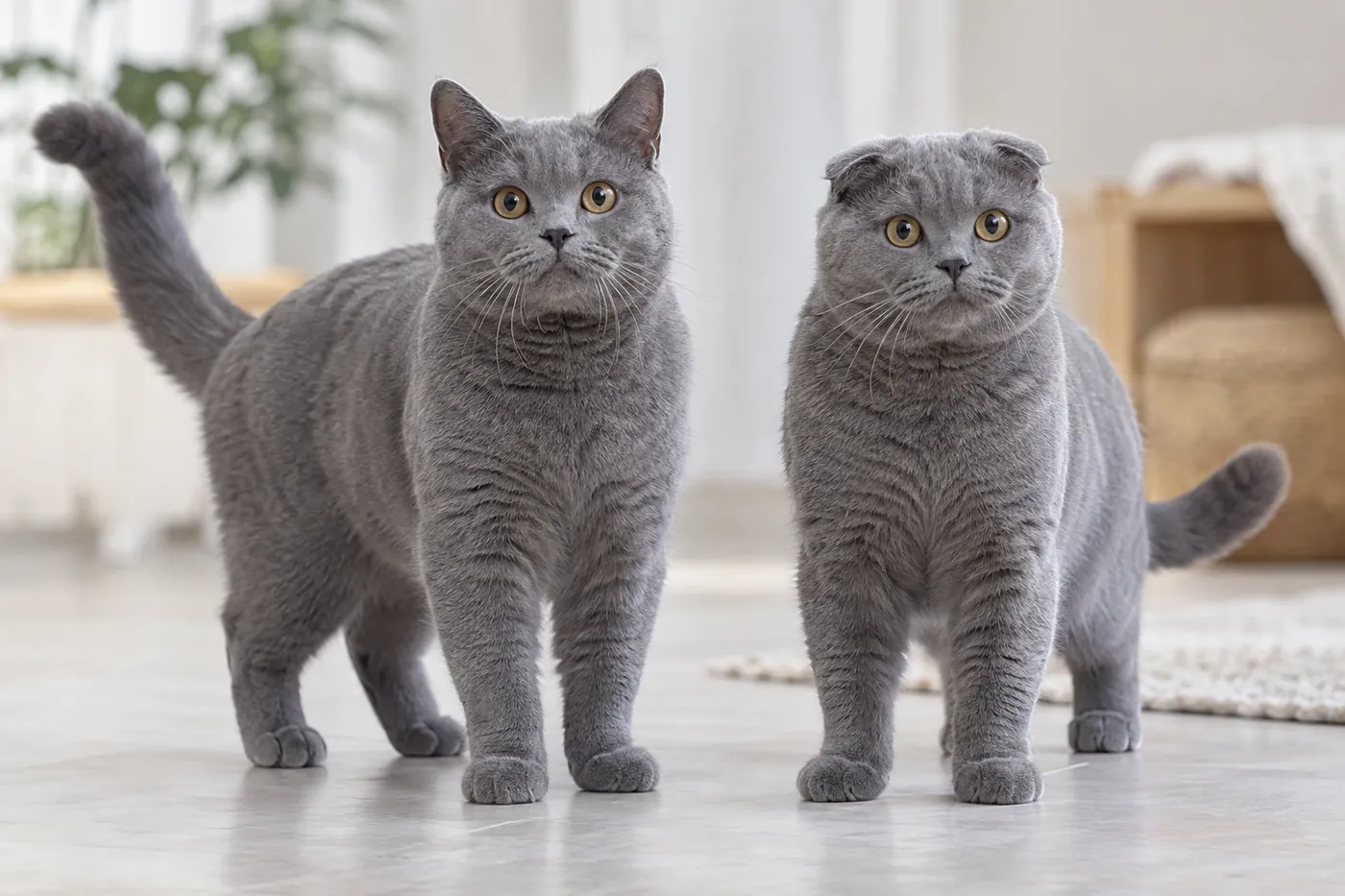
The visible ear therefore records more than a cosmetic bend.
The TRPV4 variant associated with the Scottish Fold phenotype affects cartilage and bone throughout the body, even though severity varies between cats.
| Ear record | Visible result | Genetic meaning | Practical consequence |
|---|---|---|---|
| Foldex Fold | Ear bends forward and down | Carries the fold-associated pathway | Requires lifelong attention to gait, joints and tail flexibility |
| Foldex Straight | Ear remains upright | Does not display the fold phenotype | Avoids selecting for the fold, but still needs ordinary health evidence |
| Temporary early fold | Ear folded in early kittenhood then straightened | CCA still records the kitten as a Fold | Adult ear position does not erase the inherited history |
| Unknown ancestry | Ear shape without reliable documents | Cannot establish breed or genotype | Do not accept appearance as health evidence |
A straight-eared kitten is not an inferior pet. When the household wants the general Foldex type, choosing a straight ear removes the demand to preserve the cartilage change that creates the signature fold.
An original DNA report can separate no copy, one copy and two copies of the known fold-associated variant. The cat's name or microchip number should connect that result to the individual, because a screenshot with no identity cannot establish which kitten was tested.
Ear appearance alone is weaker evidence, particularly during early development. A kitten can be sold before its final ear position is obvious, while a recorded early fold can remain relevant even if the adult ear later looks straighter.
Is the Foldex ear fold linked to painful joint disease?
Yes, the inherited fold is linked to osteochondrodysplasia in Scottish Fold cats, and Foldex descends directly from that population.
The same missense variant in TRPV4 is associated with the folded-ear phenotype and abnormal cartilage and bone development.
Two copies are associated with earlier and more severe disease, but one copy does not guarantee freedom from pain. Studies of heterozygous cats show wide variation, from no clinical signs during a limited follow-up to lameness, joint enlargement and progressive changes in other reports.
The best-practice recommendation is to choose a cat without the folded-ear trait. If you already care for a folded Foldex, focus on comfort and early recognition rather than blame.
Mating a folded cat to a straight cat reduces the risk of two-copy kittens, but it does not remove the variant from the folded offspring. Those kittens can still inherit one copy, which is why the phrase correctly bred should never be translated into no cartilage risk.
Severity cannot be predicted from how tightly one young kitten's ears fold. Age at onset and progression vary, and a normal walk during a sales visit is only evidence about function at that moment.
What movement changes should a Foldex owner watch for?
Cats often reduce painful movement before they cry or limp.
A Foldex may stop reaching a favourite perch, use smaller jumps, hesitate at stairs or spend longer resting in one position.
- Shorter stride or a stiff hind-limb gait
- Reluctance to jump up or down from familiar surfaces
- Thickened wrists, ankles, feet or tail
- Tail that becomes rigid or painful when gently handled
- Less grooming over the back or hindquarters
- Irritability when lifted or touched around joints
- Litter accidents after the tray becomes difficult to enter
- Reduced play that cannot be explained by a routine change
Record when the change began and take a short video of normal movement if the cat remains willing. A veterinarian may need an orthopaedic examination and imaging, because a buyer cannot diagnose cartilage disease by flexing the tail at home.
Do not force joints through their range or repeatedly test a painful tail. Add low, broad steps, non-slip surfaces and a low-entry litter tray while arranging assessment.
Create a baseline before a problem is obvious. A short monthly video of the cat walking, turning, rising and using one familiar step can make gradual change easier to describe, provided the cat performs those actions voluntarily.
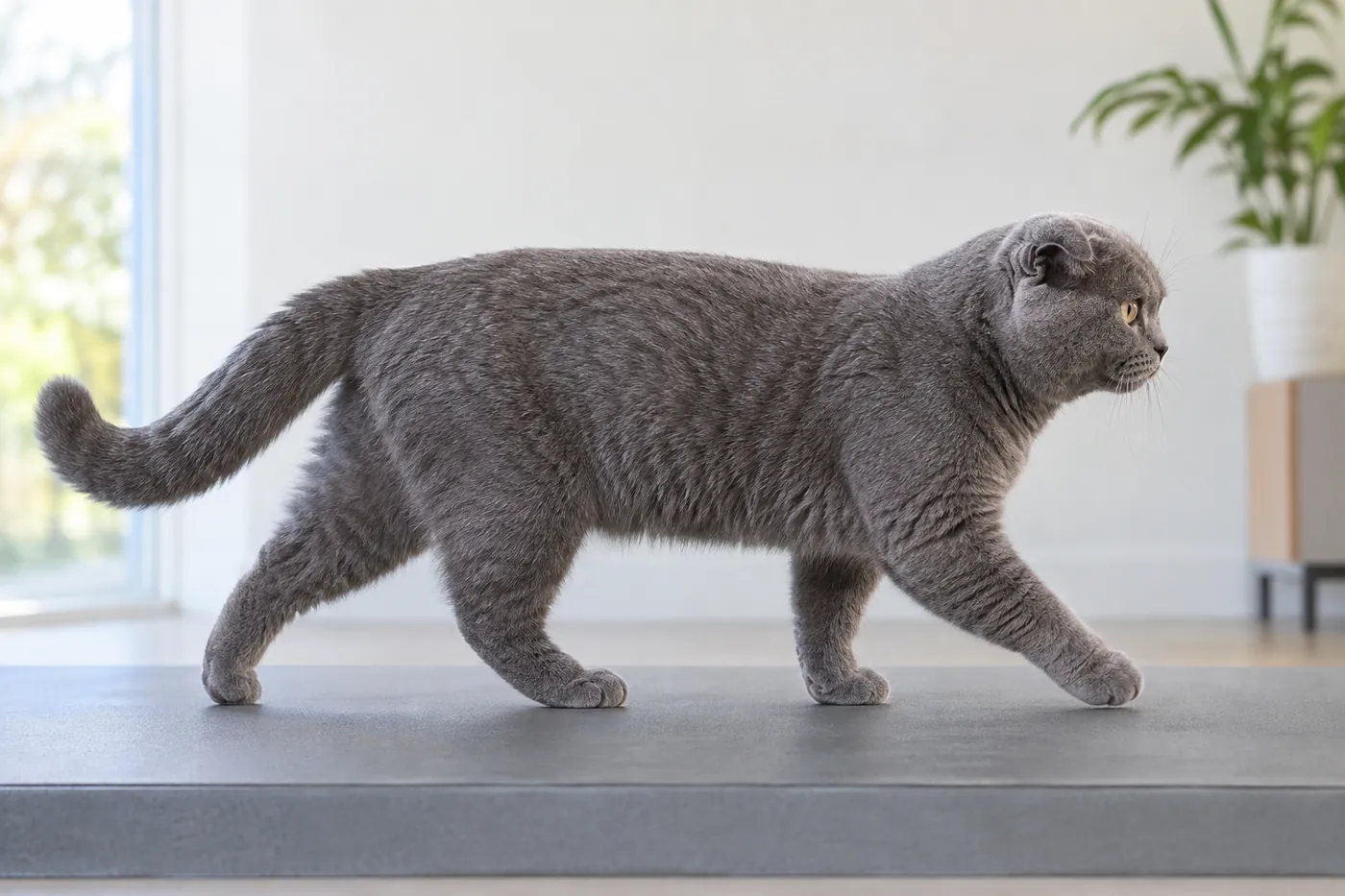
Pain may also appear as a behaviour change. Reduced grooming, hiding, irritability, sleeping in a new low location or avoiding the tray can matter even when the cat never produces a clear limp.
Keep food portions aligned with body condition because extra weight increases the load on uncomfortable joints. Weight management supports mobility, but it does not treat the inherited cartilage disorder or replace pain assessment.
Can the Foldex's short face affect breathing and teeth?
Exotic ancestry can bring brachycephaly, which means a shortened skull and face.
The CCA standard asks for a short broad nose with a definite break but penalises pinched nostrils and a break exceeding 90 degrees.
That moderation matters. Research in Persian and Exotic populations links greater brachycephaly with reduced airway space, eye exposure and dental malalignment, so a flatter face should never be treated as a better example of the breed.
| Feature to observe | Reassuring starting sign | Reason to seek veterinary advice |
|---|---|---|
| Nostrils | Open at rest with quiet nasal airflow | Pinching, persistent noise or effort |
| Exercise | Recovers promptly after ordinary play | Open-mouth breathing or prolonged distress |
| Eyes | Clear surface and complete comfortable blinking | Repeated discharge, squinting or exposed dry cornea |
| Facial folds | Dry, clean and comfortable | Redness, odour, moisture or sores |
| Mouth | Comfortable eating with no persistent drool | Dropping food, mouth pain or severe crowding |
Meet the cat after gentle play as well as at rest. Sleep noise, exercise intolerance and repeated eye staining are health information, not charming flat-face features.
Look from the front and side without pushing the nose or opening the mouth by force. Open nostrils, quiet breathing, a complete blink and comfortable chewing matter more than the shortest distance between nose and eyes.
Dental crowding may stay hidden until a veterinarian examines the mouth. A kitten that eats soft food enthusiastically can still have rotated teeth, retained baby teeth or a bite that deserves follow-up.
Persistent tear overflow also needs a cause, because wiping the stain removes moisture without correcting eyelid position, surface irritation or poor tear drainage. Repeated squinting or a cloudy eye should be assessed promptly.
What are Foldex cats like in daily life?
Secondary descriptions often call them affectionate and easygoing, but there is little independent population evidence defining a Foldex temperament.
Scottish Fold and Exotic ancestry also cannot guarantee one fixed blend.
Judge the individual cat's willingness to approach, play, be handled and settle independently. Gentle reward training can reveal whether the cat engages comfortably, while pain can suppress activity or increase irritability.
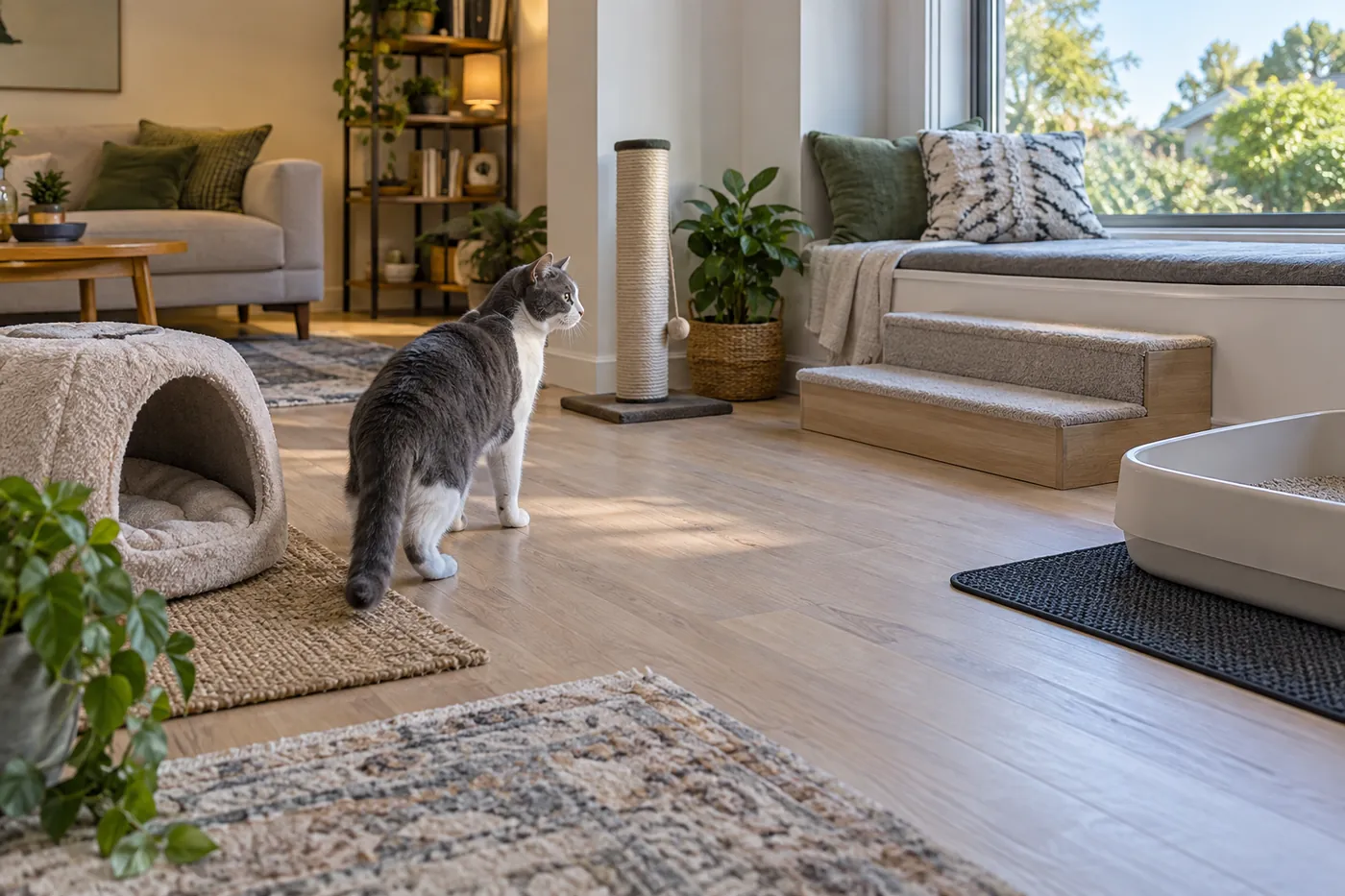
Children must let the cat keep four paws supported and leave a retreat without being followed. Another cat or dog may be compatible when introductions are gradual, litter resources are separate and play does not involve repeated body slams or pursuit.
Use play to observe comfort rather than prove athletic ability. A cat that chooses a floor-level chase, a food search and a low stable perch can remain engaged without being repeatedly lured into large jumps.
Reassess the routine when participation drops. A Foldex that stops chasing may be bored, frightened or painful, so increasing intensity before checking the context can turn a useful activity into pressure.
Temperament claims should be read beside the health evidence. A cat described as exceptionally quiet or easy to handle may simply be inhibited or reluctant to move, and that distinction cannot be settled by breed marketing.
How should you groom a Foldex coat, face and ears?
Shorthaired Foldex cats have a dense plush coat, while longhairs carry a fuller coat and plume.
Comb to the skin gently, increasing frequency where the individual forms tangles rather than using one schedule for both coat lengths.
Folded ears can make the opening harder to see, but cleaning too deeply causes injury. Inspect only the visible outer ear, use a veterinarian-approved product when needed and add claw care without turning one session into forced restraint.
- Let the cat settle on a stable non-slip surface
- Check breathing eyes facial folds and visible ears before grooming
- Comb a small section in the direction the coat lies
- Separate any fold gently without stretching skin or cartilage
- Check claws teeth and tail comfort only within the cat's willing range
- Stop when the cat stiffens turns away or shows pain
- Record persistent discharge odour soreness or movement change for veterinary care
Daily facial-fold cleaning is not automatically necessary. The goal is clean, dry and comfortable skin, and the routine should respond to the cat rather than making repeated rubbing part of the breed costume.
Never insert cotton swabs into the ear canal or unfold the ear against resistance. Dark debris, strong odour, redness, head shaking or pain needs examination because mites, infection and inflammation require different treatment.
For a longhaired Foldex, check the armpits, belly, trousers and area beneath the tail where friction and moisture tighten tangles. A shorthaired cat may need less combing but still benefits from the same skin, joint and body-condition check.
What evidence should a Foldex breeder show you?
The first question is the ear status of both parents.
Fold-to-fold mating creates a risk of kittens inheriting two copies of the fold-associated variant and should be rejected.
The second question is whether the face and body remain functional. Original veterinary records, clear breathing after play, flexible movement and open nostrils provide more value than show awards or a rounder head.
| Evidence | Ask to see | What it establishes | Limit |
|---|---|---|---|
| Pedigree | Original CCA records for kitten and parents | Recorded Foldex ancestry and ear status | Current comfort or future disease |
| Parent pairing | One straight-eared parent and the ear record of the other | Avoidance of a fold-to-fold pairing | Does not make one-copy fold harmless |
| Movement | Parents walking, jumping and turning freely | Observable function at that time | Cannot rule out later osteochondrodysplasia |
| Veterinary records | Dated joint, airway, eye and dental findings | What was examined in each named cat | No lifetime guarantee |
| DNA results | Exact genes, variants and status | Only the variants listed | A generic clear panel does not erase conformation risk |
| Family follow-up | Ages, mobility, diagnoses and causes of death | Whether the breeder tracks outcomes | Depends on complete records |
Walk away from a seller who celebrates the tightest fold, deepest nose break or shortest face. Those promises move the selection pressure in the opposite direction from normal cartilage, breathing and eye protection.
Ask what happened to kittens and adults from previous litters, including those sold only as pets. Follow-up records about movement, breathing, dental work and age at diagnosis are more informative than presenting one healthy parent on the day of your visit.
Confirm that the breeder will take the cat back if the placement fails and that the contract does not silence discussion of inherited disease. A return policy protects the cat, while transparent health reporting improves the evidence available to future families.
Some jurisdictions and welfare bodies oppose breeding cats for the folded-ear phenotype. Check local law and current welfare guidance before paying a deposit, because registry acceptance does not settle the ethical or legal question in every location.
Should you choose a Foldex cat?
The safest recommendation is to choose a straight-eared, open-faced cat with free movement, or adopt a cat whose comfort and needs are already known.
Selecting specifically for folded ears asks the next generation to carry the same cartilage change that creates the welfare concern.
- Put normal movement and breathing ahead of ear or face shape
- Reject fold-to-fold parentage
- Prefer open nostrils a moderate muzzle and comfortable eyes
- Observe walking jumping grooming and litter access
- Read original pedigree and veterinary records
- Prepare non-slip routes broad steps and low-entry litter options
- Budget for assessment if stiffness or pain develops
- Choose the individual whose social style fits the household
If a folded Foldex already lives with you, the practical job is supportive ownership. Maintain healthy body condition, provide age-appropriate easy routes, notice small changes and seek veterinary care before reduced activity becomes severe disability.
Do not start pain medicine or joint supplements from online anecdotes. Cats can be harmed by human painkillers, and a veterinarian needs to distinguish joint pain from spinal, neurological or other causes before building a treatment plan.
Adoption avoids creating new demand for the fold and can provide real information about an adult cat's comfort and routine. Ask for the same movement, airway, eye and dental history you would request from a breeder, then plan care around the individual rather than the label.
An ethical decision is not measured by whether a cat looks unusual. It is measured by whether the cat can move, breathe, see, eat and rest comfortably throughout life.
Common Questions
Is a Foldex the same as a Scottish Fold?
No. The Foldex is a separate Canadian-developed population created from Scottish Fold and Exotic ancestry, but folded Foldex cats inherit the same type of forward ear fold associated with Scottish Fold cartilage disease.
Can a Foldex have straight ears?
Yes. CCA registers straight-eared kittens as Foldex Straights. A kitten whose ears folded early and later straightened is still recorded as a Fold because it carries the fold history.
Are folded-ear Foldex cats healthy?
Some may show no clinical signs for a period, but the fold-associated TRPV4 pathway affects cartilage and bone, and severity varies. One copy does not guarantee freedom from pain or later disease.
What is the safest Foldex choice?
Choose a straight-eared, open-faced cat with free movement and documented parentage. Avoid fold-to-fold breeding and any seller selecting for tighter folds or a flatter face.
Checked Against
- Canadian Cat Association: Foldex standard cca-afc.com
- Canadian Cat Association: Foldex breed description cca-afc.com
- OMIA: Scottish Fold osteochondrodysplasia omia.org
- TRPV4 genetic and radiographic evaluation in Scottish Fold cats pmc.ncbi.nlm.nih.gov
- Osteochondrodysplasia in Scottish Fold cross-breed cats pmc.ncbi.nlm.nih.gov
- Brachycephaly and airway, eye and dental changes in Persian cats pubmed.ncbi.nlm.nih.gov
- Animal Welfare Committee: feline breeding practices gov.wales
Published 13 September 2026. Last updated .