
What Is a European Shorthair Cat and Who Suits It?
A European Shorthair is a pedigreed breed developed to preserve the balanced, unexaggerated type of Europe's ordinary domestic cat. It can be an adaptable companion, but a tabby coat and a European address do not establish breed identity, and the standard deliberately allows enough natural variation that the individual matters more than a narrow personality promise.
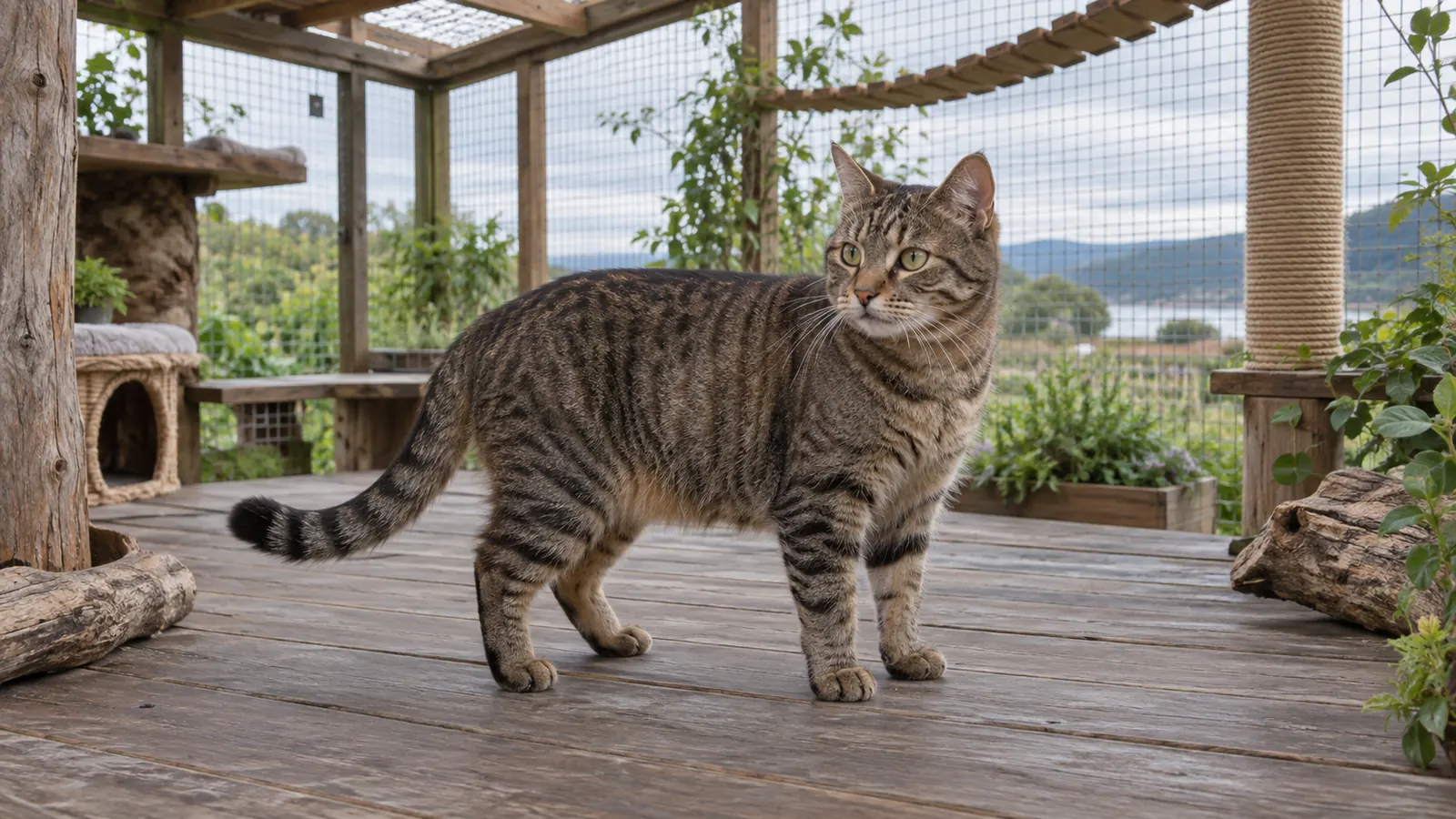
- Origin
- Continental Europe, developed from ordinary domestic cats without deliberate crossing to other recognised breeds
- Coat
- Short, dense, springy and glossy, accepted in many natural colours and patterns under the FIFe standard
- Size
- Medium to large, robust and muscular without becoming cobby or elongated
- Typical weight
- No dependable breed-population range was found in current primary registry sources
- Life expectancy
- Not established by European Shorthair-specific population evidence
- Activity level
- Variable but commonly moderate and capable. Hunting play, climbing and daily movement remain useful
- Grooming
- Low. Weekly combing is usually sufficient, with more loose-hair removal during seasonal coat change
- Suits
- Homes wanting a balanced, adaptable cat and willing to select by the individual's observed temperament rather than a breed stereotype
The name creates more confusion than the cat.
In parts of Europe, veterinary records and shelters use European Shorthair loosely for an ordinary short-haired cat, while FIFe uses European as the name of a pedigreed breed with the code EUR. That distinction changes what you can infer. A documented European may have generations selected to a standard, but an unregistered brown tabby does not become one because its appearance is familiar.
Is a European Shorthair a breed or a domestic shorthair?
It is a recognised breed when the cat has pedigree records from a registry that recognises the European. FIFe describes it as developed from the naturally occurring domestic cat population of Europe without crossing to other breeds.
Domestic shorthair is a coat-length description for cats without a verified breed pedigree. Those cats may look very similar because the European standard intentionally preserves an ordinary, balanced anatomy rather than an exaggerated feature.
| Question | Pedigree European Shorthair | Domestic shorthair |
|---|---|---|
| Identity | Recorded ancestry under a European breed standard | Mixed or unknown ancestry with short hair |
| Appearance | Balanced type defined by the registry | Broad natural variation with no single breed standard |
| Colour | Many accepted natural colours and patterns | Any naturally occurring colour or pattern |
| Temperament | Some population tendencies, with wide individual variation | Must be judged from the individual and history |
| Proof | Original pedigree and matching identity records | Appearance cannot establish a hidden pedigree |
A pedigree does not make one cat healthier, kinder or more valuable as a companion by itself. It tells you which breeding record and standard should support the claims being made.
The original document is the thing to see, rather than a cropped screenshot. The registered names, sex, colour, date of birth and breeder details should agree with the cat and with any transfer or microchip paperwork supplied at handover. A consumer ancestry panel cannot replace that chain of records. DNA tools may report genetic similarity or individual variants, but a breed identity also depends on documented descent under the registry's rules.
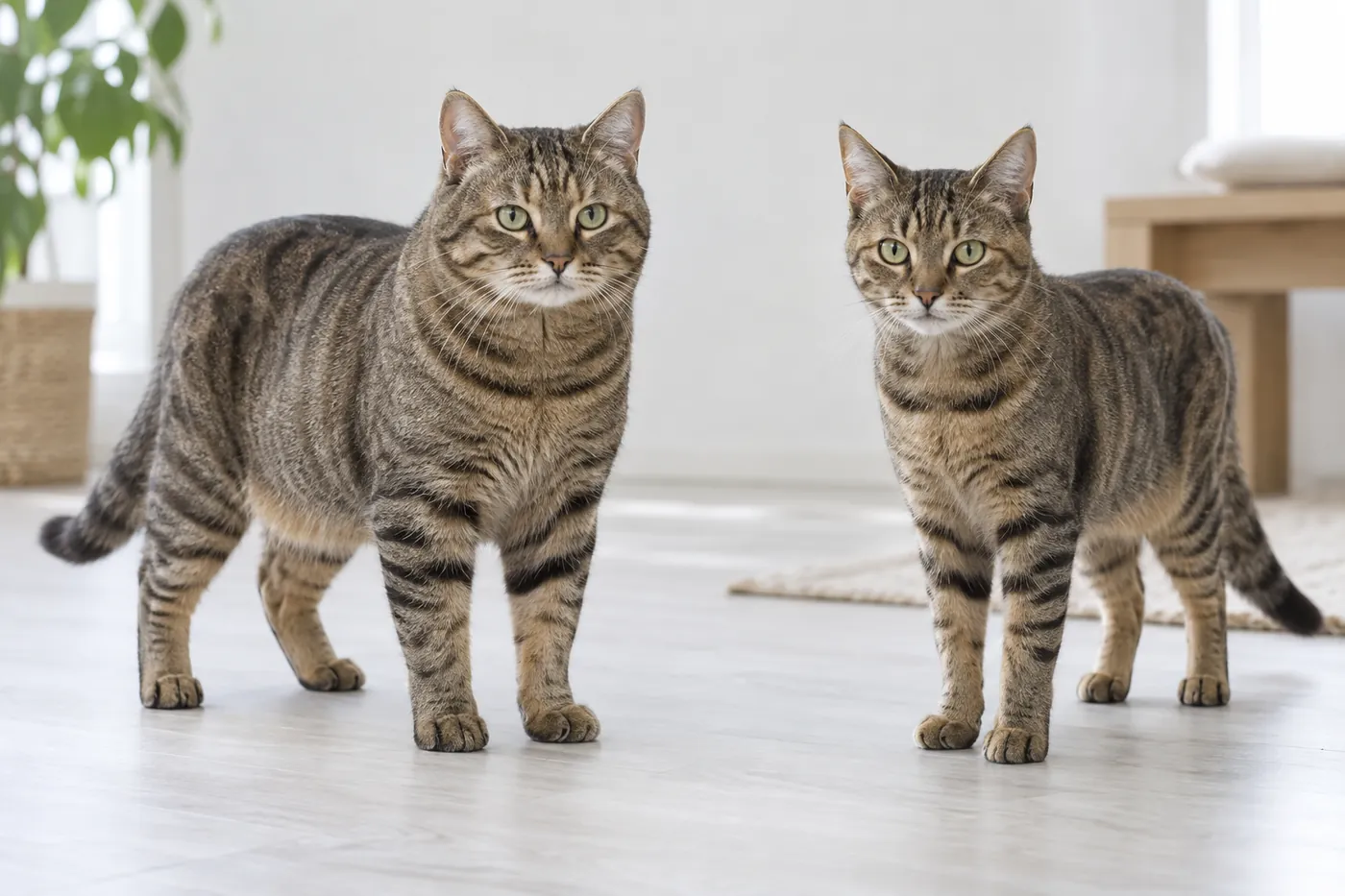
How can you tell a European Shorthair from British and American Shorthairs?
The European should look robust and muscular, but FIFe explicitly avoids both a cobby body and an elongated one. The head is rounded yet longer than it is wide, with a forehead and skull that remain slightly rounded rather than extremely full.
A British Shorthair is broader and more compact, with a denser plush coat and a more powerfully rounded head. An American Shorthair is also substantial, but its own standard reflects a working-cat line developed in North America rather than the continental European population.
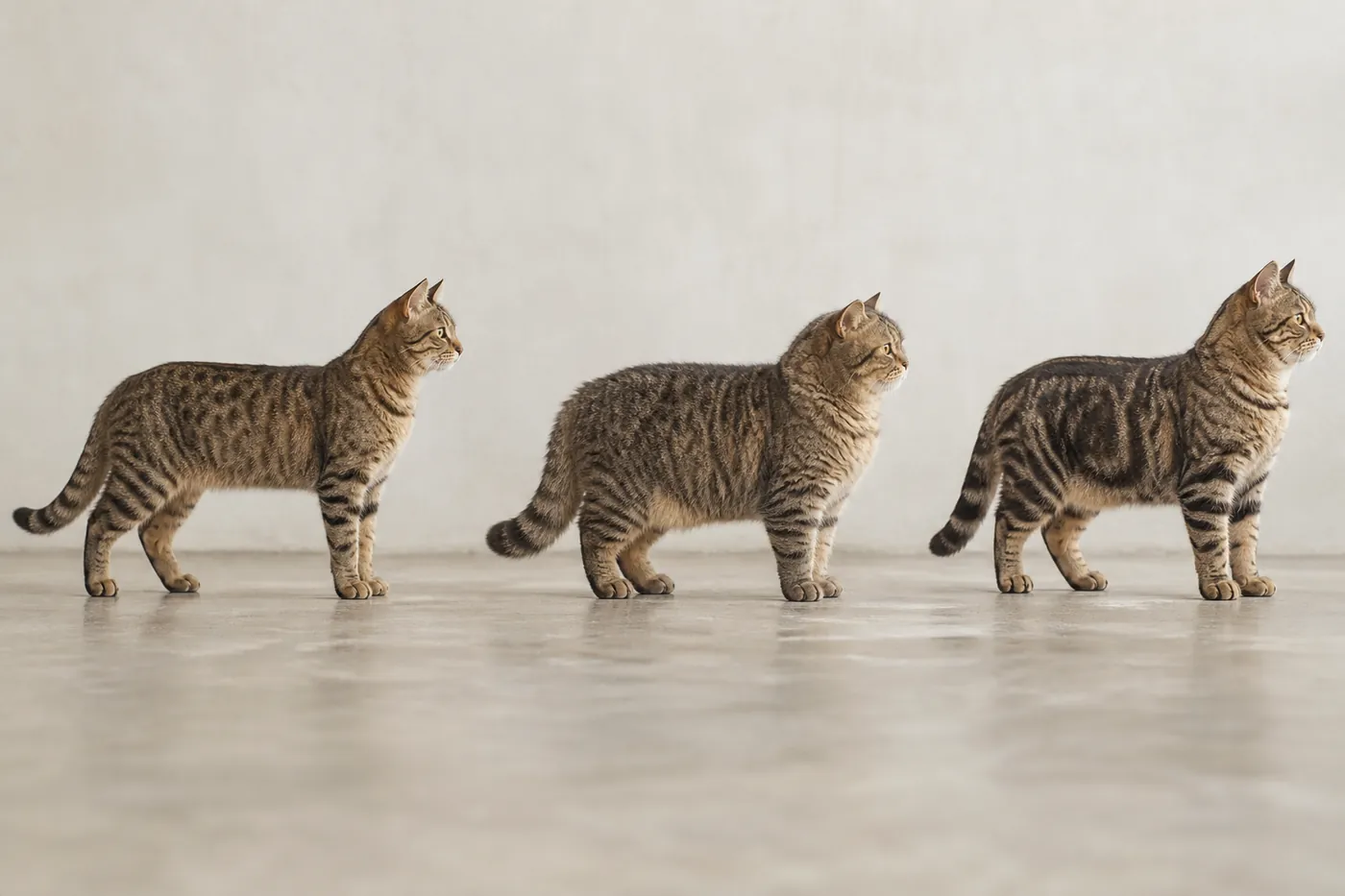
- Body
- Medium to large, robust and muscular without cobby proportions
- Head
- Rounded with slightly more length than width
- Ears
- Medium, set well apart and gently rounded at the tips
- Eyes
- Rounded and open, with colour corresponding to the coat
- Coat
- Short, dense, springy and glossy
- Tail
- Medium length, broad at the base and rounded at the tip
Photographs compress body depth and can make a heavy domestic tabby look British or a lean European look American. A verified pedigree and the whole standing cat say more than face shape alone.
The distinction becomes clearer in an adult viewed while standing and moving. The useful view is the relationship between chest, leg length, back and head, rather than one round cheek or one dense patch of coat treated as a breed marker. Age and body condition can obscure those proportions. A growing adolescent may look narrow, while excess weight can make any shorthair appear more cobby than its skeleton actually is.
What colours and patterns can a European Shorthair have?
FIFe accepts a broad range of traditional colours and patterns, including solids, tortoiseshells, tabbies, silvers, smokes and combinations with white. The variety is part of the breed's ordinary domestic-cat character.
Some colours that indicate recent ancestry from another breed are not accepted. The registry standard, rather than a seller's colour label, decides whether a particular combination belongs in the recognised population.
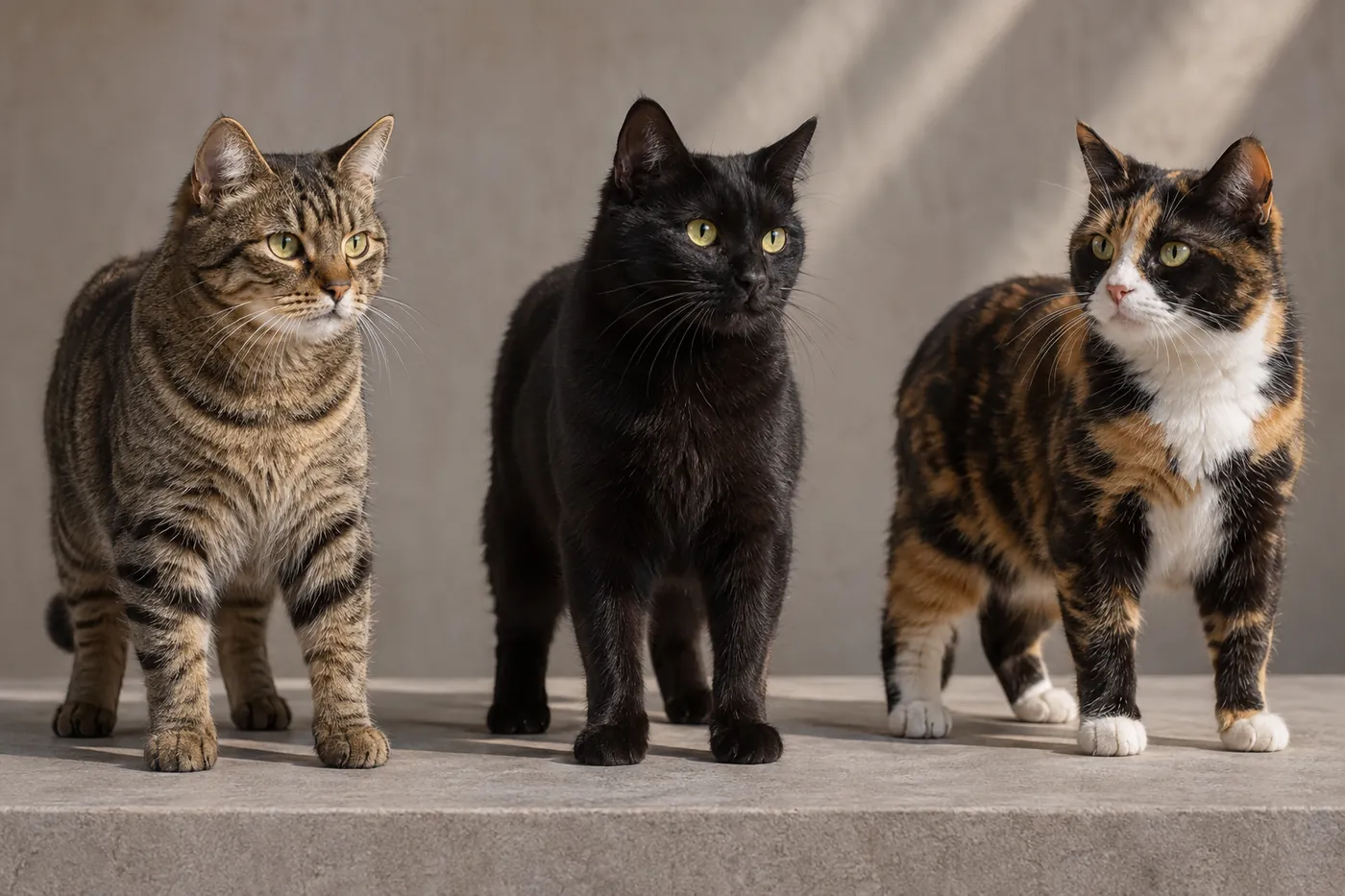
Colour also says little about temperament. A red tabby is not reliably friendlier and a black cat is not more independent because of the coat. The same caution applies to rarity claims. An unusual-looking silver, smoke or tortoiseshell pattern may be striking, but the colour does not supply missing ancestry or justify a different standard of health evidence.
When colour matters to registration, the code written on the pedigree, checked against the issuing registry's current standard, is more reliable than interpreting a kitten photo whose lighting can shift warm browns, cool greys and eye colour.
What is a European Shorthair temperament like?
The breed is often described as adaptable, intelligent and capable, with the alertness expected from cats descended from working household populations.
That broad history also means variation is a defining feature rather than a defect. One cat may seek laps and visitors, while another prefers predictable contact with familiar people. Socialisation, learning, health and previous experience all influence that outcome alongside inherited tendencies.
The useful question is how the cat behaves when nobody is trying to impress a visitor. Settling after play, eating normally around routine noise and choosing contact without being cornered are more useful signs than a single bold entrance, and so is how the cat responds when contact ends. An adaptable individual can be interested in people and still return to resting, grooming or independent exploration without repeatedly demanding a new interaction.
Hunting interest can vary sharply even within the breed. For a home with birds, rodents or an outdoor wildlife concern, observed stalking and persistence matter more than a general description such as calm or easy-going.
How much exercise does a European Shorthair need indoors?
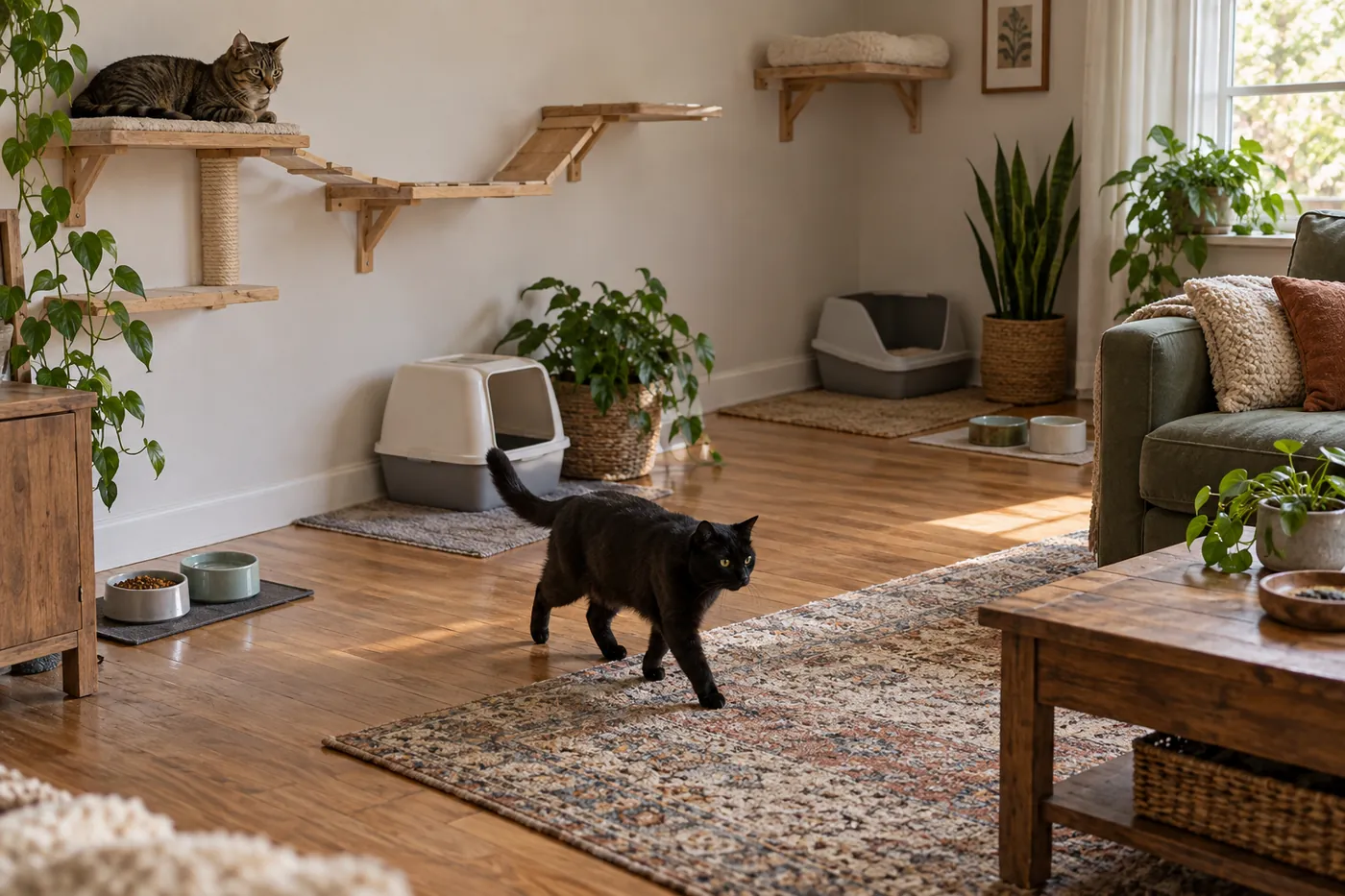
The balanced body is built for ordinary feline movement: stalking, short acceleration, climbing, balancing and jumping. Indoor life can meet those needs when the home offers legal routes rather than one inactive scratching post. A stable vertical route, a secure window position, several scratching orientations and short hunting games that end in capture cover them, and food used in puzzles belongs inside the daily ration so enrichment does not quietly increase calorie intake.
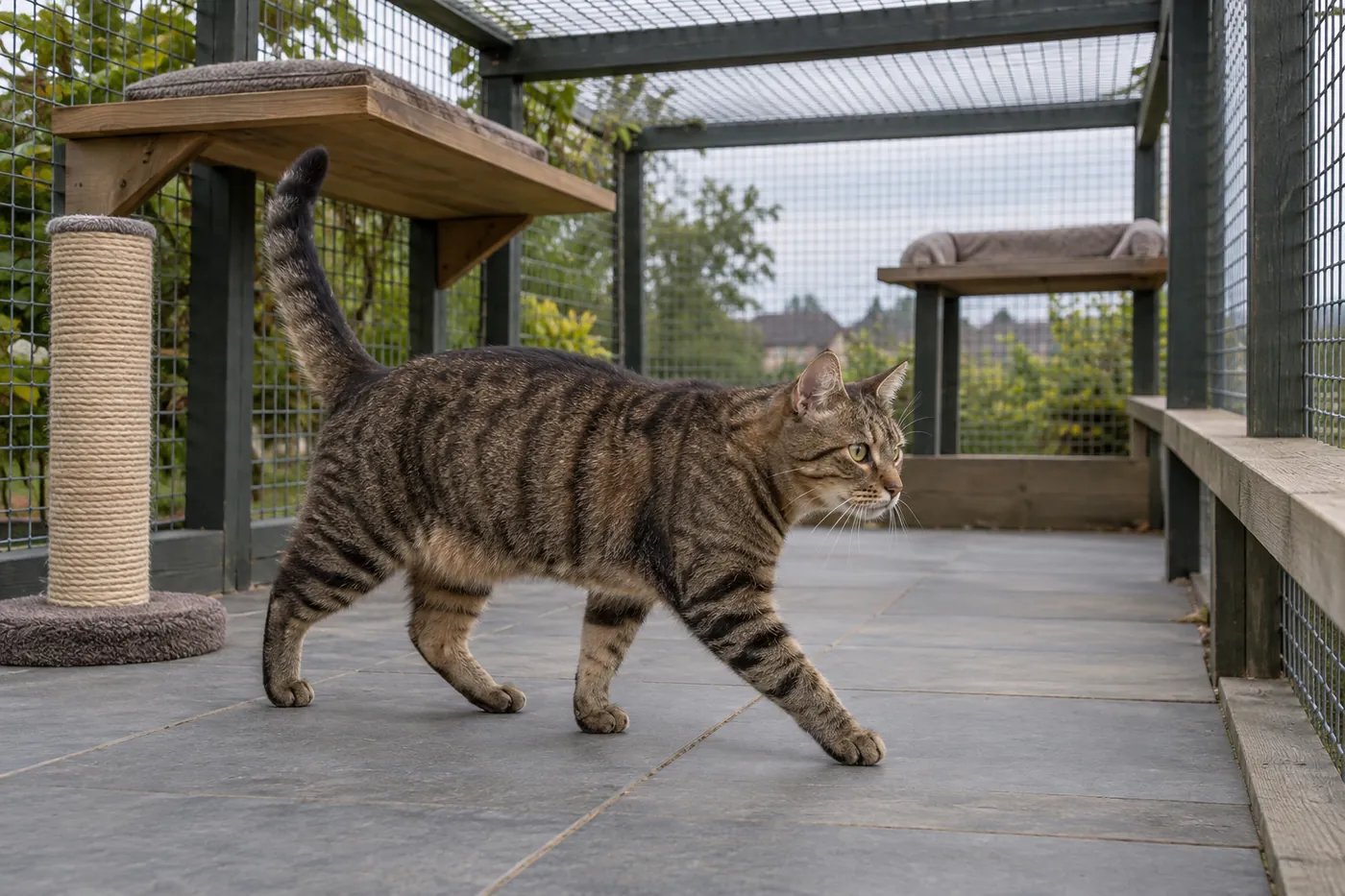
Outdoor access is not required for breed identity. A secure catio or enclosed garden can add scent and weather safely, while unsupervised roaming adds traffic, disease, conflict and wildlife risks that a hunting heritage does not cancel.
Indoor exercise works best as a sequence rather than a pile of equipment. Somewhere to watch, a route to descend, a surface to scratch and a short game that ends with a catch or food let each behaviour reach a natural stopping point. Difficulty needs lowering when the cat repeatedly misses, becomes frantic or abandons the activity, because a European Shorthair gains from regular chances to use strength, balance and attention without being pushed past recovery, and exhausting it adds nothing.
Can a European Shorthair live with children or other pets?
Many individuals can when their observed play intensity and recovery fit the household, but the breed's natural variation makes direct observation essential. A registry label cannot create tolerance the individual cat has not already shown.
| Household | What to observe | Setup that protects the match |
|---|---|---|
| Young children | Ability to walk away without freezing or striking | Adult supervision and a child-free retreat |
| Older children | Reciprocal toy play and acceptance of pauses | Toys instead of hands and no carrying by default |
| Another cat | Similar play speed and willingness to disengage | Separate food, water, litter and high resting places |
| Cat-safe dog | Curiosity without fixed staring or flight panic | Barrier introduction and a dog-free high route |
| Small pets | Predatory interest remains possible | Secure physical separation |
An adult from a foster home may provide stronger household evidence than a kitten selected only by colour. Established behaviour is still capable of changing after a move, but gradual introductions give that evidence a fair chance to carry into a multi-cat home.
With children, the thing to observe is whether the cat can leave a game without being followed and whether the child can notice that choice. A household match fails when the adults expect the cat to absorb handling that the child has not yet learned to stop.
With another animal, friendliness and compatible speed are separate questions. A bold young cat may enjoy chase play that a quiet senior experiences as pressure, even when neither animal shows immediate aggression.
How much grooming and feeding work is involved?
The dense short coat usually needs a light weekly comb, with extra loose-hair removal during seasonal shedding. It should feel springy and glossy rather than woolly, greasy or matted.
Grooming is also a body check. Feel the ribs, inspect the skin, look at the claws and visible ear, and notice whether touching one area suddenly causes withdrawal.
- Comb gently in the direction the coat lies
- Increase loose-hair removal when seasonal shedding becomes visible
- Trim claws according to growth and scratching wear
- Brush teeth with a cat-safe product and build handling gradually
- Measure complete food to the cat's current body condition
- Record persistent dandruff, bald areas, odour or touch sensitivity
There is no special European Shorthair diet: a complete and balanced food for the life stage does the job, with weight and waist monitored and the measured portion adjusted when activity or body condition changes. The springy coat can hide early weight gain when you rely only on photographs, and a monthly hands-on rib and waist check, recorded, catches the change long before a yearly number at the clinic.
Bathing is usually unnecessary unless the coat is contaminated or a veterinarian recommends it. Persistent grease, flakes, bald areas or overgrooming needs a cause investigated rather than repeated shampooing.
What health evidence exists for European Shorthairs?
Current registry material does not establish a signature inherited disorder or a breed-specific lifespan range. That gap calls for careful record-reading, and it gives no grounds for calling the breed naturally immune to disease.
A retrospective study of 680 tumours diagnosed in cats labelled European Shorthair described the distribution of cancers in that clinical sample. It cannot estimate lifetime cancer risk for every pedigree European because the study included submitted tumour cases rather than a healthy population denominator.
The label itself creates another limitation in population research. When a veterinary database uses European Shorthair for ordinary short-haired cats, its results may describe a broad local cat population rather than the pedigreed EUR breed alone. That is why a precise sample definition matters before a percentage becomes breed advice: how the cats were identified, which country supplied the records and whether the study included a comparison population all change what the figure means.
| Evidence | Useful question | Important limit |
|---|---|---|
| Pedigree | Are both parents and the kitten recorded under the EUR standard? | Records ancestry, not health |
| Parent examinations | What did the veterinarian assess and on what date? | A dated finding is not a lifetime guarantee |
| Family history | What were the ages and causes of death in close relatives? | Depends on complete and honest follow-up |
| DNA panel | Which exact genes and variants appear on the report? | A broad panel does not create a breed clearance |
| Population paper | Does the sampled group match this pedigree population? | A case series does not predict one kitten |
Routine feline risks still apply, including dental disease, obesity, kidney disease and heart disease. Screening should follow the cat's age, examination and family information rather than a marketing claim about a hardy natural breed.
The breeder's account of which conditions have actually occurred in close relatives, and how long those relatives were followed, is the useful evidence. A transparent answer may contain ordinary age-related disease; a claim that no cat in the family has ever been ill is less useful than dated records and known causes of death.
A large DNA panel is not automatically better evidence. Each result covers a named variant, while physical examination, cardiac assessment or laboratory work may be more relevant when the family history points elsewhere.
Book veterinary care for persistent appetite change, weight loss, breathing difficulty, repeated vomiting, increased thirst or new pain. A capable hunting-cat image should never be used to minimise a new symptom.
Is a European Shorthair right for you?
Choose a pedigree European when you value the documented breeding population and like a balanced cat without an extreme coat or body feature. The individual cat still matters more than any stereotype about an easy all-purpose pet.
- Verify identity through the original pedigree rather than a tabby photograph
- Observe play, rest, handling and recovery in the individual cat
- Provide daily hunting play, scratching and secure vertical territory
- Plan separate resources and retreat space for children or animals
- Expect seasonal shedding despite the short coat
- Read dated veterinary and family records
- Reject universal temperament and lifespan promises
- Consider an observed adult when household fit matters more than kitten appearance
This breed is a poor purchase when the main attraction is proving that a familiar-looking cat is rare. A domestic shorthair may offer the same companionship without pedigree, while a well-documented European offers a specific ancestry and standard. If you mainly want a balanced short-haired companion, an observed adult domestic shorthair may provide more direct evidence about temperament and household fit.
Do not pay a pedigree premium for a cat whose seller cannot produce the pedigree. Familiar appearance is expected in this breed, so identity claims need stronger documents than they would for a breed with a distinctive look.
The strongest choice is whichever individual fits the home and comes with honest records, and the breed name adds information only when those records back it.
Common Questions
Is every European domestic shorthair a European Shorthair?
No. European Shorthair is commonly used as a descriptive label, but a pedigree European is a registry-recognised breed with documented ancestry. Appearance alone cannot establish that identity.
Is a European Shorthair the same as a British Shorthair?
No. The European is robust but not cobby, while the British Shorthair has a broader, more compact body, a more rounded head and a denser plush coat.
Are European Shorthairs always tabby?
No. FIFe accepts many traditional solids, tortoiseshells, tabbies, silvers, smokes and combinations with white. Tabby is a pattern, not proof of breed.
Do European Shorthairs have a known lifespan?
No dependable breed-specific population estimate was found in current primary sources. Individual longevity depends on genetics, preventive care, environment, body condition and disease rather than a promised breed range.
Checked Against
- FIFe: European breed page fifeweb.org
- FIFe: recognised breed standards fifeweb.org
- Tumours in European Shorthair cats: retrospective study pubmed.ncbi.nlm.nih.gov
- Distribution of neoplasia in Danish cats pubmed.ncbi.nlm.nih.gov
- Bradshaw: Normal feline behaviour and why problem behaviours develop (Journal of Feline Medicine and Surgery, 2018) pmc.ncbi.nlm.nih.gov
- 2021 AAHA and AAFP feline life-stage guidelines pmc.ncbi.nlm.nih.gov
- FelineVMA: indoor and outdoor lifestyle catvets.com
Published 13 September 2026. Last updated .





