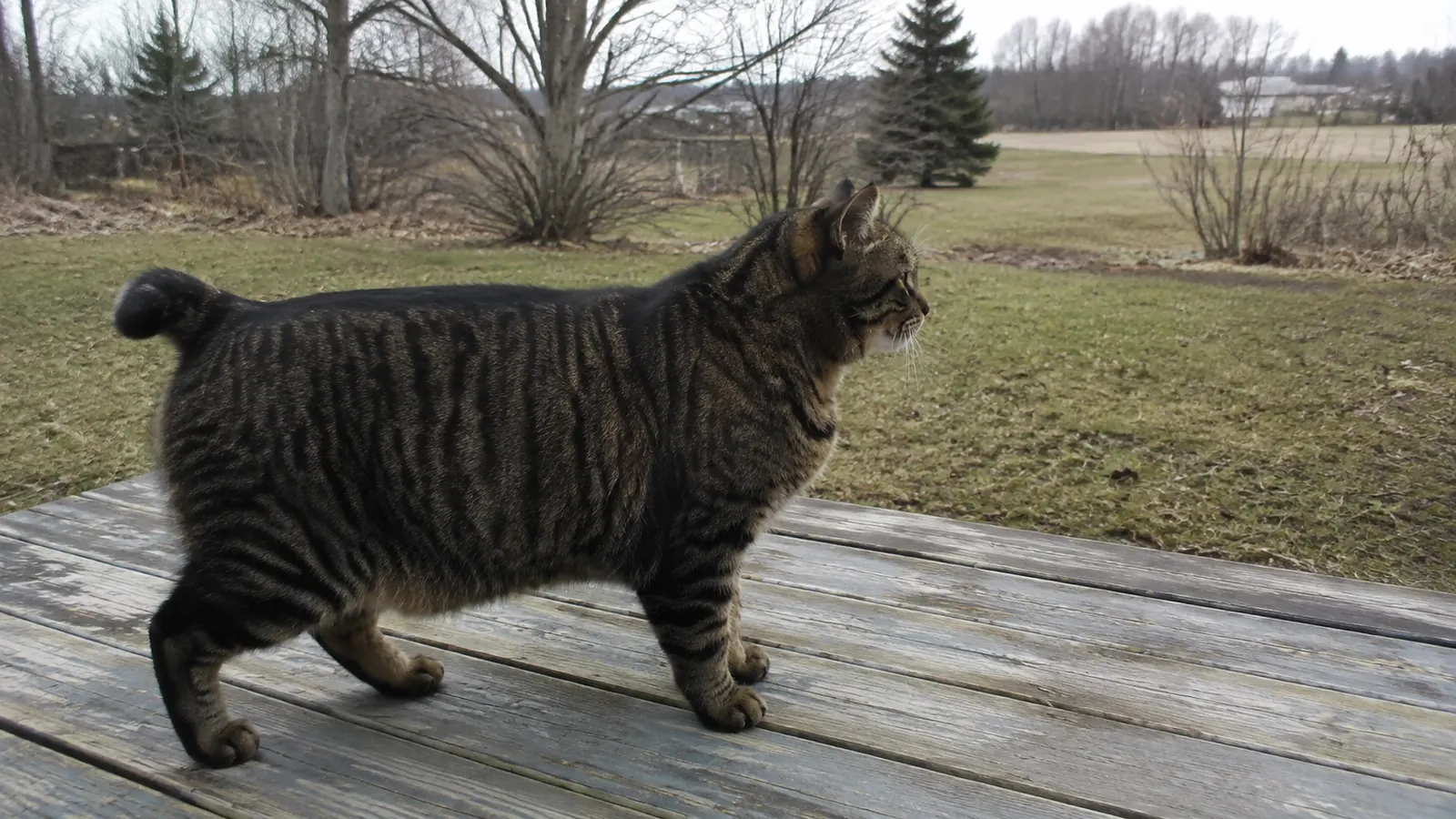
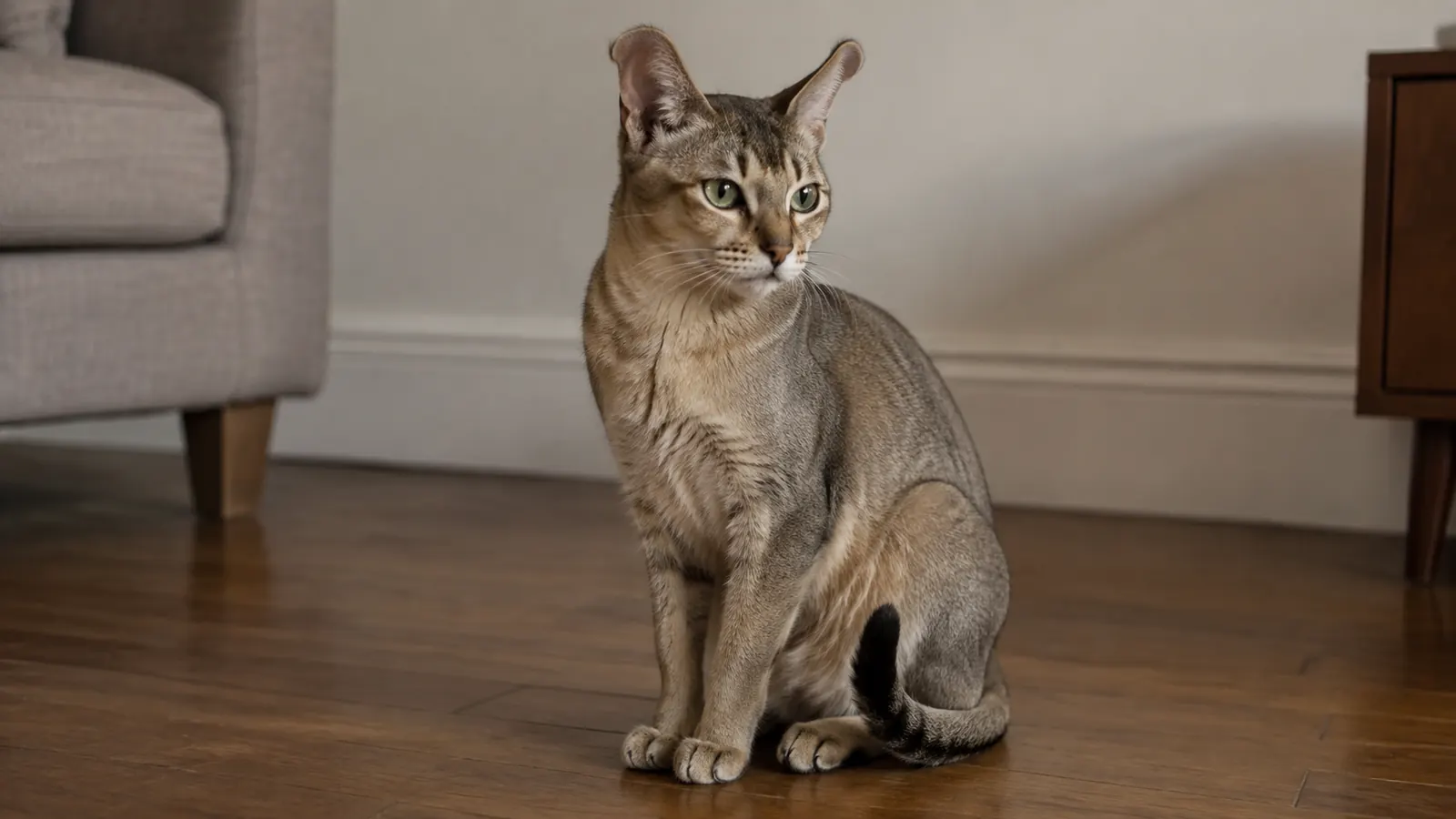
What Is a European Burmese Cat Like to Live With?
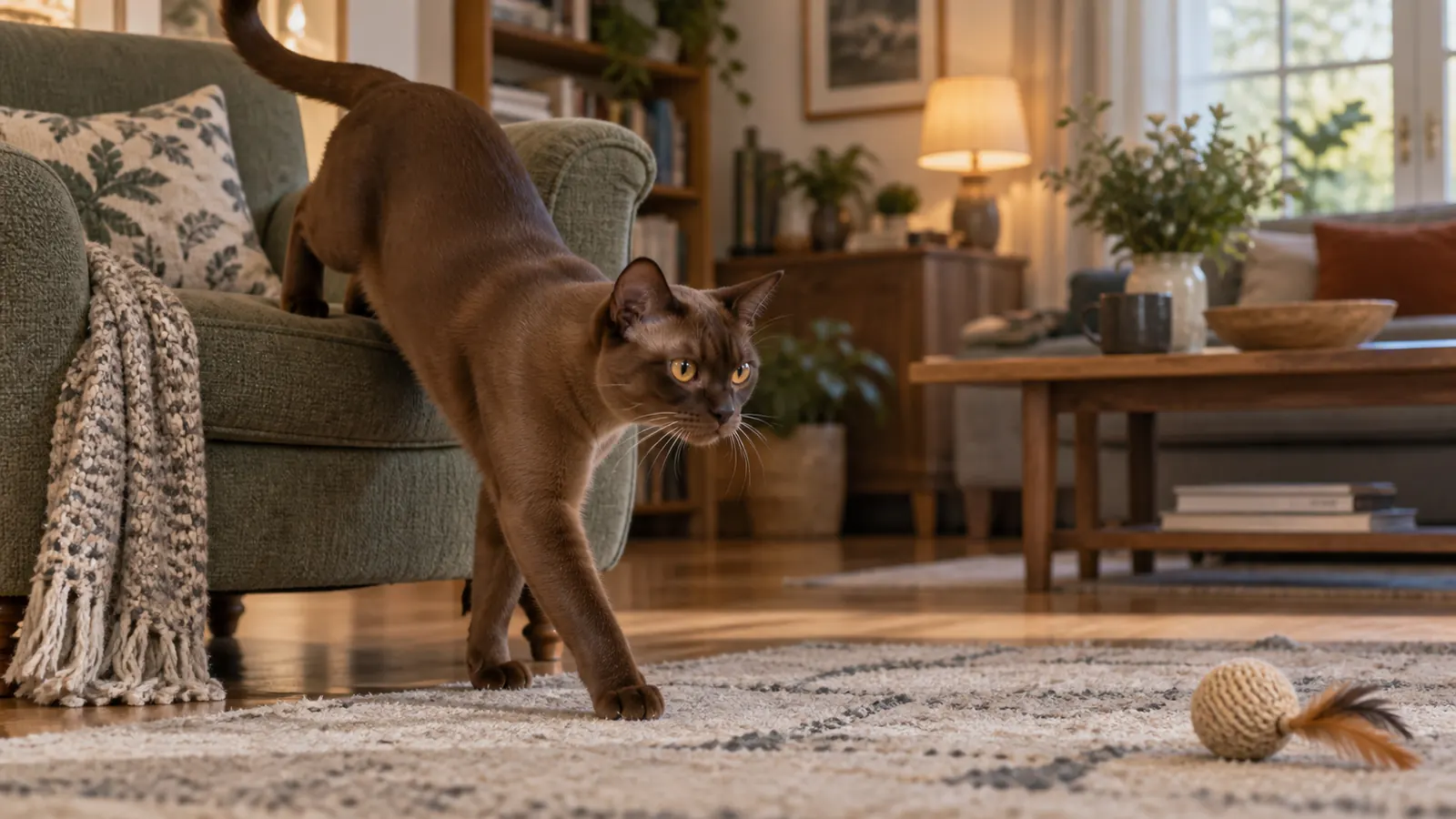
The European Burmese is a medium, muscular companion cat with a close satin coat, a more moderate outline than the American Burmese and a strong tendency to seek human company. It suits a home that wants an interactive cat and can provide daily play, predictable contact and health records that are specific about what was actually tested.
- Origin
- European lines developed from Burmese cats exported from the United States to Britain from 1949, then expanded through additional colours
- Coat
- Short, fine, close-lying and satin-like, almost without undercoat; CFA accepts ten colours
- Size
- Medium in length and size, firmly muscular and heavier than the outline first suggests
- Typical weight
- No dependable European Burmese population range was found in current primary registry sources
- Life expectancy
- Not established by a separate European Burmese population study
- Activity level
- Moderate to high. Intelligent, social and usually interested in interactive play and household activity
- Grooming
- Low coat workload, with weekly light grooming and routine nail, ear and dental care
- Suits
- Frequently occupied homes that want a social cat and can provide play, company and documented health screening
The European Burmese and the Burmese share an origin, but they are not two labels for an identical show cat.
CFA maintains separate standards because the European line developed a more moderate body, a different head and a wider colour range.
The practical question is whether you want the daily company that commonly comes with this breed. A short coat reduces grooming time, but it does not make the cat independent or hands-off.
What makes a European Burmese different from a Burmese?
Both lines trace back to Wong Mau, the cat brought to the United States in 1930. American-bred Burmese reached Britain from 1949, and British breeders later developed red, cream, chocolate and lilac alongside the original brown and blue colours.
CFA now accepts ten European Burmese colours, including four tortoiseshell combinations. Its American Burmese standard permits four colours and asks for a more compact, rounded body.
| Feature | European Burmese | Burmese in the CFA standard |
|---|---|---|
| Overall build | Medium and moderate with gently rounded contours | Compact, cobby and distinctly rounded |
| Head | Short blunt wedge with broad cheekbones | Rounded head with a full face |
| Eyes | Large, slightly slanted, yellow-gold to amber | Large, rounded and gold to yellow |
| Accepted colours | Ten solid and tortoiseshell colours | Sable, champagne, blue and platinum |
| Shared origin | Descends from the early Western Burmese population | Descends from the same foundation population |
The distinction is a registry and breeding-history question, not a way to rank one cat above the other.
Because one photograph cannot prove lineage, pedigree records identify the line more reliably than appearance alone.
Registry names also depend on the organisation recording the cat. A breeder should be able to show which registry issued the pedigree, how the parents are recorded and whether the kitten is entered specifically as European Burmese rather than asking you to infer the answer from colour.
This matters most when adverts shorten both populations to Burmese. The shared ancestry is real, but it does not make the two modern standards interchangeable or turn a pet without records into either pedigree breed.
What does a European Burmese look like at full size?
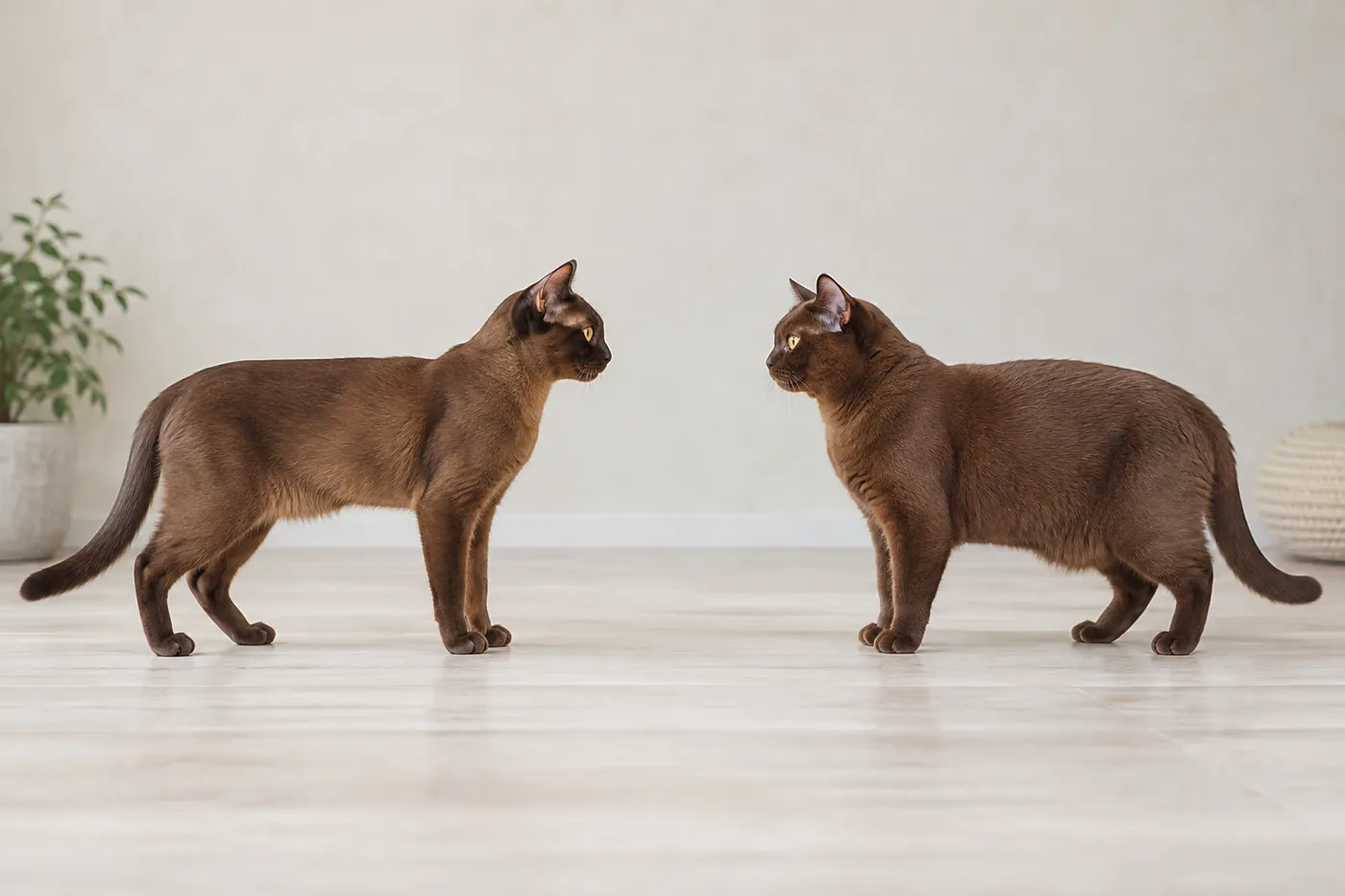
CFA describes a medium cat with a straight back, a strong rounded chest and firm muscle beneath a fine outline. The legs are relatively slender, the rear legs are slightly longer and the small oval feet keep the silhouette light.
The cat may therefore feel heavier than it looks when lifted.
Use the individual cat's standing height, body length and comfortable turning space when choosing a carrier instead of relying on an unsourced breed-average weight.
- Body
- Medium, muscular and moderate rather than long or cobby
- Head
- Broad cheekbones tapering to a short blunt wedge
- Eyes
- Large, bright and yellow-gold to amber
- Coat
- Very short, fine, glossy and almost without undercoat
- Tail
- Medium, gently tapering and finished with a rounded tip
- Colour range
- Brown, blue, chocolate, lilac, red, cream and four tortoiseshell combinations
Colour develops with age. CFA allows faint tabby markings and lighter colour in kittens and adolescents, so a young coat should not be judged as though it were already the finished adult colour.
The absence of a trustworthy weight range is useful information, not a blank to fill with a number copied from another Burmese population. Track the cat's own growth curve, muscle and body condition, then resize beds, shelves and carriers when the chest or shoulders begin to fit differently.
Viewed from above, a healthy waist should still be visible behind the ribs even on a solid adult. From the side, the abdomen should rise rather than hanging as a broad pad, although a normal primordial pouch can remain loose beneath it.
What is a European Burmese temperament really like?
CFA describes the breed as highly intelligent, affectionate and loyal. In an ordinary home, that often means a cat that notices where people are, joins changing activity and returns frequently for contact.
Those are population tendencies, not a contract for a lap cat.
Genetics, early handling, health, learning and the cat's previous home all affect whether an individual seeks touch, follows from room to room or prefers to settle nearby.
A cat that freezes through a visit may be frightened rather than calm, while a kitten that climbs over everybody may be overstimulated rather than permanently fearless. Ask what the cat does on a routine day and what happens after unfamiliar people leave.
People-oriented does not mean endlessly tolerant. A European Burmese may follow you closely and still dislike being carried, sleeping under a blanket or sharing a lap with another animal.
Watch for the cat's preferred distance and form of contact. Slow blinking from the arm of a chair, leaning into a hand and settling beside you all express sociability without requiring the same physical handling.
How much play and training does a European Burmese need?
Plan for several short opportunities to chase, search, climb and solve simple food problems across the day.
The exact duration should follow the cat's age, fitness and recovery rather than a fixed breed timetable.
This breed's social attention can make reward training especially useful. Carrier entry, a target touch, settling on a mat and accepting brief paw or mouth handling all turn the cat's interest in people into easier daily care.
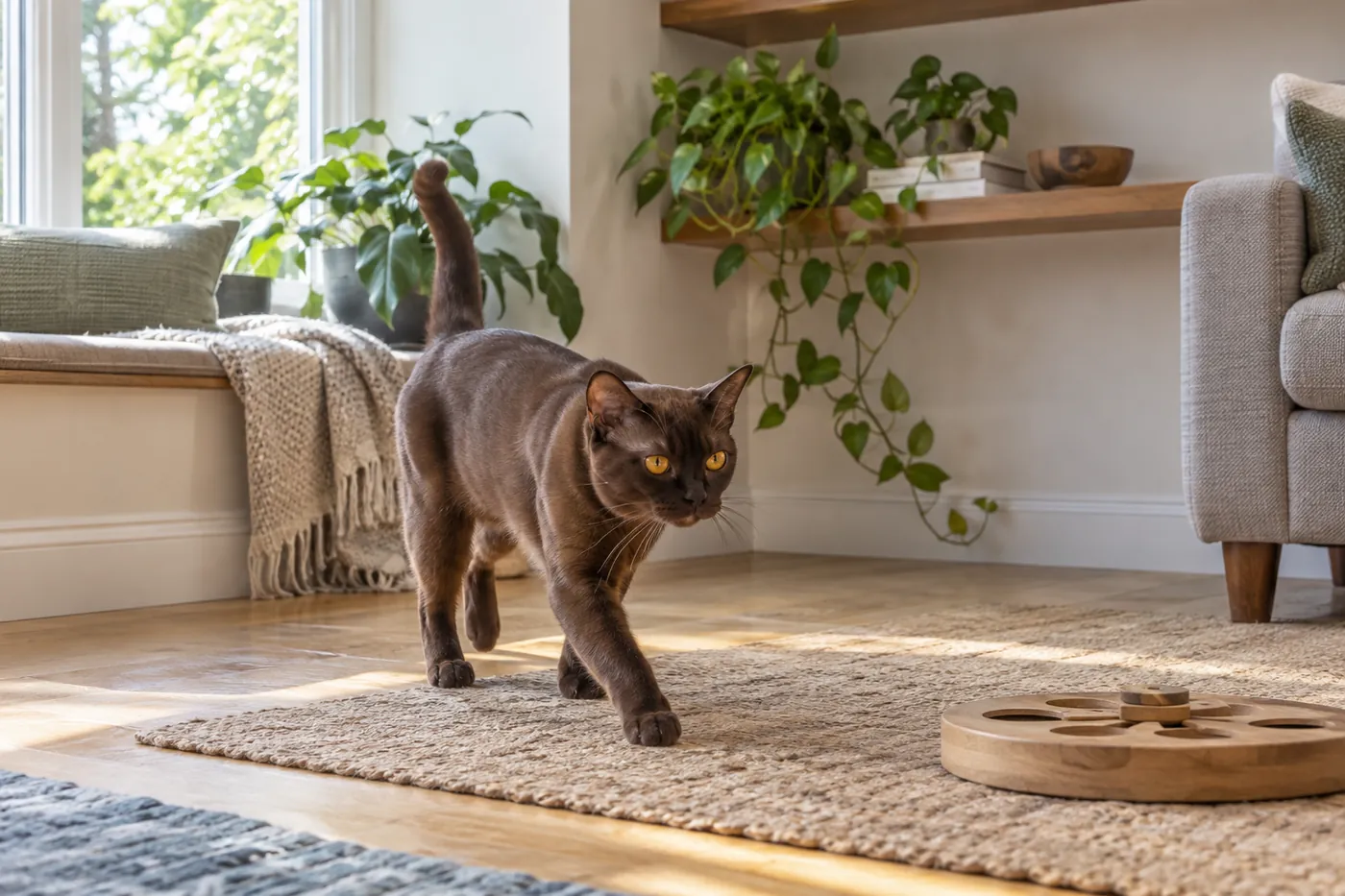
Rotate the problem, not just the product. Moving a familiar feeder, changing the search route or asking for one learned behaviour before a measured food reward can renew interest without filling the home with unused toys.
A useful weekday rhythm might pair a brief chase game before breakfast with a food search later and a calmer training session in the evening. The sequence matters more than making any one session long enough to exhaust the cat.
Stop while the cat is still succeeding. Repeated failed jumps, frantic grabbing or walking away from a familiar cue can mean the task is too hard, the reward has lost value or the cat needs rest rather than firmer handling.
Can a European Burmese cope with time alone?
No primary source establishes a universal number of safe hours alone for this breed.
A settled adult with a predictable workday differs from a kitten, a recent arrival or a cat already showing distress.
The European Burmese is still a poor starting choice for a home that is routinely empty for long days and wants a self-contained pet. Social contact is part of the breed's common appeal, so the weekly schedule should be tested before the coat or colour influences the decision.
- The cat eats and uses the litter tray normally during your absence
- Rest alternates with play instead of persistent pacing or searching
- Vocalising settles rather than escalating each day
- The cat can greet you and then return to a calm baseline
- A named person can provide food, litter care, play and observation during travel
- The plan does not depend on a second cat automatically solving loneliness
A compatible second cat may provide company, but compatibility has to be observed. Two socially intense cats can enrich each other, while a mismatch in play style can create pursuit, blocked resources and more stress.
Build independence gradually after a move. Start with short, ordinary departures after food and play, then look for eating, toileting and resting patterns that return to normal instead of increasing the absence abruptly.
A camera can reveal pacing or persistent calling, but it cannot tell you why the behaviour occurs. Pain, hunger, outside animals and a poorly placed litter tray can produce similar changes, so repeated distress needs a broader review than simply buying more toys.
Can European Burmese cats live with children and pets?
Many can live well with respectful children, cats and cat-safe dogs because the breed is commonly social and playful.
Success still depends on introductions, retreat space and whether every animal can disengage.
Children should use toys rather than hands, let the cat leave and never lift it from a protected bed. A social cat can tolerate more handling than it wants, so an adult must stop contact when the body stiffens, the tail begins to lash or the cat turns away.
| Household | Useful starting evidence | Main condition |
|---|---|---|
| Young children | Calm recovery after noise and gentle floor-level contact | Adult supervision and a child-free retreat |
| Older children | Interest in wand play or small training tasks | No chasing, carrying or hand play |
| Resident cat | Reciprocal play and an ability to pause | Separate food, water, litter and resting resources |
| Cat-safe dog | Curiosity without fixed staring or pursuit | Barrier introductions and a high dog-free exit |
| Small pets | No breed evidence cancels predatory behaviour | Secure physical separation at all times |
An observed adult can be a safer choice than a kitten when the household contains a vulnerable resident animal. Its established play and recovery pattern provides more information than a promise about the breed as a whole.
Make the first meetings boring and easy to end. Scent exchange, feeding on opposite sides of a barrier and short visual access give each animal time to recover before direct contact is considered.
Do not use the European Burmese's friendly reputation to skip this process. A confident newcomer can still overwhelm a quiet resident, and a sociable cat still needs its own route to food, rest and the litter tray.
How much grooming and shedding should you expect?
The close coat has very little undercoat and usually needs only a gentle weekly pass with a rubber grooming glove or soft cloth.
European Burmese cats still shed, and short hair does not make them hypoallergenic.
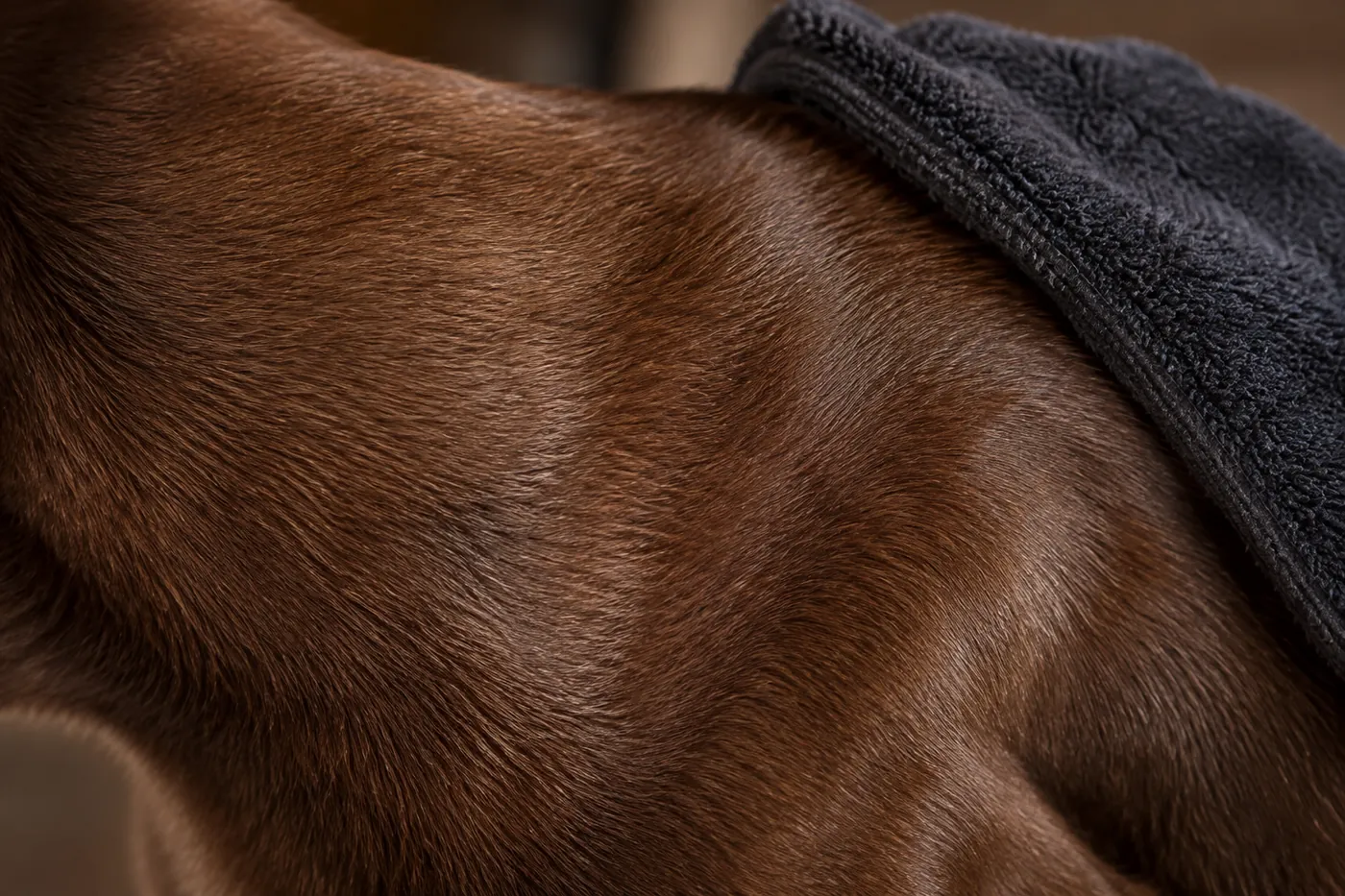
Use the session to feel the ribs, examine the skin and notice a new sore area or reluctance to be touched. Add regular nail care, visible-ear checks and tooth brushing rather than treating coat care as the whole routine.
Food should be complete and balanced for the cat's life stage, with portions adjusted to body condition. A muscular cat can still carry excess fat, and its unexpectedly solid feel is not a reason to ignore a disappearing waist or ribs that become difficult to feel.
Bathing is rarely part of routine coat care. Use it for an actual contamination or veterinary reason, because repeated shampooing can irritate skin that was already clean and does not solve ordinary shedding.
The breed is not allergy-safe. Cat allergens come from saliva and skin secretions as well as loose hair, so a fine coat and modest shedding cannot predict how one person will react in the home.
What health evidence should a breeder provide?
There is no sound basis for calling the European Burmese free of inherited disease.
The most useful evidence names the individual cat, the condition or variant assessed, the result and the date.
The WNK4 variant associated with Burmese hypokalaemic polymyopathy is a concrete question for lines in which the variant may occur. Affected cats can have episodic muscle weakness and downward neck flexion, while carriers can appear healthy.
| Evidence | What to request | What it tells you | What it cannot prove |
|---|---|---|---|
| Pedigree | Original registry record for the kitten and both parents | Recorded European Burmese ancestry | Health or temperament |
| WNK4 test | Original laboratory reports for both parents | Clear, carrier or affected status for one hypokalaemia variant | Every cause of weakness or low potassium |
| General examinations | Dated veterinary records for parents and kitten | Findings in the named cats on those dates | Future freedom from disease |
| Family history | Ages, diagnoses and causes of death in close relatives | Whether the breeder follows health through the line | A guaranteed lifespan |
| Cardiac evidence | Details of any examination or echocardiogram claimed | What was assessed and when | Permanent freedom from heart disease |
Two clear parents cannot pass that named recessive variant, while a carrier paired responsibly does not have the same status as an affected cat.
Read the laboratory wording itself instead of accepting the phrase fully tested.
For a recessive result, the pair matters as much as either report alone. A carrier can remain clinically normal and can be bred without producing affected kittens when the other parent is verified clear, but the breeder should explain the mating and identify every cat on the laboratory documents.
A clear WNK4 result does not rule out every reason for low potassium or weakness. The published mutation concerns one inherited form, while kidney disease, poor intake and other disorders can also alter potassium or muscle function and require veterinary diagnosis.
Population studies involving Burmese cats have also reported diabetes and other health associations, but regional breeding histories differ. Ask whether the evidence applies to the breeder's line and avoid turning a population association into a prediction for one kitten.
Sudden weakness, collapse, breathing difficulty, repeated vomiting or a marked change in drinking or urination needs veterinary assessment. Do not explain a new sign only by saying that the breed is vocal, muscular or people-focused.
Is a European Burmese right for your home?
Choose this breed when regular company, interactive play and a close social relationship are part of what you want.
The coat is easy, but the cat's need to participate may be the larger daily commitment.
- Compare the weekly schedule with the cat's observed need for company
- Provide stable climbing, floor play and changing food-search tasks
- Meet the individual during activity, rest and gentle handling
- Confirm that children and pets have separate resources and retreat space
- Read original health reports rather than a list of test names
- Expect a short satin coat to shed and need ordinary skin, nail and dental care
- Choose a carrier from the actual cat's dimensions
- Walk away from guaranteed temperament, allergy safety or lifetime health
A quieter household can work when somebody is present and enjoys frequent contact. A busy home can also work when the cat has protected rest and people recognise when interaction has ended.
Ask to meet an adult relative when possible, because it gives you a better view of mature body type, social intensity and coat than a young kitten can. Treat the meeting as one piece of family evidence rather than a prediction that the kitten will copy that adult exactly.
An adult European Burmese needing a new home may offer even stronger individual information. Foster notes about time alone, handling, visitors and other animals can answer the household-fit question without relying on a breed average.
The best-practice choice is the cat whose ordinary need for company still fits your least flexible weekday. That is more durable than choosing by colour and hoping the social workload disappears.
Common Questions
Is a European Burmese the same as a Burmese?
They share the same foundation but CFA treats them as separate breeds. The European Burmese has a more moderate body and short wedge-shaped head, while the CFA Burmese is more compact and rounded.
What colours can a European Burmese be?
CFA accepts ten colours: brown, blue, chocolate, lilac, red, cream, brown tortoiseshell, chocolate tortoiseshell, blue-cream and lilac-cream.
Are European Burmese cats good for working households?
They may cope with a predictable workday when mature and settled, but they are strongly social cats and are a poor starting fit for routinely long absences without dependable company and care.
What health test matters for a European Burmese?
Ask whether the WNK4 variant associated with Burmese hypokalaemic polymyopathy occurs in the line and request original reports for both parents when it is relevant. Each result covers one named variant, not the cat's whole future health.
Checked Against
- CFA: European Burmese cfa.org
- CFA: Burmese cfa.org
- FIFe: Burmese breed profile fifeweb.org
- First WNK4 hypokalaemia animal model in Burmese cats pubmed.ncbi.nlm.nih.gov
- Review of periodic hypokalaemic polymyopathy in Burmese cats pubmed.ncbi.nlm.nih.gov
- Bradshaw: Normal feline behaviour and why problem behaviours develop (Journal of Feline Medicine and Surgery, 2018) pmc.ncbi.nlm.nih.gov
- 2021 AAHA and AAFP feline life-stage guidelines pmc.ncbi.nlm.nih.gov
Published 13 September 2026. Last updated .