
What Is a Turkish Angora, and Are the White Ones More Likely to Be Deaf?
The Turkish Angora is an active, talkative, unusually low-maintenance longhair, and for most households the care load is the easy part. The decision that matters is colour: white Angoras carry a genuine risk of congenital deafness that rises sharply with blue eyes, and only a hearing test on the individual kitten answers it.
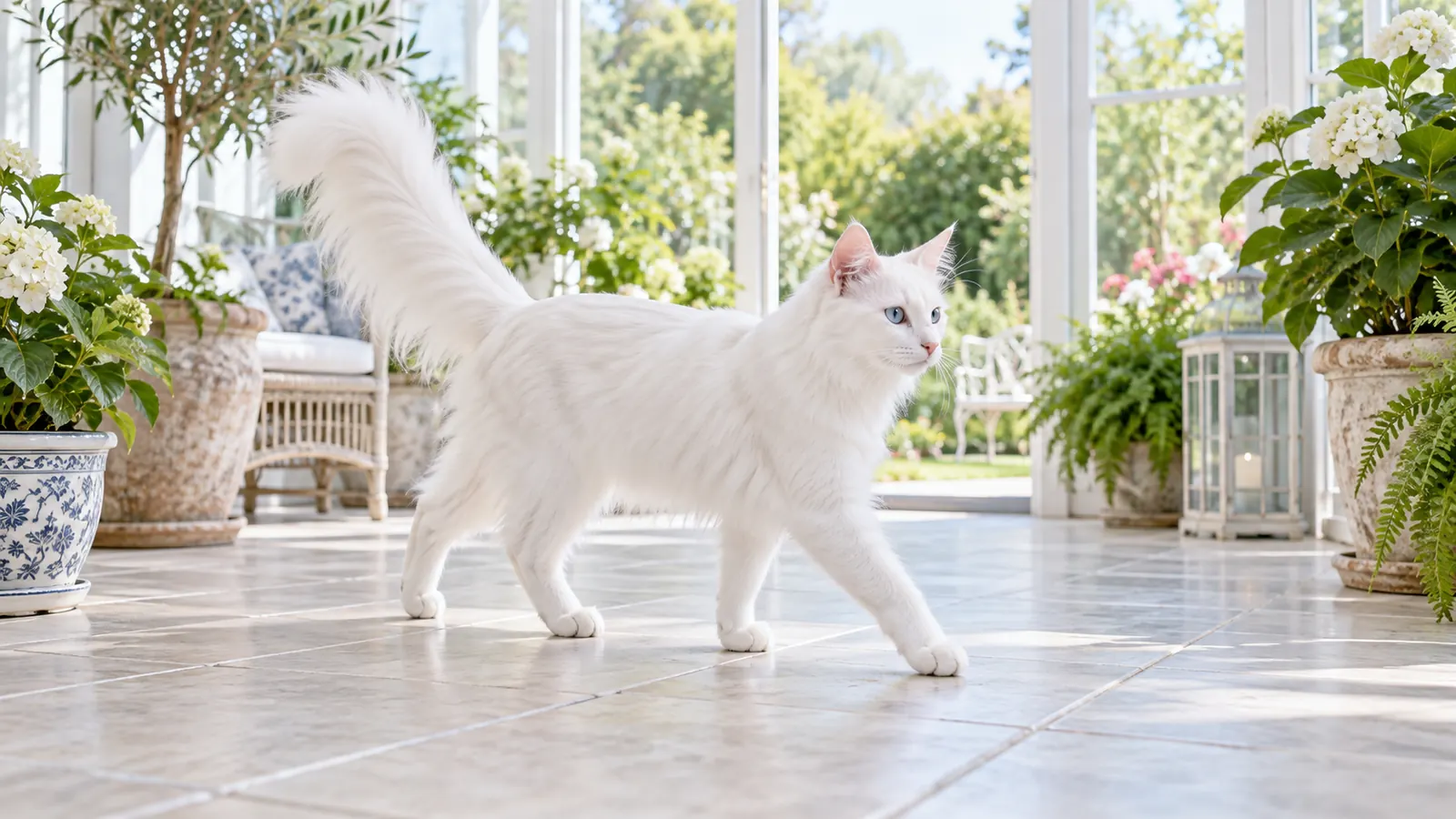
- Origin
- Turkey, an old natural longhair preserved through a breeding programme at the Ankara Zoo
- Coat
- Single-layered and silky with no woolly undercoat, carrying a full ruff, britches and a plumed tail
- Size
- Small to medium, long and slender with fine boning and hind legs longer than the front
- Typical weight
- Usually around 5 to 10 pounds, with males at the upper end of a genuinely small breed
- Life expectancy
- Commonly quoted at about 12 to 18 years, with no breed-specific population data behind it
- Activity level
- High. Busy, vocal and interactive well into adulthood, with a strong appetite for height
- Grooming
- Low for a longhair. A single coat resists matting, so combing two or three times a month usually holds it
- Suits
- Interactive households that want a longhair without the grooming load, and that will take the hearing question seriously
The Turkish Angora is one of the few longhaired cats whose coat is genuinely easy to live with. Its harder question is one most breed descriptions mention and then move past.
Why is deafness the first question about a white Angora?
The white coat is produced by a dominant masking allele of the KIT gene, usually written W. That allele does two things at once: it switches off pigment across the coat, and it interferes with the pigment cells that also have to reach the inner ear.
Those pigment cells help the inner ear keep up the potassium-rich fluid its hearing cells depend on. Without them the affected ear does not develop normal hearing, so the deafness is present from the start rather than coming on with age.
Eye colour is the visible clue, because the same pigment failure that leaves an eye blue is the one that reaches the ear.
| Coat and eyes | Reported risk of deafness | What it means when you meet the kitten |
|---|---|---|
| White, no blue eye | Roughly 17 to 22 percent | Lower, and still worth testing rather than assuming |
| White, one blue eye | Around 40 percent | Deafness may affect one ear only, and not always the ear on the blue-eyed side |
| White, both eyes blue | Roughly 65 to 85 percent | The most likely outcome, and the one to plan for |
| Any non-white colour | Not associated with this gene | The W allele is absent, so this risk does not apply |
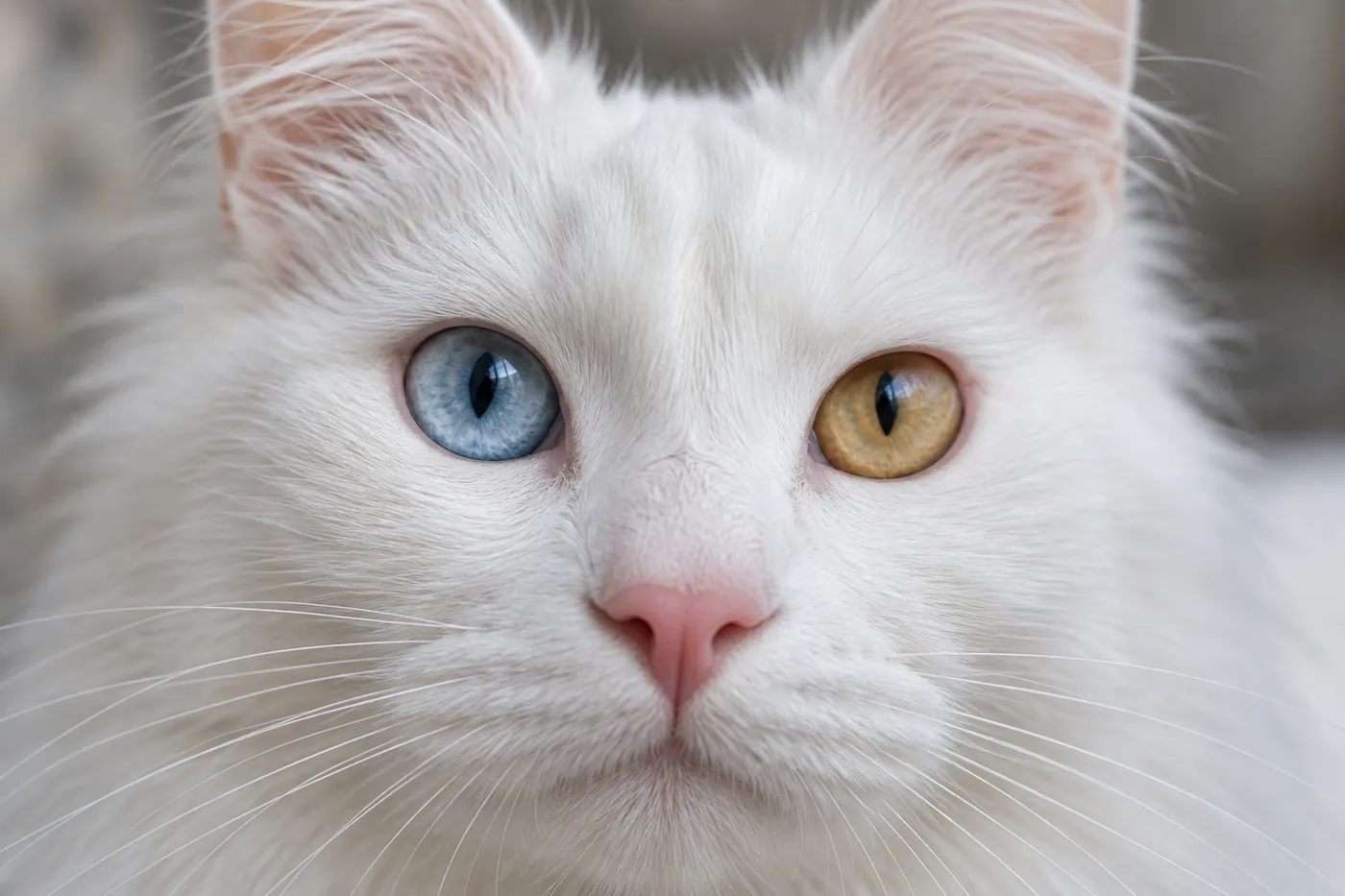
Those figures come from studies of white cats in general, and they shift between populations: a 2019 UK study of pedigree white kittens found deafness in about 22 percent of kittens without blue eyes, 44 percent with one and 50 percent with two. They describe groups rather than the cat in front of you, so a blue-eyed white kitten can hear, and a white kitten without blue eyes can be deaf.
Unilateral deafness is the case people most often get wrong. A cat that hears on one side responds to its name, comes when called and looks entirely normal, which is why the condition is usually found by a test rather than by an owner.
What does a BAER test actually settle?
The brainstem auditory evoked response test is the only method that answers the question properly.
Small electrodes record the brain's response to clicks played into each ear separately, so the result distinguishes normal hearing from deafness in one ear or in both.
It is quick and not painful, and it can be done on young kittens, which is why a breeder working with white cats has no real excuse for not having done it.
The GCCF advises testing white kittens before they are placed, and a common breeding approach is to pair white cats with coloured ones rather than white with white. Neither practice removes the risk, and neither replaces a test on the individual cat you are taking home.
If a seller has not tested and will not, the kitten is best treated as possibly deaf. That is no reason to walk away, though it is a reason not to pay a premium for a guarantee nobody has checked.
Can you live well with a deaf cat?
Yes, and the adjustments are smaller than most people expect, but they are not optional.
Containment is the one that is not negotiable. A deaf cat cannot hear traffic, a dog, or a person calling it, so free outdoor access stops being a reasonable risk.
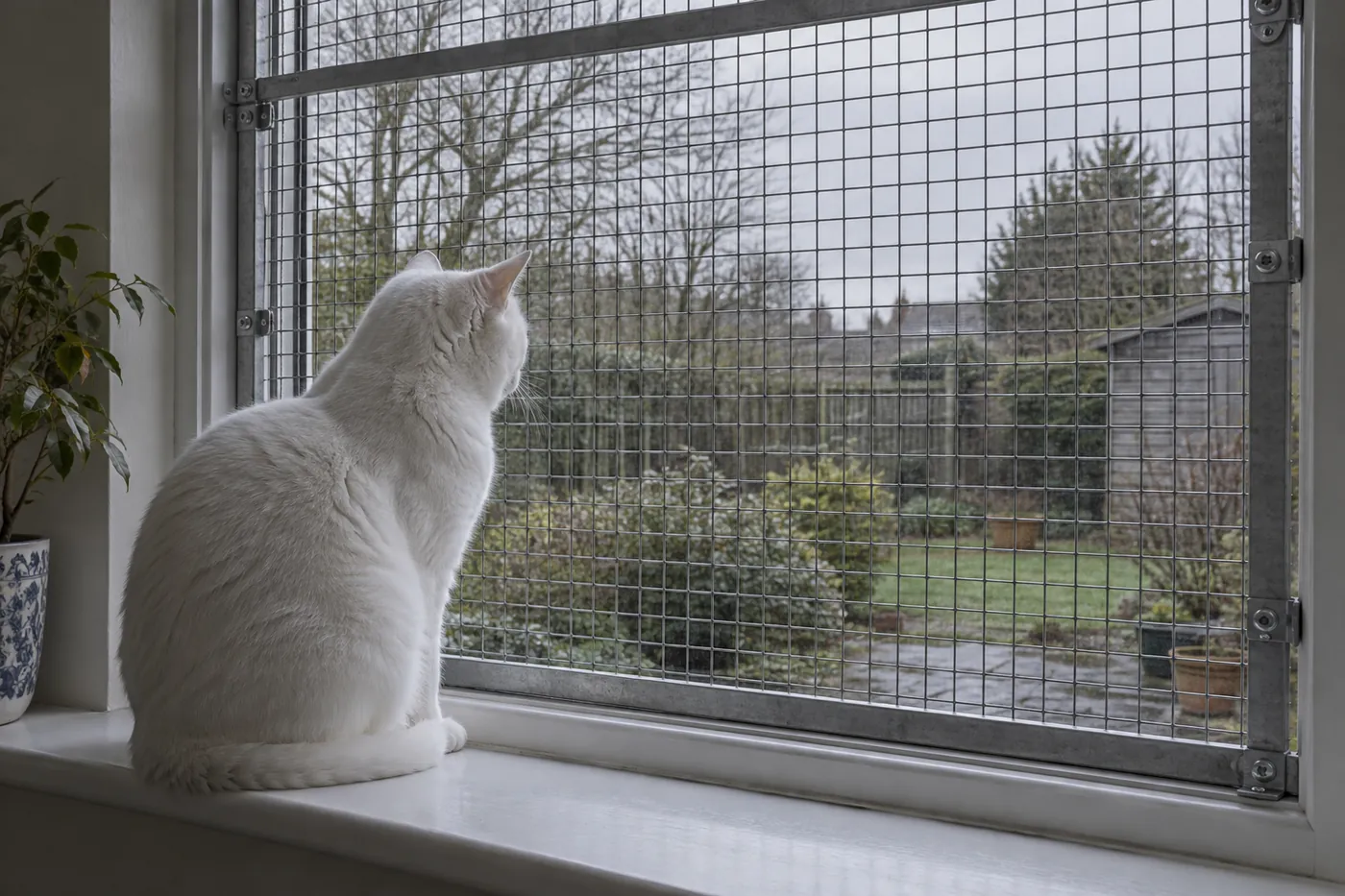
- Keep the cat indoors or in a secure enclosed run
- Fit screens on windows that will be opened
- Approach from the front, or let the cat see your shadow before you touch it
- Wake it by touching the bedding rather than the cat
- Use hand signals consistently for the few things it needs to understand
- Stamp lightly on the floor when you want attention, because vibration carries
- Expect a louder voice, since a deaf cat cannot moderate its own volume
A deaf cat startles more easily, and a startled cat that cannot hear you apologise reacts to being grabbed rather than to being greeted. Children need the approach-from-the-front rule explained once and enforced.
Other animals need a similar allowance. A deaf cat cannot hear a dog crossing the room behind it, so a resident dog needs a route that does not involve arriving unannounced at the cat's blind side.
Night hours are the other adjustment nobody warns about. A deaf cat cannot hear its own voice or yours, so night-time calling is common and is answered by going to the cat rather than by calling back.
There is no treatment for inherited deafness, so the plan is management rather than repair.
Deafness changes less than people tend to assume. A deaf cat is not in distress, is not in pain, and does not need a hearing companion to interpret the world for it. It has never heard anything, so nothing has been taken away from it.
It plays, hunts, climbs and communicates normally, and it reads the household through vibration, air movement and sight rather than sound.
The two genuine differences are the ones already covered: it cannot be recalled by voice, and it cannot hear a threat coming. Both are solved by containment rather than by sympathy.
Why is the breed mostly white in the first place?
Because it was nearly lost, and the rescue was built around white cats.
By the end of the nineteenth century the Angora had been outcrossed almost out of existence, its bloodlines absorbed into the developing Persian. The cats that had made the breed famous in Europe were being used to build a different one.
Turkey responded with a preservation programme at the Ankara Zoo, and that programme is the reason the breed still exists.
- 1954The first Angoras reach the United States, and the breed is treated as all white
- 1973CFA grants championship status, to white Angoras only
- 1978CFA accepts the coloured varieties alongside the white
The zoo's programme prized the white cat, and particularly the odd-eyed white cat, as the authentic Angora. That preference was cultural and aesthetic rather than genetic, but it shaped which cats were bred from for decades.
So the breed's link with a white coat is an artefact of how it was saved.
The colour that carries the hearing risk is the colour the preservation effort selected for, and the coloured Angoras that registries accepted in 1978 are the same breed with that history behind them.
How much grooming does a single coat need?
An Angora needs less grooming than almost any other longhair, which is the breed's quiet advantage.
An Angora carries a single silky layer with no woolly undercoat beneath it, and mats form where a soft undercoat compacts against the skin. CFA describes combing two or three times a month as enough for a younger cat, which is a fraction of what a Persian or a semi-longhair with a dense underlayer needs.
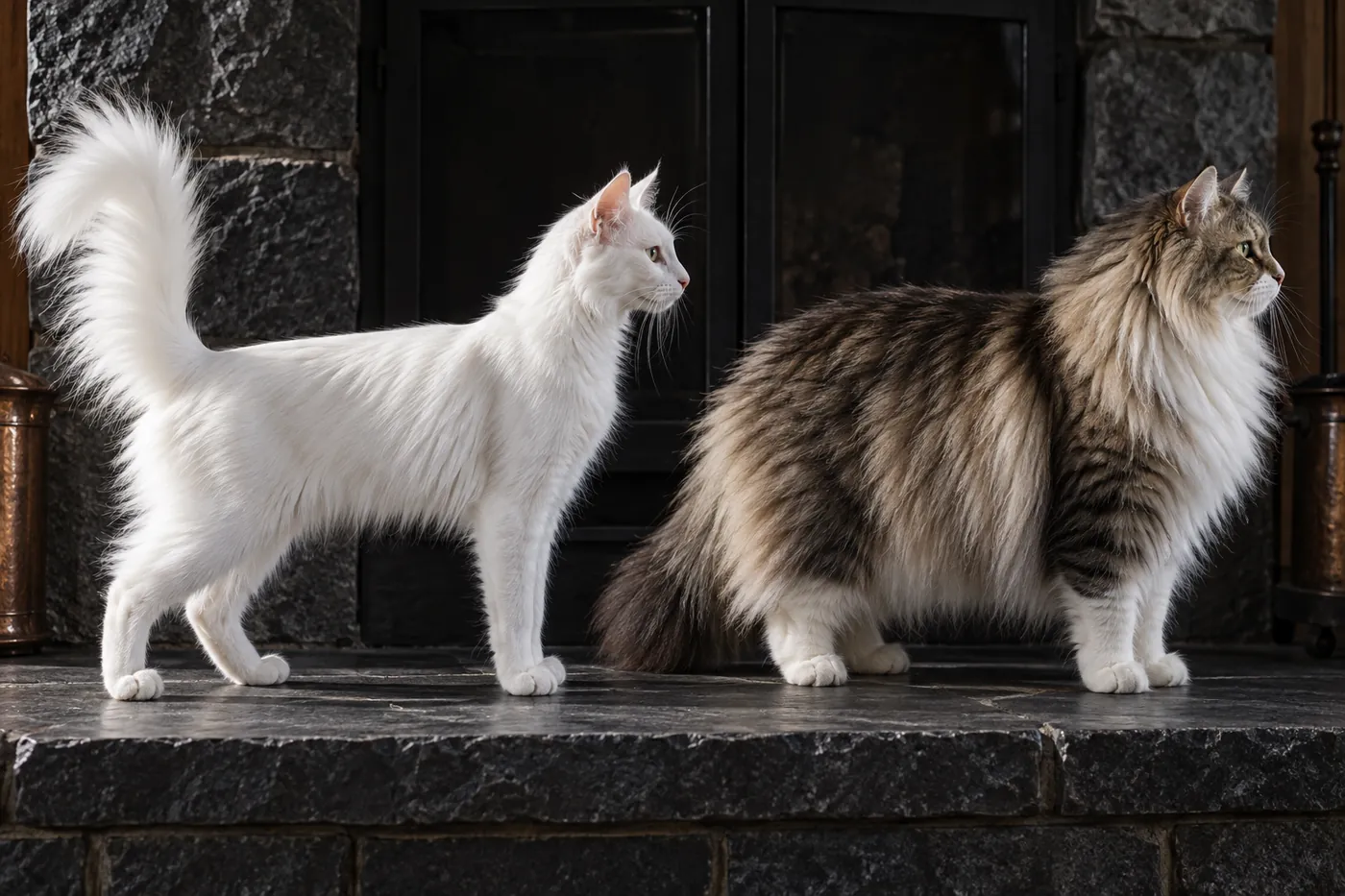
The coat still changes through the year, and older cats, heavier cats and cats with reduced mobility all groom themselves less well, so the interval shortens with age rather than staying fixed.
The ruff, the britches and the tail need the most attention, because those are the three places the length is genuinely long. The rest of the cat is close enough to the body that neglect shows slowly.
Bathing is not part of the routine for a healthy indoor Angora. A single coat carries less to trap, and washing a cat that does not need it strips oil for no benefit.
Nails, ears and teeth belong on the same weekly pass as the comb, and they matter more than the coat does. Dental disease is the condition most likely to shorten this cat's comfortable life, and it is not visible from across a room.
What does an Angora kitten turn into?
Something considerably fluffier, and later than most people expect.
An Angora kitten often looks close to shorthaired. The coat does not reach full length until around two years old, and the cat keeps filling out in muscle and coat until roughly two or three.
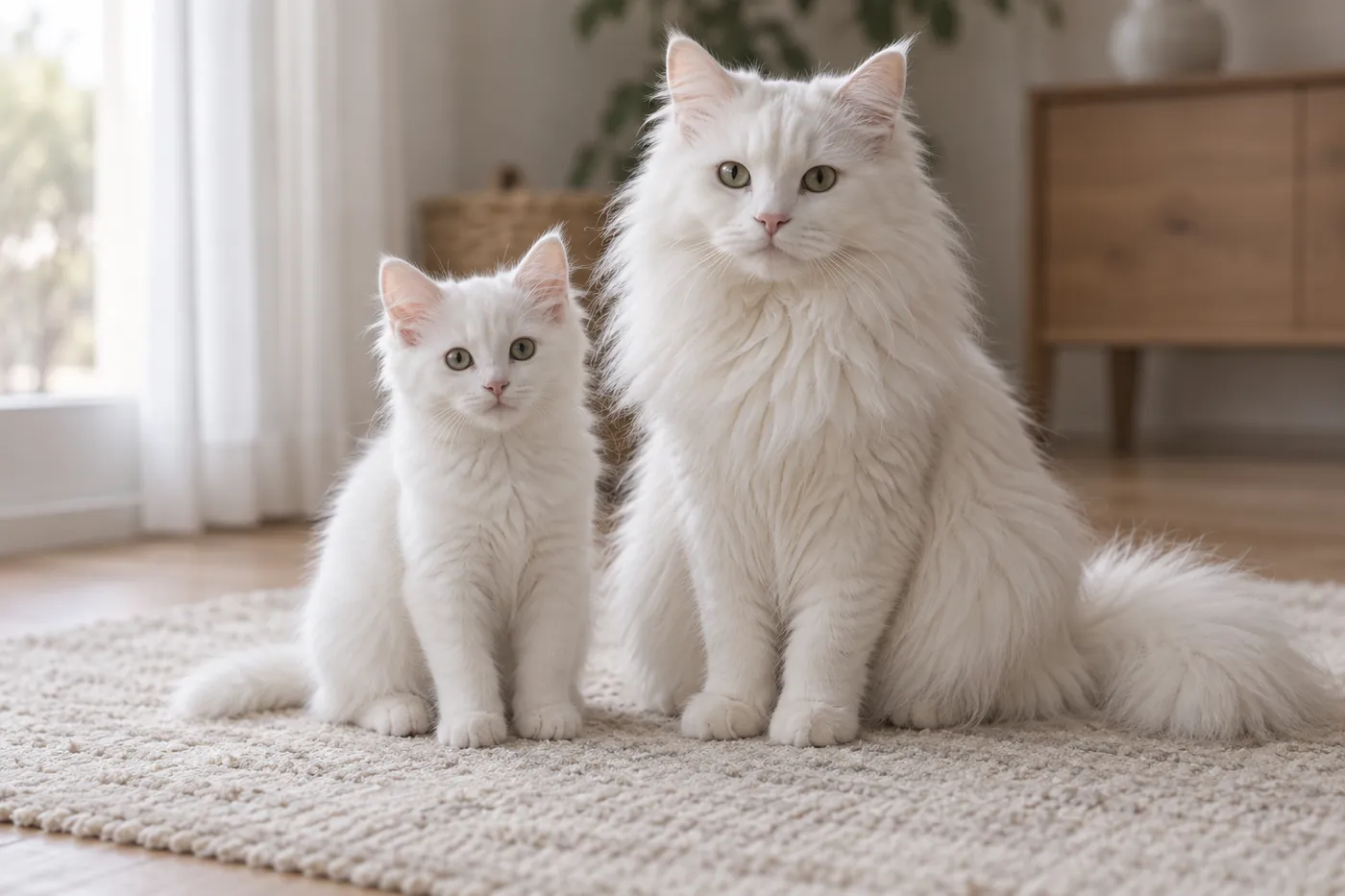
The ruff, the britches on the hind legs and the full plumed tail arrive with the mature winter coat, so a kitten viewed in summer shows almost none of the outline the breed is known for.
There is no recognised shorthaired Turkish Angora. A cat advertised that way is either an ordinary shorthair or an Angora whose coat has not come in yet, and only one of those is worth pedigree money. The shorthaired cat from Turkey's natural population that does have a standard is the Anatolian, which WCF recognises as a breed of its own and TICA, CFA and FIFe do not list.
Eye colour settles late as well. Blue, green, green-gold, amber and odd-eyed are all accepted, and the shade an adult ends up with is not reliably readable at eight weeks.
Health, handling and paperwork are what a kitten can be judged on at viewing, because coat and eye colour at viewing are both still moving.
A white coat also shows staining that a coloured one hides. Tear marks, food marks around the muzzle and yellowing along the britches are cosmetic, but they are the early sign of a cat that has stopped grooming itself properly.
What is the temperament like day to day?
Busy, and more involved in your affairs than most cats.
CFA describes the breed as curious, highly interactive and doglike in its attachment, and the recurring owner report is a cat that supervises rather than observes.
The build supports it. Fine boning, a long body and hind legs longer than the front produce a cat that gets on top of things easily and lands quietly.
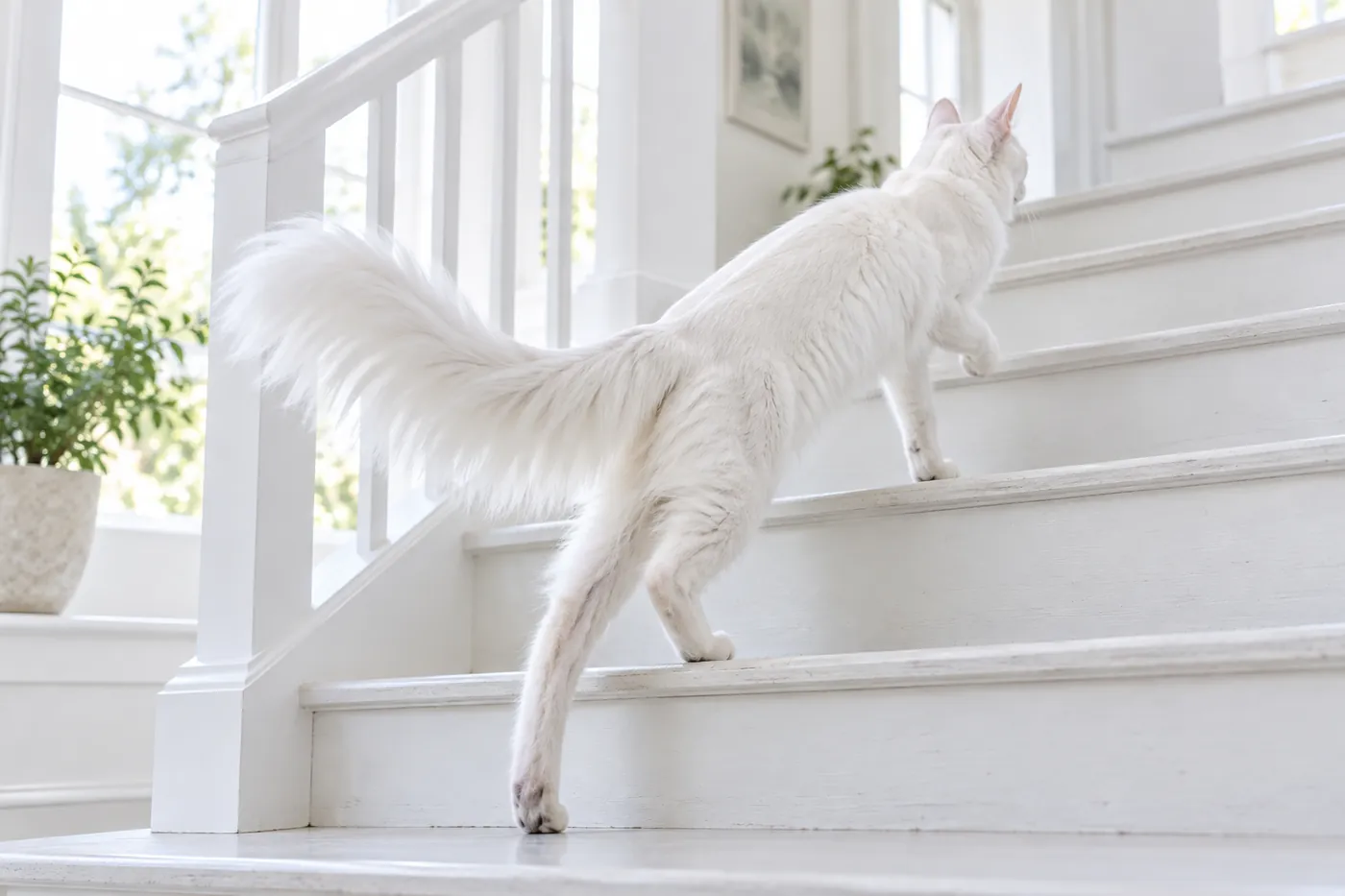
Angoras keep up a vocal commentary, and a deaf one is louder still because it cannot judge its own volume.
Angoras take direction well. They learn recall, carrier entry and simple retrieve readily, and the breed responds better to reward-based work than to being told off.
With other cats and with cat-experienced dogs the record is generally good, provided introductions are gradual and the Angora keeps a high retreat it can reach without passing the other animal.
Children are usually fine with a rule that the cat is approached rather than picked up, and that rule matters more than usual if the cat is deaf.
They usually keep the busy, kittenish quality well past the point where a calmer breed settles. That is the whole appeal for some households and the reason others find the breed exhausting.
Intelligence varies more within this breed than the marketing suggests, so the individual cat says more than the description does.
How do you keep the weight right on a fine-boned cat?
By measuring, because almost nothing else about this cat will tell you.
An Angora is small. A cat that finishes at five to ten pounds has very little margin, and the amount of food that would be unremarkable for a large breed is a meaningful surplus here.
Two things then hide the result. Fine boning means the frame carries weight without looking coarse, and a semi-long coat covers the outline that would otherwise give it away.
So the check has to be done by hand rather than by eye. Feel for the ribs under light pressure and trace the waist behind them, and do it on the same day each month rather than when something looks different.
Weigh the food rather than scooping it, and count treats and puzzle food inside the day's total rather than beside it.
A cat that stops jumping to a favourite height, or that starts leaving food it used to finish, is reporting something. Weight, teeth and joints are the three usual causes, and all three are worth a veterinary opinion rather than a diet change at home.
Which health records matter beyond hearing?
Two conditions are worth asking about by name.
Hereditary ataxia is a rare autosomal recessive disorder that appears at around four weeks as a lack of coordination, and affected kittens do not survive to adulthood. Because it is recessive, two clinically normal parents can produce an affected litter, and a breeder who has seen it in a line should be able to say so.
Hypertrophic cardiomyopathy is the other. It is usually detected between two and six years of age, more often in males, and it can be silent in a cat that looks entirely well.
- Deafness
- BAER result per kitten, per ear, in writing
- Ataxia
- Whether it has appeared in the line, since carriers look normal
- Heart
- A dated cardiologist echocardiogram on each breeding cat
- Eyes and coat
- Ordinary condition checks, since a white coat shows neglect early
- What no record covers
- Dental disease, weight and kidney function, which dominate later life
There is no DNA test that replaces a cardiac scan, so a heart result belongs to the date it was taken rather than to the cat for life.
Copies are worth handing to your own veterinarian, because a record that stays in the breeder's folder cannot inform the first murmur your vet hears.
How do you tell a Turkish Angora from a white longhaired cat?
Mostly you cannot, by looking. Plenty of white domestic longhairs are sold as Angoras, and the word angora is also used loosely for any long white coat, which is why the identity question is a paperwork question.
The breed standard describes the shape a registered Angora should have, and a few features point clearly away from it.
| Feature | What the standard describes | What describes a different cat |
|---|---|---|
| Body | Small to medium | Cobby |
| Head | Medium-long smooth wedge with a two-plane profile and almond eyes | Round |
| Ears | Large, pointed, set high and close together | Small and set low |
A cat can match every row and still be a domestic longhair, because none of these features is unique to the breed.
CFA accepts the breed in nearly every colour except chocolate, lilac and the pointed patterns, so a coloured Angora is fully standard rather than a lesser version. It also carries none of the W-linked deafness risk.
If the appeal is the temperament and the easy coat rather than the white specifically, a coloured Angora gives you the same breed with one whole category of risk removed.
The Turkish Van is a separate, larger and slower-maturing breed with its own semi-long coat and breed history. A Turkish name or a mostly white coat does not make the two breeds interchangeable.
What should you settle before you commit?
The colour question comes first, because everything else follows from it.
A white cat means budgeting for a tested kitten, planning for containment and accepting that a one-sided result is common and manageable. If the coat colour is not the point, coloured Angoras bring the same temperament and the same easy grooming without the hearing question.
After that come the ordinary checks: dated cardiac reports, an honest answer about ataxia in the line, rearing conditions, and written terms.
A quoted lifespan of about twelve to eighteen years is long for a cat, and the second half of it is dominated by teeth, weight and kidneys rather than by anything above, so the older cat is the one to plan for.
Checked Against
- International Cat Care: inherited deafness in white cats icatcare.org
- GCCF: BAER testing for white cats gccfcats.org
- The Cat Fanciers' Association: Turkish Angora cfa.org
- Louisiana State University School of Veterinary Medicine: cat breeds with congenital deafness lsu.edu
- Cornell Feline Health Center: hypertrophic cardiomyopathy vet.cornell.edu
- Life tables of annual life expectancy and risk factors for mortality in cats in the UK pmc.ncbi.nlm.nih.gov
- Journal of Veterinary Internal Medicine: prevalence of congenital sensorineural deafness in purebred kittens in the UK pmc.ncbi.nlm.nih.gov
Published 10 September 2026. Last updated .





