What Is a Highlander Cat, and Is It Right for You?
The Highlander is a recently developed domestic cat with a muscular body, loosely backward-curled ears and a naturally shortened tail; it has no wild-cat ancestry requirement. It suits an active home that wants an involved, playful companion and is prepared to ask unusually detailed questions about tail genetics, movement and parent records.
- Origin
- United States, developed from domestic lines from 2004 and named Highlander in 2005
- Coat
- Short or long, with multiple tabby and pointed patterns accepted under the TICA breed-group standard
- Size
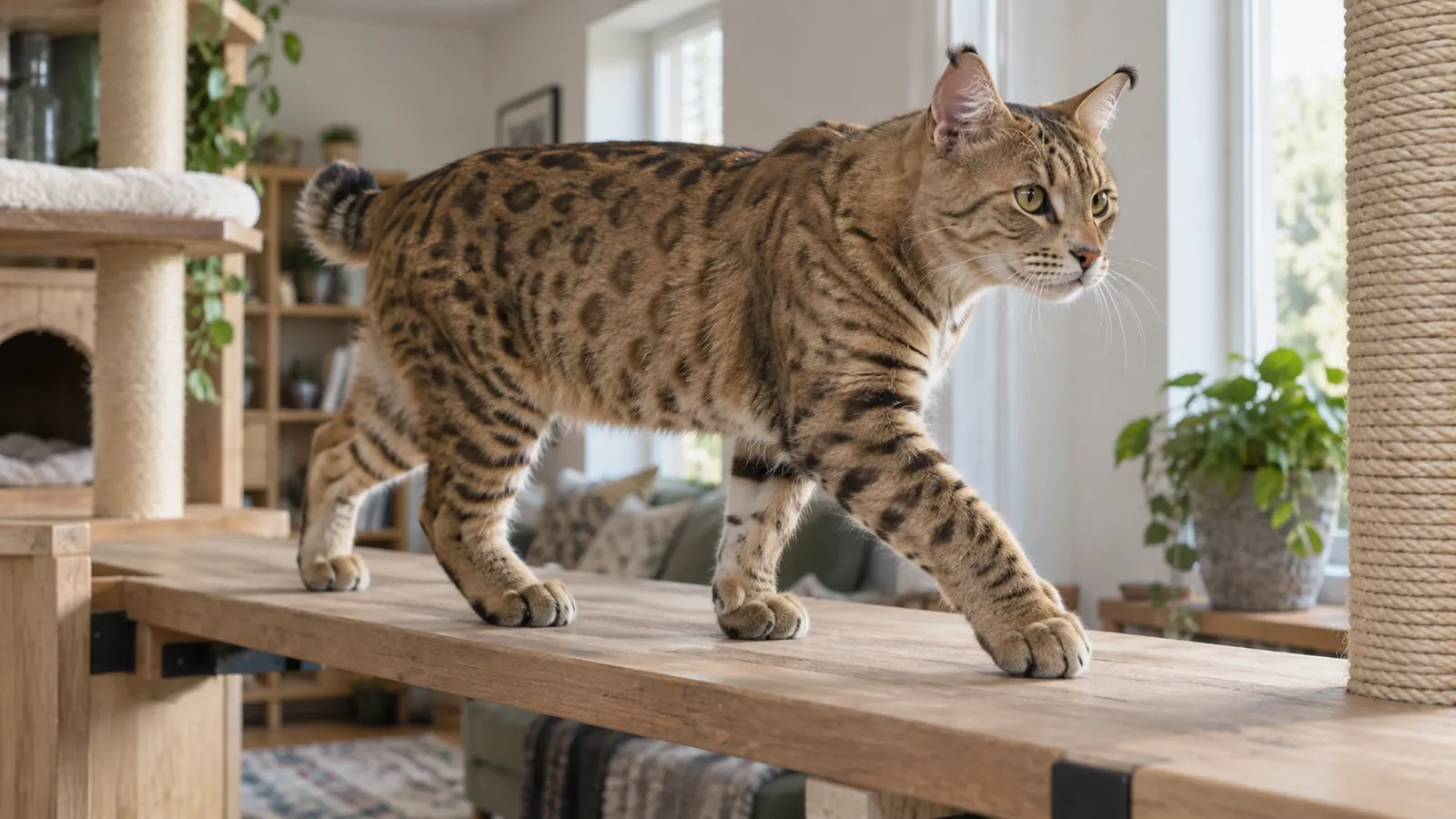
- Medium to large, muscular and athletic with substantial bone, large feet and longer flexible hind legs
- Typical weight
- No dependable breed-population range was found in current primary registry sources
- Life expectancy
- Not established by Highlander-specific population evidence
- Activity level
- High. Playful, athletic, people-aware and inclined to chase, climb and investigate
- Grooming
- Low to moderate by coat length, plus gentle visible-ear checks and observation of tail and movement
- Suits
- Active indoor homes with secure climbing, regular company and enough record literacy to evaluate a developing breed
The Highlander's wild-looking outline is deliberate, but the cat is domestic. TICA describes a breed developed from the domestic gene pool, and the name Highland Lynx is an older label rather than evidence of lynx ancestry.
Its unusual features carry separate questions. The ears curl backward at the upper third, while the tail is shortened by inherited variation that has not been uniform across the breed population.
Is a Highlander cat part wild cat or part lynx?
No verified Highlander standard requires recent wild-felid ancestry. TICA states that the cats used to develop the breed were chosen from the domestic gene pool, unlike a recognised wild-hybrid line.
That distinction matters beyond terminology. A claim of recent wild ancestry can affect housing expectations and local rules, while a domestic Highlander should come with registry records that trace an ordinary domestic pedigree. Those records show the kitten's registered name, registration number, parents and issuing registry on the original document. A photograph of one ancestor or a certificate with no verifiable chain does not establish the population behind the cat.
Large feet, a blunt muzzle, curled ears and a short tail create the intended big-cat impression. Those visual cues do not change the species, legal category or behavioural needs of the cat.
Bobcat, jungle cat or hybrid language without verifiable ancestry and applicable legal records is a warning sign in a seller. A domestic pedigree should be sold honestly as a domestic pedigree. The older Highland Lynx name can appear in a genuine breed history, but it should not be used to imply that the cat is biologically part lynx. If a seller alternates between domestic and hybrid descriptions depending on which sounds more exciting, the safer decision is to walk away.
What do a Highlander's ears, tail and body look like?
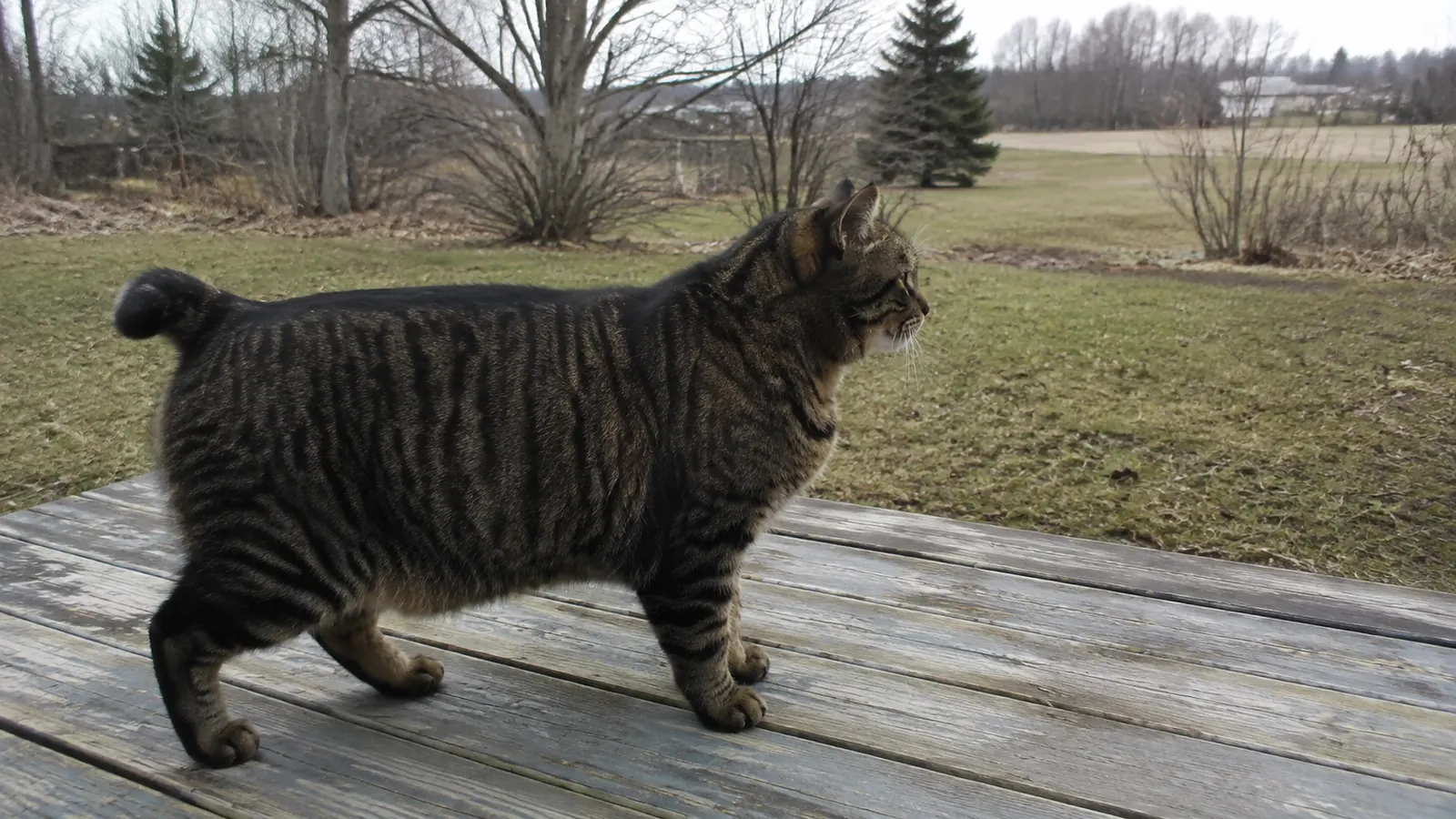
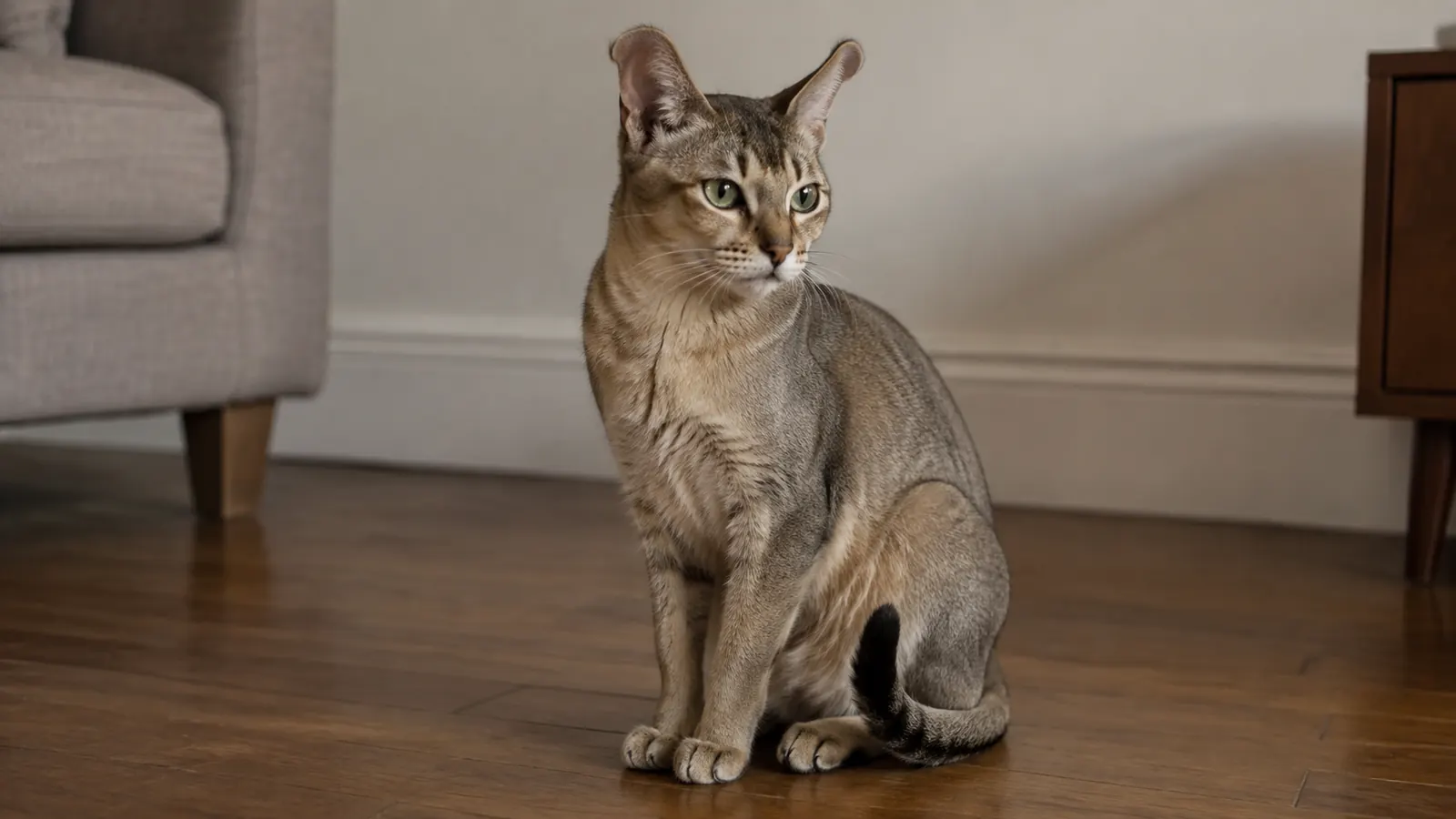
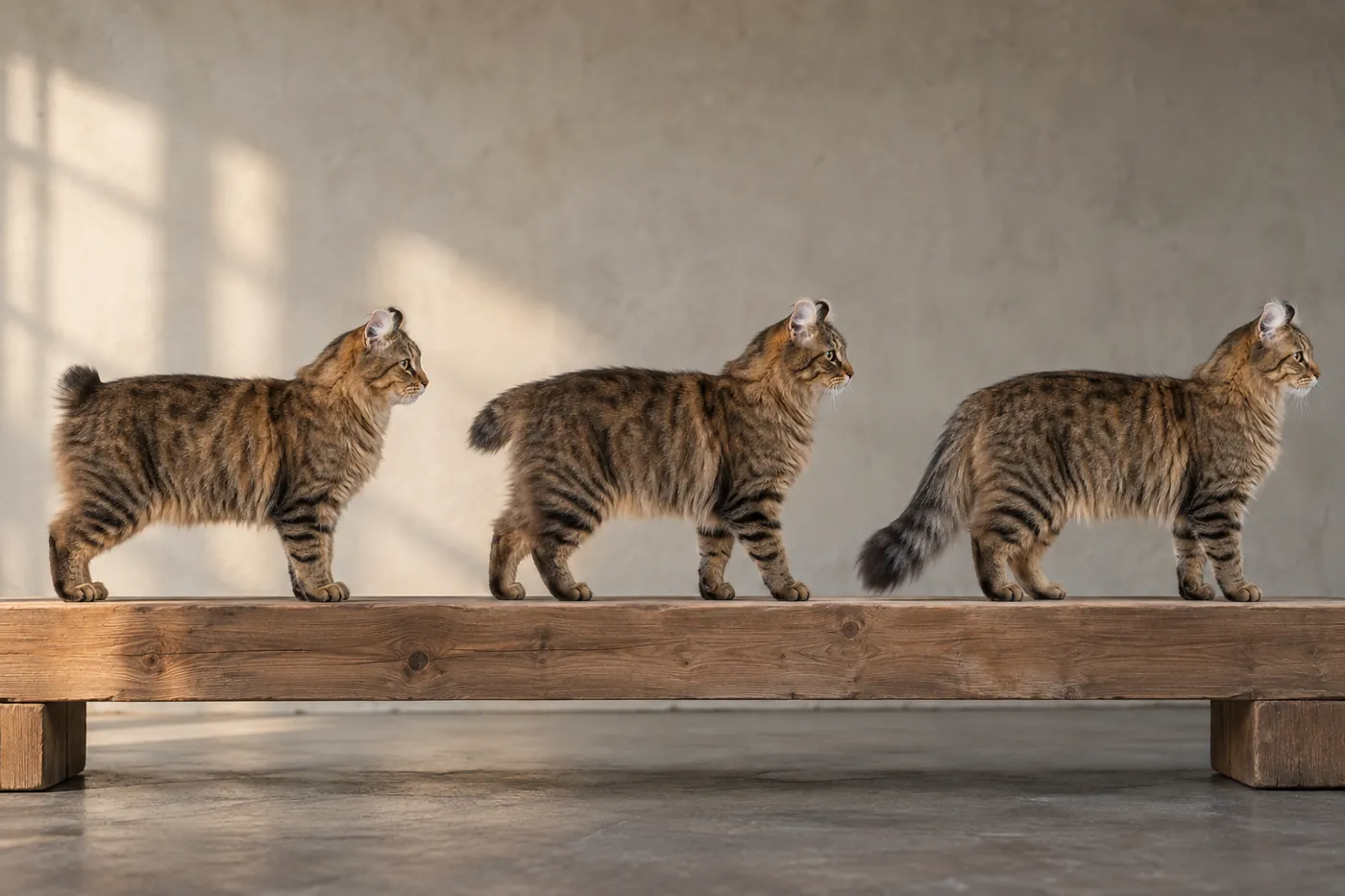
The current TICA standard describes a muscular, athletic cat with a straight to slightly convex forehead, wide nose and blunt-looking muzzle. The ears are tall, open and wide at the base, with a loose relaxed curl in the upper third. The tail is shortened and thick, with at least two inches of bone in an adult and no extension beyond the hock. Hooks or kinks may occur, but the tail should remain an expressive, functional part of the cat.
The ears and tail are easy to treat as collectible features, but the whole cat is what has to move well. The chest, shoulders and hindquarters should support balanced movement, and the feet should land securely when the cat walks, turns and jumps at an ordinary pace. No dependable population weight range appears in the primary registry material, so a copied internet number is a weak way to judge an individual. Body condition, muscle over the spine and hips, and the cat's own growth curve give a veterinarian a better basis for a healthy target.
- Body
- Medium to large, muscular and athletic
- Ears
- Erect, wide-based and open with a loose backward curl at the top
- Muzzle
- Broad and blunt in profile
- Feet
- Medium to large with prominent knuckles
- Tail
- Shortened, thick and no longer than the hock
- Coat divisions
- Highlander longhair and Highlander Shorthair
- Ancestry
- Domestic cat population rather than a wild hybrid requirement
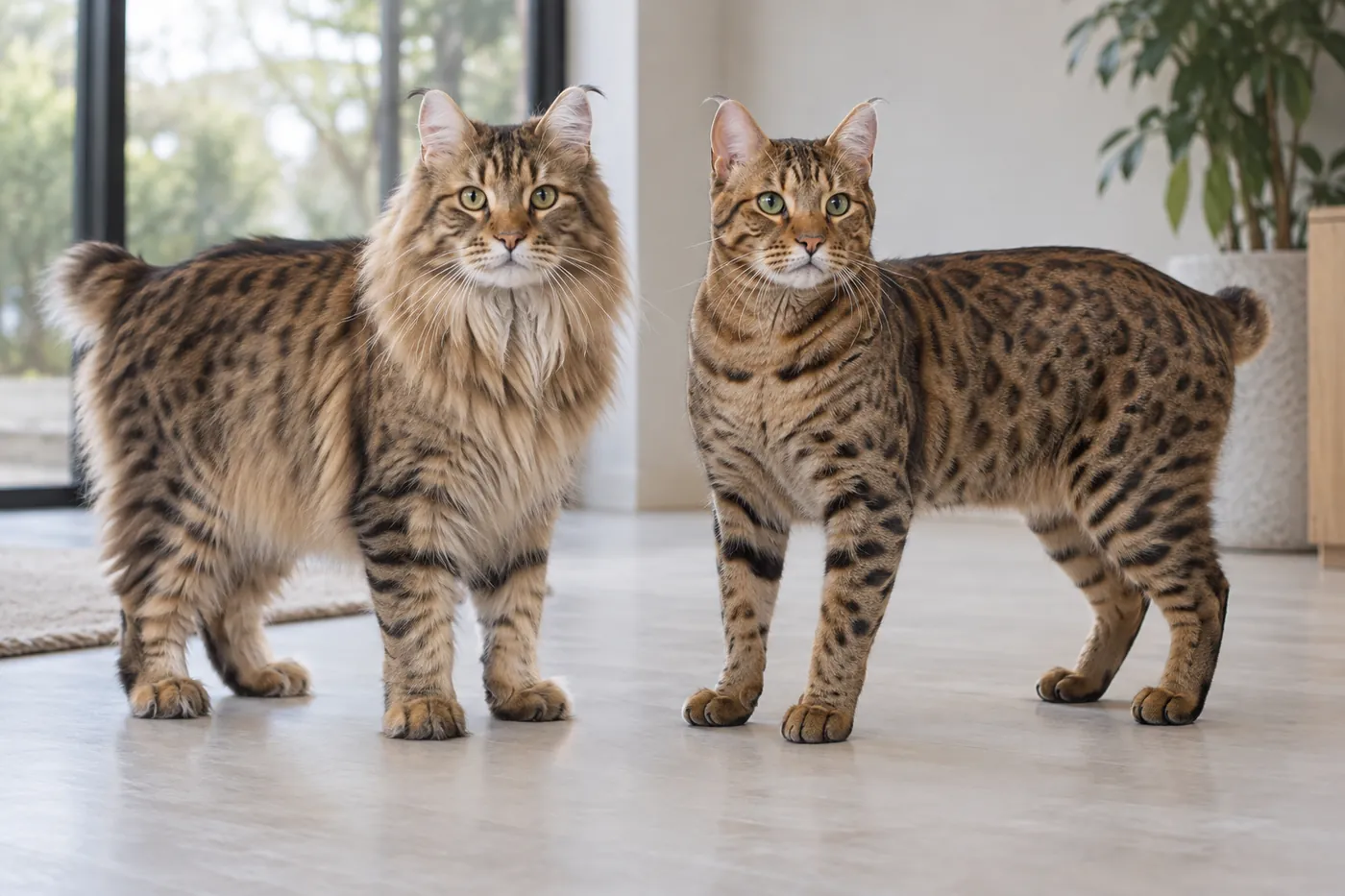
Polydactyly appears in some informal Highland Lynx marketing, but TICA's current Highlander standard disqualifies extra toes. A seller should name the registry and standard being used instead of combining incompatible labels. The loose ear curl should leave the opening visible and should not be forced into a more dramatic arc.
Equipment should follow the individual cat's measured body and tail rather than a generic medium-to-large label, especially when choosing a carrier or litter tray.
What is known about the Highlander's short-tail genetics?
The answer is more complicated than one Highlander gene. A large genetic survey found known Manx T-box variants in 94 of 231 tested Highlanders, while other short-tailed cats in the population lacked the tested variants.
That is 40.6 percent of the tested Highlanders, which shows why one broad statement about the breed's tail is inadequate. The remaining cats were negative for the variants included in that analysis; a negative result did not identify the cause of their shortened tails or prove that every untested cause was harmless. TICA breed-development documents describe work to identify novel tail variants and reduce reliance on known Manx-associated mutations. That work is ongoing population evidence and clears no individual Highlander line.
| Claim | Evidence to request | What the evidence means | What remains unknown |
|---|---|---|---|
| Known Manx variant absent | Original report naming the tested T-box variants | The named variants were not detected in that cat | Untested or novel causes of the short tail |
| Known variant present | Exact genotype and breeder explanation | Identifies one inherited tail route | Individual spinal or neurological outcome |
| Novel line claimed | Laboratory or research documentation linked to the parents | Shows why the line is called novel | The causal variant and long-term effect may still be unresolved |
| Normal movement | Current examination and videos of parents | Function at the observed time | Future disease or kitten outcome |
A line described as novel is not automatically safe, and the questions that matter are which variant was tested, what was found and how the result changed the mating decision. The laboratory report itself says more than a breeder's summary of clear. The report should identify the cat, the laboratory, the sample date, the gene or variants examined and the genotype; a result from one parent cannot be silently extended to the other parent or every kitten.
Genotype and current function answer different questions. A genetic result describes the named inherited variant, while an examination and ordinary movement videos show how one cat was functioning at a particular time.
What is a Highlander temperament like?
TICA describes the breed as playful, people-focused and relatively quiet in voice despite high physical energy. Many Highlanders are expected to greet household activity and turn movement into chase or display.
Quiet voice does not mean low need. An individual may ask for attention by following people, carrying toys, climbing into the middle of a task or repeatedly initiating chase instead of meowing.
Healthy high energy looks coordinated and recoverable. During a visit, a cat that can pursue a toy, pause when it disappears, redirect to another activity and settle without grabbing hands or repeatedly ambushing another animal is showing that kind of energy.
That combination can feel engaging in a home that wants participation. It can feel relentless when the household expected a decorative large cat that would mostly sleep.
Temperament evidence remains individual, and how the kitten behaves after visitors, household noise, handling and an interrupted play session says more than the breed description. A confident cat may investigate quickly, but healthy confidence also includes the ability to retreat and return on its own terms.
Time alone should be introduced gradually rather than inferred from a breed description. A camera can reveal pacing, prolonged calling or door-focused waiting, although those signs can also reflect a sudden routine change, insufficient activity or another health or behaviour problem.
How much space, play and training does a Highlander need?
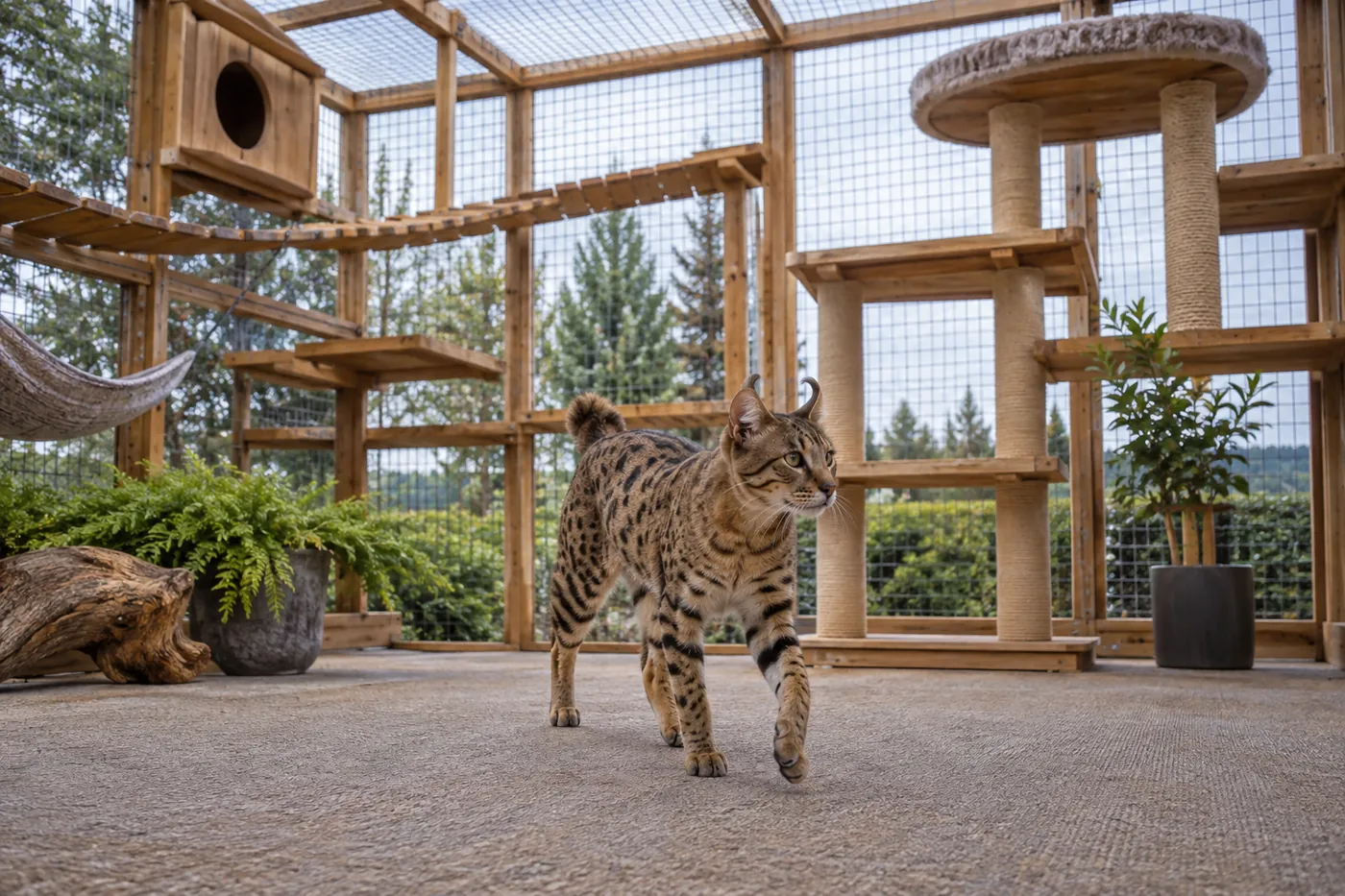
Large muscle and flexible hind legs need secure routes: broad shelves, a stable tall tree, clear landing zones and a floor lane long enough for short chase games. A useful setup offers more than height. It gives the cat a predictable route up, a platform wide enough to turn, a second way down and a resting point where another pet or child cannot block the exit.
A bigger room is not useful when every high surface is fragile or the floor has poor traction. Connected choices can change with age and let the cat descend without repeatedly launching from unstable furniture.
Short reward sessions suit carrier entry, target work, mat settling and body checks. Food puzzles should use measured portions because an athletic cat can still gain excess weight. Several brief opportunities across the day suit the cat better than one exhausting session. A chase game, food search and two-minute training exercise use different skills, while a predictable quiet period helps the cat practise settling after activity.
- Begin with a brief chase or search that uses the cat's attention
- Mark one simple behaviour such as touching a target
- Reward with a small measured food piece or immediate play
- Move the behaviour into carrier entry mat work or handling
- End before speed makes landings sloppy or the cat loses focus
- Offer a quiet elevated resting place after activity
Kittens need lower routes and closer supervision, while older cats may need broader landings and shorter distances. When movement changes, the environment changes with it, so the cat keeps some way to climb. Repeatedly missing a familiar landing, hesitating before a usual jump or abandoning play sooner than normal is more informative than a comparison with another athletic cat, and that change is worth recording and taking to a veterinarian before it is put down to laziness.
Can Highlanders live with children and other pets?
Many may enjoy busy family life because the breed is selected for an unchallenging temperament and active play. A high-energy cat still needs boundaries, especially around younger children or a timid resident cat.
Play pressure matters as much as sociability. A friendly Highlander that pursues for longer than the resident cat can tolerate is still a poor companion unless people interrupt the chase and provide separate routes, food, water, resting places and litter trays.
| Household | Likely attraction | Main safeguard |
|---|---|---|
| Older active children | Chase games and simple training | Toys instead of hands and respect for rest |
| Young children | Confident social contact in some individuals | Adult supervision and no pulling ears or tail |
| Playful resident cat | Matched speed and reciprocal pursuit | Separate resources and gradual introduction |
| Quiet resident cat | Company may still develop | Multiple escape routes and protection from repeated chase |
| Cat-safe dog | Robust confident interaction in some cats | Controlled barriers and an elevated dog-free path |
Never use the tail as a handle and never encourage children to unfold the ears. Cartilage and tail anatomy are not interactive tricks, even when the cat appears tolerant.
A new cat starts in a closed base room, with scent exchanged before face-to-face contact. Barrier sessions should be short enough that both animals can eat, explore or disengage; staring, blocking or repeated pursuit means the introduction has moved too quickly.
Small pets require secure physical separation. A friendly domestic cat retains the stalking and capture sequence of its species.
How do you groom curled ears and two coat lengths?
The short coat usually needs light weekly brushing, while the longhair needs combing through the belly and furnishings. Frequency should follow tangles and seasonal shedding rather than the breed name alone.
For a longhair, separate the coat with your fingers and comb the friction areas behind the forelegs, around the trousers and under the collar area. For a shorthair, a light pass that removes loose hair is usually more useful than repeated brushing that irritates the skin.
The curled ear is open rather than tightly folded. Inspect the visible surface for wax, redness, odour or soreness, and never force the curl farther back or insert a swab into the canal. Clean only what your veterinarian has advised you to clean, using a cat-safe product and allowing the cat to shake. Persistent debris can come from mites, infection, allergy or skin disease, so repeated home cleaning can delay the diagnosis without fixing the cause.
- Comb to the skin gently where the long coat separates poorly
- Use a soft brush or cloth on short coats
- Check the visible ear without changing its natural curl
- Feel the tail only within the cat's willing comfortable range
- Watch the gait while the cat moves voluntarily
- Trim claws according to wear and build dental handling gradually
- Book veterinary care for persistent discharge pain stiffness or balance change
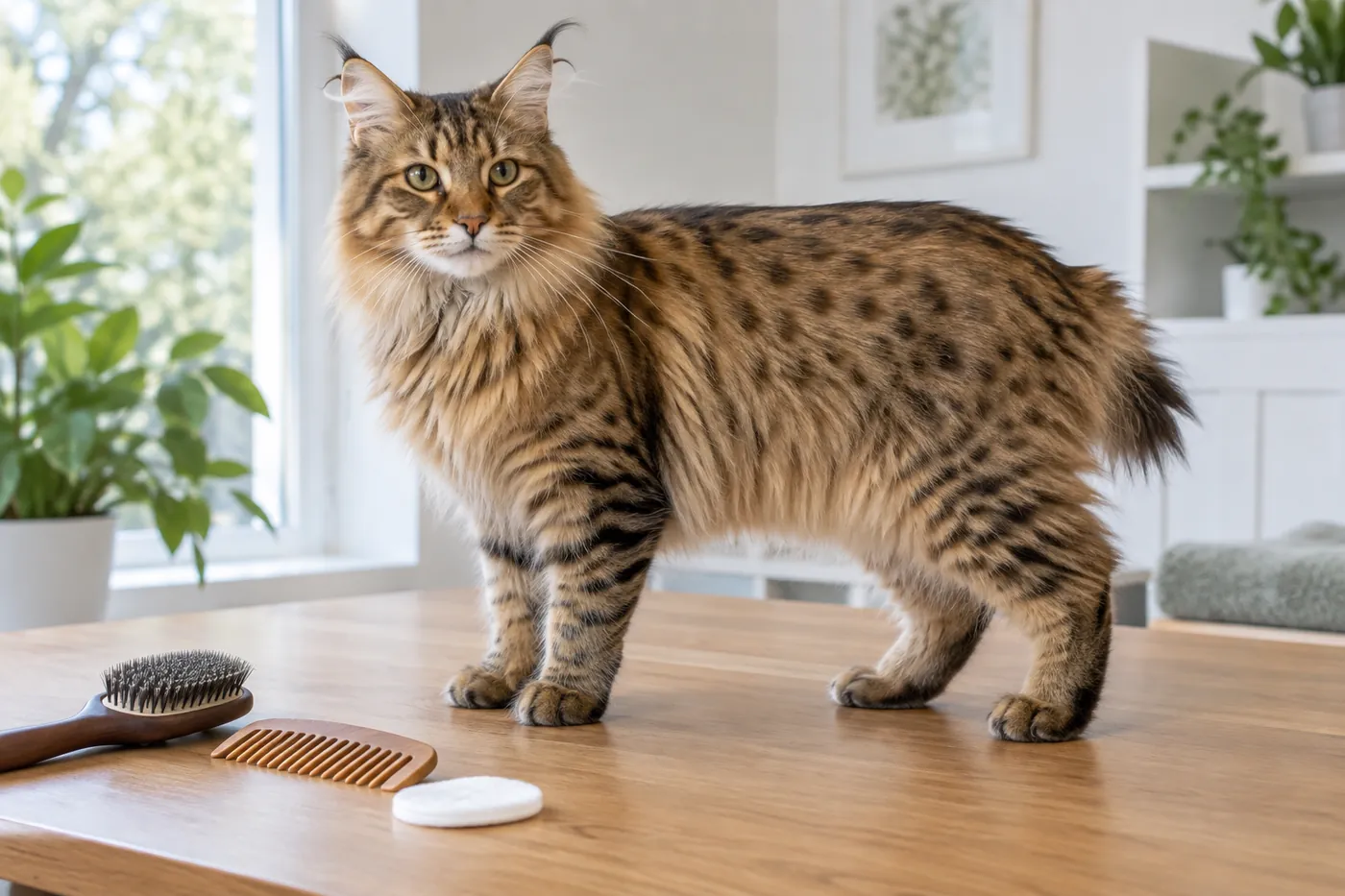
The tail may contain hooks or kinks allowed by the standard, so forceful straightening is inappropriate. A new reduction in motion, pain response or change in gait needs professional assessment. Use cooperative handling: touch briefly, reward, and stop before the cat has to struggle. That routine makes it easier to notice a new sensitive area because you know how the cat normally responds to the same gentle check.
What health records should a Highlander breeder provide?
There is no dependable Highlander-specific lifespan estimate or complete disease map. The developing tail evidence makes exact documentation more important than a generic DNA clear statement.
There is no single test result that certifies the whole cat. Tail genetics, physical examination, family outcomes and current movement each cover a different part of the decision, and an honest breeder should explain the limits of every record without turning uncertainty into reassurance.
| Evidence | Ask to see | Reader value | Limit |
|---|---|---|---|
| Pedigree | Original registry records for kitten and parents | Confirms the claimed population and coat division | Does not prove health |
| Tail panel | Full laboratory report naming every variant tested | Shows known results rather than a summary label | Cannot detect an unnamed novel variant |
| Parent movement | Dated examination and ordinary movement videos | Provides evidence of current function | Does not predict every kitten |
| Cardiac and general exam | Named veterinarian findings with dates | Shows what was assessed | Not permanent clearance |
| Family history | Ages diagnoses mobility and causes of death | Reveals follow-up through the line | Depends on complete reporting |
| Breeding explanation | Why this pair was chosen given tail results and relatedness | Tests whether evidence changed a decision | Explanation still needs records |
The useful question is whether any kitten developed continence problems, hind-limb weakness, pain or an unusually short rigid tail. A breeder should track pets that never enter a show ring because those cats still carry the family's health evidence. Outcomes for adult relatives on both sides matter too, including cats kept as pets and cats removed from breeding. Ages, diagnoses, mobility changes and reasons for retirement are more useful than a row of young parents described only as healthy.
Which cardiac check was performed, and by whom, matters because a routine examination, an echocardiogram and a genetic test are different records, so the phrase heart checked has little value until the method, date, result and cat identity are visible.
New pain, altered urination or defecation, weakness, repeated falling or a stiff tail requires veterinary care. A tray that becomes difficult to enter may reveal reduced movement before a clear limp appears.
Is a Highlander right for your home?
A Highlander suits a home where an active, involved domestic cat fits and the owner is comfortable evaluating a developing breed's records. The ears and tail should be secondary to movement, comfort and temperament.
Time with the cat on ordinary surfaces shows what posed photographs cannot: how it walks away, turns, climbs into a tray, jumps onto a low platform, plays and settles. Comparable unedited observations of both parents add to that when they are available.
- Verify domestic pedigree and the exact registry standard
- Read the complete tail-variant report for both parents
- Observe ordinary walking jumping turning and litter use
- Provide broad stable vertical routes and grippy landings
- Plan daily play training and predictable social contact
- Match coat care to the longhair or shorthair individual
- Protect ears and tail from handling by children
- Reject wild-hybrid marketing and universal health claims
This breed is a poor fit when the home wants a quiet ornamental cat or when unusual anatomy matters more than records. It is also a poor purchase when a seller cannot explain which tail variants were tested and why the pairing was made.
An adult Highlander in a breed rescue or rehoming situation may offer unusually useful information because its movement, coat, social recovery and household preferences can be observed directly. Adoption also avoids creating demand for a mating whose tail evidence you cannot evaluate.
A seller who treats unknown genetics as proof of safety, markets domestic cats as exotic hybrids, or discourages an independent veterinary examination is one to walk away from. Uncertainty is acceptable in a developing breed only when it is stated plainly and used to make a more cautious decision. The best-practice choice is a freely moving, socially stable cat from a breeder who can show the limits of the evidence. A dramatic silhouette is never worth guessing about lifelong function.
Common Questions
Is a Highlander cat part lynx or bobcat?
No verified Highlander standard requires wild-cat ancestry. TICA describes the breed as developed from the domestic cat gene pool, and its wild-looking features do not make it a hybrid.
Are Highlander cats polydactyl?
Some cats marketed under older or informal Highland Lynx labels have extra toes, but the current TICA Highlander standard disqualifies polydactyly. Ask which registry standard the seller uses.
Why does a Highlander have a short tail?
The population has not had one uniform explanation. Known Manx T-box variants occur in some Highlanders, while other tested short-tailed cats lacked those variants and were investigated for novel causes.
How active is a Highlander cat?
TICA describes a high-energy, playful and people-focused cat. Plan secure climbing, clear landing zones, short chase games, food-search work and regular social contact.
Checked Against
- TICA: Highlander tica.org
- TICA: Highlander breed-group standard tica.org
- TICA: Highlander breed-development genetics tica.org
- TICA: Highlander tail-variant breeding plan tica.org
- Anderson et al.: Genetic epidemiology of blood type, disease and trait variants, and genome-wide genetic diversity in over 11,000 domestic cats (PLOS Genetics, 2022) pmc.ncbi.nlm.nih.gov
- American Curl ear inheritance pubmed.ncbi.nlm.nih.gov
- Bradshaw: Normal feline behaviour and why problem behaviours develop (Journal of Feline Medicine and Surgery, 2018) pmc.ncbi.nlm.nih.gov
- 2021 AAHA and AAFP feline life-stage guidelines pmc.ncbi.nlm.nih.gov
Published 13 September 2026. Last updated .