
What Is a Chausie, and Why Does Its Generation Number Matter?
Every practical question about a Chausie traces back to one number: how many generations separate this specific cat from its jungle cat ancestor. That number affects where it may be legal to keep, whether the males can breed, how predictable its behaviour may be, and what a buyer should verify.
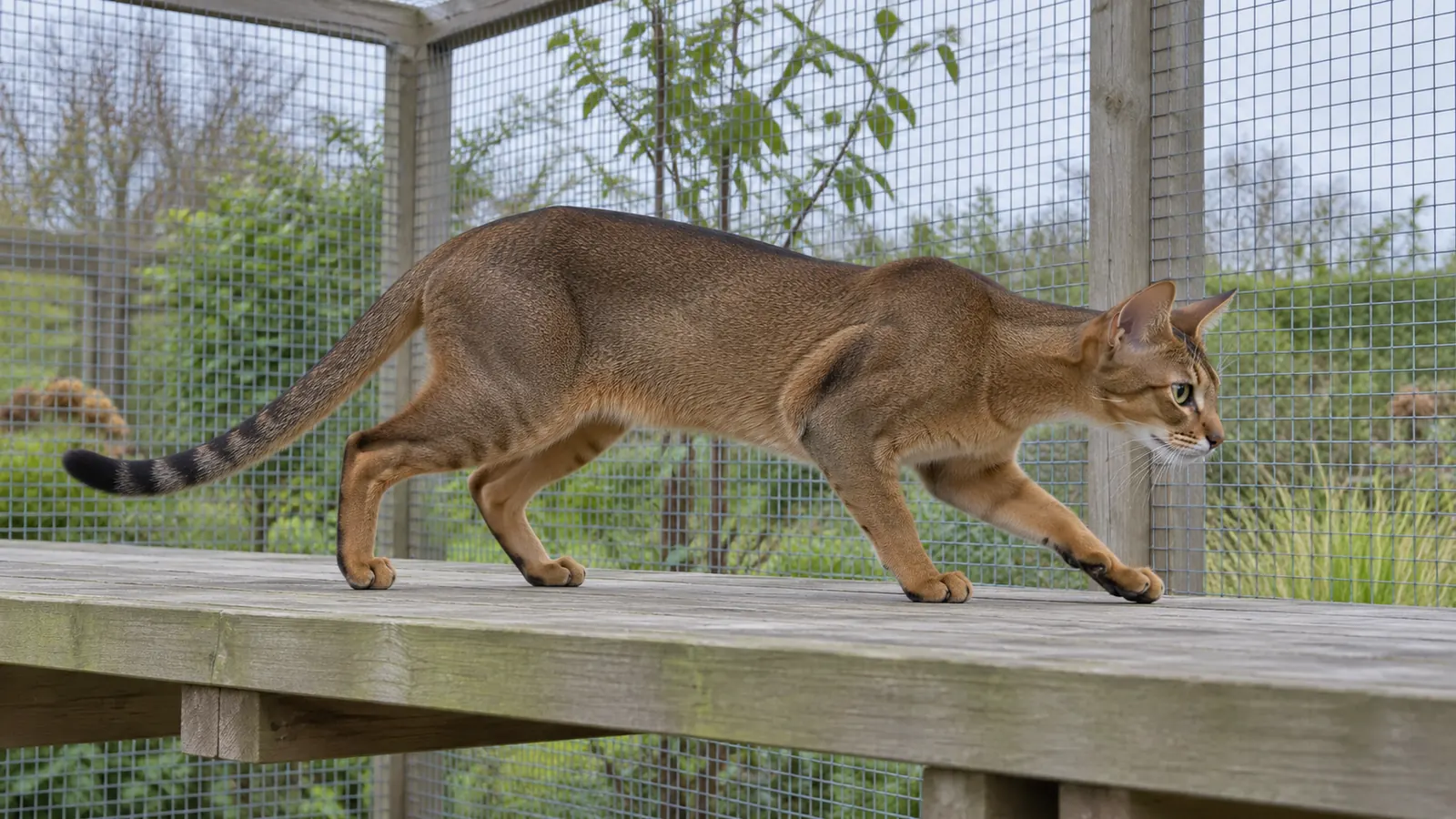
- Origin
- Developed from crosses between the jungle cat (Felis chaus) and domestic cats, formalised as a breed in the United States from the 1990s
- Coat
- Short, in solid black, black grizzled tabby, or black ticked tabby for championship classes; other colours occur outside competition
- Size
- Medium to large, long-bodied and long-legged, built for running and jumping rather than bulk
- Typical weight
- Roughly 11 to 16 pounds for males and 8 to 13 pounds for females, about 5 to 7 kg and 3.5 to 6 kg
- Life expectancy
- Commonly quoted at 12 to 15 years; no population study has been published
- Activity level
- High. Athletic, playful well into adulthood, and closely bonded to its people
- Grooming
- Low. A weekly comb is generally enough for the short coat
- Suits
- Experienced owners who can verify local legality and meet the needs of an athletic hybrid-derived cat
Two Chausies can need quite different things from their owners, and the reason is usually one number. Almost everything about this breed depends on its generation: how many matings separate a specific cat from the jungle cat cross that founded its line. That number shapes where the cat may legally be kept, whether a male can father kittens and how predictable its behaviour is likely to be.
What does the generation number on a Chausie actually mean?
It is a count of how many matings sit between this cat and the original jungle cat parent. An F1 is the direct offspring of a jungle cat and a domestic cat. An F2 is an F1 bred back to a domestic cat, and so on, with wild ancestry roughly halving at each step.
Once a line is far enough removed from the jungle cat, TICA designates its cats SBT, and only SBT cats are eligible to compete in championship classes.
| Generation | Approximate wild ancestry | Male fertility | Typical temperament predictability |
|---|---|---|---|
| F1 | About 50 percent | Sterile | Least predictable, most demanding |
| F2 | About 25 percent | Sterile in most males | Still variable |
| F3 | About 12 percent | Varies between individual males | More consistent |
| F4 and later | 6 percent or less | Varies between individual males | Closest to an ordinary domestic cat |
Legal risk is left out of the table because it depends on where you live rather than on the generation alone: some rules restrict only early generations, while others cover any animal with wild ancestry.
TICA granted the Chausie foundation registration in 1995 and championship status from 1 May 2013. The World Cat Federation's list of shorthair breeds also includes the Chausie, so a registered cat's papers can come from WCF as well as TICA.
Why cross a jungle cat with an Abyssinian in the first place?
The Abyssinian was the starting point because it already looked the part: its ticked coat and lean, alert build echo a wild cat's appearance closely enough that early breeders could push a domestic line toward jungle cat proportions without starting from nothing.
Breeders first recorded a mating between a jungle cat and a domestic cat in 1990, and the breed as a defined programme, complete with a name drawn directly from Felis chaus, came together through the 1990s as breeders worked to fix a consistent standard and temperament rather than leaving each litter unpredictable.
The goal from the start was explicit: a cat that looked and moved like its wild ancestor without the legal, welfare and practical burden of keeping one.
Why are Chausie males sterile in the early generations?
Crosses between different cat species follow a documented pattern called Haldane's rule: when one hybrid sex is sterile, it is almost always the male. A 2021 study in the journal Molecular Biology and Evolution examined this directly in Chausies and found the mechanism was linked to the X chromosome.
In testes from sterile Chausie males, sperm development stops partway through a stage called pachynema, and about a fifth of the protein-coding genes on the X chromosome were more active than in fertile males. The study also found that fertility does not return at a fixed generation: litters begin producing fertile males after two or three generations, and males from about the third to the fifth generation vary, some fertile and some not.
- F1 and F2 males
- Sterile, following Haldane's rule for hybrid crosses
- F3 to F5 males
- Fertility varies between individual males
- Mechanism
- Arrested sperm development linked to X-chromosome gene expression
- What this means for breeding
- Early F1 females are bred back to domestic males or later fertile Chausie males, never to another F1 male
The practical consequence is that an F1-to-F1 mating cannot produce kittens, because the F1 male is sterile. Programmes work by repeatedly crossing females back toward domestic lines, which is also why the wild-ancestry percentage in the table above keeps halving rather than staying fixed.
Is it legal to own a Chausie where you live?
The answer depends on the country, the state and sometimes the town, and it is harder to pin down for a Chausie than for most breeds.
Rules may classify an animal by wild ancestry rather than by the breed name on its pedigree. A summary for Savannahs or another hybrid cannot settle how a Chausie is treated.
United States law is particularly fragmented. Some rules name species, while others use broad language about wild or hybrid felines that can cover a Chausie even when the statute never mentions Felis chaus, and local ordinances may add another layer.
- Read your state's exotic or hybrid animal statute for the actual wording, not a summary written for Savannahs
- Check whether the law sets a generation cutoff, since some rules restrict only early generations
- Check city and county ordinances separately, since a state-legal cat can still be a city-illegal one
- Ask a breeder for their own understanding of your specific jurisdiction in writing, and verify it yourself anyway
Legal ownership also leaves the bite question open. South Carolina says wild-domestic hybrids may be handled under its rule for animals other than dogs, cats and ferrets, and public-health officials decide how the rule applies to the animal and exposure.
Under that rule, the department may require immediate euthanasia and testing or specify quarantine conditions. A vaccination record does not let an owner assume the ordinary domestic-cat protocol will apply, so the current rule is worth confirming with the responsible agency before ownership.
How big does a Chausie get?
A Chausie is medium to large and built for movement rather than bulk.
Adult males typically reach 11 to 16 pounds and females 8 to 13 pounds, on a long body with long legs. That is a modest weight range next to the Savannah's, and the visible difference between a Chausie and an ordinary cat is proportion rather than sheer size.
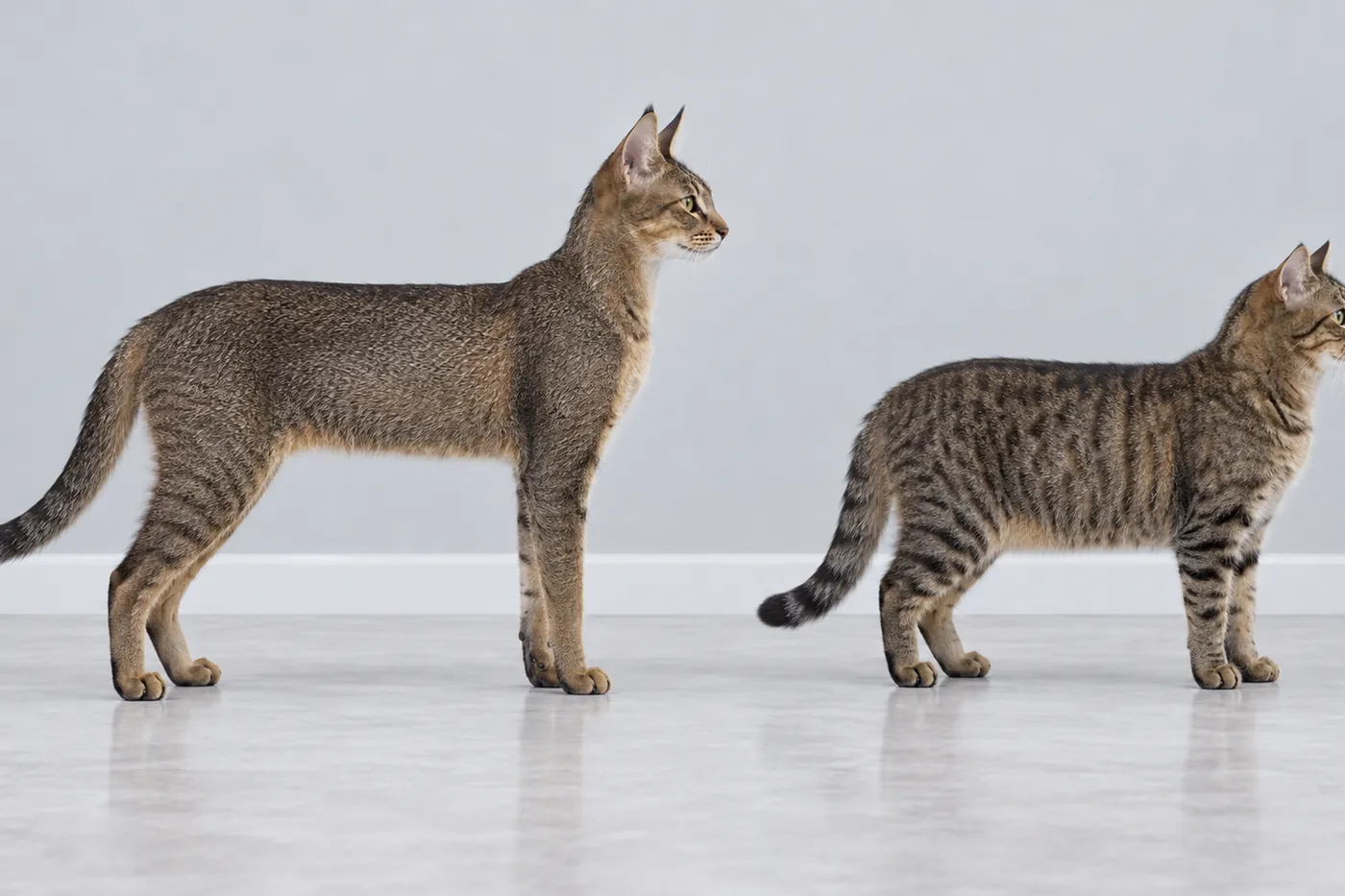
Three coat variants compete in championship classes: solid black, black grizzled tabby, and black ticked tabby. The grizzled pattern is the one worth knowing by name: TICA attributes it to the jungle cat used in developing the breed, so it marks the wild parentage rather than an ordinary domestic tabby.
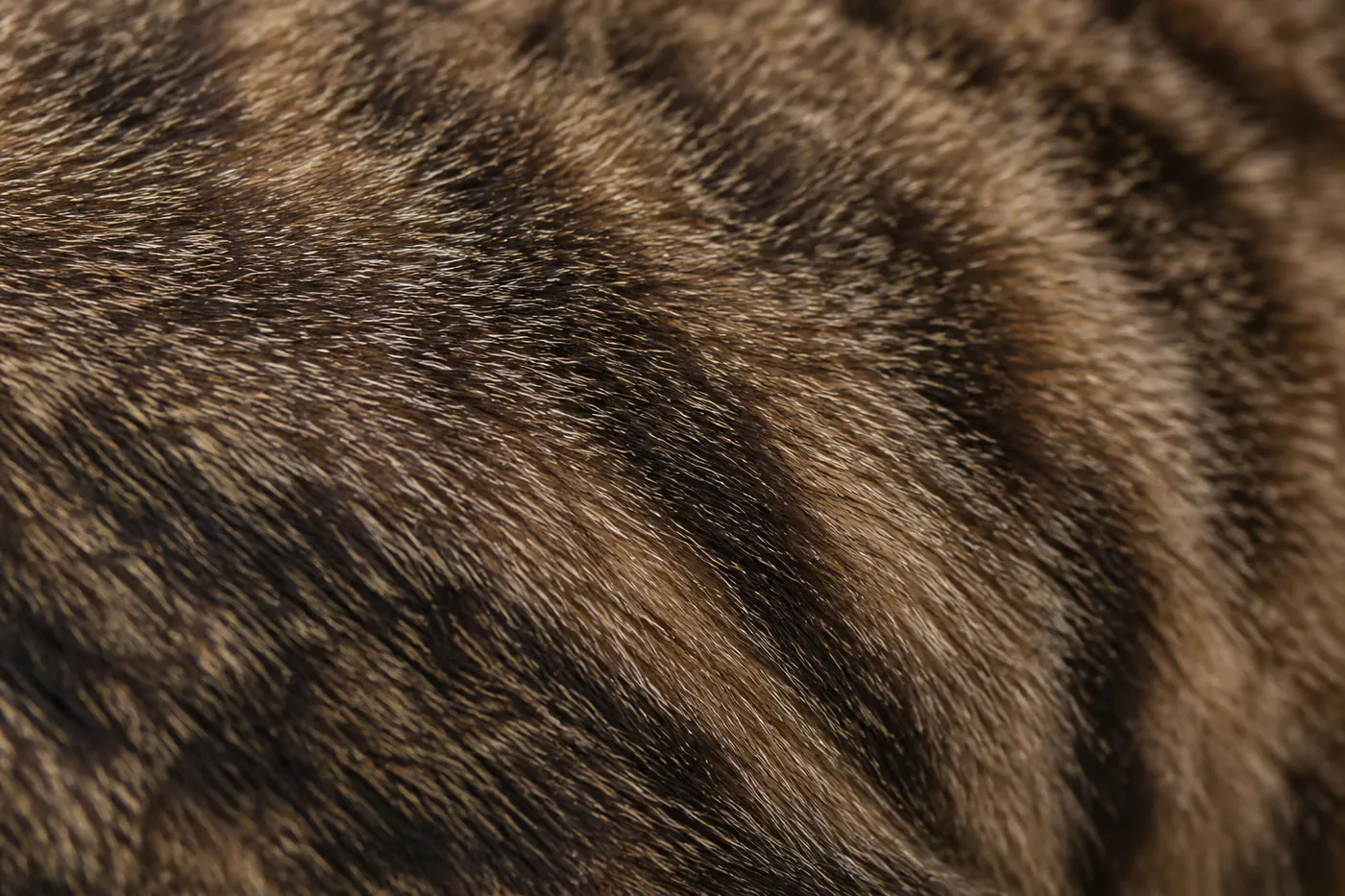
Growth runs slower than an ordinary cat's. A Chausie typically does not reach full adult size until two to three years old, and earlier generations tend to mature even more slowly than later ones, so a two-year-old F1 may still be filling out while an SBT littermate of the same age is already finished.
What is it actually like living with one day to day?
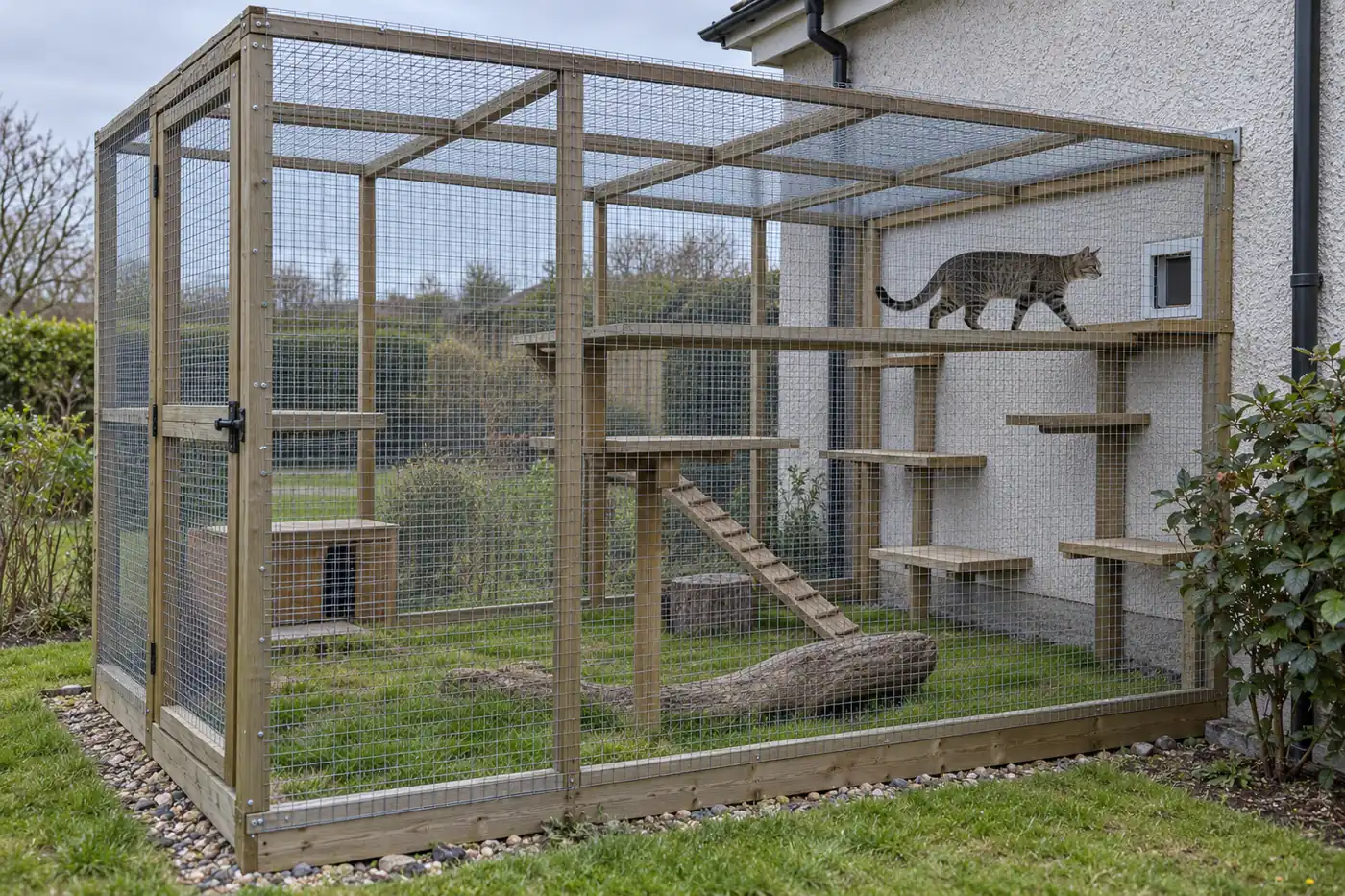
A Chausie is usually loud, active and hard to satisfy with a purely indoor routine. Chausies are reported as consistently vocal, including a loud purr, and owners commonly describe a cat that asks clearly for what it wants rather than waiting quietly. Daily outdoor time, whether that means a secure enclosure, harness walks or supervised garden access, tends to matter more for a Chausie than for most breeds.
Does an early-generation Chausie need a special diet?
No breed-specific diet has been established. Breeders sometimes say early-generation Chausies have a shorter intestine and need raw food, but no published study supports either claim. A complete food suited to the cat's life stage and body condition covers its needs, and a new kitten settles best on its familiar food for the first days at home, with any change made gradually.
Cornell advises that raw diets have no clear proven benefit and can expose cats and people to bacteria, viruses and parasites. Persistent diarrhoea, vomiting, poor growth or food refusal needs a veterinary assessment rather than a more exotic protein or an assumed hybrid sensitivity.
What is the temperament like, and does it change by generation?
Across the whole line, Chausies are described as athletic, playful well into adulthood and closely bonded to their people.
Generation changes predictability more than affection, because temperament becomes easier to predict as wild ancestry recedes. An F1 or F2 carries more of the behavioural unknowns that come with recent wild ancestry, while an SBT cat behaves close to an ordinary confident, energetic domestic cat.
Chausies form strong attachments and are reported to struggle with rehoming as adults, which is worth weighing seriously before committing to any generation. Their need for daily play also stays high long after most cats have slowed down, so the usual exercise needs by age understate what an adult Chausie wants.
What should you ask a breeder, and what should it cost?
Generation, registration, location and the individual breeder can all affect an asking price, so an uncited online range is a poor budget and a poor identity check.
Paperwork matters more for a Chausie than for an ordinary pedigree cat because the generation claim affects both legal questions and behavioural expectations. That claim is only as good as the registration behind it: a seller-created certificate proves nothing, while the issuing registry can confirm a registered cat's generation.
- A registration document and pedigree showing the generation, from a registry that can confirm it
- A veterinary record book with the vaccination history, rather than a verbal assurance
- The name of the food the kitten eats now, so it can stay on it for the first days at home
- For a first cat, an F3, F4 or SBT kitten. An F1 or F2 offered to a first-time owner is a reason to slow down
Who should think twice about one?
The first group is anyone who has not checked local law against the actual statute, in writing, rather than a general list.
Anyone choosing a first cat is better served by SBT or late F4 lines, or by a different breed entirely. The legal uncertainty and behavioural unpredictability of an early generation are not a forgiving place to learn cat ownership. Anyone who cannot commit to an athletic, demanding, closely bonded cat for well over a decade should also look elsewhere.
If the appeal is a leggy, wild-looking, hybrid-derived cat and the legal uncertainty is the sticking point, the Savannah is a related but separately regulated alternative, with its own size range and its own state-by-state picture to verify independently.
Common Questions
What does F1, F2, F3 mean on a Chausie?
It counts generations from the original jungle cat cross. An F1 is the direct jungle cat and domestic cat offspring; each later generation is bred back to a domestic cat, roughly halving the wild ancestry each time until a line reaches SBT, the designation TICA gives the later generations it allows in championship classes.
Are male Chausies infertile?
F1 and F2 males are sterile, following Haldane's rule for hybrid crosses. A 2021 study linked the sterility to arrested sperm development and X-chromosome gene activity, and found fertility varying between individual males from about the third to the fifth generation.
Is a Chausie legal to own?
It depends on your jurisdiction, and US state law is inconsistent about naming the jungle cat specifically rather than just the Serval. The rule may classify the animal by ancestry instead of the breed name. The current statute and local ordinance, confirmed with the responsible agency, settle the question.
Do Chausies need a special diet?
No reliable evidence establishes a shorter intestine or a raw-food requirement for the breed. A complete life-stage diet meets its needs, changes go best when made gradually, and persistent digestive signs need a veterinary assessment rather than an assumption that hybrid ancestry is the cause.
Why does a Chausie price vary?
Generation, registration, location and the individual breeder can all affect the asking price. A registration and pedigree confirm the generation you are paying for, and written quotes from breeders make a better budget than an uncited online range.
Is a Chausie a good cat for a first-time owner?
An SBT or late F4 Chausie can suit an experienced, active household. An F1 or F2 is a poor first cat, because legal uncertainty and the behavioural unpredictability of early generations leave little room for beginner mistakes.
Checked Against
- The International Cat Association: Chausie breed standard and history tica.org
- South Carolina DPH: exotic pets and farm animals dph.sc.gov
- South Carolina DPH: rabies laws and regulations dph.sc.gov
- Molecular Biology and Evolution: rapid macrosatellite evolution promotes X-linked hybrid male sterility in a feline interspecies cross pmc.ncbi.nlm.nih.gov
- Cornell Feline Health Center: feeding your cat vet.cornell.edu
- World Cat Federation: shorthair breed standards wcf.de
Published 11 September 2026. Last updated .





