
What Is a Cymric, and What Does Its Tail Gene Mean for Health?
A Cymric is the longhaired member of the Manx breed group, sharing its body, tail spectrum and inherited risks. The coat is manageable, but the tail-reducing Brachyury variants can also affect spinal and pelvic development, so movement, toileting history and responsible breeding evidence matter more than whether a kitten has the shortest possible tail.
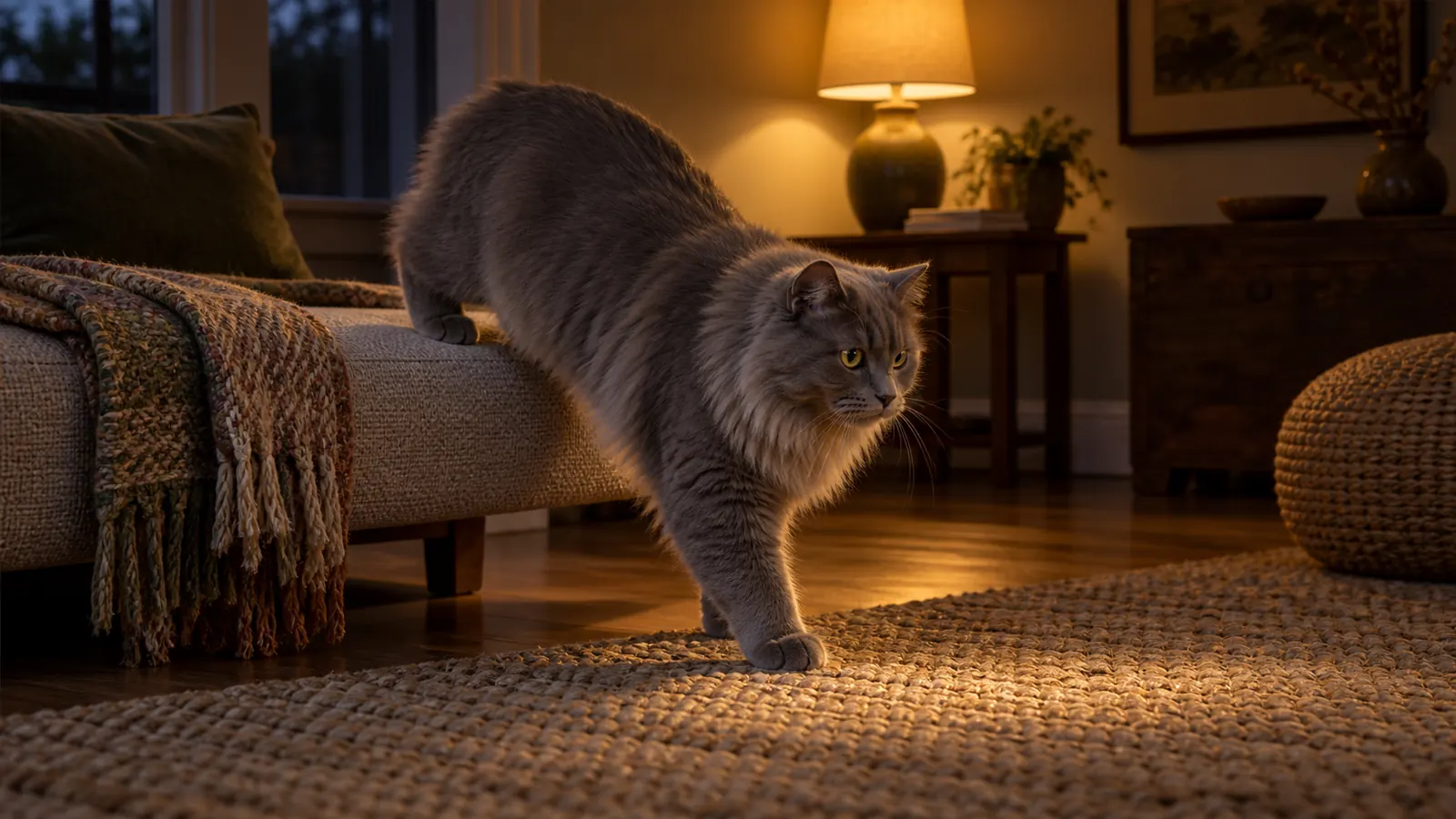
- Origin
- The longhaired form of the Manx population associated with the Isle of Man, formalised under the Cymric name in North America
- Coat
- Medium-long to long double coat with breeches, abdominal hair and a full ruff in mature cats
- Size
- Medium, compact, rounded and heavy for its size, with longer hind legs and powerful hindquarters
- Typical weight
- No dependable separate Cymric population range; judge the individual within the Manx breed group
- Life expectancy
- Not established separately from Manx by robust population data
- Activity level
- Moderate and playful, with jumping ability varying when spinal or mobility problems are present
- Grooming
- Moderate. Comb through the double coat regularly and more often during seasonal shedding
- Suits
- Homes prepared to prioritise mobility and toileting evidence, maintain a double coat and reject breeding that treats extreme taillessness as the only goal
The long coat gives the Cymric a soft, rounded outline. The gene behind the short or absent tail is the part that needs the harder look. Tail length is visible, but it is not a complete health test. A responsible decision starts with how the cat moves, toilets and has been bred, then considers coat and temperament.
Is a Cymric the same breed as a Manx?
TICA places Cymric and Manx in one breed group and says they differ only in coat length. CFA registers the longhaired form as Longhair Manx and notes that it was once called Cymric. That makes the answer registry-dependent in wording but simple in biology. These cats share the same body standard, tail-length spectrum and inherited welfare concern.
| Feature | Cymric or Longhair Manx | Shorthair Manx |
|---|---|---|
| Coat | Medium-long to long double coat | Short dense double coat |
| Body | Compact, rounded and muscular | The same |
| Hind legs | Longer than forelegs | The same |
| Tail spectrum | Rumpy through fully tailed | The same |
| Core inherited concern | Brachyury-related tail and spinal development | The same |
| Registry wording | TICA uses Cymric; CFA uses Longhair Manx | Both use Manx |
A pedigree should therefore make clear which registry and coat division are being used. One label is not evidence that the longhaired cat escapes the Manx health question.
What do rumpy, riser, stumpy and longy mean?
They are practical names for positions on one tail-length spectrum within the same breed. A rumpy has no externally visible tail vertebrae, while a rumpy riser has a small rise that may be felt. A stumpy has a short partial tail, and a longy or tailed cat has substantially more tail, sometimes close to ordinary length.
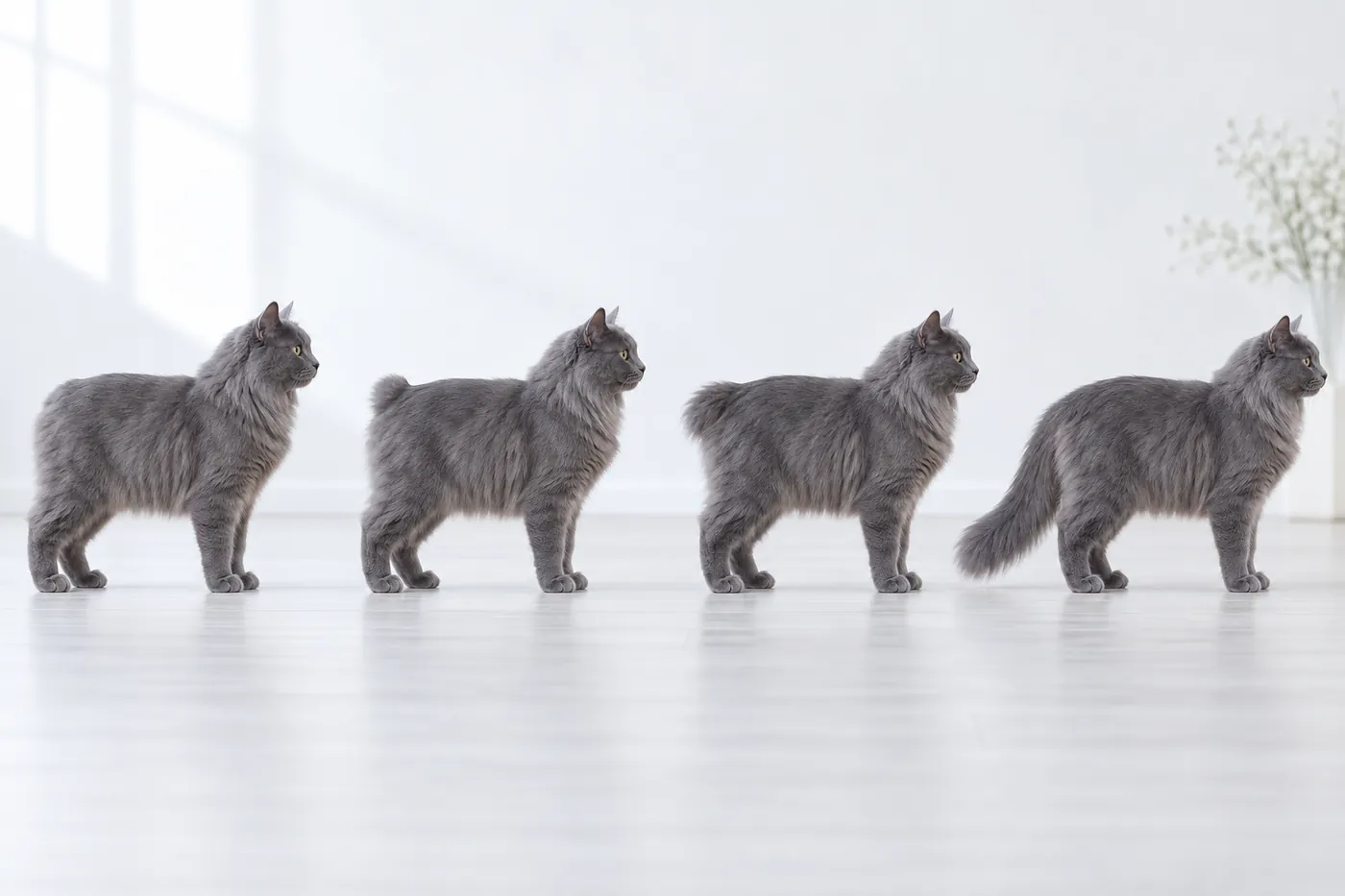
Show rules can favour a particular presentation, while a breeding programme needs tailed cats to protect genetic diversity and avoid high-risk pairings. A family choosing a companion should not treat a full tail as a defect.
Why can the tail gene affect more than the tail?
Manx-type taillessness is caused by variants in the T gene, which encodes the developmental protein Brachyury. Research has identified multiple frameshift variants that reduce normal Brachyury function. The gene acts while the embryo's spine and related structures are forming. A variant selected because it shortens the tail can therefore be associated with malformations involving the sacral spinal cord, vertebrae and nerves that control the hindquarters, bladder and bowel.
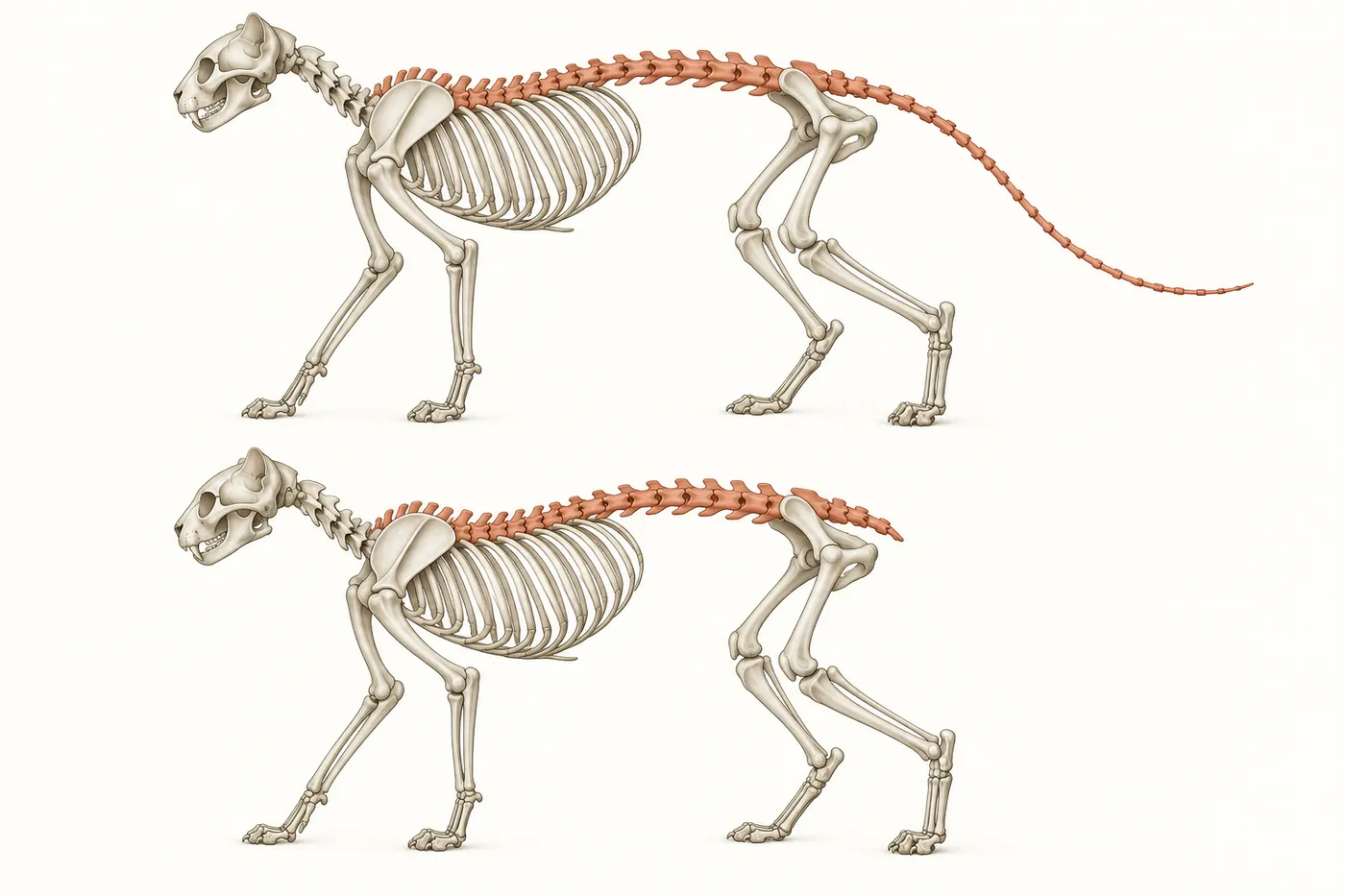
The risk is not identical in every short-tailed cat. Expression varies, so neither a rumpy tail nor a longer tail tells the entire neurological story on sight.
What signs are associated with Manx syndrome?
Published veterinary reports describe spina bifida, weak or abnormal pelvic-limb movement, urinary or faecal incontinence and related developmental problems. These signs require veterinary attention, whether the disability is obvious or appears as subtler difficulty using the tray or keeping the hindquarters clean.
- Watch the cat walk, turn, run and rise from rest on a non-slip surface
- Ask whether either hind foot scuffs, crosses or places unpredictably
- Confirm that urine and stool are passed voluntarily and consistently
- Look for persistent soiling, urine scald or skin irritation around the rear
- Ask for every spinal, neurological or toileting assessment already performed
- Arrange an independent veterinary examination rather than relying on tail appearance
Urgent veterinary attention is appropriate for inability to urinate, sudden hind-limb weakness, severe pain or loss of bladder or bowel control. Do not attribute a new problem to the breed and wait.
When can a kitten be assessed with more confidence?
The later the observation window, the more opportunity there is to see coordinated movement and voluntary toileting. A very young kitten has not yet demonstrated the ordinary functions an owner needs to evaluate. Some breeding guidance historically recommended keeping Manx kittens until at least four months because developmental problems may emerge as they grow. That is not a guarantee that every later problem has been excluded, but it is a useful reason to resist unusually early handover and to confirm voluntary toileting over time.
- Early weeksTail length is visible, but movement and elimination are still developing
- Weaning periodGait, play and litter use can be observed repeatedly
- Around four monthsA longer record of voluntary toileting and coordinated movement is available
- After acquisitionThe new veterinarian establishes an independent baseline
- Across lifeNew pain, gait or elimination changes are assessed as medical signs, not dismissed as normal for the breed
Ask for written observations and veterinary records rather than a verbal promise that the kitten has never had an accident.
What does a healthy Cymric look like in motion?
The standard body is compact and rounded, with a deep flank, broad chest and hind legs longer than the forelegs. That structure can create a rising back line without causing an abnormal gait.
A healthy individual should still move willingly and place the hind feet with control. A rabbit-like hop repeated at ordinary walking speed, difficulty climbing into the tray or reluctance to have the rear touched deserves examination rather than romantic description.
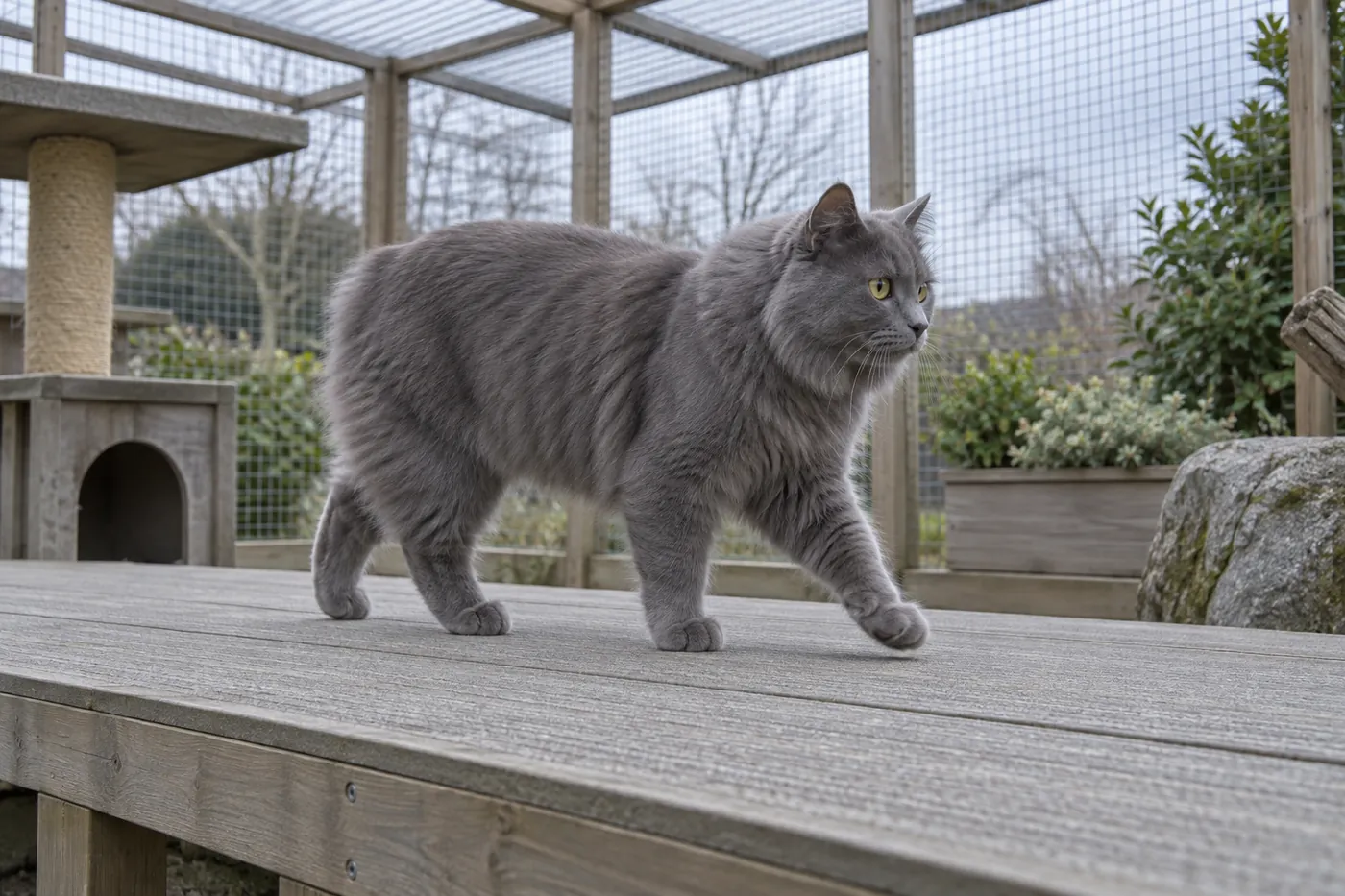
The breed is slow to mature, so the body may continue filling out for several years. Equipment should support the adult cat's substantial body and any individual mobility limit.
How much grooming does the long coat need?
A Cymric needs more grooming than the shorthaired Manx, because it carries a medium-long to long double coat with longer hair around the neck, abdomen and hindquarters. Seasonal shedding can increase the workload.
Comb to the skin without scraping it, paying attention behind the forelegs, through the breeches and under the abdomen. Tool angle matters, and a small tangle separated early is far easier to clear than one left to tighten.
- Feel through the coat with your fingers before using a comb
- Work one small area in the direction the hair grows
- Support the skin below a tangle instead of pulling from the tip
- Stop before irritation turns grooming into avoidance
- Check the rear coat for urine or faecal soiling separately
- Seek veterinary or professional help for tight mats close to skin
A sudden inability to keep the rear clean may reflect pain, weight gain or neurological change, so trimming dirty hair alone may miss the reason.
What home setup helps a Cymric?
A sound, mobile Cymric can be playful and capable, but the safest setup allows the individual to choose routes that do not depend on one large jump. Broad stable platforms, non-slip landing areas and more than one way down provide those routes. A low-entry tray is useful for a cat with limited mobility, while a cat moving normally may use a standard tray that provides enough floor length.
- Floor grip
- Add stable non-slip surfaces where the cat accelerates or lands
- Vertical route
- Use intermediate steps and broad supported platforms
- Litter access
- Match entry height to the individual's movement, with generous turning room
- Rest
- Offer warm supported beds at both floor and raised levels
- Resources
- Distribute food, water, litter trays and rest so no animal blocks the only set
- Monitoring
- Notice a route the cat stops using before removing every high option
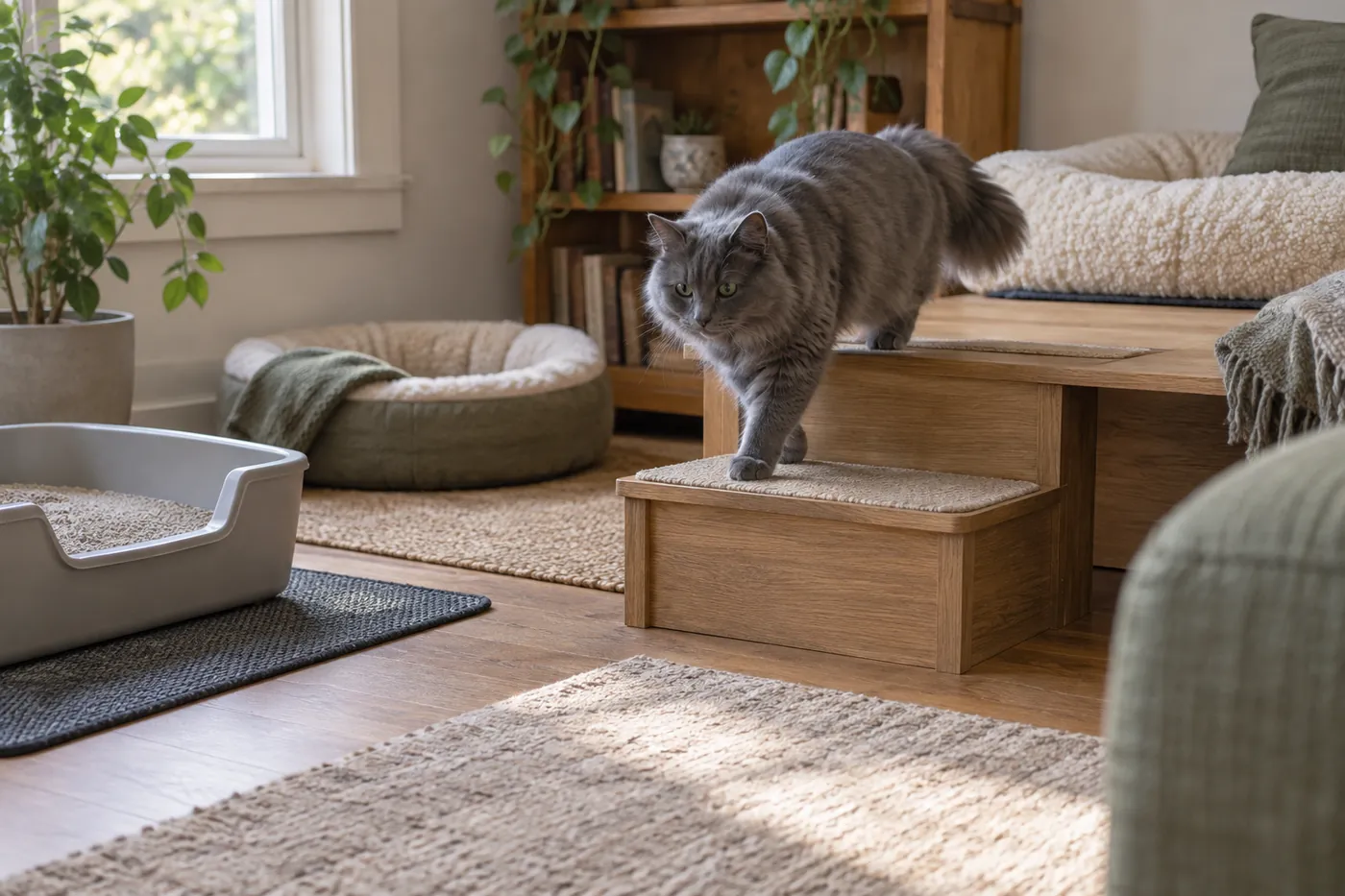
Breed risk alone is no reason to restrict a healthy cat. Once safe choices are in place, the useful signal is a change in which of them the cat uses.
What temperament should a family expect?
TICA describes the Manx and Cymric group as affectionate, adaptable and playful, often fitting families and other pets. Those descriptions are tendencies, and pain or neurological difficulty can change tolerance for touch and activity.
Children should support the body, avoid the rump and let the cat leave. No one should press or manipulate the tail area to test how much is present.
Introductions to cats and dogs need scent exchange, distance and separate resources. A cat that moves differently also needs escape routes another animal cannot block.
What health and breeding records should you request?
The central evidence is broader than a DNA panel because the known T variants do not convert into a simple healthy or unhealthy certificate.
| Evidence | Ask to see | What it supports | Limit |
|---|---|---|---|
| Parent tail status | Written pedigree and breeder explanation | The logic of the mating | It does not predict every kitten outcome |
| Veterinary examination | Dated assessment of the kitten | Findings at that age | Later changes remain possible |
| Movement history | Repeated observations and videos on a normal surface | Functional gait over time | A video can omit difficult moments |
| Toileting history | Written record of voluntary urine and stool control | Everyday function before handover | Stress can alter litter use after moving |
| Family history | Diagnoses and outcomes in close relatives | Whether the breeder tracks the problem | Small numbers limit confidence |
| Permanent identification | Microchip or registered identity on reports | That records belong to the named cat | The quality of each assessment |
A responsible breeder should welcome an independent examination and explain why welfare takes priority over producing the shortest tail. Walk away from any claim that Manx syndrome is a myth or that a rumpy kitten is automatically sound.
Is a Cymric the right cat for you?
A Cymric is a sound choice when the individual has convincing mobility and toileting evidence, the breeder can explain the pairing, and you want a playful substantial cat with a double coat.
- Understand that Cymric and Longhair Manx describe the same breed group
- Prioritise movement and elimination over the shortest tail
- Never support a tailless-to-tailless mating
- Observe the kitten on a non-slip surface and using the litter area
- Read original veterinary and family records
- Prepare coat care, grippy routes and accessible resources
- Compare the shorthaired Manx, which carries the same health issue
This is a poor choice when appearance will outrank welfare evidence or when rear-coat care and lifelong observation feel excessive. A tailed Cymric with sound function can be the more responsible companion, even if it cannot win under a rule that rewards a particular tail presentation.
Common Questions
Is a Cymric just a longhaired Manx?
Yes in breed-group terms. TICA treats Cymric and Manx as coat-length divisions of one breed group, while CFA registers the longhaired form as Longhair Manx and notes that it was once called Cymric.
Do all Cymric cats have no tail?
No. Cymrics occur across a spectrum from rumpy with no externally visible tail through riser and stumpy to fully tailed cats. A longer tail does not make the cat a different breed.
What is Manx syndrome?
It is a group of developmental problems associated with tail-reducing Brachyury variants, potentially involving the spine, pelvic-limb movement and bladder or bowel control. Severity varies and tail appearance alone cannot rule it in or out.
How often should a Cymric be groomed?
The double coat needs regular combing, with extra attention during seasonal shedding and around the abdomen and hindquarters. Frequency should respond to the individual coat rather than a rigid quota.
Checked Against
- TICA: Cymric and tailed Manx tica.org
- CFA: Manx cfa.org
- CFA: Manx registration rules cfa.org
- Multiple mutant T alleles cause short tails in Manx cats pubmed.ncbi.nlm.nih.gov
- Malformations and the Manx syndrome in cats pmc.ncbi.nlm.nih.gov
- GCCF: UK Manx breeding policy gccfcats.org
- UK Animal Welfare Committee: feline breeding practices gov.wales
- 2021 AAHA and AAFP feline life-stage guidelines pmc.ncbi.nlm.nih.gov
Published 13 September 2026. Last updated .





