
What Is a Chinese Dragon Li, and What Proves a Cat Is One?
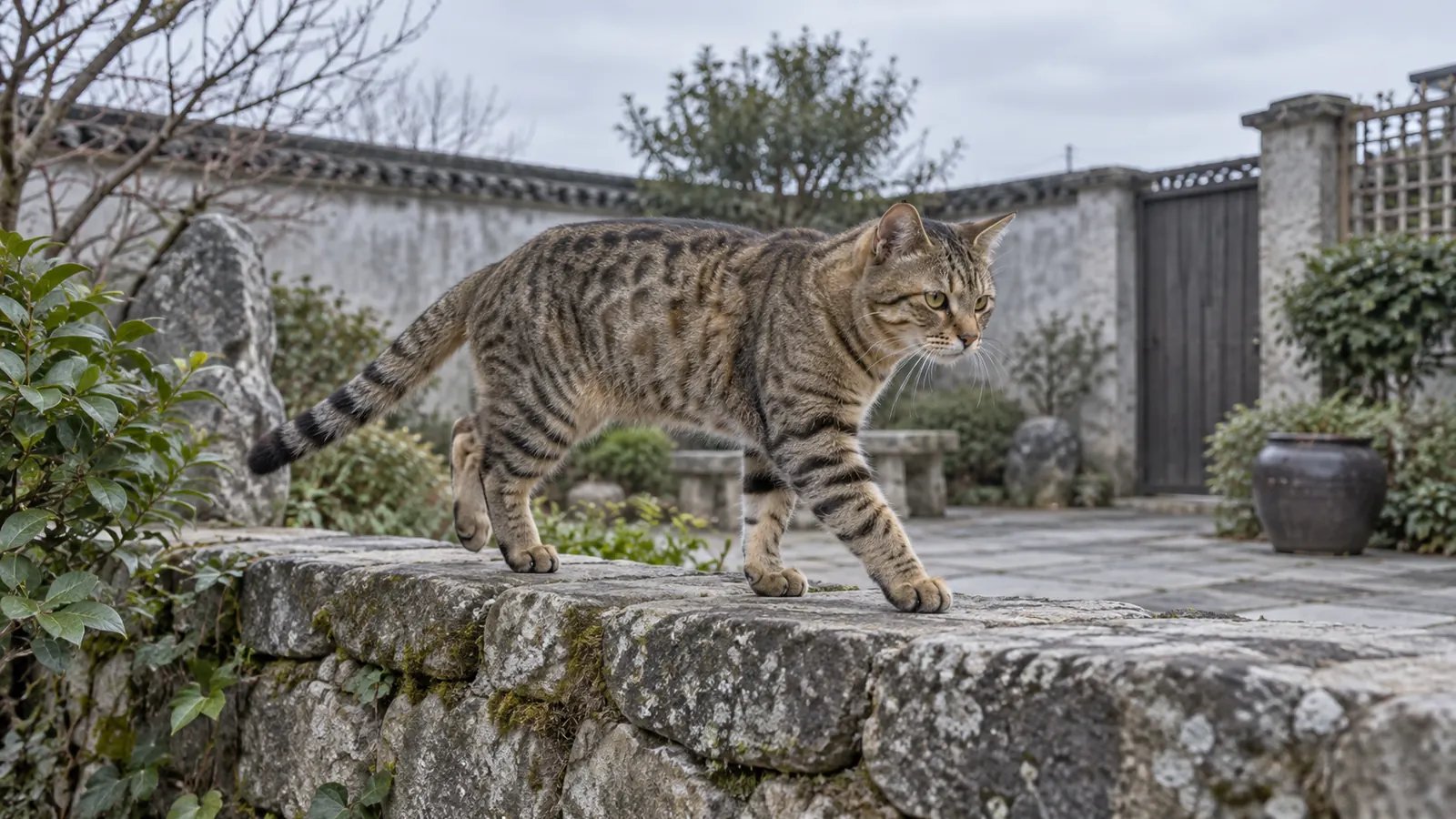
The Chinese Dragon Li is a standardised native Chinese domestic cat, also called Chinese Li Hua, but the name is used more broadly than the documented breed. A brown mackerel-tabby coat does not prove ancestry, and modern genetic evidence does not support the old story that these cats descend from the Chinese mountain cat.
- Origin
- China, formalised from native domestic cats under the Li Hua and Dragon Li names in the early 2000s
- Coat
- Short brown mackerel tabby, with a ticked background and dark broken bars in published standards
- Size
- Medium, sturdy and balanced rather than extreme
- Typical weight
- No dependable breed-population range was found in current primary sources
- Life expectancy
- Not established by breed-specific population data
- Activity level
- Moderate to high, with hunting play and vertical choices more useful than an assumed breed stereotype
- Grooming
- Low. The short coat needs a simple weekly check rather than intensive grooming
- Suits
- Households that value a natural domestic type and will verify identity without expecting a rare name to guarantee temperament or health
Dragon Li, Chinese Li Hua and Li Hua Mau are names that overlap in English-language sources. They do not all carry the same evidentiary weight, so the useful first question is whether the name describes a registered lineage, a local landrace type or simply a brown tabby domestic cat, since a cat can look like the photographs in any of those cases.
Are Dragon Li and Chinese Li Hua the same cat?
They are generally used for the same standardised Chinese breed, although organisations and translations choose different forms. CFA meeting records from 2010 describe Chinese Li Hua as the breed name and Dragon Li as an alternate name adopted by China's Cat Aficionado Association in 2001. Feline Fanciers' Federation material uses Chinese Li Hua and specifies no allowable outcrosses.
- Chinese name in English sources
- Chinese Li Hua or Li Hua Mau
- Alternate name
- Dragon Li
- Formalisation
- Chinese cat organisations developed a written standard in the early 2000s
- Historic CFA position
- Accepted into the Miscellaneous class in 2010
- Current CFA directory
- The breed is not listed among current CFA recognised breeds
- Identity rule
- A tabby pattern or Chinese origin alone does not establish a registered Dragon Li
CFA's 2011 minutes recorded the first two imported examples reaching the United States in October 2010 and described the breed as rare. That historical acceptance should not be turned into a claim of current CFA recognition, because the current directory no longer lists it.
Does the Dragon Li come from the Chinese mountain cat?
No evidence supports that as the origin of the modern breed. CFA's 2010 discussion explicitly noted there was no evidence for a Chinese mountain cat hybrid origin. Genome-wide research published in 2021 reached a broader conclusion: the Chinese mountain cat was not involved in the domestication of cats in China.
The 2021 study did find recent gene flow between Chinese mountain cats and some domestic cats living in the Qinghai-Tibet Plateau region. That local conservation finding does not establish the ancestry of Dragon Li breed lines, and it should not be used to market them as wild hybrids.
What evidence identifies a registered Dragon Li?
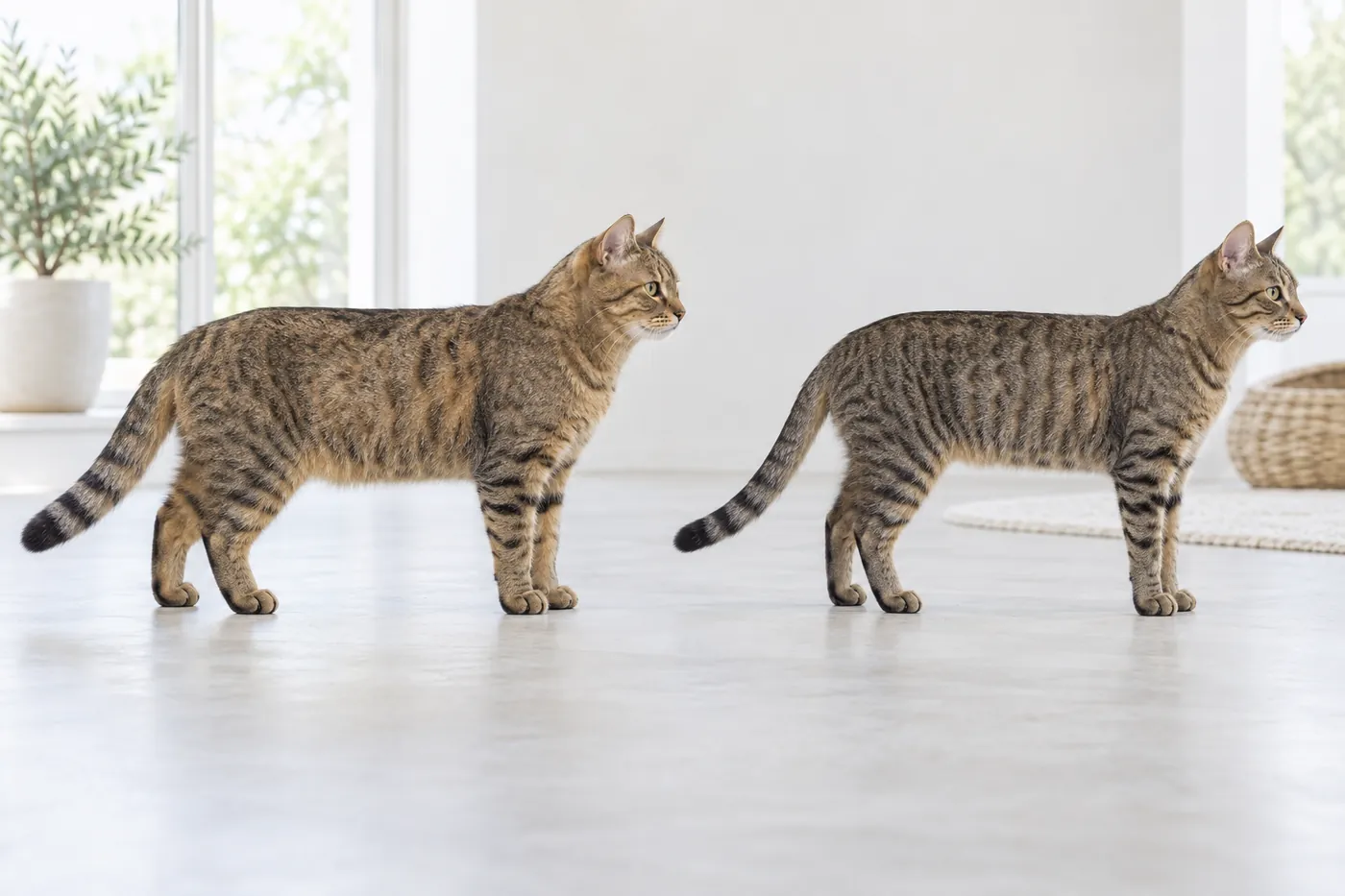
A pedigree from an organisation that records the breed is the strongest practical evidence, and appearance can support a claim without settling it. Published standards describe a sturdy, balanced domestic cat with a short brown mackerel-tabby coat. The dark bars may break along the sides, while the background hairs show bands of colour that give the coat depth.
| Evidence | What it supports | What it cannot prove |
|---|---|---|
| Original pedigree | Recorded parents and registry identity | Adult personality or lifetime health |
| Matching permanent identification | That the paperwork belongs to the named cat | Whether every breeder claim is accurate |
| Conformation to a written standard | A body and coat consistent with the breed description | Ancestry without records |
| Chinese place of birth | Geographic origin of the individual | Dragon Li breed identity |
| Brown mackerel tabby coat | A common visible pattern | Breed, rarity or market value |
A rare name cannot turn a common pattern into a pedigree. This matters most in advertisements for cats found outdoors or imported without a continuous paper trail.
What does a Chinese Dragon Li look like?
The type is natural and moderate, without the extremes that make some breeds instantly distinct. CFA's historical description called for a sturdy, well-proportioned cat, while the FFF standard describes a broad modified-diamond head, strong body, medium ears and a brown mackerel pattern. The overall impression is of a capable domestic working cat rather than a very slender, cobby or oversized one.
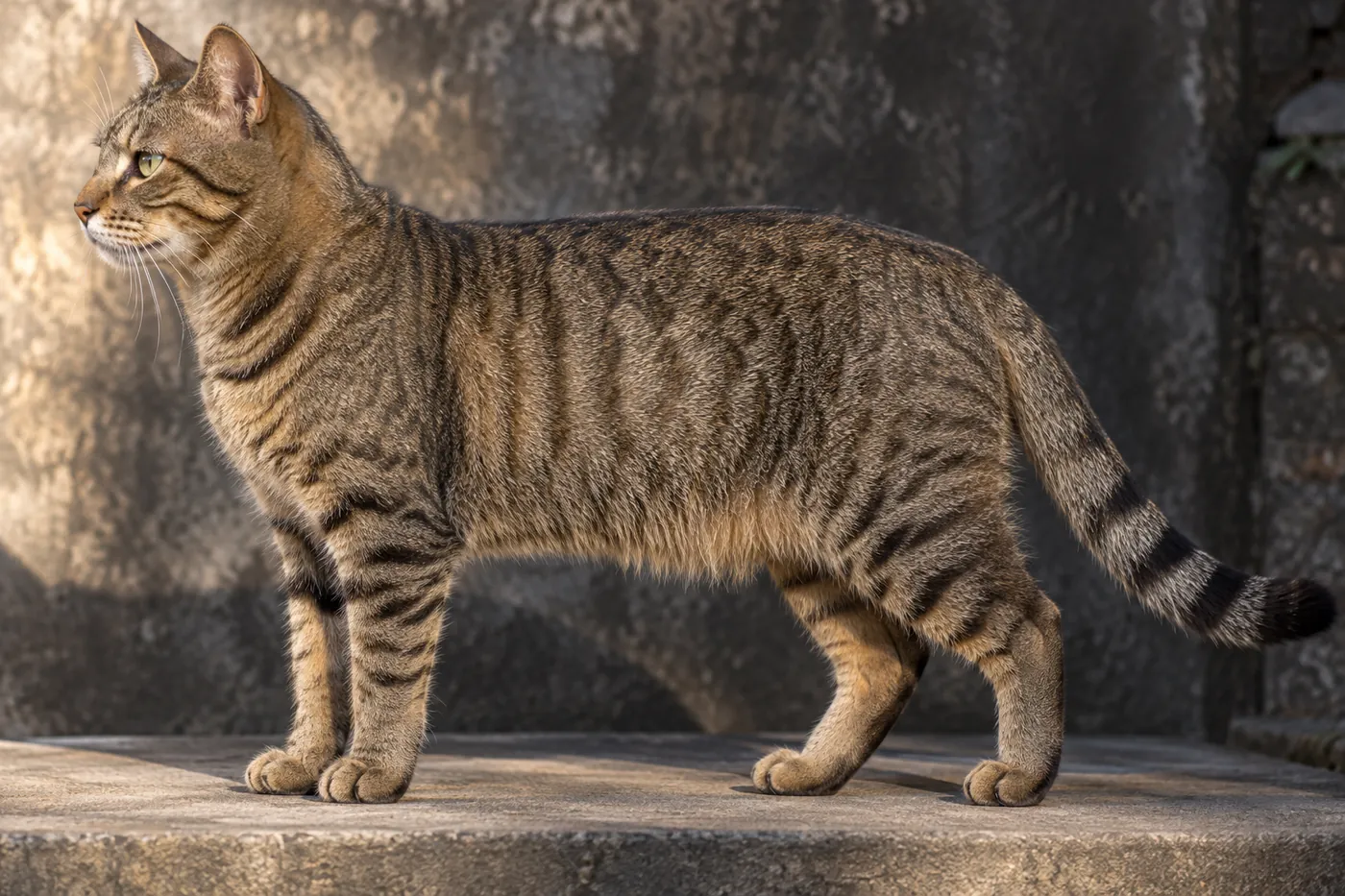
Reliable adult weight and lifespan distributions have not been published for a well-defined Dragon Li population. Websites that repeat one narrow range are usually passing the same unsourced estimate from page to page.
Equipment is sized from the measured cat: it should be able to stand, turn and lie flat inside its carrier, and the tray should allow a full turn without the body striking the sides.
What is the temperament really known to be?
Registry and breed descriptions commonly call the Dragon Li intelligent, active, loyal and a capable hunter. No controlled breed research has tested them, so they describe tendencies at most. Early handling, the mother, learning history, health and the present environment all shape behaviour. An adult with a known foster history can therefore offer more predictable household information than a rare-breed label attached to a young kitten.
Whether the individual explores, recovers after a small interruption and chooses contact again shows its confidence, which is better judged across several ordinary moments than during one forced handling test.
How should activity and indoor life be planned?
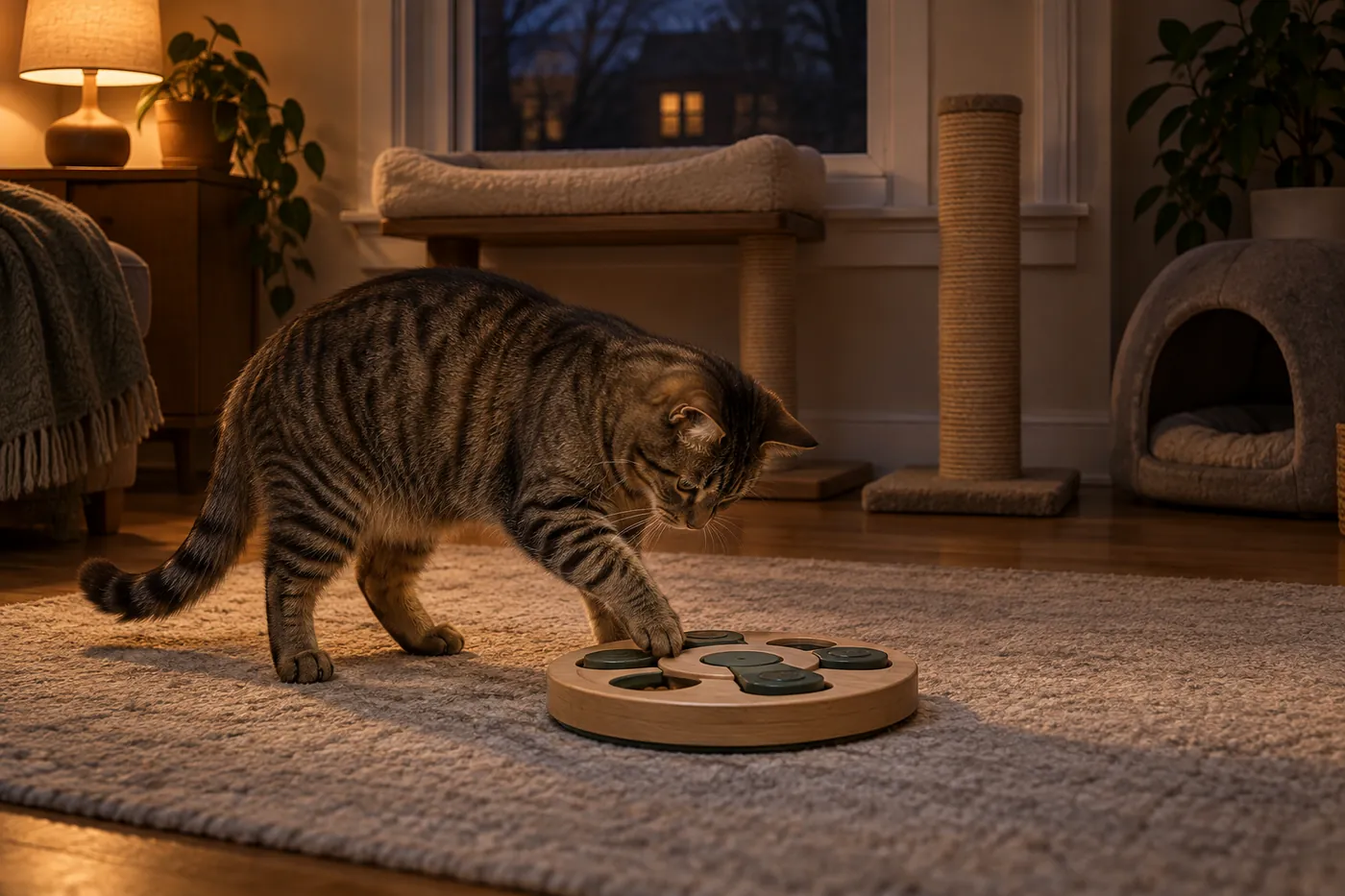
A capable, alert domestic cat needs room to climb, hide, scratch, search and rest. The Feline Veterinary Medical Association recommends that indoor cats have access to safe resting places, vertical space, food and water, clean toileting areas, play and simulated hunting or foraging. Those needs apply whether the cat has Dragon Li papers or no breed label at all.
- Provide at least one stable elevated route with more than one way down
- Use short interactive play that ends in a catch
- Scatter part of the measured daily food or use simple search puzzles
- Keep hiding and resting places away from busy doors
- Distribute resources when more than one animal lives in the home
- Offer controlled outdoor access only through a secure enclosure or suitable trained system
Reward-based training can support carrier entry, a mat station and comfortable handling. The goal is useful cooperation in care, whatever the breed's reputation for intelligence suggests.
Is the coat easy to care for?
Yes, in the limited sense that short hair does not mat like a long undercoat. A weekly hand and comb check is usually enough to remove loose hair and notice changes. More frequent sessions during seasonal shedding help if the cat enjoys them, while brushing normal skin merely to keep a schedule does not.
Short coat does not mean no shedding, no allergens or no skin disease. Persistent itching, bald patches, scabs, odour or a sudden reluctance to groom belongs with a veterinarian rather than a different brush.
- Let the cat inspect the comb before it touches the body
- Start at the shoulder or cheek where touch is already comfortable
- Make one or two gentle passes in the direction of hair growth
- Pause before the tail begins to flick or the skin ripples
- Check claws, outer ears and body condition in separate short sessions
What health claims can be supported?
No breed-specific health survey was found that establishes unusually low disease risk or a dependable lifespan for the Dragon Li. That gap has a simple consequence: robust native breed and ancient breed remain stories unless a seller can connect a health statement to records. A small documented population can also hide problems because too few cats have been studied, not because the problems are absent.
| Record | Useful question | Limit |
|---|---|---|
| Veterinary history | What has been examined, treated and vaccinated in this cat? | It cannot predict every future condition |
| Parent records | Do names and identification match the pedigree? | Healthy parents do not guarantee a healthy kitten |
| Family history | Are ages, diagnoses and causes of death tracked? | Small families provide limited statistical confidence |
| DNA result | Which exact variant does this report test? | A panel does not clear diseases outside its variants |
| Registration | Can the documented lineage be followed? | Registration is not a health certificate |
For a kitten, the useful questions cover infectious-disease control, socialisation, congenital findings and the health of close relatives, and an independent veterinary examination after acquisition sets the baseline for preventive care built around the individual.
Will a Dragon Li live well with children or other pets?
The answer depends more on the individual and the introduction than on the name.
Children should let the cat approach, use toys instead of fingers and keep food and sleeping areas undisturbed. Adults should provide a retreat the child cannot enter and remain responsible for all handling.
Cats and cat-experienced dogs need scent exchange, distance and gradual visual access before direct contact. A confident hunter may be unsafe around birds, rodents or reptiles, so vulnerable animals need permanent physical separation.
Who is the Chinese Dragon Li best suited to?
A Dragon Li suits someone who values the individual cat, can verify any pedigree claim and is comfortable with a moderate natural type whose behaviour rarity does not guarantee.
- Clarify whether Dragon Li describes registered ancestry or only appearance
- Verify the issuing organisation and match records to the cat
- Ignore wild-hybrid stories that conflict with current genomic evidence
- Judge adult size from the individual and known relatives, not a copied range
- Prepare ordinary high-quality feline resources and daily interaction
- Ask for specific health evidence rather than a claim of natural robustness
- Meet the cat during play, rest and voluntary contact, and confirm normal litter use
Someone seeking a visually unmistakable breed or a predictable personality from the label may be disappointed. Someone happy with a brown-tabby companion should also consider local adult cats, where health, behaviour and household history may be known more clearly.
Common Questions
Is Dragon Li the same as Chinese Li Hua?
The names are generally used for the same standardised native Chinese breed. CFA historical records used Chinese Li Hua as the breed name and described Dragon Li as an alternate name adopted by China's Cat Aficionado Association.
Is the Chinese Dragon Li a wild hybrid?
No evidence establishes the breed as a Chinese mountain cat hybrid. Genome-wide research found that the Chinese mountain cat was not involved in cat domestication in China, although recent local gene flow has occurred in some Plateau domestic cats.
Does CFA recognise the Chinese Li Hua today?
CFA accepted Chinese Li Hua into its Miscellaneous class in 2010, but the breed is absent from CFA's current recognised-breed directory. Historical Miscellaneous status should not be described as current championship recognition.
Can a brown tabby be a Dragon Li?
A registered Dragon Li can have a brown mackerel-tabby coat, but that common pattern cannot establish breed ancestry. Original pedigree records are needed to support the breed claim.
Checked Against
- CFA February 2010 meeting transcript: Chinese Li Hua cfa.org
- CFA February 2011 meeting transcript: Chinese Li Hua imports cfa.org
- CFA: current recognised breeds cfa.org
- Feline Fanciers' Federation: Chinese Li Hua standard fffcat.com
- Science Advances: Chinese mountain cat genomics and domestic-cat introgression pubmed.ncbi.nlm.nih.gov
- Cell Genomics: the late arrival of domestic cats in China pubmed.ncbi.nlm.nih.gov
- AAFP and ISFM feline environmental needs guidelines pmc.ncbi.nlm.nih.gov
- FelineVMA: responsible breeding in feline medicine catvets.com
Published 13 September 2026. Last updated .





