
What Is a Singapura, and Is Such a Small Cat Easy to Keep?
The Singapura is genuinely small, and that small body belongs to an inquisitive, people-focused climber. It best suits a home that wants that kind of company and can verify PK deficiency, PRA and heart-health records while protecting such a light cat from rough handling and accidental escape.
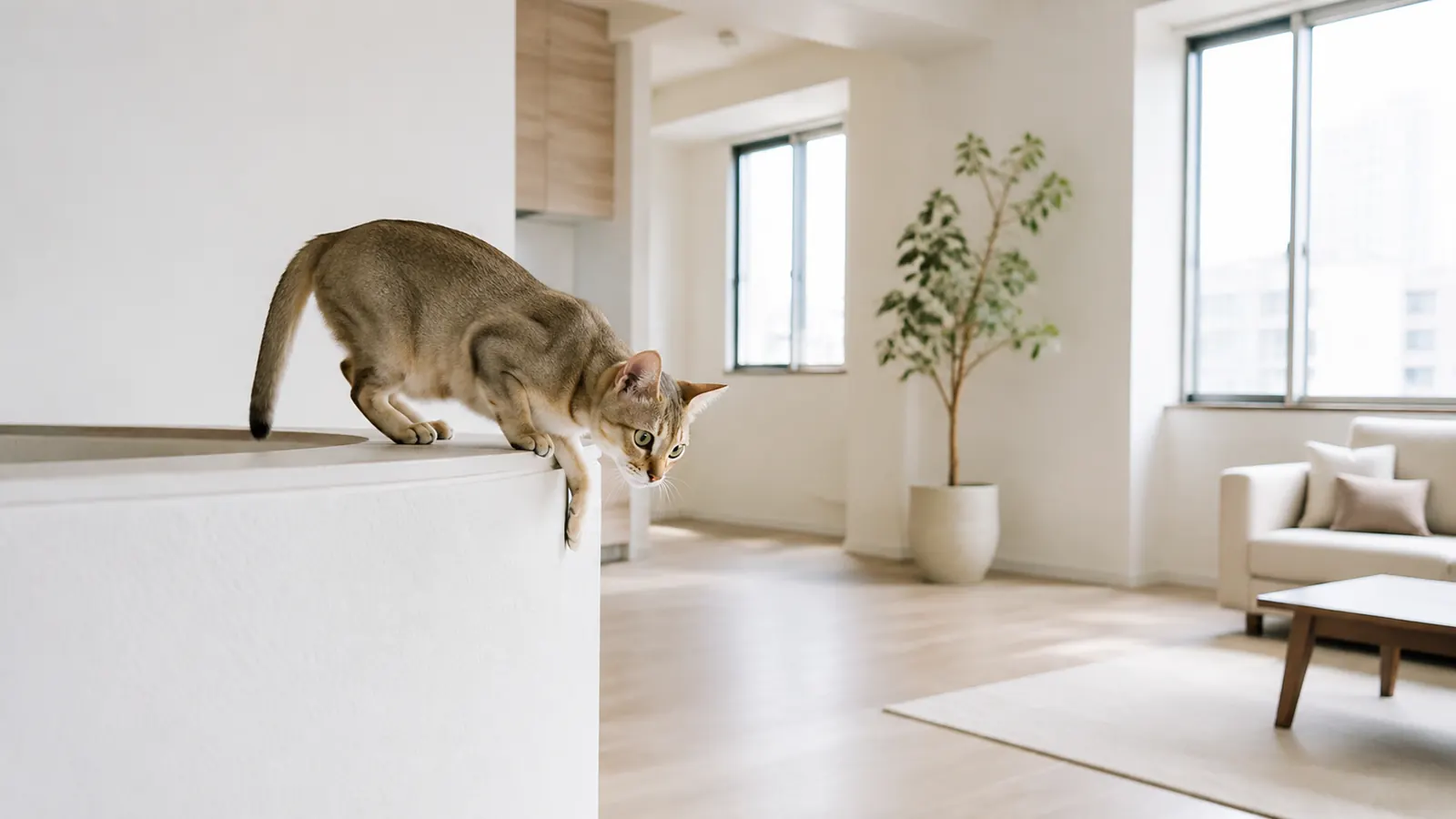
- Origin
- Singapore-associated foundation population developed as a pedigreed breed in the United States during the 1970s
- Coat
- Short, close-lying sepia agouti coat with dark ticking over a warm old-ivory ground
- Size
- One of the smallest pedigreed breeds, compact and muscular rather than fragile or elongated
- Typical weight
- TICA gives approximately 4 to 6 pounds for females and 6 to 8 pounds for males
- Life expectancy
- TICA estimates approximately 11 to 18 years
- Activity level
- High for its size. Curious, agile, interactive and strongly drawn to elevated observation points
- Grooming
- Low. Weekly light brushing and routine nails, teeth and skin checks are usually sufficient
- Suits
- Interactive households that enjoy a small, busy companion and can provide safe height, gentle handling and company
The Singapura is often introduced as the smallest pedigreed cat, but size is only the beginning of the ownership decision. This compact cat is typically curious, socially persistent and willing to climb above eye level to observe whatever the household is doing.
Its best home treats that smallness as a handling and safety consideration and still expects plenty of activity from a busy companion in a light body.
How small is a Singapura when fully grown?
TICA gives approximately 4 to 6 pounds for adult females and 6 to 8 pounds for males. CFA describes a similar range, with females often around 4 to 5 pounds and males around 6 to 7 pounds. The Toybob, which TICA recognised for championship in 2022, is smaller still at about 3 to 5 pounds as an adult, with its whole body scaled down evenly rather than set on short legs.
Those figures describe typical cats and set no target for a particular one. A healthy cat should have visible proportion, firm muscle and an appropriate body-condition score rather than being kept thin to preserve a tiny appearance.
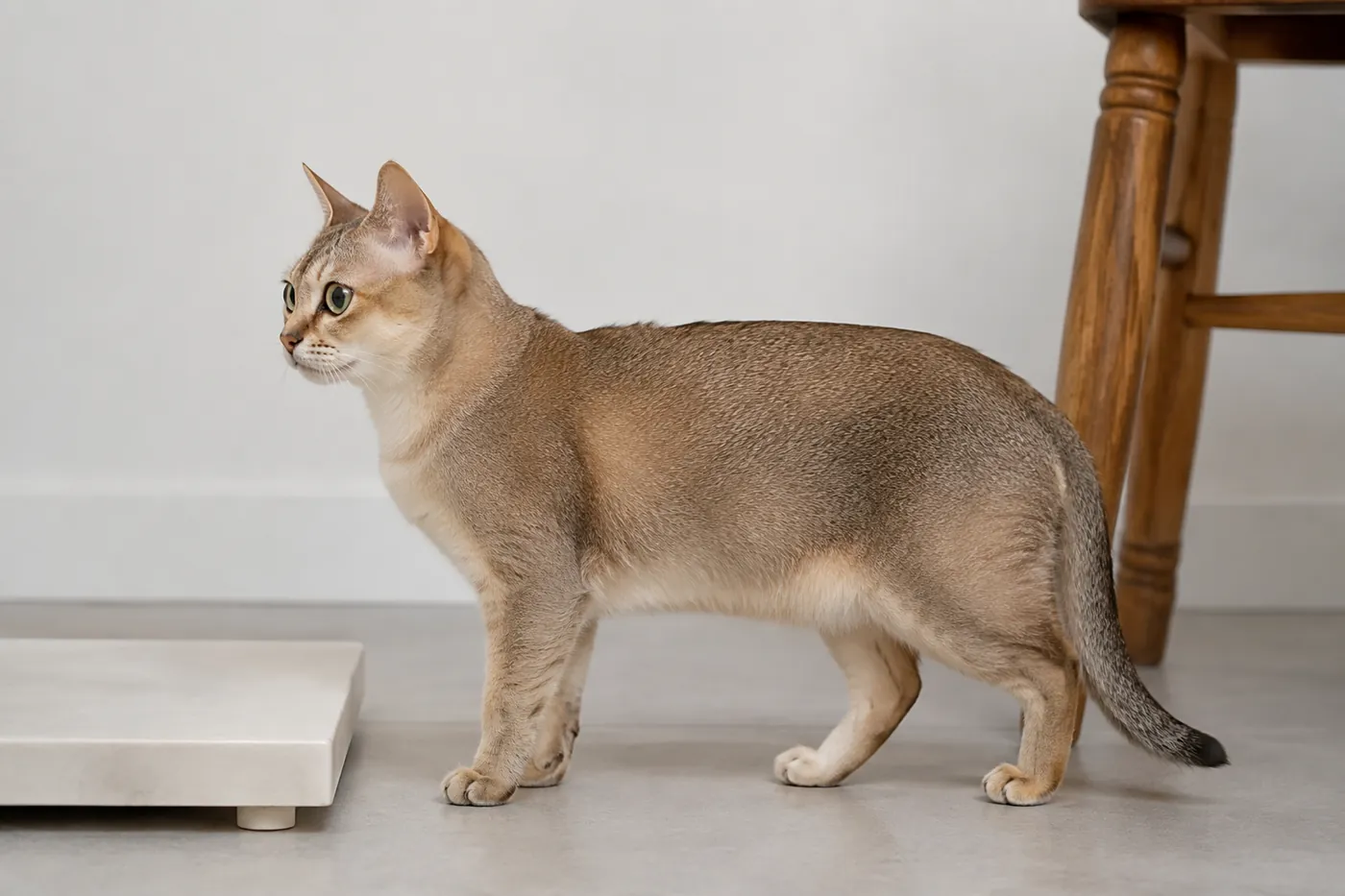
Full size may not settle until close to two years. A small adolescent can still be developing normally, but poor growth, persistent diarrhoea, low appetite or weak muscle deserves veterinary assessment rather than a breed-size explanation.
| Item | Small-cat issue | Practical choice |
|---|---|---|
| Carrier | Wide gaps invite escape during loading | Rigid secure door and close-fitting hardware |
| Harness | Narrow chest can slip through a loose loop | Individually fitted escape-resistant design |
| Cat tree | Tiny top pads may tempt a size-based compromise | Stable base and full-body resting platform |
| Litter tray | High entry can challenge a kitten | Low accessible entry with enough turning room |
| Household handling | Light weight encourages unnecessary carrying | Four feet supported and freedom to leave |
The breed's small body does not mean miniature equipment is always best. Platforms still need room for stretching, and litter trays need enough usable floor space to turn without stepping into waste.
Small size changes handling risk more than it changes ordinary feline needs. Doors, recliners, washer drums and the space behind appliances deserve deliberate checks because a light, curious cat can enter a gap that a larger adult ignores.
Body condition separates petite from underweight. The ribs should be easy to feel without being sharply exposed, the waist should remain visible, and the spine and hips should not become prominent simply to keep the cat near the low end of a breed range.
Which features identify the breed?
An authentic Singapura combines a compact muscular body with a rounded head, very large open ears and large almond-shaped eyes. The eyes may be hazel, green or yellow, and dark facial lines create a distinct alert expression.
Only one coat pattern defines the traditional breed: sepia agouti. Individual hairs carry alternating dark and light bands over a warm old-ivory ground, while barring is restricted to particular inner-leg and knee areas rather than forming strong body stripes.
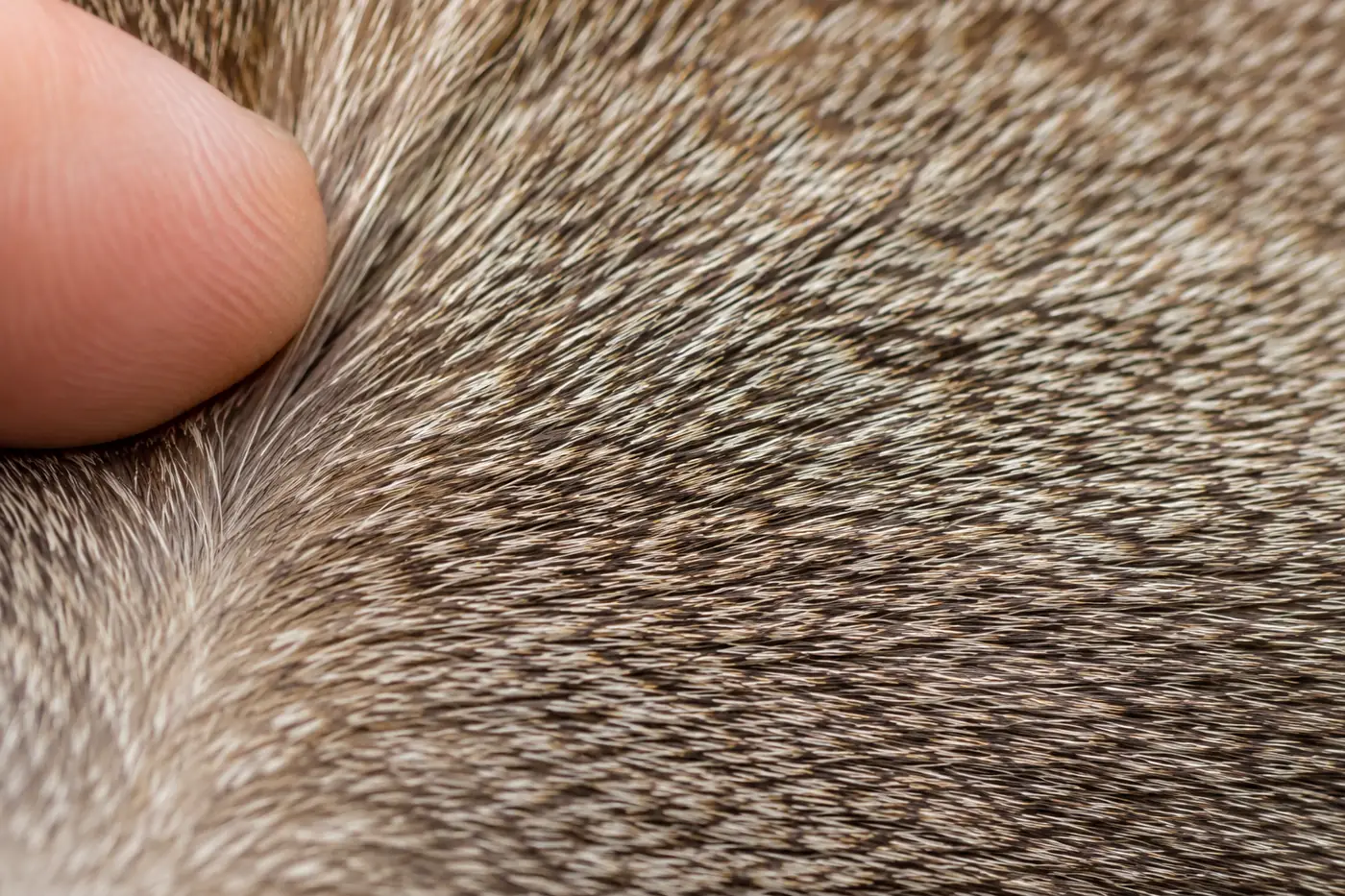
- Head
- Rounded with a broad short muzzle and definite whisker break
- Eyes
- Large, almond shaped and outlined by dark facial markings
- Ears
- Very large, open at the base and deep cupped
- Body
- Small to medium, compact and muscular
- Coat
- Short sepia agouti ticking over warm ivory
- Identity
- Supported by pedigree or registration, not small size alone
The Abyssinian also has a ticked coat, but it is larger and more elongated, with a different head and colour standard. A petite brown-ticked shelter cat may resemble either breed without having documented ancestry.
Small, large-eared and ticked must occur together before the visible type even begins to match. Only records establish pedigree.
The facial pattern is a useful supporting detail rather than a standalone test. Dark lines extend from the eyes and along the nose, but lighting, age and image processing can make those lines look stronger than they are in person.
Kittens do not display every adult proportion at once. Ears can dominate the head before the body fills, and coat warmth and ticking may become clearer with age, so an extreme baby photograph should not replace observation of mature relatives.
What is the Singapura temperament really like?
TICA and CFA describe an extroverted, affectionate cat that wants to investigate the activity around it. Many Singapuras use shoulders, shelves and cabinet tops as observation points, then return to laps or bedding when the room becomes quiet.
This pattern can feel charming in a home that enjoys participation and intrusive in one that expects an independent background pet. Cupboards, drawers and doors may become puzzles, so childproof latches and secure screens can be more useful than repeated verbal correction.
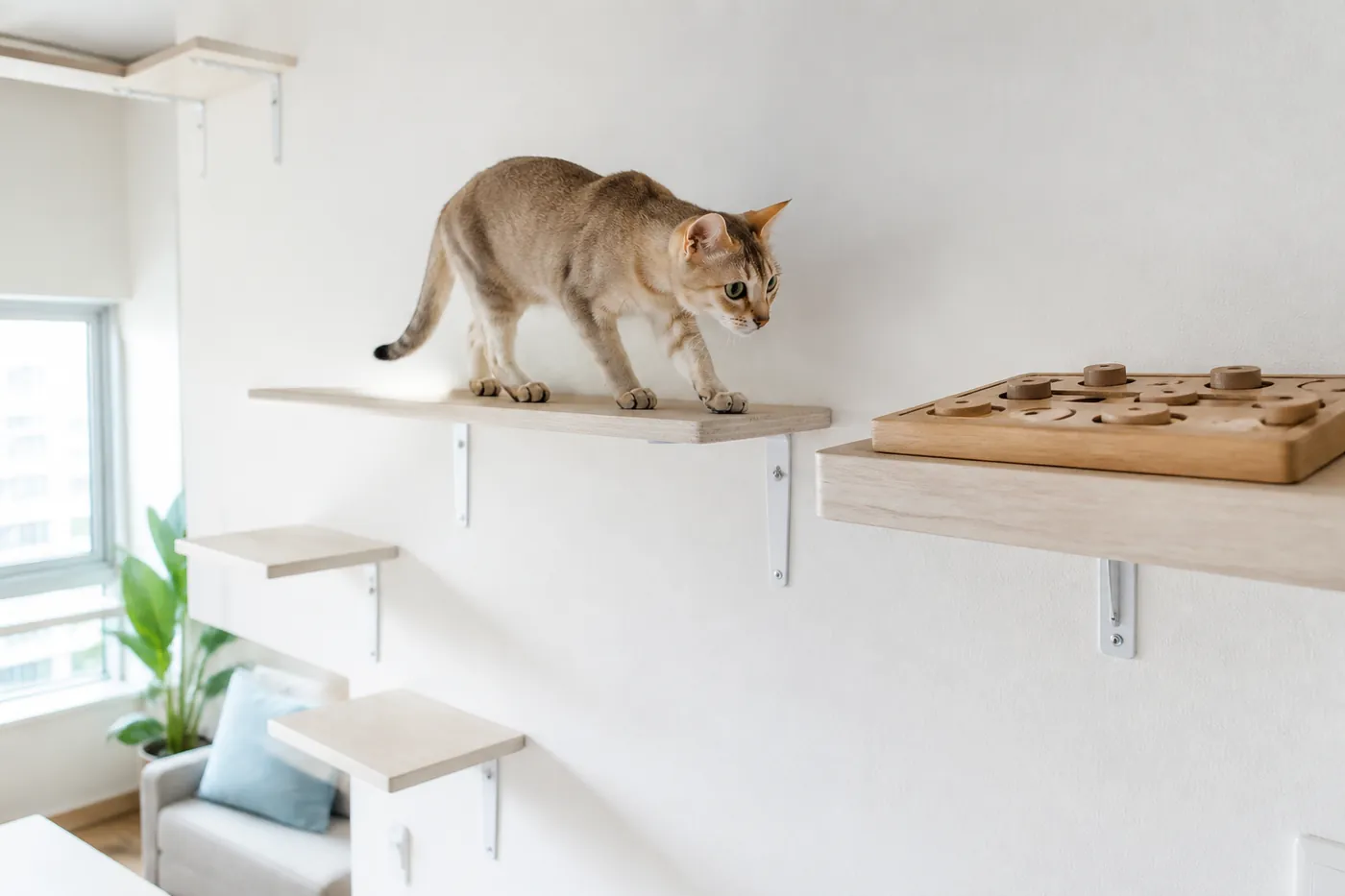
Many are described as soft voiced, but individuals vary. Meeting the cat during ordinary interaction, and hearing how often it calls, how it reacts when left alone and whether it seeks continuous physical contact, tells you more than the breed description.
A Singapura may get along well with another social cat, a calm dog or respectful children. Success still requires separate resources and gradual introductions, plus an adult who prevents chasing or one-handed carrying.
Household sociability still leaves the cat in control of contact. A high retreat that children and dogs cannot follow gives it somewhere to go, and once it has chosen to leave, letting it approach again works better than returning it to the activity.
Confidence also depends on context. A cat that explores freely at home may become quiet with visitors or in a carrier, while a kitten that rushes toward every stimulus may still need help learning how to settle.
Does the breed need more exercise than its size suggests?
Yes. A Singapura's compact body can jump, climb and sprint, and its curiosity needs both physical routes and problems to solve.
Sturdy vertical paths with small gaps between levels matter, because the cat may attempt ambitious transitions long before you expect it, and window screens and narrow openings behind appliances, cabinets and recliners need securing.
- Offer at least one high resting point with a safe descent
- Rotate small chase toys and food-search tasks
- Close recliners and appliances only after locating the cat
- Check screen frames and door gaps for escape points
- Use short reward-based training sessions
- Keep fragile objects away from preferred routes
Short fetch, target training and carrier games can use mental energy while teaching useful skills. Clicker training works especially well when rewards are tiny enough that practice does not become a large share of the daily calories.
Laser play aimed at walls or heights leaves the cat with an uncertain landing, and a chase game that finishes with a tangible toy or food item ends with something the cat can catch.
Can a Singapura cope with being alone?
Many Singapuras seek frequent company and do poorly when every weekday is long and empty, so the deciding factor is predictable interaction before and after working hours.
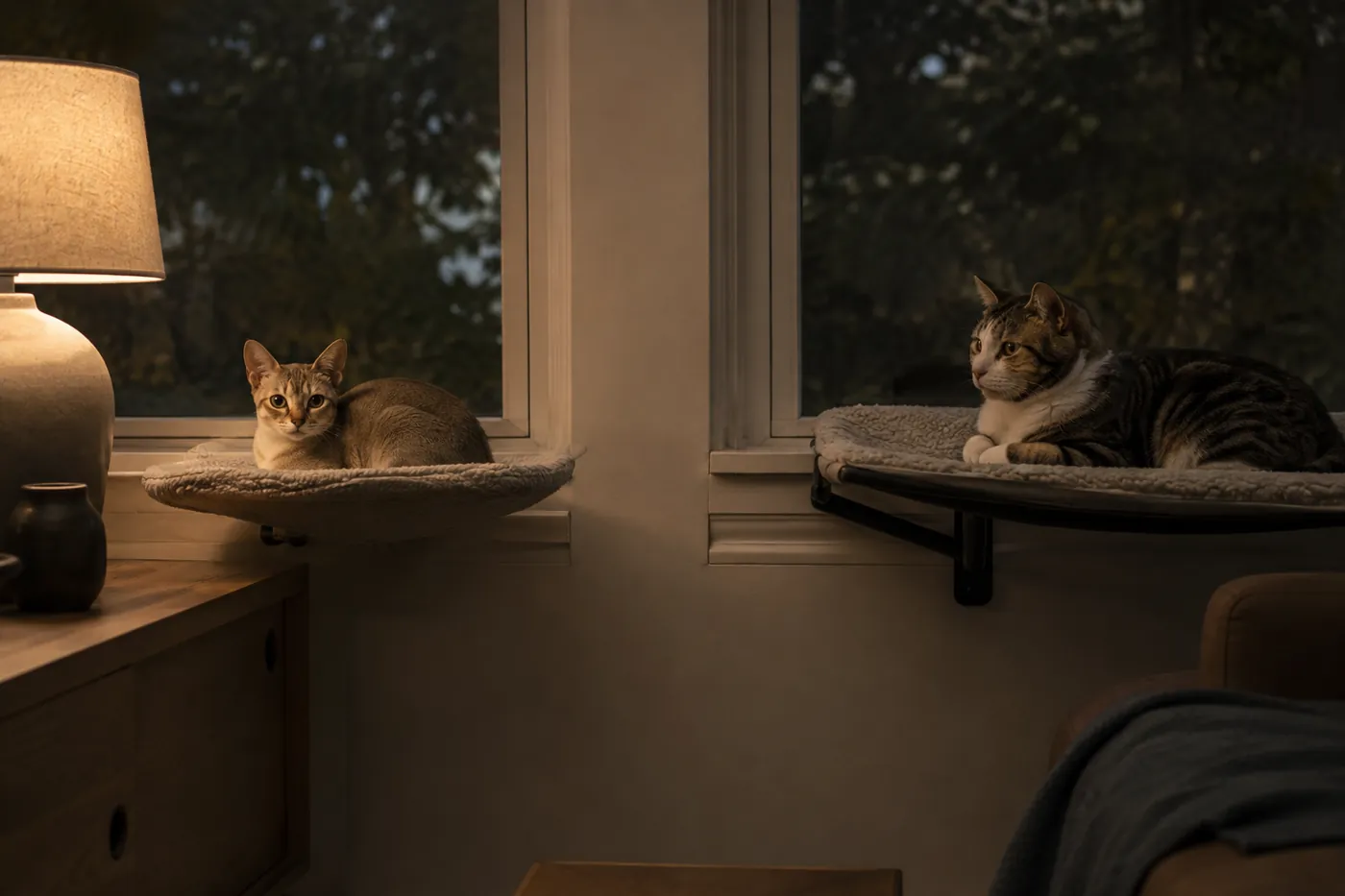
A second cat helps only when play style and confidence match, the introduction is gradual, and feeding, water, litter and high resting places are spread out so one animal cannot control access.
A repeatable daily rhythm of active play, a meal or puzzle, then a quiet period suits the breed. An automatic feeder may create a midday event, but it does not replace touch, observation or interactive movement.
Persistent calling, overgrooming, destructive exploration or conflict around the owner's return can reflect unmet social needs, fear or illness, and the response should identify the cause rather than simply add more toys.
Short absences practised before a full workday becomes unavoidable show how the cat copes. A camera can show whether the cat sleeps, eats and uses its usual spaces or spends the interval pacing and calling, but it cannot diagnose why a behaviour changed.
A calm arrival leaves time to observe the cat before intense play starts. Appetite, posture, vocalising and litter use around the same daily times can reveal a developing health or routine problem earlier than a single dramatic incident.
How much grooming does a Singapura require?
The short close coat usually needs a light weekly brushing or a pass with a soft grooming cloth. This removes loose hair and gives you a chance to check for parasites, flakes, lumps or soreness without altering the smooth texture.
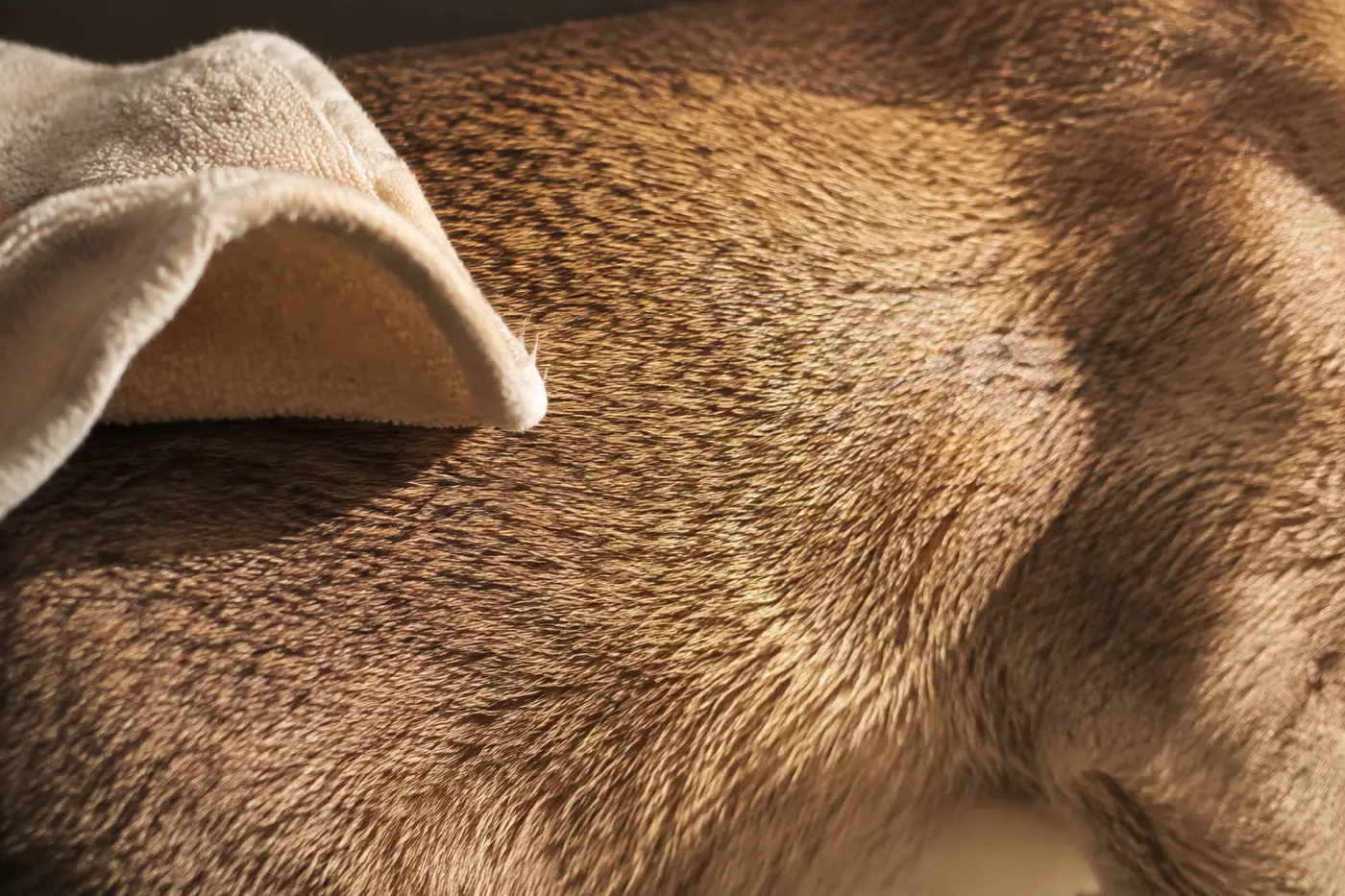
Bathing is rarely necessary for a healthy indoor cat. Use cat-safe products only when contamination or veterinary treatment creates a reason, and keep a light-bodied wet cat warm until fully dry.
Nails need trimming as they grow, and tooth brushing works best introduced gradually. The mouth deserves routine attention because inherited screening does not prevent ordinary periodontal disease.
Shedding is usually manageable but not absent, and the breed is not allergen-free. Anyone with allergy or asthma should discuss exposure with a clinician and test realistic contact with the individual rather than relying on the short coat.
Which inherited conditions should you ask about?
Pyruvate kinase deficiency and progressive retinal atrophy are two named genetic questions in this breed. Both require the exact laboratory result and variant context rather than a vague claim that a parent passed a panel.
PK deficiency affects red-blood-cell energy metabolism and can cause intermittent hemolytic anemia. A recessive carrier may look completely healthy, so carrier status matters to a mating without predicting that the carrier will develop the disease.
Progressive retinal atrophy causes gradual retinal degeneration. DNA testing can identify particular known variants, but the report must name what it tested because one result does not exclude every possible eye disorder.
TICA also recommends attention to heart health because cardiomyopathy has appeared in some lines. Veterinary cardiac examinations and the health of older relatives are the relevant questions, and a general DNA panel cannot replace echocardiography when heart structure is the question.
Every cat still needs routine examination, vaccination, parasite prevention and dental care. Breed testing narrows specific inherited uncertainty; it does not certify lifelong health.
A recessive test result answers a mating question as well as an individual one. A healthy carrier is not the same as an affected cat, but two carriers can produce affected kittens, so both parental reports and the planned pairing matter.
Eye appearance cannot replace the named PRA report. Wide pupils, hesitation in dim light or bumping into objects warrants veterinary assessment, while a normal-looking young cat may still carry a variant relevant to breeding.
What about uterine inertia and breed history?
Singapura breeding discussions sometimes mention uterine inertia, in which labour fails to progress normally. That is primarily a breeding and emergency-veterinary concern, but it matters to buyers because it reinforces the need for transparent reproductive history and skilled care around a litter.
The breed's historical narrative is also more complicated than a simple discovery story. Registries associate its foundation with cats connected to Singapore and development in the United States, while later accounts have debated how particular founders reached Singapore.
Choosing a companion does not depend on settling every historical dispute. Current registration, traceable parentage, genetic management and welfare practices say far more about quality than a romantic origin claim.
A breeder working with newly introduced foundation lines should be able to explain the registry process and the health and identity records supporting those cats. New genetic diversity can be valuable, but it still requires documentation.
How the breeder plans for an emergency delivery before a queen is mated is a fair question. Access to veterinary help, transparent discussion of previous difficult births and a plan that protects the mother matter more than presenting uterine inertia as a mysterious breed label.
The history question also helps reveal how a seller handles uncertainty. A careful source can distinguish documented registration from disputed narrative without turning either version into a claim that its kittens are rarer or more authentic.
How should you feed such a small, active cat?
A complete diet appropriate to life stage, with portions calculated from the food's energy density, current weight, activity and body condition, is the base. A few extra treats represent a larger share of daily calories in a five-pound cat than in a fifteen-pound cat.
- Read calories per can, pouch or measured gram
- Set a daily total with your veterinarian or feeding guide
- Reserve part of that total for puzzles and training
- Weigh the cat regularly on the same scale
- Feel ribs and waist instead of judging by breed size
- Adjust when the trend or life stage changes
Calories become an actual portion size only once the food is measured, and for a cat this small the measuring method decides the accuracy.
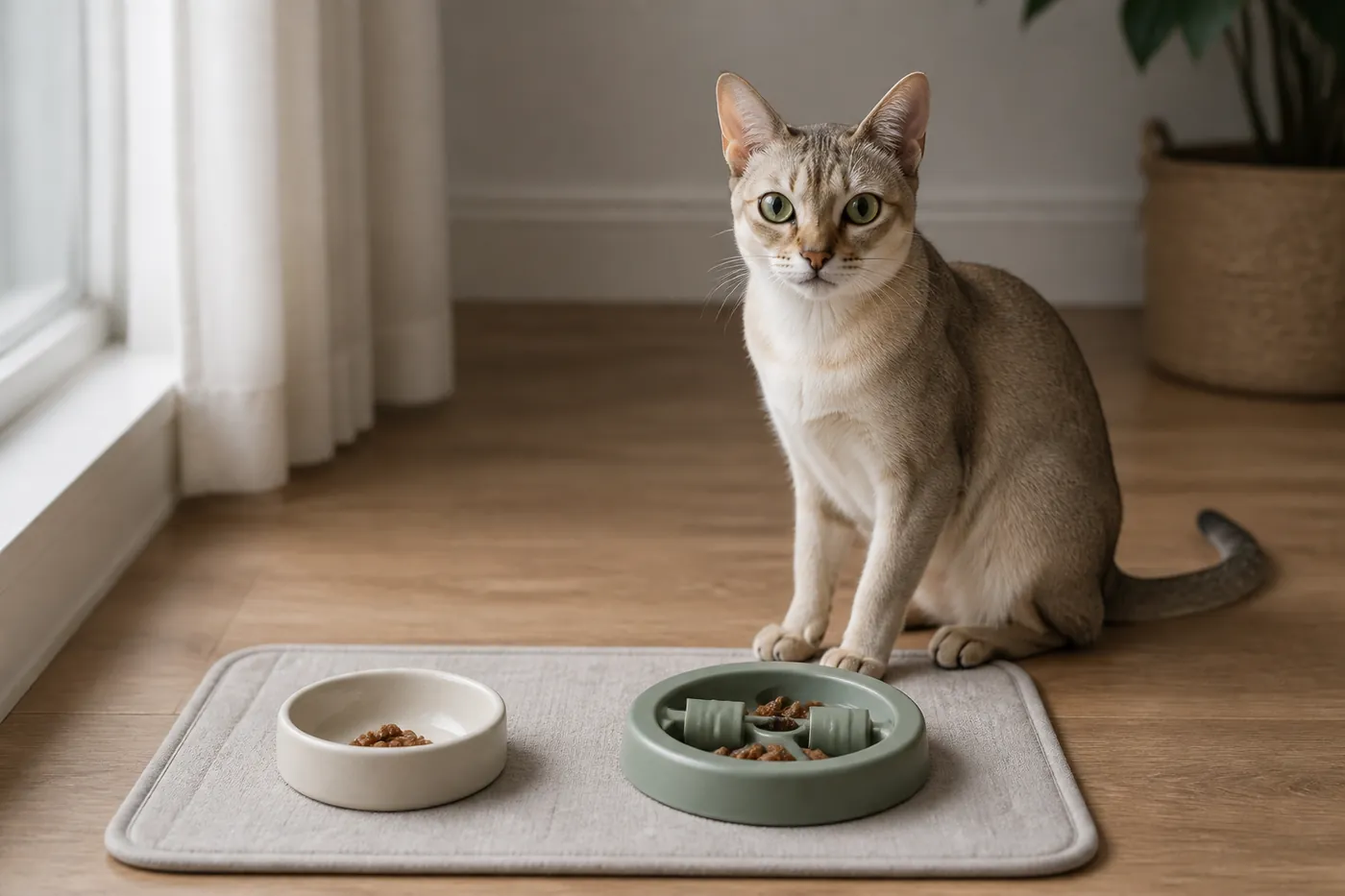
Sudden weight loss is important even when the number looks small. Losing half a pound can be substantial for a cat that began near five pounds, which is why percentage change and body condition say more than the raw number.
Small portions make measuring errors proportionally larger. Weighing dry food in grams and checking the calorie statement on each wet-food flavour is more reliable than assuming every scoop, pouch or can contributes the same energy.
Meals can also support observation. When you know what was offered and what remains, reduced appetite becomes visible on the first day instead of disappearing into a bowl that is continuously topped up.
What should you verify before bringing one home?
The most useful meeting shows the cat moving, investigating and recovering after play, and shows whether it can settle, whether handling is voluntary and whether the breeder protects kittens from rough or constant contact.
Where kittens eat, sleep, climb and use litter shows more than a presentation room. The ordinary setup reveals whether a small cat has safe routes, clean resources and experience with household sounds without being passed constantly between hands.
Identification and transport need to fit the individual body. A microchip provides permanent identification, while a rigid carrier with secure fasteners prevents a small head or shoulder from finding the gap that a generic size label overlooks.
Age and development matter more than being offered the youngest or tiniest kitten. Time with the mother and littermates supports social learning, and the source should explain vaccination, parasite care, feeding, handling and the date at which the kitten is ready to move without using small size as urgency.
- Confirm pedigree or registration when sold as a Singapura
- Match PK deficiency and PRA reports to both parents
- Ask about cardiac assessment and disease in older relatives
- Review veterinary care, vaccination and parasite records
- Inspect screens, recliners and narrow escape gaps at home
- Read congenital-health and return terms before payment
An unusually tiny kitten is no reason on its own to choose it. Extremely low weight, weak muscle or poor growth may signal a health problem, and responsible breeding does not reward the smallest possible body.
TICA estimates a broad lifespan of roughly 11 to 18 years. That range helps plan long-term care and predicts nothing about one cat.
The right home wants a social climber with a small footprint, provides company without restraint and values traceable health evidence more than novelty.
Checked Against
Published 7 September 2026. Last updated .





