
What Is a Bengal Savannah Cross, and What Does Combining Two Hybrid-Origin Breeds Mean?
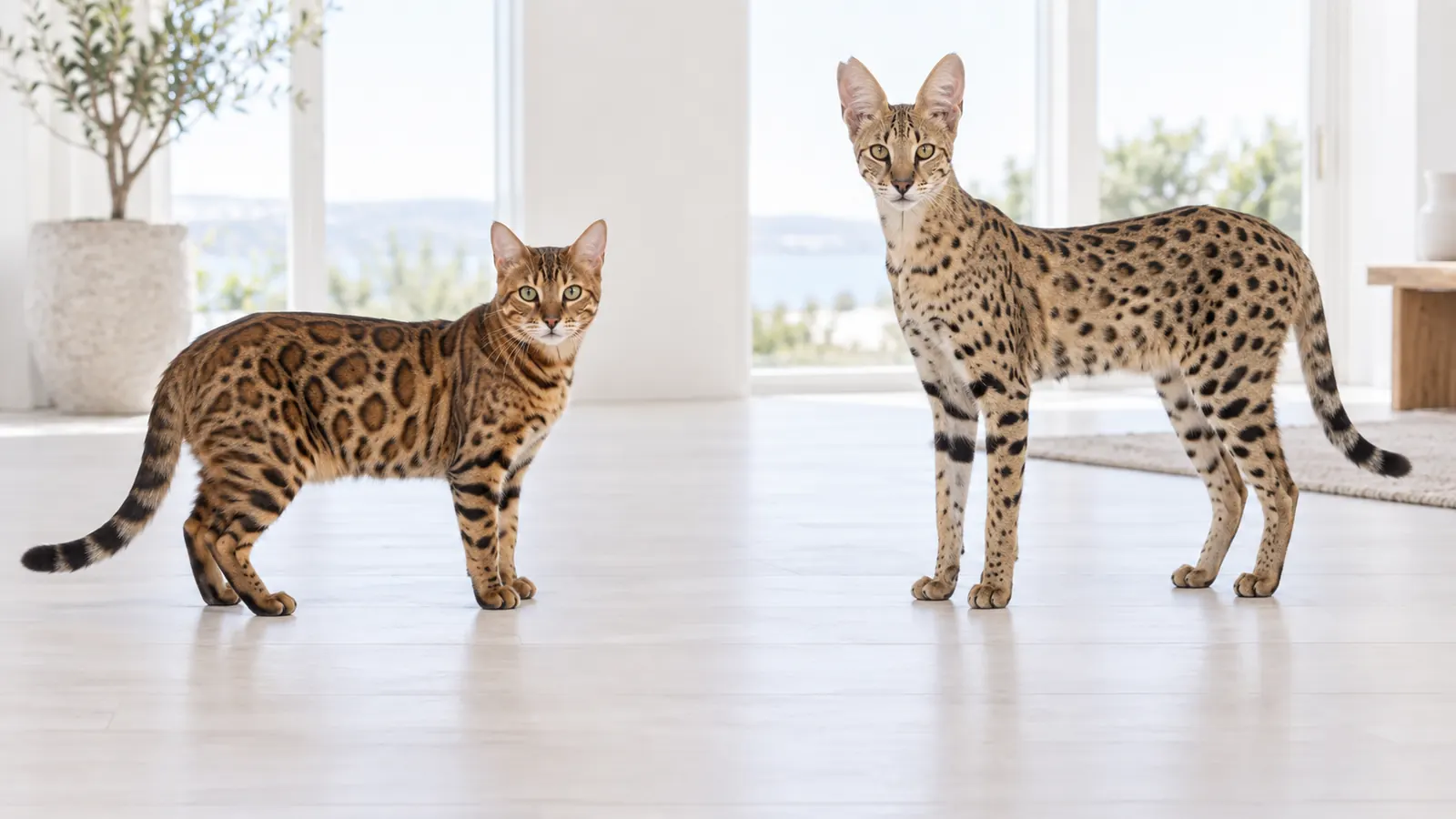
A Bengal Savannah cross combines two breeds that each carry wild-cat ancestry in their background: the Bengal from the Asian Leopard Cat and the Savannah from the African Serval. No registry recognises this combination, and the cross raises a question the other mix pages do not: whether compounding two sources of wild ancestry changes the legal or behavioural picture.
- Origin
- Not applicable; an informal mixed-breed designation combining two hybrid-origin breeds
- Coat
- Likely short and spotted or rosetted; both parent breeds carry short spotted coats
- Size
- Variable; Bengals are medium-large, Savannahs range from medium to very large depending on generation
- Typical weight
- Highly variable; depends on the Savannah parent's generation number
- Life expectancy
- No mix-specific data; parent breed estimates of 12 to 15 years apply loosely
- Activity level
- Very likely high; both parent breeds are among the most active domestic cats
- Grooming
- Likely low; both parent breeds have short, close coats
- Suits
- Experienced owners who understand hybrid-origin legal considerations and high-energy management
A Bengal Savannah cross combines two spotted, athletic breeds that both trace part of their ancestry to a wild cat species.
The Bengal descends from crosses between domestic cats and the Asian Leopard Cat (Prionailurus bengalensis). The Savannah descends from crosses between domestic cats and the African Serval (Leptailurus serval).
No registry recognises this combination as a breed. The cross is informal, and most cats described this way come from casual breeding.
Why Does the Wild Ancestry on Both Sides Matter?
SBT (stud-book tradition) Bengals are four or more generations removed from the Asian Leopard Cat. At that distance, TICA treats them as fully domestic.
No legal restrictions typically apply to SBT Bengals alone.
Savannah cats carry generational legal considerations that persist into later generations in some jurisdictions. An early-generation Savannah parent (F1 through F3) may mean the resulting kitten inherits a legal status that an SBT Bengal alone would not trigger.
Check your local laws before acquiring any cat with Savannah ancestry. The legal restrictions on wildcat-hybrid ownership vary by jurisdiction and may apply based on the Savannah parent's generation, regardless of what the other parent breed is.
- Registry recognition
- None for the cross itself
- Bengal status
- SBT Bengals treated as domestic (TICA Championship)
- Savannah status
- Generational legal restrictions apply in many jurisdictions
- Appearance
- Likely spotted, athletic, medium to large
- Energy
- Very likely high from both sides
- Key consideration
- The Savannah parent's generation determines legal status
What Physical and Temperamental Outcomes Are Likely?
Both parent breeds are spotted, short-coated and athletic, so the visual and activity range is narrower than in most mix crosses. The coat is likely short and spotted or rosetted, and the energy level is likely high. A short coat keeps grooming light, but it still sheds, and no source has measured how much this cross sheds.
Size depends heavily on the Savannah parent's generation. An F1 or F2 Savannah can produce very large offspring.
An SBT Savannah produces cats closer to standard domestic size.
Both breeds are described as active, intelligent and interactive. A cross of the two is likely to produce a demanding, high-energy cat that needs substantial climbing access, interactive play and environmental enrichment.
Both parents also learn readily. CFA calls the Bengal extremely intelligent and quite trainable, and TICA describes the Savannah as a cat that enjoys being taught tricks and can be trained to walk on a harness. A cross is likely to pick up training quickly, so short daily sessions of tricks, harness work and puzzle feeding give a cat this active something to do with its intelligence indoors.
What Health Concerns Apply?
No study has looked at this cross, so its health picture comes from what each parent line is known to carry.
| Condition | How it is inherited | Screening available | What to ask for |
|---|---|---|---|
| Hypertrophic cardiomyopathy (HCM) | The gene has not been found in Bengals | An echocardiogram by a cardiologist; no DNA test covers the Bengal form | Dated scan results for the breeding cats |
| PRA-b (progressive retinal atrophy) | Recessive; signs from about nine weeks | A DNA test | A result showing at least one clear parent |
| Pyruvate kinase deficiency | Recessive | A DNA test, recommended for Bengals | A result for the Bengal parent |
A recessive condition appears only when a kitten inherits a copy from each parent, so in most crosses one clear parent is enough to rule it out. PRA-b is the one that matters most for this cross: the variant has been found in Savannah cats as well as Bengals, so the Savannah parent cannot be assumed clear just because it is not a Bengal.
No breed-specific health study exists for the Savannah itself.
Which Households Suit One, and Which Struggle?
The cross suits an experienced owner who has checked the law first, is home for much of the day, and can give it daily play, training and plenty of climbing height. The homes most likely to struggle are the opposite: a place where the Savannah parent's generation makes the cat restricted, a small flat with little height, or a house left empty for long working days. TICA describes the Savannah as bonding strongly with its family and following people around the house, and a cat that attached and that active is hard to keep content alone.
With other cats and dogs, CFA says the Bengal gets along with other pets when properly introduced. That is a statement about introductions, so a slow, staged introduction with separate food, trays and resting places is part of taking one on. Neither parent's breed description says anything reassuring about birds, rodents or fish, and the safe assumption is that this cross may treat a small caged animal as prey.
With children, TICA describes the Savannah as affectionate on its own terms rather than a lap cat. That points towards older children who enjoy wand-toy play and let the cat walk away, rather than young children who want to pick it up and hold it. Size matters too, because a cross from an early-generation Savannah parent can be a large, strong cat.
How Do You Evaluate One?
- Confirm the Savannah parent's generation number and check your local hybrid-ownership laws
- Ask for documentation of both parents' breed identity
- Assess the individual cat's size, energy level and temperament in person
- Ask for a dated echocardiogram on the Bengal parent, since no DNA test covers Bengal HCM
- Ask for PRA-b results on both parents and a pyruvate kinase deficiency result on the Bengal parent
If you want a spotted, athletic domestic cat without the hybrid-origin legal complexity, the Bengal on its own or the Ocicat offer that aesthetic within a single recognised breed.
Common Questions
Is a Bengal Savannah cross a breed?
No. It is an informal combination of two breeds. No registry recognises it.
Is a Bengal Savannah cross legal?
It depends on the Savannah parent's generation and your jurisdiction. Many areas restrict early-generation Savannah ownership. Check local laws before acquiring.
How big does a Bengal Savannah cross get?
Highly variable. It depends primarily on the Savannah parent's generation. An F1-derived cross can be substantially larger than an SBT-derived one.
Are Bengal Savannah crosses high energy?
Very likely yes. Both parent breeds rank among the most active domestic cats. Substantial climbing access and interactive play are near-certain requirements.
Checked Against
- TICA: Bengal breed tica.org
- TICA: Savannah breed tica.org
- CFA: Bengal cfa.org
- NC State College of Veterinary Medicine: Bengal cat hypertrophic cardiomyopathy study hospital.cvm.ncsu.edu
- OMIA: progressive retinal atrophy, KIF3B-related, in the domestic cat omia.org
- Ofri et al.: early-onset progressive retinal degeneration in Bengal cats (2015) pubmed.ncbi.nlm.nih.gov
- OMIA: pyruvate kinase deficiency in the domestic cat omia.org
- Grahn et al.: erythrocyte pyruvate kinase deficiency mutation across cat breeds (2012) pubmed.ncbi.nlm.nih.gov
Published 17 September 2026. Last updated .





