Abyssinian vs Savannah: Which Can Your Home Support?
For most people choosing between these cats, the Abyssinian is the responsible starting recommendation. A Savannah becomes a reasonable choice only once the cat's generation and parentage, current local rules, housing terms and a plan for secure lifetime containment of a high-energy hybrid-derived breed have all been confirmed.
Colour, height and which cat looks more unusual are the wrong place to start. A Savannah's serval ancestry can affect legal status, paperwork, containment and welfare planning, while an Abyssinian is an established domestic breed without that hybrid ownership layer.
Generation does not function as a temperament score. It records ancestry, and the individual cat still needs to be assessed through original records, observed behaviour and the exact home.
What must you verify before comparing an Abyssinian with a Savannah?
The Savannah's registered identity and parentage come first. TICA describes an F1 as the first-generation cross with a serval parent, while subsequent F numbers record additional generations of descent.
An F label in an advertisement is only a claim. The registration document, the registered names of the parents and a pedigree are what make the claimed generation checkable.
The current law where the cat will live is the second check. TICA warns that Savannah ownership remains restricted in some states and countries, and national, regional or municipal rules may distinguish generations or require permits.
A lease, housing association or insurer can impose another restriction even when public law permits ownership. Written confirmation is stronger than an agent's casual reassurance.
- Obtain the Savannah's full registered name, registration record and pedigree
- Confirm the filial generation from documented parentage rather than an advertisement
- Check current national, regional and municipal rules for the exact address
- Read lease, housing association and insurance terms in writing
- Audit every exterior door, window, screen, balcony and outdoor plan
- Confirm that the daily care and backup care can continue for the cat's lifetime
Permission does not prove suitability, because a home can be legal and still lack safe containment, enough activity, compatible animals or a reliable caregiver.
These checks prevent you from acquiring a cat that cannot legally or humanely be kept at the address.
Which breed is the more realistic household fit?
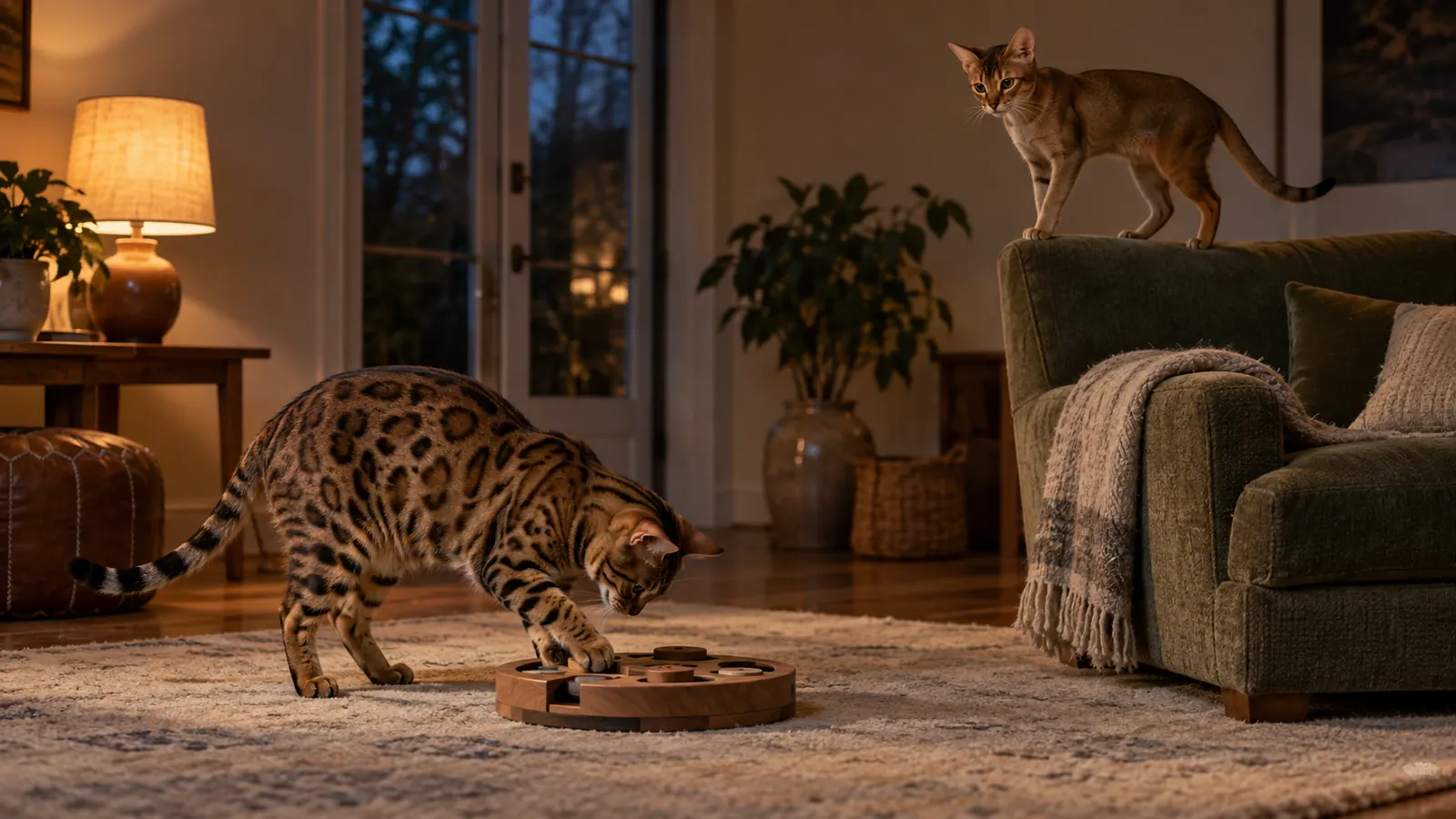
The Abyssinian is the better fit for most households because it does not add the Savannah's ancestry, legal and containment obligations. It is still a demanding domestic cat that commonly needs frequent interaction, connected height and changing enrichment.
A Savannah is also active, persistent and highly curious. TICA describes door opening, faucet play, powerful jumping and strong family bonds, all of which turn routine household details into management questions.
| Profile | Ownership gate | Activity | Containment | Best fit |
|---|---|---|---|---|
| Abyssinian | Normal domestic-breed ownership rules, subject to ordinary local cat law and housing terms | Extremely high, with exploratory movement and frequent participation | Secure indoor home with connected climbing routes and careful window safety | An interactive home that wants a demanding domestic cat |
| Savannah | Verify documented generation, current law, housing and insurance before preference | High energy, persistent exploration, powerful jumping and frequent interaction | Secure lifetime plan for doors, screens, balconies, transport and any outdoor access | An experienced, fully informed home that has cleared every legal and welfare condition |

Moving from an Abyssinian to a Savannah adds more ways for a mismatch to become difficult for the cat, the household and surrounding wildlife.
How different do they look, and what does generation tell you?
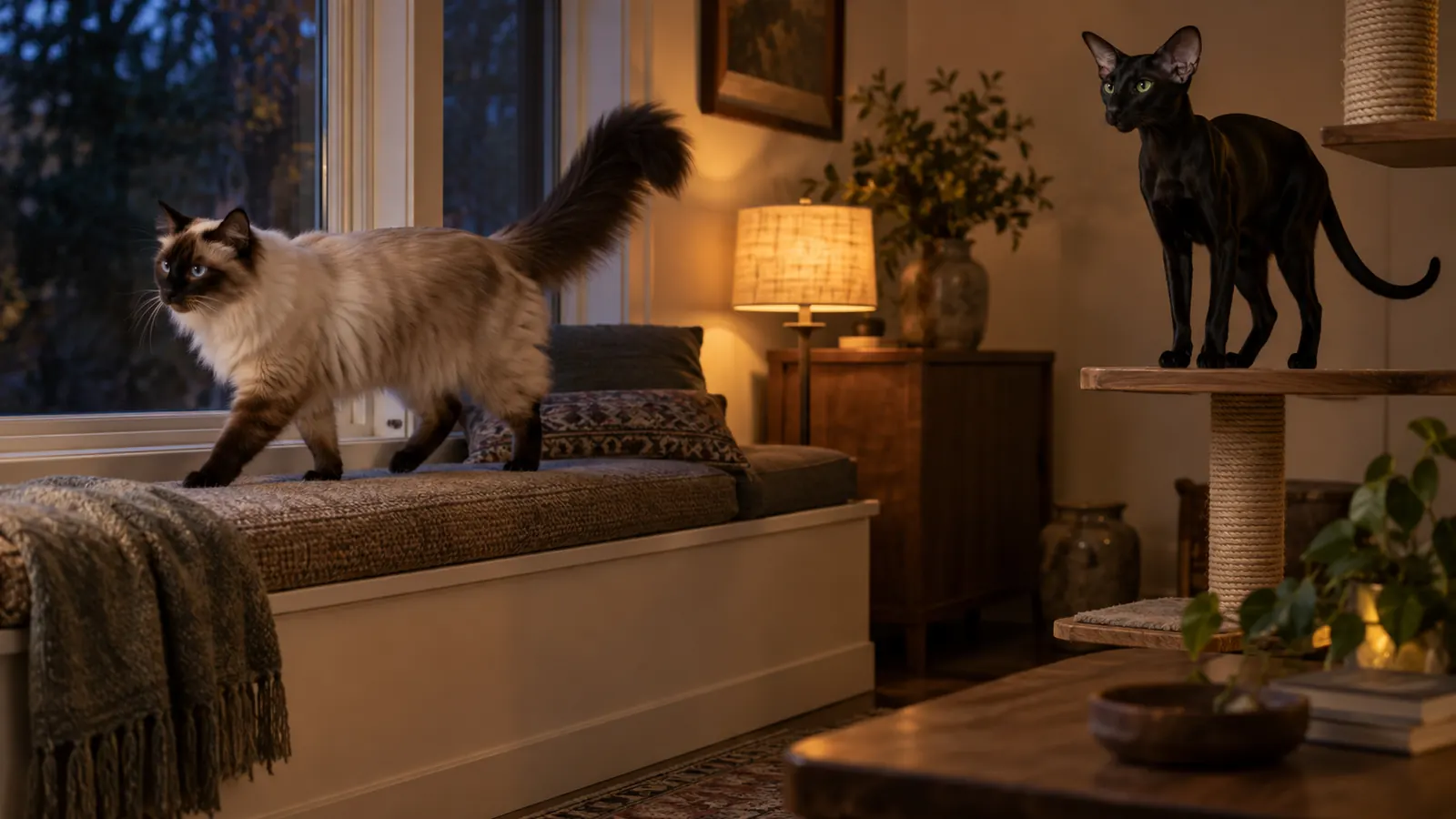
An Abyssinian has a fine, balanced body, long legs, large alert ears and a close ticked coat. TICA places adult females around 6 to 9 pounds and males around 7 to 12 pounds.
A Savannah is tall, lean and long-necked with exceptionally long legs, high-set ears, hooded eyes and bold spots. The long limbs can make the cat appear heavier than it is, which is why photographs without a shared baseline distort the comparison.
| Feature | Abyssinian | Savannah | Limit |
|---|---|---|---|
| Body line | Fine, balanced and athletic | Tall, lanky and long-necked | Body condition and sex change the individual outline |
| Coat | Close ticking on individual hairs | Distinct dark spots on an accepted background | Pattern does not establish generation |
| Ears | Large and alert | Exceptionally tall and set high on the head | Camera angle can exaggerate ear height |
| Adult size | Medium, with TICA sex ranges of about 6 to 12 pounds | Medium to large with substantial variation | Measure the actual adult rather than buying from an online size claim |
| Identity | Registration and documented parentage | Registration, pedigree and documented generation | Appearance alone proves neither breed |
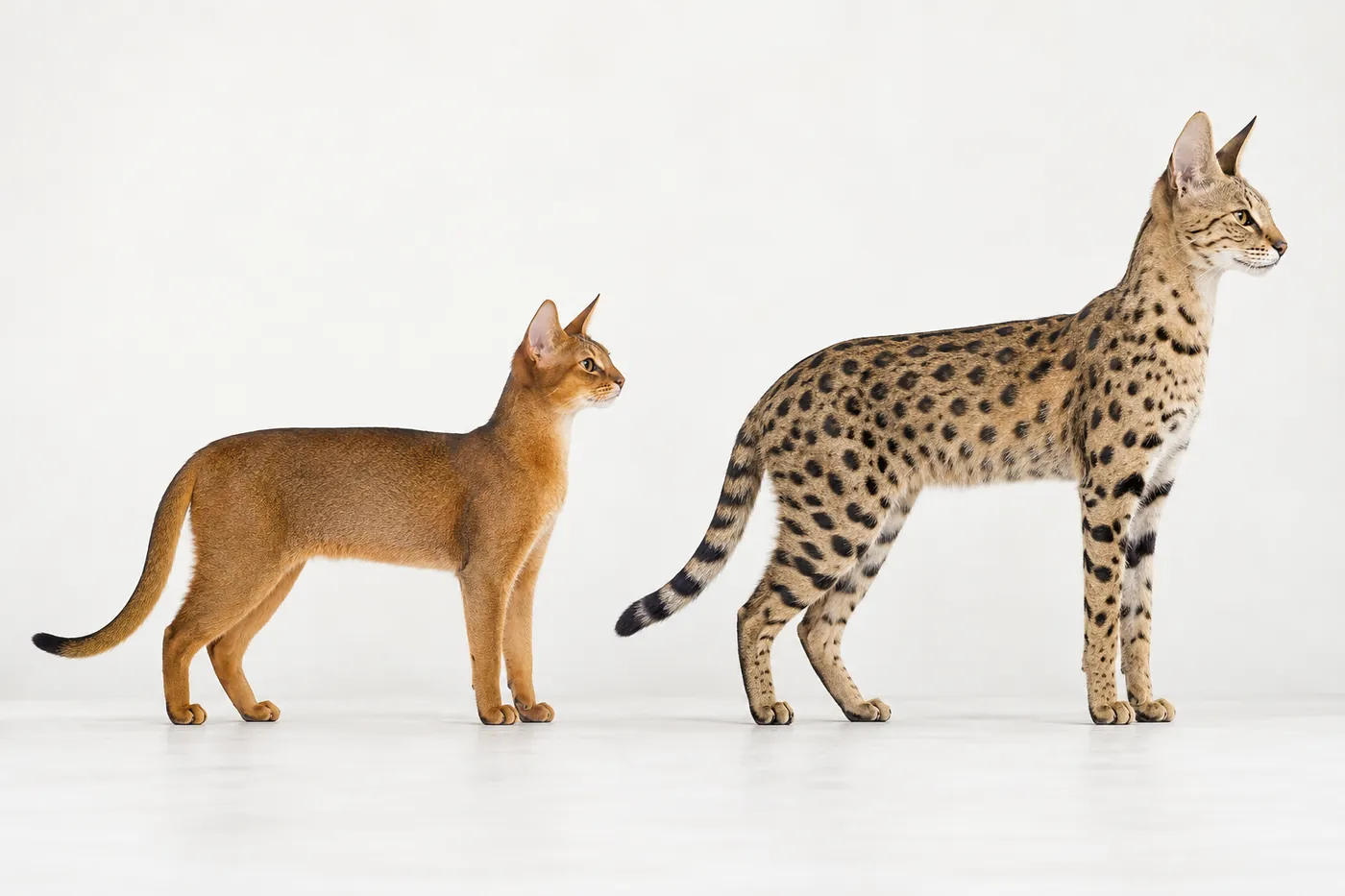
Generation is ancestry information. It does not guarantee adult weight, affection, trainability or safety with another animal, so a seller who uses one F number as a complete personality description is withholding the harder evidence.
How much space, climbing and containment do they need?
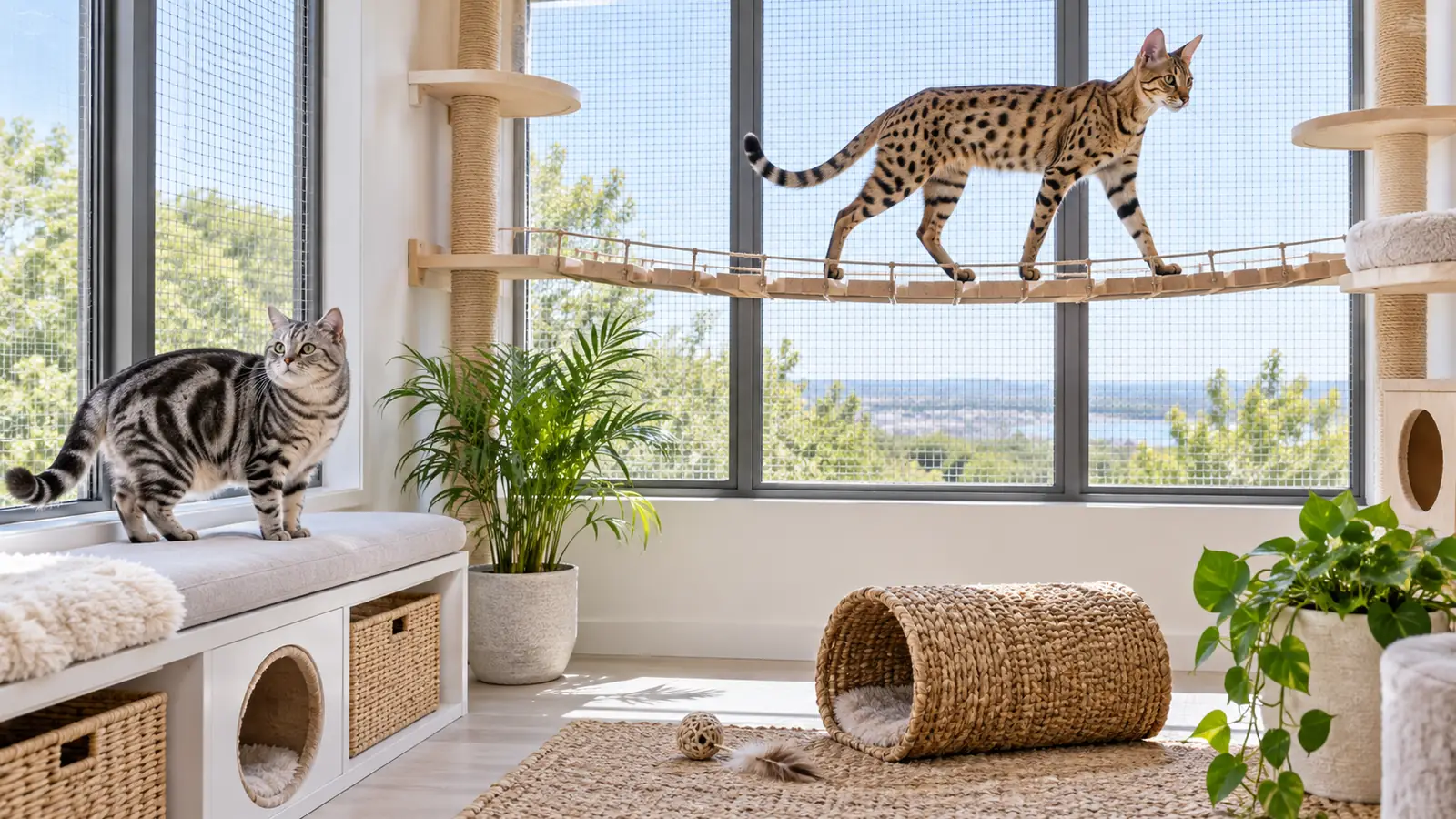
Both cats can exploit vertical space, but a Savannah adds reach, persistence and a stronger reason to audit every boundary. TICA notes that Savannahs may occupy doors, refrigerators and high cabinets, while their curiosity can extend to handles and taps.
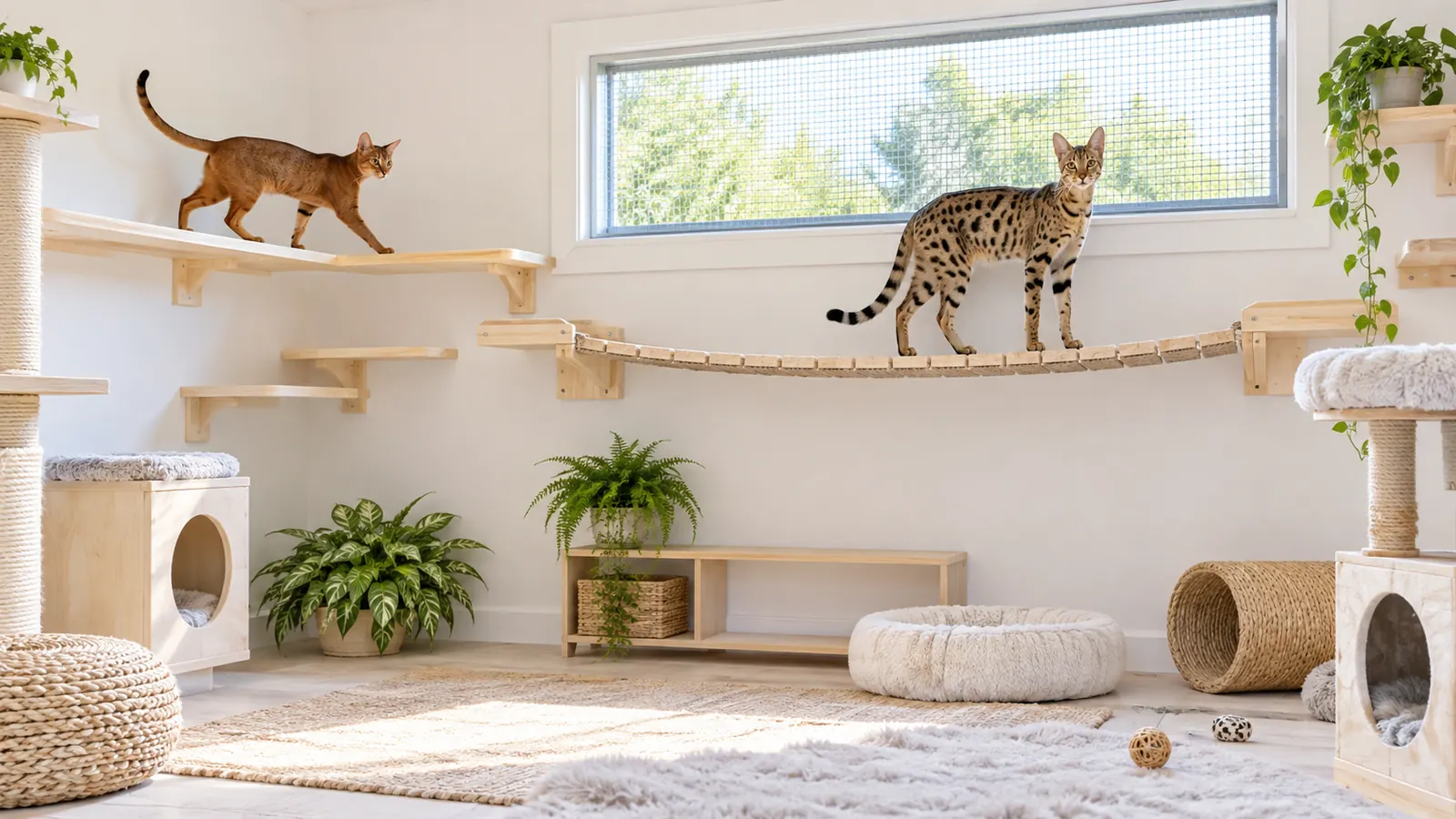
An Abyssinian benefits from linked shelves, stable trees and legal observation points. A Savannah needs those opportunities at a larger practical scale, plus landing distance and structures that tolerate a powerful jump without swaying.
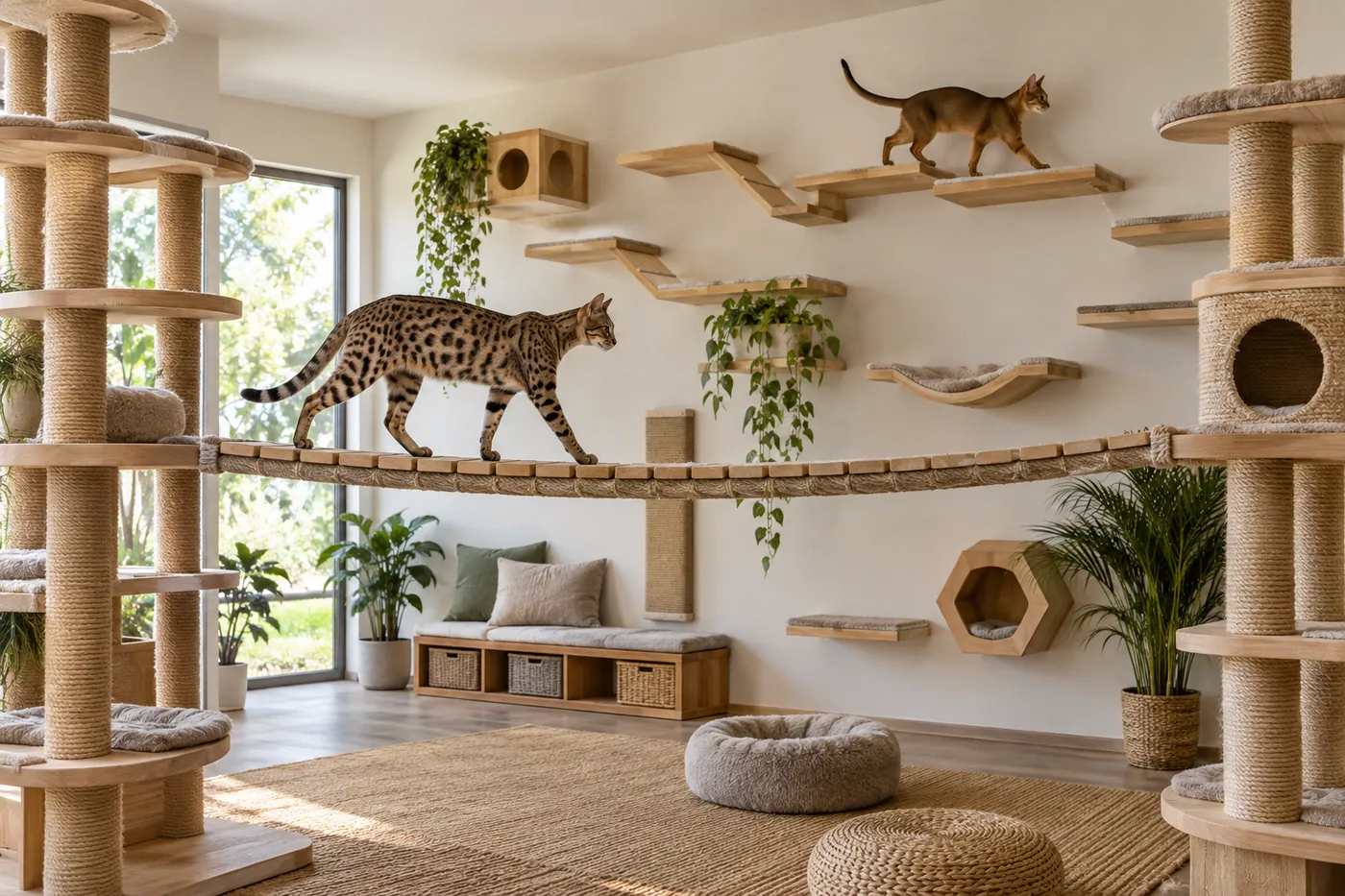
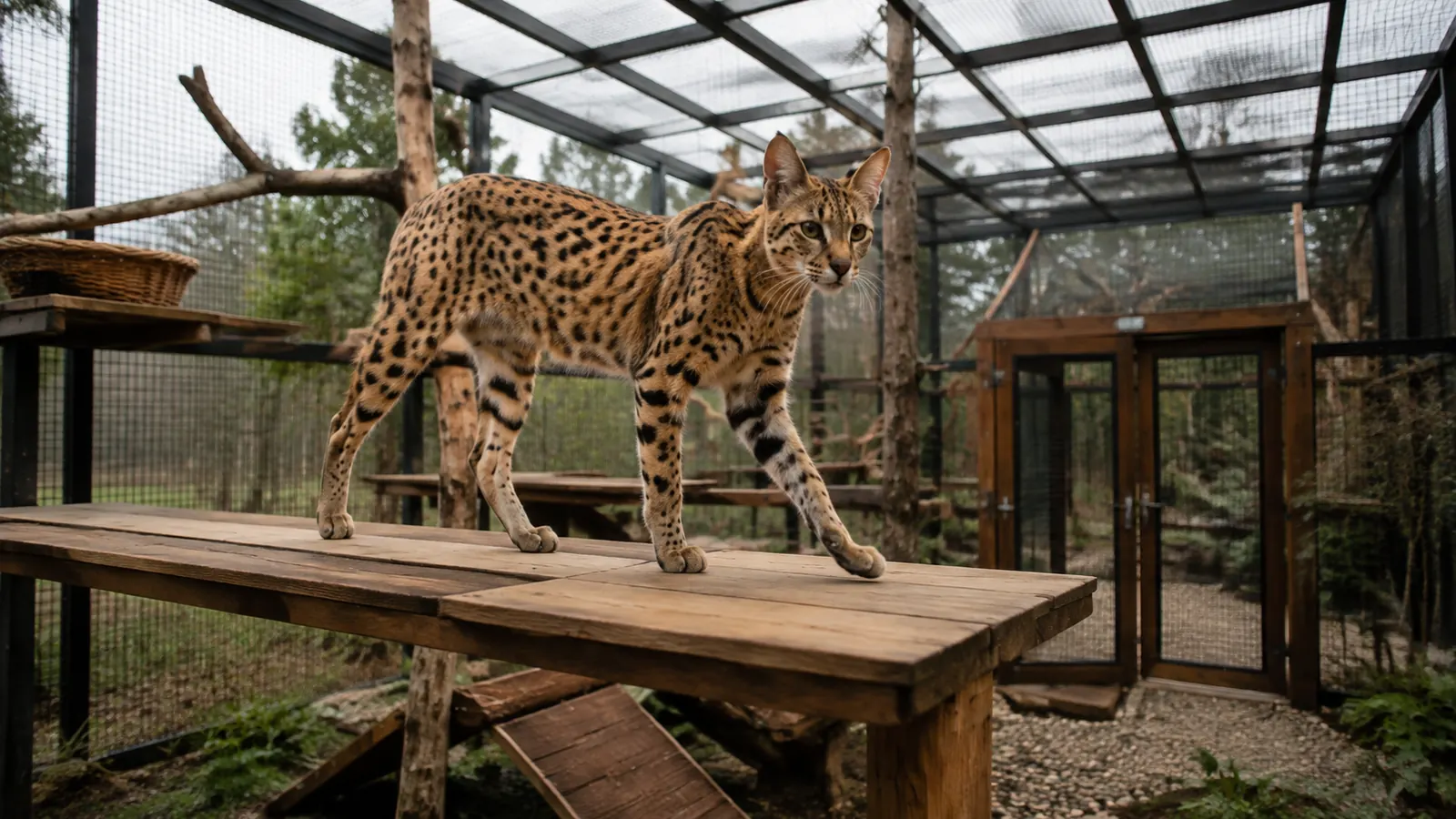
Containment includes small failures people stop seeing. A loose screen corner, a door opened while carrying bags, a balcony gap or a visitor who does not know the routine can defeat an otherwise careful setup.
- Interior route
- Connect stable observation points and keep fragile objects outside the travel line
- Landing volume
- Leave enough clear floor and platform depth for the actual cat to turn and descend
- Door control
- Use a repeatable entry routine and a closed interior buffer where practical
- Window safety
- Treat insect mesh as insect control unless it is specifically secured for animal load
- Outdoor boundary
- Use only a lawful secure enclosure or trained supervised system that the individual accepts
- Backup care
- Teach every caregiver the same door, transport and emergency routine
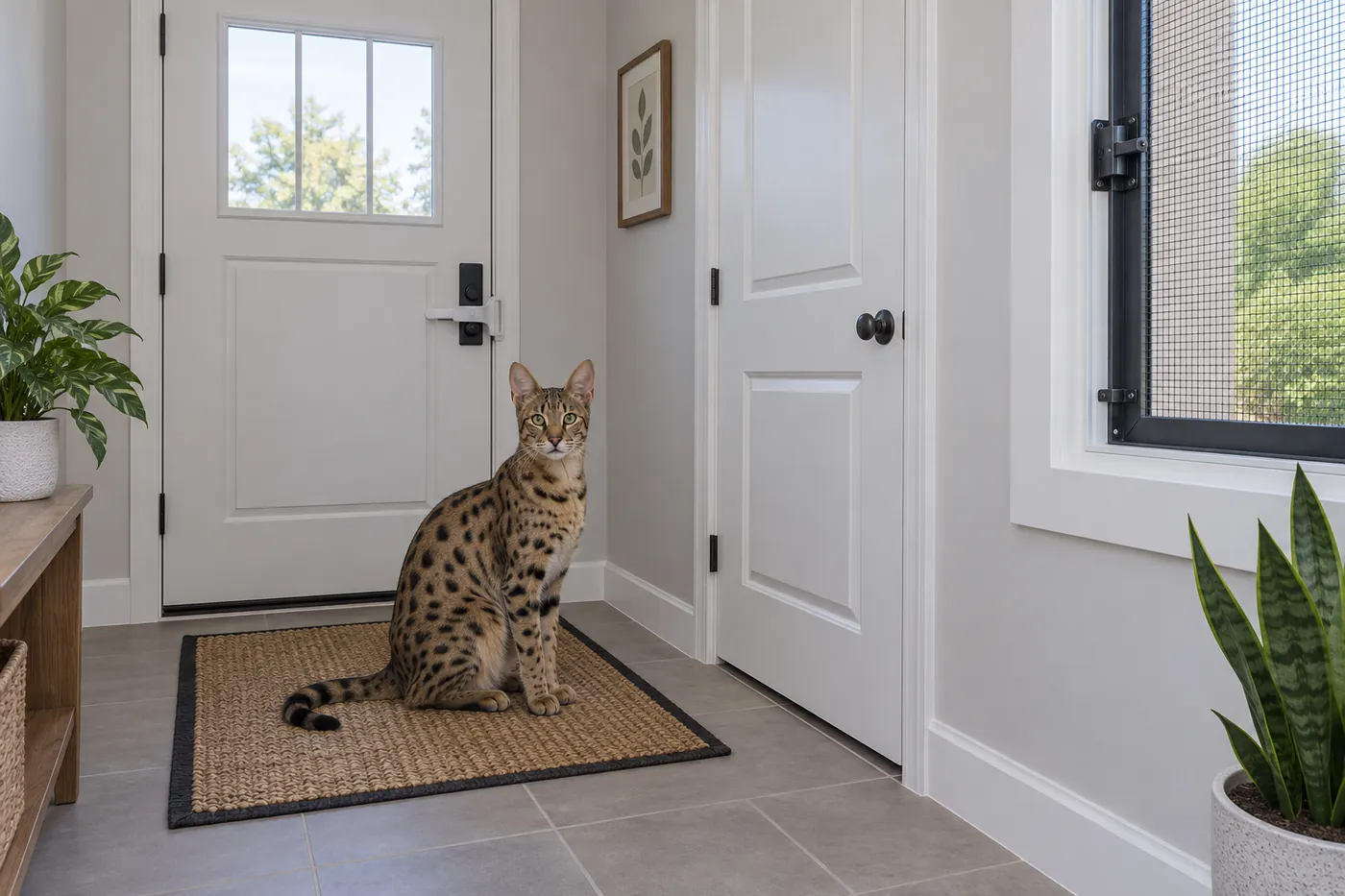
A harness is not containment by itself. Fit, gradual training, a backup grip and a lawful low-risk environment all matter, and some cats should not be taken into an exposed place at all.
Are Savannahs easier to train than Abyssinians?
Both breeds can learn quickly because food, play, access and curiosity provide strong rewards. The practical question is whether training produces reliable care behaviours for transport, handling and household routines.
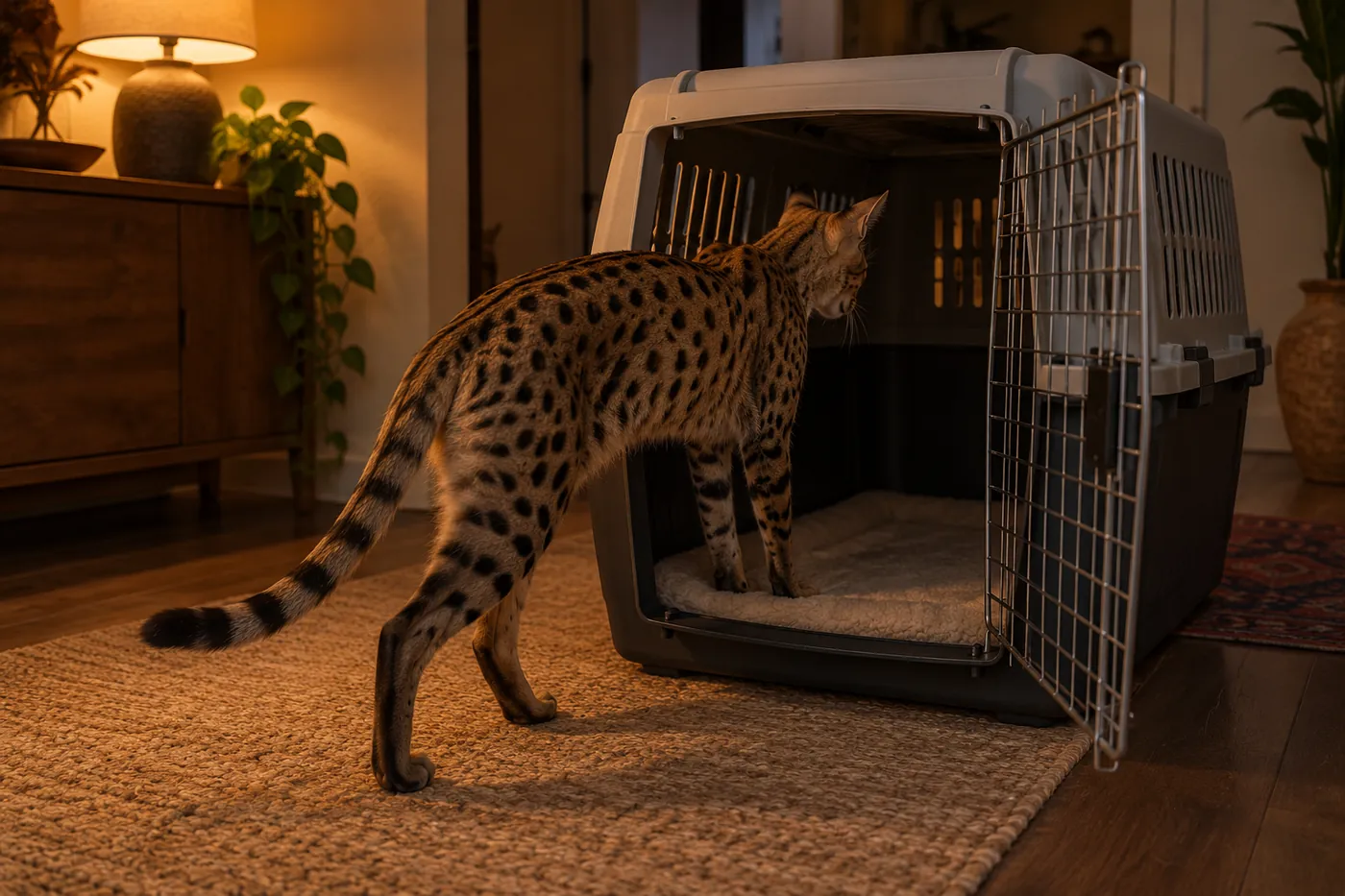
The behaviours worth training first are voluntary carrier entry, target following, moving to a mat, entering an interior room on cue and pausing for brief handling. They reduce conflict during travel, deliveries, veterinary care and household maintenance.
| Training job | Why it matters | Abyssinian consideration | Savannah consideration |
|---|---|---|---|
| Carrier entry | Makes transport less confrontational | Use a short search or target sequence | Size the carrier carefully and rehearse the full door routine |
| Target and mat | Redirects curiosity to a legal position | Change the route before repetition becomes dull | Reinforce heavily enough to compete with doors and high surfaces |
| Interior recall | Moves the cat away from an exterior opening | Practise from several rooms | Never treat recall as permission to leave an exterior boundary unsecured |
| Handling pause | Supports claw, mouth and body checks | Reward brief stillness between movement | Stop before restraint creates avoidance |
Clicker training marks one action at a time and builds duration in small steps. Punishment can increase avoidance or make the person part of the threat, while management prevents rehearsal before training is reliable.
Training cannot erase ancestry, guarantee recall outdoors or make an unsuitable home suitable.
Which homes and animals create the hardest match?
Fast, forceful play can frighten a timid cat even when no injury occurs. Size and persistence also matter around small dogs, elderly animals and cats that cannot reach a protected resource.
Small mammals, birds, reptiles and other vulnerable animals require secure physical separation, and a closed cage in a shared room is not automatically sufficient if a cat can reach, tip, open or repeatedly stalk it.
Older respectful children may enjoy structured play with either breed. Adults still control doors, handling and interaction, and a child should never become the only person responsible for a high-management cat.
Another energetic cat is not an automatic solution. The useful evidence is whether both animals take turns, pause, keep access to separate resources and recover after interaction.
What will food, grooming and routine care involve?
Both breeds have short coats that usually need only occasional gentle brushing, more attention during shedding and normal claw, ear, dental and body checks. The Savannah's coat advantage does not cancel the time required for activity and secure routines.
Both need a complete diet suited to life stage and body condition, and serval ancestry does not make raw meat, whole prey or an improvised high-protein recipe complete and balanced for a pet Savannah.
| Care area | Abyssinian | Savannah | Shared control |
|---|---|---|---|
| Food | Measure for a lean active body | Measure for the individual rather than a hybrid marketing claim | Track body condition and count training rewards inside the ration |
| Grooming | Gentle weekly surface pass | Occasional combing, with more attention during shed | Use grooming to inspect skin, ears, claws and new painful areas |
| Litter | Provide clean trays in quiet accessible locations | Large body and long legs may require an especially roomy tray | Offer one tray per cat plus one, spread across useful locations |
| Carrier | Measure chest, length and standing height | Check length and height rather than buying from a breed label | Leave the carrier available and train voluntary entry |
Sudden weight change, appetite loss, pain, diarrhoea or a marked change in urination is not an enrichment problem. It needs timely veterinary assessment.
Which breeder records should you inspect?
For the Abyssinian, the useful records are original reports from both parents for the CEP290 rdAc variant associated with progressive retinal atrophy and the PKLR variant associated with pyruvate kinase deficiency. Renal amyloidosis across close relatives is a separate question, because no simple DNA clearance answers that family history.
TICA's Savannah material recommends screening for pyruvate kinase deficiency and progressive retinal atrophy and notes a history of hypertrophic cardiomyopathy without one breed-specific genetic clearance. A useful answer names the exact variant, examination or family record the breeder used, which the word panel on its own does not.
| Record | Abyssinian question | Savannah question | Limit |
|---|---|---|---|
| Registration | Does the identity match the laboratory reports and pedigree? | Does the registered identity, pedigree and generation match the cat offered? | Registration does not guarantee temperament or health |
| PRA result | What is each parent's CEP290 rdAc status? | Which PRA test was used, for which cat and why? | One variant does not cover every cause of blindness |
| PK deficiency result | What is each parent's PKLR status? | What is each parent's PKLR status if the breeder follows TICA's recommendation? | A carrier is not the same as an affected cat |
| Family history | Are renal amyloidosis, cardiac disease, longevity and cause of death tracked? | Are cardiac findings, longevity and causes of death tracked across relatives? | Absence of a recorded event is not proof of absence |
| Dated veterinary record | What was examined in the individual and when? | What was examined in the individual and when? | A normal examination describes that time |
For a Savannah, the paperwork also supports legal due diligence, which is why the complete registration and pedigree records are worth keeping rather than a sales receipt or a screenshot of a breeder listing.
The breeder's adult cats, where you can meet them, show how the line recovers after something new, which says more than willingness to approach. A responsible seller should ask about your address, other animals, enclosure and daily routine because those facts change the placement.
When should you walk away from either choice?
A Savannah purchase is best abandoned when the generation cannot be documented, the current rule is unclear, housing permission is verbal, or the containment plan depends on everyone remembering an improvised warning. Those are ownership prerequisites that cannot be fixed after payment.
The same applies to either cat when the seller guarantees final size, temperament, allergy safety or lifetime health, when original health records cannot be matched to the parents, or when questions about older relatives are discouraged.
- The Savannah's registered generation and parentage are documented
- Current law, housing and insurance permit the exact cat in writing
- Every exterior opening has a practical containment procedure
- Children and caregivers can follow that procedure consistently
- Vulnerable animals remain securely separated without chronic exposure to pursuit
- The household welcomes daily high-energy interaction for years
- Original health results, dates, identities and family records are available
- The individual can play, pause, recover and disengage without escalating
For most homes that want an athletic, involved cat, the Abyssinian is the better recommendation because it meets that daily companionship goal without the Savannah's additional legal, ancestry and containment burdens.
A Savannah becomes a defensible choice only when every prerequisite is already resolved and the added work is understood rather than romanticised.
Checked Against
- TICA: Abyssinian tica.org
- TICA: Savannah tica.org
- TICA: Savannah breed standard tica.org
- UK Animal Welfare Committee: opinion on hybrid and exotic cat breeding gov.wales
- Australian Government: live import list and Savannah cat decision dcceew.gov.au
- UC Davis Veterinary Genetics Laboratory: PRA rdAc vgl.ucdavis.edu
- UC Davis Veterinary Genetics Laboratory: pyruvate kinase deficiency vgl.vetmed.ucdavis.edu
- GCCF: Abyssinian breeding policy gccfcats.org
Published 12 September 2026. Last updated .