
What Is an Oriental Longhair, and Where Does It Sit in the Siamese Family?
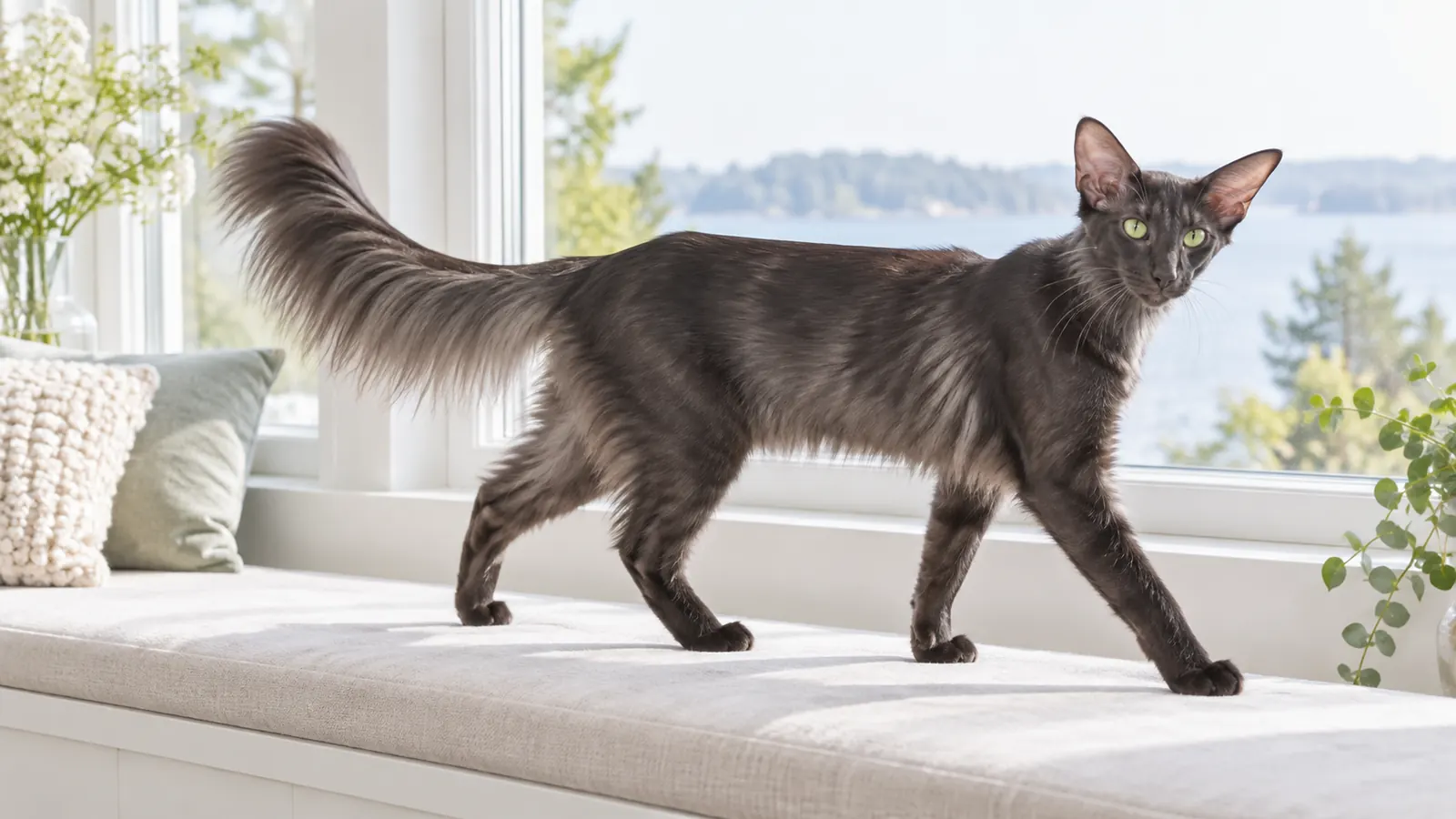
An Oriental Longhair is a fine-boned, wedge-headed cat with a silky semi-long coat in any colour or pattern. It carries the same body, voice and social intensity as the Oriental Shorthair and the Siamese, with a recessive longhair gene that produces its flowing coat. TICA recognises it as a separate breed; CFA treats it as a division of the Oriental.
- Origin
- Developed from Siamese-family breeding programmes in which the recessive longhair gene surfaced
- Coat
- Semi-long, fine, silky, lying close to the body with a plumed tail; all colours and patterns
- Size
- Medium, long and fine-boned with a tubular body and long whip tail
- Typical weight
- Secondary sources commonly cite 5 to 10 pounds
- Life expectancy
- No breed-specific figure; UK veterinary records give 11.74 years for cats overall
- Activity level
- High; intensely interactive, vocal and persistent about attention
- Grooming
- Moderate; the silky coat lacks a dense undercoat and tangles less than a Persian-type coat
- Suits
- Households that welcome constant social engagement, tolerate vocal communication and can provide interactive play
An Oriental Longhair is an Oriental Shorthair with a semi-long silky coat: the same fine-boned, wedge-headed body and the same loud, sociable temperament, in any colour or pattern.
The confusion comes from its relatives. The Siamese family has four closely related breeds that share that body and temperament and differ only in coat length and in whether colour is restricted to the points, and two of the four are semi-long-haired.
How Does the Siamese Family Tree Work?
Four breeds share the same fine-boned, wedge-headed body type and the same intensely social temperament. They differ in two traits: whether the coat is short or long, and whether the colour is restricted to the points or expressed across the full body.
| Breed | Coat length | Colour expression |
|---|---|---|
| Siamese | Short | Pointed (colour restricted to face, ears, legs and tail) |
| Balinese | Semi-long | Pointed |
| Oriental Shorthair | Short | Full-body (any colour or pattern, no restriction) |
| Oriental Longhair | Semi-long | Full-body (any colour or pattern, no restriction) |
The Balinese is the long-haired version of the Siamese. The Oriental Longhair is the long-haired version of the Oriental Shorthair.
The Javanese adds a fifth name. Under CFA, Javanese refers to Balinese-type cats in non-traditional point colours. Under TICA, the Javanese name is not used, and those cats are registered as Balinese.
The Oriental Longhair is not a pointed breed. If it carries the pointed pattern, it is registered differently depending on the registry.
How Do Registries Handle the Oriental Longhair?
TICA recognises the Oriental Longhair as a separate breed with its own standard.
CFA treats the Oriental as one breed with two coat-length divisions: shorthair and longhair. A CFA Oriental Longhair competes within the Oriental breed rather than as a separate breed.
Both approaches describe the same cat. The difference is administrative, and it affects showing and registration but not what the cat is like to live with.
- TICA
- Recognised as a separate breed
- CFA
- Treated as a division of the Oriental breed
- Coat gene
- Recessive longhair (l/l); both parents must carry it
- Body type
- Identical to Oriental Shorthair and Siamese
- Colour range
- Any colour and pattern, the widest of the Siamese family
- Distinction from Balinese
- Full-body colour, not pointed
The recessive longhair gene means both parents must carry at least one copy for long-haired kittens to appear. A mating between two Oriental Shorthairs that both carry the gene can produce Oriental Longhair kittens.
What Does an Oriental Longhair Look Like?
The coat is semi-long, fine and silky, lying closer to the body than a Persian or Maine Coon coat. It lacks the dense undercoat that produces heavy seasonal shedding in double-coated breeds.
The plumed tail is the single most noticeable difference from the Oriental Shorthair. The body furnishings are modest compared to a heavily coated breed, and the angular bone structure remains visible beneath the coat.
The cat underneath is medium-sized, long and fine-boned. Weights of about 5 to 10 pounds are commonly cited, and the body feels lighter than it looks because of that slender frame.
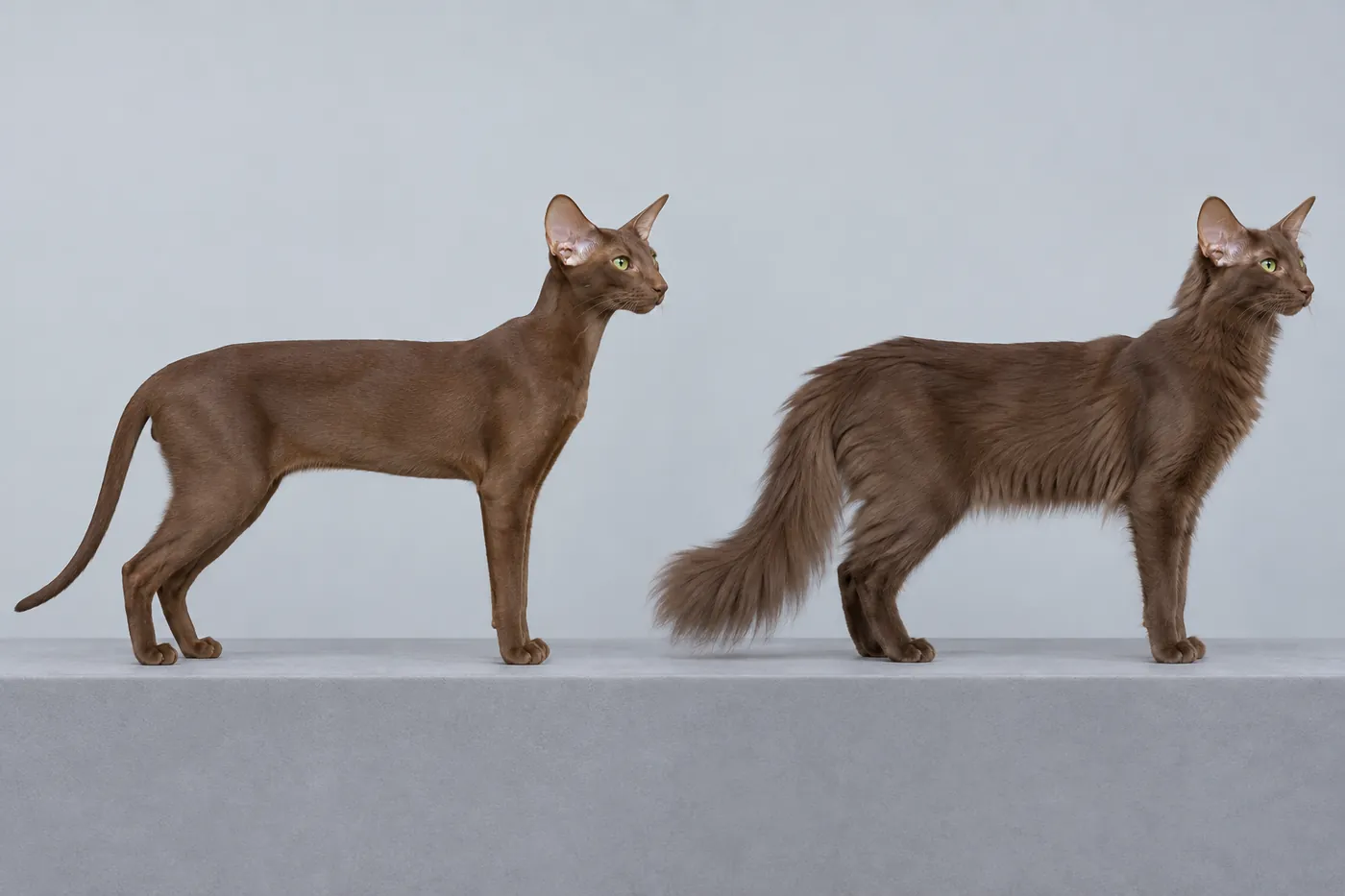
Shedding is lighter than breeds with a thick undercoat, and there is no heavy seasonal release to manage. Regular combing prevents the fine hair from forming small tangles behind the ears and under the legs, but the grooming commitment is moderate rather than intensive.
Because there is little undercoat, the routine used for long coats applies here in a lighter form. A cat that resists grooming usually comes round through short sessions paired with a food reward, started early.
Why Does the Vocal Temperament Matter More Than the Coat?
The Oriental Longhair inherits the Siamese-family temperament in full, and for most households that weighs more in the decision than the coat does.
These cats are consistently described across registries and breed clubs as vocal, demanding, interactive and persistent about human company. They tend to follow people between rooms, vocalise when ignored and insert themselves into household activities.
That intensity is the breed's largest practical consideration. A quiet household that wants a decorative longhaired cat will find an Oriental Longhair exhausting. A household that enjoys constant interaction and does not mind audible opinions will find it engaging.
Isolation tolerance is low. A Siamese-family cat left alone for a full workday without company or enrichment may develop vocal distress, over-grooming or destructive behaviour. A compatible companion cat can help, but it does not replace human attention.
Trainability is strong. Siamese-family cats are food-motivated and quick to learn reward-based routines. Carrier entry, recall, leash walking and cooperative handling are all realistic.
What Health Concerns Come From the Siamese Lines?
The Oriental Longhair shares the health profile of the Siamese family.
| Condition | What it is | Relevance |
|---|---|---|
| Amyloidosis | Abnormal protein deposits that can damage the liver, documented in Siamese and Oriental lines | Ask whether the breeding line has a history of liver disease |
| Asthma and bronchial disease | A higher reported incidence in Siamese-family breeds | Watch for coughing, wheezing or laboured breathing |
| Progressive retinal atrophy (PRA) | A genetic eye condition that can lead to vision loss | A DNA test is available |
| Dental disease | Siamese-family breeds may be predisposed to periodontal problems | Regular dental checks |
No health study has looked at Oriental Longhairs on their own, so the evidence in the table comes from Siamese and Oriental Shorthair research, which applies because the breeds share their genes. Lifespan is in the same position: no population study has measured the Oriental Longhair separately, and the nearest measured anchor is the UK all-cat life expectancy of 11.74 years from veterinary records, which cannot predict one cat's lifespan.
How Does an Oriental Longhair Fit a Family or Multi-Cat Home?
Children who are old enough to handle a fine-boned cat gently can suit the breed well, because the cat's social drive usually meets the child's desire for interaction. Very young children and the breed's slender build are a riskier combination.
Multi-cat households often work when the other cat tolerates the Oriental's persistent social energy. A timid or solitary-natured companion may find the approach overwhelming.
The breed's activity level is high. An Oriental Longhair wants interactive play, vertical climbing access and varied enrichment. A household that provides these outlets channels the energy into play. One that does not may find it redirected into cupboard opening, counter surfing or vocal protest.
Who Suits an Oriental Longhair Best?
The breed fits a household that actively wants a participating member rather than a quiet observer.
- Interactive play sessions several times a day
- Company during working hours, either human or a compatible cat
- Tolerance for frequent and sometimes loud vocalisation
- Regular combing of the semi-long coat, heavier behind the ears and under the legs
- Parent PRA (rdAc) DNA results and an honest account of any liver disease in the line
An apartment works well when the vertical space is supplied. The breed's slender build does not need the wide turning room a Maine Coon requires, but it does need height and movement routes.
How Do You Verify What You Are Getting?
The Oriental Longhair, Balinese and Javanese are easy to confuse because all three are semi-long-haired Siamese-family cats.
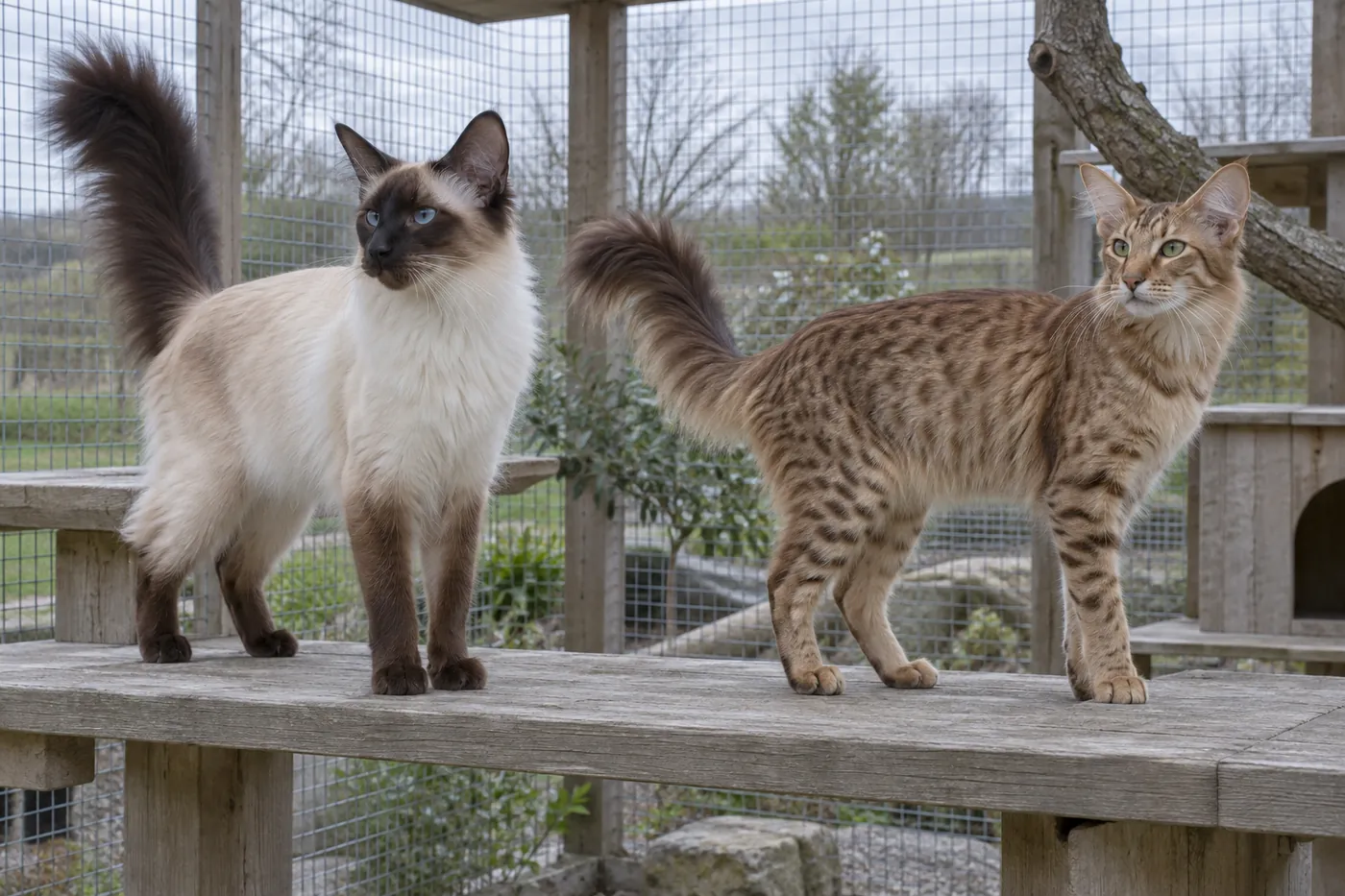
The key distinction is colour. An Oriental Longhair expresses colour across the full body in any pattern, while a Balinese carries the pointed pattern with colour restricted to the extremities. If you are looking at a semi-long-haired Siamese-type cat with seal, blue, chocolate or lilac points and blue eyes, that is a Balinese or Javanese.
Registration papers should identify the breed and both parents. A PRA (progressive retinal atrophy) DNA test result is worth asking for, since the test is available and the condition is documented in these lines.
A breeder who can explain which of the four Siamese-family breeds they produce and why, and who tests for PRA and discusses the amyloidosis history of their line, is providing the information this decision needs.
Common Questions
Is an Oriental Longhair the same as a Balinese?
No. Both are semi-long-haired cats from the Siamese family, but the Balinese carries the pointed colour restriction while the Oriental Longhair expresses colour across the full body in any pattern.
Are Oriental Longhairs vocal?
Yes. They inherit the Siamese-family vocal temperament in full and are consistently described as loud, persistent and communicative. This is the breed's most consequential daily trait.
How much grooming does an Oriental Longhair need?
Moderate. The silky coat lacks a dense undercoat, so it tangles less than a Persian-type coat. Regular combing behind the ears and under the legs is the main commitment.
How big does an Oriental Longhair get?
The breed is medium-sized, long and fine-boned. Secondary sources cite 5 to 10 pounds. The body feels lighter than it looks.
What health problems do Oriental Longhairs have?
They share Siamese-family health concerns including amyloidosis, asthma, progressive retinal atrophy and dental disease. A DNA test exists for the rdAc form of PRA, and no study has looked at Oriental Longhairs separately.
Checked Against
- TICA: Oriental Longhair breed tica.org
- CFA: Oriental cfa.org
- TICA: Siamese tica.org
- CFA: Balinese cfa.org
- Generalized AA-amyloidosis in Siamese and Oriental cats pubmed.ncbi.nlm.nih.gov
- Widespread retinal degenerative disease mutation (rdAc) across popular cat breeds pubmed.ncbi.nlm.nih.gov
- UC Davis Veterinary Genetics Laboratory: PRA rdAc vgl.ucdavis.edu
- Life tables of annual life expectancy and risk factors for mortality in cats in the UK pmc.ncbi.nlm.nih.gov
Published 17 September 2026. Last updated .





