
What Is a Mandalay Cat, and How Does It Differ From a Burmese?
A Mandalay is a Burmese-type cat with a full-expression coat colour rather than the sepia pattern that defines the standard Burmese. It is recognised by the New Zealand Cat Fancy (NZCF), and the breed lists of FIFe, CFA and WCF do not include it. The breed shares the Burmese body type, temperament characteristics and inherited health concerns, so the practical ownership experience closely tracks what a Burmese requires.
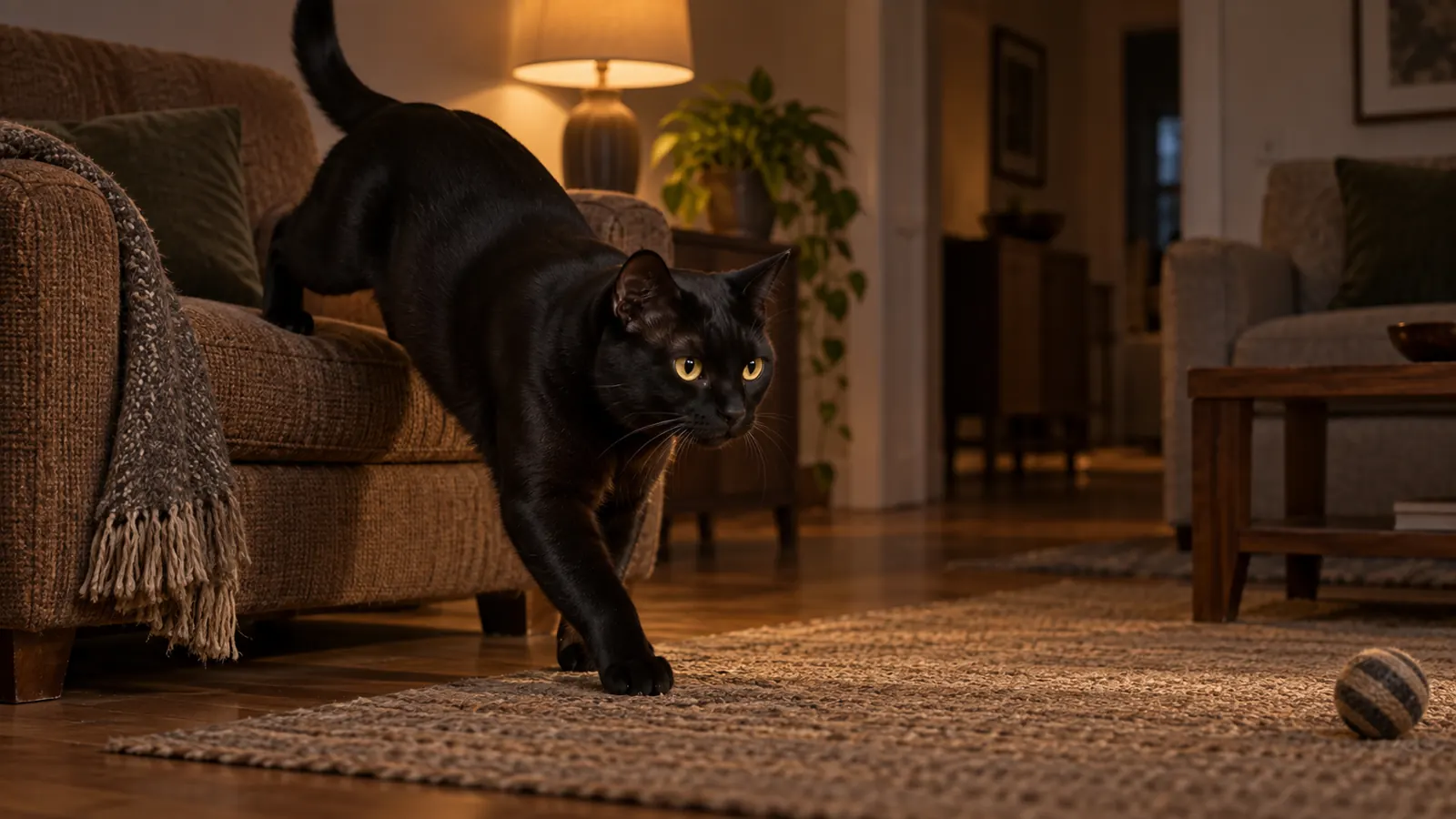
- Origin
- New Zealand, 1980s, from Burmese crossed with solid-coloured domestic cats
- Coat
- Short, close-lying, satin-textured coat in full-expression colours including black, chocolate, cinnamon, red and their dilutes
- Size
- Medium, muscular and compact, following the Burmese body type
- Typical weight
- Similar to Burmese; secondary sources commonly cite 8 to 12 pounds
- Life expectancy
- No Mandalay-specific data exists; UK veterinary records give the Burmese a life expectancy of 14.42 years at birth
- Activity level
- Active, sociable and people-oriented, consistent with the Burmese temperament
- Grooming
- Low; the short satin coat needs minimal maintenance
- Suits
- Households that provide company, interactive play and realistic health planning for Burmese-line conditions
A Mandalay is a Burmese-type cat whose coat expresses colour at full intensity rather than through the Burmese sepia dilution.
The New Zealand Cat Fancy (NZCF) recognises it as a separate breed. FIFe, CFA and WCF do not list the Mandalay, and acquiring one outside New Zealand and Australia is extremely difficult.
That limited recognition is the single most important fact about the Mandalay as a breed decision. The cat itself closely resembles a Burmese in body, temperament and health, and the distinction is primarily a registration boundary around coat colour.
What Is a Mandalay, and Who Recognises It?
New Zealand breeders developed the Mandalay in the 1980s from matings between Burmese and solid-coloured domestic cats, the origin the New Zealand Cat Fancy itself records. The kittens kept the Burmese build and eye shape, but each carried a full-colour gene from its non-Burmese parent, so their coats came out at full depth and a Burmese sable became black. The Burmese standard requires the sepia colouring, which left those kittens with no show category.
Rather than breeding the colour back out, the breeders asked for a separate breed name, and NZCF accepted the Mandalay as a distinct breed with its own standard. The FIFe, CFA and WCF breed lists do not include it.
The Bombay is the closest parallel. It also began with a Burmese crossed to a non-Burmese cat, in its case a black American Shorthair in Kentucky, to produce a solid black cat of Burmese type, and CFA granted it championship status in 1976. The Mandalay has not achieved the same international acceptance.
- Registry status
- NZCF recognised
- CFA
- Not listed
- FIFe
- Not listed
- WCF
- Not listed
- Origin
- New Zealand, 1980s, from Burmese and solid-coloured domestic cats
- Defining difference
- Full-expression coat colour instead of Burmese sepia pattern
- Body type
- Burmese-type: muscular, compact, medium
- Practical availability
- Extremely limited outside New Zealand and Australia
Registries also differ over which colours a Burmese may have: the GCCF accepts ten, including red, cream and the torties, where CFA accepts four. Those are all sepia colours, though, so the wider British list still gives a full-colour cat like the Mandalay no place in the Burmese standard.
How Can You Tell a Mandalay From a Burmese by Sight?
The body follows the Burmese type: medium, muscular, compact and surprisingly heavy for its size. The head shape, eye placement and overall conformation match the Burmese standard, because the Mandalay is bred to the Burmese type.
The coat is short, close-lying and has the satin-like texture associated with Burmese lines. In a Mandalay, the colour appears at full depth: a black Mandalay is a rich solid black, not the warm brown sable of a Burmese carrying the same underlying pigment.
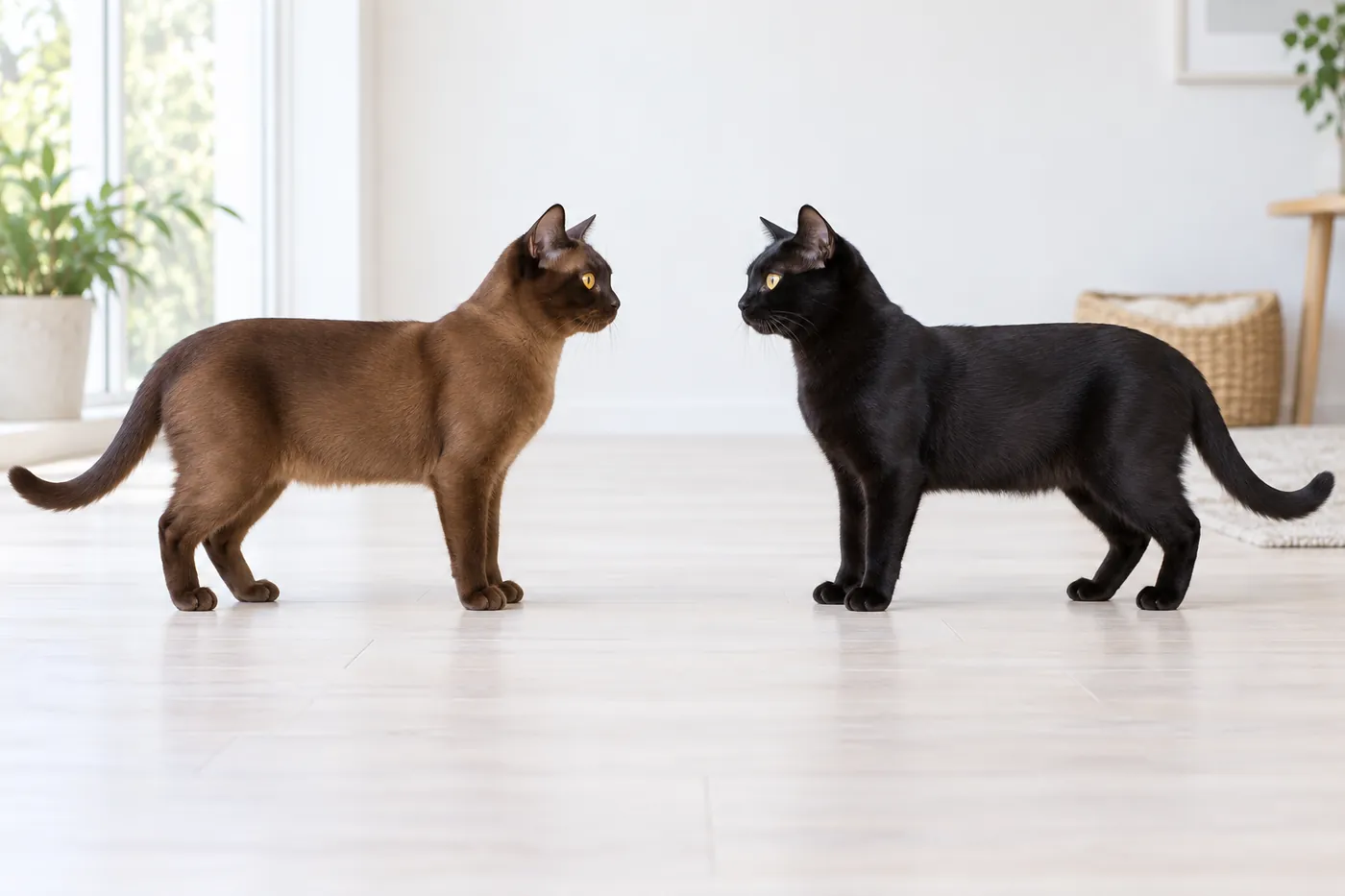
Mandalay colours include black, which New Zealand breeders call ebony, chocolate, cinnamon, red, blue, lilac, fawn, cream and tortoiseshell, and the New Zealand Burmese club also lists ticked and spotted tabbies.
Eye colour ranges from gold to amber, consistent with Burmese heritage.
What Genetics Separate a Mandalay From a Burmese?
The distinction is a single gene: the Burmese colour-restriction gene, known as cb.
A standard Burmese is homozygous (cb/cb), which reduces the intensity of coat colour and creates the characteristic warm sepia effect. A Mandalay carries at least one copy of the full-colour allele (C/cb or C/C), which allows the underlying pigment to express at full intensity.
The body type, temperament and health profile are inherited independently of the colour gene.
Breeding a standard Burmese (cb/cb) to a Mandalay (C/cb) produces kittens that are either cb/cb (Burmese colour) or C/cb (Mandalay colour). Both types share the same body, temperament and health genetics.
What Does Burmese Temperament Mean in Practice?
The Mandalay's temperament draws from Burmese lines, and Burmese temperament descriptions are the most relevant reference.
Burmese cats are consistently described across registries as people-oriented, vocally communicative and active. They tend to follow household members between rooms and prefer company to solitude.
A Mandalay raised from these lines is likely to share those characteristics. Individual variation still applies, but the Burmese tendency toward close human contact is one of the more reliable breed-level temperament patterns in the cat fancy.
The sociability that makes a Burmese-type cat appealing also makes it a poor match for a household where everyone is away for long hours with no plan for company or enrichment. A cat that expects interaction and receives an empty room may respond with persistent vocalisation, over-grooming or destructive behaviour.
Trainability is a practical strength. Burmese-type cats are commonly food-motivated, so short, reward-based training sessions work well, and carrier entry, recall and cooperative handling for grooming or veterinary visits are all realistic goals.
What Burmese Health Concerns Does a Mandalay Inherit?
Because the Mandalay is bred to the Burmese type and alongside Burmese lines, the documented Burmese health concerns can apply.
| Condition | What it is | What can be checked |
|---|---|---|
| Burmese craniofacial defect | A congenital malformation of the skull and face linked to the ALX1 gene, seen primarily in North American Burmese lines | Parent DNA results for the ALX1 variant, which is lethal in two copies |
| Hypokalemic polymyopathy | A recessive condition causing muscle weakness due to low blood potassium, caused by a WNK4 variant in Burmese and related breeds | Parent DNA results for the WNK4 variant, since a DNA test settles carrier status |
| Diabetes mellitus | A higher predisposition reported in Burmese populations, including Australian cats, compared to mixed-breed cats | No test exists; affected relatives and a lean body condition are what can be checked |
| Flat-chested kitten syndrome | Compression of the chest in young kittens, seen more frequently in Burmese litters | Veterinary assessment of any kitten with visible chest compression |
These are not certainties for any individual cat, but they are documented population-level findings that responsible health planning should account for.
No health study has looked at Mandalays as a population of their own, so every figure here comes from Burmese research. Because the breed began with non-Burmese crosses, its lines may carry these variants less often than a closed Burmese population does, but nobody has measured that, and results on the actual parents are the only way to know.
Lifespan estimates draw from Burmese data. UK life tables built from veterinary records give the Burmese a life expectancy of 14.42 years at birth, the longest figure for any breed in that study, against 11.74 years for cats overall. No separate Mandalay figure exists, and a population estimate cannot predict one cat's lifespan.
Weight belongs in the health picture because of the diabetes finding. A Mandalay grows into a medium, muscular adult usually cited at 8 to 12 pounds that feels heavier than it looks, and that compact build hides gradual gain, so body condition judged by rib feel and waist says more than the scale alone.
How Much Activity Does a Mandalay Need?
A Burmese-type cat is typically active, playful and interested in household life without being as physically demanding as the large athletic breeds.
- Interactive play sessions that use the cat's reported problem-solving interest
- Company during the day, or a compatible companion animal if the household is away
- A scratching post and moderate climbing access
- Toys that engage hunting and retrieval behaviours
A second compatible cat can cover some of the daytime company a Mandalay wants, although it wants people as well.
How Should You Groom a Mandalay?
The short satin coat needs very little maintenance. A weekly pass with a soft cloth or grooming glove removes loose hair and distributes skin oils. The coat naturally lies close and smooth.
Shedding is light compared to double-coated breeds. The Burmese-type coat has minimal undercoat, so seasonal coat release produces far less loose hair than a breed with a dense underlayer.
Dental care, nail trimming and routine weight checks follow the same schedule as any cat.
Does the Burmese Sociability Carry Into a Family Home?
The Burmese-type temperament is often described as adaptable and sociable, and many Burmese-line cats live successfully with children and other pets.
The breed's muscular compact body and confident disposition may handle the activity of a family household well. Children should still learn to handle any cat gently and allow it to withdraw.
Multi-cat households often suit Burmese-type cats better than solitary living, provided a new cat meets the resident one through a staged introduction rather than all at once.
How Do You Find and Assess a Mandalay?
Availability is the largest practical barrier. The breed exists almost exclusively in New Zealand and Australia, and finding a Mandalay breeder outside those countries may not be possible.
If you are attracted to the Burmese type and temperament but prefer a full-expression colour, a Mandalay may be worth pursuing through NZCF-registered breeders. If you are in a region where Mandalay breeders do not operate, a Burmese or European Burmese offers the same body type and temperament with established local availability.
- NZCF registration papers naming both parents
- Parent DNA results for the ALX1 head defect and WNK4 hypokalaemia
- The cat's full-expression colour distinguishes it from a standard Burmese
- Individual temperament observed during contact and handling
- The source can explain what NZCF recognition means and does not mean in terms of other registries
A breeder who explains the Mandalay's relationship to the Burmese honestly, including the health screening the Burmese line requires, is providing more useful information than one who presents it as a wholly separate and rare breed.
Common Questions
Is a Mandalay the same as a Burmese?
A Mandalay is a Burmese-type cat that carries a full-colour gene from non-Burmese ancestors. The body type, temperament and health concerns are shared. NZCF treats it as a separate breed; FIFe, CFA and WCF do not list it.
Where can you get a Mandalay cat?
Mandalay breeders are concentrated in New Zealand and Australia. FIFe, CFA and WCF do not list the breed, so finding one outside those countries is extremely difficult.
What health problems do Mandalay cats have?
Mandalay cats can inherit Burmese health concerns including the craniofacial defect (ALX1 gene), hypokalemic polymyopathy, diabetes predisposition and flat-chested kitten syndrome. DNA tests exist for the ALX1 and WNK4 variants, and no Mandalay-specific health study exists.
How big does a Mandalay cat get?
The Mandalay follows the Burmese body type: medium, muscular and compact. Secondary sources cite 8 to 12 pounds, consistent with Burmese weight ranges.
What colours do Mandalay cats come in?
Mandalay cats express colour at full intensity rather than through the Burmese sepia dilution. Colours include black, chocolate, cinnamon, red, blue, lilac, fawn, cream and tortoiseshell variations.
Checked Against
- New Zealand Cat Fancy: Mandalay breed information nzcf.com
- CFA: Recognised breeds, list page 3 (Mandalay not listed) cfa.org
- Lyons et al.: Aristaless-like homeobox protein 1 (ALX1) variant associated with craniofacial structure and frontonasal dysplasia in Burmese cats (Dev Biol, 2016) pmc.ncbi.nlm.nih.gov
- Merck Veterinary Manual (Williamson and Carnevale): Feline hypokalemic polymyopathy merckvetmanual.com
- Burmese Cat Club of New Zealand: About Mandalay cats burmesecatclub.nz
- Life tables of annual life expectancy and risk factors for mortality in cats in the UK pmc.ncbi.nlm.nih.gov
- UC Davis Veterinary Genetics Laboratory: Burmese hypokalemia vgl.ucdavis.edu
- First WNK4-hypokalemia animal model identified by genome-wide association in Burmese cats journals.plos.org
- FIFe: Cat breeds by category (Mandalay not listed) fifeweb.org
- WCF: Shorthair breed standards (Mandalay not listed) wcf.de
Published 17 September 2026. Last updated .





