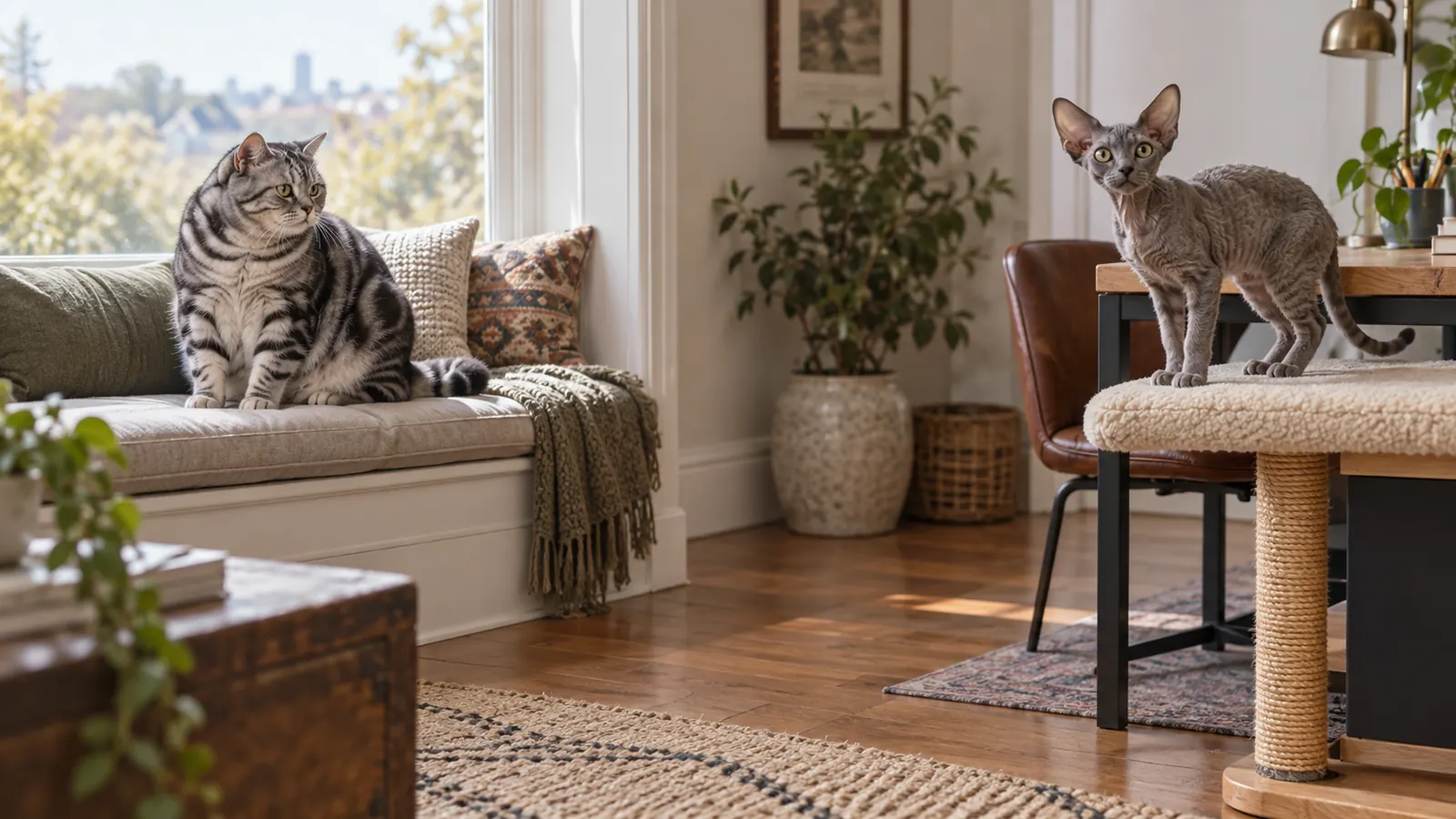
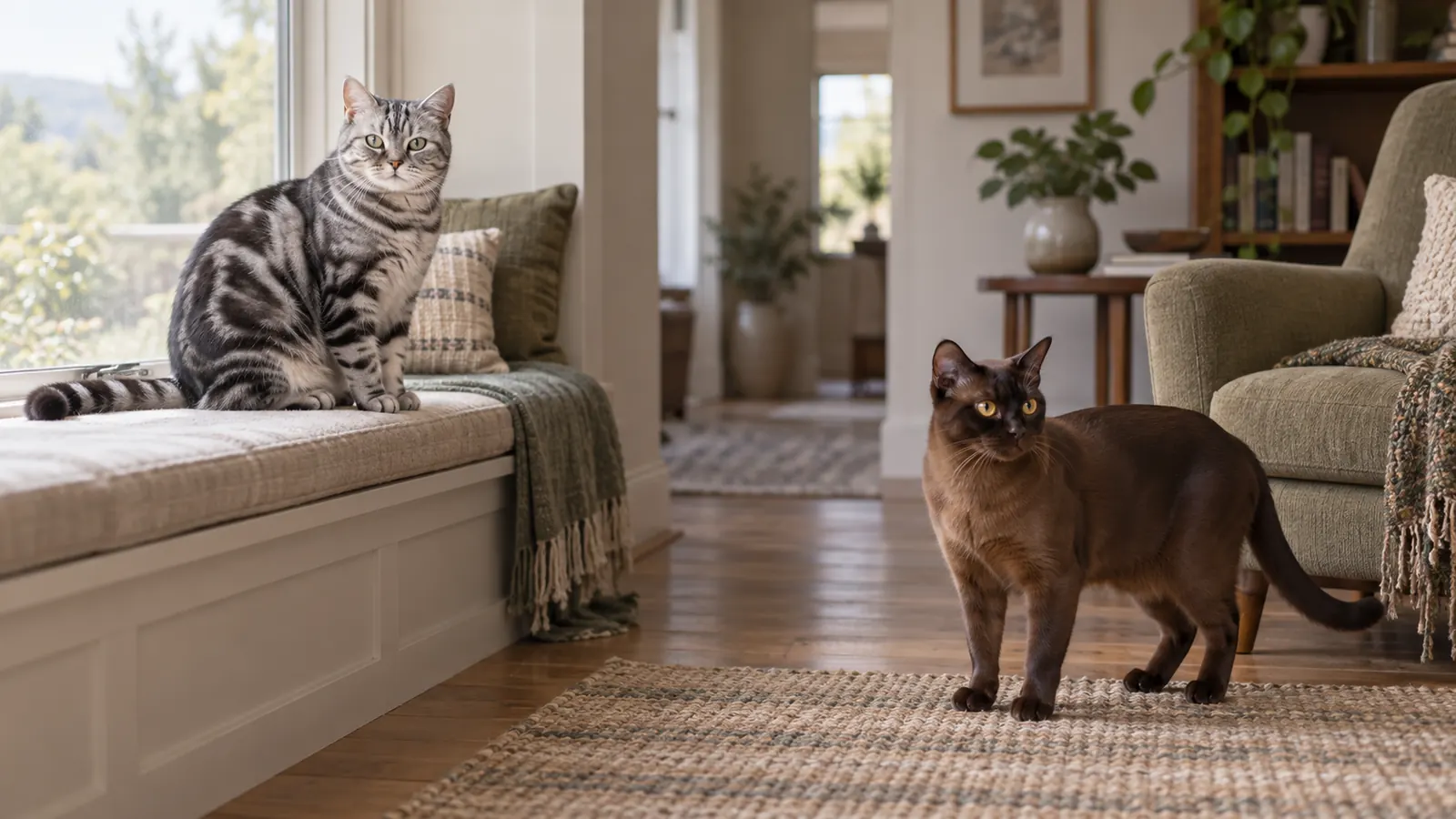
Abyssinian vs Devon Rex: Which Social Cat Suits You?
An Abyssinian suits someone who wants social contact expressed through exploration, height and changing activity. A Devon Rex suits someone who wants closer lap-and-shoulder company and can manage warmth, delicate coat handling, skin and ear checks, plus a more specific set of breeder documents.
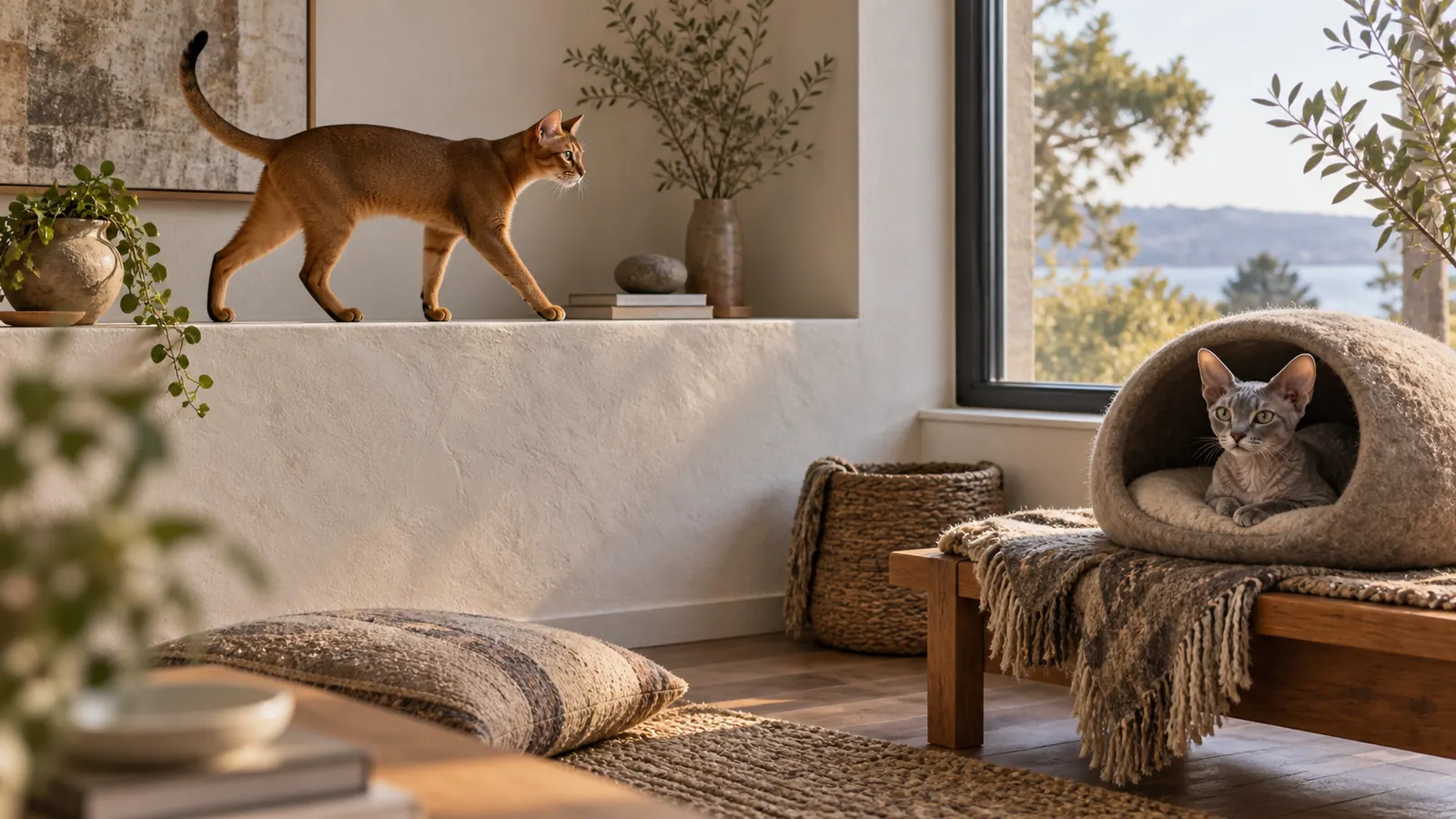
Both breeds are active, intelligent and strongly interested in people, so a simple temperament score does not separate them. The useful question is where the cat wants to be while it joins you. An Abyssinian often moves around the activity and watches from above, while a Devon Rex is more likely to turn the person into a lap, shoulder, blanket and source of warmth.
Which breed asks for the kind of company you want?
The Abyssinian suits somebody who enjoys mobile company. It commonly follows a change, inspects the new object, crosses a high route and returns, keeping contact frequent without making stillness the centre of the relationship.
The Devon Rex suits somebody who actively welcomes physical closeness. CFA describes it as intensely loyal, loving and deeply attached to its people. Its playful energy remains important, but the breed's familiar shoulder-riding and lap-seeking behaviour place the person more directly inside the activity.
| Profile | Contact style | Time alone | Care load | Best fit |
|---|---|---|---|---|
| Abyssinian | Mobile proximity, object investigation and brief returns for contact | Poor starting fit for routine long absences | Light coat care; substantial play and vertical planning | A home that enjoys an exploratory cat using the whole room |
| Devon Rex | Lap, shoulder and under-cover contact mixed with agile play | Poor starting fit for routine long absences | Gentle coat handling plus individual skin, ear and warmth needs | A warm, occupied home that genuinely wants close physical company |
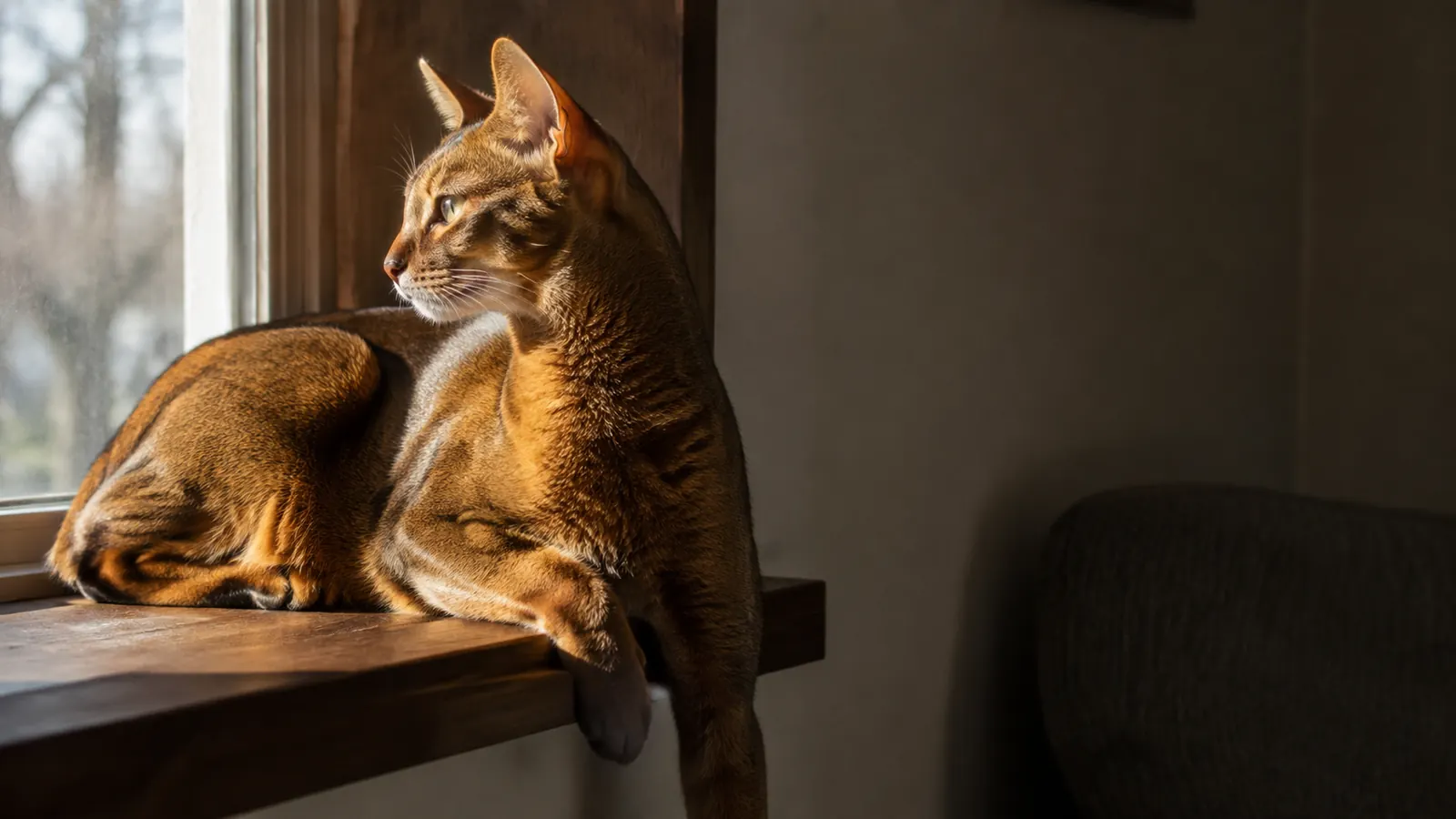
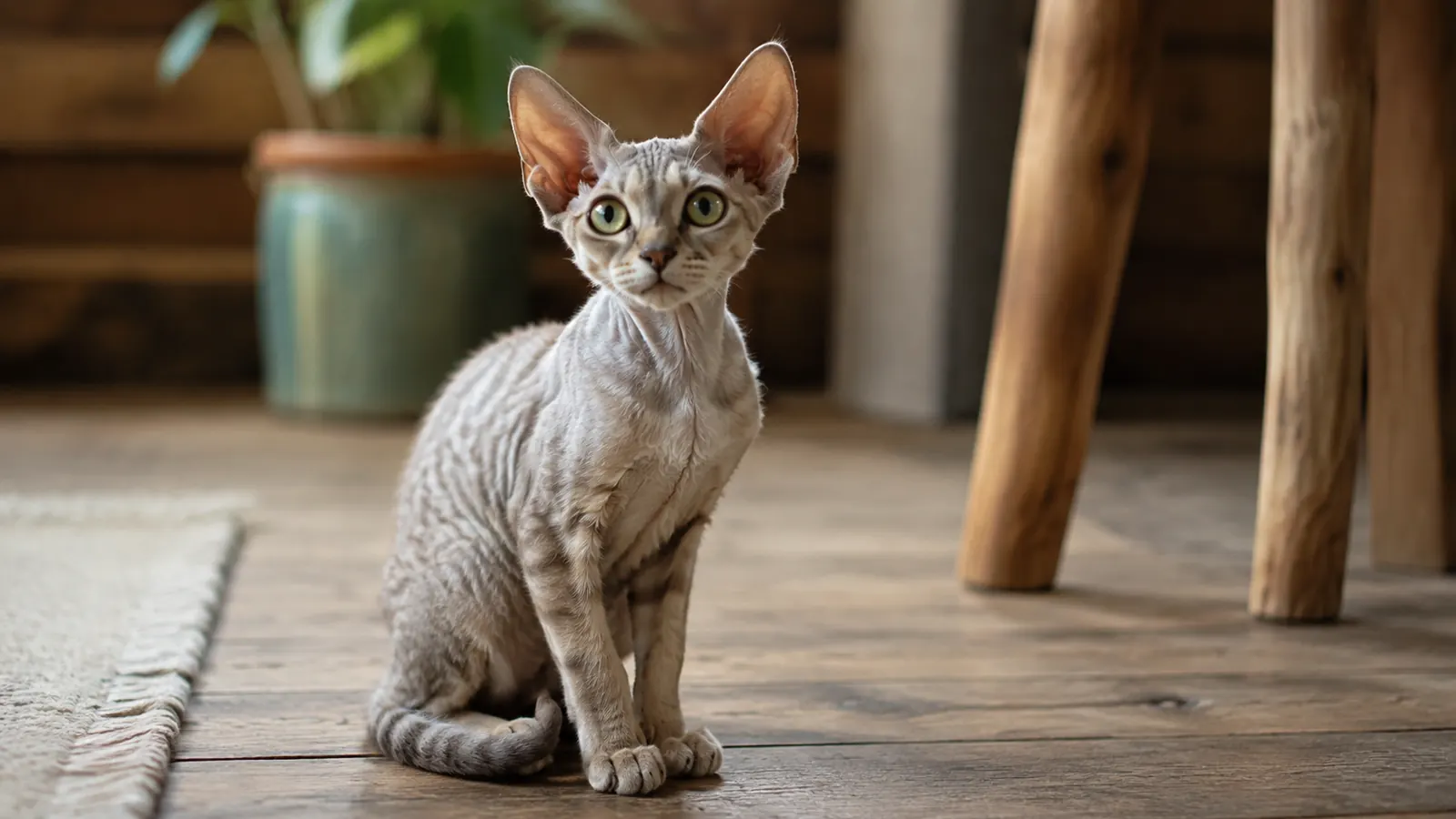
Neither breed should be chosen as a decorative shorthaired cat. The work sits in daily participation, and the Devon Rex adds bodily care that its sparse coat can initially hide.
How different do an Abyssinian and Devon Rex look?
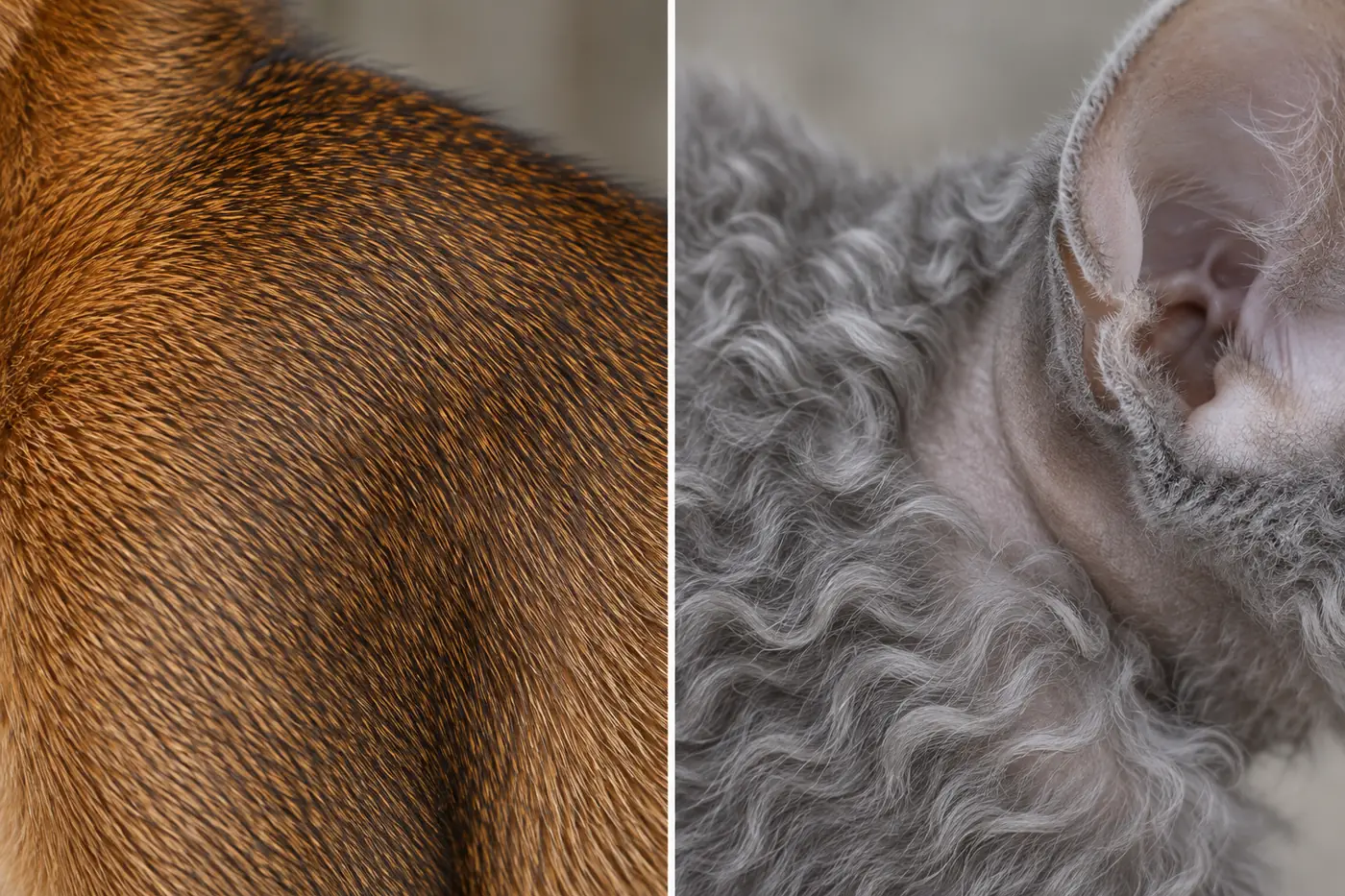
An Abyssinian is long and balanced, with fine legs, compact paws, a modified wedge and large ears held high. Alternating light and dark bands on each hair produce the ticked coat without conventional body stripes. TICA gives adult females at about 6 to 9 pounds and males at 7 to 12 pounds. The body remains firm and athletic rather than fragile.
A Devon Rex is usually smaller at about 6 to 9 pounds, yet CFA asks for surprising heft because the body is muscular beneath the fine outline. The chest is broad, the legs are long and the hind legs are especially powerful.
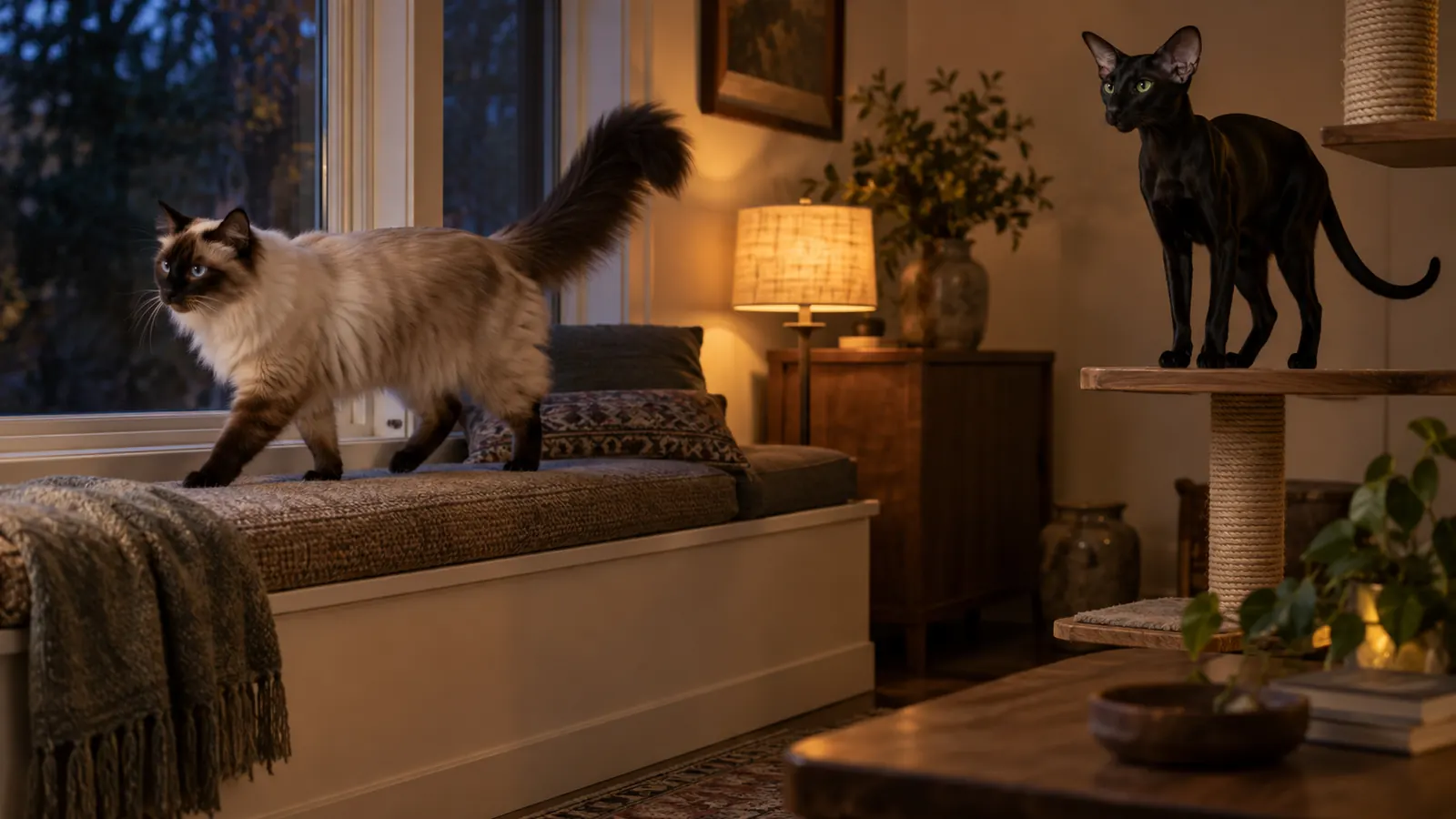
Its head is the quickest identifier. Very large ears sit low on the sides of a modified wedge, above wide cheekbones, large eyes and a short muzzle. The soft coat forms an open wave and may appear thinner in some regions without being bare.
Sex, lineage, body condition and the changing kitten coat can shift those proportions and wave density. Registration and parentage therefore carry more identity weight than a photograph.
Genetic work identifies the Devon Rex coat in KRT71, which is a different mechanism from the Cornish Rex LPAR6 deletion. A rex label therefore does not make the two coats interchangeable or turn either coat result into a general health clearance.
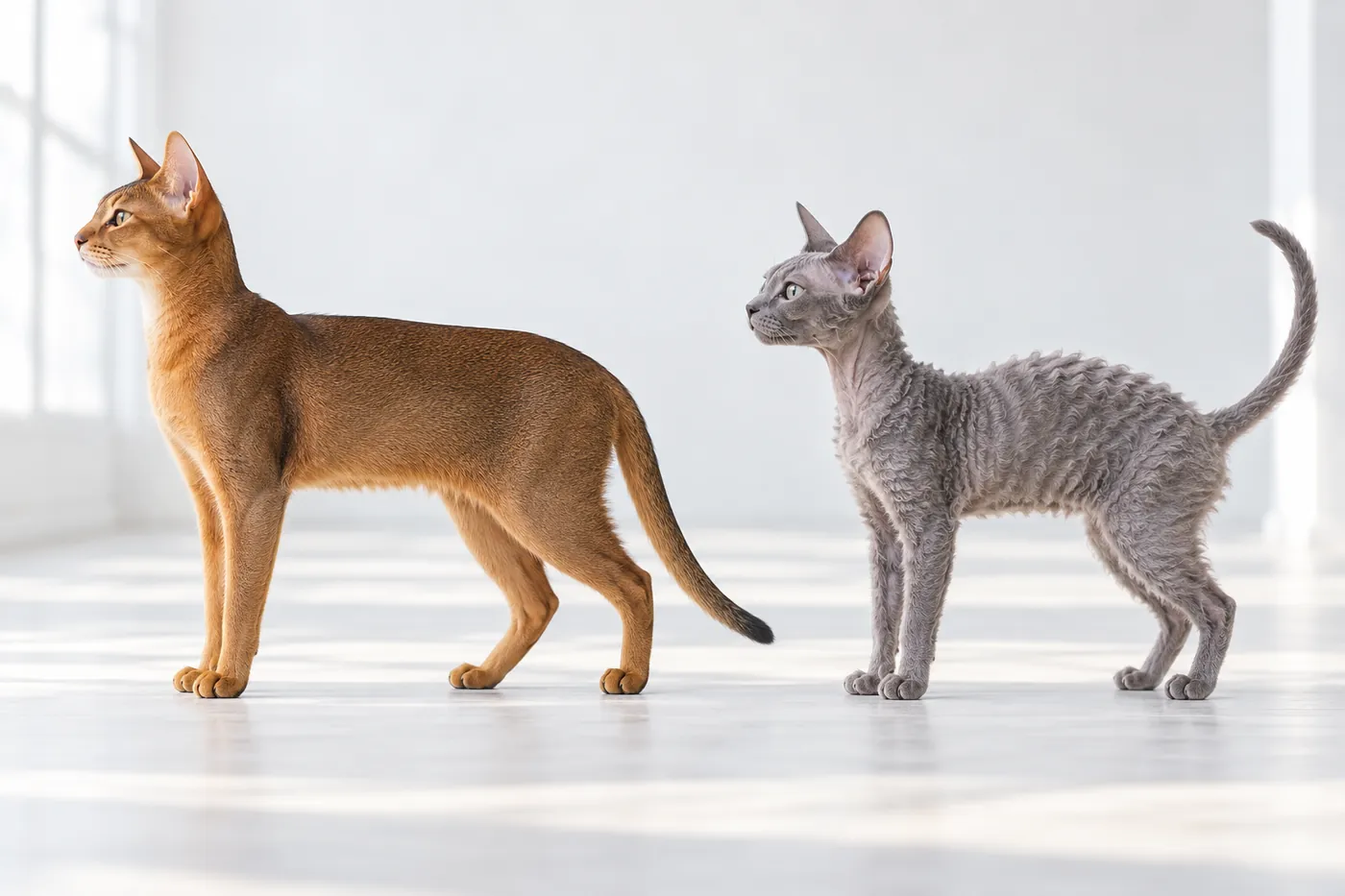
A carrier is best sized from the measured adult in front of you. Both need room to stand and turn, and the Devon Rex's prominent ears make adequate interior height especially easy to underestimate.
Do they use people and height in the same way?
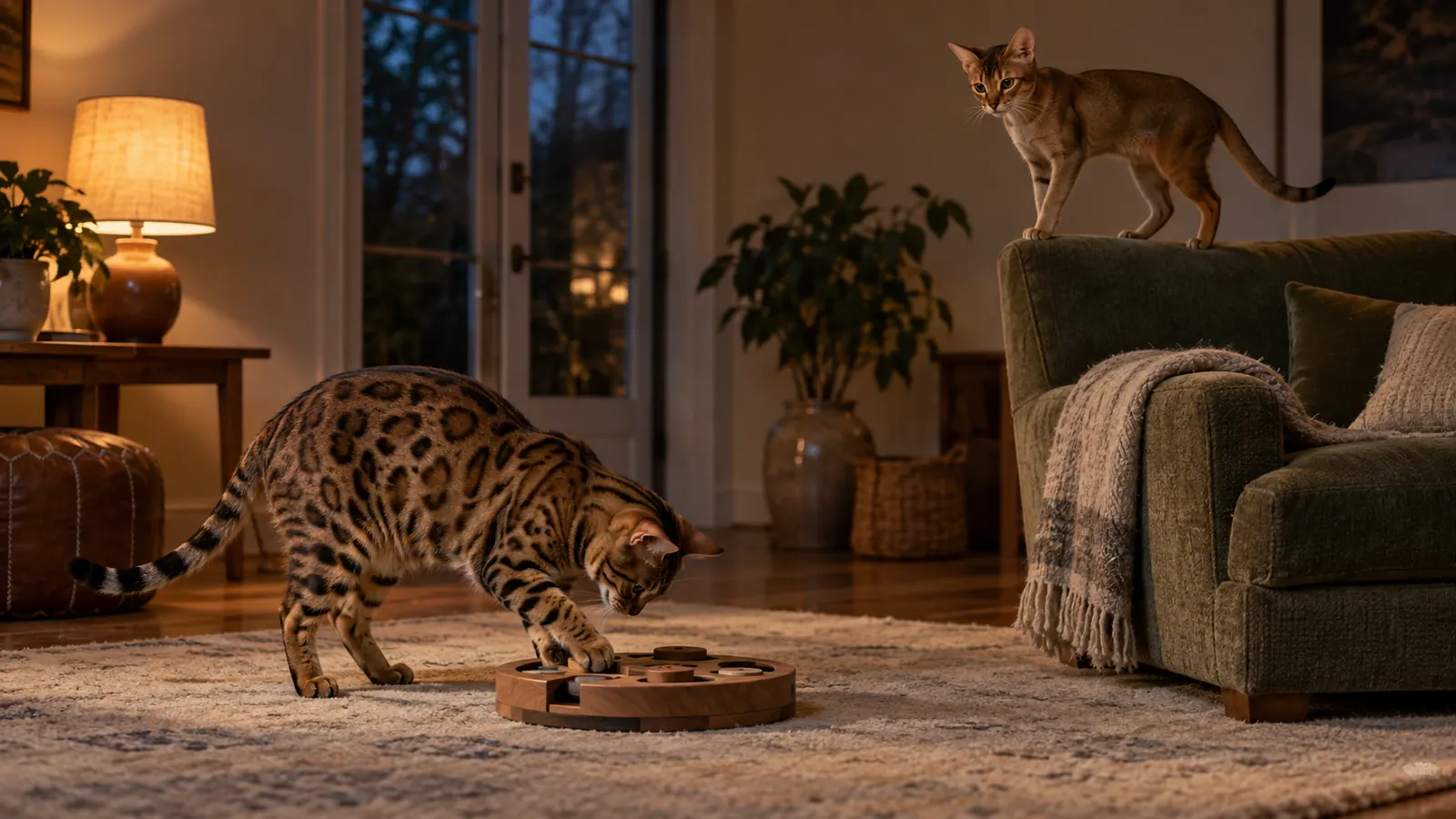
The Abyssinian often uses height as an independent route through shared life. A shelf above a desk can be valuable because it lets the cat observe without occupying the keyboard or demanding continuous touch.
The Devon Rex climbs well too, but the destination is often social. A shoulder, the back of a chair or the warm space under a blanket can be more rewarding than the highest point in the room.
That distinction matters to somebody who likes an active cat but does not want frequent body contact during work or sleep.
| Ordinary moment | Abyssinian tendency | Devon Rex tendency | Fit question |
|---|---|---|---|
| Desk work | Watches movement from a shelf and investigates changing objects | Tries lap, shoulder, chair back or the warm space beside equipment | Can the cat settle after a planned activity without being repeatedly displaced? |
| Interactive play | Pursues, searches and changes level readily | Leaps, retrieves and often keeps the person central to the game | Do you enjoy changing routes or repeating a social game? |
| Quiet evening | Alternates high observation, play and shorter contact | More often presses into a person, blanket or warm resting place | How much sustained touch feels welcome every day? |
| Closed room | May investigate an alternate route or wait nearby | May object more directly to loss of access to the person | Can the home offer choice without turning every boundary into conflict? |
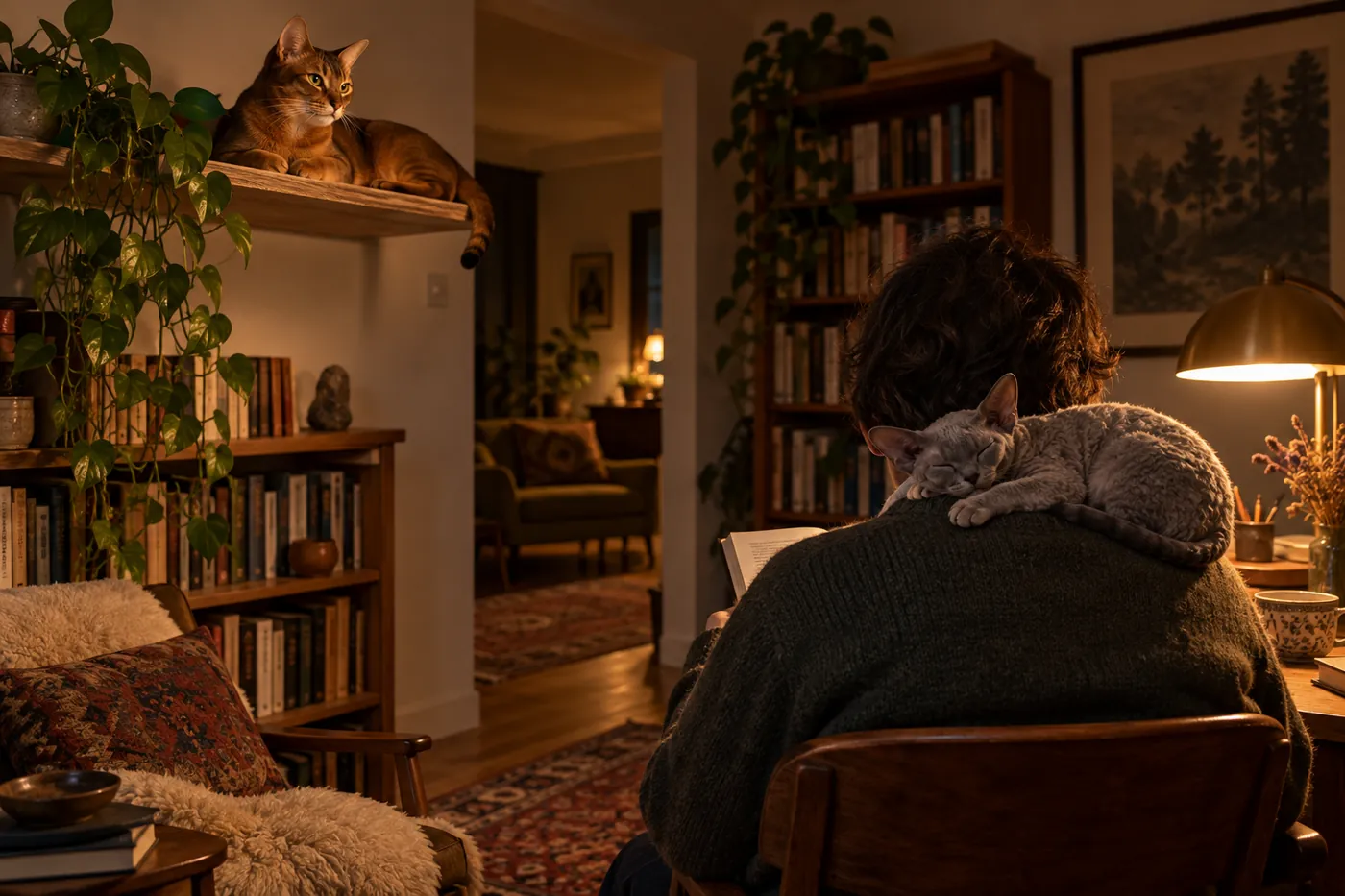
Individual variation still outranks the diagram. Early handling, learned routines, health and the exact home can produce a lap-seeking Abyssinian or a Devon Rex that prefers a nearby heated bed.
Which home setup supports each breed safely?
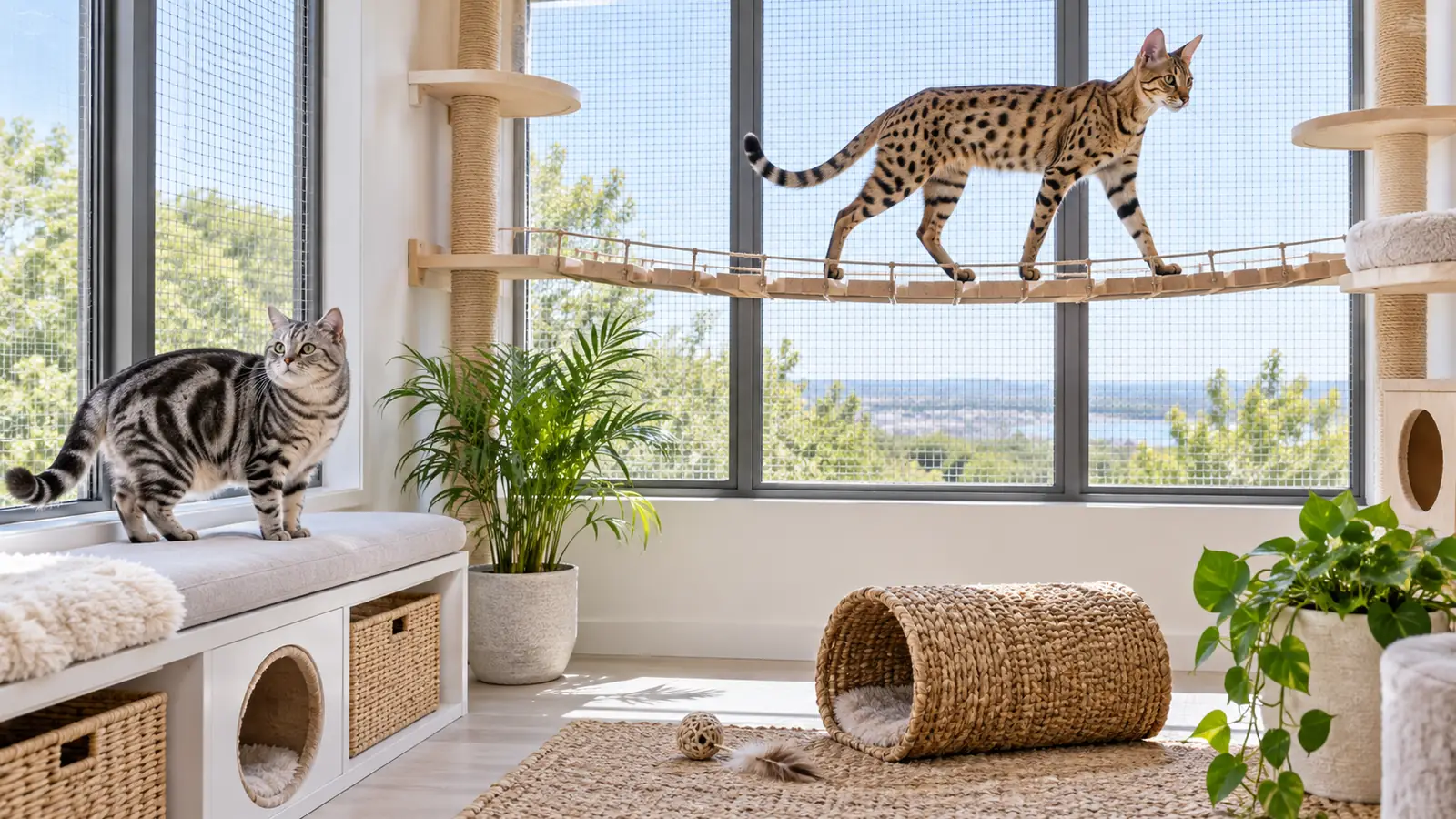
The Abyssinian needs connected height rather than one isolated tower. Stable shelves, a window platform, grippy landing surfaces and at least two ways down reduce conflict when a person, child or other animal blocks one route.
The Devon Rex needs usable height too, with more attention to warmth and traction. Sparse fine hair provides less protection on cold surfaces, and powerful hind legs can launch a small body farther than expected. Warm beds should be available away from draughts, while direct contact with a hot radiator or heating appliance must remain impossible.
- Abyssinian route
- Connect observation points so the cat can travel without unstable furniture
- Devon Rex warmth
- Offer an enclosed bed or blanket plus a cooler place the cat can choose
- Shared landing rule
- Use stable, non-slip surfaces and keep breakable objects outside the route
- Play rhythm
- Mix pursuit, searching and a small learned task rather than relying on one toy
- Food puzzles
- Take rewards from the measured daily ration
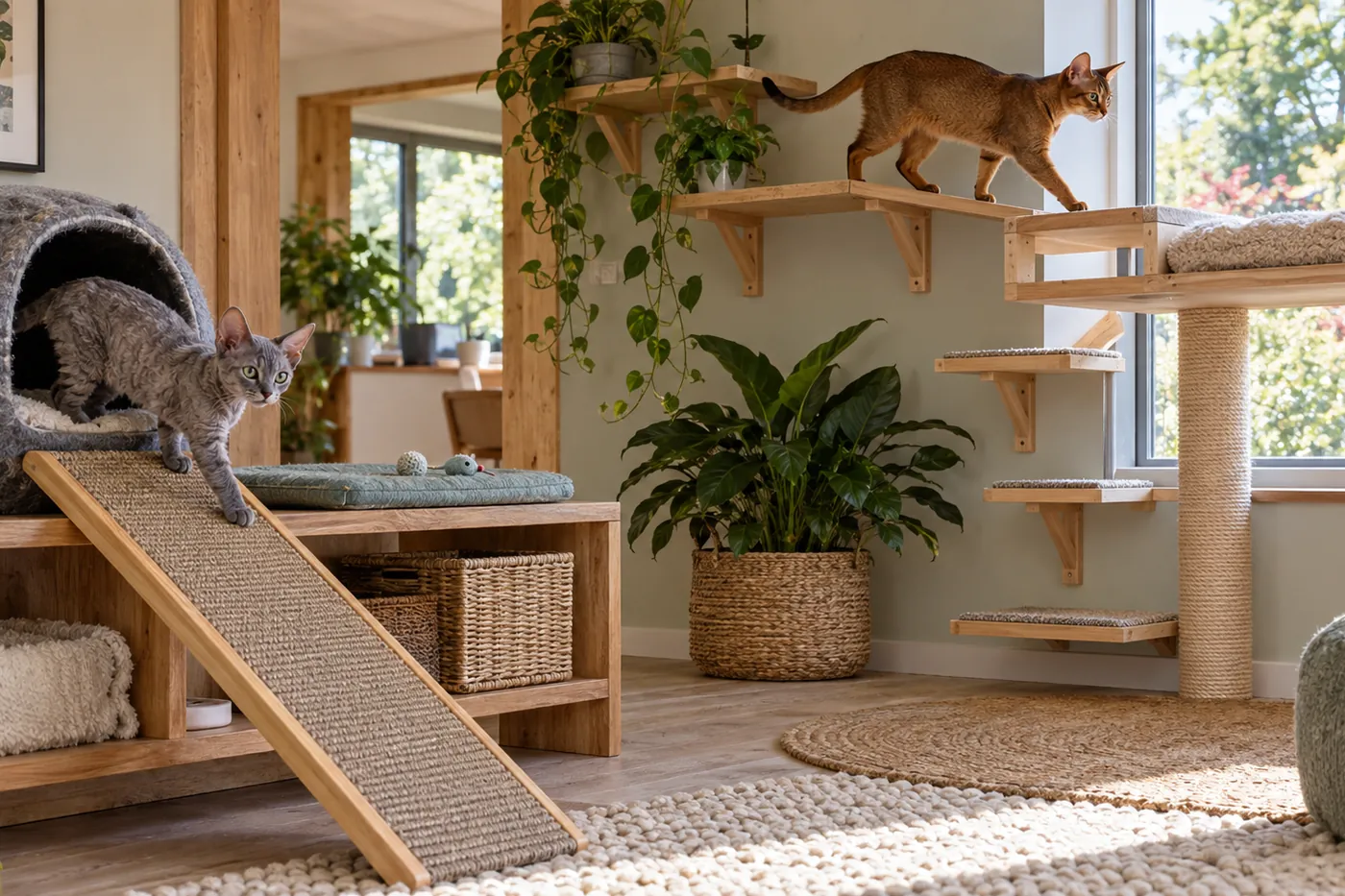
Clicker training suits target, mat and carrier work because it rewards one small action and then builds duration. Both breeds can learn quickly; the likely difference is that an Abyssinian may value novelty while a Devon Rex may value continuing interaction with the person.
Jumping power and recovery shift as exercise needs change with age. Removing all height from a healthy older cat can be as frustrating as leaving difficult landings unchanged.
Does the Devon Rex need more grooming, skin and ear care?
The answer depends on what grooming means. An Abyssinian usually needs a gentle weekly brush or cloth, while a Devon Rex may need even less brushing but more observation and occasional cleaning in specific places.
The Devon coat is soft, fine and loosely waved, with sparse short guard hairs. Firm brushing can break or thin it, so hands and the gentlest suitable grooming tools should do only the work the individual coat requires.
Sebum can remain on the Devon Rex skin because there is too little hair to carry it away efficiently. The base of the large ears, under the chin, between the toes and around the claws are common places to inspect. Healthy variation in oil does not justify automatic frequent bathing, and repeated cleaning can irritate the same skin it is meant to help.
| Care point | Abyssinian | Devon Rex | Stop and investigate when |
|---|---|---|---|
| Coat handling | Gentle cloth, glove or soft brush to lift loose hair | Hand grooming first; avoid firm brushing across fragile waves | Touch causes pain, redness appears or hair loss is new |
| Ears | Inspect visible outer ear during normal handling | Inspect large outer ears and learn the individual's buildup pattern | Discharge, odour, redness, head shaking or discomfort appears |
| Paws and claws | Routine claw and pad check | Also inspect sparse folds around claws for greasy debris | Swelling, smell, soreness or persistent licking develops |
| Bathing | Usually for contamination or a specific need | Only as the individual skin requires, using cat-safe veterinary guidance | Oil returns with itch, redness or odour rather than simple buildup |
Published Malassezia work and treatment reports describe selected Devon Rex cats, not the percentage of all Devons affected. Red, itchy, greasy or smelly skin belongs in a veterinary assessment rather than a cycle of home shampoos or human antifungal creams.
Is a Devon Rex safer for cat allergies?
No breed label can promise that result.
A Devon Rex often sheds less visible hair because the coat is sparse and short, while an Abyssinian also has a close coat without the volume of a longhaired breed. Allergens are produced in saliva and skin secretions, so counting hairs on a sofa does not measure exposure.
The Devon Rex may create a different practical problem for an allergic person because it often seeks direct contact with skin, clothing, pillows and blankets. Less airborne-looking hair does not necessarily mean less close exposure.
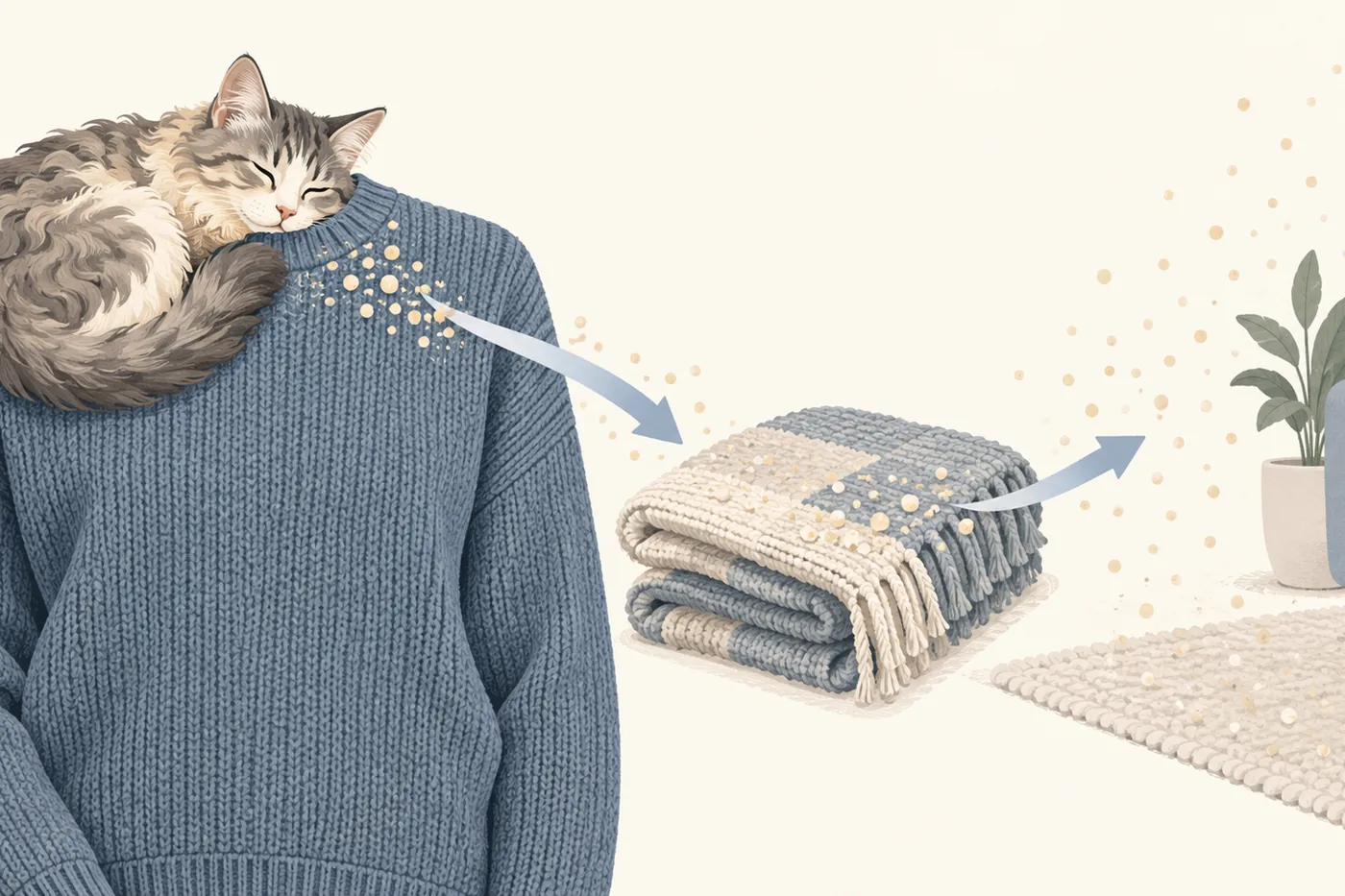
Repeated time with adult cats from the relevant home or breeding line is the better test before committing, because a short visit with a recently groomed kitten says little about how somebody will respond after weeks of shared furniture and bedding.
Claims such as allergy-free, non-shedding and guaranteed safe are sales language. The honest answer remains individual and should be planned with the person's clinician when reactions are significant.
Which is better with children, dogs or another cat?
Both can live successfully with respectful children and compatible animals, but neither breed makes supervision optional. Fast movement can trigger dog pursuit, and frequent touch can continue after a cat wants to leave.
Abyssinian speed may be easier for an older child who enjoys wand play, searching games and short training tasks. A Devon Rex may appeal to a family that wants cuddling, yet its willingness to return for contact does not turn carrying or restraint into consent.
- Children let either cat leave and use toys rather than hands for fast play
- An Abyssinian keeps access to high routes that children and dogs cannot follow
- A Devon Rex has a warm enclosed retreat where nobody reaches in
- Dogs stay controlled until quick feline movement no longer triggers pursuit
- Each cat receives separate food, water, litter, scratching and resting resources
- Adults watch whether both animals can pause, disengage and return voluntarily
Two active cats are not automatically a match. One may want repeated wrestling while the other wants parallel rest, so reciprocity and separate routes decide how introductions go, and shared energy alone does not.
An adult with a known history is especially valuable where children or vulnerable pets already live. Recovery after noise, the ability to take a pause and comfort with gentle handling offer more useful evidence than a registry adjective.
Which health documents differ between the breeds?
For an Abyssinian, the documents that matter are original results from both parents for the CEP290 rdAc variant associated with progressive retinal atrophy and the PKLR variant associated with pyruvate kinase deficiency. These answer specific recessive questions and do not clear every eye or blood disorder. Renal amyloidosis remains a family-record question because the GCCF Abyssinian policy notes no simple DNA clearance. Ages and causes of death in close relatives show whether the breeder tracks the concern over time.
The Devon Rex adds a mandatory-style document in GCCF registration practice: normal status for the COLQ c.1190G>A congenital myasthenic syndrome variant must be established through the cat, its parents or the pedigree conditions described by the registry. A carrier can be healthy, so the result has to be read together with the planned mating, and a carrier is not an affected cat.
| Breed and concern | Evidence to request | What the evidence answers | Limit to keep visible |
|---|---|---|---|
| Abyssinian PRA rdAc | Both parents' named CEP290 reports | Clear, carrier or affected status for this recessive variant | Other causes of blindness and future eye health |
| Abyssinian PK deficiency | Both parents' named PKLR reports | Whether each parent can pass the recessive variant | Other causes of anaemia |
| Abyssinian renal amyloidosis | Ages and causes of death across close relatives | Whether a recognised family concern is tracked | No genetic clearance or individual prediction |
| Devon Rex CMS | COLQ c.1190G>A status meeting the registry condition | Whether the recessive CMS variant can produce an affected mating | Other causes of weakness |
| Devon Rex blood compatibility | Actual blood types of both parents | Whether the litter was planned around neonatal isoerythrolysis risk | General health or future transfusion needs |
| Devon Rex cardiac evidence | Recent heart screening used by the breeder and cardiac history in relatives | Whether the line is monitored at a meaningful time | A normal scan cannot guarantee a lifetime free of HCM |
| Devon Rex bleeding history | Surgical outcomes and known clotting problems in relatives | Whether the breeder tracks documented vitamin K-dependent coagulopathy | Prevalence, because case reports do not supply it |
Blood type matters because type B has been common in sampled Devon Rex populations, yet population percentages cannot identify the parents in front of you. Testing the actual cats is the useful action.
Vitamin K-dependent coagulopathy is supported by case reports rather than a breed-prevalence survey. Tell a veterinarian about any family history before surgery, although a rare documented event is not the expected Devon Rex experience.
No panel guarantees lifetime health for either breed. The stronger breeder explains the scope and date of every report, names gaps openly and can discuss health and longevity across related cats without turning absence of data into proof.
Which suits you, exploration or close contact?
The Abyssinian fits if a cat moving across high routes, inspecting change and joining you without continuous body contact sounds right. It still needs company and daily interaction, but the relationship commonly leaves more physical space.
The Devon Rex fits if you actively want lap, shoulder and under-cover contact and can keep the home warm. It adds the work of learning one cat's skin and ear routine and reading CMS, blood-type, cardiac and family records carefully.
- Test both options against a normal workday and sleeping arrangement
- Decide how much lap, shoulder and blanket contact remains welcome every day
- Map connected height for the Abyssinian and warm safe resting choices for the Devon Rex
- Meet the individual during play, rest, gentle handling and a brief interruption
- Read both parents' named results instead of accepting a panel-clear summary
- Ask about close relatives' longevity, cardiac findings, surgery and cause of death
- Walk away from guaranteed temperament, allergy safety or lifetime health
The best individual can become excited and then settle again. That transition is worth watching, because a cat that can choose distance, recover after surprise and return voluntarily is giving you evidence about the home you will actually share.
Breed tendency is a fair way to start a shortlist, and observed behaviour and checkable records are what settle it.
Checked Against
- TICA: Abyssinian breed introduction tica.org
- TICA: Devon Rex breed introduction tica.org
- CFA: Abyssinian cfa.org
- CFA: Devon Rex breed profile and standard cfa.org
- UC Davis Veterinary Genetics Laboratory: PRA rdAc vgl.ucdavis.edu
- UC Davis Veterinary Genetics Laboratory: pyruvate kinase deficiency vgl.vetmed.ucdavis.edu
- GCCF: Abyssinian breeding policy gccfcats.org
- GCCF: Devon Rex breeding policy gccfcats.org
- PLOS ONE: COLQ mutation and congenital myasthenic syndrome journals.plos.org
- Mammalian Genome: KRT71 mutation defining the Devon Rex coat pmc.ncbi.nlm.nih.gov
- JAVMA: vitamin K-dependent multifactor coagulopathy in Devon Rex cats pubmed.ncbi.nlm.nih.gov
- Animals: feline blood groups systematic review pmc.ncbi.nlm.nih.gov
- Veterinary Dermatology: Malassezia-associated dermatitis treatment in Devon Rex cats pubmed.ncbi.nlm.nih.gov
- Satyaraj et al.: Keep the cat, change the care pathway, a transformational approach to managing Fel d 1 (Allergy, 2019) pmc.ncbi.nlm.nih.gov
- Bradshaw: Normal feline behaviour and why problem behaviours develop (Journal of Feline Medicine and Surgery, 2018) pmc.ncbi.nlm.nih.gov
Published 11 September 2026. Last updated .