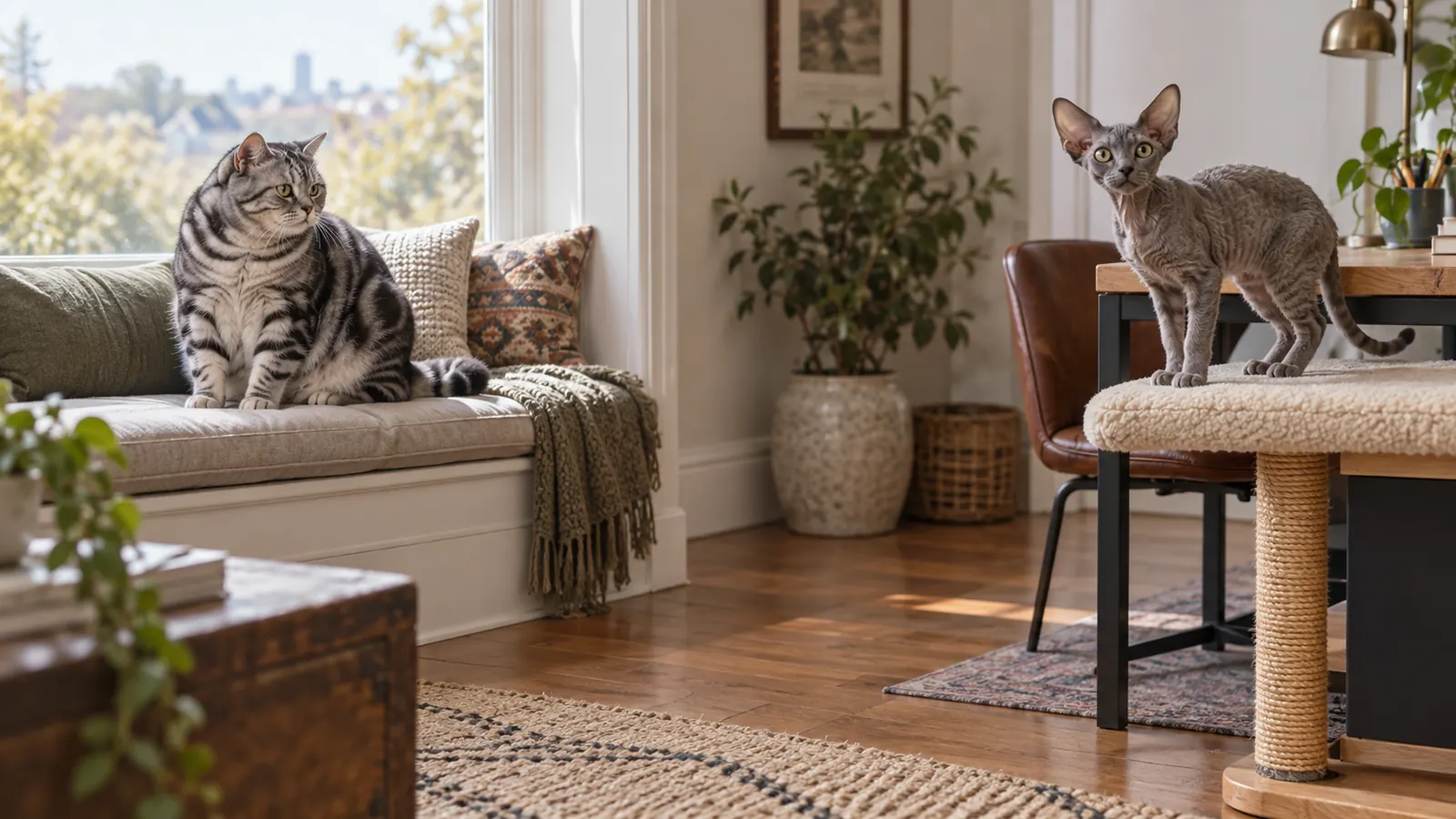
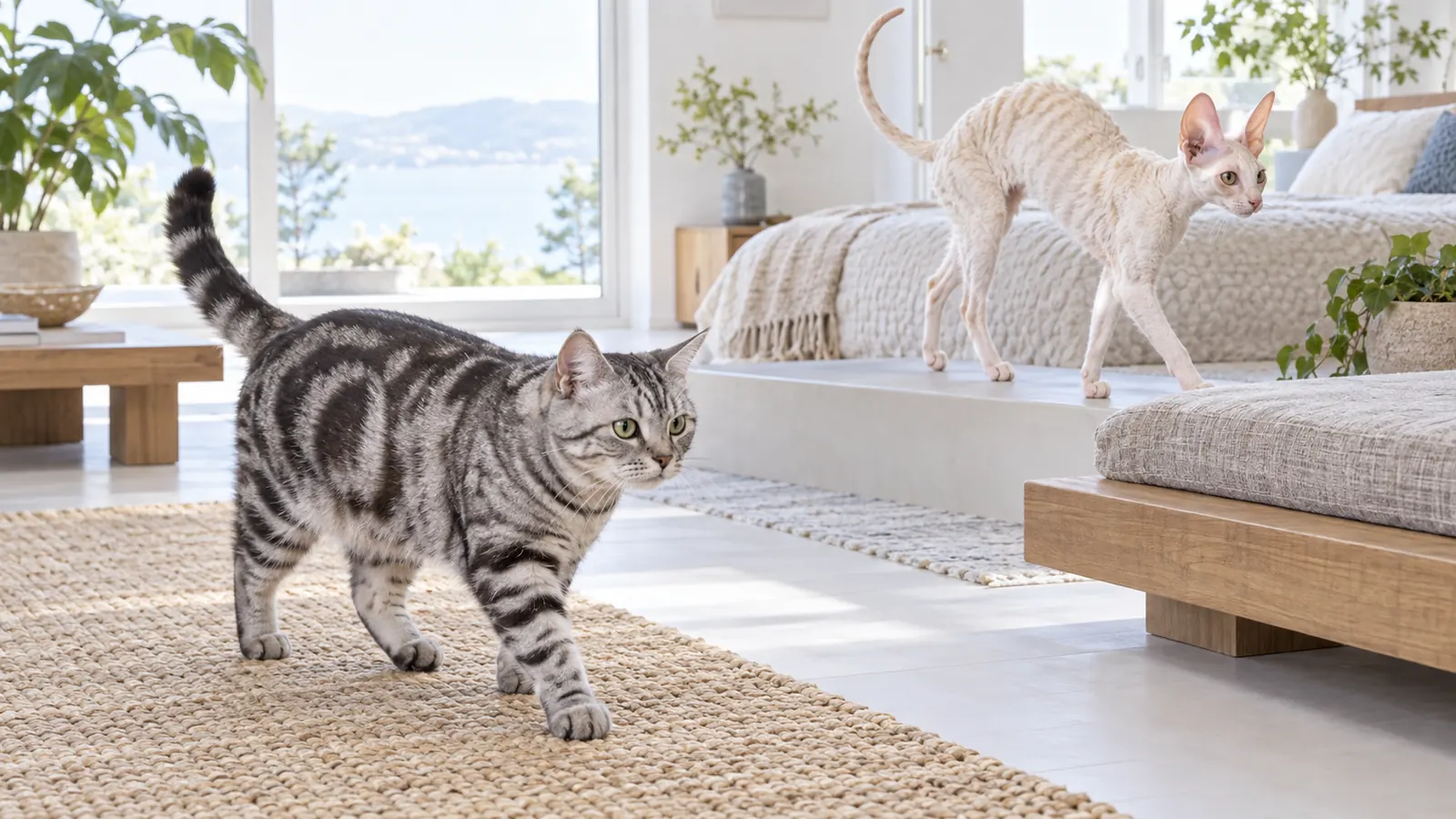
American Shorthair vs Burmese: Which Fits Your Week?
The American Shorthair is usually the easier fit if you want an affectionate cat that can also occupy itself. A Burmese suits a home where close company, frequent participation and a cat that expects access to daily life are features the household can sustain.
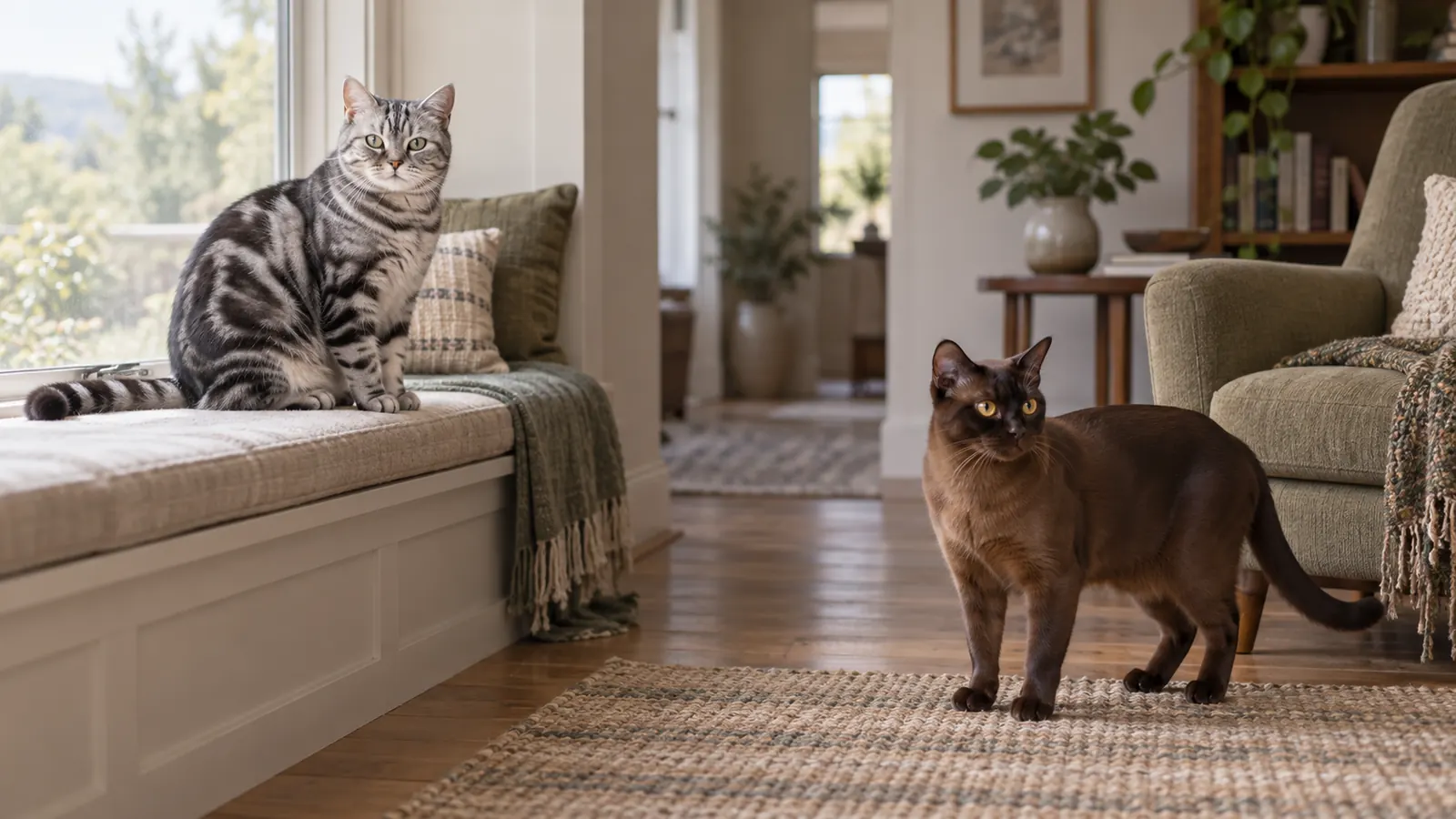
Both breeds can be playful, trainable and good with considerate families, so a list of shared positives does little to settle the choice. The useful difference appears when the household is busy. An American Shorthair commonly combines affection with more self-directed time, while a Burmese is typically more insistent about staying close to people and joining whatever they are doing.
That contrast describes a breed tendency, and one kitten can sit anywhere within it. Watching the individual during activity and rest, and hearing how the parents behave when a person leaves the room or ends contact, shows where this cat falls.
Which breed is the easier fit for most homes?
The American Shorthair is the lower-friction recommendation for more households. It usually offers a moderate daily rhythm, enjoys interactive play and human company, then can settle without making continuous access to a person the centre of its day.
The Burmese is the stronger choice for somebody who actively wants close feline company. CFA describes the breed as people-oriented and involved, and that can mean following, lap time, conversation and repeated attempts to rejoin a closed room.
| Profile | Contact style | Activity rhythm | Coat work | Best fit |
|---|---|---|---|---|
| American Shorthair | Warm but less insistent, often supervising from nearby | Moderate play with hunting games and calm recovery | Short dense coat with seasonal loose undercoat | A home wanting company without continuous physical closeness |
| Burmese | Close, participatory and often vocal about changed access | Playful, clever and likely to turn interaction into a social event | Very short satin coat with modest loose hair | A home that welcomes frequent contact and has little routine isolation |
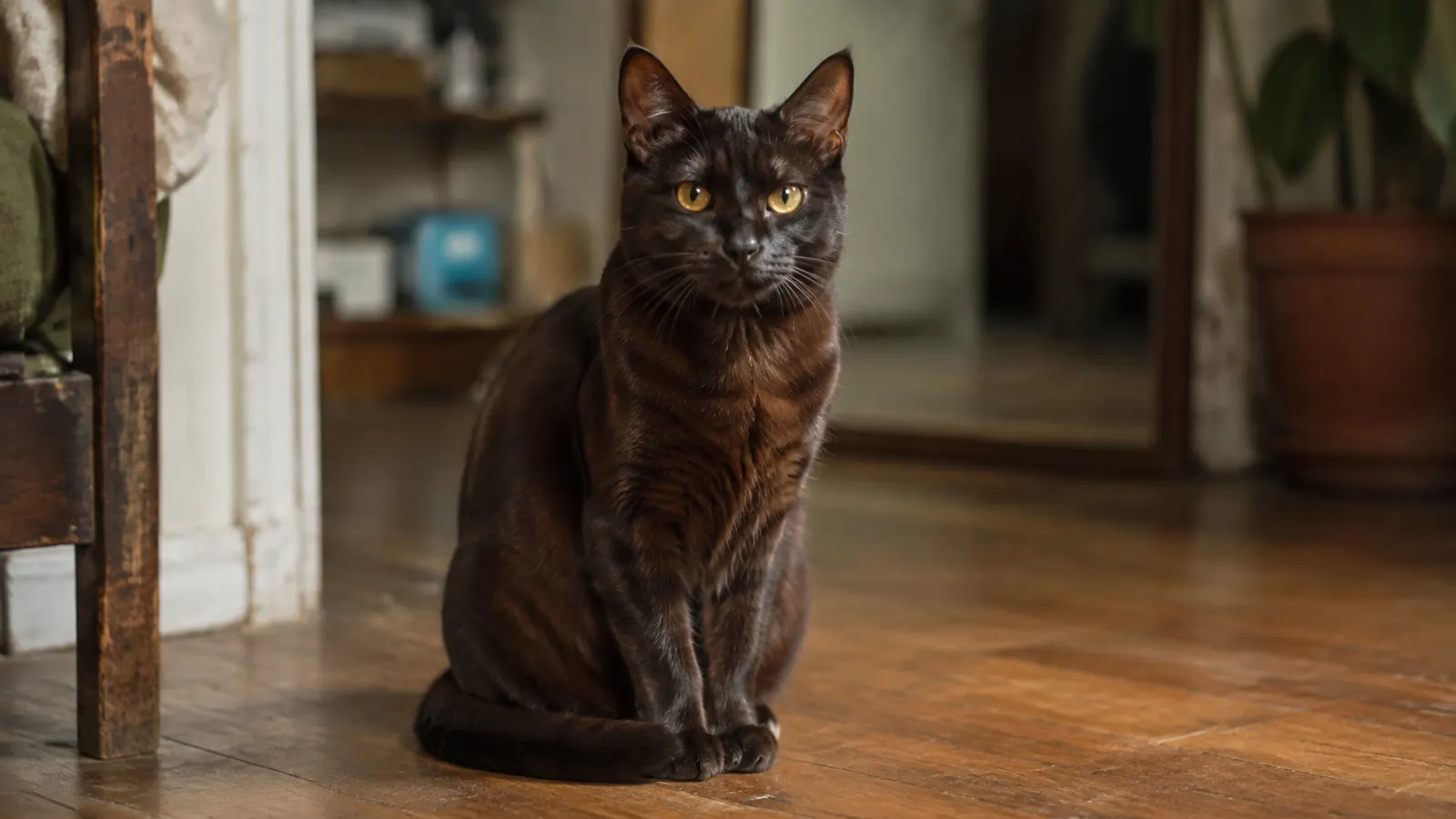
A Burmese can rest contentedly without being touched. Trouble comes from a repeated mismatch between a highly social individual and a home where doors stay closed, workdays are long and interaction is postponed most evenings.
An adult cat with known behaviour can reduce that uncertainty. A breed label cannot tell you whether a particular cat prefers a lap, the back of a sofa or a quiet room after play.
How do their bodies and coats differ?
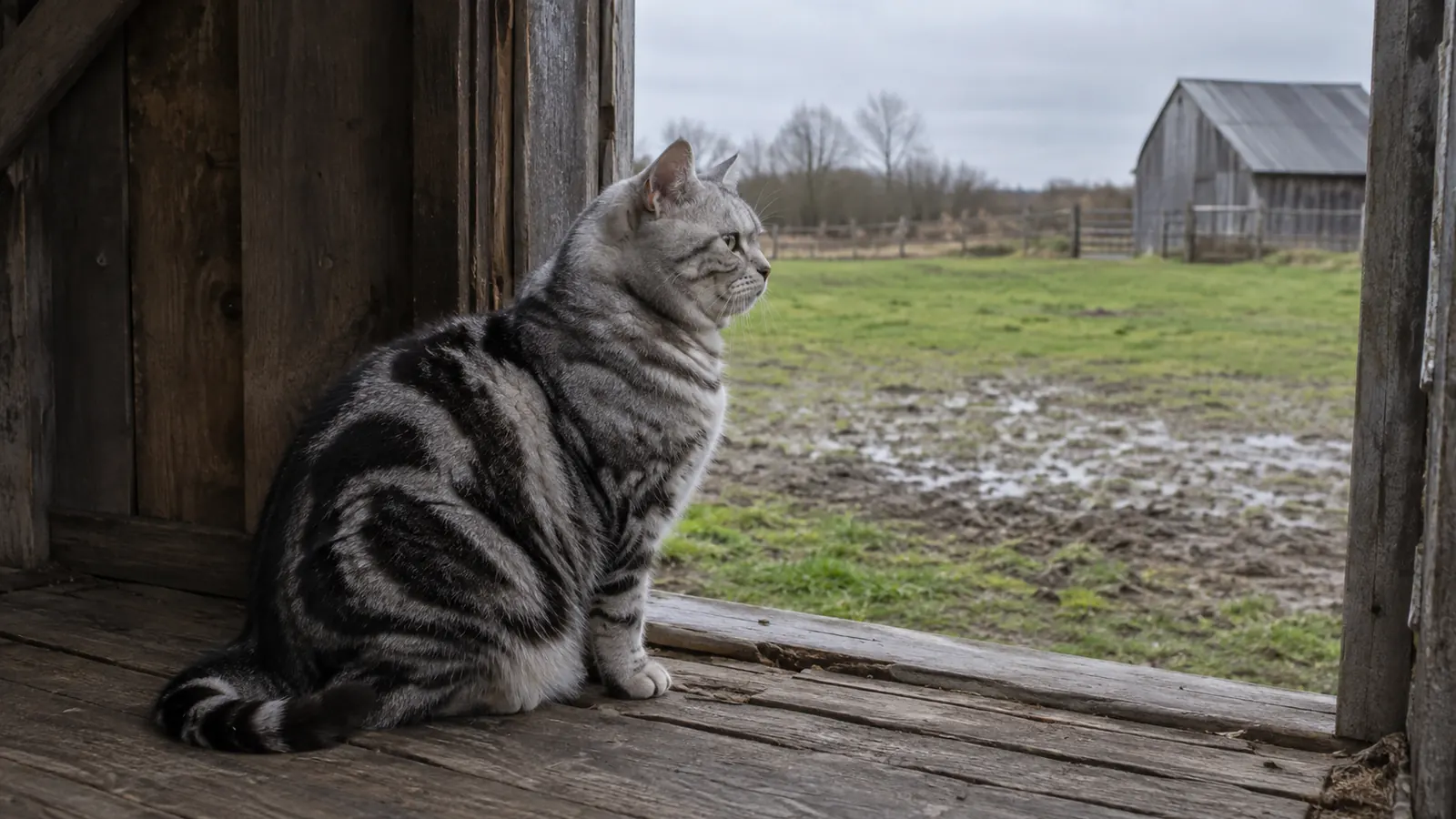
The American Shorthair is medium to large, broad through the chest and strongly muscled, with a dense resilient coat. Its outline should look powerful and balanced rather than round because of excess weight.
The Burmese is medium, compact and surprisingly heavy for its apparent size. A mature cat has substantial muscle, a rounded chest, a rounded head and a very short fine coat that lies close with a satin-like sheen.
| Feature | American Shorthair | Burmese | What the difference means |
|---|---|---|---|
| Body | Broad, powerful and well developed through chest and hindquarters | Compact, muscular and heavier than the outline suggests | Support either cat fully when lifting; do not estimate weight from a photograph |
| Head | Broad with a strong jaw and medium-short muzzle | Rounded with a short broad muzzle and visible nose break | Head shape helps explain the breed standard but does not prove identity |
| Coat | Dense, hard-textured and protective | Fine, glossy, satin-like and very close lying | The American coat holds more undercoat; the Burmese surface needs less tool pressure |
| Colour | Many colours and patterns | A defined Burmese palette that varies by registry | Colour alone cannot authenticate either breed |
| Maturity | Develops gradually into a substantial adult | CFA notes full growth around 18 months | Size the actual individual rather than relying on a kitten photo |
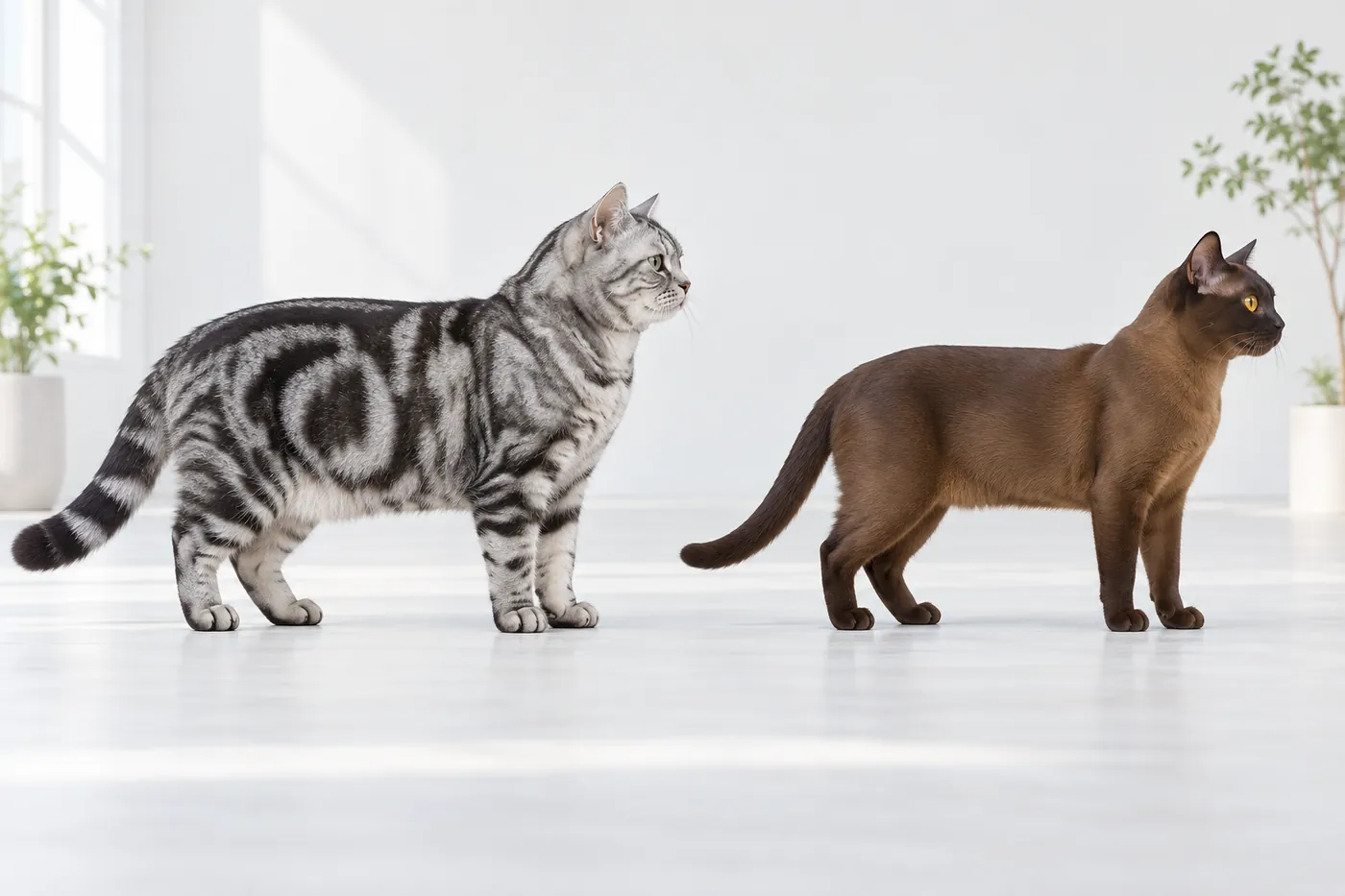
Neither silhouette establishes pedigree. Registration, the registered names of the parents and records that match those identities provide stronger evidence than a familiar tabby pattern or sable colour.
Body condition can blur the comparison. Ribs should be easy to feel beneath a light covering, with a waist appropriate to the individual, even though both standards describe substantial cats.
What does a normal workday feel like with each breed?
An American Shorthair often enjoys being in the same room without occupying the same chair. A window perch, food search, safe toys and a planned play period can support stretches of self-directed activity while you work.
A Burmese is more likely to make proximity part of the arrangement. It may settle against you, follow between rooms or object when a previously open door becomes a boundary.
- Before workGive either cat an interactive hunt and part of breakfast through a simple search; the Burmese may value the shared routine as much as the food
- During absenceLeave distributed resources and safe activity; an American Shorthair may settle more readily while a social Burmese may need a compatible companion or midday human contact
- After returnOffer calm greeting before active play; a Burmese may arrive with more accumulated demand for participation
- EveningThe American Shorthair may alternate between nearby observation and contact, while the Burmese is more likely to seek sustained lap, sofa or bed access
There is no responsible number of hours that every cat of either breed can tolerate alone. Age, previous routine, health, another animal and the quality of the home during absence all change the answer. A second cat helps only when the two are actually compatible, and human contact still matters to a Burmese that is strongly attached to people.
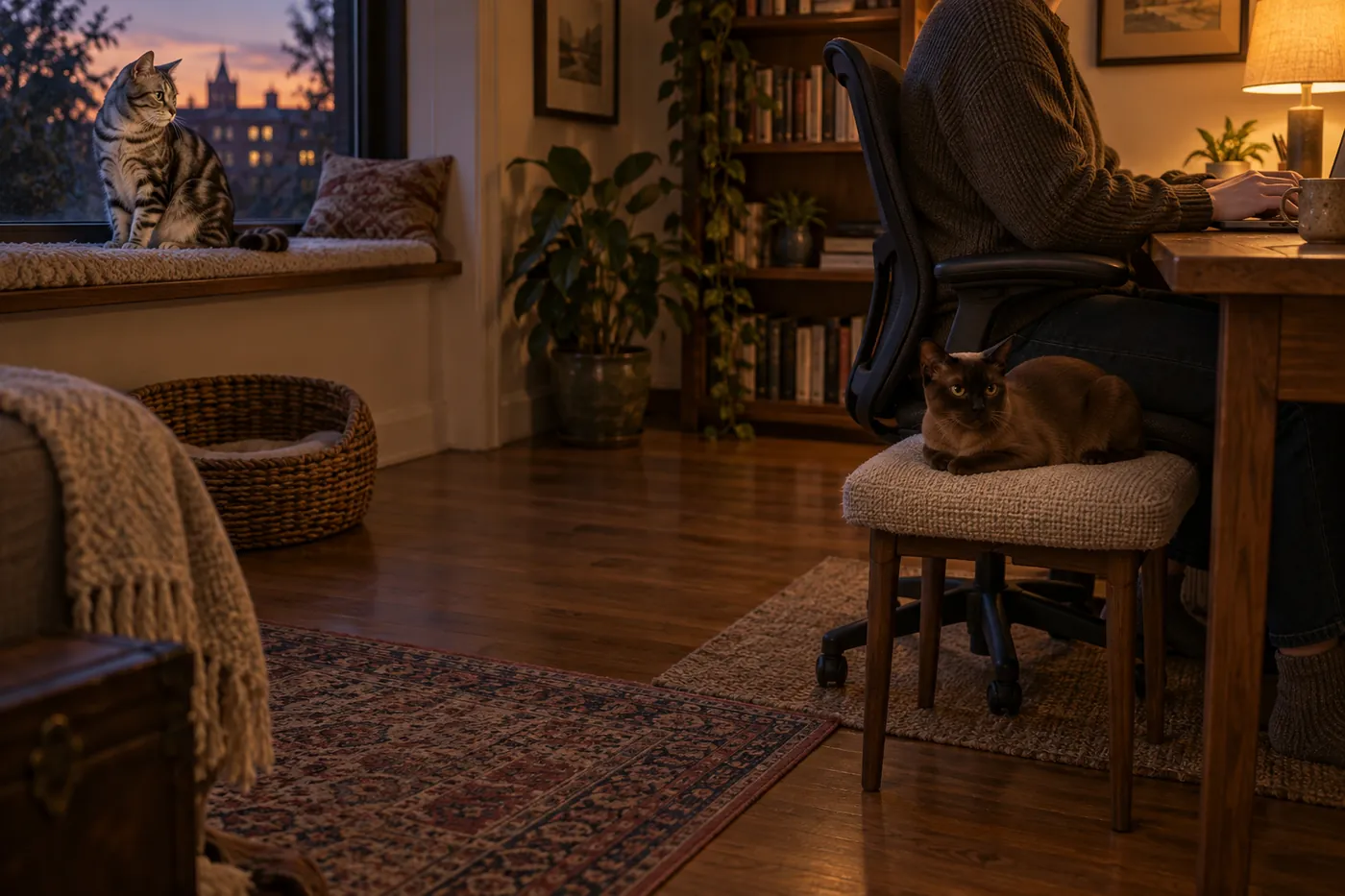
A mismatch usually shows in the weeks after a routine changes. Reduced eating, persistent vocalising, house-soiling, overgrooming, hiding or frantic greeting deserve attention rather than being dismissed as a dramatic personality.
Which cat asks for more play and training?
The Burmese commonly asks for more participation, while the American Shorthair often brings a stronger stalking and pouncing flavour to play. Both benefit from several short sessions that allow watching, pursuit, capture and a clear finish.
An American Shorthair gets more from rotating wand paths, small searches and food puzzles than from a toy left in the centre of the floor. Its working-cat history does not mean it will exercise itself in a room with nothing useful to hunt.
The Burmese often treats the person as part of the reward. Retrieval, target following and simple household tasks can satisfy attention and learning at the same time.
- American Shorthair play
- Stalking lanes, changes of direction and a final capture rather than endless frantic waving
- Burmese play
- Several brief shared sessions through the day, ending before demand turns into grabbing
- Useful training
- Carrier entry, target following, mat work and a brief handling pause
- Reward control
- Food used in puzzles and training counted inside the measured daily ration
- Recovery
- Sessions that end while the cat can disengage, settle and breathe normally
Our clicker training guide explains how to mark one small action and add duration, building cooperative behaviour that makes care easier. Punishment is especially unhelpful when a cat is asking for access or activity, because it can make the person unpredictable while leaving the original need unresolved.
Which is better with children, dogs or another cat?
The American Shorthair is often the easier starting fit for a moderately busy family because its pace is usually steadier. A Burmese can thrive with children who enjoy structured play and adults who supervise boundaries, but constant handling is not a substitute for respectful interaction.
Both cats need an exit that a child or dog cannot block. A high retreat should have more than one route down, and food, water, litter and rest should not all sit in a passage controlled by another animal.
- Children use toys instead of hands and stop when the cat turns away
- Adults support chest and hindquarters whenever lifting is necessary
- Dogs remain controlled until quick movement no longer triggers pursuit
- Each animal has separate feeding, drinking, litter, scratching and sleeping resources
- Play shows pauses, turn-taking and voluntary return rather than one animal repeatedly escaping
- Introductions move forward only while both animals eat, rest and use resources normally
A confident Burmese may approach a dog or child more readily, which can look like immediate compatibility. The more useful evidence is whether both sides can pause, leave and return without guarding or pursuit. An adult with a known history may be safer when a timid cat, elderly dog or very young child already lives in the home. Breed reputation cannot replace that individual evidence.
How different are grooming, shedding and allergy concerns?
The American Shorthair's dense coat releases more loose hair, especially when the undercoat changes seasonally. A gentle comb, grooming mitt or suitable brush can lift loose coat without scraping the skin.
The Burmese coat is shorter, finer and usually sheds less visibly. A soft rubber brush or hand pass is often enough to remove loose hair and keep the surface tidy.
| Care point | American Shorthair | Burmese |
|---|---|---|
| Coat depth | Dense protective coat with undercoat | Very short fine coat lying close to the body |
| Routine | Gentle weekly pass, increased when undercoat releases | Light weekly hand or rubber-brush pass |
| Tool pressure | Reach loose undercoat without repeated scraping | Keep pressure low on the fine close surface |
| Bathing | Usually need-based rather than routine | Usually need-based rather than routine |
| Problem signs | Pain, redness, bald areas, odour or a sudden coat change | The same signs, plus any new greasy or flaky area |
| Allergy meaning | More visible hair does not measure allergen production | Less loose hair does not make the breed hypoallergenic |
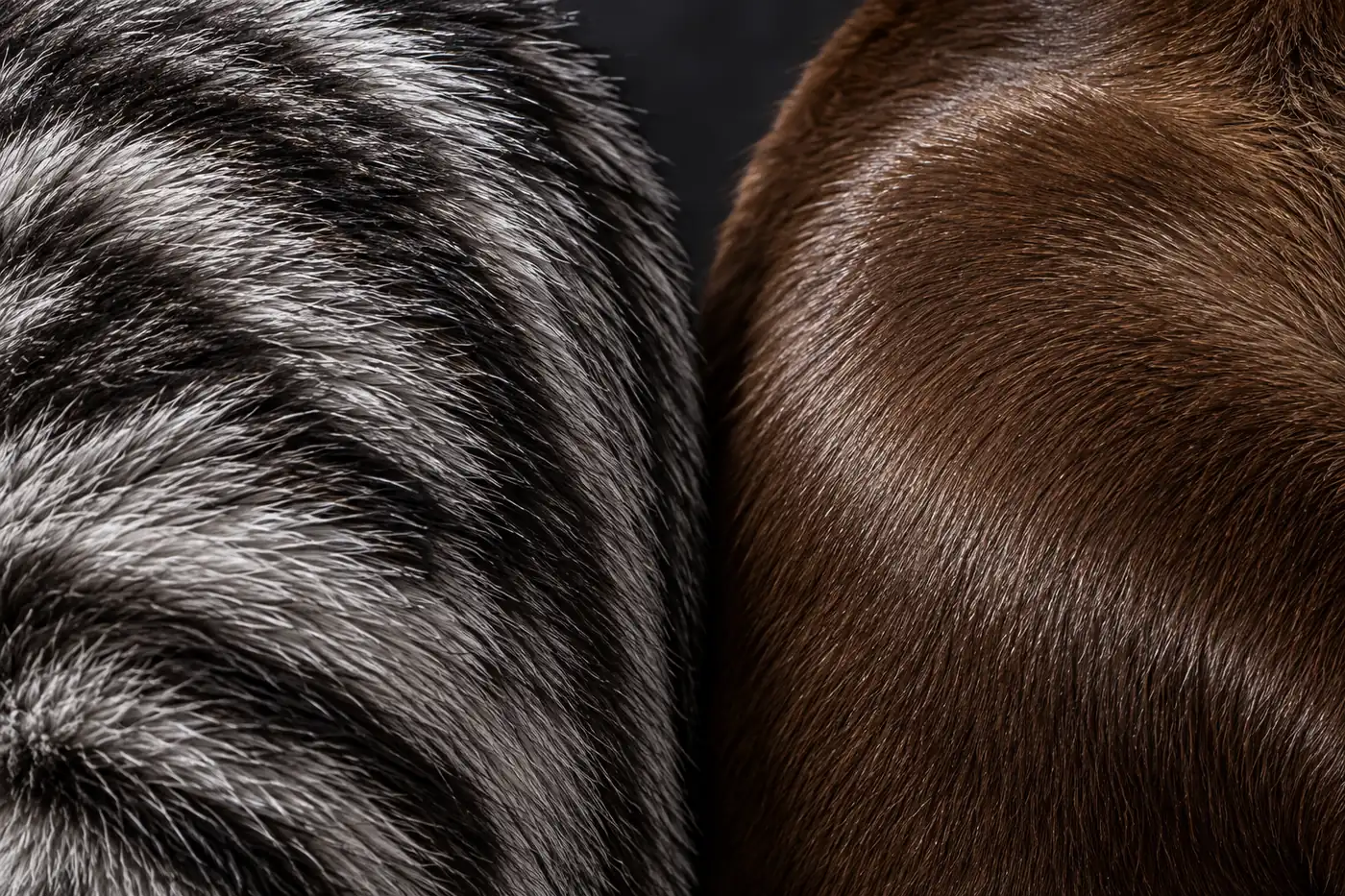
Our grooming tools guide matches each tool type to coat depth. Removing the greatest amount of hair is not the goal if the method irritates skin or breaks healthy coat.
Neither breed can be selected as allergy-safe from shedding claims. A person with cat allergy should discuss risk with a clinician and spend meaningful time around the actual cat before making a commitment.
Which breeder records matter for each breed?
Any breeder should be able to show registration documents, parent identities, dated veterinary information and the health history of close relatives. For a Burmese, several named inherited conditions make the exact laboratory reports especially important.
UC Davis documents an ALX1 variant associated with Burmese head defect. Two copies cause a severe congenital craniofacial condition that is incompatible with life, while one copy can be associated with a shortened facial structure, so the result matters to breeding decisions rather than serving as a simple healthy or unhealthy badge.
Langford Vets documents familial episodic hypokalaemic polymyopathy as an autosomal recessive condition associated with low potassium and episodes of muscle weakness.
Burmese GM2 gangliosidosis is another named inherited question for which a breeder may present a specific DNA result.
| Record | What to ask | What it can establish | What it cannot promise |
|---|---|---|---|
| Registration and pedigree | Do parent names match every report? | Identity and recorded ancestry | Temperament, future health or final size |
| Burmese hypokalaemia | What is each parent's result for the known variant? | Normal, carrier or affected status for that variant | Every cause of weakness or low potassium |
| Burmese head defect | What is each parent's ALX1 result and how was the mating planned? | Status for the named variant | A complete assessment of skull, airway or dental health |
| Burmese GM2 | Which laboratory and exact GM2 test produced the report? | Status for the named mutation tested | Other neurological disease |
| Cardiac and family history | Which relatives were assessed, at what ages, and what were causes of death? | Evidence that the breeder tracks outcomes | A lifetime guarantee for the kitten |
| Dated examination | What did the veterinarian examine in this individual and when? | Findings at that visit | Future disease |
The American Shorthair is often described by registries as hardy and without a prominent breed-specific disorder list. That is not permission to accept no evidence, because dental disease, heart disease, excess weight and other feline conditions can still affect an individual.
The result, the identity it belongs to and its date matter more than how many items appear on a panel. A longer panel can include irrelevant tests, while one well-chosen report may answer a consequential question clearly. Walk away when a seller will not show original results, cannot match reports to the parents or promises that a clear panel guarantees lifetime health. A responsible breeder should be able to explain why each test was chosen and how results affected the mating.
Which breed fits your ordinary week?
The American Shorthair suits a home that wants an affectionate, playful cat whose company often includes independent rest. It remains a poor choice if moderate activity will be treated as no activity or if hunting play will be redirected toward hands.
The Burmese suits a home that wants a cat to participate closely and can provide dependable human contact. It becomes a poor match when frequent proximity, vocal requests or bedroom access will create resentment.
- The preferred contact style still feels welcome on a busy weekday
- Daily play has a place in the schedule after the kitten stage
- Every resident animal has unblocked resources and protected retreat space
- The household accepts seasonal American Shorthair shedding or gentle Burmese coat care
- Original health records match the named parents and explain exact tests
- The individual cat can play, pause, recover and accept ordinary boundaries
- No seller is guaranteeing temperament, allergy safety or lifetime health
For most homes, the American Shorthair is the more forgiving default because it combines sociability with greater self-direction. The Burmese is the better answer when sustained close company is exactly what the household wants and can keep providing.
Checked Against
- CFA: American Shorthair cfa.org
- TICA: American Shorthair tica.org
- CFA: Burmese cfa.org
- UC Davis Veterinary Genetics Laboratory: Burmese head defect vgl.vetmed.ucdavis.edu
- UC Davis Veterinary Genetics Laboratory: cat DNA tests vgl.vetmed.ucdavis.edu
- Langford Vets: Burmese hypokalaemia langfordvets.co.uk
- Langford Vets: genetic diseases by cat breed langfordvets.co.uk
Published 12 September 2026. Last updated .