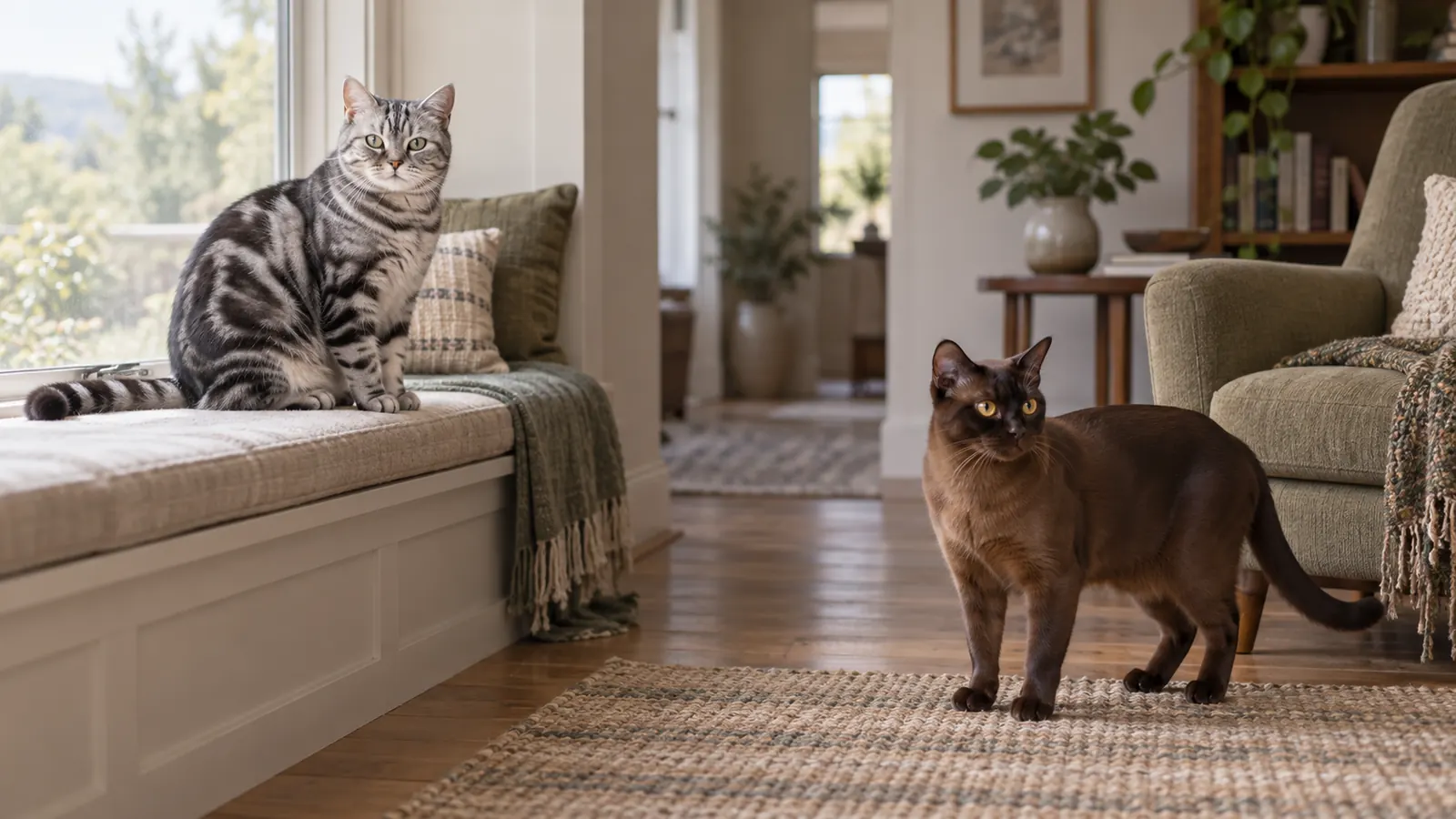
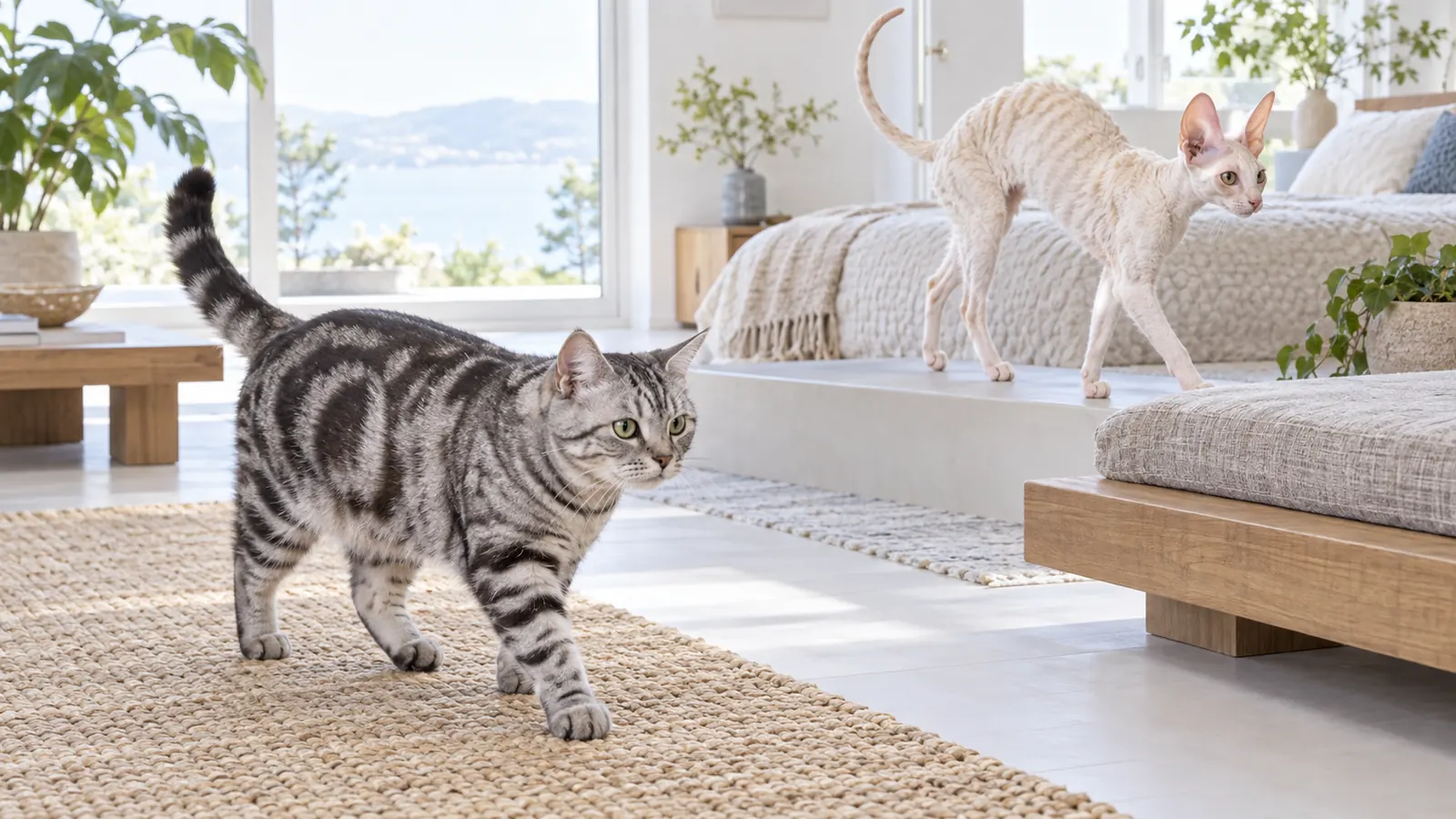
American Shorthair vs RagaMuffin: Space or Closeness?
The American Shorthair suits people who want an affectionate but more self-directed cat with a compact care footprint. The RagaMuffin suits homes where sustained close company and a much larger, slow-maturing, semi-longhaired cat fit the space and routine available.
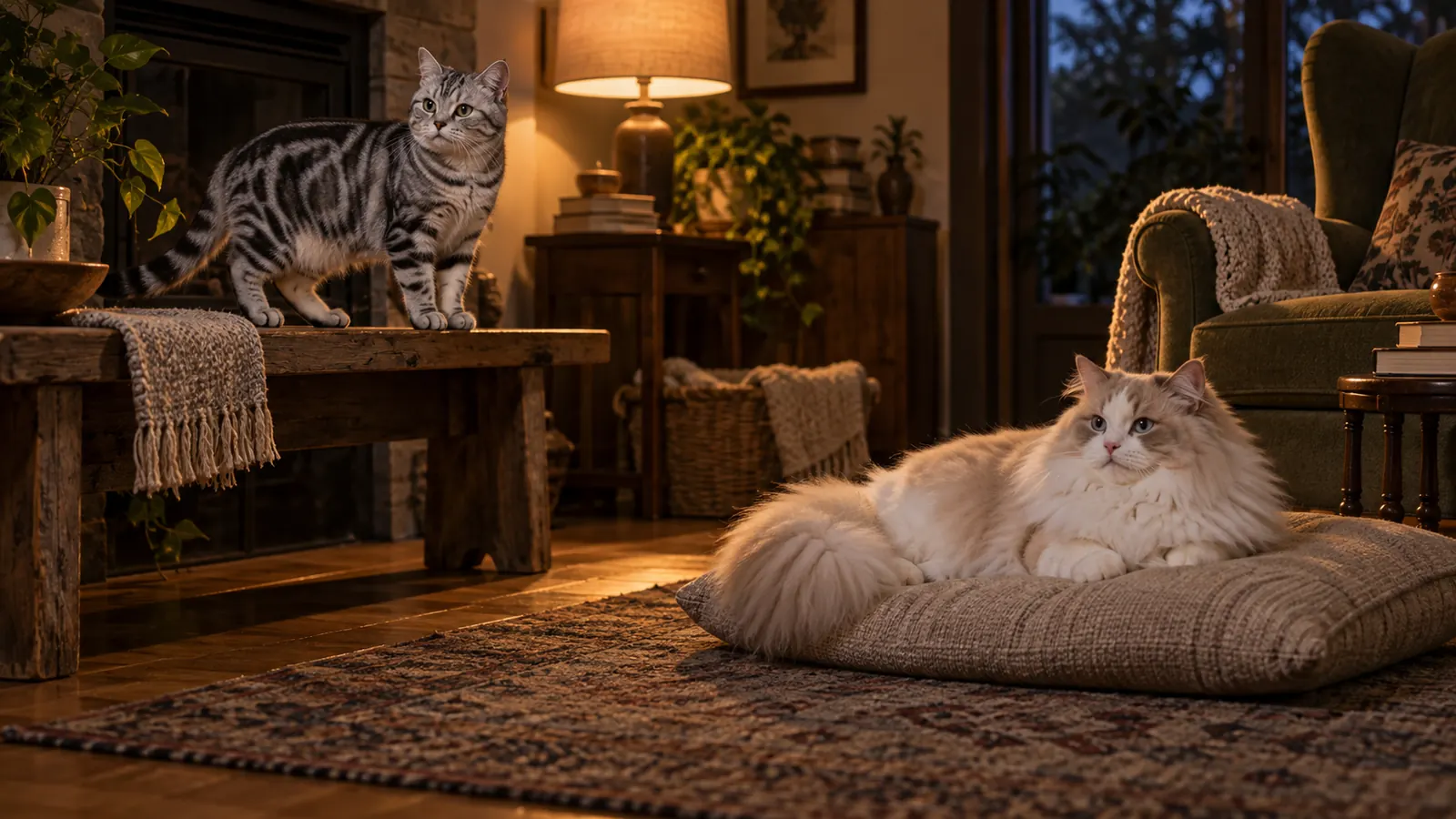
Both breeds are often presented as easy family companions, but easy describes different daily experiences. The American Shorthair is a substantial shorthaired cat that commonly balances affection with independent rest. The RagaMuffin is larger, slower to mature and more strongly associated with close physical company.
Size and docility need careful interpretation. A large gentle cat still requires exercise and choice, while a tolerant individual should never be treated as an object a child can carry whenever they want.
Which breed fits more households?
The American Shorthair is the more adaptable default for a wider range of homes. Its moderate activity, ordinary short-coat care and tendency to settle nearby can fit people who want company without organising every seat and routine around sustained contact.
The RagaMuffin fits households that deliberately want a large, affectionate cat close to them. CFA describes the breed as people-loving and docile, with many cats happy to spend long periods on or beside a favourite person.
| Profile | Contact style | Adult scale | Coat work | Best fit |
|---|---|---|---|---|
| American Shorthair | Affectionate, often nearby, and commonly more self-directed | Medium to large, broad and muscular | Short dense coat with seasonal shedding | A home wanting a balanced companion and conventional short-coat care |
| RagaMuffin | People-loving and often inclined toward lap or sofa contact | Medium to large with substantial bone; some adult males become very large | Plush medium to medium-long coat requiring depth combing | A home that welcomes sustained closeness and can size equipment for the adult |
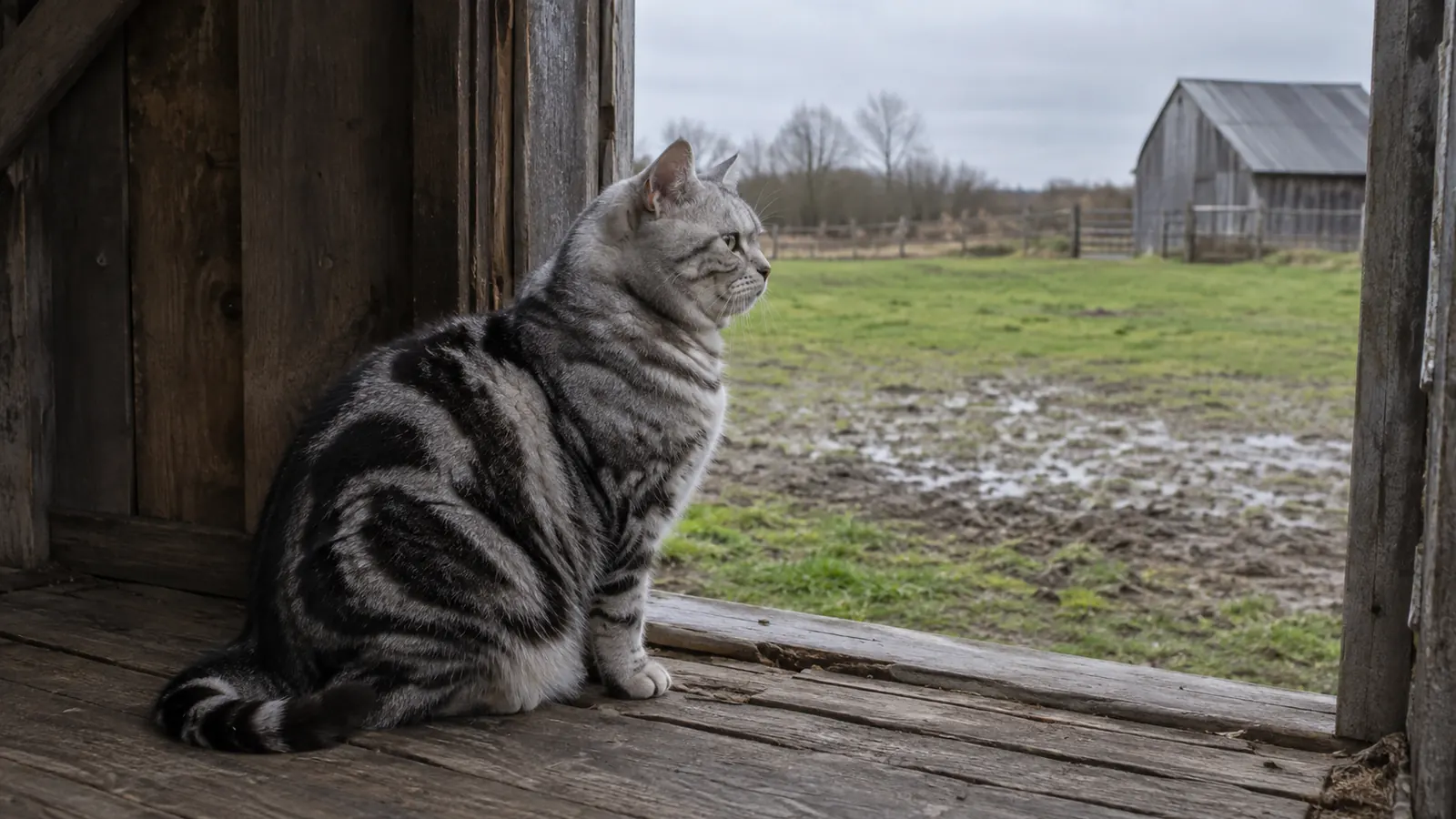
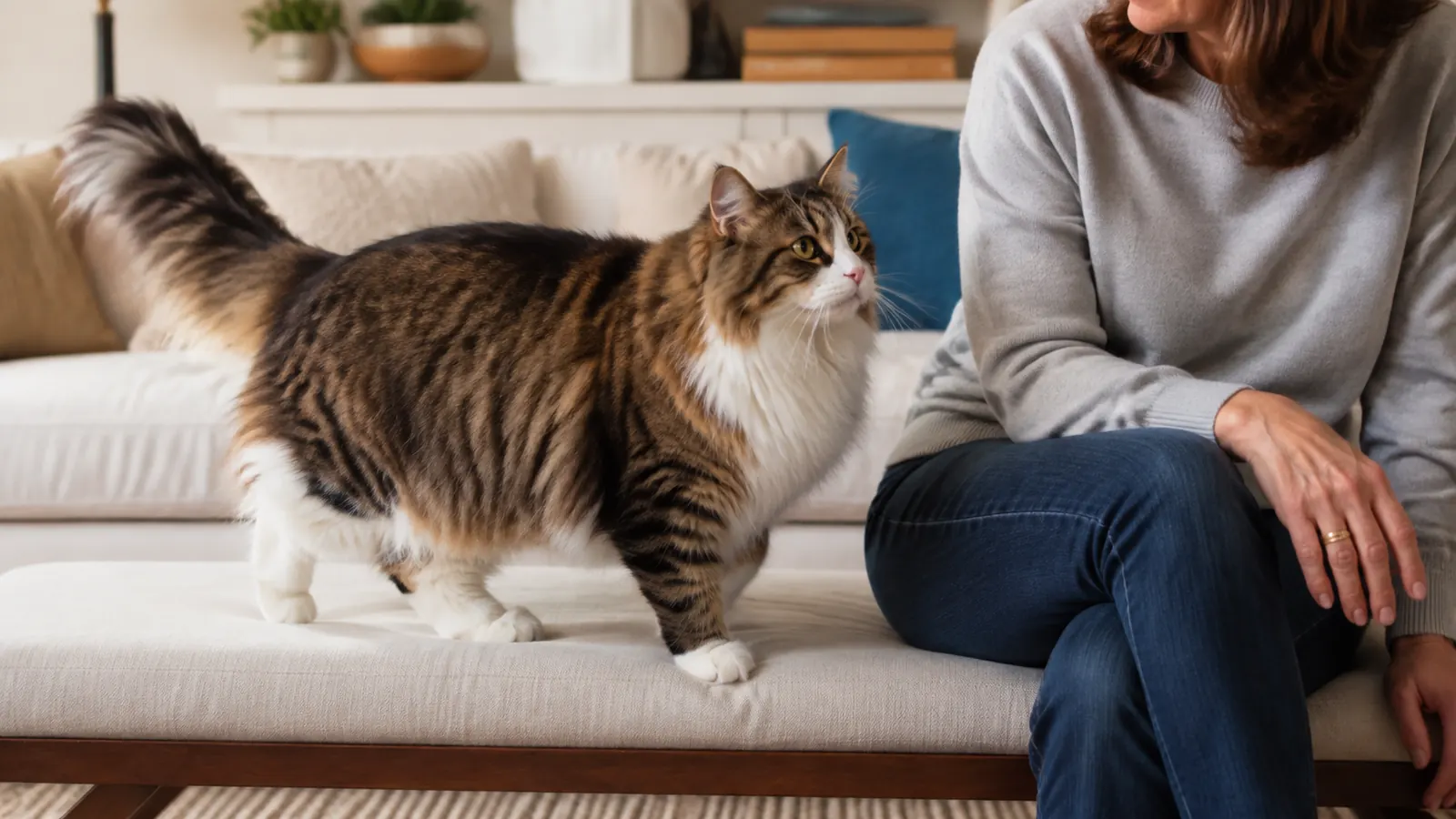
RagaMuffin docility is not a guarantee. The individual can dislike restraint, another animal or a noisy room, and respectful handling still ends when the cat tries to leave. An adult with known size and behaviour may be particularly useful if furniture space, lifting ability or an existing pet makes uncertainty expensive.
How different are their adult size and appearance?
The American Shorthair is broad, balanced and powerful with a dense short coat. Females are usually smaller than males, but the breed should remain proportionate rather than being selected or fed for maximum weight.
The RagaMuffin has a broad modified wedge head, substantial bone, a rectangular body and a long fully furnished tail. CFA notes that the breed can take about four years to reach full maturity, so a one-year-old may still add body and coat.
| Feature | American Shorthair | RagaMuffin | Household effect |
|---|---|---|---|
| Body | Broad, muscular and medium to large | Rectangular, heavy-boned and medium to large | The RagaMuffin may need deeper beds and wider support surfaces |
| Maturity | Gradual development into a powerful adult | Slow maturity over roughly four years | Kitten equipment can become inadequate later |
| Coat | Short, dense and protective | Soft, dense, silky and medium to medium-long | Grooming must reach through the RagaMuffin coat |
| Tail | Medium, in proportion to the body | Long, fully furred and plume-like | Tail and trousers add grooming friction points |
| Handling | Support chest and hindquarters | Full support is especially important in a large adult | Children should keep the cat on a stable surface |
| Identity | Registration and documented parentage | Registration and documented parentage | Appearance and size alone prove neither breed |
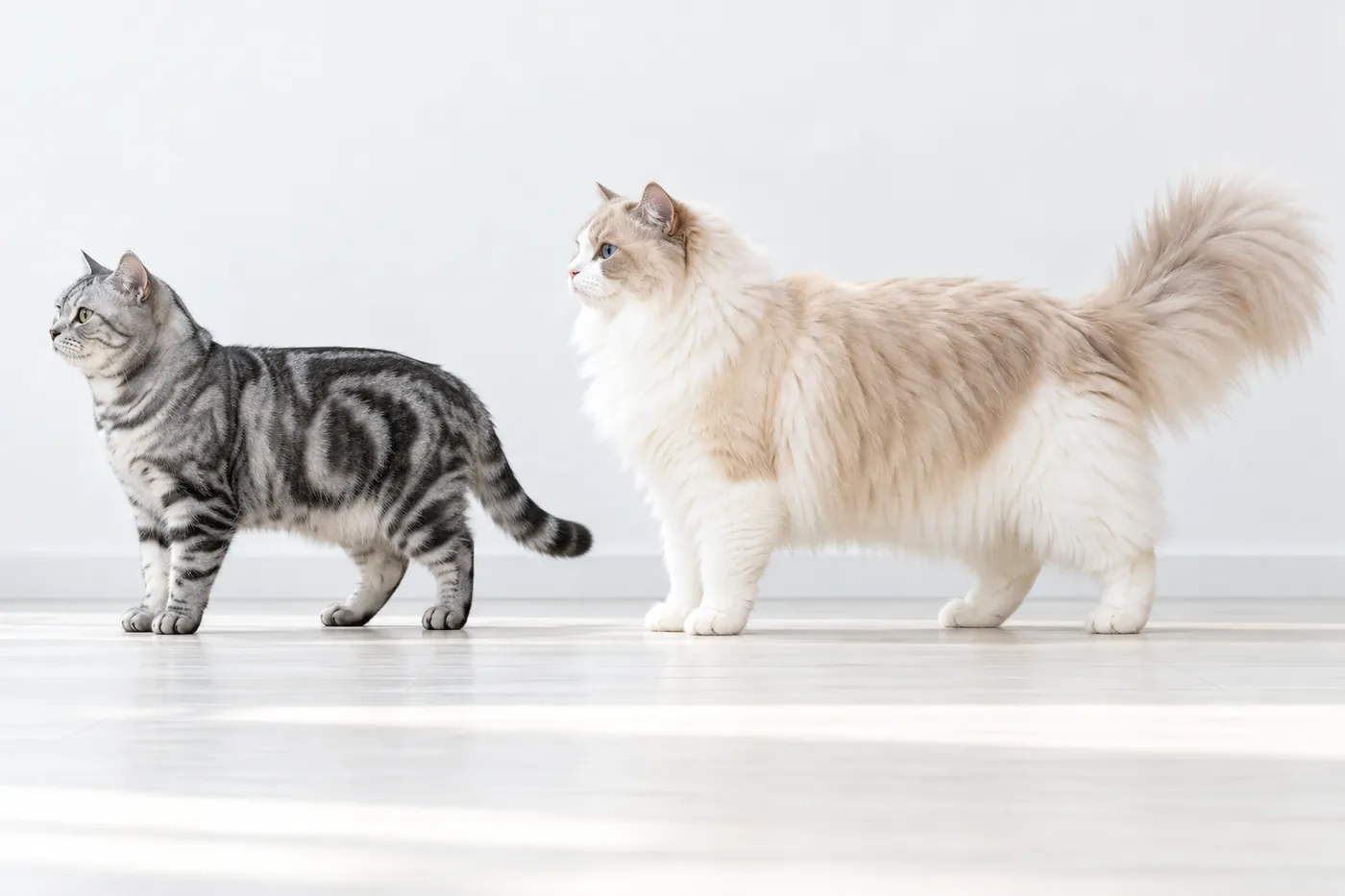
CFA mentions mature RagaMuffin males reaching around 20 pounds and females often remaining smaller. Those figures give context for adult scale and are neither a feeding goal nor proof that every cat will reach the same size. Length from chest to rump, standing height and turning room, measured on the actual adult, often matter more than a weight printed on a carrier label.
What do company and time alone look like?
An American Shorthair may choose a window station or chair near the person and return for contact between periods of rest. Its company can be warm without remaining physically attached.
A RagaMuffin more often makes touch and close placement part of shared time. That may mean occupying a lap, lying against a hip on the sofa or following to the room where the family settles.
| Household moment | American Shorthair | RagaMuffin |
|---|---|---|
| Desk work | Often supervises from a nearby perch | More likely to seek a broad chair, desk-side bed or lap |
| Quiet evening | Alternates between contact and independent rest | May sustain close sofa or lap contact for longer |
| Closed bedroom | Can object, but may accept a trained nearby alternative | Changed access can conflict more strongly with a close-contact routine |
| Time away | Uses safe independent activity according to the individual | A social individual still needs reliable human contact despite a calmer pace |
| Return home | Often joins a planned play or greeting | May prioritise physical reunion before settling |
There is no sound breed-wide hours-alone rule, and eating, litter use, sleep, vocalising, hiding, overgrooming and recovery after people return show how the individual copes.
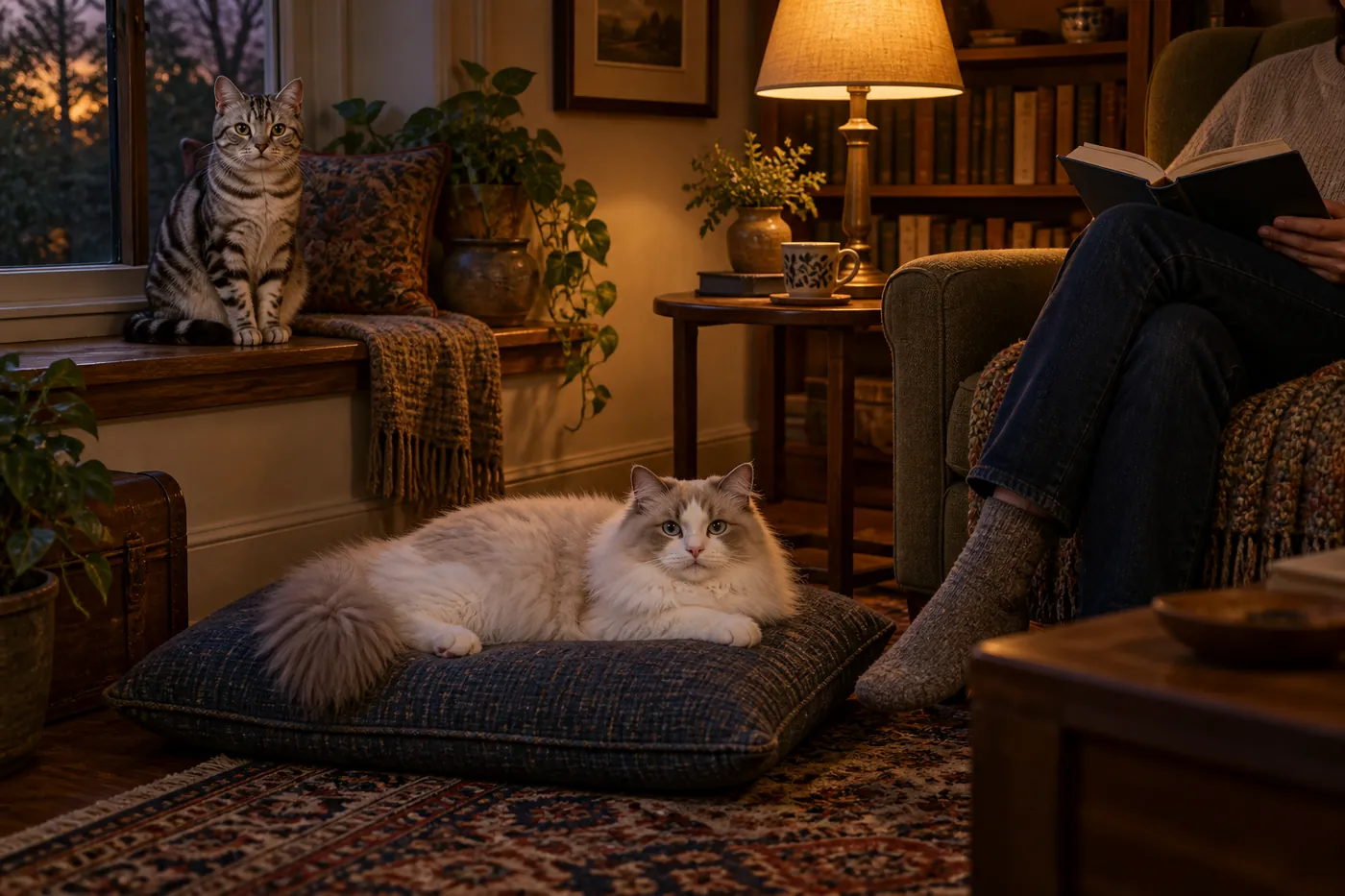
A second cat cannot cover an absence problem on its own, because the animals need compatible play, protected resources and human relationships of their own. A predictable greeting, short play and a comfortable station near the family can support either breed. Consistency matters more than trying to compensate for a week of absence with one exhausting weekend session.
How should furniture and activity change for each breed?
The American Shorthair needs stable climbing options and hunting play, but most conventional robust cat furniture can fit an adult once measurements are checked. A RagaMuffin may expose narrow beds, shallow trays and light trees that looked adequate for a kitten. Broad platforms should support the chest, abdomen and hips without forcing the cat to curl tightly. The base should remain stable when the adult jumps from an angle rather than only when weight is placed slowly in the centre.
- Platform depth
- Let the adult RagaMuffin lie and turn without hanging most of the body over an edge
- Tree stability
- Test movement from the likely take-off direction, not only by pressing straight down
- Tray room
- Choose a litter tray long and wide enough for a full turn and normal posture
- Carrier fit
- Measure body length and standing height, then use a carrier the cat can enter voluntarily
- American Shorthair play
- Use pursuit, capture and food-searching games that channel hunting interest
- RagaMuffin play
- Keep daily movement gentle but real, using floor lanes, low steps and toys the cat can catch
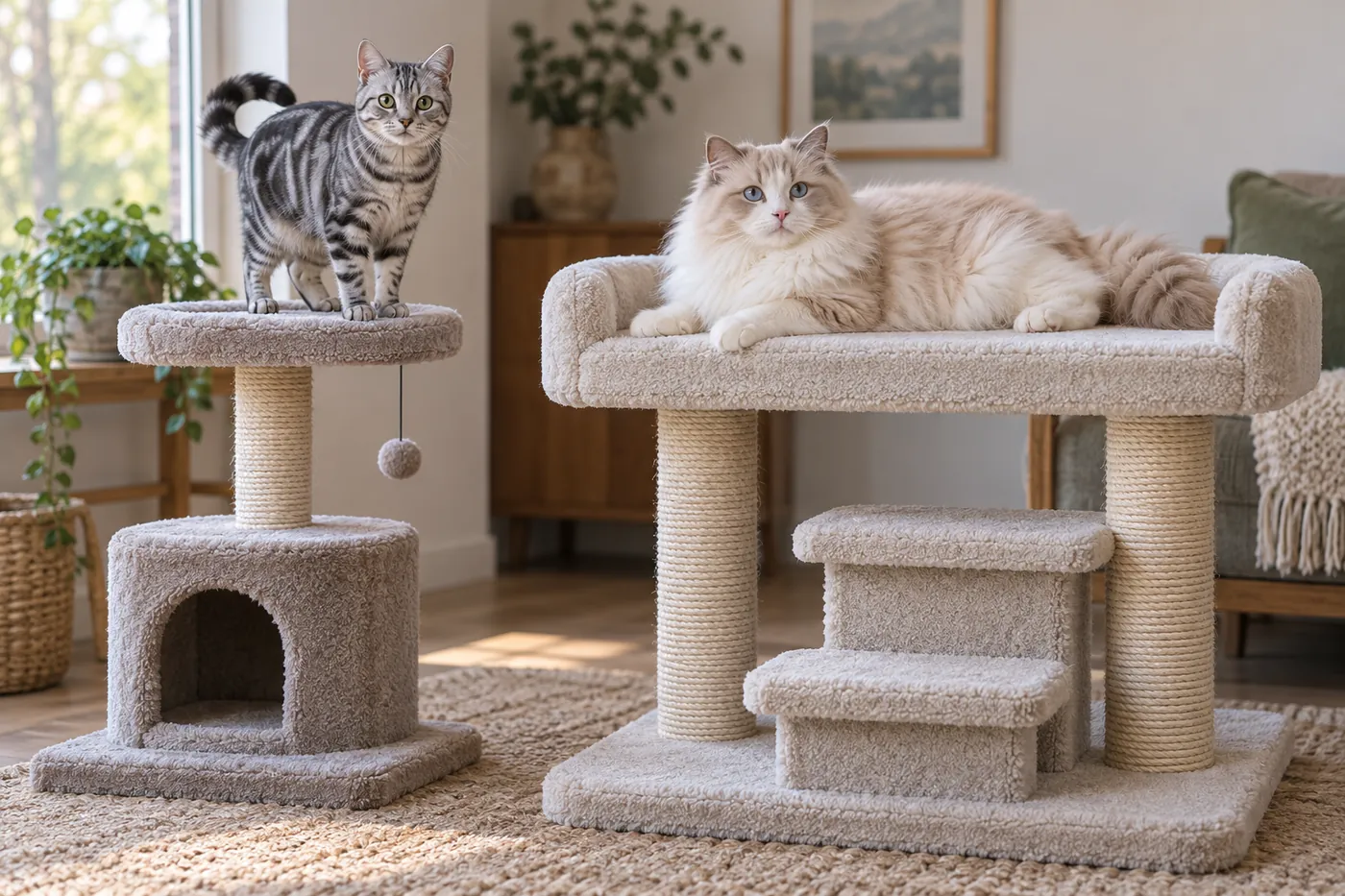
A large cat still needs daily movement, which helps preserve muscle, mobility and a healthy body condition, and play should continue after the novelty of kittenhood ends. Food rewards need care because a substantial body can hide gradual fat gain, so puzzle and training food belongs inside the daily ration, with the individual's body condition tracked.
How much grooming and shedding should you expect?
The American Shorthair usually needs a gentle weekly pass, with more attention when the dense undercoat releases. A comb or grooming mitt should lift loose hair without repeated scraping.
The RagaMuffin coat is longer and deeper, although CFA describes its texture as relatively resistant to tangling. Combing once or twice weekly may suit many cats, but season, friction and the actual coat decide the schedule.
- Feel through the RagaMuffin coat with your fingers, especially behind ears, under front legs, across the chest and through the trousers
- Divide a small area so the comb reaches the coat beneath the surface
- Hold hair near the skin and work from the free end of a small tangle
- Recheck the plume tail and rear coat for debris or soiling without pulling
- Increase attention during coat release instead of using more force
- Stop for pain, odour, redness, tight mats or a sudden change in coat quality
Surface brushing can leave a hidden knot close to the skin. Work in small areas and let the cat change position rather than restraining a large body through a long session.
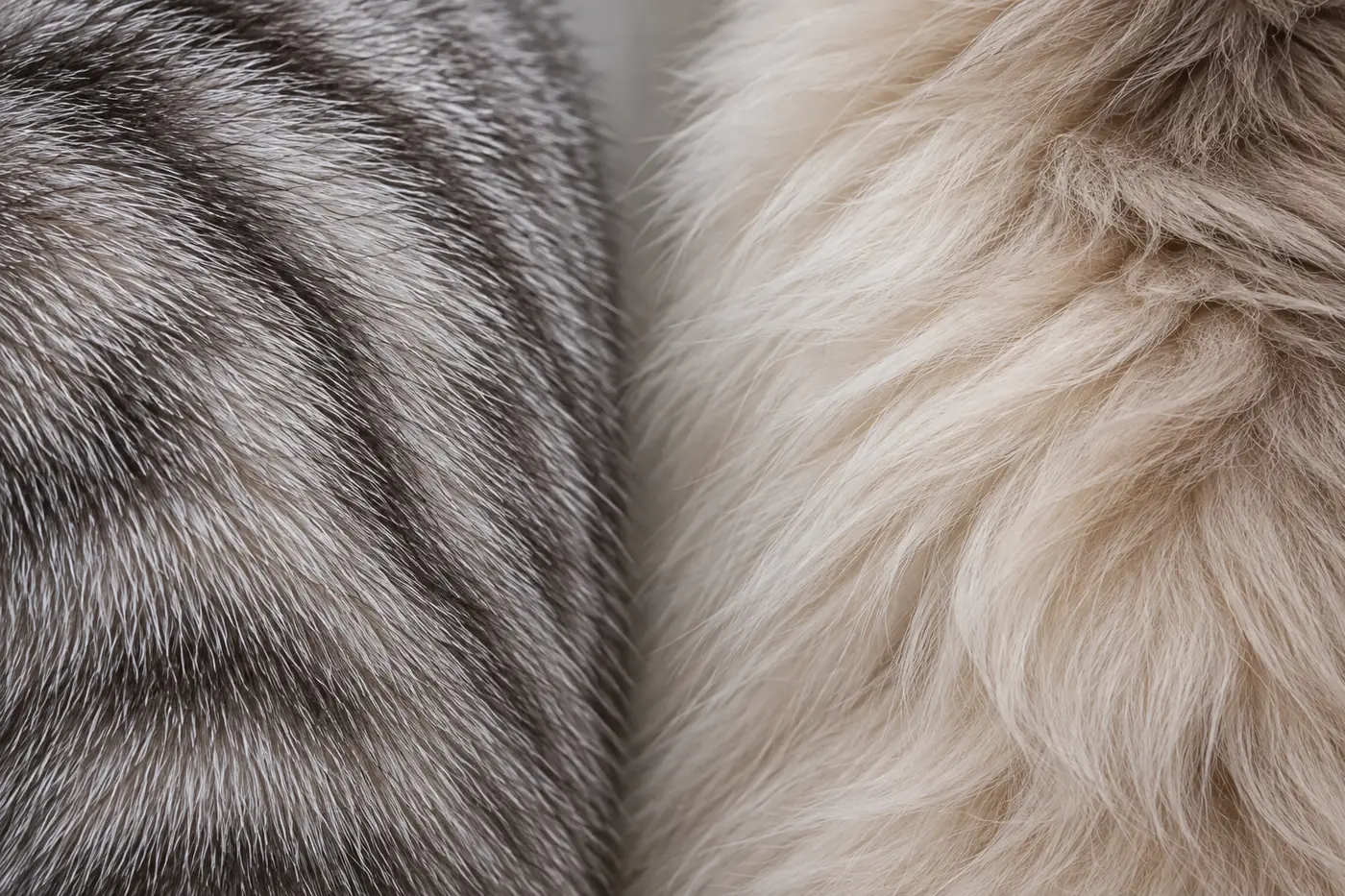
Comb tooth spacing and brush surface decide whether grooming tools reach the coat near the skin. Cutting a tight mat near moving skin is risky and may require professional help.
Neither breed is hypoallergenic. A larger longhaired cat may spread more visible hair, but allergen response cannot be predicted from hair length or grooming frequency.
Which is better with children, dogs or another cat?
The RagaMuffin's close, tolerant reputation may suit a calm family, while the American Shorthair's steadier independence can suit children who enjoy play without expecting a lap cat. Both arrangements need adult supervision.
A large RagaMuffin may exceed what a child can support safely. Keep the cat on the floor, a broad bench or a sofa and let it enter the child's space under its own power.
- Children use toys rather than hands and let either cat end contact
- Nobody lifts a RagaMuffin without supporting chest and hindquarters
- Dogs remain controlled until feline movement no longer triggers pursuit
- Each animal has separate food, water, litter, scratching and sleeping places
- High retreats have two exits and broad landings appropriate to the cat
- Play includes pauses and role changes rather than one animal repeatedly escaping
A very tolerant cat can remain still while stressed, so adults should notice tense muscles, tail movement, ears turning back and attempts to look away before a swat becomes the first obvious signal.
An adult with a known history is the safer choice when a fragile older pet or young child already lives in the home, because a kitten's future body, pace and tolerance remain uncertain.
Which health and breeder records matter?
Registration, parent identities, dated veterinary records and family outcomes are the evidence to ask for with either breed, and every laboratory or imaging report should match the named cat rather than arrive as a screenshot without context.
CFA notes that hypertrophic cardiomyopathy and polycystic kidney disease may occur in RagaMuffins. That supports direct questions about cardiac and kidney evidence, but it does not establish one universal panel or show that every line carries the same risk.
| Evidence | Ask the breeder | What it shows | Limit |
|---|---|---|---|
| Registered identity | Do parent names and numbers match the reports? | Which cats produced the litter | Does not predict temperament or health |
| Cardiac evidence | Which cats were assessed, by whom and on what date? | A finding at a defined time | Cannot guarantee future freedom from HCM |
| Kidney evidence | Which exact condition or variant was assessed? | The result of that named investigation | A generic panel does not clear every kidney disorder |
| Body condition | Can you see adults moving and can the breeder discuss weight history? | Whether large size is managed as a health variable | One visit does not predict lifelong weight |
| Family outcomes | What ages, diagnoses and causes of death are recorded? | Whether health is followed beyond sale | Missing diagnoses are not proof of absence |
| Individual examination | What was checked in this kitten or adult and when? | Findings for that cat at that visit | Cannot provide a lifetime guarantee |
American Shorthair registry material does not identify the same focused inherited list. That still leaves meaningful questions about cardiac findings, weight, dental care, longevity and the health of close relatives.
A seller who markets size as the main achievement, discourages questions about older relatives or says a panel proves the kitten is fully clear is giving the wrong answers. A responsible answer names the document, the cat, the date and the limitation.
Which breed belongs in your home?
The American Shorthair suits someone who wants a broad, playful companion whose affection often leaves room for independent rest. It is still a poor match if daily hunting play, weight control and seasonal shedding will be ignored.
The RagaMuffin suits someone who wants sustained close company and can support a large adult body, broad equipment and regular depth combing. It becomes a poor fit when adults cannot lift safely, furniture space is already tight or lap contact will be repeatedly rejected.
Meeting the individual during play, rest and brief handling shows whether the cat can pause, recover and leave, which says more than friendliness at the first approach.
For more households, the American Shorthair is the easier practical fit. The RagaMuffin is the better choice when large-scale support and close companionship remain welcome every ordinary day.
Checked Against
Published 12 September 2026. Last updated .