Abyssinian vs Burmese: Which Kind of Companion Fits You?
Choose an Abyssinian when you want an athletic cat that joins life through movement, climbing and investigation. Choose a Burmese when you want closer physical company and can give a highly social cat regular access to people, but treat a routinely empty home as a poor starting fit for either breed.
Both cats are intelligent, playful and people-oriented.
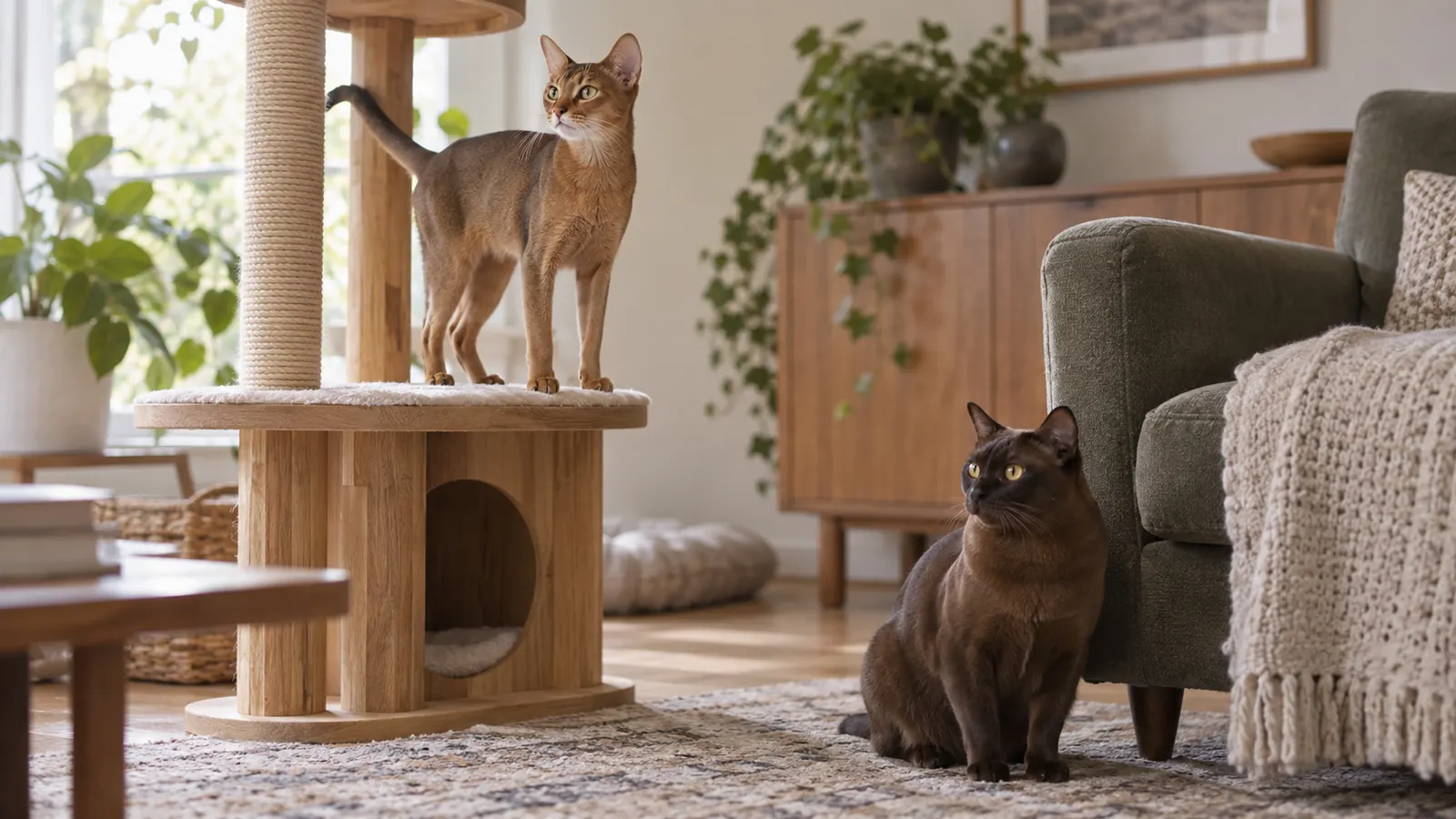
The useful distinction is how they use your presence: an Abyssinian often circulates through the room and watches from height, while a Burmese is more likely to settle against you, return to your lap and object when access to people disappears.
Those are breed tendencies rather than promises. Early handling, health, learning and the individual cat's history still shape the companion that actually lives in your home.
Which breed is the better fit for your daily routine?
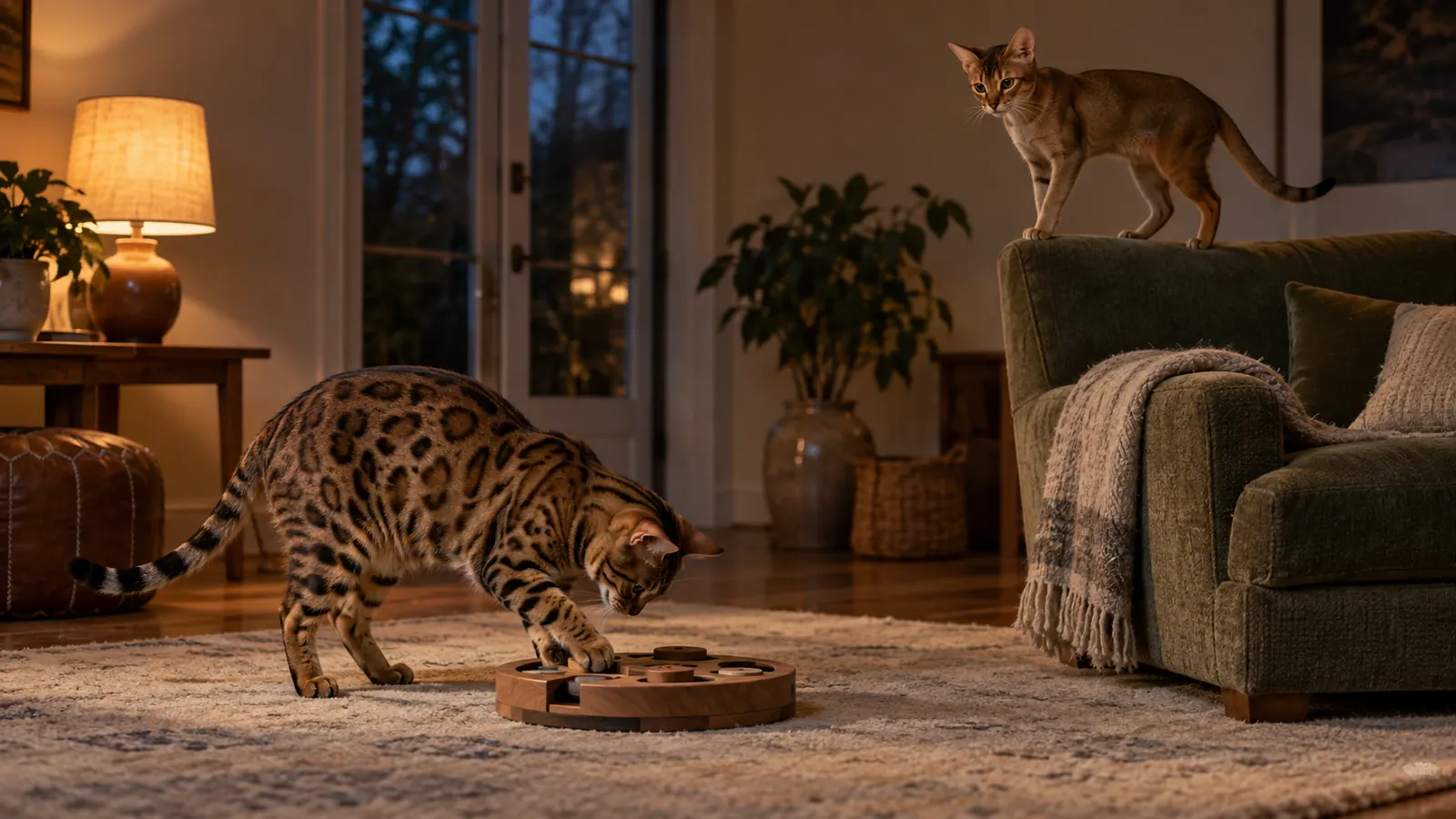
The Abyssinian is the stronger fit for somebody who enjoys an active observer. It commonly follows movement, investigates whatever changes and uses high ground as working territory, so its owner needs to enjoy managing routes and finding constructive jobs for a quick learner.
The Burmese is the stronger fit when close contact is part of the appeal. TICA describes the breed as outgoing, lap-seeking and extremely people-oriented, while the GCCF calls Burmese intensely social animals that do not like to feel neglected.
| Profile | Contact style | Time alone | Space | Best fit |
|---|---|---|---|---|
| Abyssinian | Mobile company, often nearby or above you rather than continuously on you | Poor starting fit for long routine absences | Connected climbing routes plus open play space | A home that enjoys movement, training and a cat involved in changing activity |
| Burmese | Close body contact, lap time and frequent room-to-room company | Poor starting fit for long routine absences | Warm resting places plus interactive floor and furniture-level play | A home with regular human presence that wants a cuddly, conversational companion |

Neither row describes a low-maintenance cat in the broad sense. Coat work is light, but the daily cost sits in attention, play and noticing when a social cat stops coping.
The choice therefore starts with preference rather than experience. A first-time owner who genuinely wants one of these routines may be a better match than an experienced owner who expects the cat to fit around an empty week.
How different do an Abyssinian and Burmese look?
An Abyssinian reads as long, lifted and light on its feet. Large ears, almond-shaped eyes, slim legs and a close ticked coat create the familiar wild-looking outline, although the body carries firm muscle rather than fragility.
TICA places adult females around 6 to 9 pounds and males around 7 to 12 pounds. The numbers overlap ordinary domestic cats, so proportion remains more useful than weight for recognising the type.
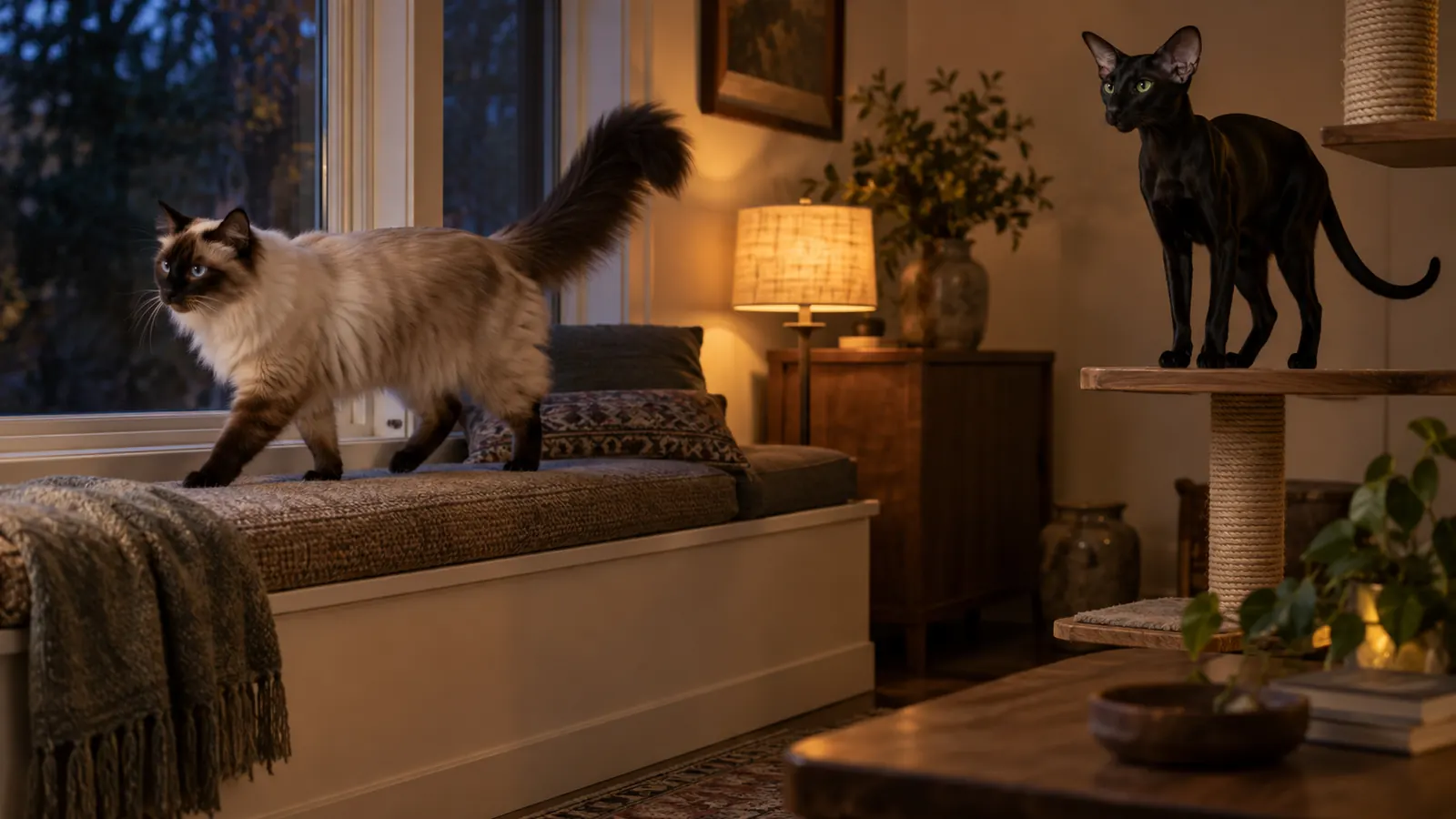
A Burmese looks compact and rounded. The chest is deeper, the bone more substantial and the head broader, while the very short satin coat follows the muscle closely enough to make the cat look smaller than it feels when lifted.
The CFA standard deliberately asks for surprising weight for size but does not supply a target number. That makes the cat's actual body length and weight more useful than a guessed breed average when choosing a carrier, wall bed or shelf.
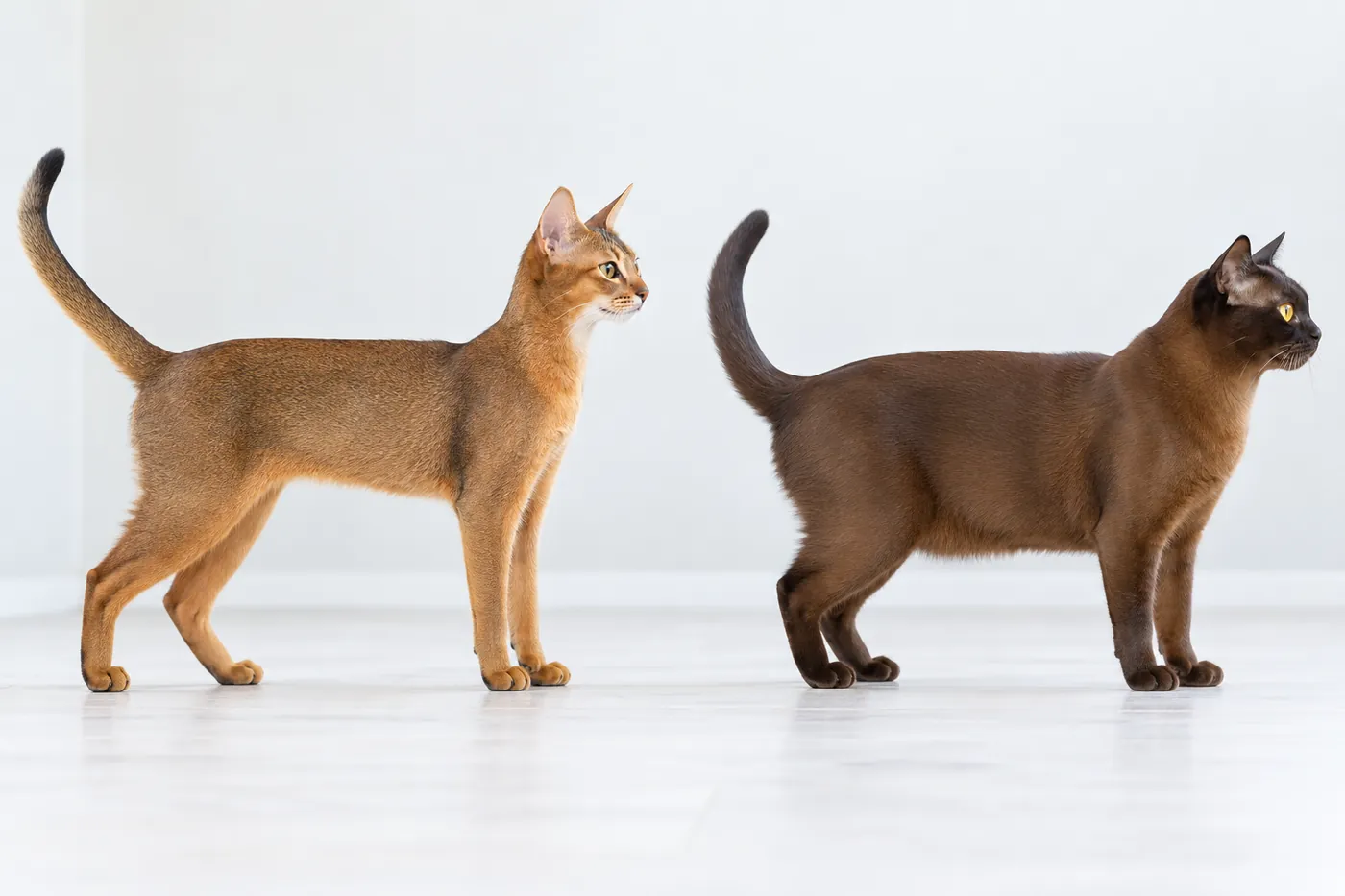
Their coats also create different colour effects.
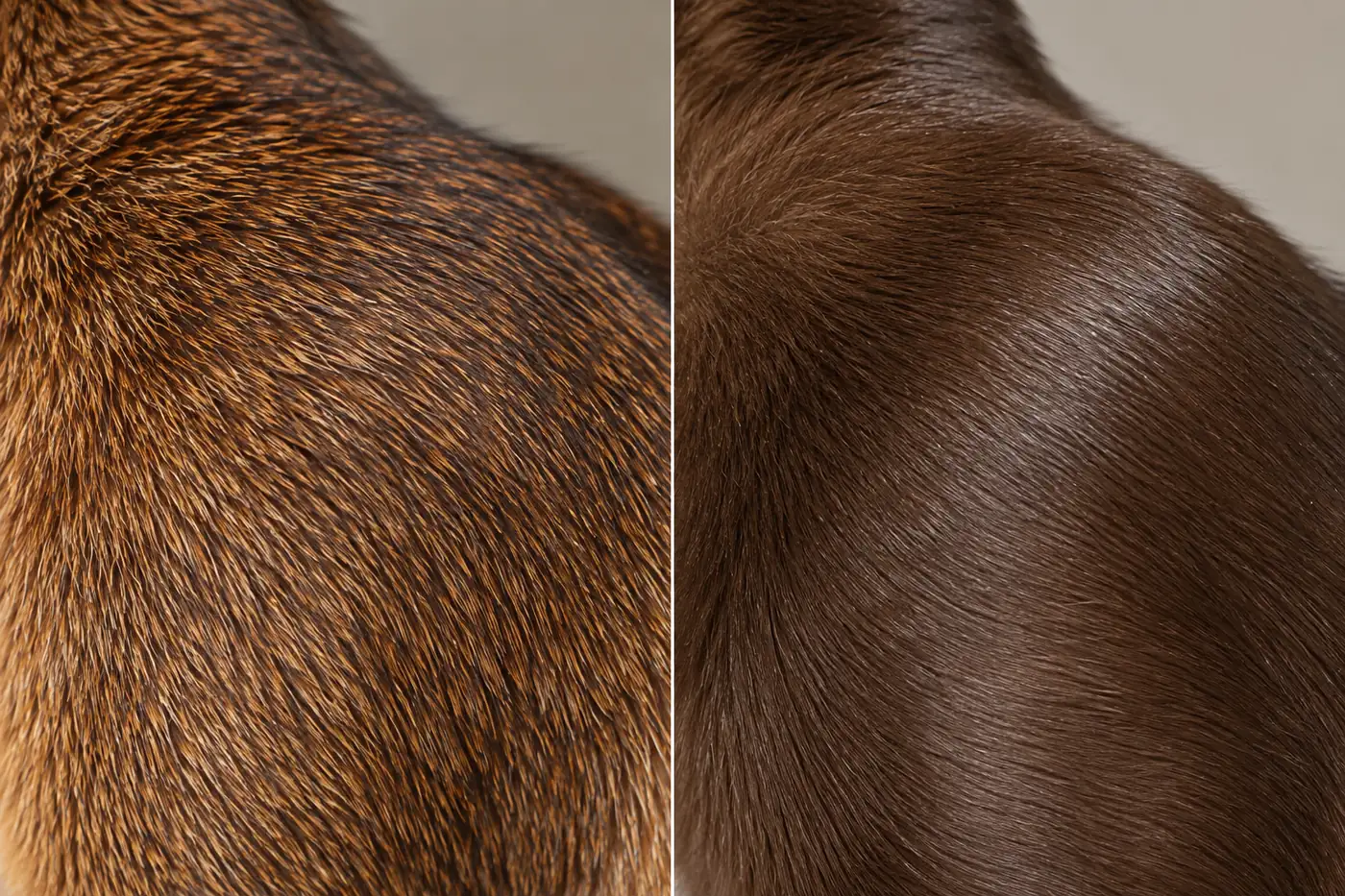
Abyssinian ticking places dark and light bands along individual hairs, while Burmese sepia colour restriction produces a rich solid-looking body with somewhat deeper colour at the points, especially in younger cats.
Neither appearance proves pedigree. Registration, parentage and the breeder's records carry that job.
Do they want the same kind of attention?
An Abyssinian often participates without remaining still. It may inspect a keyboard, cross a shelf, watch from the top of a cabinet and return when a cupboard opens, giving the owner frequent contact in short moving episodes.
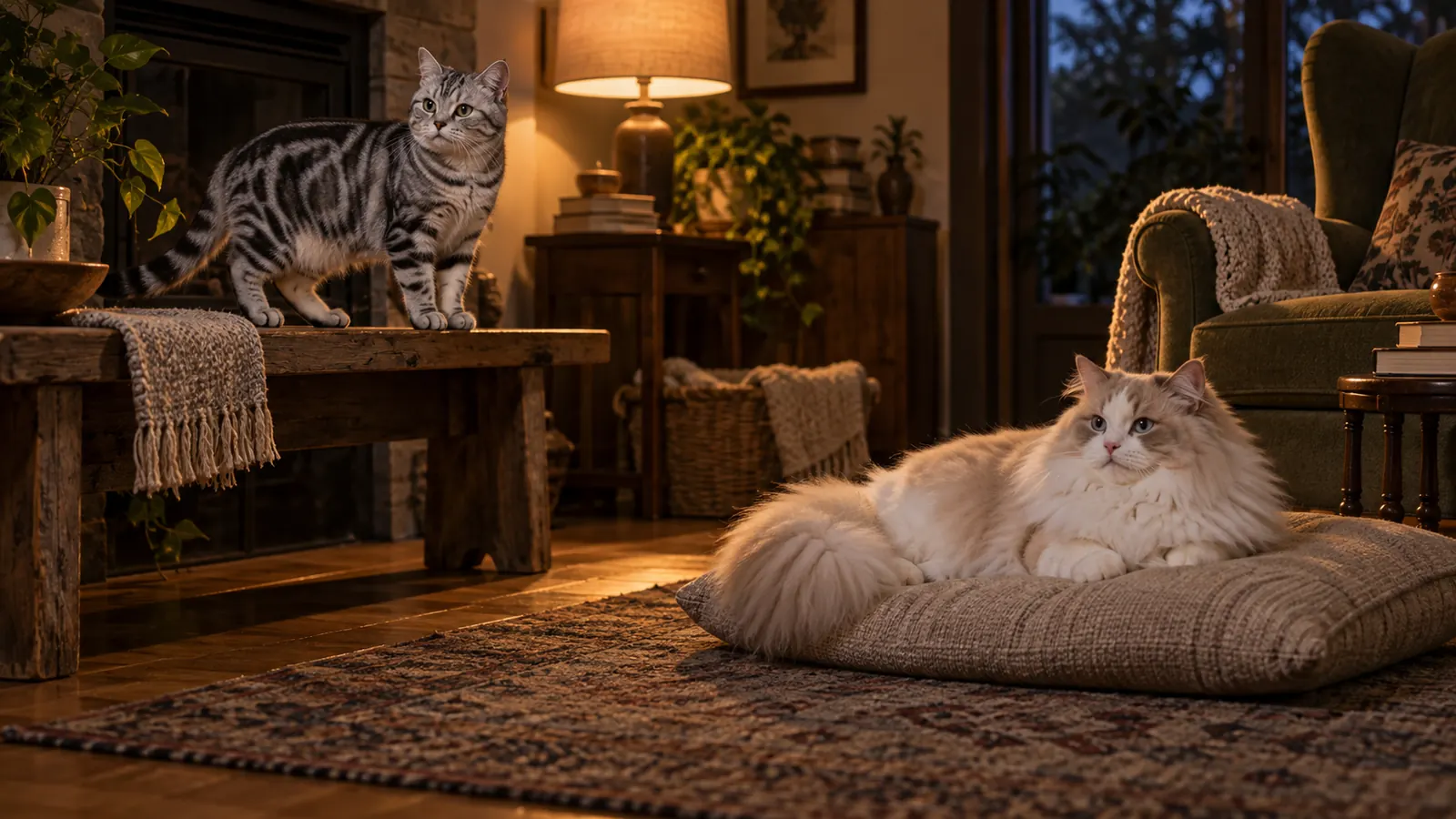
A Burmese more often converts presence into physical proximity. Registry descriptions repeatedly mention laps, rooms, conversations and company, which makes a closed door or long uninterrupted absence more likely to become the friction point.
| Household situation | Abyssinian tendency | Burmese tendency | What matters in the individual |
|---|---|---|---|
| Working from home | Investigates movement, screens and high observation points | Seeks lap, chair or nearby body contact and may follow between rooms | Whether the cat can settle after a planned play period |
| Full workday away | May search, climb or create activity when under-stimulated | More likely to experience the missing company as the central problem | Eating, litter use, vocalising, destructive searching and recovery after you return |
| Quiet evening | Often moves between play, height and brief contact | More often remains against or very close to a person | Whether your preferred amount of touch matches the cat's |
| Compatible second cat | Can share chase and exploration with a suitable partner | Can gain regular social contact from a comfortable relationship | Whether both cats rest freely and disengage without pursuit |
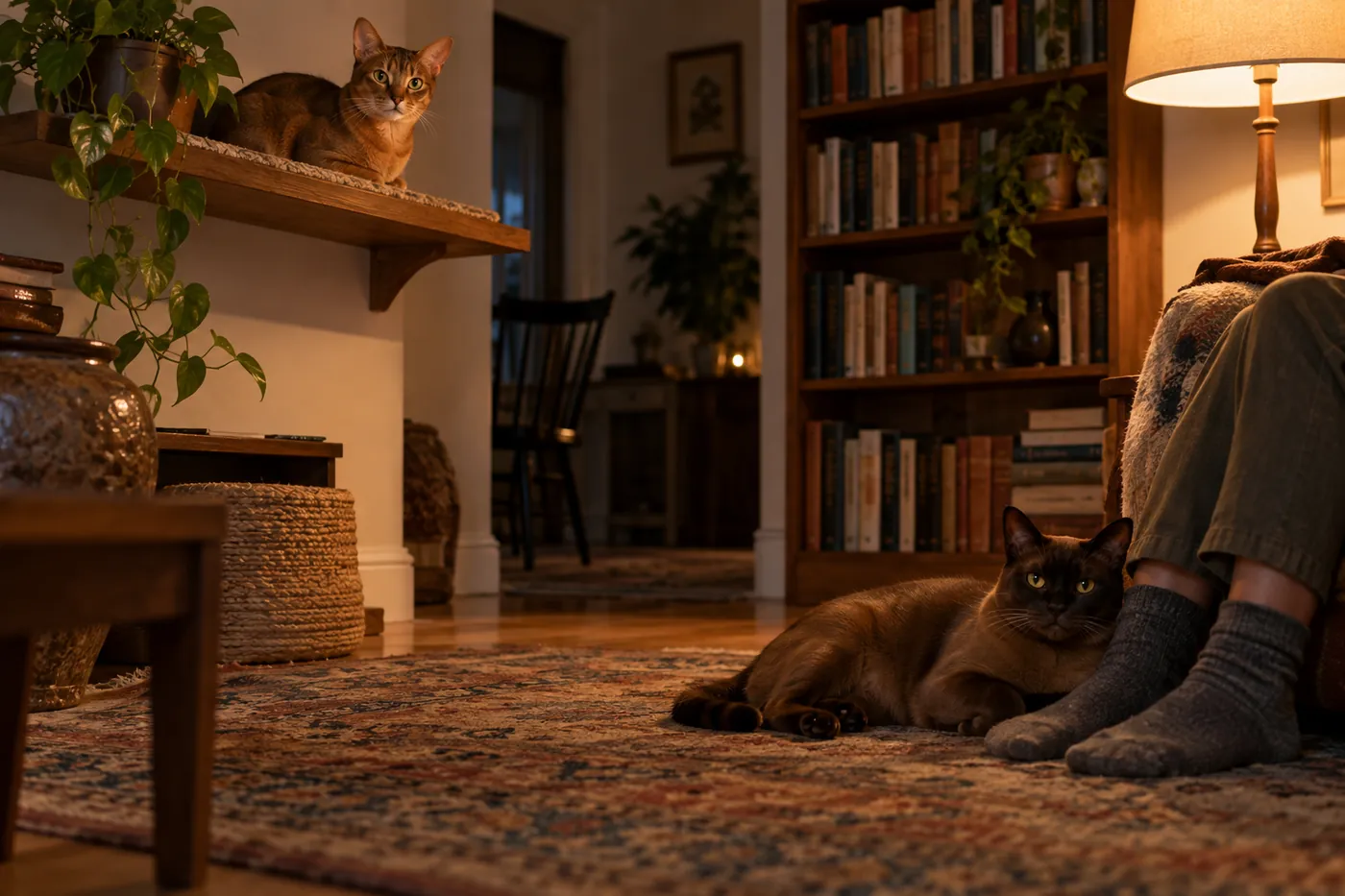
No registry or study establishes a universal number of safe hours alone. Kittens, a newly adopted cat and an adult already showing distress need a different plan from a settled individual that sleeps through much of a predictable absence.
A second cat is not a substitute owner.
It helps only when the two animals actually choose contact, play fairly and have enough separate food, water, litter, resting and high resources to avoid competition.
Persistent overgrooming, loss of appetite, litter changes, pacing or vocalising deserves an individual assessment. Do not explain a new health or behaviour change only by saying the breed is needy.
Which cat needs more play, training and vertical space?
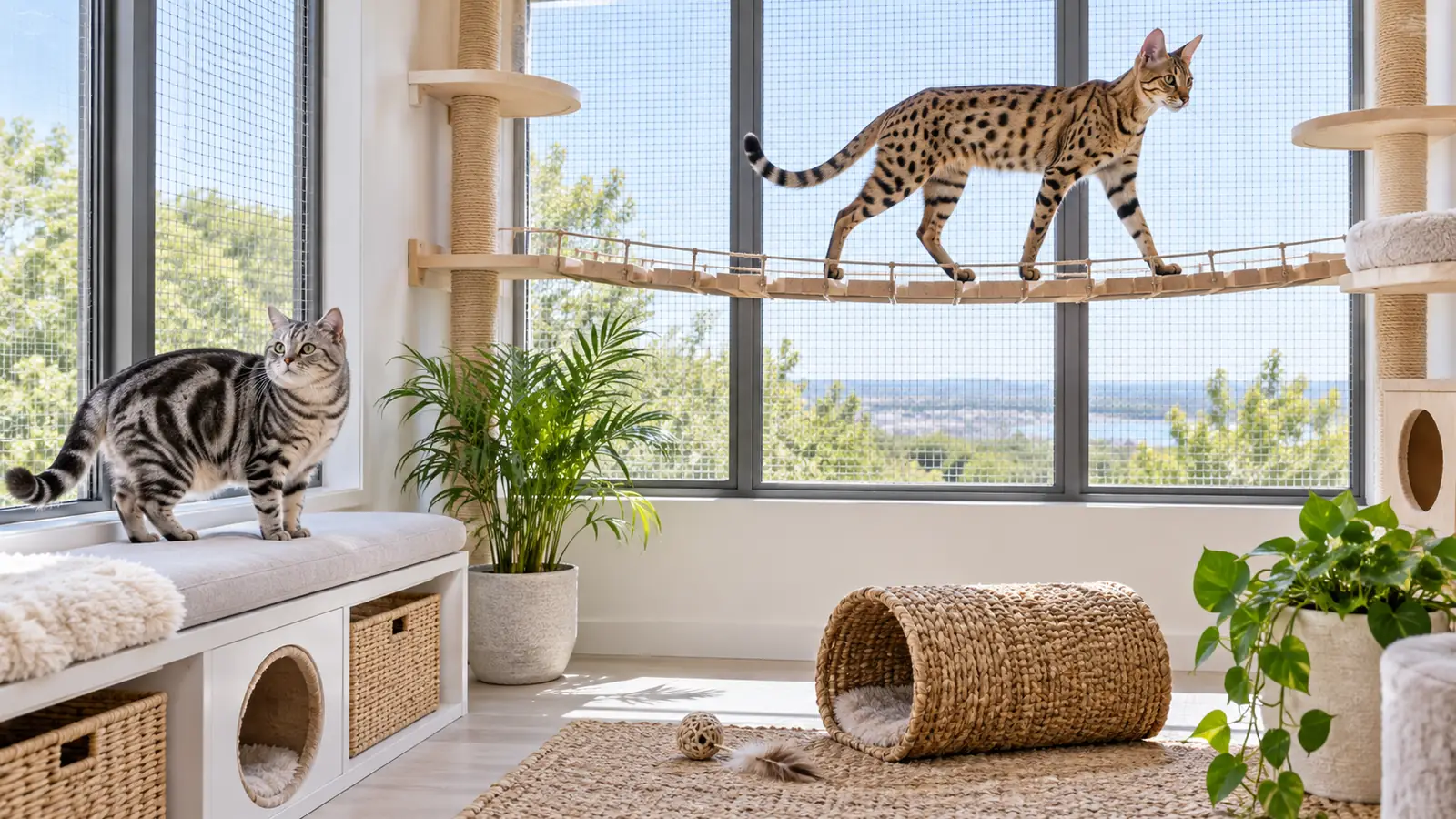
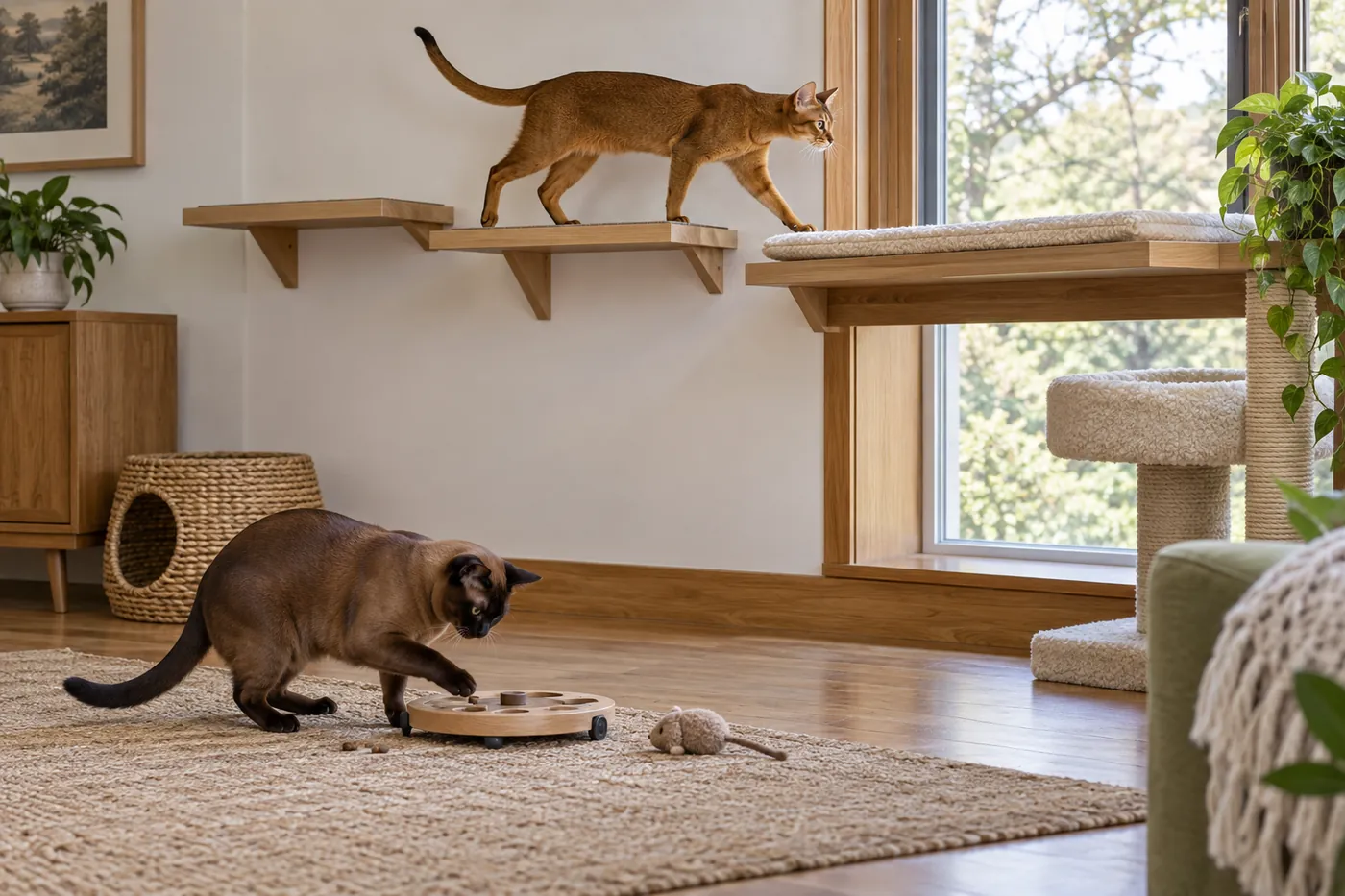
The Abyssinian places the larger demand on connected height. One tall tree provides a destination, but shelves, a stable window perch, clear landing areas and more than one route down let the cat travel without turning doors, televisions and unstable furniture into the route.
Its curiosity also shortens the useful life of simple activities. A feeder solved in seconds or the same wand pattern every evening stops being a problem and becomes a routine, so changing the route or task matters more than extending one exhausting play session.
The Burmese needs active play too, but the activity is more readily social and floor-based. TICA recommends games, tricks, puzzle toys and plenty of attention, which suits a routine that mixes a chase, a small learned behaviour and food work rather than asking the cat to entertain itself all day.
Use the clicker training guide for reward timing and step-by-step shaping. Both breeds can learn carrier entry, mat work, paw handling and retrieval, but the Abyssinian commonly asks for more novelty while the Burmese commonly asks for more participation from the person.
Use food from the measured daily ration in puzzles.
A clever cat can gain weight through enrichment when every solved device quietly adds calories on top of meals, and Burmese diabetes research makes healthy body condition especially relevant without turning weight into a breed diagnosis.
Activity changes with age. The exercise-by-age guide explains how to shorten bursts and improve traction or landing distance without removing daily play from an older cat's routine.
Which is better with children, dogs or another cat?
TICA describes both breeds as generally good with children and other pets. The Burmese is often the easier starting fit with younger children because registries emphasise tolerance and close contact, while an Abyssinian can be especially rewarding for an older child who wants to use wand toys and teach simple tasks.
That distinction never turns handling into consent.
A confident Burmese may endure being carried after it wants to leave, and a busy Abyssinian may escalate from play to grabbing when hands replace toys.
- Children use a wand toy and let either cat leave without following
- The cat has a high or enclosed retreat that children and dogs cannot enter
- Each cat receives separate food, water, litter, sleeping and scratching resources
- Introductions proceed behind barriers before unrestricted contact
- Dogs remain controlled until the cat can move without triggering pursuit
- Adults watch whether play remains reciprocal and both animals can disengage
A timid resident cat may find an Abyssinian's speed difficult even when the newcomer intends to play. A highly independent resident may dislike a Burmese repeatedly seeking contact, so energy and social style both matter.
The observed adult is valuable in a home with vulnerable animals. A cat that can notice novelty, return to baseline, accept a pause and walk away offers better evidence than a promise that every member of its breed loves dogs or children.
Are grooming and shedding meaningfully different?
Both coats need little routine labour, but they do not look or feel the same. The Abyssinian coat is fine and close with visible bands along each hair, while the Burmese coat has little undercoat and a polished satin finish over a denser body.
| Coat question | Abyssinian | Burmese |
|---|---|---|
| Structure | Fine close coat with ticked bands on individual hairs | Very short close satin coat with little undercoat |
| Routine tool | Soft brush, grooming cloth or rubber glove used gently | Rubber glove or fine comb used lightly |
| Loose hair | Real shedding, often visually modest because the coat lacks bulk | Real shedding despite the very short coat and sparse undercoat |
| Bathing | Usually only for contamination or a specific care reason | Usually only for contamination or a specific care reason |
| Allergy | No dependable allergy advantage | No dependable allergy advantage |
Short hair does not make either breed hypoallergenic.
Cat allergens come from saliva and skin secretions as well as loose hair, so direct repeated exposure to the actual cat is more useful than choosing by coat length.
Grooming should remain a light body check rather than an attempt to polish the coat. Look for a new sore area, dandruff, hair loss, ear debris or reluctance to be touched, and stop if the skin becomes irritated.
Which health evidence should a breeder show you?
The health comparison is not a contest over which list is longer. It asks which risk has a named test, which relies on family records and which published association cannot predict an individual kitten.
| Breed and concern | Evidence to request | What it can tell you | Important limit |
|---|---|---|---|
| Abyssinian PRA rdAc | Original laboratory reports for both parents naming the CEP290 rdAc variant | Clear, carrier or affected status for this recessive retinal-degeneration variant | A clear result does not cover every cause of blindness |
| Abyssinian PK deficiency | Original reports naming the PKLR variant for both parents | Whether each parent can pass this recessive anaemia variant | Carrier does not mean affected, and the report covers one variant |
| Abyssinian renal amyloidosis | Ages and causes of death in related cats plus the breeder's longitudinal records | Whether the breeder tracks a recognised family concern | No simple DNA clearance is available and family history is not a guarantee |
| Burmese hypokalaemia | Both parents' reports for the WNK4 variant | Whether this recessive cause of episodic muscle weakness can be passed to kittens | It does not clear every cause of low potassium or weakness |
| Burmese diabetes | Family history, body-condition records and an honest account of affected relatives | Whether the breeder tracks a population-associated concern within the line | Australian and European population findings do not predict one kitten |
| Burmese orofacial pain | Family history and any known episodes in related cats | Whether a breeder records the one-sided mouth-pawing syndrome reported heavily in Burmese referrals | A referral series does not provide breed prevalence or a DNA clearance |
UC Davis describes Abyssinian PRA rdAc and PK deficiency as autosomal recessive conditions with named variants. Two carriers can produce affected kittens, while a carrier may remain clinically normal, so the reports from both parents matter more than the phrase DNA tested.
The GCCF Abyssinian breeding policy recognises renal amyloidosis but notes the absence of a genetic test.
Ask for ages and causes of death across close relatives because another panel cannot answer the question.
Burmese hypokalaemia has a named WNK4 test. An affected cat can develop episodes of muscle weakness and a characteristic downward-flexed neck, but a clear WNK4 result still says nothing about diabetes or orofacial pain.
Published research has found increased diabetes susceptibility in particular Burmese populations. Treat that as a reason to ask about close relatives, maintain healthy body condition and notice increased thirst, larger urine clumps or weight loss, not as an individual forecast.
Most of that evidence concerns British, European and Australian Burmese populations. American, European and Australian breeding histories have diverged, so ask which population and family records a claim comes from instead of transferring one regional estimate to every Burmese cat.
The orofacial pain evidence needs the same care. A retrospective series contained 100 Burmese among 113 referred cats, which establishes a strong concentration in that caseload but cannot tell a buyer what percentage of all Burmese will be affected.
Life-expectancy figures also use different evidence. UK veterinary life tables estimated 14.42 years for Burmese cats, the longest breed-group estimate in that study, while the Abyssinian did not have enough recorded deaths for a separate figure.
Missing Abyssinian data is not a worse outcome, and the Burmese population estimate cannot predict one kitten. Prefer a breeder who names every document's limit over one who turns either breed's figures into a guarantee.
Choose the contact style you can sustain
Choose the Abyssinian when a cat moving through your day, occupying high routes and asking for changing problems sounds rewarding. The home still needs regular company, but physical lap contact is less central to the typical appeal.
Choose the Burmese when you actively want closer contact and somebody is present often enough for that bond to have somewhere to go. The short coat reduces grooming work, not the cat's social demand.
- Decide whether mobile high-ground company or frequent lap and body contact suits you
- Test the choice against a normal workday, not a weekend at home
- Meet the individual during play, rest, gentle handling and a small interruption
- Read both parents' named DNA reports where a test exists
- Ask for ages, causes of death and relevant illness across close relatives
- Confirm that children and animals have separate resources and protected retreats
- Walk away from guaranteed temperament, allergy safety or lifetime health
Watch how the actual cat recovers after excitement.
The useful individual can play, accept a pause, return to baseline and choose distance without freezing or escalating.
The best-practice choice is the cat whose preferred contact still feels welcome on an ordinary Tuesday. That standard protects both breeds from being bought for a polished coat and then asked to live a week that does not fit.
Checked Against
- TICA: Abyssinian breed introduction tica.org
- TICA: Burmese breed introduction tica.org
- CFA: Abyssinian cfa.org
- CFA: Burmese cfa.org
- CFA: European Burmese cfa.org
- UC Davis Veterinary Genetics Laboratory: PRA rdAc vgl.ucdavis.edu
- UC Davis Veterinary Genetics Laboratory: pyruvate kinase deficiency vgl.vetmed.ucdavis.edu
- UC Davis Veterinary Genetics Laboratory: Burmese hypokalemia vgl.ucdavis.edu
- GCCF: Abyssinian breeding policy gccfcats.org
- PLOS ONE: Burmese, Maine Coon and Birman metabolic profiles and diabetes risk journals.plos.org
- Feline orofacial pain syndrome: retrospective study of 113 cases pubmed.ncbi.nlm.nih.gov
- Journal of Feline Medicine and Surgery: UK cat life tables pmc.ncbi.nlm.nih.gov
- Bradshaw: Normal feline behaviour and why problem behaviours develop (Journal of Feline Medicine and Surgery, 2018) pmc.ncbi.nlm.nih.gov
Published 11 September 2026. Last updated .