
What Is a Chartreux, and How Is It Different From a British Shorthair?
A registry once merged the Chartreux into the British Blue and nearly ended it as a separate breed. That decision is why the cat in front of you is hard to identify, and why breeders talk about bloodlines first.
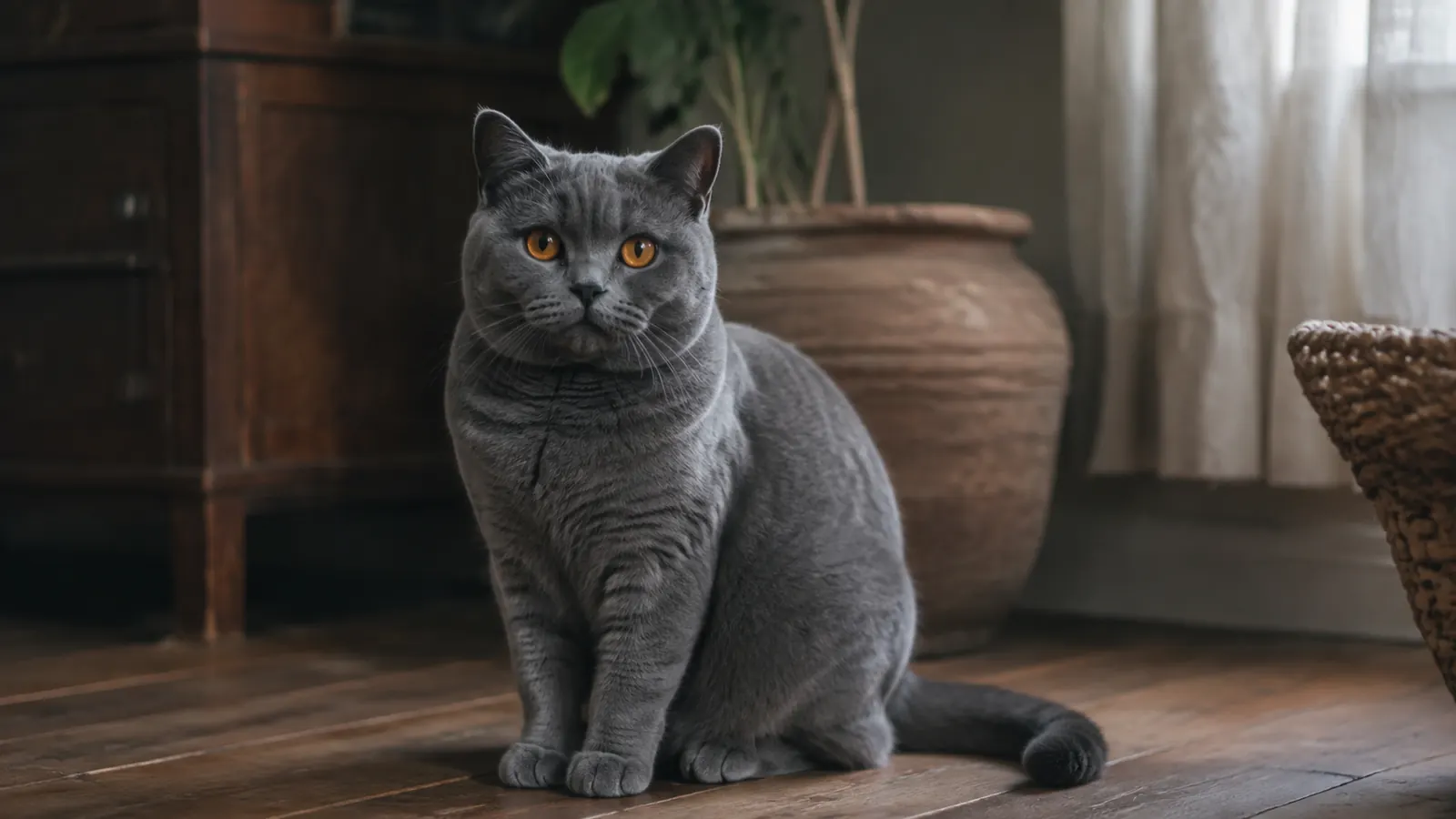
- Origin
- Bred from a semi-feral colony on Belle-Ile by the Leger sisters, from about 1928
- Coat
- Medium-short and woolly, a dense undercoat under a longer topcoat. Ash to slate blue
- Size
- Medium-long and robust, broad shoulders and deep chest. Heavier than it looks
- Typical weight
- Males may weigh up to 14 pounds, with females significantly smaller
- Life expectancy
- No measured figure. Neither registry publishes one and no life table covers the breed
- Activity level
- Moderate. Sociable and companionable rather than demanding, and notably quiet
- Grooming
- Low most of the year, heavy through the spring moult. Comb rather than brush
- Suits
- Quiet homes and shared walls. Ask for PKD1, blood group, coat length and patella results
A registry once decided that the Chartreux and the British Blue were the same cat, and the decision nearly ended one of them.
That is not ancient history. It is why the breed in front of you is hard to tell from a blue British Shorthair, and why a French breeder will want to talk about bloodlines before temperament.
How can you tell a Chartreux from a blue British Shorthair?
Eye colour settles nothing here. CFA asks for Chartreux eyes ranging from gold to copper with a brilliant orange preferred, and the blue British Shorthair standard asks for gold or copper as well.
The test that does work sits in your hands rather than your eyes.
On coat texture, the two standards say directly opposite things. CFA calls the Chartreux coat medium-short and slightly woolly, built as a resilient undercoat beneath a longer protective topcoat.
The British Shorthair standard states that its coat is not double coated or woolly.
That is the same trait written once as a requirement and once as a prohibition, which is as close to a decisive test as breed standards ever get.
So run your fingers against the lie of the coat, across the shoulder and down the flank.
A Chartreux coat is dense enough to break where the cat turns, and it springs back rather than lying flat under your hand.
The Russian Blue is the easier call of the three. That standard asks for vivid green eyes and guard hairs distinctly silver-tipped, so vivid green adult eyes distinguish that standard.
A silver sheen alone does not: the Chartreux standard also permits lightly silver-brushed tips.
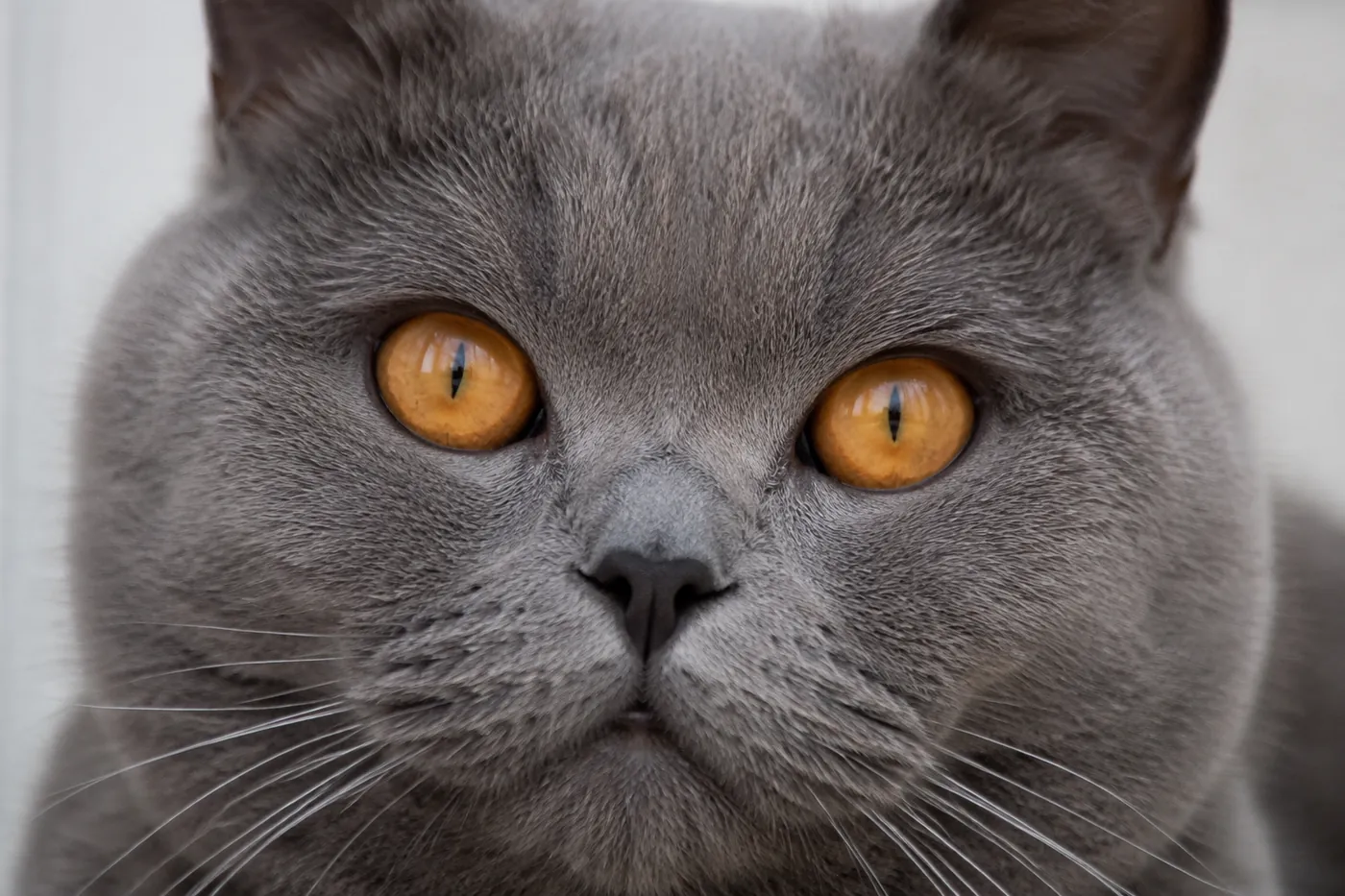
One case defeats the coat test. A Chartreux carrying a copy of the M4 longhair gene has a shaggier, softer coat than the standard describes, and that is a genetic result the breeder should already hold.
- Feel the coat against the lie for two distinct layers
- Judge the texture as woolly and resilient rather than crisp
- Rule the breed out if the eyes are green
- Do not use silver tipping alone to exclude a Chartreux
- Ask to see registration papers before believing any of the above
These checks compare the cat with a standard. Pedigree cannot be settled by looking, and only the paperwork does that.
Why did the Chartreux nearly stop existing as a separate breed?
Breeds usually disappear because of war, disease, or the slow indifference of the people who once kept them, and this one very nearly went a different way. It came closest to disappearing through a committee vote.
Around 1970, FIFe merged the Chartreux and the British Blue under a single breed code with a single standard, on the view that they were one breed.
The breed club's own policy records that FIFe went further and encouraged breeders to cross their cats with Persians to improve them, without consulting the people breeding them.
The instruction landed on ground that was already prepared. Through the 1960s, French breeders had been exchanging cats with British Shorthair breeders in England to widen the gene pool. By the end of the decade some bloodlines were intermixed enough that breeders and judges could no longer tell the two breeds apart.
Jean Simonnet published an essay in 1972 arguing that the Chartreux was a distinct breed with its own bloodlines, history, and standard.
FIFe reversed itself in 1977 and recognised the two as separate breeds again.
- 1928First documented breedings, by the Leger sisters under the de Guerveur cattery name
- 1960sCats exchanged with British Shorthair breeders in England, and bloodlines begin to blur
- Around 1970FIFe merges Chartreux and British Blue into one breed code and one standard
- 1972Simonnet's essay argues the Chartreux is a distinct breed
- 1977FIFe separates the two breeds again, each with its own standard
The reversal came with a cost that is easy to miss. Chartreux lines heavily crossed with British Shorthair or Persian during those years either fell out of favour or were simply absorbed into the British Shorthair.
Today's cats descend mainly from the bloodlines that stayed out of that crossbreeding. So when a breeder wants to discuss where a line came from, they are talking about a reconstruction that took two decades, not about pedigree snobbery.
Did Carthusian monks really breed the Chartreux?
Every Chartreux page tells this story. Carthusian monks bring blue cats to the Grande Chartreuse monastery in the French Alps, and a breed takes its name from the order that kept it. CFA publishes that legend on its own pages, and in the same article says it has no supporting evidence.
What the record does hold starts later, and somewhere less romantic. The first documented breedings run from around 1928, when the Leger sisters began working under the de Guerveur cattery name with cats from Belle-Ile off the Brittany coast.
Those foundation cats were a semi-feral colony living around the church-run hospital in the town of Le Palais.
Locally they were known as the Hospital Cats, which is the closest thing the breed has to a documented origin.
None of this proves the monks kept no cats at all. It does mean that a seller who opens with the monastery is reaching for marketing rather than for the record, and the same is true of the crusader story that sometimes replaces it.
What size does a Chartreux reach, and how long does it take?
CFA describes males that may weigh up to 14 pounds, with females significantly smaller. That is a solid mid-sized cat rather than a large one.
A dense coat over a heavy frame absorbs a kilogram before the outline changes, so weigh this breed against a measured portion rather than judging it by eye.
The number undersells what you will actually pick up. The standard asks for a robust physique, medium-long, with broad shoulders and a deep chest. Boning is strong and the muscle mass is described as solid and dense.
Put that inside a medium outline and you get a cat that is heavier than it looks, which is the thing new owners remark on first.
- Male weight
- Up to 14 pounds at maturity
- Female weight
- Significantly smaller, and noticeably finer in the head
- Build
- Medium-long and robust, with broad shoulders and a deep chest
- Boning
- Strong, with solid dense muscle rather than bulk
- Jowls
- Larger in mature males, and absent in a male still finishing
The jowls matter more than they sound. Young males may not yet have adult jowls, and neuter status also affects cheek development. Missing jowls alone do not establish age or maturity.
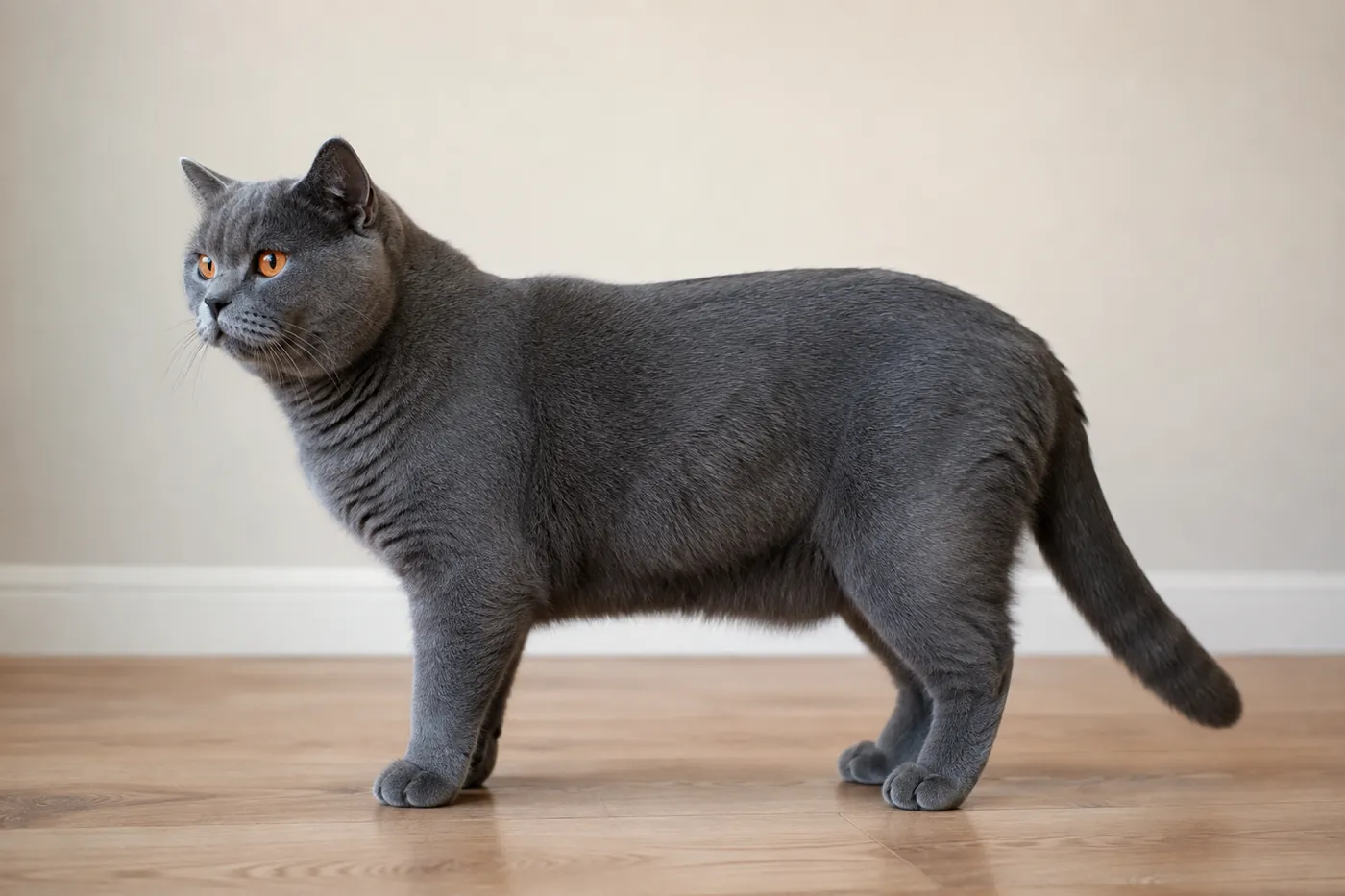
One caution applies to every figure above. A breed standard describes what breeders aim at, not a measured average of the cats that exist.
What is a Chartreux like to live with day to day?
Owners notice an absence first. The cat is in the room, has been for a while, and said nothing about it. CFA describes the breed as even-tempered and adaptable, with a calm cheerful dignity.
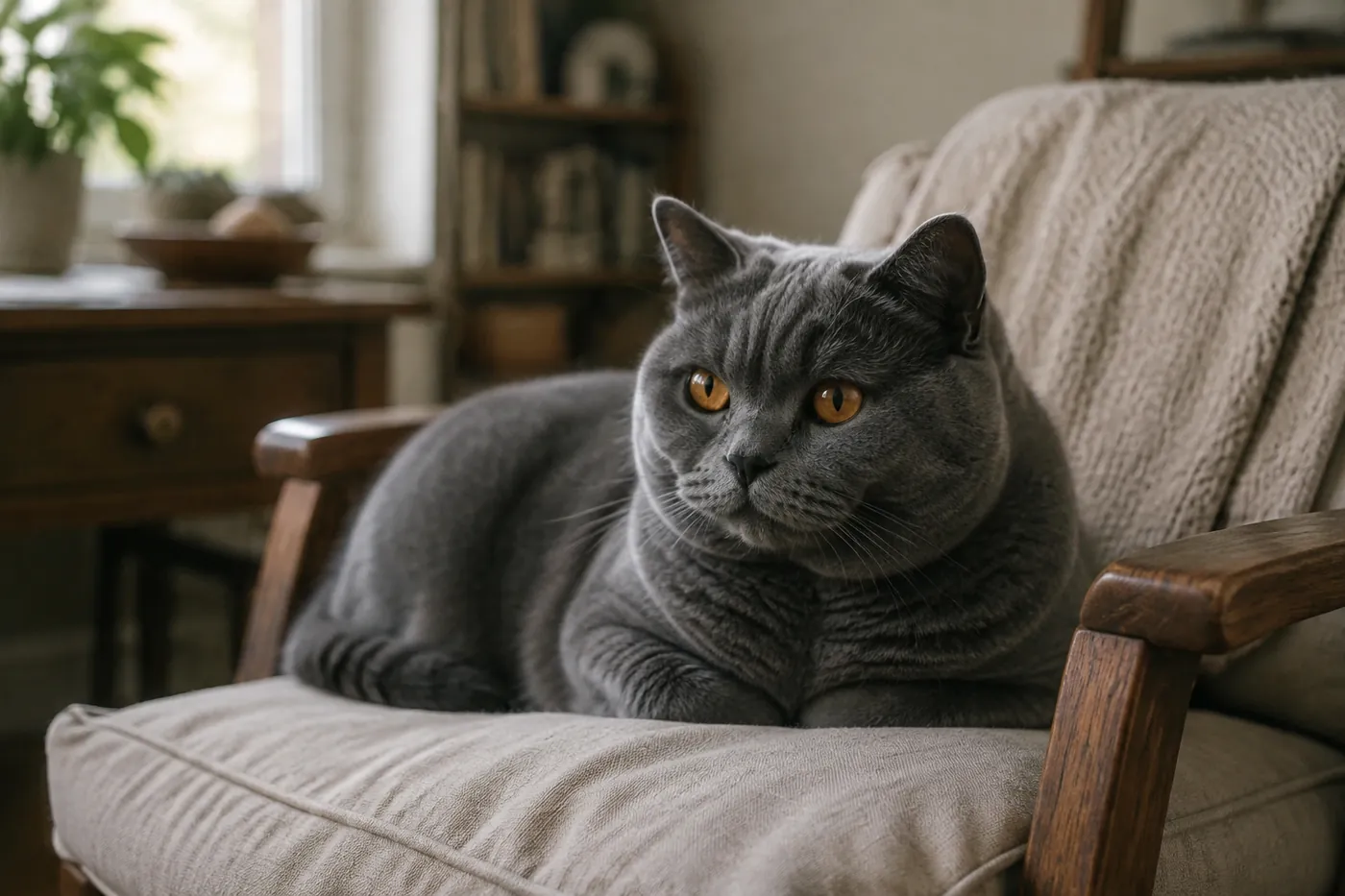
It also reaches for the phrase most breed pages use and few explain, which is dog-like behavior. In practice that phrase resolves into four things a household can actually observe:
- Moves between rooms with you rather than settling somewhere and staying
- Responds to its own name often enough that you keep using it
- Settles in company instead of patrolling for something to do
- Absorbs a changed routine without the sulk that some breeds run
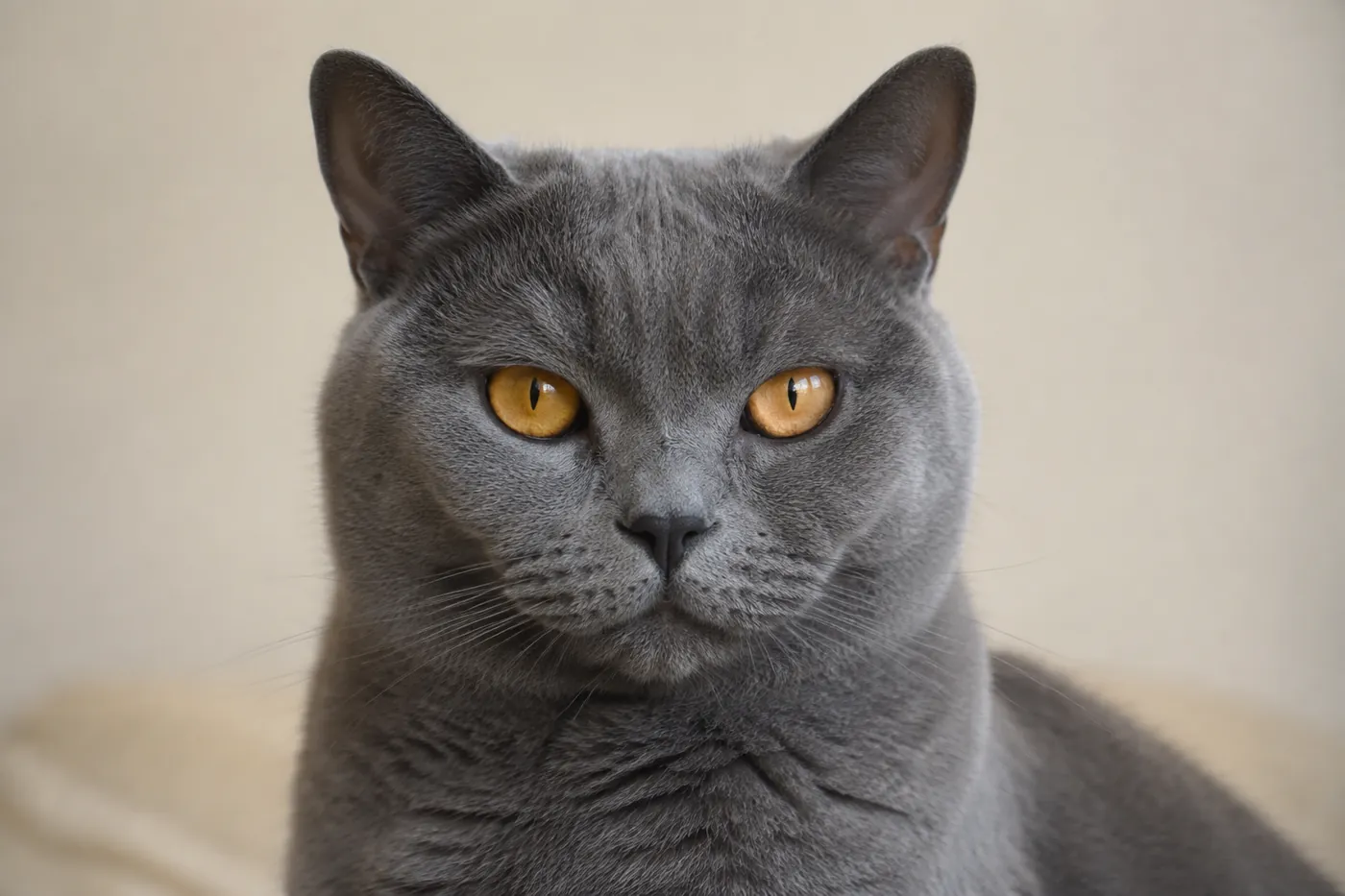
The face carries the same impression. The head is rounded and broad without being a sphere, and the full cheeks either side of a powerful jaw give the breed its settled, faintly amused expression.
Not everyone wants this. If you were hoping for a cat that answers back and negotiates about dinner, a quiet, undemanding companion will read as indifference rather than as dignity.
The reverse is a strong argument for the breed. In a flat with thin walls or a shared floor, a cat that rarely raises its voice is worth a great deal.
CFA describes a Chartreux that is playful on its own terms: toss a toy towards one and you are likely to find yourself in interactive play that continues until its energy flags, and some enjoy walks on a leash or retrieve toys.
Does a Chartreux shed a lot for a double coated cat?
Yes and no at once, which is why a single sentence about shedding in this breed will always mislead somebody who reads only that sentence.
Seasonal shedding may release a large amount of undercoat, so gentle combing increases when loose hair accumulates, and the handling precautions for a long coat apply if a tangle forms. Across most of the year the coat asks for very little.
The reason sits in the structure. The shedding load lives in the resilient undercoat rather than in the topcoat you can see, so it stays invisible until it comes out all at once.
That makes the tool matter more than the frequency. A surface brush slides over the top of a double coat and takes almost nothing with it, while a comb reaches the layer that is actually moving.
- Routine care
- Comb gently and inspect the coat and skin
- Heavy shedding
- Increase checks when loose undercoat collects
- Individual variation
- Indoor light, health and climate can change the shedding pattern
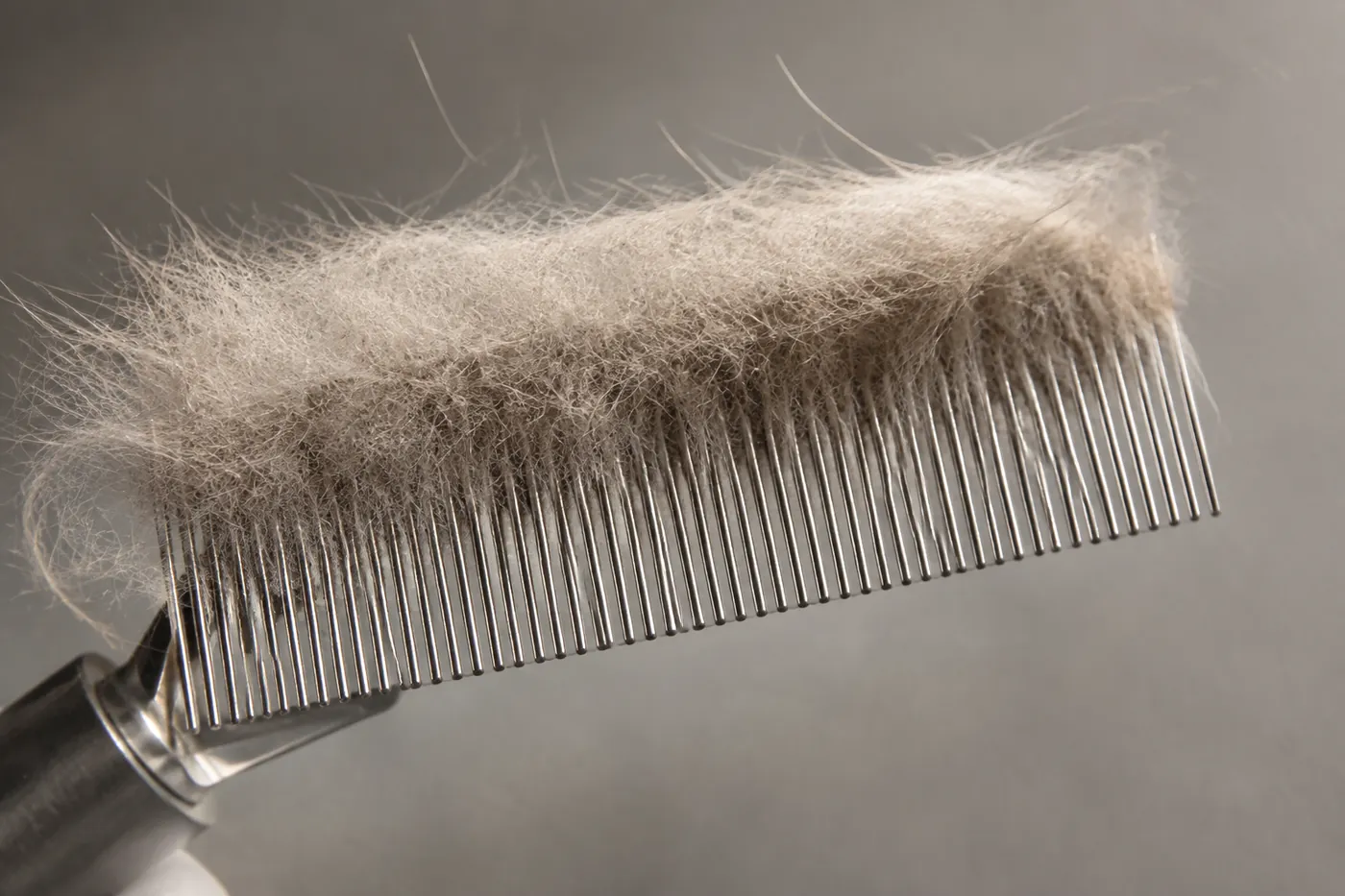
One coat should prompt a question. The breed club describes a normal breaking look in a cat carrying two copies of the shorthair gene, and a shaggier appearance with a softer coat texture in carriers of the M4 longhair gene.
A Chartreux whose coat feels unusually soft may be a longhair carrier rather than a faulty cat, which is a fact the breeder should already know from a test rather than learn from your hands.
Which health tests should a Chartreux breeder already have done?
Most breed pages answer this with a list of diseases. That is the less useful version of the question, because it leaves you nothing to ask for. The breed club publishes a policy that names the tests instead.
Every cat used in its breeding programmes must be tested for PKD1, blood group, and coat length, unless both parents were tested and are known to be clear.
| Test | What it settles | What an incomplete answer looks like |
|---|---|---|
| PKD1 | Polycystic kidney disease, which is dominant, so one copy is enough to matter | Verbal assurance that the line has never had it |
| Blood group | Whether a queen is group B, which drives the mating decision | A result that tested only the common b1 allele |
| Coat length | Whether the cat carries the M4 longhair gene | No result at all, on the grounds that the cat looks shorthaired |
| Patellar luxation | Whether the kneecap slips, graded by a veterinarian | A DNA panel alone, because this needs a clinical examination |
| HCM scan | Heart muscle disease that can appear later in life | A scan done once, at under two years old |
The blood group row is the one that catches people. Two b alleles exist in the breed, the common b1 and an uncommon b2 allele, and the policy warns plainly that not all laboratories test for it.
That detail has consequences in the nest. Breeding a group B queen to a group A male risks neonatal isoerythrolysis, where antibodies in the mother's milk attack her own kittens' red blood cells.
Two of these are not genetic tests at all. Patellar luxation is screened by simple clinical examination at routine vet visits, and the policy is that cats at grade 2 or above should not be bred from.
The heart scan sits in a different category again. Scanning is a recommendation rather than a requirement, with a first scan at age two repeated every two years, so a breeder who has not done one is not breaking the policy.
The same policy calls PKD1 extremely uncommon in this breed and still requires the test, which is roughly the attitude a buyer should copy.
How long do Chartreux cats live?
The cited sources do not establish a breed-specific life expectancy. The UK life tables do not report a separate Chartreux estimate. Neither the CFA breed page nor the breed club's policy publishes a figure.
The UK veterinary life tables that produce reliable numbers work from breed groups large enough to appear in the practice population, and a breed this uncommon outside France does not reach that threshold. An advertised lifespan needs a named population and method before it can be treated as a measured breed estimate.
The missing figure is not bad news about the breed. It is an absence of evidence in either direction, and treating it as a warning would be as unfounded as treating an invented range as a promise.
A litter is better judged on what can actually be shown, and screening results on both parents tell you more about a kitten's prospects than any lifespan figure on any breed page, including this one.
Is a Chartreux the right cat for your household?
Fit matters more than usual with this breed. It suits a household that wants company without commentary, and one that can absorb a few weeks of serious combing each spring. It suits shared walls, home offices, and people who like a cat that follows them around without narrating it.
It also suits anyone who would rather ask a breeder for four documents than be told a story about monks.
The mismatch is just as clear. If you want an animal that talks back, demands negotiation, and fills a room, the calm you are buying will read as an absence rather than a quality.
Whatever wait you end up with is worth using rather than resenting, because it is long enough to read the breed club's policy, decide which documents you intend to ask for, and work out whether the quiet you are buying is the quiet you actually want.
Common Questions
Are Chartreux cats hypoallergenic?
No breed is reliably allergen-free. The cited evidence does not establish a Chartreux-specific allergy guarantee. If somebody has allergy or asthma, discuss exposure with their clinician before arranging contact with the particular cat.
What colours does a Chartreux come in?
One. CFA recognises any shade of blue-gray from ash to slate, with the tips lightly brushed with silver, and nothing else. A blue cat sold as a rare Chartreux colour is either not a Chartreux or not being described honestly.
Why do some Chartreux kittens show faint tabby markings?
Every Chartreux is genetically non-agouti, but all cats carry pattern genes underneath. The GCCF breeding policy notes that Chartreux kittens typically show ghost tabby markings, in spotted, mackerel or classic patterns, and that these are allowed in kittens and should fade in adulthood.
Do Chartreux cats get on with children and other pets?
The registry describes an even-tempered, adaptable cat with a calm cheerful dignity, which is the temperament that usually copes with a busy home. That describes what breeders select for rather than a guarantee about one cat, so meet the individual and its mother before deciding.
Checked Against
- The Cat Fanciers' Association: Chartreux breed profile and standard cfa.org
- The Cat Fanciers' Association: Chartreux breed history article cfa.org
- The Cat Fanciers' Association: British Shorthair breed standard cfa.org
- The Cat Fanciers' Association: Russian Blue breed standard cfa.org
- GCCF and Chartreux Cat Club UK: Breeding Policy for the Chartreux, April 2023 gccfcats.org
- Governing Council of the Cat Fancy: Chartreux breed information gccfcats.org
Published 4 September 2026. Last updated .





