
What Is a Snowshoe Cat, and Why Are the White Paws So Hard to Breed?
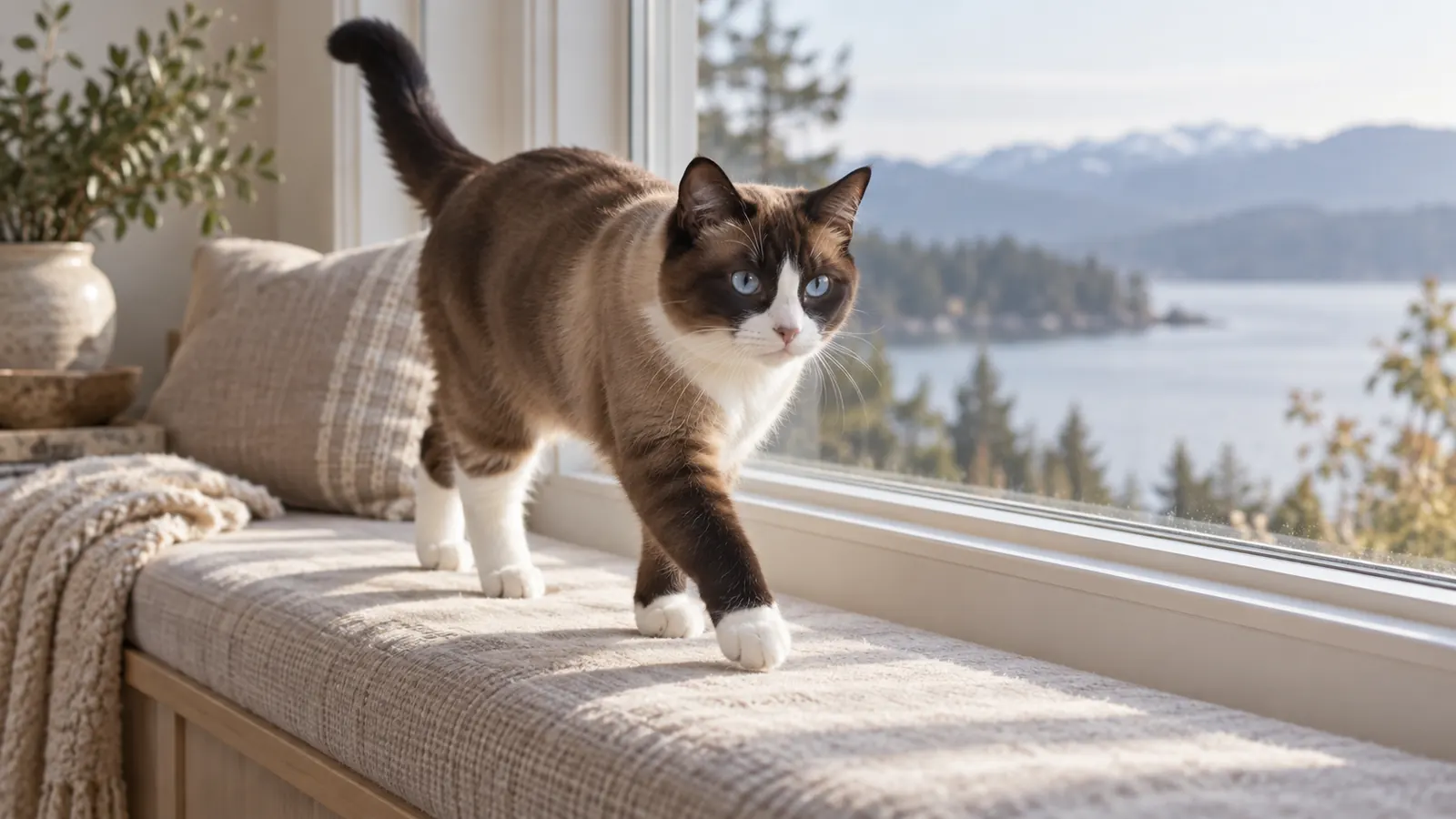
A Snowshoe is a pointed cat with white mittens on the paws, developed from Siamese cats crossed with bicolour shorthairs. FIFe and GCCF both recognise the breed. The breed's defining white paw pattern is produced by the white-spotting gene interacting with the colorpoint gene, and the combination is difficult to breed consistently, which is one reason the Snowshoe remains less common than its Siamese parent.
- Origin
- United States, developed from the early 1960s by Dorothy Hinds Daugherty of Philadelphia from Siamese kittens with white feet
- Coat
- Short, smooth, close-lying in pointed colours with white mittens on the front paws and white boots on the rear
- Size
- Medium, muscular and moderately built, heavier-boned than the Siamese
- Typical weight
- Secondary sources commonly cite 7 to 12 pounds
- Life expectancy
- Secondary sources cite 14 to 20 years; no breed-specific population study has been published
- Activity level
- Moderate to high; social, playful and people-oriented but less intense than a modern Siamese
- Grooming
- Low; the short smooth coat needs minimal care
- Suits
- Social households that provide company and interactive play, with more tolerance for a moderate temperament than the Siamese extreme
A Snowshoe is a pointed cat with white paws, combining Siamese colour restriction with white markings from bicolour shorthairs, which GCCF describes as domestic tuxedo-marked cats and other accounts identify as American Shorthairs.
The white paw pattern is the breed's signature. It is also the reason consistent Snowshoes are difficult to produce, because the white-spotting gene does not distribute white in a predictable amount.
Why Are the White Paws So Hard to Breed Consistently?
The Snowshoe pattern requires two genes: the colorpoint gene (cs) for the pointed colour, and the white-spotting gene (S) for the white mittens.
The cs gene is recessive and predictable: two copies produce the pointed pattern reliably.
The white-spotting gene, a dominant variant of KIT usually written S, behaves differently. It is semi-dominant, and the amount of white it produces varies from kitten to kitten in a way breeders cannot steer. On a Siamese-type body the same gene produces the Seychellois, whose white ranges from patches on the legs and chest to colour left mainly on the tail and small head patches, and whose litters commonly include kittens with more or less white than either parent.
A Snowshoe standard calls for white mittens on the front paws and white boots extending partway up the rear legs, plus a white inverted V on the face. A litter from two correctly marked Snowshoes can produce kittens with too much white, too little, or none at all.
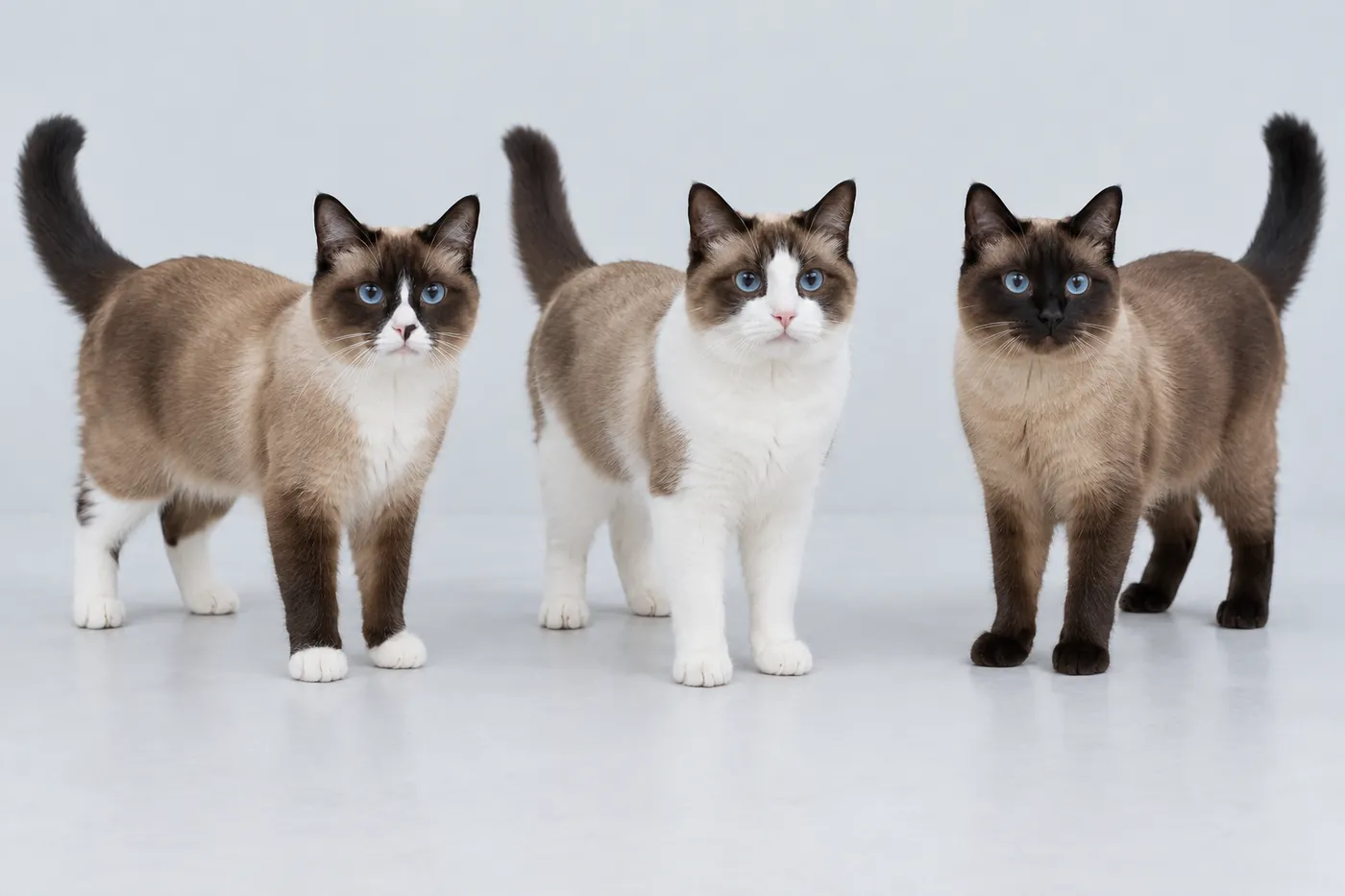
For a buyer, the practical result is that show-quality Snowshoes with the full correct pattern are uncommon, while kittens with too much or too little white turn up regularly and are sold as pets. The markings affect appearance and nothing else.
How Does the Snowshoe Differ From the Birman and Ragdoll?
All three carry pointed colour with white paws, but the genetics and breed histories are different.
The Birman gets its white gloves from two recessive variants in the same KIT gene, which every Birman carries in two copies, and genetic work has ruled out the dominant white-spotting allele as the cause of its pattern. That is why Birman gloves are consistent across the breed while Snowshoe white varies. The Birman body is stocky and its coat semi-long.
The Ragdoll is a much larger, heavier cat with a semi-long coat and a famously docile temperament. Its mitted pattern comes from white spotting too, and genetic work points to a different KIT variant from the Birman's.
The Snowshoe is medium-bodied, short-coated, moderately muscular and vocally social. It is closer to its Siamese parent in temperament than either the Birman or the Ragdoll.
- FIFe
- Recognised
- GCCF
- Recognised
- Origin
- Philadelphia, United States, early 1960s
- Parent breeds
- Siamese and bicolour shorthairs, often described as American Shorthairs
- Defining pattern
- Pointed colour with white mittens, boots and facial inverted V
- Pattern genetics
- Colorpoint (cs) plus white-spotting (S); difficult to breed consistently
- Body type
- Medium, moderately muscular, heavier-boned than Siamese
- Distinction from Birman
- Dominant white spotting rather than the Birman's recessive gloving variants; shorter coat, lighter build
- Distinction from Ragdoll
- Smaller, short-coated, more vocally active
What Temperament Comes From the Siamese and Shorthair Lines?
The Snowshoe's temperament sits between its two parents. The Siamese contribution brings sociability, vocalisation and a desire for human company. The shorthair side moderates the intensity, and GCCF describes a talker with a soft, melodic voice.
The result is a cat that is social, playful and people-oriented without reaching the relentless vocal persistence of a full Siamese. The cat usually described is one that wants to be in the same room, joins in and communicates, but with a softer voice and more measured energy.
A Snowshoe left alone all day may call for attention when people come home, and although it is usually described as coping with absence better than a Siamese, it still wants company for part of each day.
Reward-based training suits it, because the Siamese curiosity and food motivation tend to carry through.
What Health Profile Does the Breed Carry?
No population health study of the Snowshoe has been published, so its health picture comes from its parent lines.
From the Siamese side, liver amyloidosis has been recorded in Siamese and Oriental cats, the rdAc form of retinal degeneration is common in Siamese and can be DNA tested, and a Siamese tendency to asthma has been suggested but not proven. Where American Shorthair lines were used, that side carries fewer named conditions, although a variant in the ALMS1 gene linked to hypertrophic cardiomyopathy has been recorded in the breed.
Secondary sources cite a lifespan of 14 to 20 years, but no study of the breed supports that figure, and the American Shorthair's long-life reputation rests on similarly unstudied estimates.
What Does the Coat Need, and How Active Is the Breed?
The short, smooth coat needs very little grooming. A weekly pass with a grooming glove removes loose hair, and shedding is light to moderate because there is no heavy undercoat to produce seasonal surges.
The activity level is moderate to high. A Snowshoe wants interactive play and social contact without the relentless climbing intensity of a Bengal or the nonstop vocal pursuit of a full Siamese. Puzzle feeders, wand toys and fetch games suit the breed's intelligence.
How Does a Snowshoe Fit a Family or Multi-Pet Home?
The moderate temperament makes the Snowshoe more broadly accessible than the full Siamese, and children who handle a cat gently usually do well with the breed's sociable disposition.
Multi-cat households work when introductions are managed, and the Snowshoe's social nature means it generally prefers company to solitude.
Who Suits a Snowshoe?
The Snowshoe suits a household that wants a social, moderately active cat with Siamese-family intelligence but a quieter voice. It fits families and multi-cat homes well, and a working household can manage one if the cat has company for part of the day, from a second cat or a person at home for some hours.
- Registration with a recognised body such as FIFe or GCCF, naming both parents
- Whether the kitten carries the standard white mittens, boots and facial V
- The parents' pattern consistency in previous litters
- Parents' rdAc DNA results, and any family history of liver amyloidosis
- The individual cat's temperament observed during calm contact
Common Questions
Why are Snowshoe cats rare?
The white-spotting gene produces unpredictable amounts of white. Breeding consistently for the correct mitten-and-boot pattern is difficult, so show-quality Snowshoes are uncommon even in large litters.
Is a Snowshoe the same as a Birman?
No. Both have pointed colour with white paws, but the white comes from different variants of the KIT gene: recessive gloving variants that every Birman carries, and dominant white spotting in the Snowshoe. The Birman is also stockier with a semi-long coat, while the Snowshoe is medium-bodied and short-coated.
Are Snowshoe cats vocal?
Moderately. The Siamese heritage produces a social, communicative cat, but the shorthair side softens the intensity, and GCCF describes a soft, melodic voice. Most Snowshoes are described as vocal but less extreme than a pure Siamese.
How big does a Snowshoe get?
Medium-sized and moderately muscular. Secondary sources cite 7 to 12 pounds, heavier-boned than the Siamese.
Is the Snowshoe a recognised breed?
Yes. FIFe and GCCF both recognise it, although the ideal show pattern varies between breed associations.
Checked Against
- GCCF: Snowshoe gccfcats.org
- FIFe: Recognised breeds fifeweb.org
- Montague et al.: Domestic cat genome and the Birman KIT gloving variants (PNAS, 2014) pmc.ncbi.nlm.nih.gov
- OMIA: Hypertrophic cardiomyopathy variants in cats omia.org
- van der Linde-Sipman et al.: AA amyloidosis in Siamese and Oriental cats (1997) pubmed.ncbi.nlm.nih.gov
- Menotti-Raymond et al.: rdAc retinal degeneration across cat breeds (Veterinary Journal, 2010) pubmed.ncbi.nlm.nih.gov
- Cornell Feline Health Center: Feline asthma vet.cornell.edu
Published 17 September 2026. Last updated .





