
What Is a Seychellois, and What Makes Its Pattern Different From Other Pointed Cats?
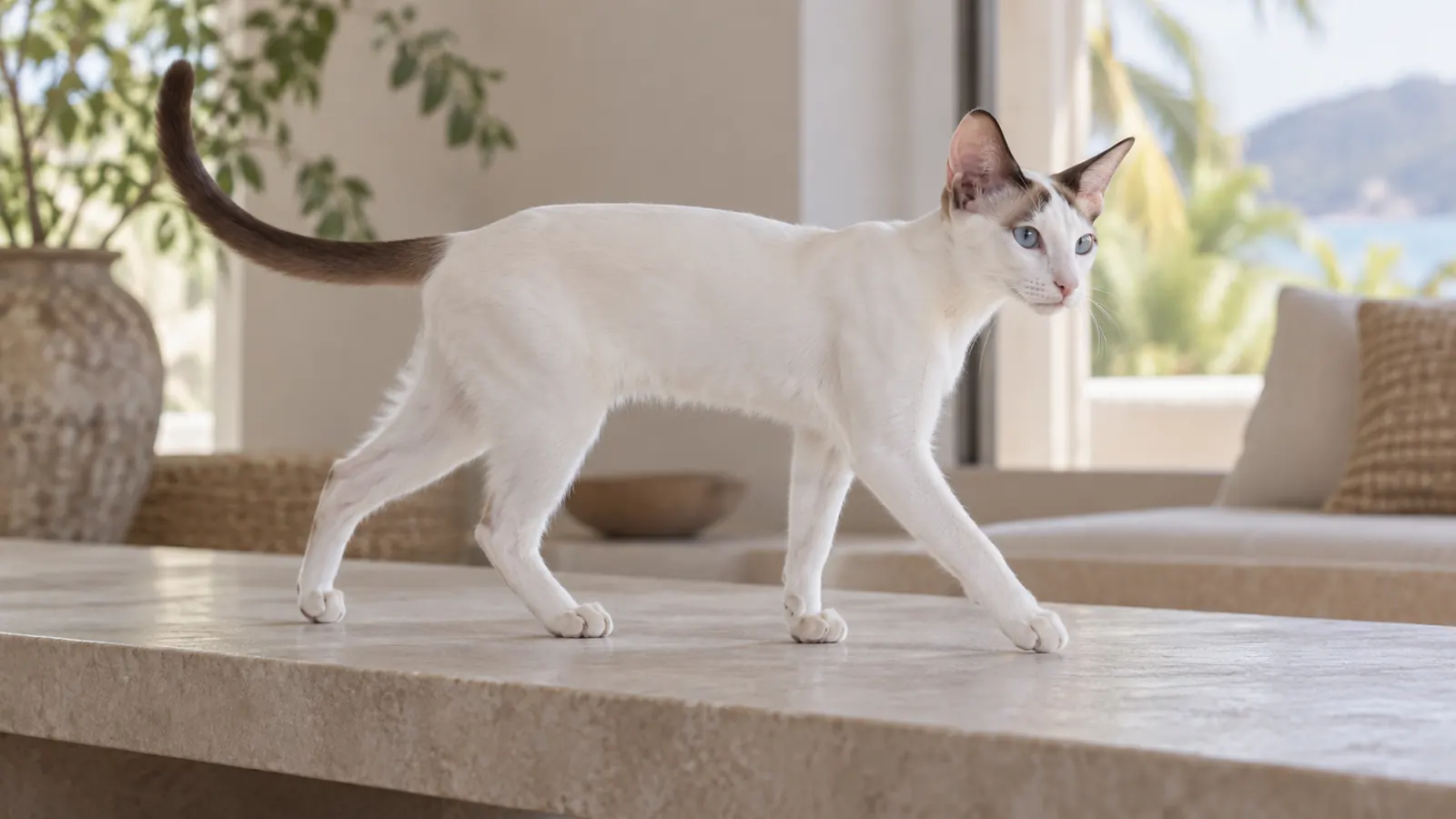
A Seychellois is a Siamese-type cat that combines the pointed colour pattern with large areas of white, producing a bicolour or van-patterned appearance that no other Siamese-family breed name is reserved for. FIFe's current breed list does not include it, although FIFe previously published a standard for short and long coat varieties. The breed shares the Siamese temperament in full, so the ownership decision is the same vocal, social commitment with a different coat pattern.
- Origin
- United Kingdom, developed from Siamese and Oriental lines carrying the white-spotting gene
- Coat
- Short or semi-long, in pointed colours combined with large white patches (harlequin or van pattern)
- Size
- Medium, long and fine-boned, following the Siamese body type
- Typical weight
- Consistent with Siamese-family breeds; secondary sources cite 6 to 11 pounds
- Life expectancy
- Consistent with Siamese-family breeds; secondary sources cite 12 to 15 years
- Activity level
- High; vocal, social and persistent about human attention
- Grooming
- Low for the shorthair variety, moderate for the longhair
- Suits
- Households that want a Siamese-type temperament and are prepared for the vocal social intensity that comes with it
A Seychellois is a Siamese-type cat whose coat combines pointed colours with large white patches.
Its nearest relatives each lack part of that combination. The Siamese has points and no white. The Balinese has points, long hair and no white.
The Oriental Shorthair has full-body colour and no points. The Seychellois has points plus substantial white patterning, and it is the only breed name reserved for that combination.
What Creates the Seychellois Pattern?
The pattern requires two genes working together.
The colourpoint gene (cs) restricts full pigment to the cooler extremities, producing the familiar pointed pattern. The white-spotting gene (S) overlays large white areas on the body, producing the harlequin or van distribution.
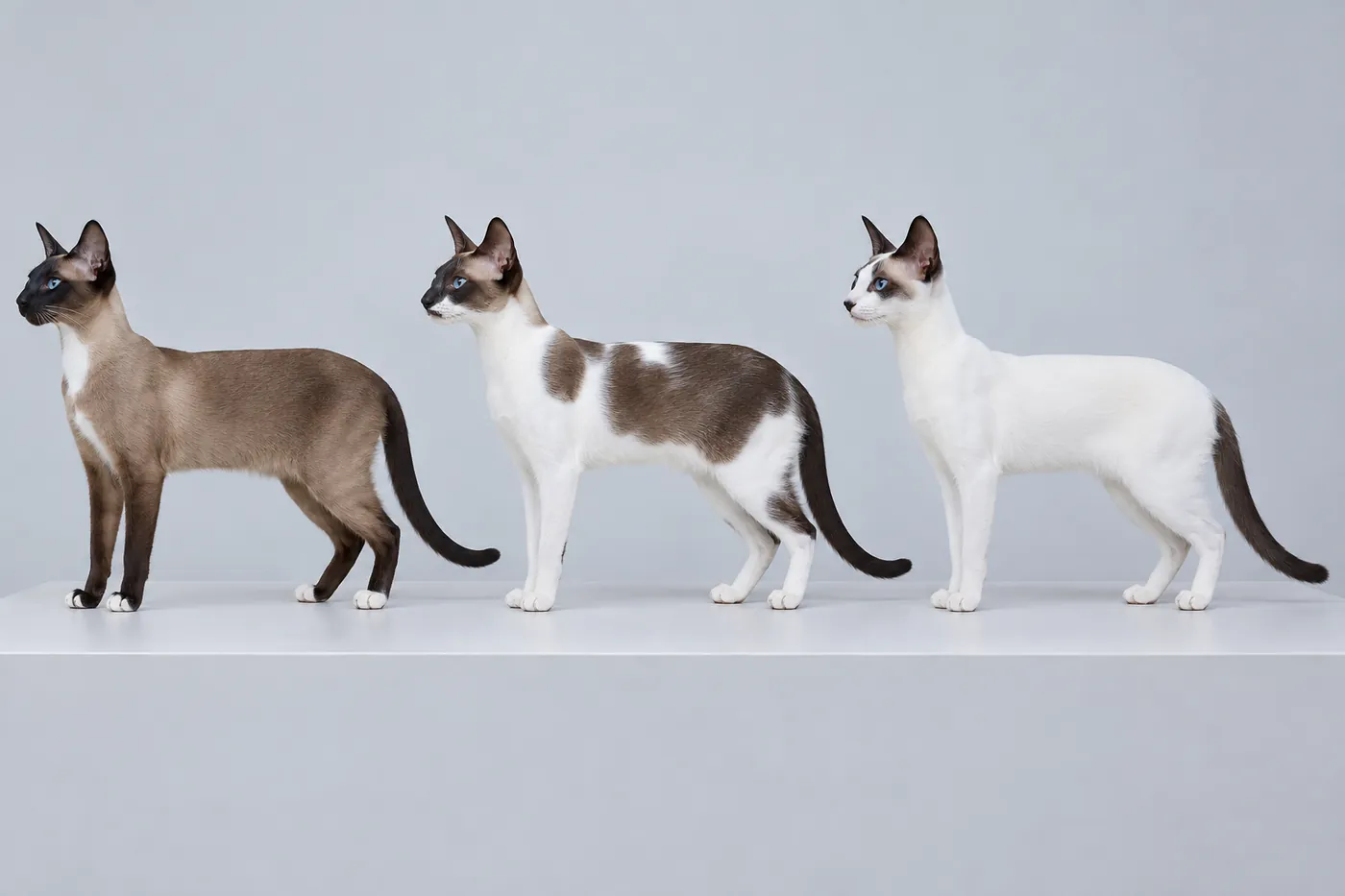
The amount of white varies. Three pattern grades are traditionally described:
| Grade | White coverage | Named pattern |
|---|---|---|
| Septieme | Least white; small white patches on the legs and chest | Bicolour-pointed |
| Huitieme | Moderate white; larger patches covering a third or more of the body | Harlequin-pointed |
| Neuvieme | Most white; colour restricted mainly to the tail and small head patches | Van-pointed |
Breeding for a specific grade of white is difficult because the white-spotting gene's expression is variable. Litters commonly produce kittens with more or less white than either parent, which is one reason the breed remains rare.
Which Registries Recognise the Seychellois?
FIFe's current breed list does not include the Seychellois under either coat length, although FIFe previously published a Seychellois standard covering both.
WCF's Siamese and Oriental list does not include the Seychellois either, and neither does CFA's breed list. A cat of this type may therefore carry papers under another breed name, and the papers matter more than the label a seller uses.
- FIFe
- Not in the current breed list (a standard was published previously)
- CFA
- Not in the breed list
- WCF
- Not listed
- Coat varieties
- Short and semi-long
- Pattern
- Pointed colours combined with white (harlequin or van)
- Body type
- Siamese: long, fine-boned, tubular
- Key distinction
- Siamese points combined with substantial white
Does the Siamese Temperament Come Through?
The Seychellois's ancestry is Siamese and Oriental, and the white-spotting gene changes the coat without touching behaviour, so the vocal, social Siamese temperament comes with it.
These cats follow people, vocalise persistently when they want attention and do not tolerate isolation well.
A household that finds the Siamese temperament appealing and wants a visually different pattern may find the Seychellois rewarding. A household looking for a quiet bicolour cat should look elsewhere.
Most are food-motivated and interactive, which makes reward-based training for carrier entry, recall and cooperative handling practical.
What Health Profile Does the Breed Share?
Because the Seychellois draws from Siamese and Oriental lines, the inherited conditions documented in those breeds are the ones to ask a breeder about.
Progressive retinal atrophy caused by the rdAc mutation is recessive and leads gradually to blindness, with visual impairment typically by five or six years of age. A 2010 survey found the mutation at an allele frequency of about one in three in North American Siamese and in Oriental Shorthair samples, and a DNA test identifies carriers as well as affected cats.
AA amyloidosis, in which an abnormal protein builds up in the liver, spleen and other organs, was diagnosed in 12 of 194 Siamese and Oriental cats examined after death over seven years, and pedigree analysis of the affected cats suggested it runs in families. No health study has looked at the Seychellois itself, so these figures describe its parent breeds rather than the Seychellois.
Blue eyes and white patches raise the deafness question. Congenital deafness in cats is tied mainly to dominant white, a different variant from the white spotting a Seychellois carries, and the blue eyes that come with the colourpoint allele are not associated with deafness. A kitten that does not respond normally to sound can still have its hearing checked with a BAER test.
Secondary sources cite a lifespan of 12 to 15 years, consistent with Siamese-family data.
The breed is medium-sized, long and fine-boned. Secondary sources cite 6 to 11 pounds.
What Does the Coat Need, and How Active Is the Breed?
The shorthair variety needs minimal grooming: a weekly pass removes loose hair. The longhair variety needs regular combing, similar to any fine semi-long coat, with more attention behind the ears and under the legs.
Shedding is light for the shorthair and moderate for the longhair. Neither carries a heavy undercoat.
The activity level is high, consistent with the Siamese family. A Seychellois wants climbing access, interactive play and environmental variety.
When a Seychellois is understimulated, it turns that energy into vocal protest or destructive exploring.
How Does a Seychellois Fit a Family or Multi-Pet Home?
The same Siamese-family social drive that makes the breed engaging also makes it demanding. Children old enough to interact calmly tend to match the breed well.
Another social cat can provide company during the day. A solitary or reserved companion may not tolerate the Seychellois' persistent approach.
The breed's fine-boned build means rough handling by very young children carries more injury risk than with a sturdier breed.
How Rare Is the Seychellois, and Can You Find One?
It is very rare. The combination of limited registry recognition, difficulty breeding to a specific white-pattern grade and the small number of active breeders makes this one of the harder Siamese-family breeds to acquire.
Breeders are few, and because the current registries do not use the Seychellois name, a kitten of this type may be registered under another breed name. Depending on where you live, a kitten may have to travel internationally.
- Registration papers naming both parents and the registry and breed name they were issued under
- The breeder explains the three white-pattern grades and what to expect
- A BAER hearing result for any kitten that does not respond normally to sound
- rdAc (PRA) DNA test results for both parents
- The Siamese-level vocal intensity is described honestly before purchase
- The individual cat's temperament observed during calm contact
A breeder who presents the breed primarily as a rare colour novelty is underselling the temperament commitment.
Common Questions
Is a Seychellois a Siamese?
It shares the Siamese body, temperament and pointed colour gene, but it also carries the white-spotting gene that produces large white areas on the body. The Seychellois is the only breed name reserved for that combination.
Are Seychellois cats recognised?
Not by that name in the registries checked. FIFe once published a standard but its current breed list omits the breed, WCF's Siamese and Oriental list does not include it, and neither does CFA's breed list.
Are Seychellois cats vocal?
Yes. The Siamese temperament comes through in full. Expect persistent vocalisation, social demand and low isolation tolerance.
Can Seychellois cats be deaf?
Congenital deafness in cats is linked mainly to dominant white, a different variant from the white spotting a Seychellois carries, and blue eyes from the colourpoint allele are not associated with deafness. A BAER test can check the hearing of any kitten that does not respond normally to sound.
How rare is the Seychellois?
Very rare. Limited registry recognition and breeding difficulty make it one of the harder Siamese-family breeds to find.
Checked Against
- FIFe: Current breed list (Seychellois not listed) fifeweb.org
- WCF: Siamese and Oriental breed standards (Seychellois not listed) wcf.de
- Louisiana State University School of Veterinary Medicine: cat breeds with congenital deafness lsu.edu
- Menotti-Raymond et al.: Widespread retinal degenerative disease mutation (rdAc) discovered among a large number of popular cat breeds (Veterinary Journal, 2010) pmc.ncbi.nlm.nih.gov
- van der Linde-Sipman et al.: Generalized AA-amyloidosis in Siamese and Oriental cats (Veterinary Immunology and Immunopathology, 1997) pubmed.ncbi.nlm.nih.gov
- CFA: breed list, page 3 (ends at Selkirk Rex) cfa.org
- CFA: breed list, page 4 (begins at Siamese) cfa.org
Published 17 September 2026. Last updated .





