
What Is a Mekong Bobtail, and How Does It Differ From Other Bobtail Breeds?
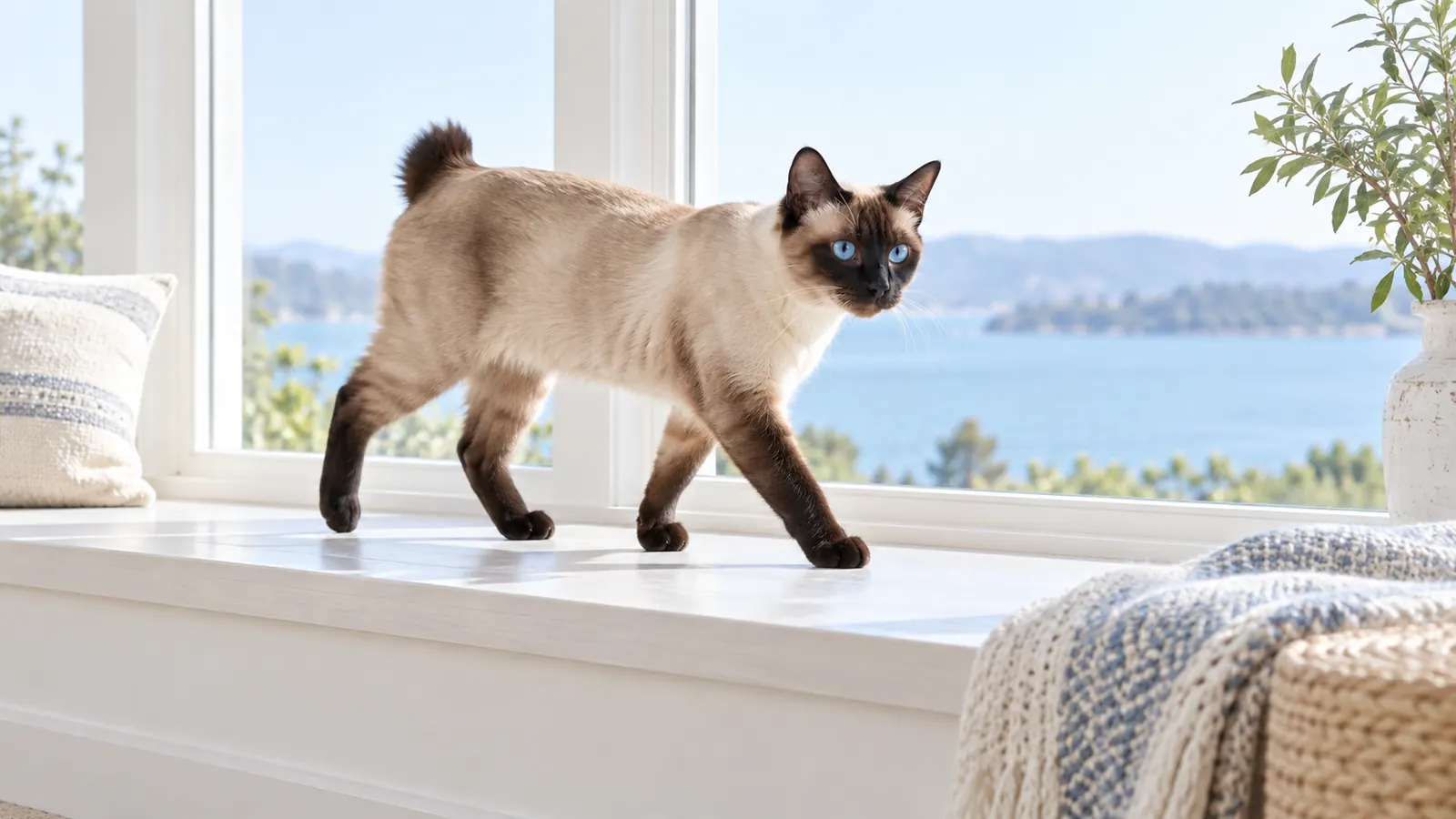
A Mekong Bobtail is a medium-sized, colorpoint cat with a short kinked tail, originating from naturally occurring bobtailed cats in Southeast Asia. WCF publishes a standard for the breed. Its pointed coat, blue eyes and Siamese-type body set it apart from the Kurilian Bobtail, the Japanese Bobtail and the Manx, while its short tail appears to come from the same HES7 variant found in the other Asian bobtails.
- Origin
- Southeast Asia, from naturally occurring bobtailed cats along the Mekong River region; formally developed by Russian breeders
- Coat
- Short, close-lying, glossy colorpoint coat with darker colour on the face, ears, legs and tail
- Size
- Medium, elegant and muscular with a rectangular body and slightly longer hind legs
- Typical weight
- Secondary sources commonly cite 8 to 10 pounds
- Life expectancy
- Secondary sources cite 15 to 18 years; no published population study was found
- Activity level
- Active, social and reported to display dog-like follow-and-retrieve behaviours
- Grooming
- Low; the short close coat needs minimal care
- Suits
- Households that provide company, interactive play and room for an active social cat
A Mekong Bobtail is a colorpoint cat with a short, kinked tail that originated in Southeast Asia.
The breed is recognised by WCF and combines two defining features: the Siamese-type colour restriction that produces dark points on the face, ears, legs and tail, and a naturally occurring bobtail structure. The pointed coat is what separates it from the Kurilian Bobtail, the Japanese Bobtail and the Manx; the tail on its own does not.
The Kurilian Bobtail comes from a different region, has a heavier body and is accepted in all colours, and the Japanese Bobtail also comes in a wide range of colours. At the level of the tail the three are closer than their histories suggest: a survey of more than 11,000 cats found that the HES7 variant behind the Japanese Bobtail tail was also common in Kurilian and Mekong Bobtails.
The Manx tail comes from a different gene altogether, one with documented spinal consequences, and that is the genetic distinction that matters most for a cat's welfare.
Where Did the Mekong Bobtail Originate?
Short, kinked tails are common among free-living cats in parts of Asia. In a 2016 genetic study, about two-thirds of the short-tailed feral cats sampled in southern China carried a variant in the HES7 gene, the same variant found in Japanese Bobtails.
Russian breeders acquired cats from Southeast Asia and began formalising the breed in the late twentieth century. WCF lists it under the name Mekong Bobtail, and older sources also call it the Thai Bobtail.
WCF publishes a standard for the breed, and FIFe's complete breed list does not include it, so a pedigree for one comes from a WCF-affiliated club.
- Registry status
- WCF standard published
- FIFe
- Not listed
- Origin
- Southeast Asia, naturally occurring; formally developed by Russian breeders
- Coat pattern
- Colorpoint (Siamese-type colour restriction)
- Tail
- Short and kinked
- Eye colour
- Blue, as in other colorpoint breeds
- Key distinction
- Colorpoint pattern and blue eyes on a Siamese-type bobtailed cat
The earlier name, Thai Bobtail, still appears in older sources and is easily confused with the Thai, a separate breed that keeps the traditional Siamese body type.
What Makes the Mekong Bobtail Visually Distinct?
The body is medium-sized, elegant and muscular with a rectangular outline and hind legs slightly longer than the front.
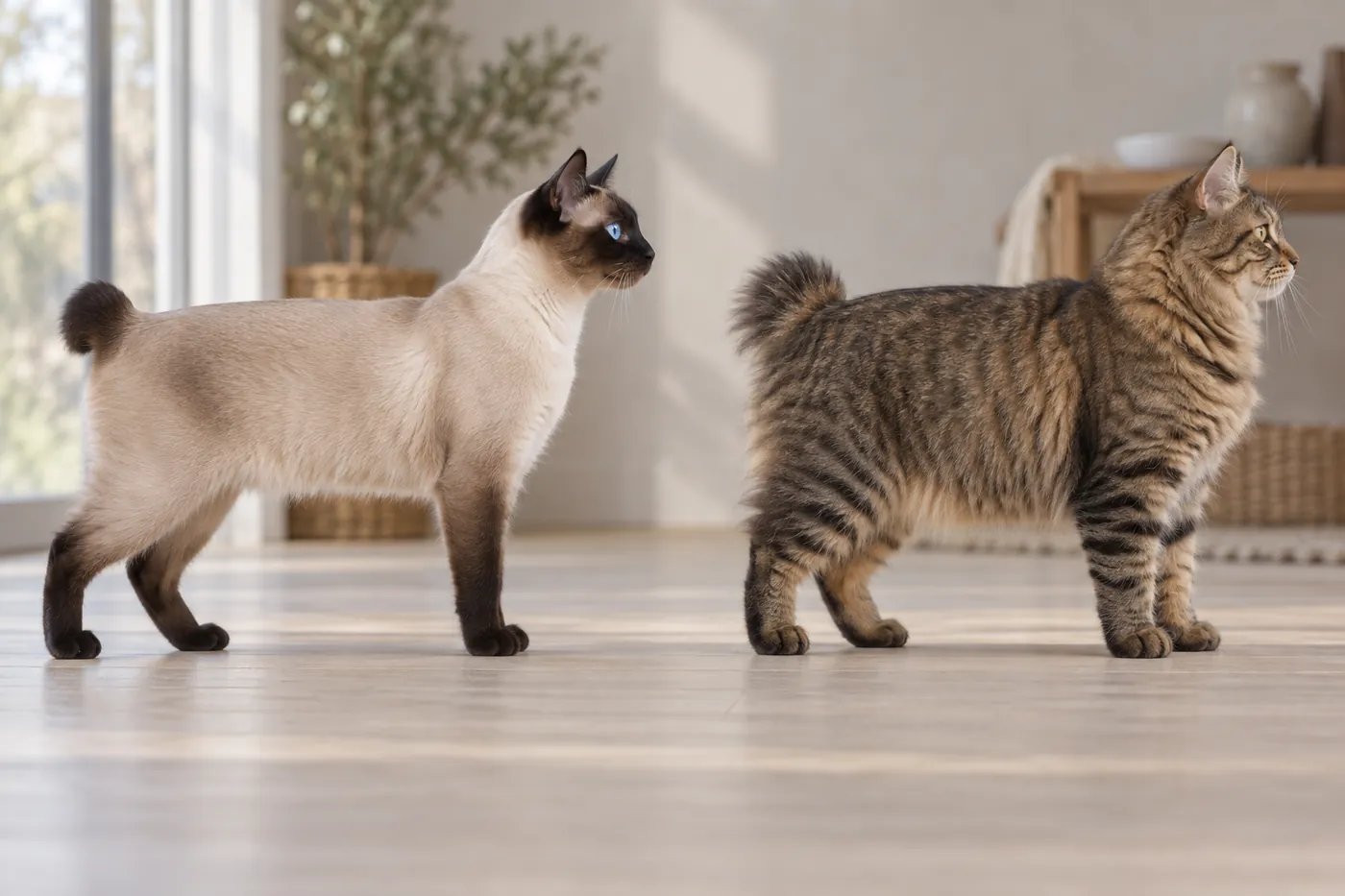
The colorpoint pattern is the most immediately visible feature after the tail. The body is lighter, and the face, ears, legs and tail carry darker pigment, following the same temperature-sensitive colour expression as the Siamese.
The tail is short and kinked. Each cat's tail has a unique combination of kinks and angles, and no two are identical.
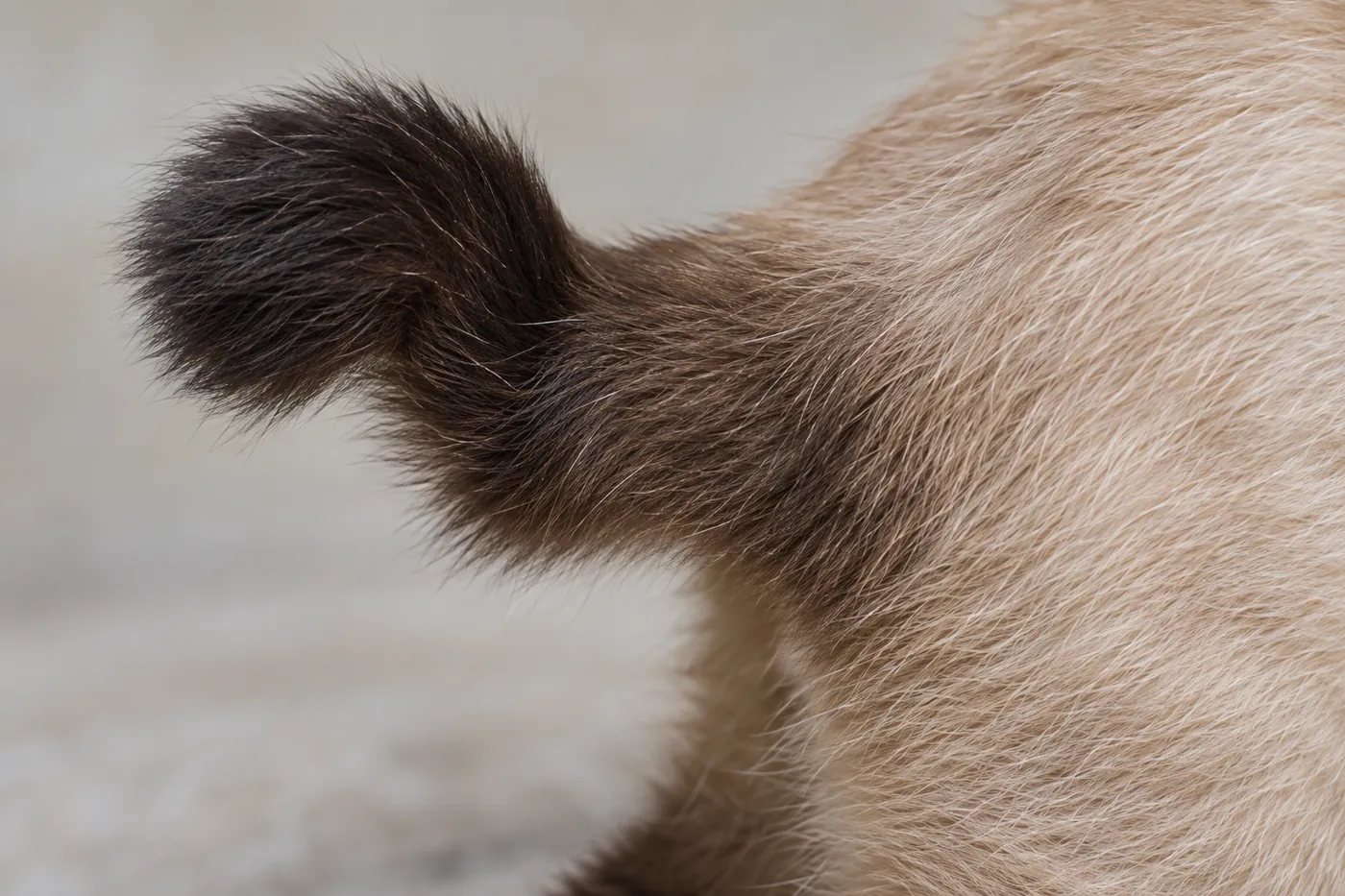
The breed expects a visible, flexible tail, so a cat with no tail at all does not fit the type.
Blue eyes go with the colorpoint pattern, as they do in the Siamese.
| Feature | Mekong Bobtail | Kurilian Bobtail |
|---|---|---|
| Origin | Southeast Asia | Kuril Islands (Russia/Japan) |
| Coat pattern | Colorpoint (Siamese-type) | All colours and patterns |
| Eye colour | Blue | Any colour |
| Body type | Medium, elegant, rectangular | Medium-large, muscular, semi-cobby |
| Tail | Short, kinked | Short, pom-pom |
| Registry | WCF | FIFe and WCF |
The head is a modified wedge with a gently rounded top, medium ears set high and slightly rounded at the tips, and oval blue eyes.
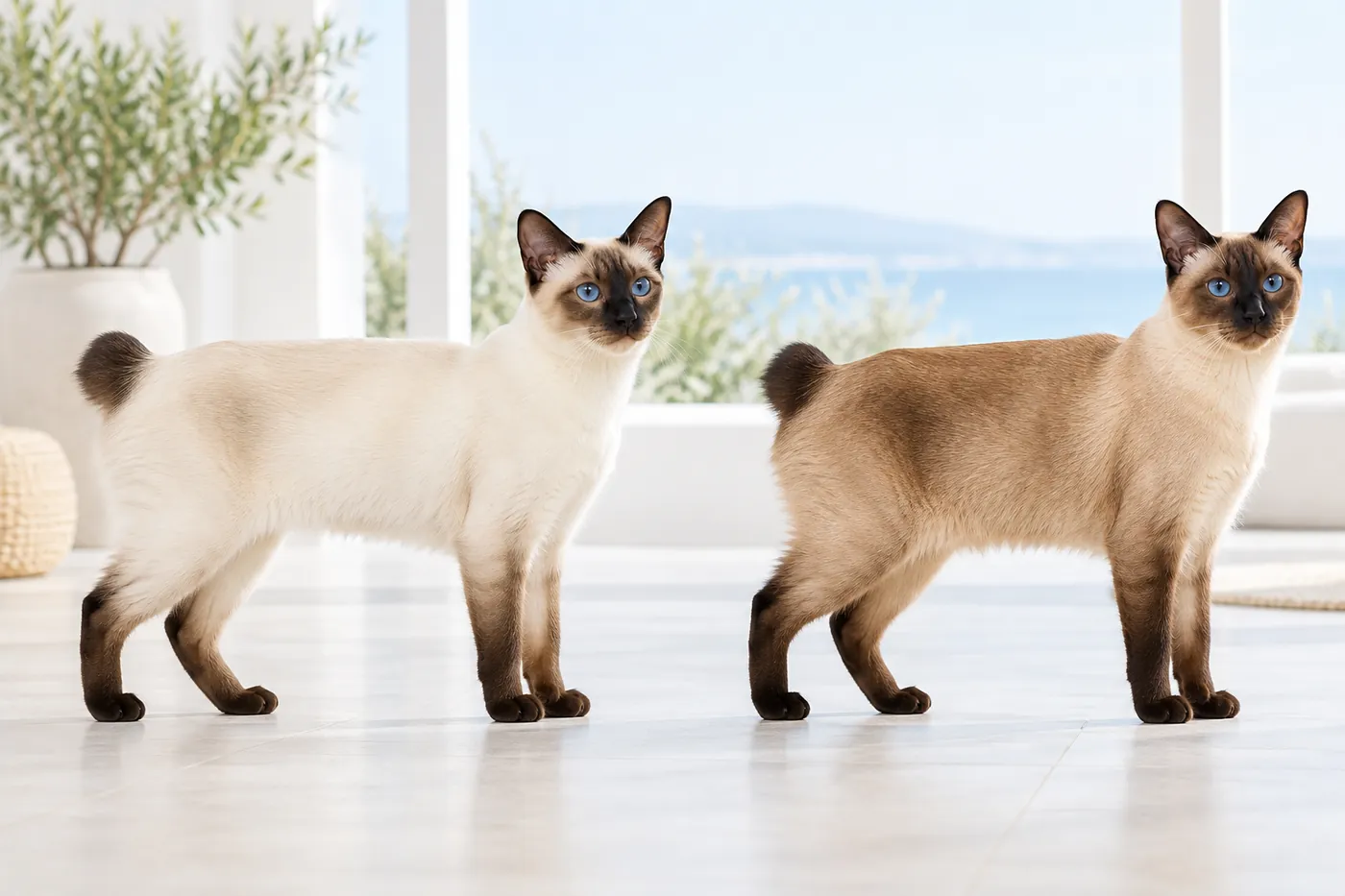
Point colours include seal, blue, chocolate, lilac, red, cream, tortie and tabby point variations.
What Genetics Shape the Tail and the Colorpoint Pattern?
Two genetic systems define the Mekong Bobtail.
The bobtail variant produces the short, kinked tail. A survey of more than 11,000 cats found the HES7 variant associated with the Japanese Bobtail tail to be common in Mekong Bobtails as well. In the 2016 study that first linked it to short tails in Asian cats, one copy was enough to shorten the tail, two copies gave more severe tail changes, and carriers otherwise appeared normal. About a third of the kinked-tailed cats in that study lacked the variant, so it may not explain every short tail in the breed.
The Manx tail comes from a different gene and is associated with spinal defects including spina bifida and bowel dysfunction. HES7 carriers in the 2016 study showed changes only in the tail vertebrae, which is the best evidence available that the Mekong tail does not carry the Manx risk, though no study has examined Mekong Bobtails for it directly.
The colorpoint pattern comes from the cs allele (Siamese colour restriction), which limits full pigment expression to the cooler extremities of the body. This is the same gene that produces the pointed pattern in the Siamese and related breeds.
Together the two systems explain the breed's look: the pointed coat comes from the same gene as the Siamese coat, and the tail in many cats from the same HES7 variant as other Asian bobtails.
Is the Reported Dog-Like Behaviour Real?
Breeder and owner descriptions present the Mekong Bobtail as an unusually social, interactive cat, and some compare its behaviour to a dog's.
Reports include walking on a lead, fetching thrown objects, following household members between rooms and greeting visitors at the door. These are plausible behaviours for a breed derived from the sociable Siamese-type gene pool.
A cat that follows people from room to room gets little of what it wants from an empty house, so long workdays alone are the situation most likely to show up as calling, restlessness or damage. A second compatible cat may help, but it does not replace human interaction.
Individual variation is wide, and a kitten's early socialisation and handling history shape adult behaviour more reliably than a breed description.
How Much Activity Does a Mekong Bobtail Need?
The breed is reported to be active and playful with a strong interest in interactive play.
- Interactive play sessions that engage hunting and retrieval behaviour
- A companion animal if the household is regularly empty for long periods
- Moderate climbing access with stable platforms
- A scratching post and varied toys
- Separate food, water, litter and resting spots
What Grooming Does a Mekong Bobtail Need?
The short, close-lying coat needs minimal maintenance. A weekly pass with a soft cloth or grooming glove is usually sufficient, and the coat naturally lies smooth and glossy without the dense undercoat that produces heavy seasonal shedding in some other breeds.
Dental care, nail trimming and routine weight checks follow standard principles.
Colorpoint cats darken gradually with age, because the temperature-sensitive enzyme that makes their pigment keeps adding colour over the years. The change is normal and needs no special care.
What Is Known About Mekong Bobtail Health?
No population health study of the Mekong Bobtail has been published, so the picture rests on the tail genetics above and on the Siamese side of its ancestry. Nothing published links the Mekong tail to the spinal defects documented in the Manx.
Secondary sources commonly cite a lifespan of 15 to 18 years. That range is unverified by published research.
| Area | What to monitor | When |
|---|---|---|
| Weight and body condition | Rib feel, waist view, weight trend | Routine visits and home observation |
| Dental | Gum colour, tartar, eating changes | Annual veterinary dental check |
| Tail area | Comfort when the tail is gently handled | Ongoing; report pain or stiffness |
| Points and coat | Gradual darkening is normal with age; sudden changes warrant a check | Ongoing observation |
The Siamese health record is the nearest guide for the rest. Liver amyloidosis has been found in Siamese and Oriental cats, the rdAc form of retinal degeneration is common enough in Siamese that a DNA test for it is worth asking about, and a Siamese tendency to asthma has been suggested but not proven. How often any of these occurs in Mekong Bobtails is unknown.
How Does the Mekong Bobtail's Social Drive Affect Household Fit?
The breed's reported sociability and interactive nature suggest it can adapt well to a multi-person household.
Children should learn to handle the cat gently, particularly around the kinked tail. Although the tail is not associated with the pain sensitivity that Manx syndrome can cause, any structural feature deserves respectful handling.
Multi-cat households often suit sociable, Siamese-type breeds, provided a newcomer is introduced gradually rather than put straight in with the resident cat.
Where Can You Find a Mekong Bobtail?
WCF publishes a breed standard, but the breed's limited recognition outside WCF means availability depends heavily on geography. Most breeding happens in Russia and in WCF-affiliated clubs elsewhere in Europe. FIFe does not register the breed, so a kitten will come with papers from a WCF-affiliated club rather than a FIFe one.
- WCF registration papers naming both parents
- The colorpoint pattern with blue eyes and a visible kinked tail
- Health records from a veterinarian
- The cat's behaviour observed during contact, play and handling
- The source can explain the breed's registry status and what is known about its tail genetics
If you are comparing bobtail breeds, the Mekong Bobtail's colorpoint pattern and blue eyes are the quickest visual distinction from the Kurilian Bobtail, which comes in all colours and eye colours and has a larger, more muscular body.
A cat without WCF papers but with a colorpoint coat and a kinked tail is best described by what can be seen, since nothing on paper shows it is a registered Mekong Bobtail.
Common Questions
Is a Mekong Bobtail the same as a Kurilian Bobtail?
No. The Mekong Bobtail is a pointed, blue-eyed cat of Siamese type from South-east Asia with WCF recognition. The Kurilian Bobtail is a larger, heavier cat from the Kuril Islands in all colours, recognised by FIFe and WCF. Their tails can carry the same HES7 variant, so body and coat are what tell them apart.
Is the Mekong Bobtail's tail gene related to the Manx?
No. The Mekong tail is associated with a variant in the HES7 gene, while the Manx tail comes from a different gene linked to spinal defects including spina bifida. Cats carrying the HES7 variant have shown changes only in the tail.
Which registries recognise the Mekong Bobtail?
WCF publishes a standard for the breed. FIFe's breed list does not include it.
How big does a Mekong Bobtail get?
The Mekong Bobtail is a medium-sized, elegant cat. Secondary sources commonly cite 8 to 10 pounds.
Do Mekong Bobtails act like dogs?
Breed descriptions frequently compare their behaviour to dogs, citing following, fetching and greeting behaviours. These traits are plausible for a breed from the sociable Siamese-type gene pool, but individual variation is wide.
Checked Against
- WCF: Siamese and Oriental breed standards (Mekong Bobtail) wcf.de
- FIFe: Recognised breeds fifeweb.org
- Scientific Reports: HES7 and short tails in Asian domestic cats pmc.ncbi.nlm.nih.gov
- PLOS Genetics: genetic epidemiology in more than 11,000 cats pmc.ncbi.nlm.nih.gov
- Menotti-Raymond et al.: rdAc retinal degeneration across cat breeds (Veterinary Journal, 2010) pubmed.ncbi.nlm.nih.gov
- van der Linde-Sipman et al.: AA amyloidosis in Siamese and Oriental cats (1997) pubmed.ncbi.nlm.nih.gov
- Cornell Feline Health Center: Feline asthma vet.cornell.edu
- CFA: Siamese cfa.org
Published 17 September 2026. Last updated .





