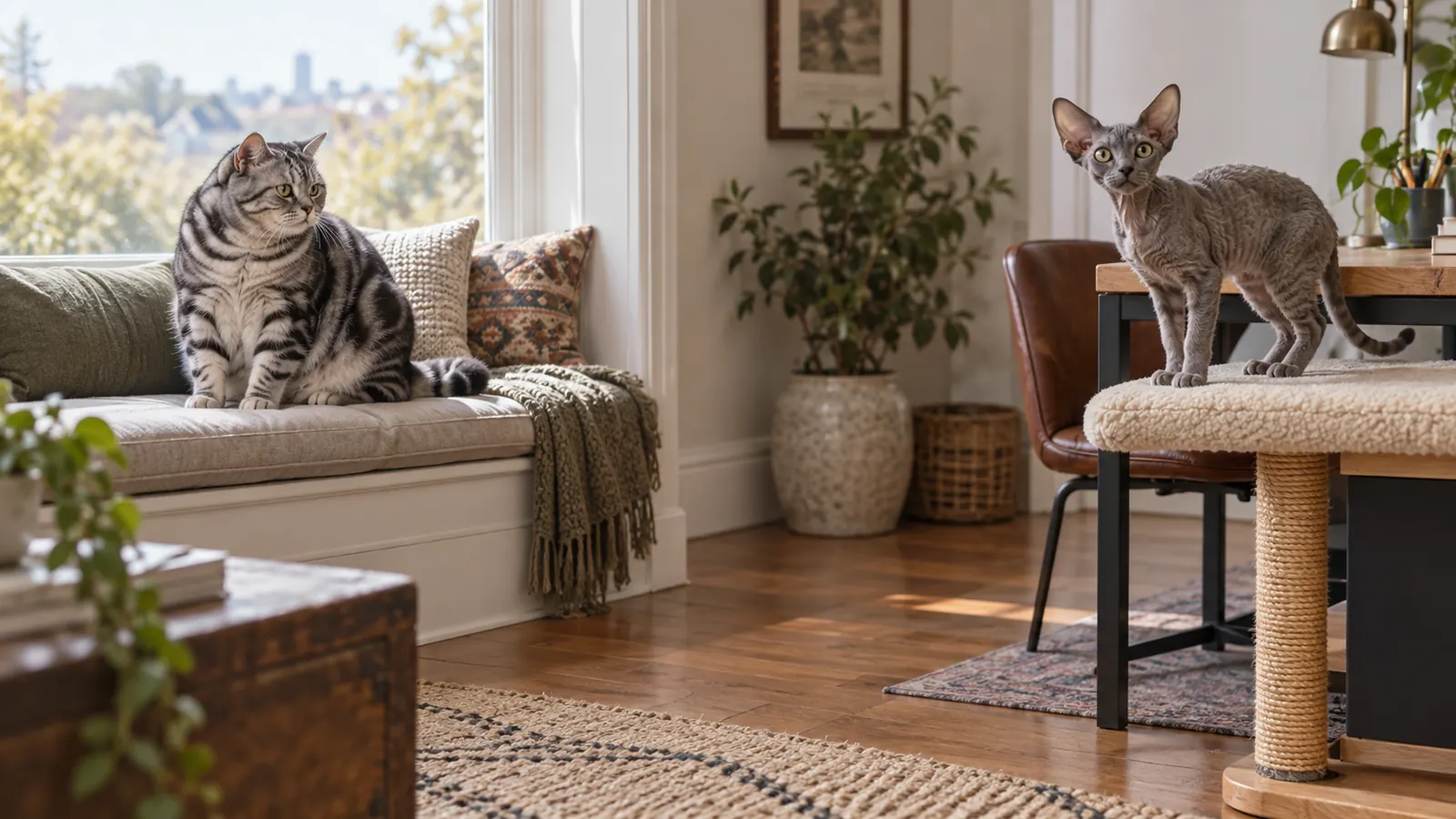
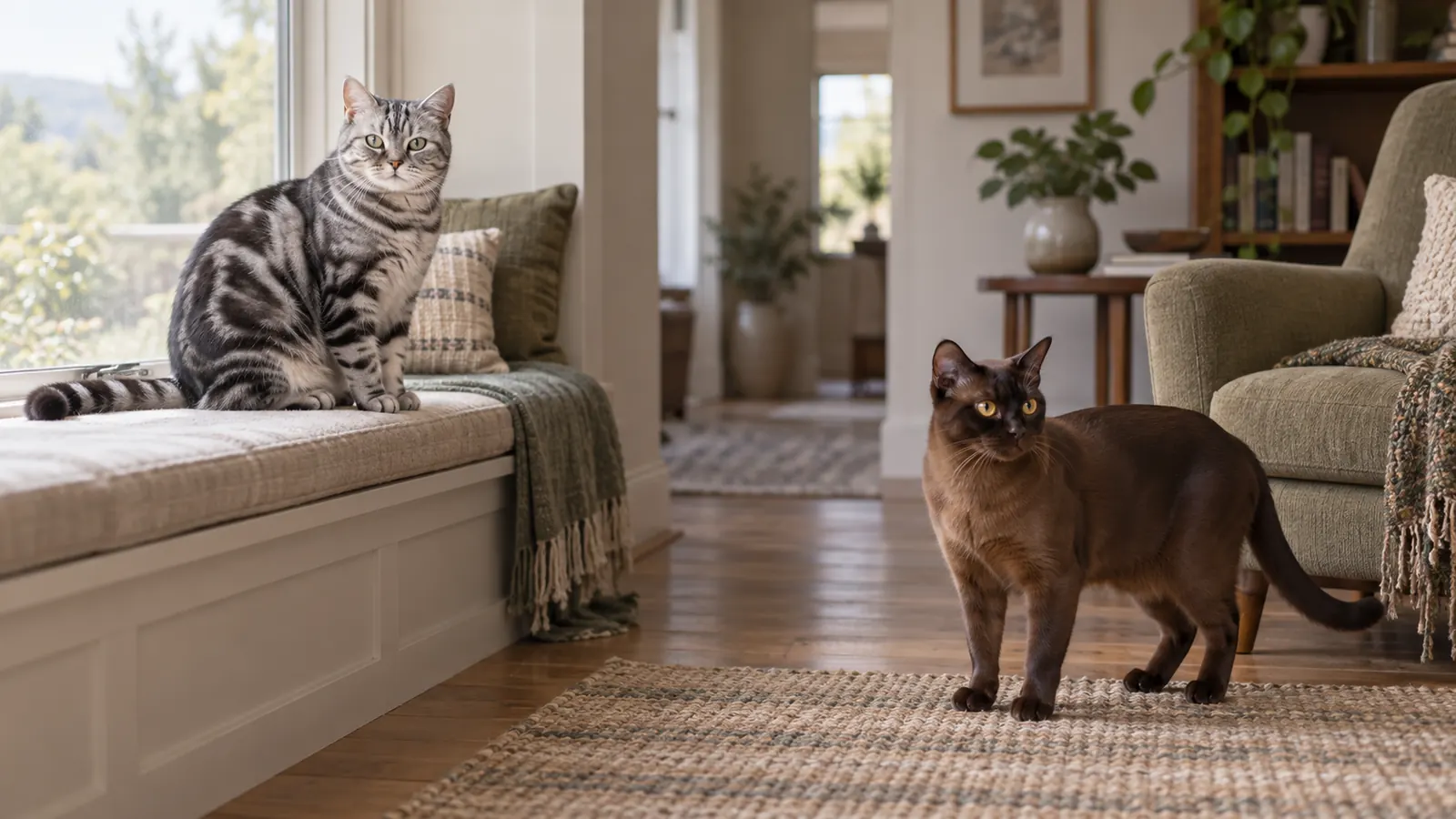
Abyssinian vs Norwegian Forest Cat: Which Fits Your Home?
Choose an Abyssinian if you want an intensely active cat woven through daily life and can build connected climbing routes. Choose a Norwegian Forest Cat if you prefer a gentler social rhythm and can support a much larger body, sturdy equipment and a seasonal double coat.
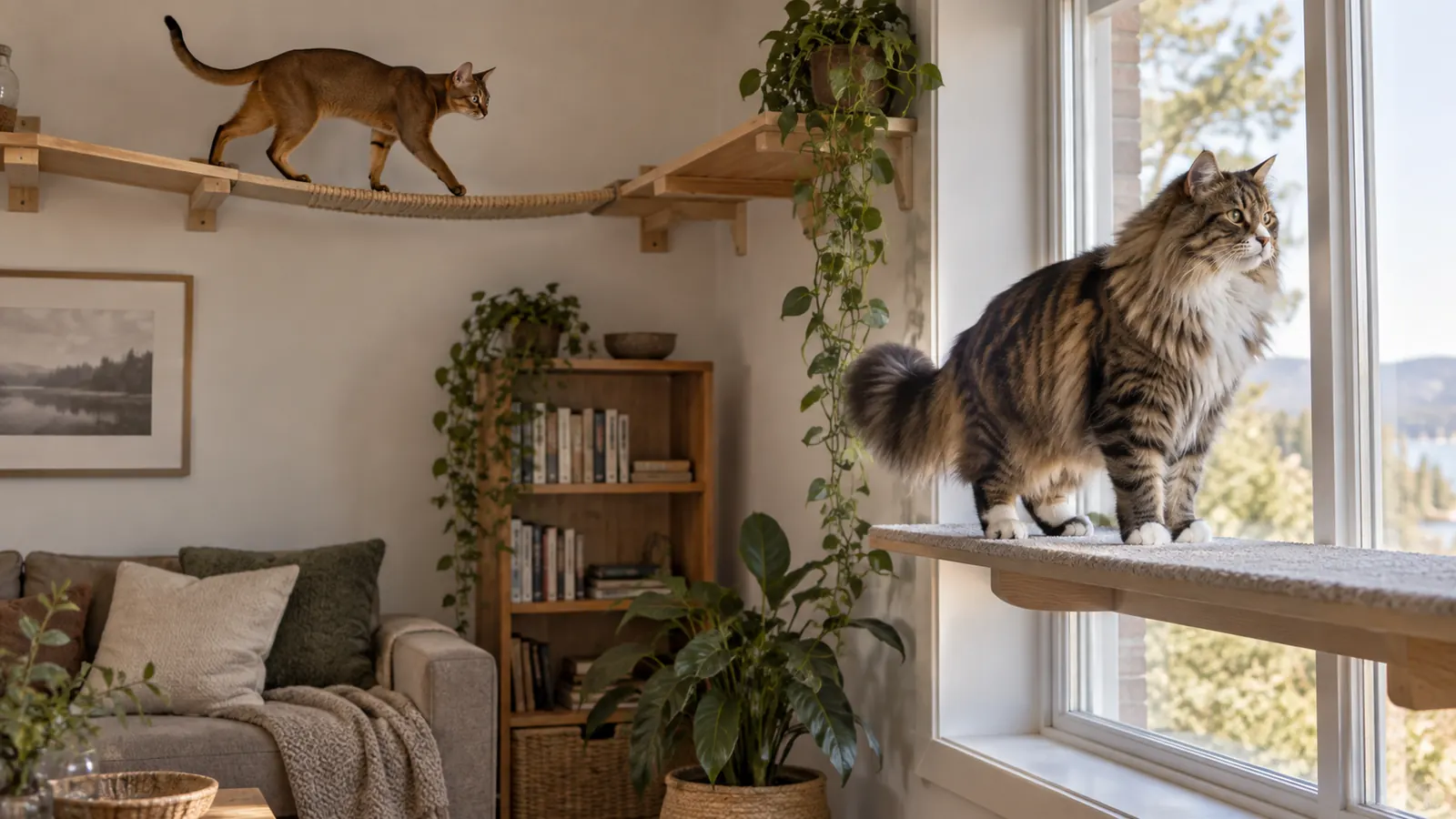
Both breeds are athletic, intelligent and comfortable above floor level, but that shared description hides two different ownership jobs.
The Abyssinian turns height into continuous movement, while the Norwegian Forest Cat combines climbing ability with greater body mass, slower maturity and much more coat.
The easier breed is the one whose hardest ordinary week still fits your home. Compare a busy workday, the heaviest shedding period and the equipment a full-grown cat will use, rather than choosing from a kitten photograph.
Which breed is the easier fit for most homes?
The Norwegian Forest Cat is often the more forgiving choice for a household that wants an interactive companion without the Abyssinian's near-constant exploratory pace.
That recommendation assumes the household can manage a large cat, strong climbing furniture and regular combing through a weather-adapted coat.
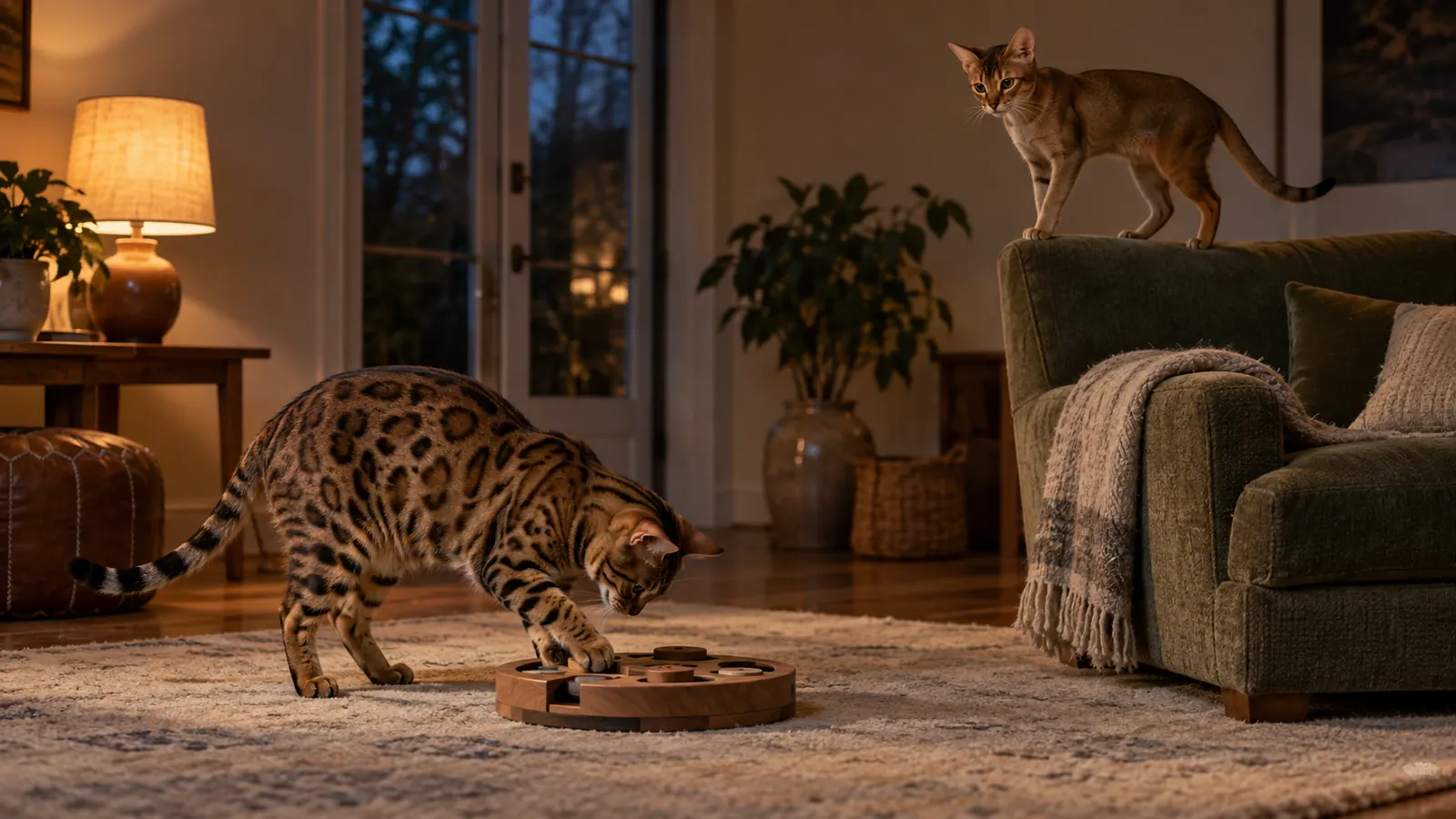
The Abyssinian is the stronger match when active participation is the attraction. It tends to follow movement, investigate objects and revisit people throughout the day, so a home that merely tolerates activity may find the relationship demanding.
| Profile | Activity | Space and equipment | Coat work | Best fit |
|---|---|---|---|---|
| Abyssinian | Very high and frequent | Connected height with quick routes and secure landings | Light weekly coat care | A highly interactive home that enjoys daily play and changing challenges |
| Norwegian Forest Cat | Playful and athletic at a more measured pace | Broad load-bearing platforms, a roomy carrier and generous turning space | Weekly combing with heavier work during seasonal coat release | A home that wants a gentle large companion and accepts peak grooming work |

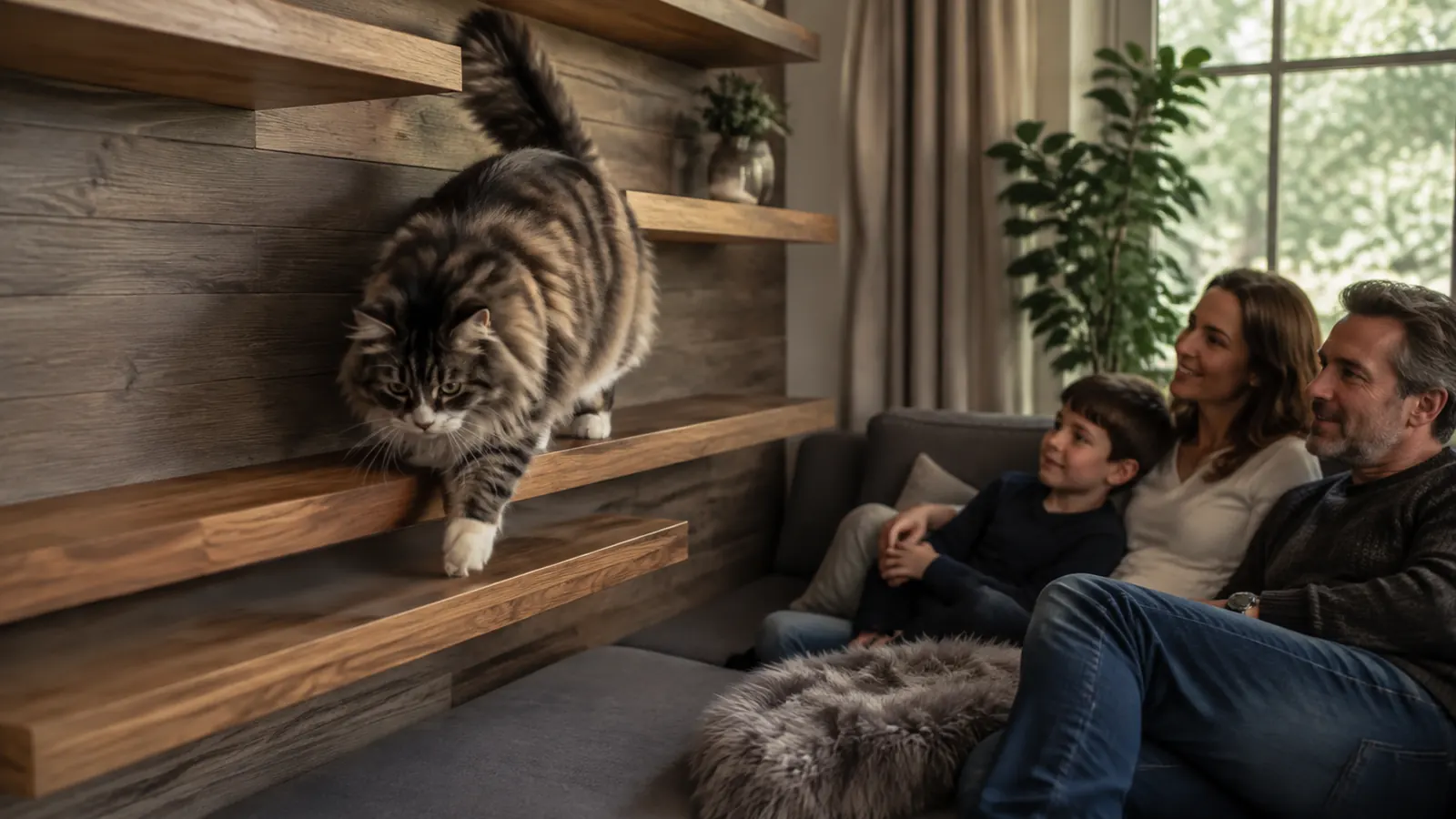
Neither profile predicts every individual. A confident adult with known habits gives better evidence about handling, noise recovery and other animals than a breed adjective applied to a young kitten.
How different do an Abyssinian and Norwegian Forest Cat look and grow?
An Abyssinian has a long, fine outline with slim legs, compact paws, a modified wedge and large alert ears. Its short coat lies close to the body, and each hair carries alternating bands of colour that create ticking rather than conventional body stripes.
TICA gives adult females at roughly 6 to 9 pounds and males at 7 to 12 pounds. Weight alone is a weak identifier, but the breed's light bone, long limbs and sleek surface remain clear beside a Norwegian Forest Cat.
The Norwegian Forest Cat is a substantial semi-longhaired cat with strong bone, a triangular head, a straight profile and a long furnished tail. GCCF places the breed around 9 to 16 pounds and notes that full maturity may take as long as five years, so a young cat can gain breadth and coat after it already looks tall.
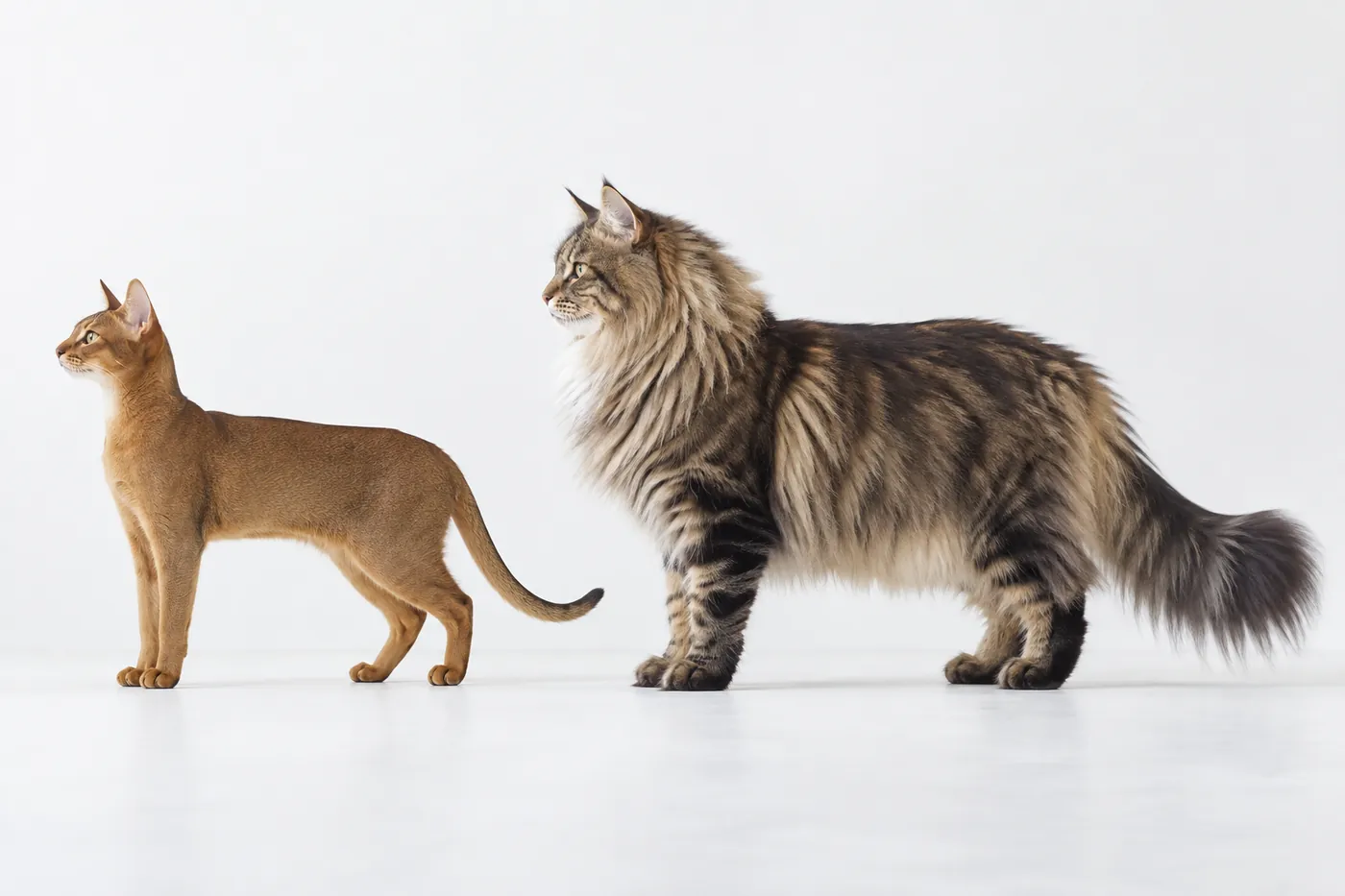
That difference reaches ordinary equipment. Measure the adult cat before choosing a carrier, and allow enough interior length and height for the cat to stand, turn and settle without compressing the coat.
A photograph cannot establish pedigree.
Registration records and documented parentage carry breed identity, while the visible outline helps you plan space and recognise the standard.
Do both breeds need the same kind of climbing space?
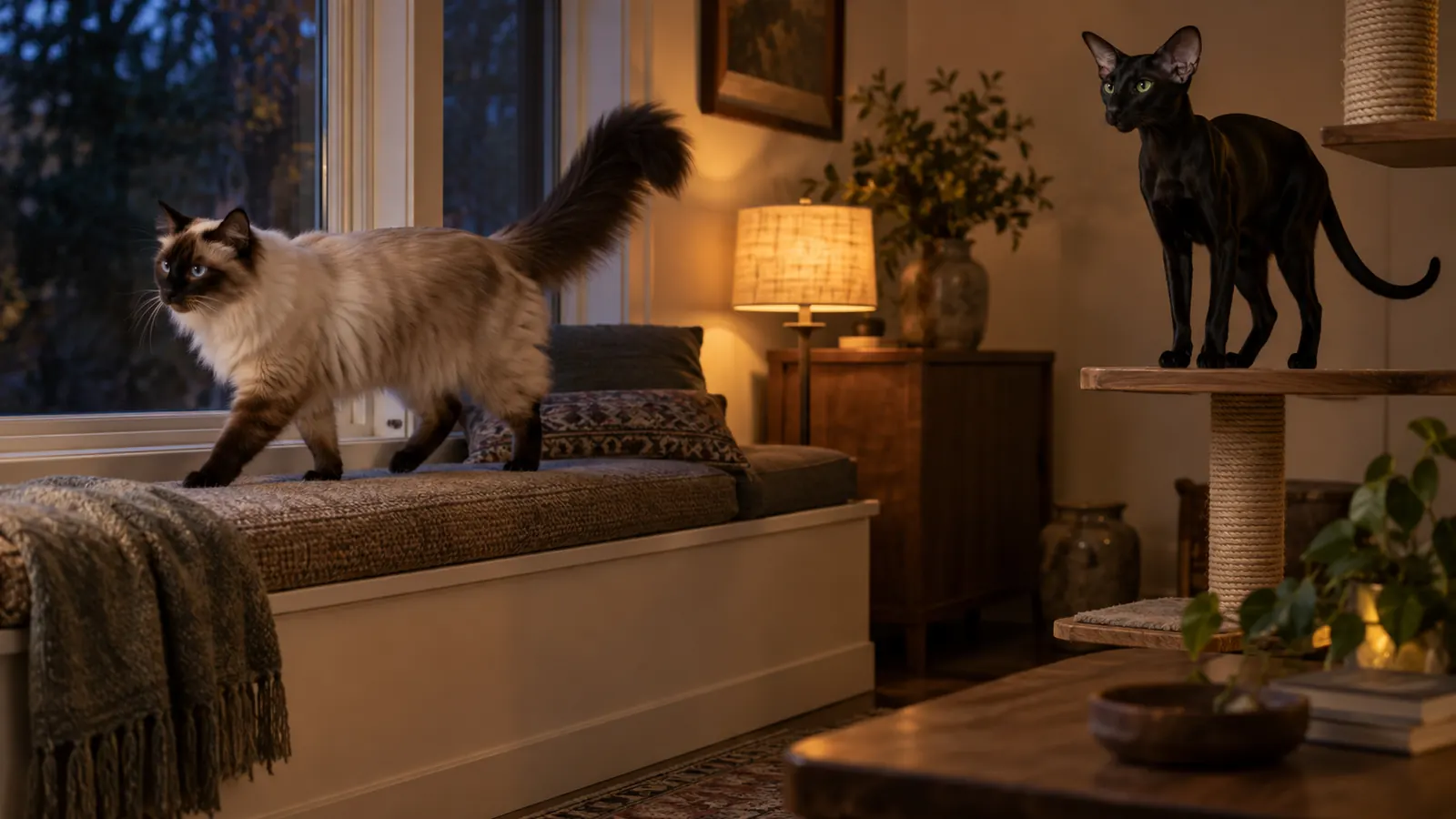
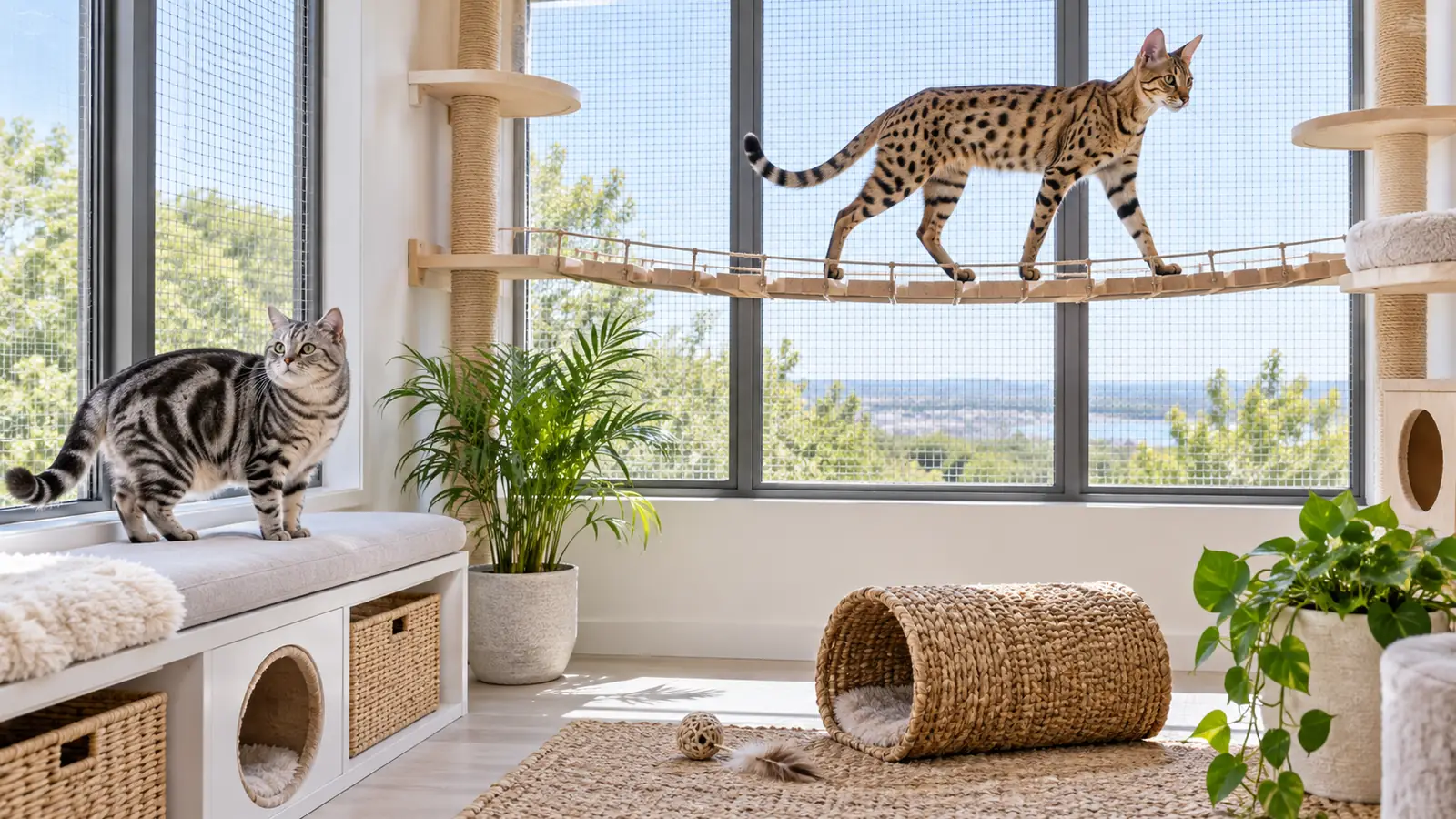
Both cats need secure vertical territory, but they use it under different physical constraints. An Abyssinian benefits from continuity because the reward is often the journey itself: shelf to window ledge, ledge to tree, then a quick return to the room.
A Norwegian Forest Cat needs fewer narrow shortcuts and more usable support beneath the whole body. Platforms must be wide enough for turning, posts must resist leverage from a large jumping cat, and descent points need room for a controlled landing.
- Abyssinian route
- Join several legal observation points so movement does not spill onto doors, screens or unstable furniture
- Norwegian platform
- Choose broad load-bearing surfaces that support all four paws and the torso
- Shared landing
- Add grip, clear the floor below and provide more than one way down
- Older-cat adjustment
- Shorten gaps and add intermediate steps when jumping or recovery changes
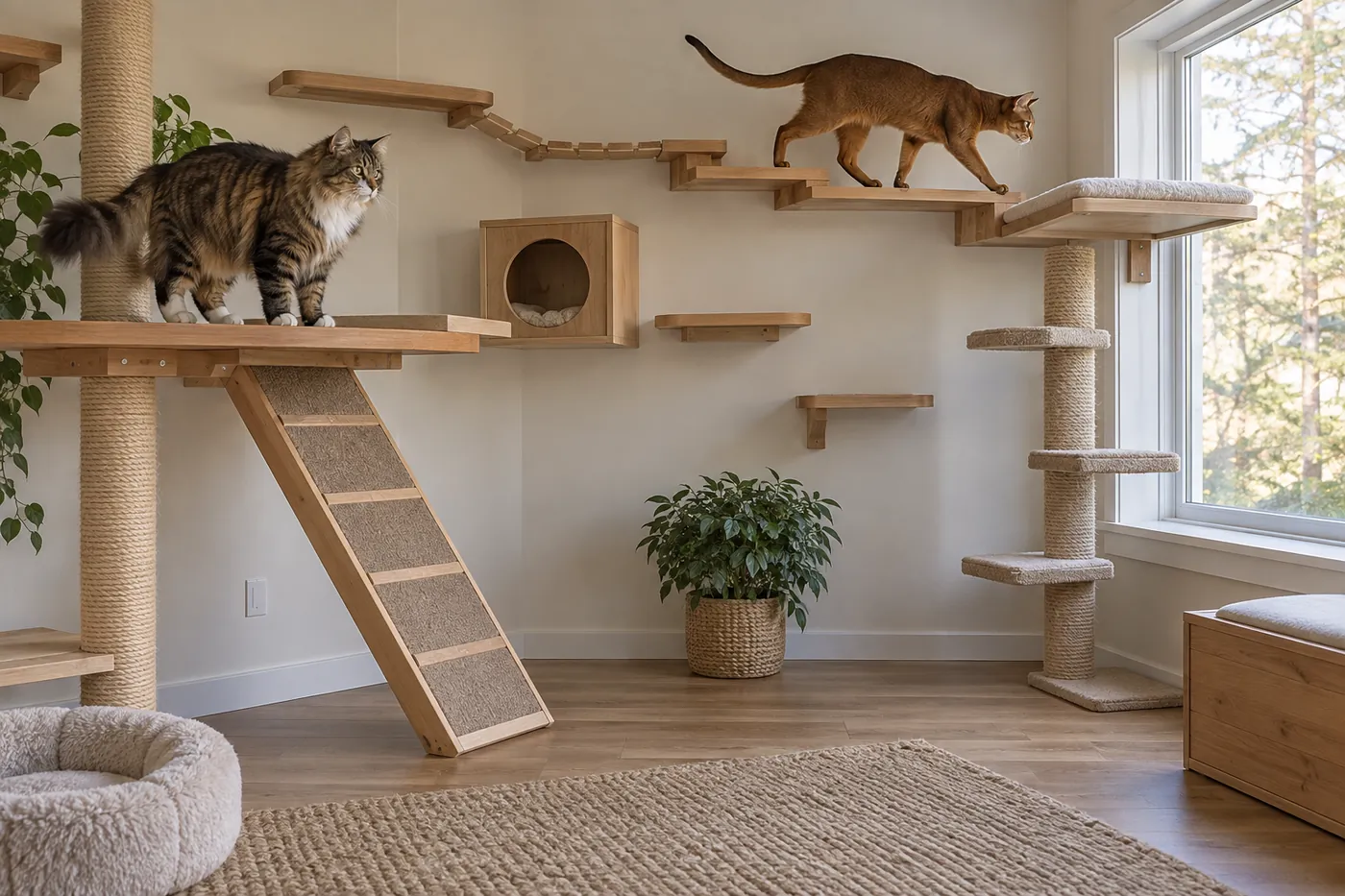
A large floor plan cannot compensate for unusable height, and a tall decorative tree is not automatically safe. Push the structure from several directions, check every fixing and watch whether the cat can reverse direction without backing over an edge.
Age changes what safe movement looks like. Our exercise by age guide explains how to preserve choice while reducing difficult gaps and landings.
What are they like with attention and time alone?
Abyssinian companionship often appears as repeated participation rather than one long lap session. The cat may inspect a keyboard, cross a shelf, watch food preparation and return when a cupboard opens, which suits somebody who enjoys frequent small interactions.
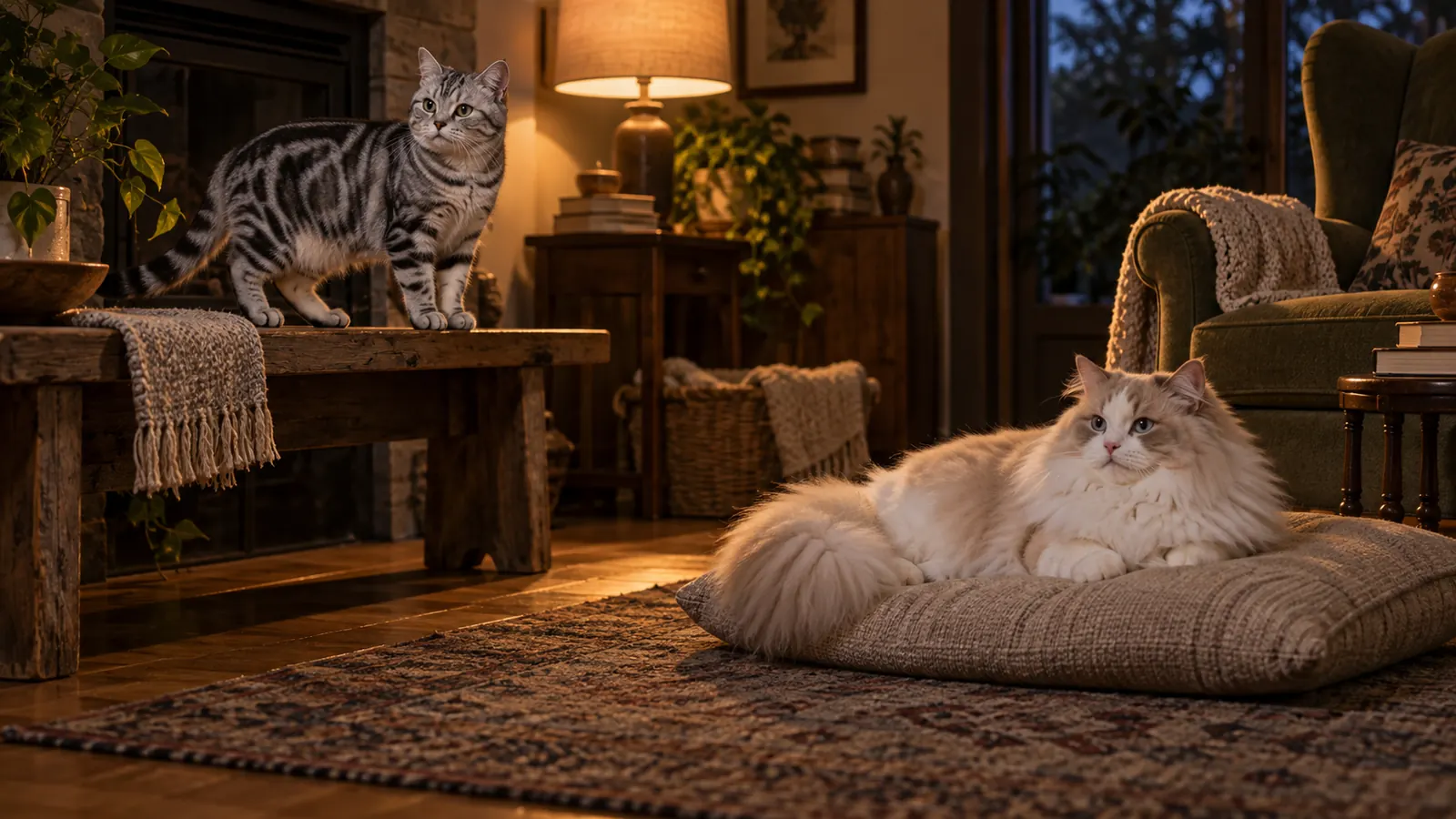
Norwegian Forest Cats are also playful and people-oriented, but their social presence is commonly more measured. Many are comfortable sharing a room or choosing a nearby perch once their needs have been met.
| Ordinary moment | Abyssinian tendency | Norwegian Forest Cat tendency | What to observe |
|---|---|---|---|
| Desk work | Revisits movement, objects and upper routes | More readily alternates interaction with nearby rest | Whether the cat can settle after a planned play session |
| Full workday away | Higher mismatch risk when predictable absence is routine | Often the more forgiving starting tendency | Eating, litter use, searching, vocalising and recovery after your return |
| Quiet evening | May ask for another route, game or investigation before resting | More likely to combine a play period with sustained nearby rest | Whether the household enjoys the cat's preferred pace |
| Overnight travel | Requires dependable daily care and meaningful interaction | Also requires daily care, grooming observation and health checks | Whether a sitter can perform the real routine rather than refill bowls |
No reliable source supplies one safe number of hours alone for either breed.
A compatible animal companion may help, but it cannot replace human care or guarantee that a highly social individual will cope with a quiet house.
Which is better with children, dogs or another cat?
The Norwegian Forest Cat may be the easier starting choice where the home wants a calmer pace, while an Abyssinian can be an excellent match for older children who enjoy wand play, searching games and short training sessions. Supervision and escape choice matter more than the family-friendly label.
A Norwegian Forest Cat's larger body creates its own risk. Children should not lift or restrain the cat, and a broad retreat must support the adult rather than forcing it onto a narrow shelf.
An Abyssinian's fast movement can trigger pursuit from a dog or overwhelm a timid resident cat. Introductions should keep the dog controlled and give the cat an elevated route that cannot become a dead end.
- Give each cat a protected retreat that children and dogs cannot enter
- Use toys rather than hands for fast play and stop when the cat disengages
- Prevent dogs from rehearsing pursuit when either cat runs or climbs
- Separate food, water, litter, scratching and resting resources during introductions
- Watch whether both animals take turns and can leave without being followed
- Choose a known adult history when the household already includes a vulnerable animal
Friendly behaviour during one visit does not guarantee a relationship. Look for recovery after noise, willingness to pause and the ability to return voluntarily after contact ends.
How much grooming and shedding should you expect?
The Abyssinian coat usually needs a gentle weekly pass with a soft brush, grooming cloth or hand. Its close hairs make loose coat and skin changes easy to notice, but short-haired never means non-shedding or allergy-safe.
The Norwegian coat has a woolly undercoat beneath longer, smoother guard hairs.
Weekly combing may be enough during an easy part of the year, yet spring coat release can produce a sharp increase in loose undercoat and tangles around friction points.
| Care point | Abyssinian | Norwegian Forest Cat |
|---|---|---|
| Coat structure | Short, close and finely ticked | Semi-long double coat with woolly undercoat, smooth overcoat, ruff and furnishings |
| Routine | Gentle surface grooming and a skin check | Comb through the depth in small sections, especially behind legs and around the ruff |
| Peak shed | Usually lighter and easier to lift | Loose undercoat can release heavily and needs more frequent attention |
| Equipment | Soft brush, cloth or grooming glove | Wide-tooth comb plus a tool that reaches loose undercoat without scraping skin |
| Stop signs | Pain, bald areas, inflamed skin or a sudden coat change | Tight mats, pain, inflamed skin or a coat change that grooming cannot explain |
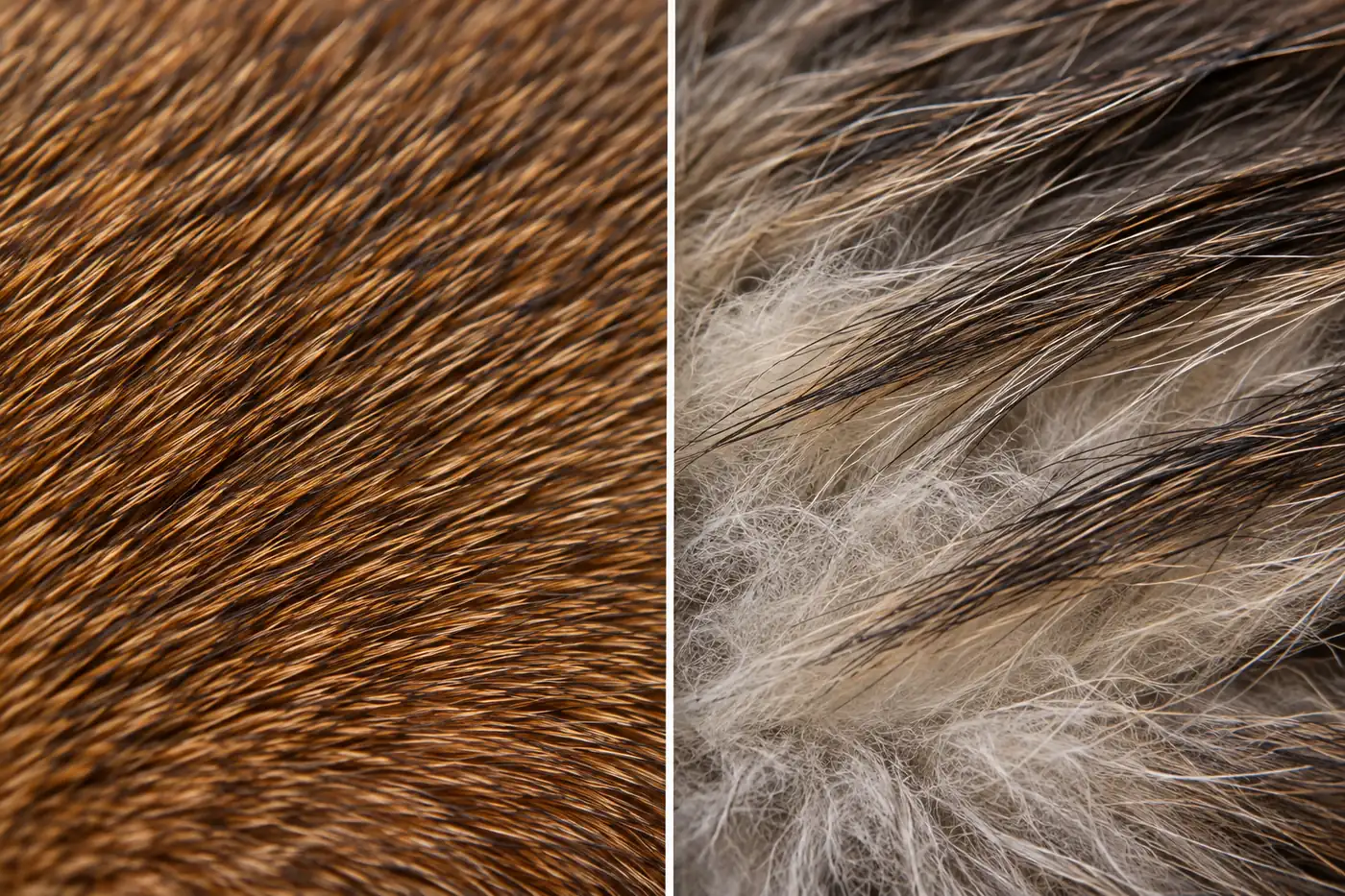
Work from the ends of a tangle and support the skin rather than pulling at the root. The grooming tools guide explains what each tool does and why a sharper or more aggressive tool is not automatically more effective.
Which health tests and records should a breeder show you?
A useful breeder conversation names the cat, test, result and date. It never ends with fully tested, healthy lines or a screenshot that omits identity.
For an Abyssinian, ask for both parents' original reports for the CEP290 rdAc variant associated with progressive retinal atrophy and the PKLR variant associated with pyruvate kinase deficiency. These are recessive conditions, so carrier status must be interpreted across the actual mating rather than treated as a disease in a healthy carrier.
Renal amyloidosis remains a family-record question because the GCCF breeding policy recognises the concern but notes that no simple DNA test is available. Ask about ages, diagnoses and causes of death in close relatives instead of accepting absence of a panel result as reassurance.
For a Norwegian Forest Cat, FIFe breeding rules require GBE1 testing for glycogen storage disease type IV unless both parents already prove non-carrier status. The rules also bind identification to the result, which is why a report with a microchip or tattoo number is more useful than a detached status claim.
| Breed and concern | Evidence to request | What it answers | Limit |
|---|---|---|---|
| Abyssinian PRA rdAc | Both parents' original CEP290 reports | Clear, carrier or affected status for the named recessive variant | Other eye disease and future vision |
| Abyssinian PK deficiency | Both parents' original PKLR reports | Whether the named anaemia variant can pass through the mating | Other causes of anaemia |
| Abyssinian renal amyloidosis | Family history with ages and causes of death | Whether the breeder tracks a recognised concern over time | No genetic clearance or individual prediction |
| Norwegian GSD IV | Identified GBE1 reports or documented clear parentage | Whether the mating follows the breed rule for this recessive disease | Other inherited or acquired disease |
| Norwegian cardiomyopathy | Family cardiac history and any dated imaging used by the breeder | Whether relatives and breeding cats have been examined at meaningful times | A normal examination cannot guarantee lifetime cardiac health |
A Norwegian Forest Cat cardiomyopathy study found that some affected cats had no audible murmur. That does not create a universal testing schedule here, but it explains why a quick stethoscope check or the words vet checked cannot substitute for documented family history and a breeder's transparent screening practice.
Read the document itself, match it to the registered parent and ask what happened in older relatives.
A clear result is narrow evidence for a named question, not a lifetime health certificate.
Which breed fits your ordinary week?
Choose the Abyssinian when connected height, rotating play and frequent participation remain welcome on a busy weekday. It is the poorer fit when long routine absences or a preference for a quiet decorative companion define the home.
Choose the Norwegian Forest Cat when you want a large, gentle and playful presence and can buy equipment for the adult rather than the kitten. It is the poorer fit when seasonal combing, heavy loose coat or large load-bearing furniture would be postponed.
- Test the activity commitment against a normal workday rather than a weekend
- Measure carriers, platforms and turning space for the expected adult body
- Plan the Norwegian Forest Cat routine for peak coat release
- Meet the individual during play, quiet observation and gentle handling
- Read named test reports and family records with dates and identities
- Protect separate routes and resources for children, dogs and resident cats
- Walk away from guaranteed temperament, final size or lifetime health
The Norwegian Forest Cat is the broader fit when the home can carry its physical and grooming workload. The Abyssinian is the deliberate high-involvement choice, and it becomes the better answer only when that involvement is wanted for years.
Checked Against
- TICA: Abyssinian tica.org
- GCCF: Norwegian Forest Cat gccfcats.org
- CFA: Norwegian Forest Cat cfa.org
- UC Davis Veterinary Genetics Laboratory: PRA rdAc vgl.ucdavis.edu
- UC Davis Veterinary Genetics Laboratory: pyruvate kinase deficiency vgl.vetmed.ucdavis.edu
- GCCF: Abyssinian breeding policy gccfcats.org
- FIFe: breeding and registration rules fifeweb.org
- März et al.: Familial cardiomyopathy in Norwegian Forest cats (Journal of Feline Medicine and Surgery, 2015) pmc.ncbi.nlm.nih.gov
Published 12 September 2026. Last updated .