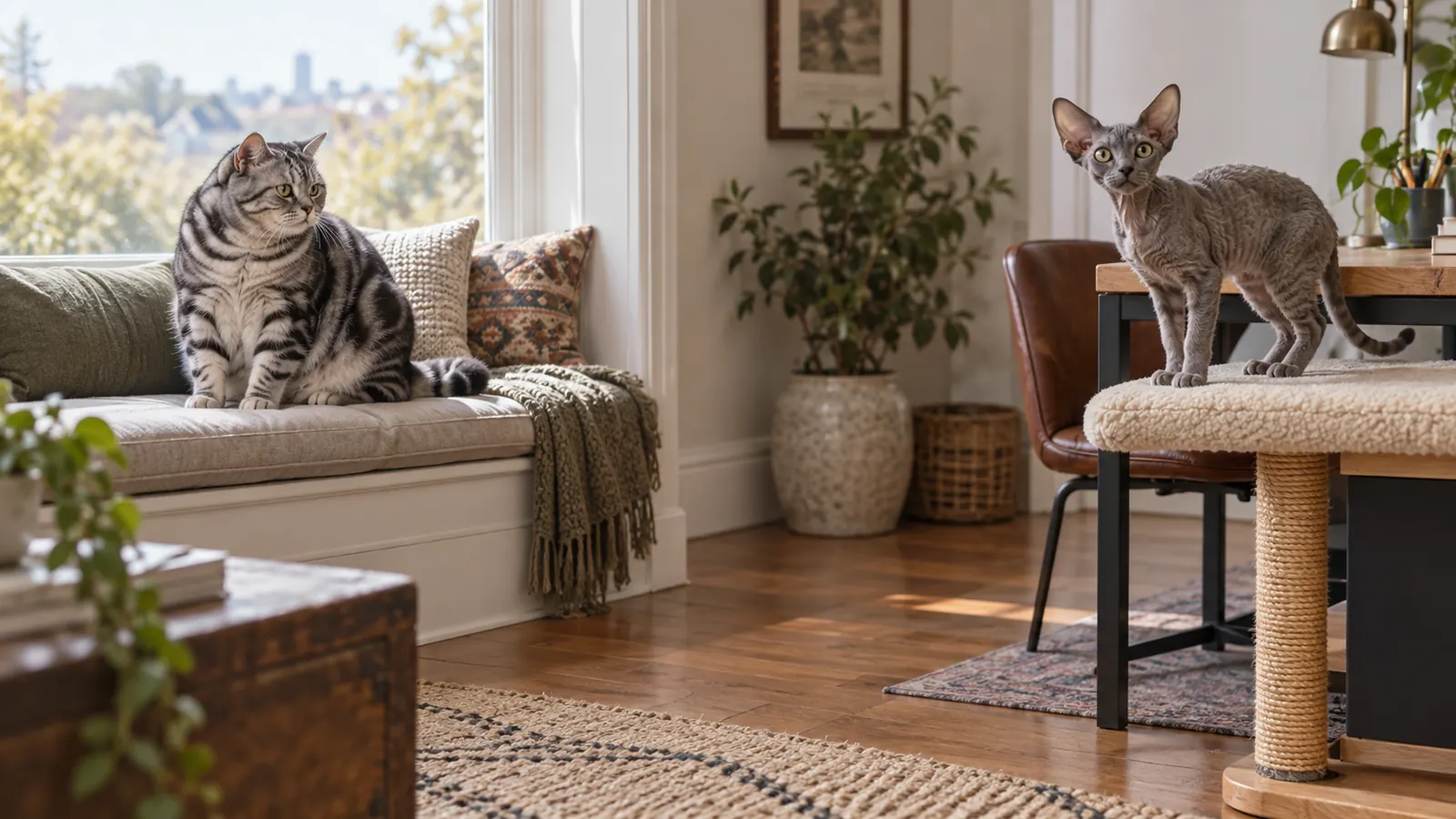
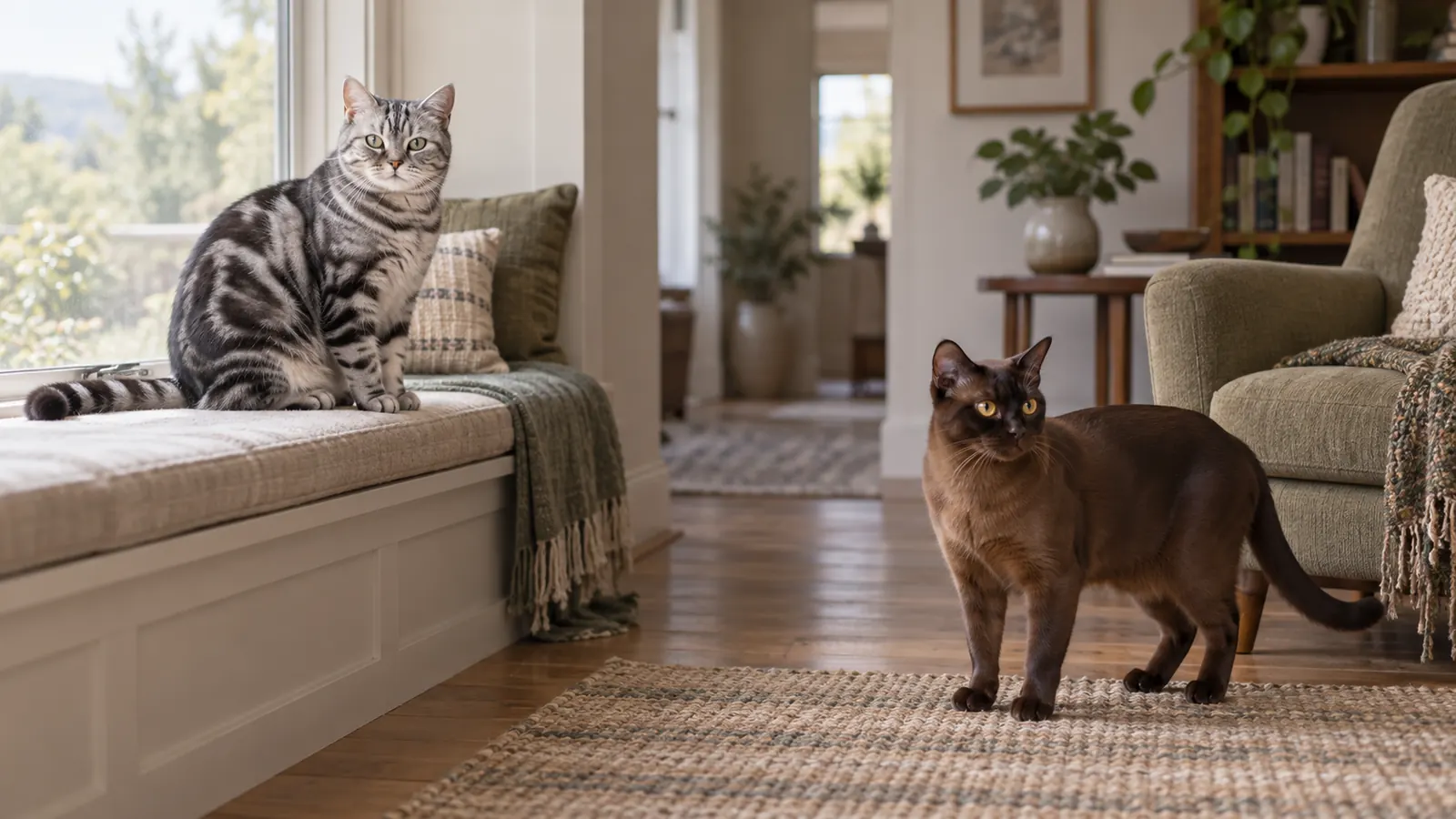
Abyssinian vs American Shorthair: Which Fits Your Routine?
The American Shorthair is usually the easier fit for a first-time owner or a home with a regular workday. An Abyssinian suits people who actively want a highly involved cat and can provide daily interaction, climbing routes and changing challenges.
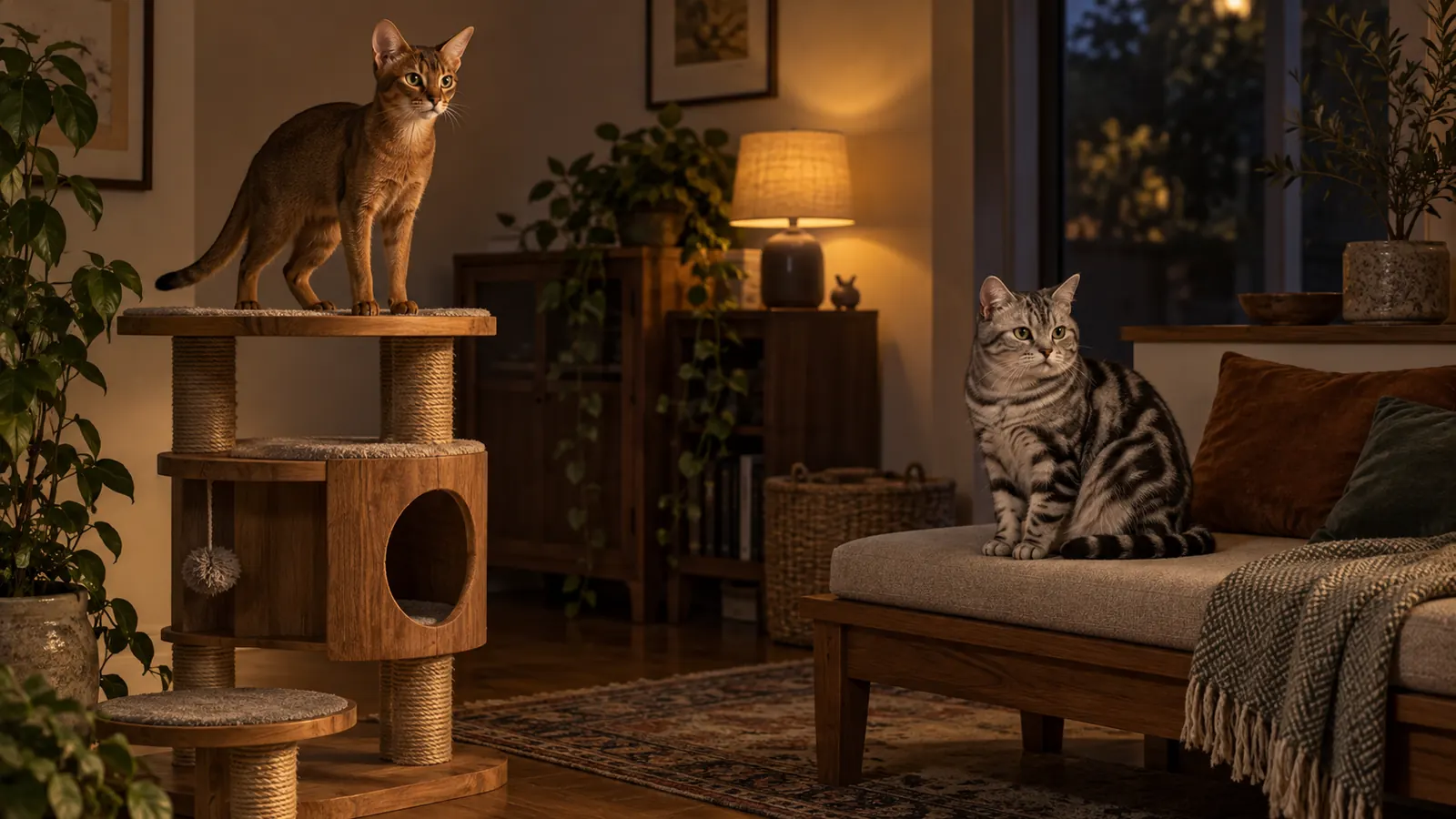
The recommendation turns on workload. Both breeds can be affectionate, trainable family cats, but the Abyssinian tends to ask for more participation while the American Shorthair more readily settles into the rhythm already there.
Breed descriptions show population tendencies. The adult cat in front of you remains better evidence about confidence, handling and play style than a promise based on pedigree alone.
Which breed is the easier fit for most homes?
For many households, the American Shorthair is the lower-friction choice. Breed registries consistently describe it as adaptable, even-tempered and able to entertain itself, which matters when people work outside the home or want affection without continuous activity.
The Abyssinian suits a narrower but enthusiastic audience. It is an agile, observant cat that tends to follow people, investigate activity and use the highest available position, so its ideal owner regards play and home setup as part of the relationship rather than optional extras.
| Profile | Activity | Time alone | Coat work | Best fit |
|---|---|---|---|---|
| Abyssinian | Very high | Often a poor match for long, routine absences | Light weekly care | An interactive home that welcomes climbing and frequent play |
| American Shorthair | Moderate | Commonly more self-directed during a workday | Weekly care with heavier seasonal shedding | A busier or first-time home seeking a steadier rhythm |
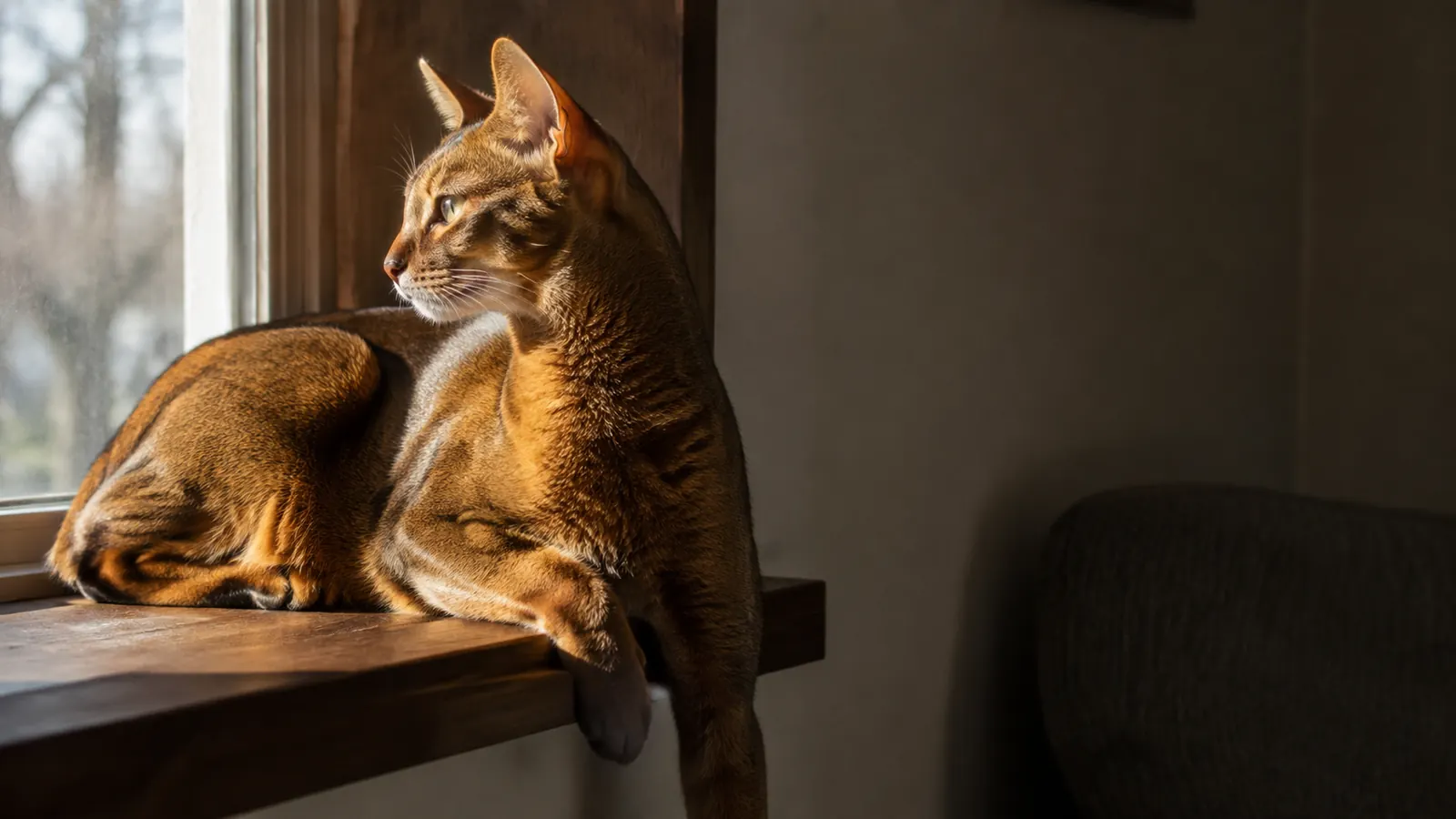
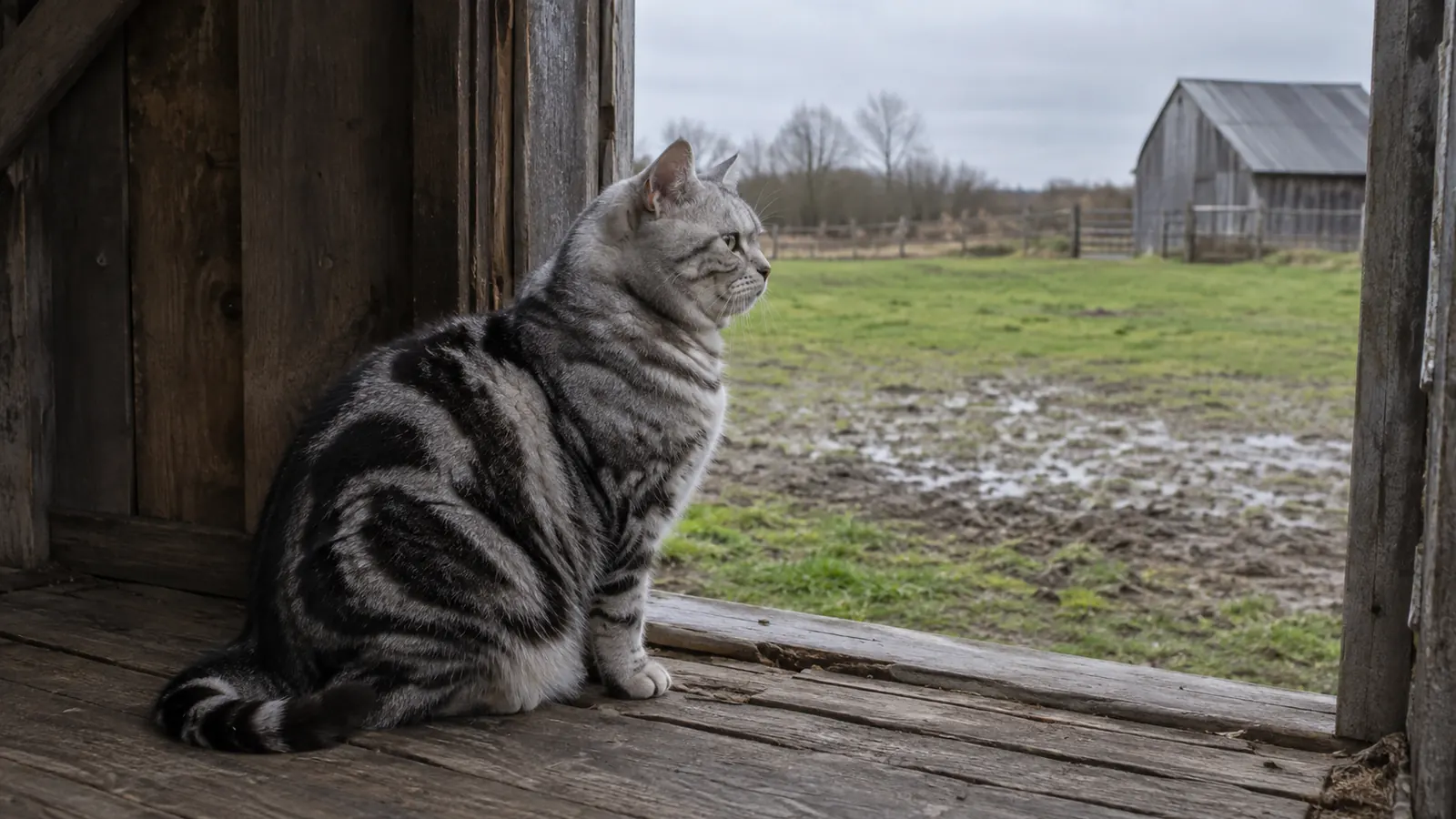
The comparison ranks neither affection nor intelligence. An American Shorthair still needs play, company and a usable environment, while a well-matched Abyssinian is not a problem to manage. The difference is how much activity the owner wants woven through an ordinary day.
How different do an Abyssinian and American Shorthair look?
An Abyssinian looks long and light on its feet. The legs are slim, the paws compact, the ears large and alert, and the short coat has ticking, which means individual hairs carry alternating bands of colour rather than forming a conventional striped or spotted pattern across the body. TICA gives adult Abyssinian females as roughly 6 to 9 pounds and males as 7 to 12 pounds. Those ranges overlap many ordinary domestic cats, so the stronger visual clue is the combination of fine bone, long limbs, large ears and a close ticked coat.
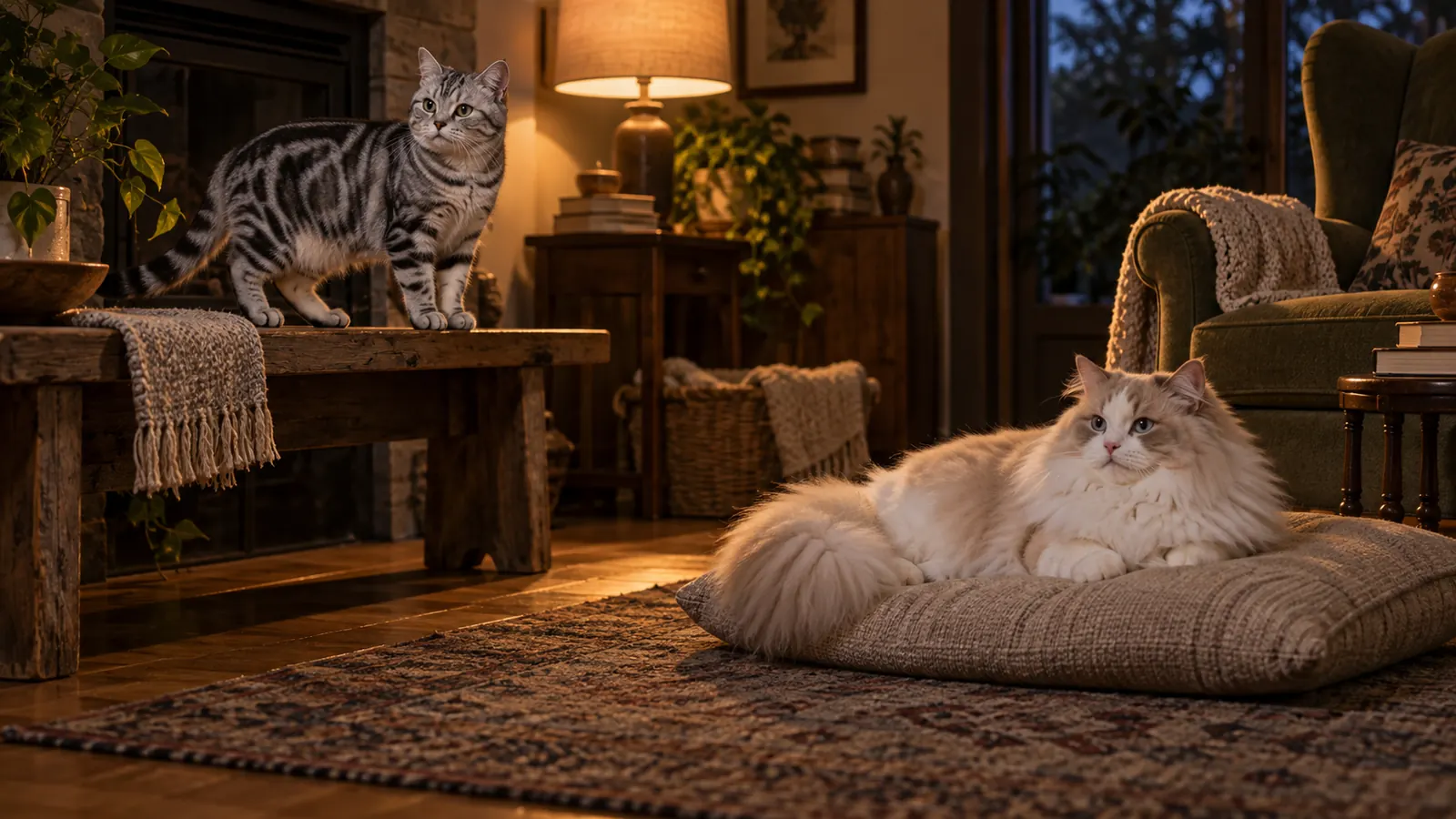
An American Shorthair is medium to large with a broad chest, substantial bone, rounded paws and a head that reads wider and rounder. Its coat is short but dense and firm enough to protect the body, with silver classic tabby being familiar rather than exclusive. The American Shorthair standard does not prescribe a target body weight, so a precise breed-wide number would create false certainty. Sex, lineage and body condition matter for both breeds, and the cat's actual chest depth and body length should determine carrier and bed size.
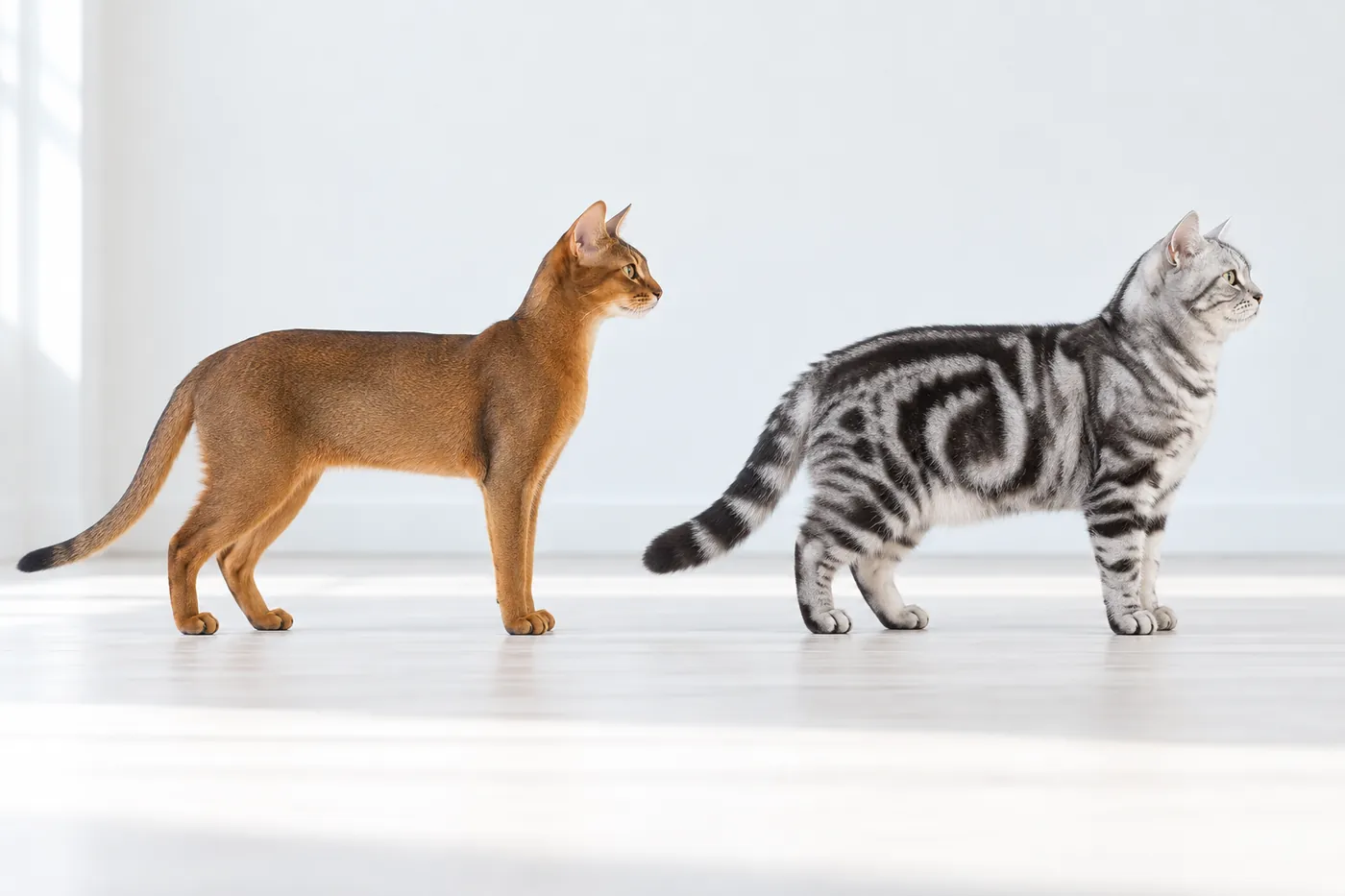
A photograph cannot prove pedigree. If identity matters, registration records and parentage carry that evidence. An American Shorthair is a pedigreed breed defined by recorded ancestry and a written standard. Domestic shorthair describes coat length in a cat without that documented breed identity, so a broad silver tabby from a shelter is not an American Shorthair based on appearance alone.
Which cat needs more exercise and vertical space?
The Abyssinian has the larger activity commitment. TICA describes the breed's activity level as extremely high, and its interest often runs through climbing, opening, carrying, watching and joining rather than one energetic burst followed by a quiet day.
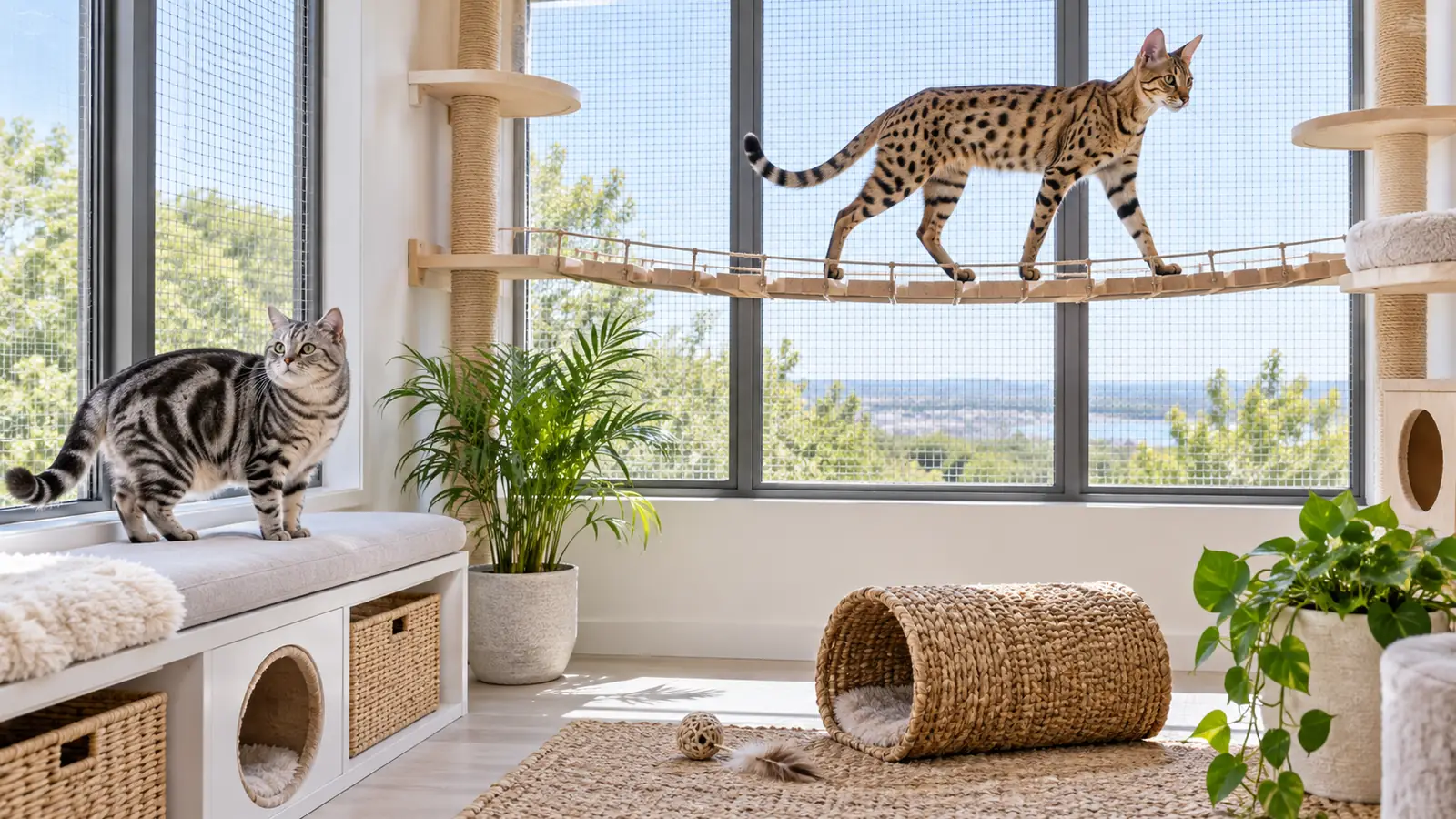
Useful territory therefore extends upward. A tall, stable tree is a starting point, but connected routes are better: a shelf leading to a secure window perch, clear landing zones and more than one way down let the cat move without balancing on televisions, doors or unstable furniture. Floor area alone does not solve that job. A compact room with safe height and a clear chase route can serve an Abyssinian better than a large room that offers no legal place to climb.
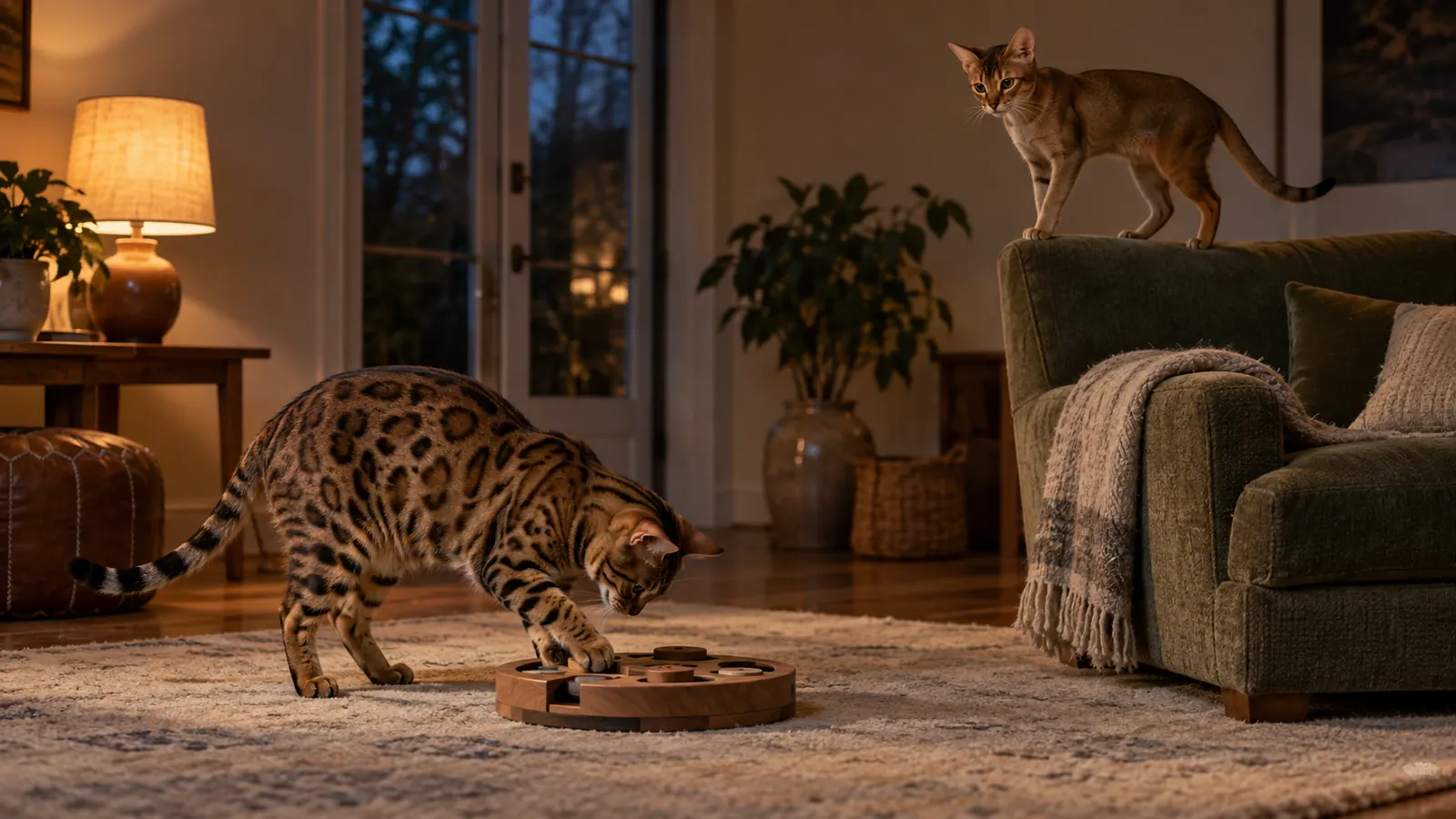
The American Shorthair still retains the quick hunting play expected of a working mouser, but registry descriptions place it closer to moderate activity. Short interactive sessions, puzzle feeding and an open route for chasing usually fit alongside longer periods of rest instead of becoming the organising feature of the room.
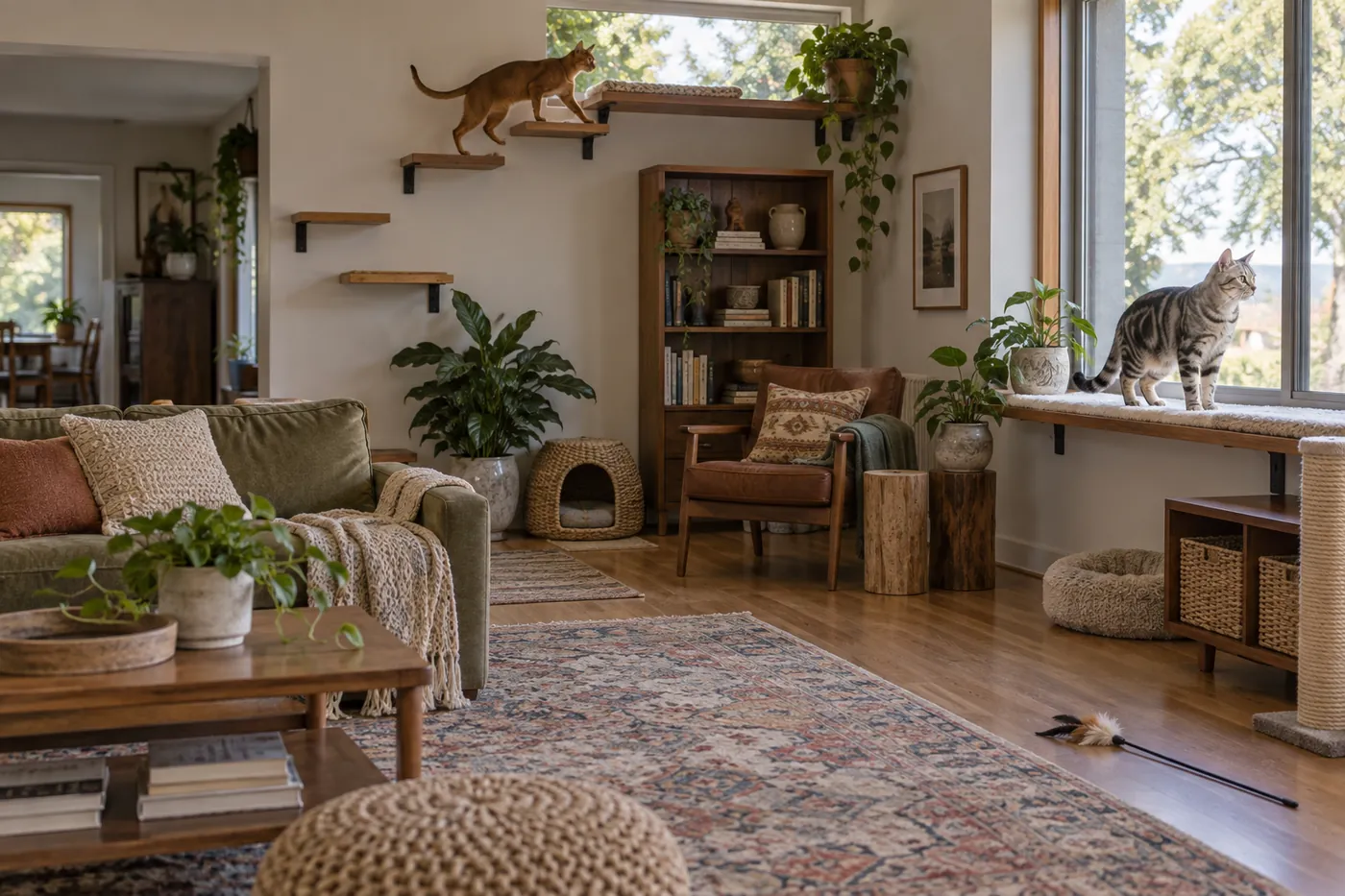
Age changes the expression of both tendencies. A kitten of either breed can be relentless and an older Abyssinian may slow down, so recovery after play is the guide for adjusting height, traction and landing distance, rather than the breed description treated as a permanent setting.
What are they like with attention and time alone?
Abyssinians commonly stay close to household activity without necessarily remaining on a lap. They may visit briefly, move to a nearby high point and return whenever something changes, which can feel companionable to one person and demanding to another.
American Shorthairs are also social, but CFA specifically describes them as capable of amusing themselves while owners are at work, which reflects a stronger tendency to rest or choose a solitary activity between predictable periods of attention rather than indifference.
| Household situation | Abyssinian tendency | American Shorthair tendency | What to observe |
|---|---|---|---|
| Working from home | Likely to inspect calls, keyboards and movement | More likely to alternate contact with independent rest | Whether the cat can settle after play without repeated frustration |
| Full workday away | Higher mismatch risk when absence is routine | Usually the more forgiving breed tendency | Eating, litter use, destructive searching, pacing and recovery after your return |
| Quiet evening | Often wants play, height or participation before settling | More readily shares the room without directing it | Whether the preferred contact style matches yours |
| Frequent overnight travel | Poor fit without dependable daily care | Also a poor fit without dependable daily care | A sitter must handle food, litter, play and health observation every day |
No sound source establishes a universal number of safe hours alone for either breed. A second cat may provide company when the pair is genuinely compatible, but it cannot guarantee that an under-stimulated Abyssinian will be satisfied or remove the need for human observation.
Which is better with children, dogs or another cat?
Both breeds are described as capable of living well with children and other pets. The useful distinction is interaction style, because a family-friendly label says little about noise, chasing, handling or competition around valued resources.
An American Shorthair's more even, tolerant pattern is often easier with younger children who are still learning to read a cat's signals. The cat still needs a child-free retreat, and an adult should stop reaching, carrying or play as soon as the cat turns away, flattens its ears or begins to leave.
An Abyssinian can be a rewarding match for older children who want to use wand toys, teach small tasks and respect escape routes. That same speed can overwhelm a timid resident cat, especially when one animal wants to chase and the other wants the room to remain still.
| Household | More likely starting fit | Condition that matters more than breed |
|---|---|---|
| Young children | American Shorthair | Calm handling, active supervision and a retreat children cannot enter |
| Older active children | Abyssinian | Consistent toy play without hands, grabbing or cornering |
| Calm resident cat | American Shorthair | Separate food, water, litter, resting and high resources during a gradual introduction |
| Confident playful cat | Either, with energy matched | Whether both cats take turns and can disengage without pursuit |
| Cat-safe dog | Either | Controlled introductions, no chasing and an elevated dog-free exit |
The individual relationship is never guaranteed. Socialisation and lifetime experience shape behaviour alongside genetics, so a calm observed adult may be a safer choice than choosing a kitten on breed expectation when the home already contains vulnerable animals.
Are they equally easy to train?
Both breeds can learn through food, play and access to something they value. The Abyssinian often notices a target quickly and offers new behaviour readily, while the American Shorthair's steadier pace can make short household lessons feel less hectic. Greater curiosity does not make the Abyssinian less work. A cat that solves a feeder or opens a cupboard quickly also exhausts simple activities quickly, so rotating puzzle difficulty and teaching useful alternatives to climbing on work surfaces matter more than repeatedly buying another toy.
The most useful first behaviours improve daily care: entering a carrier, touching a target, standing on a mat and accepting brief paw or mouth handling. A clicker can mark each of those actions for a reward without any punishment.
An American Shorthair may retrieve and learn the same cues, but it may not volunteer repetitions for as long. Sessions work best when they end while the cat is still engaged and use small rewards, and success means the learned action makes ordinary care easier, however many tricks either breed performs.
How much grooming and shedding should you expect?
Both coats are manageable with weekly attention, but they do not feel or shed alike. The Abyssinian's hair lies close to the body with little bulk, while the American Shorthair carries a dense coat with undercoat and firmer guard hairs.
| Coat task | Abyssinian | American Shorthair |
|---|---|---|
| Coat structure | Short, close and finely ticked | Short, dense and hard-textured enough to protect the body |
| Routine brushing | Gentle weekly pass with a soft brush or grooming cloth | Weekly combing or brushing through the dense coat |
| Seasonal shed | Usually lighter in the hand and around the home | More visible undercoat loss in spring and guard-hair shedding in autumn |
| Bathing | Usually unnecessary unless the coat is contaminated | Usually unnecessary unless the coat is contaminated |
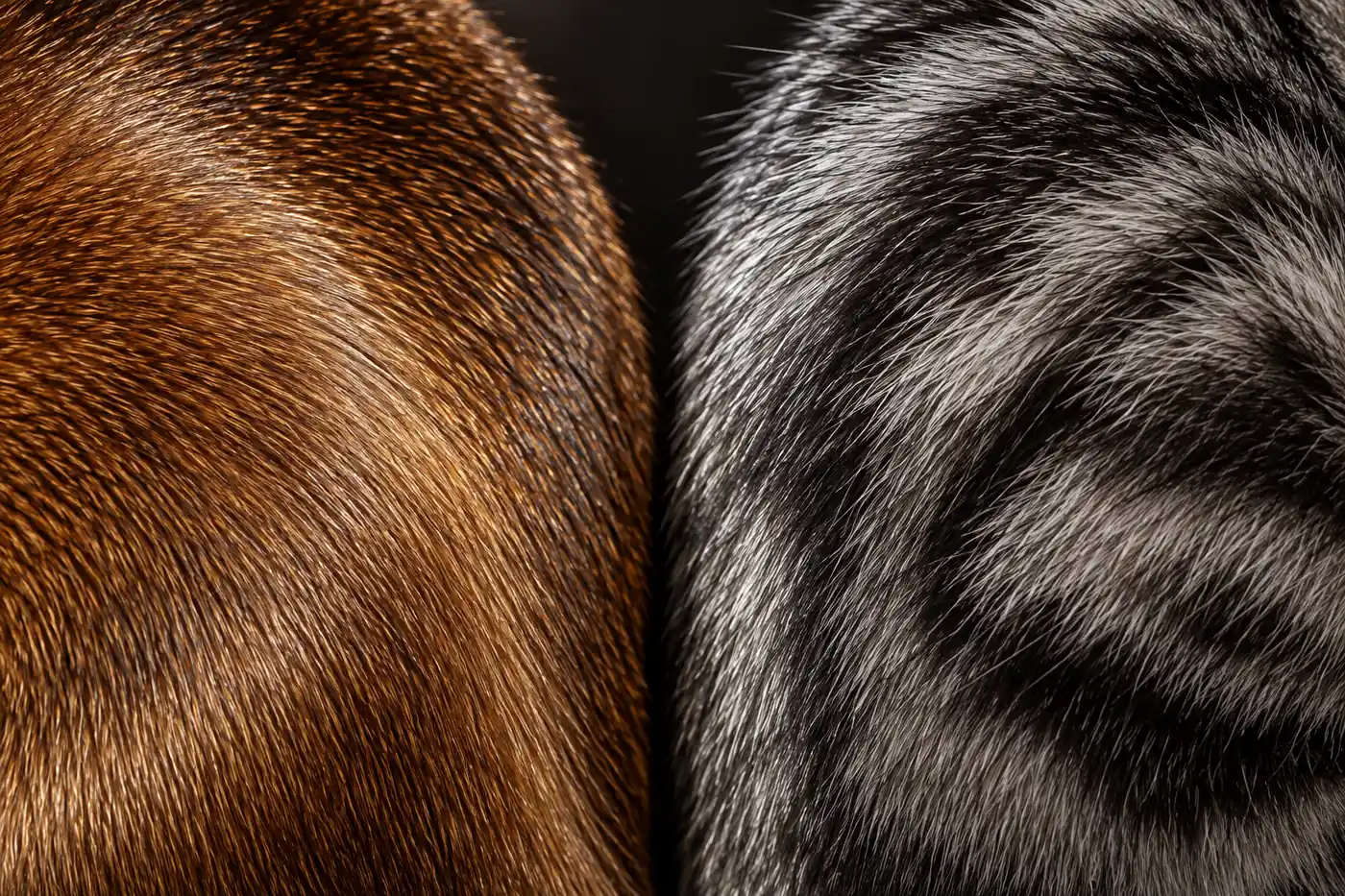
Short-haired does not mean non-shedding or hypoallergenic. Allergens come from saliva and skin secretions as well as loose hair, so a person with cat allergy should spend time around the actual cat before committing rather than using coat length as a proxy.
Grooming also provides a regular body check. Run your hands over the ribs and skin, look at the claws and ears, and notice a new lump, sore area, dandruff or reluctance to be touched. Either breed may need veterinary assessment when the change is sudden or persistent.
Which health tests should a breeder show you?
The two breeds create different paperwork questions. Abyssinians have named DNA tests that can answer specific inherited-risk questions, while an American Shorthair buyer relies more heavily on family history, veterinary records and the breeder's evidence-based screening choices.
| Breed and concern | What to ask for | What the evidence means | What it does not prove |
|---|---|---|---|
| Abyssinian PRA rdAc | Both parents' laboratory reports for the CEP290 rdAc variant | Identifies clear, carrier or affected status for an autosomal recessive retinal-degeneration variant | A clear result does not cover every possible eye disease |
| Abyssinian PK deficiency | Both parents' laboratory reports for the PKLR variant | Identifies clear, carrier or affected status for an inherited cause of haemolytic anaemia | A carrier is not the same as an affected cat, and the result covers one condition |
| Abyssinian renal amyloidosis | Family history and the breeder's records across related cats | Shows whether the breeder tracks a recognised concern for which no simple genetic clearance is available | A reassuring family history is not a lifetime guarantee |
| American Shorthair records | Parents' veterinary history, documented examinations and a specific account of illness in the line | Replaces a vague healthy-line claim with records that can be read and dated | There is no equivalent short DNA checklist that clears the breed as a whole |
| Either breed and HCM | Family history and any cardiac examinations the breeder has performed | Adds evidence about the cats examined at that time | Hypertrophic cardiomyopathy can affect any breed, and one examination cannot guarantee the future |
UC Davis describes PRA rdAc as an autosomal recessive condition linked to a CEP290 variant. Two copies put a cat at risk of progressive retinal degeneration, while one copy makes a carrier that can remain visually normal. The mating pair matters because two carriers can produce affected kittens.
Pyruvate kinase deficiency is also inherited recessively and can cause haemolytic anaemia with variable severity. The original laboratory result, matched to the cat's registered identity, shows the status itself, which the phrase fully tested does not.
The GCCF breeding policy also recognises renal amyloidosis in Abyssinians while noting that no genetic test is available. That turns the conversation toward family history, age and cause of death in related cats rather than another box on a DNA panel.
CFA states that no specific health problem is currently associated with the American Shorthair, but that is not the same as immunity from ordinary feline disease. Hypertrophic cardiomyopathy can affect a cat of any breed, age or sex, and the value of any examination lies in what was checked, in which cat and on what date.
Use the records in a fixed order so a polished folder does not obscure what was actually tested.
- Request the original report rather than a verbal summary or cropped screenshot
- Match the registered names or microchip details on the report to the parents
- Read the exact clear, carrier or affected result and identify the variant it covers
- Check the examination or sample date because a result describes a particular cat at a particular time
- Ask how family illness, longevity and cause of death are recorded when no single DNA test answers the concern
A clear test is narrow evidence about one variant in one cat. The breeder worth choosing explains each document's limit and asks about your home, where a weaker one promises a disease-free line or a guaranteed temperament.
Which cat matches your ordinary day?
The American Shorthair is the usual recommendation for most first-time owners because its moderate activity and greater self-direction leave more room for a normal workday. Prior cat experience matters less than whether you can reliably provide the routine the chosen cat needs.
An Abyssinian becomes the better choice when the extra involvement is the attraction. If connected climbing routes, frequent interactive play and a cat that monitors household activity sound welcome for years rather than exciting for a weekend, the higher workload has a willing owner.
- Choose an Abyssinian when daily play, secure height and frequent interaction are welcome work
- Choose an American Shorthair when adaptability and a quieter workday matter more
- Meet the individual during play, rest and gentle handling rather than judging one greeting
- Read named health reports, dates and family history instead of accepting a verbal assurance
- Check that existing children and animals have separate resources and protected retreat space
- Walk away from any promise of guaranteed temperament or lifetime health
How the actual cat recovers from novelty is the best evidence. A suitable cat can explore, accept a pause, return to baseline and disengage without remaining frozen or escalating, although one visit still cannot reveal every part of life at home. The decision itself is best made with an ordinary Tuesday in mind rather than an idealised day off, because the cat whose needs still fit your time, space and attention on that day is the stronger match.
Checked Against
- TICA: Abyssinian breed introduction tica.org
- TICA: American Shorthair breed introduction tica.org
- CFA: Abyssinian cfa.org
- CFA: American Shorthair cfa.org
- CFA: Finding the purr-fect pedigreed kitten cfa.org
- UC Davis Veterinary Genetics Laboratory: PRA rdAc vgl.ucdavis.edu
- UC Davis Veterinary Genetics Laboratory: pyruvate kinase deficiency vgl.vetmed.ucdavis.edu
- GCCF: Abyssinian breeding policy gccfcats.org
- AAFP: hypertrophic cardiomyopathy client handout catvets.com
- Scientific Reports: breed differences in inherited feline behaviour traits pmc.ncbi.nlm.nih.gov
- Bradshaw: Normal feline behaviour and why problem behaviours develop (Journal of Feline Medicine and Surgery, 2018) pmc.ncbi.nlm.nih.gov
Published 11 September 2026. Last updated .