
What Is a Peterbald, and How Does Its Hairless Gene Differ From the Sphynx?
A Peterbald is an elegant, Oriental-bodied cat that carries an incompletely dominant hair-loss gene from the Donskoy. Unlike the Sphynx, whose hairlessness is recessive, a single copy of the Peterbald's gene can produce a range of coat types from fully bald to a short brush coat. FIFe recognised it in 2012, and WCF also lists the breed.
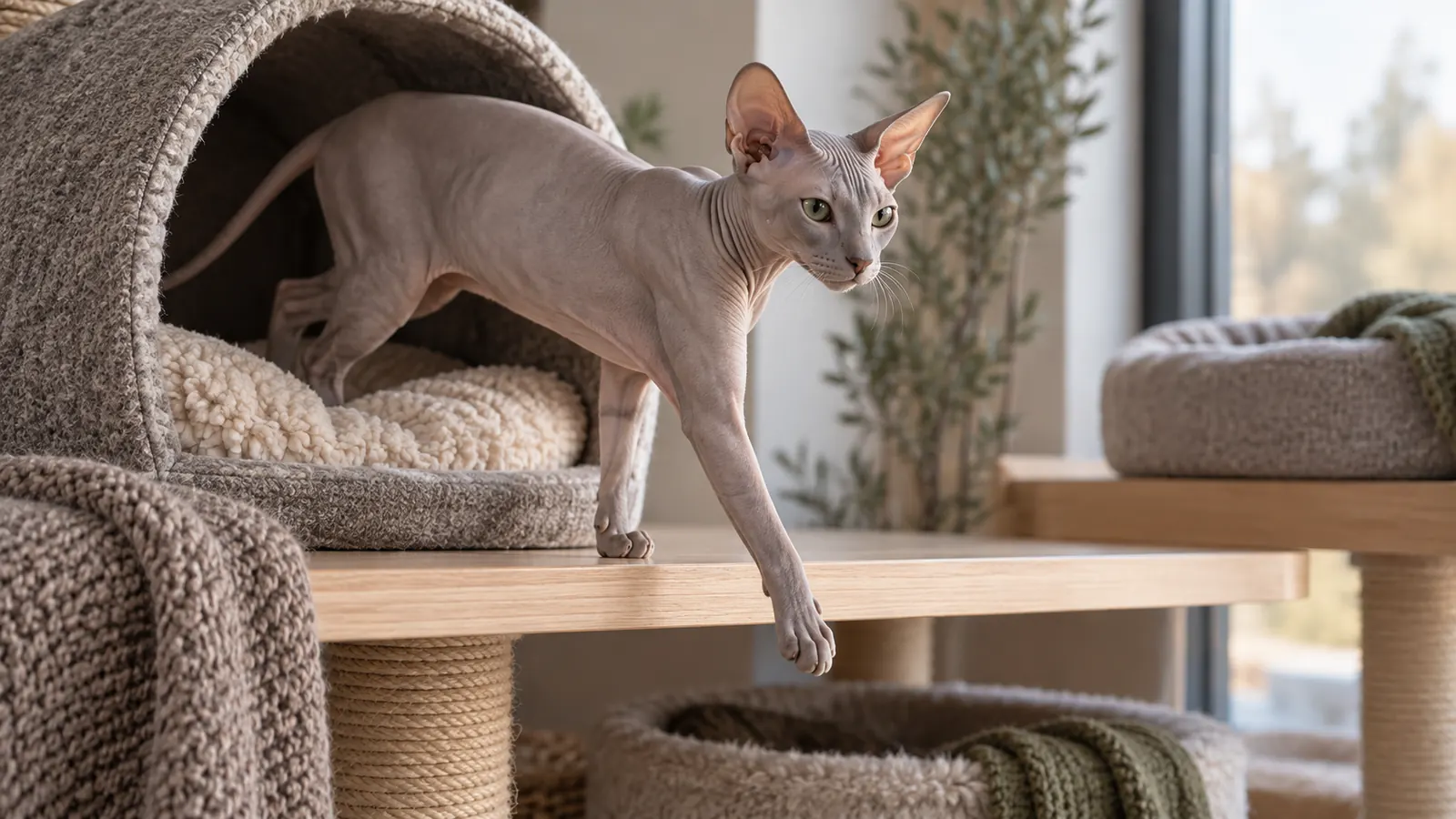
- Origin
- Russia, developed in Saint Petersburg in 1994 by crossing a Donskoy with an Oriental Shorthair
- Coat
- Ranges from completely bald through flock and velour to a short wiry brush coat; kittens without the gene have an ordinary straight coat
- Size
- Medium, long and fine-boned with an Oriental-type body, long whip tail and large ears
- Typical weight
- Secondary sources commonly cite 6 to 10 pounds
- Life expectancy
- Secondary sources cite 12 to 15 years; no Peterbald-specific population study was found
- Activity level
- High; social, athletic and strongly people-oriented
- Grooming
- Low coat maintenance but regular skin care: bathing, sun protection and temperature management
- Suits
- Indoor households that can manage skin care, temperature and sun exposure while providing constant social company
A Peterbald combines an Oriental-type body with a hair-loss gene that produces a range of coats, from completely bald to a short brush coat.
The breed was created in 1994 in Saint Petersburg by crossing a Donskoy male with an Oriental Shorthair female. The Donskoy contributed the hair-loss gene; the Oriental contributed the long, fine-boned body, wedge head and social temperament.
One copy of the Peterbald's hair-loss gene is enough to thin the coat, whereas a Sphynx needs two copies of its recessive KRT71 variant, and that difference in inheritance explains most of what separates the two breeds' coats.
Where Did the Peterbald Come From, and Who Recognises It?
Russian breeder Olga Mironova made the founding cross in 1994. The resulting kittens combined the Donskoy's hair-loss trait with the Oriental's elegant proportions and active temperament.
FIFe recognised the breed in 2012 and WCF also lists it, so a pedigree comes through a club affiliated to a registry that accepts the Peterbald.
- FIFe
- Recognised (2012)
- WCF
- Listed
- Origin
- Saint Petersburg, Russia, 1994
- Founding cross
- Donskoy (dominant hairless) x Oriental Shorthair
- Body type
- Oriental: long, fine-boned, tubular, large ears
- Hair-loss gene
- Incompletely dominant, from the Donskoy; causal variant not yet identified
- Key distinction
- Dominant Donskoy gene vs recessive KRT71 variant in the Sphynx
Ongoing outcrosses to Oriental Shorthairs and Siamese maintain the body type and genetic diversity.
What Are the Five Coat Types?
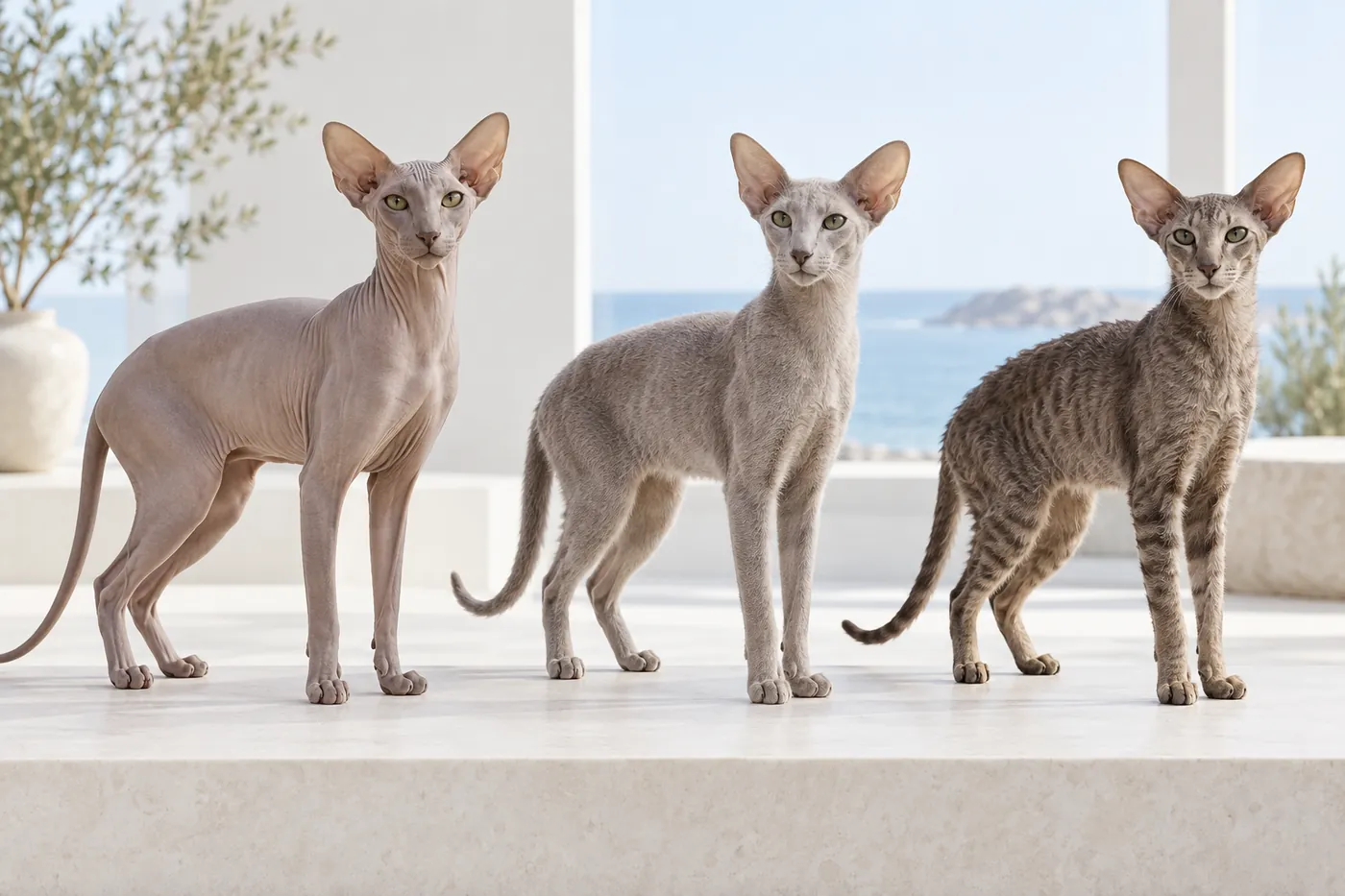
The hair-loss gene produces a spectrum of coats rather than a single appearance. Breeders describe four grades of it, and a fifth type is the ordinary coat of kittens that did not inherit the gene at all:
| Type | What it looks like | What to expect over time |
|---|---|---|
| Bald | Completely hairless, warm smooth skin, may feel slightly sticky | Stays bald |
| Flock, sometimes called chamois | Very fine, almost invisible down with a peach or chamois feel | May lose more hair or stabilise |
| Velour | A breeder term for a short, visible fuzz between flock and brush, which FIFe does not list separately | May thin toward flock or stabilise |
| Brush | Short wiry or wavy coat, sometimes dense enough to see curl structure | Usually retains coat |
| Straight coat | An ordinary short coat on a kitten that did not inherit the gene | Stays coated and cannot pass hair loss on |
A kitten's birth coat does not always predict its adult coat type. Some Peterbalds born with a velour or flock coat lose hair progressively during their first two years. Others stabilise at their birth coat type or shift only slightly.
Brush-coated Peterbalds are sometimes excluded from the show ring depending on the registry, but they are used in breeding programmes to maintain genetic diversity and Oriental body type.
How Does the Dominant Gene Differ From the Sphynx?
The Sphynx owes its coat to a recessive variant of the KRT71 gene, often written hr. Both parents must contribute a copy for a kitten to be hairless, and the resulting cats have a consistent near-hairless appearance with very fine residual fuzz.
The Peterbald and Donskoy share a hair-loss gene that is incompletely dominant. One copy produces hair loss to a varying degree, which is why the coat grades exist. Researchers have ruled out KRT71 as its cause and have not yet identified the variant itself, so no DNA test can confirm that a cat carries it.
Two copies may be associated with more complete baldness, though controlled studies are limited.
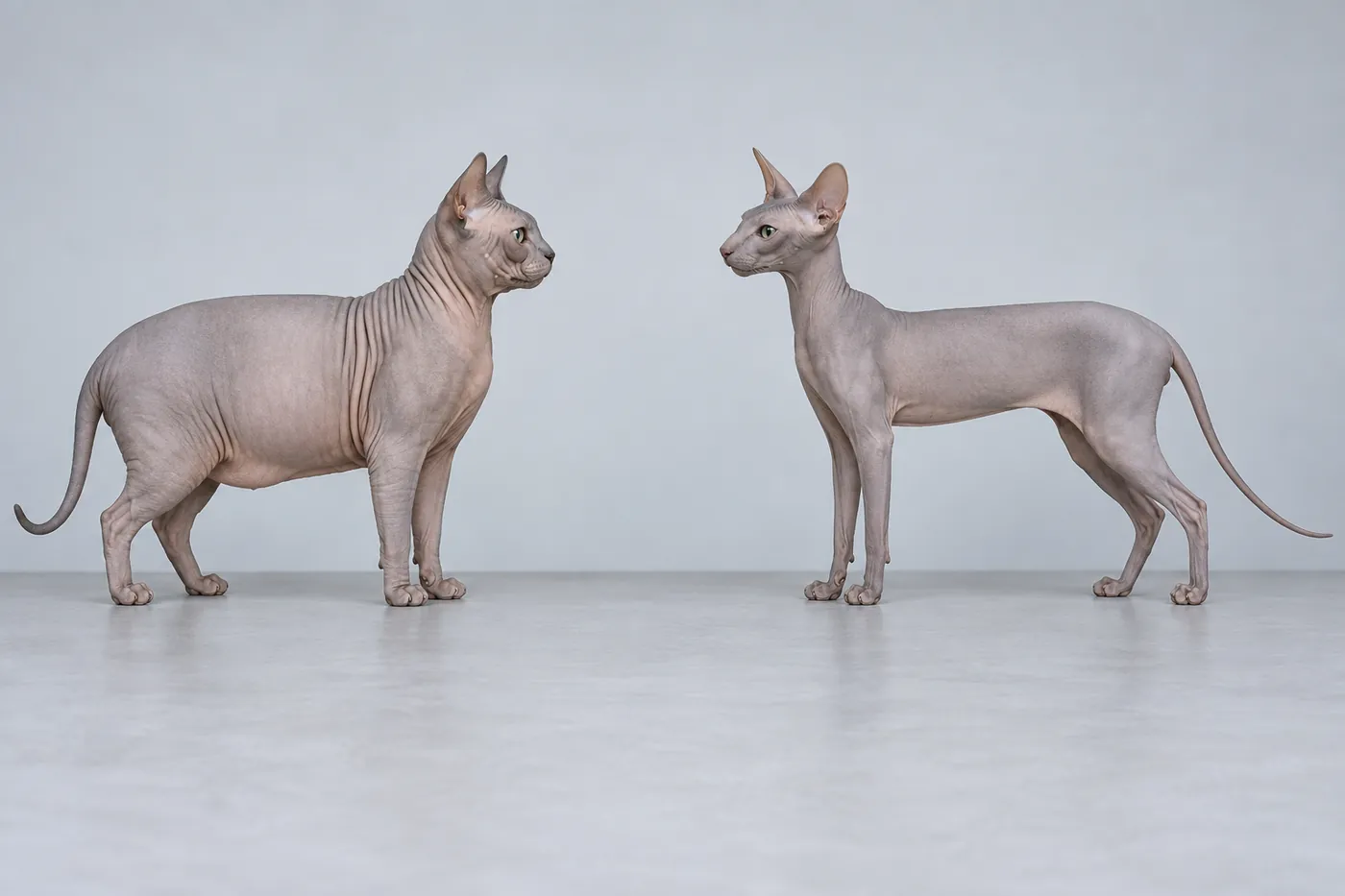
The body types are also different. A Sphynx has a muscular, barrel-chested body with round contours, and a Peterbald has the long, fine-boned Oriental silhouette. At a distance, the body shape alone often identifies which breed is which.
What Skin Care Does a Peterbald Need?
The degree of skin exposure determines the care routine. A bald or chamois Peterbald needs the most attention; a brush-coated one needs less.
Bathing. Exposed skin accumulates oils that a normal coat would absorb. A gentle bath with an unscented cat-safe cleanser every one to two weeks keeps the skin clean without stripping it.
Sun exposure. Bare or nearly bare skin burns, and a sunny window seat is enough to do it, so an indoor life with shade over the favourite resting spots is the usual arrangement.
Temperature. A bald Peterbald loses body heat faster than a coated cat. Warm bedding, stable indoor temperatures and protection from draughts matter year-round, and more during cooler months.
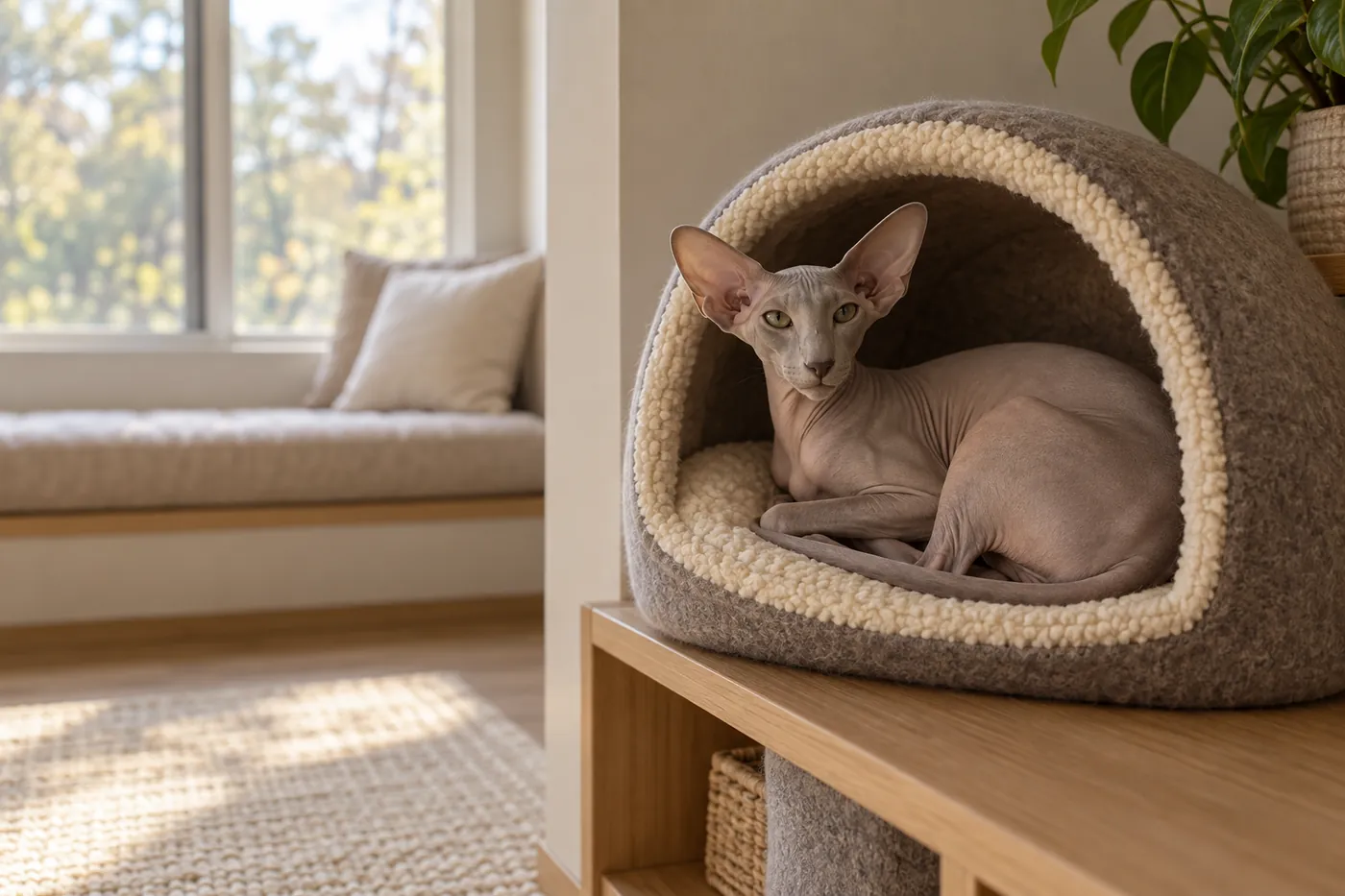
Skin injuries. Without a coat to buffer contact, a Peterbald's skin is more vulnerable to scratches, abrasions and friction burns from rough surfaces. Smooth, clean bedding and safe furniture surfaces reduce the risk.
Nail care matters more than in a coated breed because a Peterbald scratching its own skin can cause visible damage.
A bald Peterbald needs the full routine described above, while a brush-coated one needs little more than an ordinary shorthair, because the wiry coat absorbs oils and provides insulation. Knowing which coat type you are acquiring, and whether it is likely to change, is one of the most practical questions to ask a breeder.
What Is the Peterbald's Temperament Like?
The Oriental Shorthair ancestry shows in the temperament. Peterbalds are described as affectionate, curious and energetic, and FIFe notes that they tend to follow their owners and want to be with them.
They tend to follow people between rooms, and seek physical contact. The temperament is closer to the Siamese family than to the more independent Sphynx.
That attachment has a cost for a household that is out all day, because a cat built to follow people has nobody to follow, and long absences tend to show up as calling and restlessness.
Food motivation and curiosity make reward-based training work well, and that matters more here than in a coated breed: a Peterbald that has learned to accept handling makes the regular bath a short job rather than a struggle.
What Health Considerations Apply?
No population health study of the Peterbald has been published, so its health picture is drawn from its two parent lines.
From the Oriental side come the Siamese-family records. Liver amyloidosis was found in 12 of 194 Siamese and Oriental cats examined after death in one Dutch series, the rdAc form of retinal degeneration is common in Siamese and can be DNA tested, and a Siamese tendency to asthma has been suggested but not proven.
From the Donskoy side comes the hair-loss gene, whose consequences are the skin and temperature needs described above rather than a known inherited disease.
Secondary sources cite a lifespan of 12 to 15 years. That range is plausible but unverified.
How Does a Peterbald Fit a Family or Multi-Pet Home?
Children should understand that bare or nearly bare skin is more vulnerable to scratching, rough play and accidental injury than a coated cat's body. Gentle handling at the cat's level works better than picking up a fine-boned body.
The breed's social drive means it generally seeks contact rather than avoiding it. A Peterbald that has been socialised with children typically participates willingly.
Multi-cat households can work well, particularly with another social breed. A Peterbald's Oriental-derived persistence may overwhelm a reserved or solitary cat.
Who Suits a Peterbald?
The combination of high social demand, regular skin care and temperature sensitivity makes this a breed for a committed owner.
- Indoor living with stable temperature and managed sun exposure
- Bathing every one to two weeks with a gentle cleanser
- Company for most of the day, either human or a compatible cat
- Interactive play that uses the breed's athleticism and curiosity
- Parents' rdAc DNA results, from the Siamese-family side
- Willingness to manage skin injuries and monitor coat-type changes in young cats
A household that already manages a Sphynx or Donskoy will find the skin-care routine familiar, but the temperament is more Oriental than Sphynx: more people-focused and less self-contained.
With a kitten, the questions that matter most are its current coat type and how coats in that breeder's lines have changed over the first two years, because that decides how much skin care the adult will need. Registration naming both parents with a body that accepts the breed, such as FIFe or WCF, is the proof of identity; a DNA test cannot provide it, since the Donskoy hair-loss variant has not been identified.
Common Questions
Is a Peterbald the same as a Sphynx?
No. The Peterbald carries a dominant hair-loss gene from the Donskoy and has an Oriental-type body. The Sphynx carries a recessive KRT71 variant and has a muscular, barrel-chested body. Because the genes differ, a Sphynx DNA result says nothing about a Peterbald's coat.
Do all Peterbalds look the same?
No. The hair-loss gene produces coats ranging from completely bald to a short wiry brush coat, and kittens that do not inherit it have an ordinary coat. A kitten's coat may also change during its first two years.
How often do you bathe a Peterbald?
Bald and chamois-coated Peterbalds typically need bathing every one to two weeks to remove oil buildup. Brush-coated cats need less frequent bathing.
Are Peterbalds vocal?
Moderately. FIFe describes the breed as medium vocal, with a strong wish to follow its owners and be with them.
How big does a Peterbald get?
The breed is medium-sized, long and fine-boned. Secondary sources cite 6 to 10 pounds.
Checked Against
- FIFe: Peterbald fifeweb.org
- WCF: Hairless breed standards (Peterbald) wcf.de
- FIFe: Recognised breeds fifeweb.org
- OMIA: Don Sphynx hypotrichosis (inheritance and KRT71 exclusion) omia.org
- van der Linde-Sipman et al.: AA amyloidosis in Siamese and Oriental cats (1997) pubmed.ncbi.nlm.nih.gov
- Menotti-Raymond et al.: rdAc retinal degeneration across cat breeds (Veterinary Journal, 2010) pubmed.ncbi.nlm.nih.gov
- Cornell Feline Health Center: Feline asthma vet.cornell.edu
Published 17 September 2026. Last updated .





