What Is Acute Kidney Injury in Cats, and Is It Reversible?
Acute kidney injury is a sudden loss of function over hours or days, not the slow decline most people mean by kidney failure. The distinction matters because this one is sometimes reversible.

Acute kidney injury is a sudden loss of kidney function over hours or days. It is a different disease from the slow decline most people mean by kidney failure.
The distinction matters because this one is sometimes reversible.
Sudden and slow are different diseases
Acute kidney injury develops over hours or days. Chronic kidney disease is persistent kidney damage, often recognised through changes over months.
A cat with chronic disease can also suffer an acute injury.
The distinction affects treatment and outlook, but body weight or kidney size alone cannot settle it. A vet combines the history, previous results, examination, blood and urine tests, and sometimes imaging.
Some acute injuries recover; others leave permanent damage or prove fatal.
What causes it
Toxin exposure is one preventable cause, so report any possible contact with lilies, antifreeze or medicines immediately.
Several processes can injure the kidneys. None can be diagnosed safely from symptoms at home.
Toxins damage the filtering tissue directly. Lilies and antifreeze both destroy the tubules over hours, which is why they are treated before signs appear rather than after them.
Anti-inflammatories reach the same place by a different route, and they get given deliberately. They cut the blood supply to the kidney rather than poisoning it, which is why a dose that seems small still matters.
A blockage damages the kidney from downstream. Urine that cannot leave backs pressure up the system until filtration stops, and obstruction can involve either a ureter or the urethra.
The next group is about supply rather than damage. Severe dehydration, blood loss and heatstroke all reduce the blood reaching the kidney, and tissue starved of blood dies whatever sent it short.
Infection may also injure the kidneys. Its speed and severity vary, and a urine culture may be needed to guide treatment.
- Lilies, where every part of the plant including pollen and vase water causes kidney failure
- Antifreeze, where a small exposure can be fatal and treatment must not wait for a dose calculation
- Human medicines, particularly ibuprofen and other anti-inflammatories
- Some prescribed drugs, including certain antibiotics, given at the wrong dose
- A urinary blockage, which backs pressure up into the kidneys
- Anything causing severe dehydration or a drop in blood pressure, including heatstroke
- Infection reaching the kidney, usually travelling up from the bladder
A blocked bladder deserves separate mention because it is both a cause and an emergency in its own right, and it affects male cats far more often.
What it looks like
Signs arrive quickly and are non-specific at first, which is why the history matters as much as the examination.
The early picture is a cat that is suddenly quiet, off its food, and vomiting.
Vomiting has many causes, and what marks this one out is how quickly the cat became unwell. Many are dehydrated by the time they are seen.
Report changes in urine output. Producing none or repeatedly straining without urine is an emergency; increased output also has several possible causes and needs investigation.
A painful abdomen, a hunched posture, ulcers in the mouth, or breath that smells of ammonia are all consistent with it and all warrant same-day attention.
The blocked bladder, which is its own emergency
A urinary obstruction causes acute kidney injury by backing pressure up the system, and it kills faster than almost anything else on the list.
It affects male cats far more often, because the urethra narrows towards the tip and a plug of crystals, mucus, or inflammatory debris lodges there.
The picture is a cat going repeatedly to the tray and producing nothing, often crying, often licking at itself, and becoming rapidly unwell. It is frequently mistaken for constipation, which costs hours that matter.
An obstruction can rapidly cause dangerous electrolyte changes and become fatal. This is an emergency at three in the morning, not a wait for the practice to open.
How it is diagnosed
Blood tests show raised creatinine and urea, and a urine sample shows whether the kidneys are still concentrating.
Potassium is measured urgently because a high level affects the heart directly, and it is one of the reasons a cat that seems only mildly unwell can deteriorate quickly.
Imaging contributes to distinguishing the two forms but is not conclusive by itself. Acutely injured kidneys are often normal-sized or swollen and painful, where chronically damaged ones are small and irregular.
Where a toxin is suspected, the timing of the exposure changes the treatment more than the blood results do, so the history is part of the diagnosis rather than background to it.
What happens in hospital
Cats with more than the mildest grade of acute kidney injury usually need hospital care. A non-azotaemic Grade I case may sometimes be managed without admission, but it still needs a diagnostic plan and close early monitoring.
The first day is about restoring circulation to the kidneys. Fluids are given through a drip into a vein, calculated against the cat's weight and its degree of dehydration, and adjusted through the day rather than set once.
A urinary catheter is often placed so that output can be measured precisely. That number, hour by hour, is what tells the team whether the kidneys are responding.
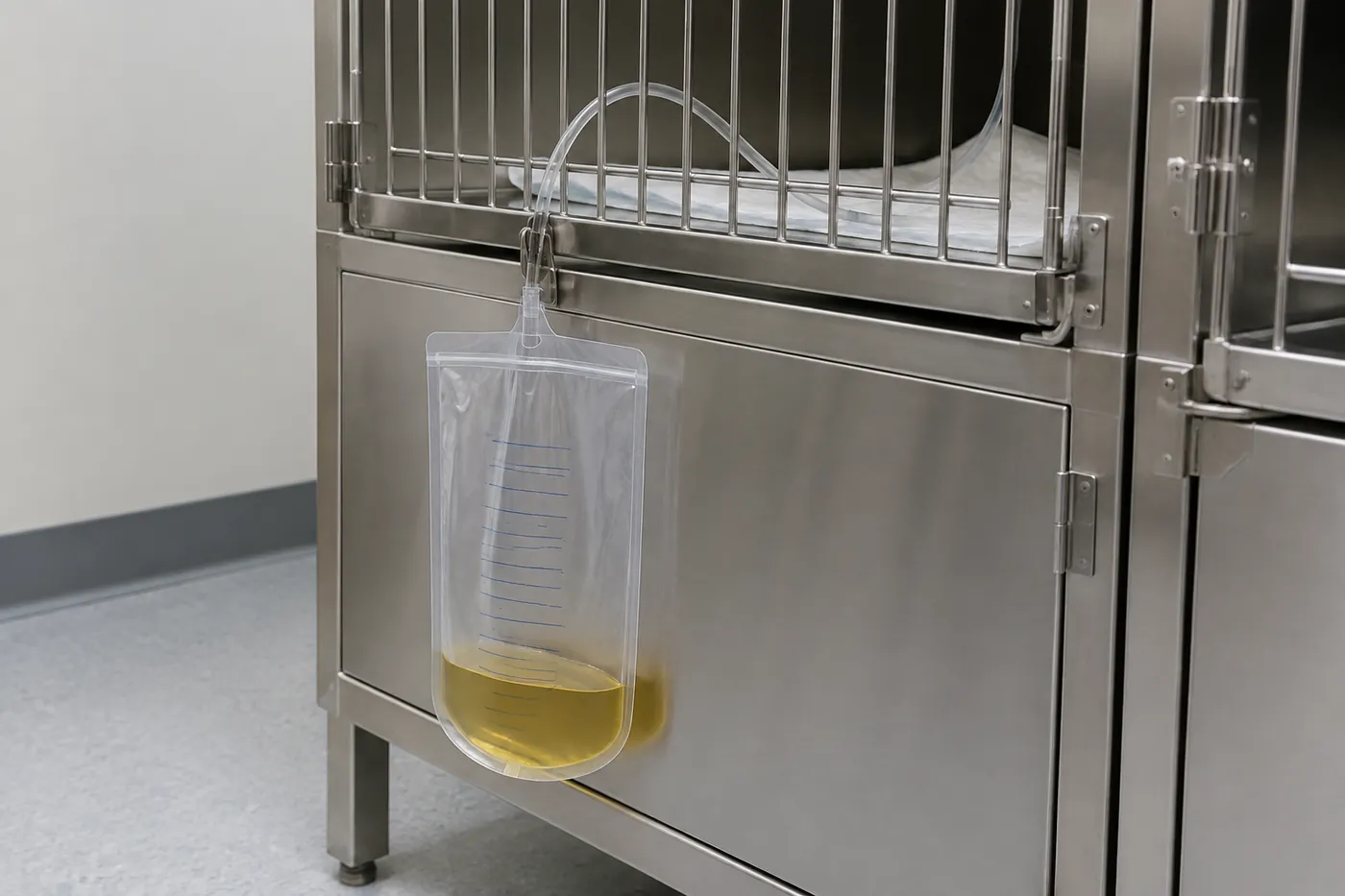
The monitoring schedule follows severity and urine output. Hospital teams may check fluid balance, electrolytes and acid-base status more than once a day in a seriously ill cat, while kidney values are interpreted as a trend rather than from one result.
There is no dependable two-to-five-day stay. Severe cases may remain in hospital for about a week or longer, and discharge is considered only when clinical signs are controlled and kidney values remain stable without intravenous treatment.
- Core treatment
- Intravenous fluids, adjusted rather than fixed
- Measured continuously
- Urine output, often with a catheter
- Repeated to clinical need
- Fluid balance, kidney values, electrolytes, acid-base status and blood pressure
- Treated alongside
- Nausea, blood pressure, and the underlying cause
- Length of stay
- Set by severity and response; severe cases may need about a week or longer
- Discharge test
- Eating, urinating, and stable off the drip
What not to do while you are arranging a vet
The instinct to help at home does more harm than good in this illness.
Do not withhold water from a vomiting cat, and do not force water into it either. A cat that cannot keep water down needs fluids into a vein, and pouring liquid into a nauseated cat risks it going into the lungs.
Do not give any human medicine. Ibuprofen and other anti-inflammatories are a common cause of this disease in the first place, and giving one to a cat whose kidneys are already failing is the worst available move.
Do not wait to see whether the cat urinates overnight. Where a blockage or a toxin is possible, the hours spent waiting are the hours in which treatment would have worked.
Do take a note of what the tray has looked like, what the cat may have reached, and when it was last normal. Those three facts shape the first hour of treatment.
Treatment, and what recovery looks like
The core of it is intravenous fluid therapy, calculated and adjusted rather than simply given, with urine output measured throughout.
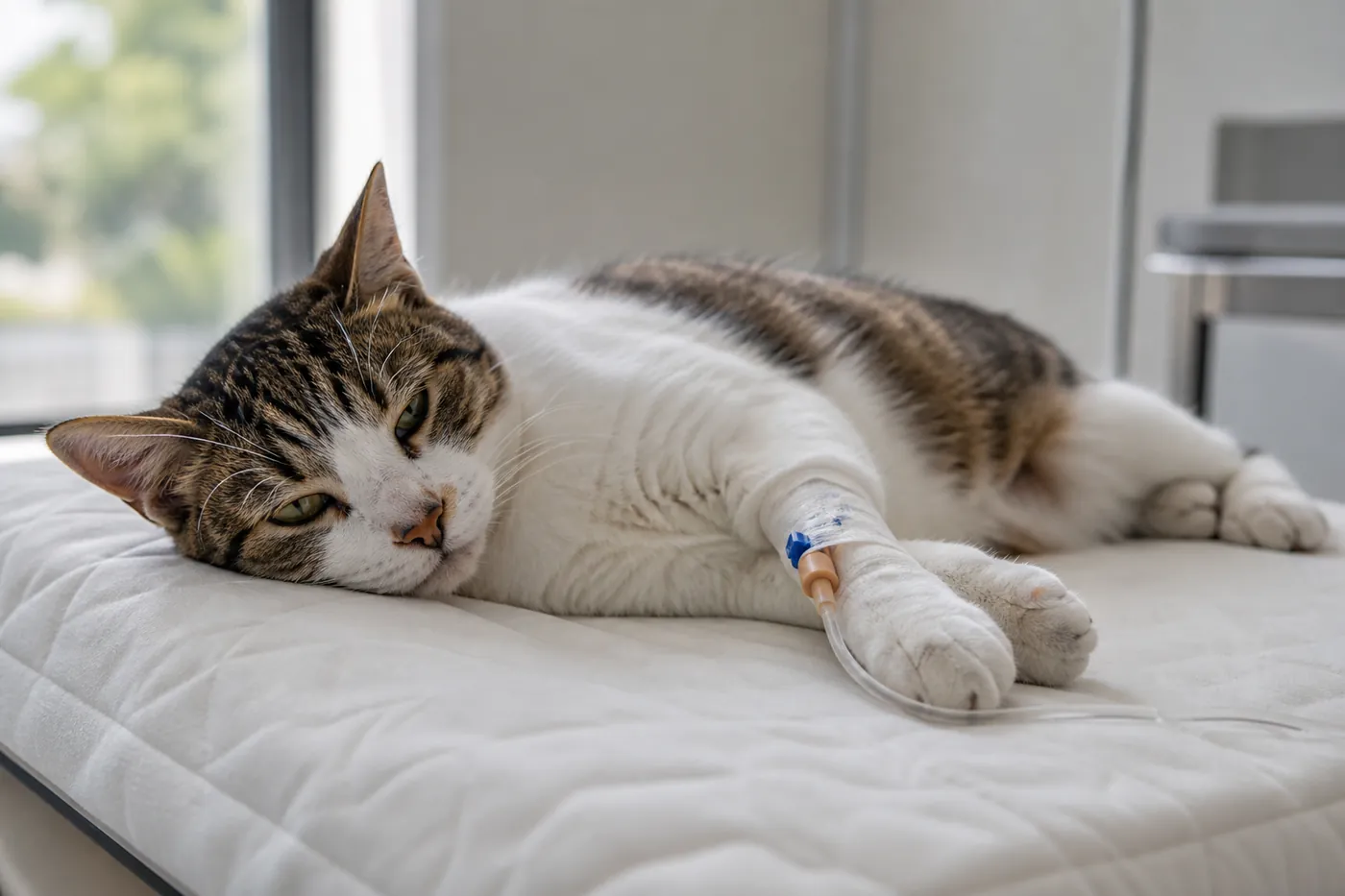
Around it sits treatment of the cause: an antidote where one exists, relief of a blockage, antibiotics for infection, and stopping any drug that may be responsible.
Anti-nausea medication and nutritional support matter more than they sound. A cat that will not eat for several days develops separate liver problems on top of the kidney injury.
Some cats recover fully. Some are left with reduced function and go on to be managed as chronic cases, and some do not survive, particularly where urine production never returns.
What the chances actually are
The prognosis is uncertain at the start. Cause, extent of injury, urine output, other illness and response to treatment all matter.
Producing urine is helpful information, but it does not prove that filtration is adequate or that recovery is complete.
Ask the team which results are improving, what complications remain and when they can reassess the outlook. Some cats recover fully, some need continuing kidney care and some do not survive despite treatment.
Dialysis is available at some referral centres. It can support selected patients while treatment and recovery take place; availability and suitability need an individual discussion.
After the crisis
A cat that recovers from acute kidney injury is not simply back to where it started.
Recheck blood tests at intervals over the following months establish whether function returned fully or settled at a new, lower level. A cat left with reduced function is then managed as a chronic kidney disease case from that point on.
That is not a bad outcome. Cats in early stage chronic disease often live for years, and knowing the kidneys are vulnerable changes future decisions about anaesthetics and medications.
Tell any vet who treats the cat afterwards about the episode. Several routine drugs are dosed differently, or avoided, in a cat with a history of kidney injury.
Prevention is mostly two decisions
Do not keep lilies in a house with a cat, and ask florists to leave them out of bouquets. There is no safe distance and no safe amount.
Store antifreeze sealed and high, wipe spills and rinse the area rather than mopping it, and check under a parked car in cold weather.

Never give ibuprofen or naproxen without veterinary direction. Paracetamol is also highly toxic, but it is a different drug and chiefly damages red cells and the liver.
Keep older cats' water easy to reach, watch for any increase in drinking, and have annual bloods on any cat past ten to discuss appropriate screening and catch a change early.
Common Questions
What causes sudden kidney failure in cats?
Possible causes include toxins such as lilies and antifreeze, some medicines, urinary obstruction, severe circulatory problems and infection. A vet needs the history and tests to identify the cause.
How is it different from chronic kidney disease?
Acute injury develops over hours or days, while chronic disease is persistent damage. They can occur together; appearance or kidney size alone cannot distinguish them.
Can a cat recover from acute kidney injury?
Some cats recover fully, some have lasting damage and some do not survive. Urine output, blood results, the cause and response to treatment all inform the outlook.
Checked Against
Published 2 September 2026. Last updated .