
What Is a Ukrainian Levkoy, and What Do Its Two Parent Mutations Mean for Welfare?
A Ukrainian Levkoy is a hairless cat with forward-folding ears, produced by crossing Donskoy and Scottish Fold lines. The breed combines two mutations that each carry documented welfare considerations: the Donskoy's incompletely dominant hair-loss gene (skin care, sun exposure, temperature sensitivity) and the Scottish Fold's fold-ear gene (osteochondrodysplasia, a progressive cartilage and bone disorder). Neither FIFe nor WCF recognises it.
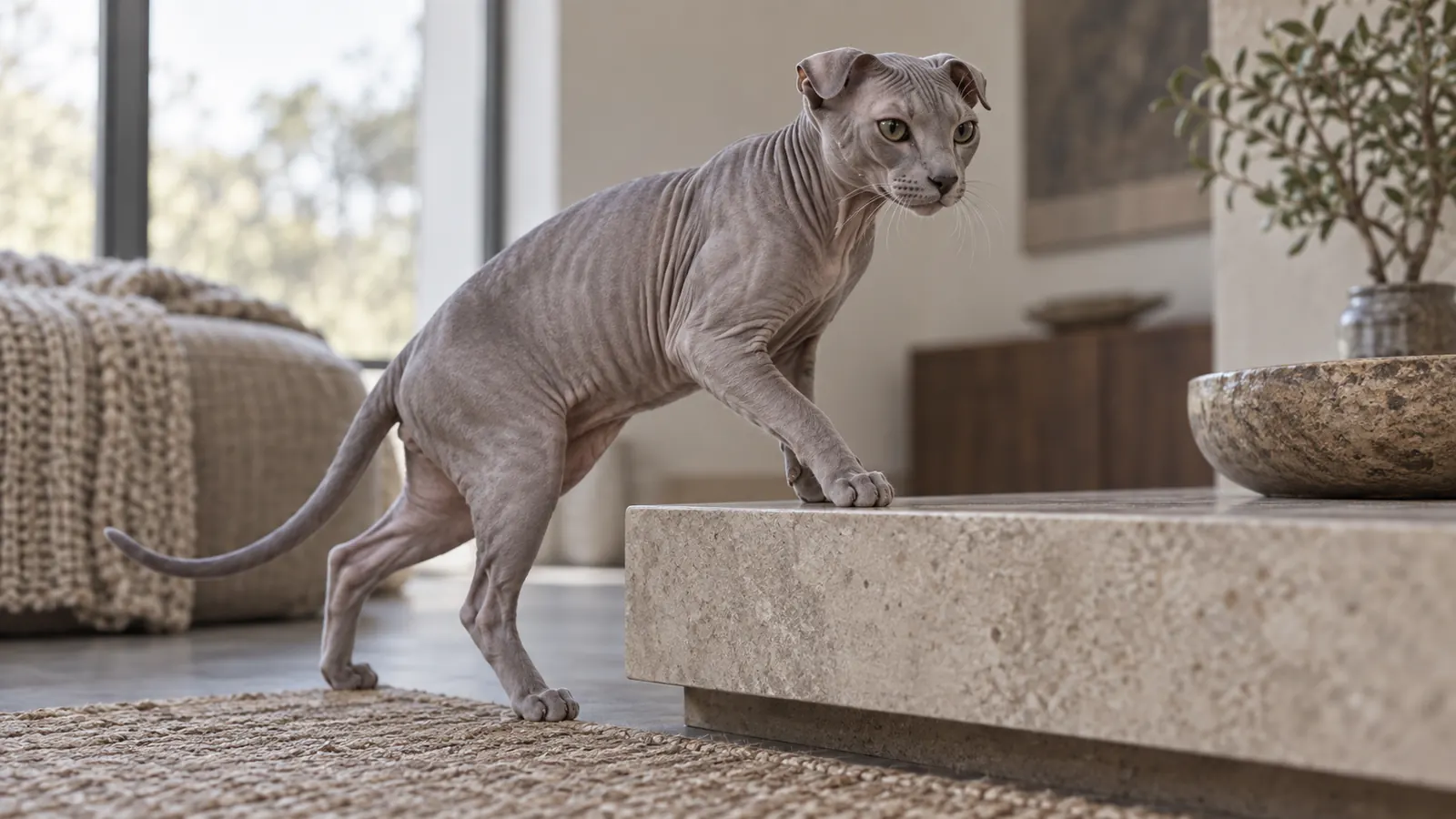
- Origin
- Ukraine, developed from Donskoy and Scottish Fold lines
- Coat
- Hairless or near-hairless, following the Donskoy coat-type spectrum
- Size
- Medium, muscular with an angular face, large eyes and the characteristic forward-folding ears
- Typical weight
- Secondary sources commonly cite 8 to 12 pounds
- Life expectancy
- No breed-specific population data exists
- Activity level
- Varies between an active, social Donskoy type and a calmer Scottish Fold type; joint pain can limit jumping
- Grooming
- Regular skin care: bathing, sun protection and temperature management from the hairless side
- Suits
- Experienced owners who understand both the skin-care commitment and the skeletal welfare concern from the fold-ear gene
A Ukrainian Levkoy combines two mutations, each borrowed from a different breed, and each carrying its own welfare concern.
The Donskoy contributes an incompletely dominant hair-loss gene that produces coats ranging from bald to brush; its causal variant has not been identified. The Scottish Fold contributes a dominant variant of the TRPV4 gene that folds the ears forward.
The fold-ear gene is the more serious concern, because the same variant that folds the ear changes cartilage and bone throughout the body.
What Does the Fold-Ear Gene Actually Do?
The Scottish Fold's ear shape comes from a TRPV4 variant that affects cartilage wherever it forms, and the ear is simply where the effect is easiest to see.
The condition is called osteochondrodysplasia (OCD). It causes abnormal development of cartilage and bone, producing progressive joint disease that can range from mild stiffness to severe, painful arthritis.
The tail, ankles, knees and other joints can all be affected.
In cats with two copies of the variant the disease is typically severe. One copy does not make a cat safe: in an Australian case series, every affected Scottish Fold whose pedigree was known came from a fold mated to a straight-eared cat, the pairing that produces one-copy kittens, and the severity and onset varied from cat to cat.
Crossing the fold into another breed does not dilute the problem either. Two Scottish Fold cross-breeds described in 2020, one with Munchkin and one with American Curl ancestry, carried two copies of the variant and had severe bone growths in the hind legs on radiographs taken at about a year old. The same gene and the same risk apply to the Ukrainian Levkoy whenever its ears fold.
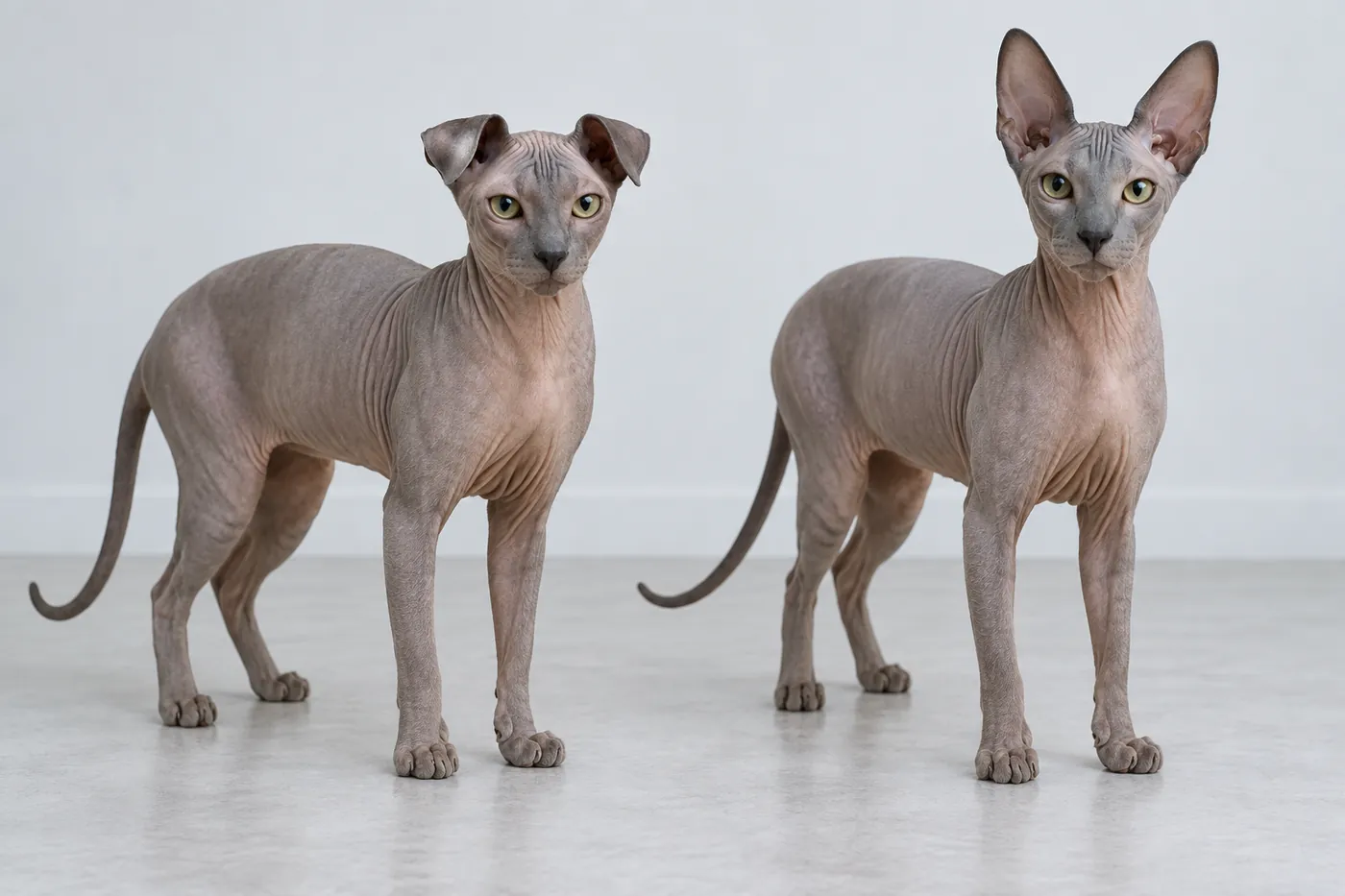
The German Animal Welfare Association reported in 2025 that Belgium, Austria and the Netherlands had banned breeding Scottish Folds, in some cases along with their sale or keeping, and that fold breeding had been stopped in individual cases in Bavaria. Rules differ between countries and change over time, and whether a given rule covers a Levkoy depends on its wording, but the welfare reasoning behind these restrictions applies to any cat carrying the fold variant.
What Registry Status Does the Breed Hold?
FIFe's complete breed list and WCF's hairless-breed index do not include the Ukrainian Levkoy, so a kitten will not come with papers from either body.
- FIFe
- Not listed
- WCF
- Not listed
- Origin
- Ukraine
- Founding cross
- Donskoy (incompletely dominant hair loss) x Scottish Fold (fold-ear gene)
- Hair-loss gene
- Incompletely dominant, from the Donskoy; causal variant not identified
- Fold-ear gene
- Dominant TRPV4 variant, from the Scottish Fold
- Key welfare concern
- Osteochondrodysplasia from the fold-ear gene
The fold variant makes wider acceptance unlikely, because a registry that recognised the Levkoy would be endorsing the osteochondrodysplasia that comes with its defining trait.
What Skin Care Does the Hairless Body Need?
The Donskoy-derived hair loss produces the same range of coats seen in the Donskoy and the Peterbald: bald, flock, velour and brush, while a kitten that did not inherit the gene grows an ordinary coat, so the care load depends on which coat a kitten ends up with.
The care is the same as for any Donskoy-derived hairless cat: regular bathing to remove the oil a coat would absorb, protection from sun on exposed skin, and stable indoor temperatures in place of the missing insulation.
What Health Monitoring Does the Breed Need?
Two separate monitoring tracks run in parallel.
For the fold-ear gene: the early signs are a reluctance to jump, a stiff or stilted gait, lameness, and a tail that feels short, thick and inflexible when gently moved. Radiographs can show osteochondrodysplasia before those signs become obvious. Pain from this condition is progressive and may not be visible until it is advanced.
For the hairless skin: the bathing, sun protection and temperature management described above, plus attention to scratches and abrasions that a coat would otherwise have buffered.
No health study of the Ukrainian Levkoy has been published. The health picture is assembled entirely from Scottish Fold and Donskoy research.
What Is a Ukrainian Levkoy Like to Live With?
No registry that recognises the Levkoy publishes a temperament description, so the best guide is its two parents. FIFe describes the Don Sphynx as curious, soft-hearted and social, active enough to need stimulation, and unhappy left alone. CFA describes the Scottish Fold as calm and affectionate, quietly playful, able to learn basic tricks and unhappy left alone for long. A Levkoy can land anywhere between those two characters, and both parents point to a cat that wants company for much of the day.
Activity has a limit that neither parent description mentions. Joint disease from the fold variant can make jumping and climbing painful, so a Levkoy that stops using high places, or plays less than it used to, may be showing early osteochondrodysplasia, and that change is worth a veterinary check.
Children and other animals bring the same two cautions. CFA notes that Scottish Folds are usually patient with children, but a cat with sore joints is best lifted with its whole body supported, and bare skin scratches more easily than a coated cat's. FIFe describes the Don Sphynx as fond of the other animals in its home, while CFA notes that other cats can read folded ears as a sign of hostility, so introductions to a resident cat need more time.
Who Should Consider a Ukrainian Levkoy?
Anyone considering a Levkoy is weighing a welfare question before a care question. The joint disease that comes with folded ears has been confirmed on radiographs in cats with one copy of the variant as well as two, it progresses, and it can cause lifelong pain; the hair loss then adds a daily routine of skin and temperature care on top.
The most useful evidence a breeder can offer is radiographs of the parents' joints and tails, together with their ear types, since a mating between two fold-eared cats risks kittens with two copies of the variant.
- Registration documentation from the breeder
- Radiographic assessment of the cat's joints for osteochondrodysplasia
- The parents' joint health and fold-ear status confirmed
- The breeder explains the osteochondrodysplasia risk honestly, not dismissively
- Skin care routine (bathing, sun, temperature) understood before purchase
- Legal status of fold-ear breeding confirmed in your jurisdiction
If the hairless aesthetic appeals but the fold-ear welfare concern does not, the Donskoy and the Peterbald offer hairless cats without the fold-ear gene and its associated joint disease.
Common Questions
Is the Ukrainian Levkoy a recognised breed?
Neither FIFe nor WCF lists it, so it has no recognition from either of those international bodies.
What is osteochondrodysplasia?
A progressive cartilage and bone disorder caused by the Scottish Fold's fold-ear gene. It affects joints throughout the body, not just the ears, and can cause chronic pain and stiffness. It applies to the Ukrainian Levkoy whenever the fold-ear gene is present.
Is the Ukrainian Levkoy legal to breed?
The German Animal Welfare Association reported in 2025 that Belgium, Austria and the Netherlands had banned breeding Scottish Folds and that fold breeding had been stopped in individual cases in Bavaria. Rules vary by country and change over time, and whether one covers a Levkoy depends on its wording, so the rules where you live decide it.
Does the Ukrainian Levkoy need special care?
Yes, on two fronts. The hairless skin needs regular bathing, sun protection and temperature management. The fold-ear gene requires monitoring for joint stiffness, lameness and progressive skeletal changes.
What alternatives exist without the fold-ear gene?
The Donskoy and Peterbald are hairless breeds that do not carry the fold-ear gene. They offer the hairless aesthetic without the osteochondrodysplasia risk.
Checked Against
- FIFe: Recognised breeds fifeweb.org
- WCF: Hairless breed standards index wcf.de
- Takanosu and Hattori: Osteochondrodysplasia in Scottish Fold cross-breed cats (J Vet Med Sci, 2020) pmc.ncbi.nlm.nih.gov
- Malik et al.: Osteochondrodysplasia in Scottish Fold cats (Australian Veterinary Journal, 1999) pubmed.ncbi.nlm.nih.gov
- OMIA: Don Sphynx hypotrichosis (inheritance and KRT71 exclusion) omia.org
- German Animal Welfare Association: Lifelong suffering, why you should not buy a Scottish Fold (2025) tierschutzbund.de
- FIFe: Don Sphynx fifeweb.org
- CFA: Scottish Fold cfa.org
Published 17 September 2026. Last updated .





