
What Is a Russian White, and Is It a Separate Breed From the Russian Blue?
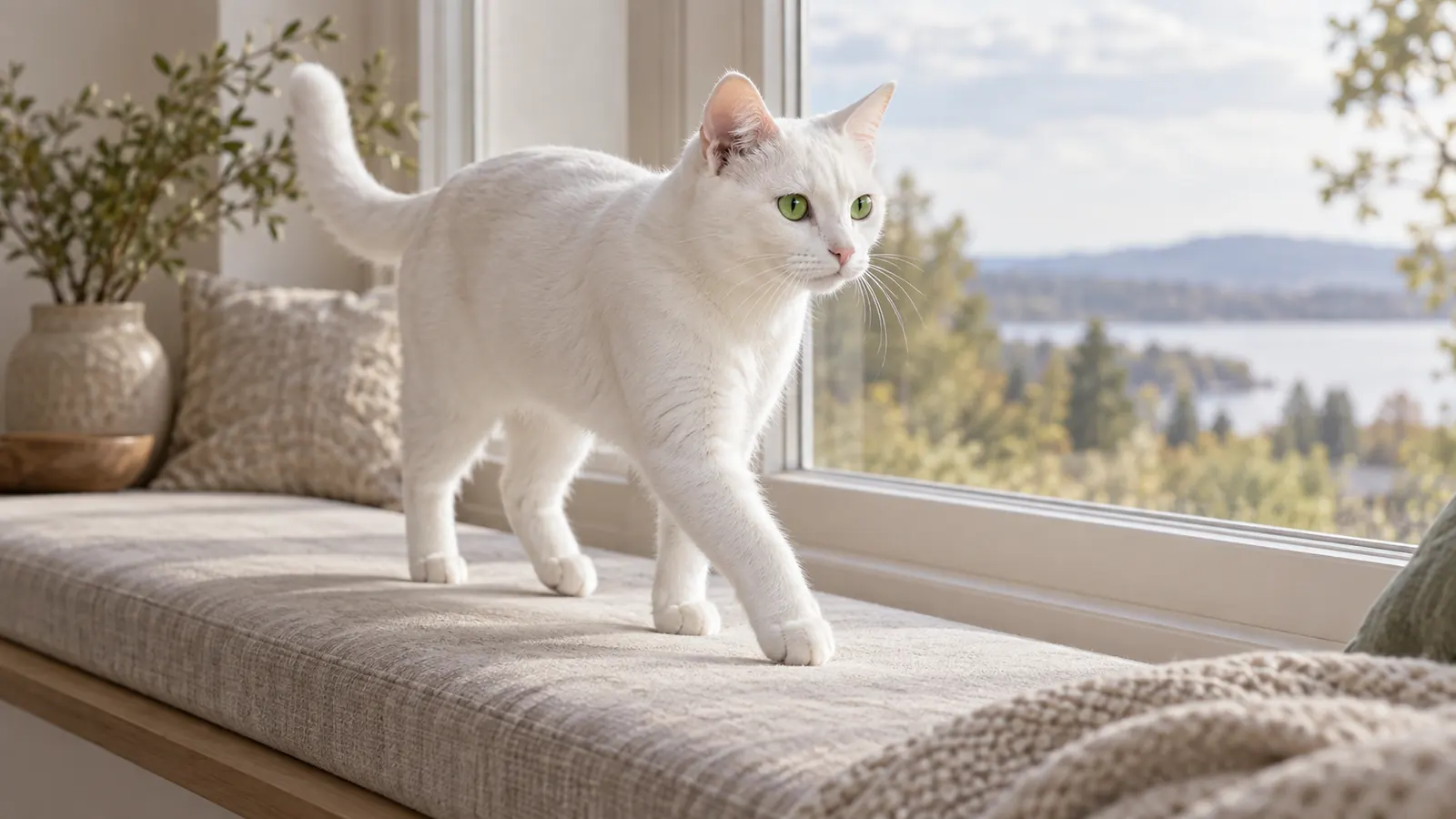
A Russian White is a Russian Blue in a white coat. The body type, temperament and plush double coat are the same, but the white gene brings a deafness risk the blue does not carry. Recognition is limited: GCCF in Britain and the Australian Cat Federation show the white as a colour of the Russian breed, while CFA, TICA and FIFe accept only blue.
- Origin
- Australia, developed in the 1970s by crossing Russian Blue with a white domestic cat
- Coat
- Short, dense, plush double coat in solid white
- Size
- Medium, graceful and fine-boned, following the Russian Blue body type
- Typical weight
- As for the Russian Blue, where no registry range defines healthy weight; body condition is the better guide
- Life expectancy
- No measured figure for either the Russian White or the Russian Blue
- Activity level
- Moderate; playful in familiar settings, reserved with strangers, consistent with Russian Blue temperament
- Grooming
- Low to moderate; the dense plush coat needs weekly combing to manage the undercoat
- Suits
- Quiet, stable households that respect the cat's reserved pace and provide consistent routines
A Russian White is a Russian Blue type cat carrying the dominant white gene (W), which hides the blue coat it would otherwise show.
The body, the plush double coat, the green eyes and the reserved temperament described for the breed are the same.
The Nebelung is sometimes grouped with it, but the relation is looser. The Nebelung was developed in the United States from long-haired blue cats and bred toward the Russian Blue type, so it differs by coat length and by a separate founding history, where the Russian White differs by colour.
How Did the Russian White Originate?
In the 1970s, Australian breeder Mavis Jones crossed a Russian Blue with a white domestic cat. The programme aimed to produce a white cat with the Russian Blue's body type, plush coat texture and green eyes.
The Australian Cat Federation (ACF) recognised the Russian White as a colour of the Russian breed, alongside the Russian Black.
GCCF in the United Kingdom recognises the Russian in three colours, blue, black and white, and shows the Russian White under that breed.
CFA, TICA and FIFe accept only blue. TICA's Russian Blue standard describes a single blue coat and treats white spots as a fault, so a Russian White cannot be shown as a Russian at TICA or CFA events.
- ACF
- Recognised as Russian White
- GCCF
- Recognised
- TICA
- Not accepted; Russian Blue in blue only
- FIFe
- Not accepted; blue only
- CFA
- Not accepted; Russian Blue only
- Origin
- Australia, 1970s
- Founding cross
- Russian Blue x white domestic cat
- Genetic difference
- Dominant white gene (W) masking the blue colour
- Body, coat texture and temperament
- Same as the Russian Blue
What Does the White Gene Do?
The dominant white gene (W) masks whatever colour the cat carries underneath. A Russian White is genetically a blue cat (or carries blue) whose colour is hidden by the white overlay.
This is different from albinism and different from the white spotting gene. The W gene produces a solid white coat regardless of the underlying colour genetics.
One health consequence matters: congenital deafness. The dominant white gene can cause deafness in one or both ears, and the risk rises with the number of blue eyes. Studies of white cats compiled by Louisiana State University's veterinary school found roughly 65 to 85 percent of cats with two blue eyes deaf, about 40 percent with one blue eye, and 17 to 22 percent with no blue eyes. Russian Whites are bred for green eyes, which puts them in the lowest group, where about one white cat in five is still affected.
A deaf cat can live well indoors with appropriate management, but it should not go outdoors unsupervised, and the owner should know before the sale rather than discovering it after.
What Does a Russian White Look and Feel Like?
The body follows the Russian Blue standard exactly: medium, graceful, fine-boned with long legs and a long tail.
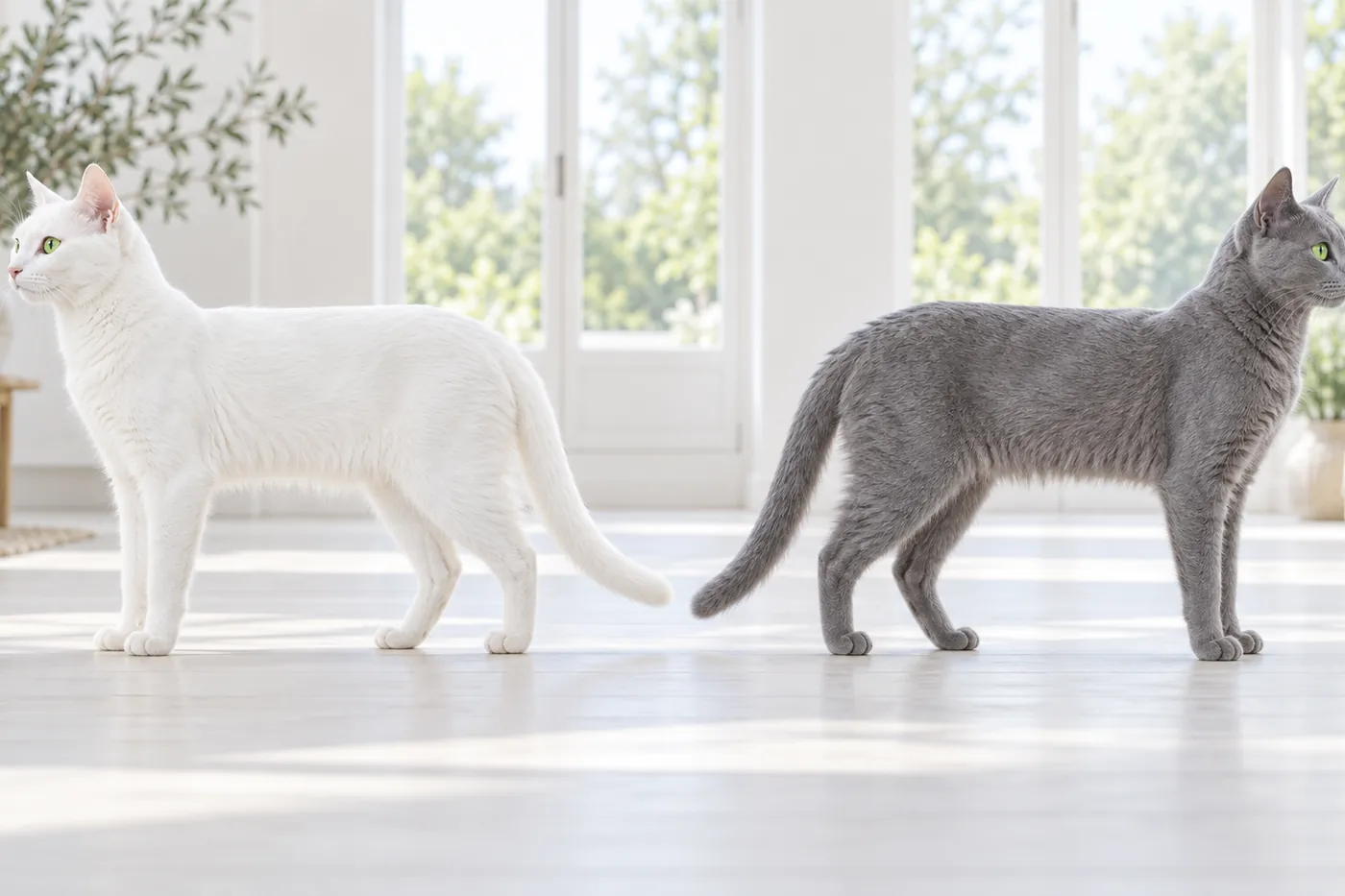
The coat is short, dense and plush with a distinctive double texture that stands away from the body. The undercoat is thick enough to give the coat its characteristic soft, springy feel.
Eye colour is green, the same as the Russian Blue standard requires. Blue or odd-eyed Russian Whites exist but may not meet all registry standards, and the blue-eyed form carries a higher deafness risk.
The white coat shows dirt and staining more visibly than a darker coat, but the dense plush texture is naturally resistant to matting.
Shedding follows the Russian Blue pattern. The dense undercoat releases seasonally, producing more loose hair in spring and autumn than the rest of the year.
Weekly combing manages the undercoat between peaks. The white hair is more noticeable on dark furniture and clothing than a blue coat's would be.
How Does the Reserved Temperament Work Day to Day?
The Russian White inherits the Russian Blue temperament: reserved with strangers, affectionate once bonded, and sensitive to changes in routine.
A new person, a rearranged room or a disrupted schedule may produce hiding, reduced eating or watchful behaviour. This is not a breed that adjusts quickly to novelty.
Once the bond develops, Russian Whites tend to be quietly affectionate with their primary people. They follow at a distance, rest near rather than on, and vocalise less than Siamese-family breeds.
Trainability responds to reward-based methods with familiar people. Forced handling generally fails and can damage the trust that took weeks to build.
How Does a Russian White Fit a Family or Multi-Pet Home?
The reserved temperament means introductions take longer than with a more outgoing breed. Calm, patient children suit it best, because a reserved cat that is chased or cornered may hide for days.
Older children who understand the cat's pace often develop a strong bond. The cat's willingness to sit near a quiet person and follow at a distance can become genuinely rewarding once trust is established.
A second cat of similar temperament can provide company during the day. A loud, boisterous companion is more likely to drive a Russian White into hiding than to draw it out.
What Health Profile Does a Russian White Share With the Blue?
CFA describes the Russian Blue as a generally healthy natural breed and names no established breed-specific genetic disorder. The Russian White shares that position, with two additions from the white coat: the deafness risk above, and skin that sunlight can damage.
| Area | What to check | When |
|---|---|---|
| Hearing | BAER test for congenital deafness | Before purchase, ideally as a kitten |
| Eyes | Green eye colour confirmed (blue eyes increase deafness risk) | At purchase |
| Weight and body condition | Rib feel, waist view, weight trend | Routine veterinary visits |
| Dental | Gum health and tartar | Annual check |
| Coat and skin | Staining on white coat, skin condition beneath the dense undercoat | During grooming |
| Ear tips, eyelids and nose | Scabs or sores that heal and return | During grooming and at every veterinary visit |
White fur leaves the skin beneath it without protective pigment. Cornell Feline Health Center notes that sun-induced squamous cell carcinoma is most common in white or lightly pigmented cats, on sparsely haired skin such as the outer ear tips, eyelids, lips and nose, and that an early lesion can look like nothing more than a small scab or scratch that flakes away. Because sunlight drives it, a Russian White that spends long hours in a sunny window carries more of the risk, and a scab on an ear tip that keeps returning is worth showing a veterinarian while it is small, when treatment works best.
A short breed disease list does not mean any individual Russian White is guaranteed healthy. Standard feline health concerns apply: dental disease, obesity, kidney disease in old age and infections are not prevented by pedigree.
No veterinary population study has measured a Russian Blue median lifespan, and none exists for the Russian White. The 15 to 20 years quoted in breed descriptions is an advertised range rather than a measured one.
How Do You Find a Russian White?
Availability is the largest practical barrier. Russian White breeders are far less numerous than Russian Blue breeders, and finding one may require a waiting list, international shipping or accepting that the colour variant is genuinely uncommon.
For a household that wants the Russian body type and temperament and cannot find a Russian White breeder, a Russian Blue offers the same type in blue, without the white gene's deafness risk, with wider availability and full registry support.
- Registration papers from GCCF or an Australian registry naming both parents
- BAER results for both ears of the kitten
- Green eye colour confirmed
- Individual temperament assessed during calm, unpressured contact over more than one visit if possible
- The breeder explains the white gene's deafness risk honestly
A shelter cat with a white coat and green eyes may have Russian heritage, but appearance alone does not confirm breed identity, and only a pedigree establishes it. A white cat of unknown background still deserves the same hearing check.
Common Questions
Is a Russian White the same as a Russian Blue?
Genetically, a Russian White is a Russian Blue carrying the dominant white gene that masks the blue colour. The body type, coat texture, eye colour standard and temperament are the same, but the white gene adds a deafness risk.
Are Russian White cats deaf?
The dominant white gene carries a risk of congenital deafness that rises with the number of blue eyes. Russian Whites are bred for green eyes, the lowest-risk group, although studies of white cats still find roughly one in five with no blue eyes deaf in one or both ears. A BAER test checks each ear.
Which registries accept the Russian White?
GCCF and the Australian Cat Federation show the Russian White as a colour of the Russian breed. CFA, TICA and FIFe accept only the blue.
How big does a Russian White get?
The breed follows the Russian Blue standard: medium, graceful and fine-boned. No registry sets a weight range, so body condition is the better guide.
Are Russian White cats rare?
Yes. Russian White breeders are far less numerous than Russian Blue breeders. Finding one may require a waiting list or international search.
Checked Against
Published 17 September 2026. Last updated .





